Carelessness is believed to have been the underlying cause of a fire that decimated garages and other installations at a snow removal contractor’s base of operations on des Perron Avenue near Montée Saint-François in Duvernay earlier this month.
(Photo: Courtesy of Association des pompiers de Laval)
The Laval region’s 9-1-1 service received a call around 5:45 pm on March 10 and Laval Fire Dept. personnel were on the scene at Déneigement SM within minutes.
As is frequently the case with industrial fires, a tall pall of dark smoke rose and hung over the site, visible from a considerable distance.
It wasn’t until nearly 9:20 pm that the firefighters were able to finally declare the blaze under control.
The LFD speculated that the cause may have been a carelessly discarded cigarette butt and estimated overall damage at $2.5 million.
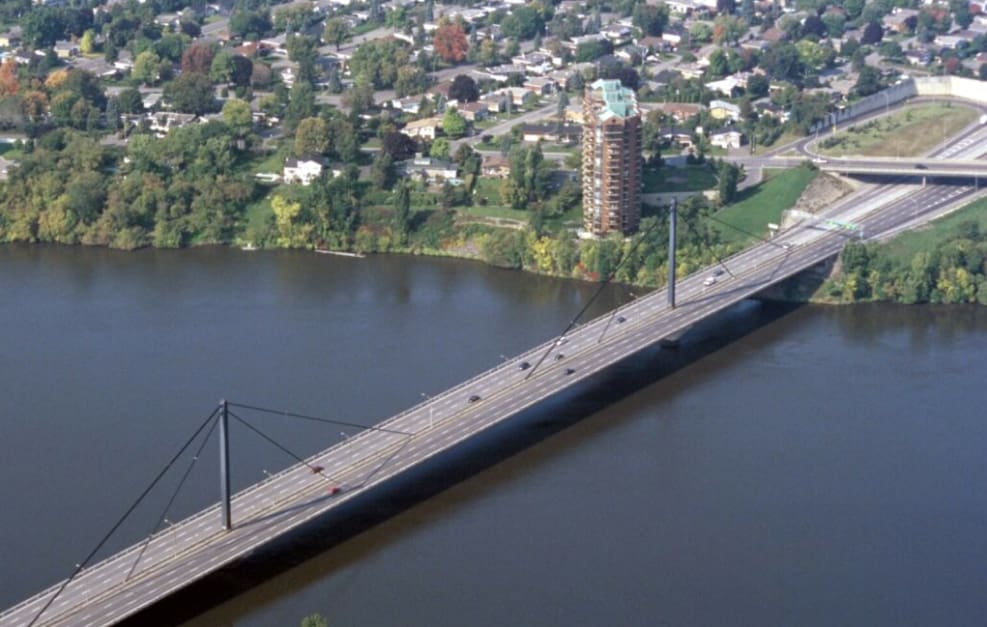
The Papineau-Leblanc Bridge, which carries Autoroute 19. (Photo: Courtesy Transports Québec)
The Quebec Ministry of Transport and Sustainable Mobility informs road users that a lengthy period of repair work resumed on March 20 on the Papineau-Leblanc Bridge, carrying Autoroute 19 between Laval and Montreal over the Rivière des Prairies, with a projected completion date in the summer of 2027.
According to the ministry, the purpose of the work is to continue the refurbishment of the bridge, notably by replacing the guardrails, wheel guards, as well as the asphalt pavement of the roadway and the bridge membrane.
From Friday, March 20, at 11 PM, to Monday, March 23, at 5 AM:
Complete closure of Highway 19 (Papineau) southbound between Highway 440 (Jean-Noël-Lavoie) and Henri-Bourrassa Boulevard. Access to Boulevard Saint-Martin will be possible. Complete closure in the northbound direction between Henri-Bourassa and de la Concorde boulevards. To travel between Montreal and Laval, road users can take the Médéric-Martin Bridge (A-15) or the Pie-IX Bridge (R-125). Detour routes will be marked by temporary signage.Episodes of congestion are to be expected. The Ministry recommends that road users who will need to travel in the area allow more time to reach their destination.
From Monday, March 23, at 5 a.m., until August 2026:
Closure of the ramp from Boulevard Lévesque to Highway 19 southbound.
From Monday, March 23, at 5 a.m., until the end of the year 2026:
Two lanes of traffic available in each direction on the bridge at all times. Partial or complete closures of the bridge to be expected in the evening and at night. The detour routes will be marked by temporary signage. In case of adverse weather conditions or operational constraints, these disruptions could be postponed, extended or canceled. Before hitting the road, it is recommended that motorists check Québec 511, a handy tool for properly planning road trips.
Transit service slowdown expected to last eight weeks, and possibly longer
The Société de transport de Laval is asking its clients to check carefully whether scheduled STL bus routes are operating normally because of a breakdown in the transit agency’s usual supply-chain, which has cut the STL off from repair components and spare parts.
Because of the shortage, the STL is unable to keep enough buses on the road to provide full service. According to the STL, it’s a situation that’s expected to last four to eight weeks, but possibly longer.
Down by 60 bus trips
About 60 of the STL’s 2,500 daily bus trips were cancelled last week, for an overall 2.6-per-cent service reduction affecting about 1,980 passengers. However, weekend schedules are not expected to be affected.
“The STL is facing unusual difficulties in its internal parts supply chain and fleet management,” the STL said last weekend in a statement on their website.
As of last Monday March 16, the STL said it would be restoring approximately thirty bus trips that had previously been cancelled out of its 60 routes.
Limiting impact on clients
“Temporarily, we unfortunately cannot guarantee accessible vehicles on accessible routes,” they said, while adding, “Our teams are working diligently to restore the situation as quickly as possible. Our priority is to limit the impacts on our customers.”
Passengers are being invited to contact the STL’s customer contact centre to verify, among other things, whether a bus serving for a planned trip is equipped with a ramp. The agency partly blamed a particularly harsh winter and the pressure it placed on the STL vehicle fleet for the disruptions.
Some help for daily bus trips:
STL passengers are being asked to check their bus trips daily by:
Visiting the STL website (stllaval.ca);
Calling the customer contact centre at 450-688-6520;
Subscribing to service alerts;
Texting the bus stop number to 511785 a few minutes before a trip;
And using trip planning tools such as Google or Transit.
Service disruptions ongoing
Effective last Monday, the number of daily cancelled trips was still expected to be reduced, including a good number during the morning peak rush-hour, and nine during the afternoon peak period. STL management was inviting passengers to consult an up-to-date list of cancelled trips on the STL website.
In addition, the transit agency cautioned that no service would be offered during the current disruptions at certain stops during work week rush hours. And no boarding or drop offs would be possible at these stops during the specified period.
It’s time to move ‘beyond symbolism,’ says Sona Lakhoyan Olivier
Chomedey MNA Sona Lakhoyan Olivier is hoping the powers that be at the Quebec National Assembly will take a serious second look at her proposal that they acknowledge there’s a need for a national women’s health policy in Quebec.
A few days before International Women’s Day on March 8, Lakhoyan Olivier sat down with The Laval News to explain what she hopes will eventually blossom into a resolution to be adopted by the National Assembly.
“What have we done lately for women’s health?” she asked.
Chomedey MNA Sona Lakhoyan Olivier wants the members of the Quebec National Assembly to acknowledge there is a need for a national women’s health policy in Quebec. (Photo: Martin C. Barry, Laval News)
Investing in women’s health
“Here it is Women’s Day again, there are celebrations, but there’s no investment. With women living longer and working and being active, they have special needs, but we have not taken the time and put in the effort to see what we can do about women’s health.
“I believe the time has come to move beyond symbolism and build a national women’s policy – one that invests in research, prevention and care from menstruation to menopause and beyond,” she added. “Quebec has the expertise. What’s missing is the political will. And if not now – when?”
Lakhoyan Olivier pointed out that today women and men live longer than ever before. In Canada, life expectancy is around 84-85 years for women. “This means that a significant portion of women’s lives is spent after menopause,” she said. “Yet our health systems have not fully adapted to this demographic reality.”
Breaking the silence
First elected to the National Assembly in 2022, Lakhoyan Olivier said that since then she has raised the issue of menopause with colleagues as well as in political discussions. For generations, she said, menopause was considered a taboo subject.
“Our mothers and grandmothers rarely spoke about it. It was often treated as something shameful or as if it were a disease. As a result, many women today still suffer in silence without proper support or medical guidance.”
She believes that menopause is a potentially major health issue that deserves to be discussed publicly. She notes that hormonal changes in women’s bodies during menopause have been linked to several health concerns, including cardiovascular disease, osteoporosis, cognitive changes and increased risk factors for some cancers.
“These issues affect millions of women but are not systematically addressed through prevention programs,” she said. She argues that the need for a conversation on the issue has become urgent.
An important women’s issue
With that said, Lakhoyan Olivier is proposing a simple step to get things underway: the introduction of a motion in the National Assembly recognizing menopause as an important women’s issue. The motion (which she tabled recently, although it was turned down) would not impose policy immediately.
“But it would send a strong message that we care about women’s health,” she said, while adding that “such motions can often lead to real policy changes.”
If the “political will” to follow through were to become a reality, she continued, several practical measures could follow, including preventive screening programs, hormone health consultations, improved education for doctors and better access by patients to specialists.
One major issue, Lakhoyan Olivier maintains, is that many women rarely see a gynecologist. “In many cases, women only see a gynecologist if a serious problem occurs,” she said. “That should not be the case. Preventive care should include gynecological consultations after a certain age, especially during perimenopause and menopause.”
Menopause’s economic impact
As she sees it, menopause also makes an economic impact on women’s lives. Research from the Menopause Foundation of Canada indicates that unmanaged menopause symptoms cost the Canadian economy about $3.5 billion per year in lost productivity and reduced workforce participation.
Studies also show that about one in three women report menopause symptoms affecting their work performance. As such, some women leave the workforce because they don’t receive proper support.
“Even today, many women hesitate to talk about menopause,” she added, noting that research shows many employees don’t feel comfortable discussing menopause in the workplace because of stigma and lack of awareness.
“Starting the conversation publicly is essential to changing that culture,” she said. “If we truly value women, we must also care about their health at every stage of life. Starting this conversation is the first step.”
Efforts underway ‘to find a solution quickly,’ Mayor Stéphane Boyer tells Laval city council
Fourteen years after abruptly leaving office, Gilles Vaillancourt continues to cast a shadow over the city.
While the former Laval mayor served time in prison after pleading guilty to corruption charges, the City of Laval could now be on the hook for an unpaid $1 million income tax bill owed to the Canada Revenue Agency for sums Vaillancourt admitted in court he received illicitly while in office.
During the March 10 city council meeting, Mayor Stéphane Boyer brought up the issue in his opening remarks, noting that a resolution would be passed that evening, asking federal Finance Minister François-Philippe Champagne to intervene in the City of Laval’s favor.
Former Laval mayor Gilles Vaillancourt (seen here at a 2010 city council meeting). (File photo: Martin C. Barry, Laval News)
“I had a talk with Minister Champagne yesterday, at which time I was assured that an effort was being made to find a solution quickly,” said Boyer.
Vaillancourt, who served as Laval’s mayor from 1989 to 2012, pleaded guilty in 2016 to engaging in corrupt administration practices. This included an admission by him that millions of dollars of proceeds from the scheme went into a Swiss bank account.
Holding Laval responsible
Although Vaillancourt returned more than $7 million to the City of Laval, Radio-Canada reported that the CRA wants Laval to transfer $1 million back to Vaillancourt so that the CRA can close his file while the former mayor pays off the tax and interest owing.
According to the Radio-Canada report, Vaillancourt’s lawyers are arguing that the City of Laval should be held responsible for the unpaid taxes since the municipality ultimately received the reimbursed sum.
In recent media interviews, Mayor Boyer pointed out that in 2016, the Quebec government reimbursed to the city money Vaillancourt owed to Revenu Québec without demanding further payment. The mayor believes the federal government has the option to do the same thing using discretionary powers at its disposal.
In a relatively rare instance of solidarity between the mayor and opposition forces on city council, Action Laval opposition city councillor David De Cotis (Saint-Bruno) tabled a motion supporting the administration’s position on the unpaid taxes.
‘Profoundly unfair,’ says De Cotis
It demanded the federal minister of national revenue exercise his discretionary power to cancel former mayor of Laval Gilles Vaillancourt’s fiscal debt of one million dollars. “The City of Laval has recovered $7 million from municipal funds embezzled by the former mayor,” Action Laval said in a statement.
“The government of Quebec has already remitted provincial taxes to the city, that is approximately $1.8 million, while the Canada Revenue Agency claims now nearly $1 million.” According to Action Laval, Ottawa should pose a similar gesture to prevent Laval taxpayers from being penalized a second time.
“Laval is being forced to pay for crimes committed against it,” said De Cotis. “This situation is profoundly unfair for citizens who have already suffered the consequences of the actions taken at the time by Gilles Vaillancourt.”
Action Laval city councillor for Saint-Bruno David De Cotis tabled a resolution in city council on March 10 calling on Ottawa to drop its demand the City of Laval pay $1 million in taxes that had been owed by former mayor Gilles Vaillancourt. (Photo: Martin C. Barry, Laval News)
At the same time, however, De Cotis took a shot at Mayor Boyer for allegedly failing to prevent what happened.
“The mayor claims to be very surprised today, but this agreement has been in place since 2016,” De Cotis said, alluding to the settlement originally reached between Vaillancourt and the city. “What did he do all these years to try and change it?”
The full text of Action Laval’s resolution
CONSIDERING THAT the City of Laval has recovered 7 million dollars in municipal funds embezzled by fraudulent maneuvers by its former mayor, Gilles Vaillancourt;
CONSIDERING THAT by decree of the Executive Council, the government of Quebec has returned to the City of Laval the amount of taxes payable by Gilles Vaillancourt to the provincial government, that is for a value of $1.8 million;
CONSIDERING that the Governor in Council, on recommendation by its Minister of Revenue, can remit taxes or impose penalties if their perception is judged to be unreasonable or unjust;
IT IS PROPOSED by David De Cotis:
That the municipal council unanimously asks the Minister of Revenue of Canada to use his discretionary power to repay the debt of the former mayor of the city of Laval, Mr. Gilles Vaillancourt, since this is unjust for the citizens of Laval.
She ‘embodies a new generation of police leadership,’ Mayor Stéphane Boyer says
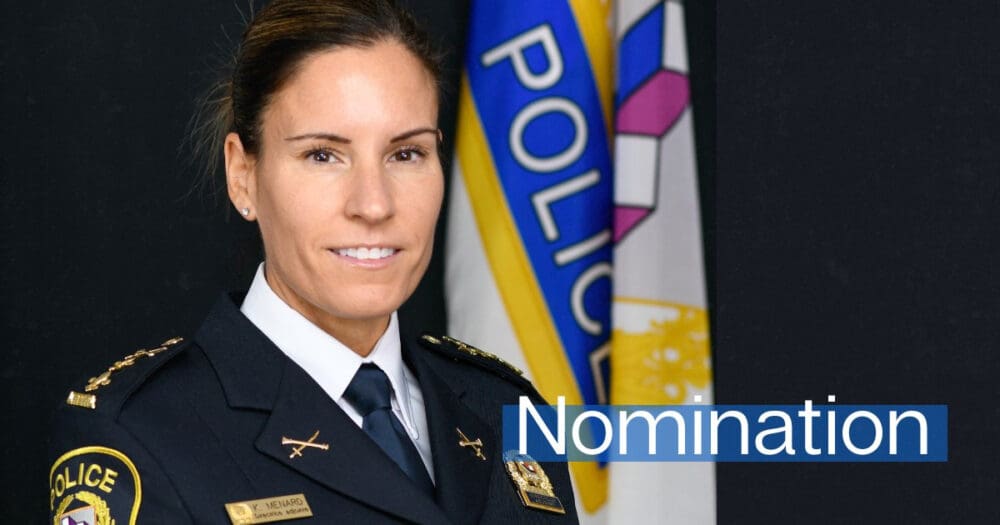
The City of Laval has named one of its own veteran police officers as the municipality’s new chief of law enforcement.
“Congratulations to Karine Ménard, named as director of the Service de police de Laval,” the Laval Police (Service de police de Laval) announced on their X social media feed last week.
“With nearly 23 years of service within the SPL, she is taking on this new mandate with commitment and determination,” they added. “We wish her a lot of success in her new functions.”
Karine Ménard’s virtually entire law enforcement career has been spent with the Laval Police. She replaces Laval’s last police chief, Pierre Brochet, who left at the end of 2025.
Karine Ménard is the City of Laval’s new chief of police. (Photo: Courtesy of City of Laval)
Will oversee BIEL
“From now on, Mme Ménard will simultaneously assume the responsibilities related to this function and those of director of the Bureau de l’intégrité et de l’éthique de Laval,” the city said in a statement posted on the municipality’s website.
(The latter refers to a responsibility conferred by the City of Laval on its police chief for overseeing anti-corruption efforts within the administration, after the city was placed in trusteeship in 2013 in the midst of a corruption scandal.)
The nomination, approved by the municipal council on March 10, was followed by the administration of an oath of office in accordance with article 83 of the provincial Police Act.
In a statement, Laval mayor Stéphane Boyer said Ménard “embodies a new generation of police leadership: a human, collaborative and field-oriented approach. She understands that public safety is built as much on prevention as on police action.
‘A major asset,’ Mayor Boyer says
“Her ability to innovate and think outside the box to better fight crime is a major asset for Laval,” he added. “I am convinced that she will be able to mobilize her teams and our partners to continue making our city a safe living environment for all.”
Ménard is the third woman to lead a major Quebec police force. In 2022, Johanne Beausoleil was named to lead the Sûreté du Québec, and Sophie Roy was named interim-police chief of the Montreal Police in May 2022. Roy was replaced in 2023 by the Montreal Police’s current police chief Fady Dagher.
A police officer by training, Karine Ménard completed studies in police technology and public security, while also pursuing a certificate in organizational leadership at HEC Montréal.
The city said her diverse training in management, strategy and innovation, coupled with a unifying leadership and a strong capacity to develop partnerships, represents a major asset for the future of the city’s police department.
Helped implement programs
According to the city, Ménard previously held several key positions within the Laval Police, including deputy director of investigations and chief inspector.
“Her path has allowed her to acquire a global and fine understanding of police issues and to distinguish herself with structuring initiatives,” the city said in its statement.
Ménard is considered to have been a key player in implementing the Laval Police’s Projet Vigilance, a proactive initiative against extortion, as well as the Justice and Equity project, and the creation of the Strategic Analysis Bureau, along with several innovative action plans.
Her predecessor, Pierre Brochet led the SPL for 12 years (2013–2025), succeeding Jean-Pierre Gariépy. before leaving to join Desjardins Group.
Brochet had previously served as a high-ranking officer with the Montreal Police. For his part, Gariépy served for 15 years (1998–2013) as police chief, retiring at the end of 2013.
When and how can you pay your tax bill? How does the city use the taxes it collects? And what should you do if you move?
These are some of the questions that property owners in the City of Laval are probably asking lately, taking into account that the deadline for paying the first installment of the annual tax bill is today (Wednesday March 18).
The City of Laval says it is working to limit tax increases in an effort to protect residents’ purchasing power, while maintaining essential services such as snow removal, park maintenance and waste management.
Laval’s interim City Hall on Saint-Martin Blvd.
Although property values are currently on the rise, the city says adjustments have been being made to ease the impact on tax bills.
While the first payment has now come due, the second installment must be made by June 16. In the event of a late payment, according to the city, fees and penalties will be applied, calculated at a daily interest rate of 8.5 per cent and 5 per cent respectively.
There are several ways to make the payment, including payment through your banking institution (for those with access to online banking services), as well as through an Automated Teller Machine or in-person at the counter at bank branches.
The city cautions that bank payments should be made at least three business days before the payment deadline in order to avoid having to pay penalties for lateness due to delayed processing times.
The city is also accepting payments through personal or certified cheques, as well as bank or postal money orders.
For those paying by cheque and to save time, the city recommends including a post-dated cheque and the corresponding payment stub for the second installment in the mailing for the first installment.
Additionally, for those making last minute payments, cheques can be brought in and deposited directly in the mail slot at the City of Laval’s Service des finances at 1333 Chomedey Blvd.
In person, payments can be made at the city’s tax counter, also at 1333 Chomedey (office 101), which is open Monday to Friday from 8.15 a.m. to 5.15 p.m. Payments here can be made by debit card (Interac) as well as in cash or by some or all of the aforementioned methods.
Work underway on new pavilion and stage in Vieux Sainte-Rose
Work on the construction of a welcome pavilion and an outdoor stage is expected to begin this month on the site beside the Rivière des Mille Îles of the Berge des Baigneurs in Vieux Sainte-Rose.
An architect’s rendering of the new pavilion and outdoor stage being built at the Berge des Baigneurs in Laval’s Vieux Sainte-Rose neighborhood. (Photo illustration: Courtesy of City of Laval)
The firm Bernard Malo inc., based in Joliette north of Laval, won a call for tenders ahead of six other compliant bidders. The contract was officially awarded at the Laval municipal council meeting on March 10.
The project has been budgeted for $7,439,607 including taxes. Over the next 12 months, the new installation will be rising a short distance from the Centre d’interprétation de l’eau (C.I.EAU), while filling a space that has been vacant for years.
The City of Laval conducted an extensive local public consultation over a good number of years before deciding to move ahead with the project.
The pavilion and outdoor stage are expected to play an important role in helping to promote the picturesque Vieux Sainte-Rose neighborhood as a destination that attracts tourists.
City is saving $100,000 annually by using winter tires all year, mayor tells March council
Answering questions during the March city council about Alto’s high-speed train which could include a station in Laval, Mayor Stéphane Boyer defended the city’s decision to sign a non-disclosure agreement with the consortium leading the project, in order to prevent land speculation from driving up costs.
Alto, also known as the Toronto–Quebec City High-Speed Rail Network, was announced more than a year ago by then-Prime Minister Justin Trudeau. While a design phase has been projected to last for up to five years, opening of the system is scheduled between 2035 and 2044.
Canada’s electrified high-speed train could look something like this when it finally comes into service starting after 2035. (Photo illustration: Courtesy of Alto)
Hi-speed train coming to Laval
Trains on the dedicated 1,000-kilometre rail route would reach top speeds of up to 300 km/h, which is nearly double what Via Rail can currently offer. Besides Toronto, Quebec City and Laval, there will also be stations in Peterborough, Ottawa, Montreal and Trois-Rivières.
With a population that will soon be reaching 440,000 – 1.2 million when you include the North Shore – Laval is seen as the logical location for an Alto station because of its strategic proximity to the northern suburbs where the population also continues to expand.
Based on illustrations and maps of the Laval region that Alto displayed during a one-day public consultation on the project at the Sheraton Laval in January, the company is apparently leaning towards a location somewhere inside the multimode transit hub in Laval’s downtown core.
Most people don’t yet know
“In speaking with my fellow citizens, I realized that the majority of people from Laval were not aware that the high-speed train will be passing through Laval and there will be a station, which I found surprising,” Pascale Durocher told the mayor during the March 10 council meeting’s public question period.
Seen here during the March 10 Laval city council meeting, Mayor Stéphane Boyer said the city sometimes signs non-disclosure agreements for major projects like the Alto high-speed train and the REM. (Photo: Martin C. Barry, Laval News)
She maintained that in early February, Denis Fafard, director of the City of Laval’s mobility office, told her that the city was near the point of signing a confidentiality agreement with Alto. “He told me that the city will have access to information from Alto that it will not be able to share with the population,” she said.
She asked the mayor what type of information that might be, and whether the city will know before residents the possible locations of the station, as well as the possible Alto rail routes.
Responding, Mayor Boyer said that at this early stages of the project “there remain many question marks on many topics, but that will become clearer in time.” However, he confirmed that the City of Laval routinely signs confidentiality agreements with outside parties when deemed necessary and appropriate.
Non-disclosure agreements
(It may also be worth noting that several municipalities all over the Montreal region along the route of the Réseau express métropolitain (REM) signed non-disclosure agreements with the project’s builder, CDPQ Infra, when it was launched about a decade ago.)
“This is normal – we did so, for example, with the REM,” said Mayor Boyer, “because we are sharing studies back and forth between us.
“So, obviously when important transit projects are being implemented in municipalities, it’s sometimes necessary to open up streets, redo intersections, [share] data from the city on traffic studies we may have done in the past. So, there is a multitude of topics or studies which technical teams from the city and Alto may have to exchange over time.
“There’s also an issue involving speculation,” he added. “Obviously we don’t know exactly where the project will be passing or where the station will be. But obviously Alto must follow certain measures in order to avoid, among other things, people speculating.
Minimizing expropriations
“Because from the moment, for example, when it’s known there’s going to be a train station, it can obviously be tempting for certain people to buy up properties to make money.”
In spite of this, Boyer said all the information about the project that the city has access to will eventually become public, although certain phases in the project will have to be completed before then.
He said he met for talks with the executive-director of Alto on two to three occasions. “Their wish is to minimize, to maximally reduce the number of expropriations. We don’t know for now whether there will be any, and if so, how many there could be. But definitely in the region of Laval, what I am told is that the hope is to pass as much a possible on autoroute rights-of-way.”
But if there were to be expropriations, Boyer noted, the legal procedure would see land owners compensated up to their property’s prevailing market value, although additional sums might also be possible in situations where owners feel they should receive more. But as the high-speed train is a federal government project, Mayor Boyer said the City of Laval has no involvement whatsoever in the expropriation process.
Mini-farm fate and cost-cutting
In a follow-up to the city’s recent cost-cutting decision to close the mini-farm at the Centre de la nature and replace it with a mobile children’s petting zoo, the mayor revealed at least two of the other measures the city is undertaking beginning this year to trim its expenses.
According to Boyer, the city managed to cut $100,000 from its nearly $1.3 billion 2026 budget by deciding not to store data from the video feeds of 600 surveillance cameras for months on end. Instead, it’s now kept for just 30 days, said the mayor.
As well, he revealed that the city has decided not to use summer tires on its vehicles anymore, keeping winter tires on year-around, for a savings of at least $100,000 in materials and labor costs.
In spite of Mayor Boyer’s cost-cutting announcements, the closing of the mini-farm didn’t sit well with the Action Laval opposition.
Action Laval city councillor for Saint-Bruno David De Cotis made a lengthy statement deriding the administration for ignoring a 20,000-signature petition signed by Laval residents demanding the city reverse the cost-cutting decision to close the mini-farm.
The current issue of the Laval News, volume 34-06, published on March 18th, 2026. Covering Laval local news, politics, and sports. (Click on the image to read the paper.)
A 47-year-old man from Laval is one of nine people from various areas of Quebec who were recently found guilty of tax evasion after they sold tobacco products clandestinely while failing to pay around $1.7 million in taxes owed to the provincial government.
(Image: Courtesy of Revenu Québec)
Ahamed Kamel Awada, 47, was sentenced to seven months in prison and fined a total of $521,525 for trafficking “significant quantities of unstamped tobacco” through his business, according to a statement issued by Revenu Québec.
In June 2022, an initial search jad resulted in the seizure of 90 kg of tobacco.
Two months later, 11 search warrants led to the seizure of an additional 1,500 kg of contraband tobacco.
Two co-defendants, Kamel Mahmoud Awada, 66, and Chawki El Chami, 61, were sentenced to 30 and 90 days in prison respectively, as well as fines of $40,585 and $89,870.