Residents report overflowing bins and confusion, while city says change will cut costs and reduce waste
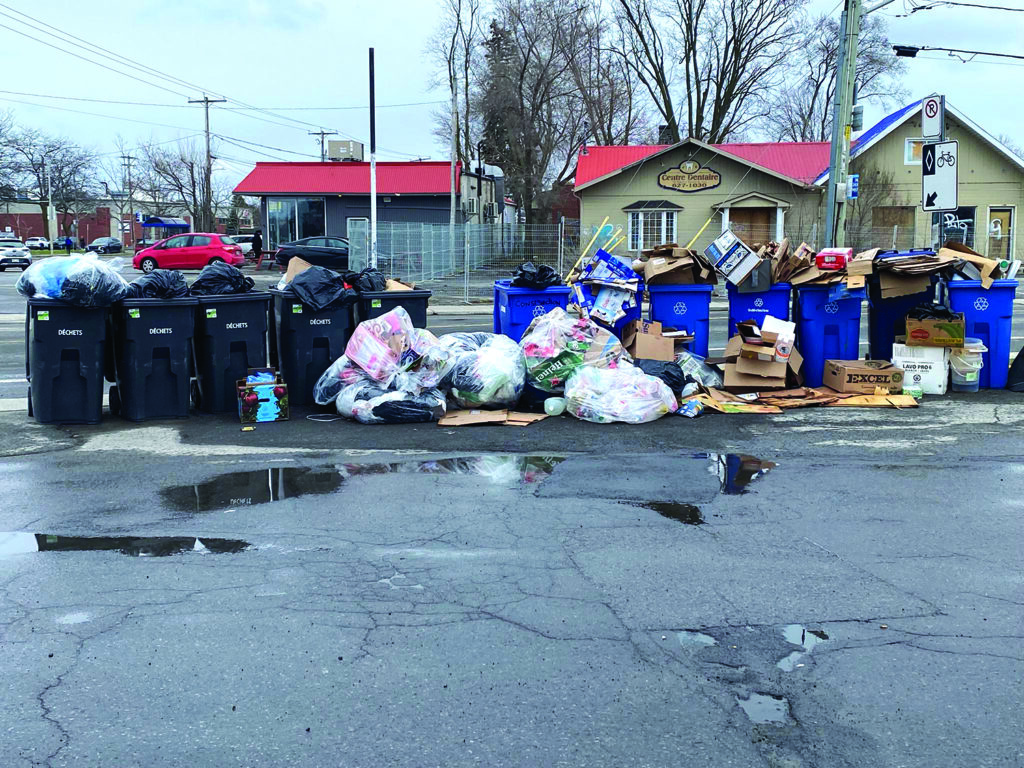
Garbage piled on at a shopping plaza in Ste-Rose, Laval. Courtesy photo Amber Row.
New schedule sparks complaints
Laval’s shift to biweekly garbage pickup is drawing criticism from some residents. Weeks after the new collection calendar took effect on April 1, complaints online range from missed bins to overflowing waste containers outside homes and multi-unit buildings.
The city reduced household garbage collection to once every two weeks as part of a larger waste-management strategy. Recycling pickup has also moved to a biweekly rhythm in many sectors, while compost collection remains weekly in summer and every two weeks in winter.
Online, residents have used neighbourhood Facebook groups and petitions to vent frustration, posting photos of full bins, bags left beside containers and confusion over zone schedules.
One petition opposing the change has gathered more than 11,000 signatures. Wael Hamdar, a Laval resident, said he launched it after learning of the decision during the holiday period.
“I got a little bit, should I say outraged, because no consultation has been made with the resident,” Hamdar said. “The city council took that decision.”

Wael Hamdar, a Laval resident, said he launched his petition after learning of the decision during the holiday period. Photo Matthew Daldalian.
Hamdar said some residents in his area appeared caught off guard when the new system began.
“A lot of people got surprised because there was a lot of people not knowing about this,” he said. “When your garbage bin is full, people are trying to put their garbage in black bags next to it.”
Opposition calls for consultation
Saint-Bruno district councillor David De Cotis said residents contacting him have expressed anger over reduced service levels.
“They’re frustrated, they’re not happy,” De Cotis said. “They’ve seen that taxes are rising, services are being reduced, so we’re getting less services, paying more taxes.”
De Cotis said different neighbourhoods may require different approaches depending on housing density and household needs.
“What we’re asking for is a public consultation,” he said. “Laval is a huge territory. Different districts have different realities.”
Waste reduction argument
Ecological transition consultant Mélissa de la Fontaine, who works with the Incita co-operative, said the policy follows a logic already seen in other municipalities: lower costs and lower waste volumes.
“There is the logic of cost savings, and there is the logic of reducing residual waste,” she said in an interview with The Laval News in French.
She said fewer truck routes can reduce fuel use, traffic wear and operating expenses, while encouraging households to better sort materials into compost and recycling streams.
“We pay a very, very high price for managing our residual waste,” she said. “If we collectively succeed in reducing what we send out […] collectively, we’ll save money too.”
De la Fontaine said many households can make relatively simple changes, such as choosing products with less packaging and avoiding disposable items.
She suggested citizens should read up on using compost more effectively.
“Most people, the vast majority of people, can adapt to the changes,” she said, while adding that special cases should contact the city for help.
Resident builds reminder tool
For some residents, the challenge has been less about principle and more about remembering a more complicated schedule.
Dmitriy Laptev, who develops software solutions for businesses at Dotcom Specialty Corporation, said missed collections and full bins led him to help create a free online alert service called CiteHub.
“I actually missed a few bins and it’s really unpleasant to have a full bin,” Laptev said.

Dmitriy Laptev said missed collections and full bins led him to help create a free online alert service called CiteHub. Photo Matthew Daldalian.
The tool allows users to register their address and receive email or text reminders based on Laval’s zone calendar.
“When it’s your turn, you are getting an alert the day before,” he said.
Laptev said even weeks into the new system, some neighbours still appeared unsure of the schedule.
“People, they still don’t know what’s going on,” he said.
City defends move
In an email statement, Director of Communications for the Mayor’s Office and Executive Committee, Gabrielle Brais-Harvey said the change aligns with the Communauté métropolitaine de Montréal’s waste plan, which sets a maximum target of 26 garbage collections per year by December 2027.
For the city, reducing frequency is a recognized way to encourage better sorting habits and increase use of blue and brown bins, according to Brais-Harvey. She added that 69 municipalities in the Montreal metropolitan community already offered 26 collections annually or fewer in 2024.
Additionally, RECYC-QUÉBEC data shows 78 per cent of average garbage-bin contents could be diverted from landfill, including 57 per cent to compost and 21 per cent to recycling.
Brais-Harvey mentioned that the new system is expected to generate annual savings of about $3.5 million by 2027 while reducing greenhouse-gas emissions tied to transport and landfill disposal.
For overflowing bins, residents or building managers are recommended to request an evaluation and possible adjustments, including added organic or recycling containers when needed.
For now, the city is not planning special summer or density-based collection changes, but staff are monitoring conditions on the ground.
What comes next
Hamdar said he plans to keep his petition active as residents continue adapting.
“I’m still hoping that something will happen in Laval,” he said.
In a previous version of this article, Gabrielle Brais-Harvey was referred to as Director of Communications for the City of Laval. She is in fact the Director of Communications of the Mayor’s Office and Executive Committee. The Laval News regrets this error.