Home Blog Page 4

City of Laval appealing CRA demand that city pay off Gilles Vaillancourt’s $1 million tax bill

Efforts underway ‘to find a solution quickly,’ Mayor Stéphane Boyer tells Laval city council

Fourteen years after abruptly leaving office, Gilles Vaillancourt continues to cast a shadow over the city.

While the former Laval mayor served time in prison after pleading guilty to corruption charges, the City of Laval could now be on the hook for an unpaid $1 million income tax bill owed to the Canada Revenue Agency for sums Vaillancourt admitted in court he received illicitly while in office.

During the March 10 city council meeting, Mayor Stéphane Boyer brought up the issue in his opening remarks, noting that a resolution would be passed that evening, asking federal Finance Minister François-Philippe Champagne to intervene in the City of Laval’s favor.

Former Laval mayor Gilles Vaillancourt (seen here at a 2010 city council meeting). (File photo: Martin C. Barry, Laval News)

“I had a talk with Minister Champagne yesterday, at which time I was assured that an effort was being made to find a solution quickly,” said Boyer.

Vaillancourt, who served as Laval’s mayor from 1989 to 2012, pleaded guilty in 2016 to engaging in corrupt administration practices. This included an admission by him that millions of dollars of proceeds from the scheme went into a Swiss bank account.

Holding Laval responsible

Although Vaillancourt returned more than $7 million to the City of Laval, Radio-Canada reported that the CRA wants Laval to transfer $1 million back to Vaillancourt so that the CRA can close his file while the former mayor pays off the tax and interest owing.

According to the Radio-Canada report, Vaillancourt’s lawyers are arguing that the City of Laval should be held responsible for the unpaid taxes since the municipality ultimately received the reimbursed sum.

In recent media interviews, Mayor Boyer pointed out that in 2016, the Quebec government reimbursed to the city money Vaillancourt owed to Revenu Québec without demanding further payment. The mayor believes the federal government has the option to do the same thing using discretionary powers at its disposal.

In a relatively rare instance of solidarity between the mayor and opposition forces on city council, Action Laval opposition city councillor David De Cotis (Saint-Bruno) tabled a motion supporting the administration’s position on the unpaid taxes.

‘Profoundly unfair,’ says De Cotis

It demanded the federal minister of national revenue exercise his discretionary power to cancel former mayor of Laval Gilles Vaillancourt’s fiscal debt of one million dollars. “The City of Laval has recovered $7 million from municipal funds embezzled by the former mayor,” Action Laval said in a statement.

“The government of Quebec has already remitted provincial taxes to the city, that is approximately $1.8 million, while the Canada Revenue Agency claims now nearly $1 million.” According to Action Laval, Ottawa should pose a similar gesture to prevent Laval taxpayers from being penalized a second time.

“Laval is being forced to pay for crimes committed against it,” said De Cotis. “This situation is profoundly unfair for citizens who have already suffered the consequences of the actions taken at the time by Gilles Vaillancourt.”

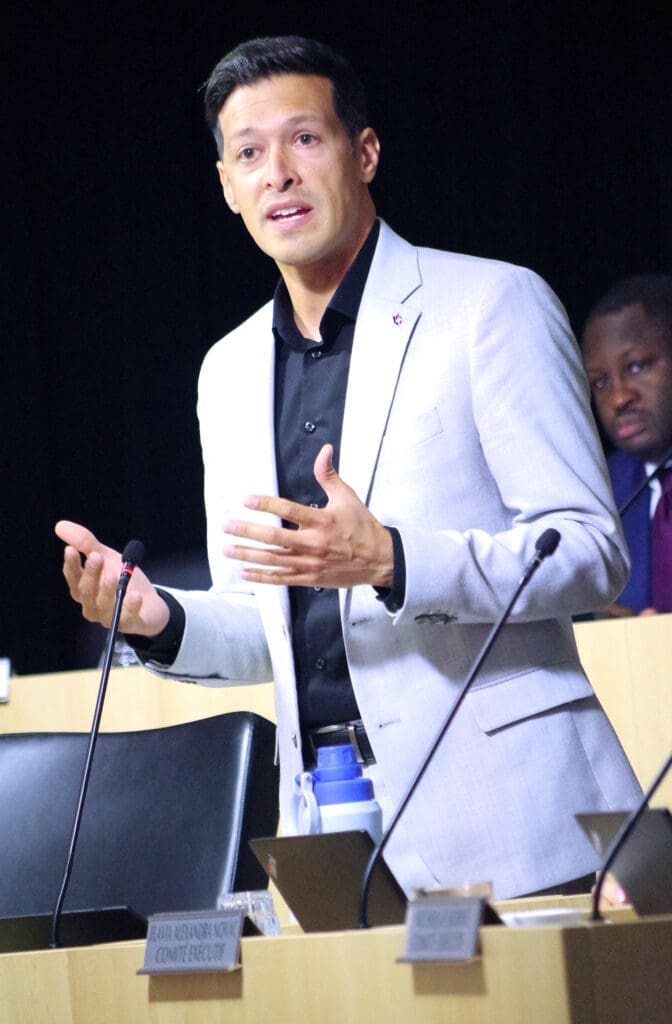
Action Laval city councillor for Saint-Bruno David De Cotis tabled a resolution in city council on March 10 calling on Ottawa to drop its demand the City of Laval pay $1 million in taxes that had been owed by former mayor Gilles Vaillancourt. (Photo: Martin C. Barry, Laval News)

At the same time, however, De Cotis took a shot at Mayor Boyer for allegedly failing to prevent what happened.

“The mayor claims to be very surprised today, but this agreement has been in place since 2016,” De Cotis said, alluding to the settlement originally reached between Vaillancourt and the city. “What did he do all these years to try and change it?”

The full text of Action Laval’s resolution

CONSIDERING THAT the City of Laval has recovered 7 million dollars in municipal funds embezzled by fraudulent maneuvers by its former mayor, Gilles Vaillancourt;

CONSIDERING THAT by decree of the Executive Council, the government of Quebec has returned to the City of Laval the amount of taxes payable by Gilles Vaillancourt to the provincial government, that is for a value of $1.8 million;

CONSIDERING that the Governor in Council, on recommendation by its Minister of Revenue, can remit taxes or impose penalties if their perception is judged to be unreasonable or unjust;

IT IS PROPOSED by David De Cotis:

That the municipal council unanimously asks the Minister of Revenue of Canada to use his discretionary power to repay the debt of the former mayor of the city of Laval, Mr. Gilles Vaillancourt, since this is unjust for the citizens of Laval.

Laval names Karine Ménard as its new chief of police services

She ‘embodies a new generation of police leadership,’ Mayor Stéphane Boyer says

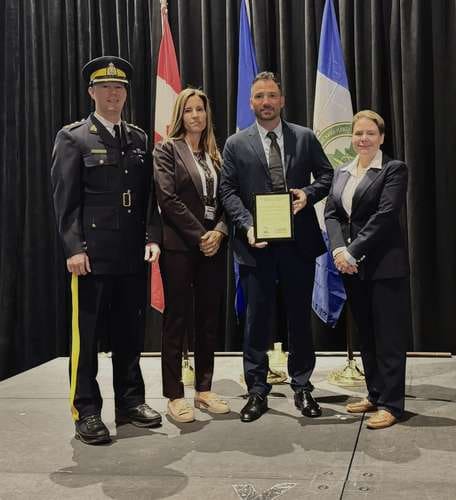
The City of Laval has named one of its own veteran police officers as the municipality’s new chief of law enforcement.

“Congratulations to Karine Ménard, named as director of the Service de police de Laval,” the Laval Police (Service de police de Laval) announced on their X social media feed last week.

“With nearly 23 years of service within the SPL, she is taking on this new mandate with commitment and determination,” they added. “We wish her a lot of success in her new functions.”

Karine Ménard’s virtually entire law enforcement career has been spent with the Laval Police. She replaces Laval’s last police chief, Pierre Brochet, who left at the end of 2025.

Karine Ménard is the City of Laval’s new chief of police. (Photo: Courtesy of City of Laval)

Will oversee BIEL

“From now on, Mme Ménard will simultaneously assume the responsibilities related to this function and those of director of the Bureau de l’intégrité et de l’éthique de Laval,” the city said in a statement posted on the municipality’s website.

(The latter refers to a responsibility conferred by the City of Laval on its police chief for overseeing anti-corruption efforts within the administration, after the city was placed in trusteeship in 2013 in the midst of a corruption scandal.)

The nomination, approved by the municipal council on March 10, was followed by the administration of an oath of office in accordance with article 83 of the provincial Police Act.

In a statement, Laval mayor Stéphane Boyer said Ménard “embodies a new generation of police leadership: a human, collaborative and field-oriented approach. She understands that public safety is built as much on prevention as on police action.

‘A major asset,’ Mayor Boyer says

“Her ability to innovate and think outside the box to better fight crime is a major asset for Laval,” he added. “I am convinced that she will be able to mobilize her teams and our partners to continue making our city a safe living environment for all.”

Ménard is the third woman to lead a major Quebec police force. In 2022, Johanne Beausoleil was named to lead the Sûreté du Québec, and Sophie Roy was named interim-police chief of the Montreal Police in May 2022. Roy was replaced in 2023 by the Montreal Police’s current police chief Fady Dagher.

A police officer by training, Karine Ménard completed studies in police technology and public security, while also pursuing a certificate in organizational leadership at HEC Montréal.

The city said her diverse training in management, strategy and innovation, coupled with a unifying leadership and a strong capacity to develop partnerships, represents a major asset for the future of the city’s police department.

Helped implement programs

According to the city, Ménard previously held several key positions within the Laval Police, including deputy director of investigations and chief inspector.

“Her path has allowed her to acquire a global and fine understanding of police issues and to distinguish herself with structuring initiatives,” the city said in its statement.

Ménard is considered to have been a key player in implementing the Laval Police’s Projet Vigilance, a proactive initiative against extortion, as well as the Justice and Equity project, and the creation of the Strategic Analysis Bureau, along with several innovative action plans.

Her predecessor, Pierre Brochet led the SPL for 12 years (2013–2025), succeeding Jean-Pierre Gariépy. before leaving to join Desjardins Group.

Brochet had previously served as a high-ranking officer with the Montreal Police. For his part, Gariépy served for 15 years (1998–2013) as police chief, retiring at the end of 2013.

First installment of Laval property tax bills due today

When and how can you pay your tax bill? How does the city use the taxes it collects? And what should you do if you move?

These are some of the questions that property owners in the City of Laval are probably asking lately, taking into account that the deadline for paying the first installment of the annual tax bill is today (Wednesday March 18).

The City of Laval says it is working to limit tax increases in an effort to protect residents’ purchasing power, while maintaining essential services such as snow removal, park maintenance and waste management.

Laval’s interim City Hall on Saint-Martin Blvd.

Although property values are currently on the rise, the city says adjustments have been being made to ease the impact on tax bills.

While the first payment has now come due, the second installment must be made by June 16. In the event of a late payment, according to the city, fees and penalties will be applied, calculated at a daily interest rate of 8.5 per cent and 5 per cent respectively.

There are several ways to make the payment, including payment through your banking institution (for those with access to online banking services), as well as through an Automated Teller Machine or in-person at the counter at bank branches.

The city cautions that bank payments should be made at least three business days before the payment deadline in order to avoid having to pay penalties for lateness due to delayed processing times.

The city is also accepting payments through personal or certified cheques, as well as bank or postal money orders.

For those paying by cheque and to save time, the city recommends including a post-dated cheque and the corresponding payment stub for the second installment in the mailing for the first installment.

Additionally, for those making last minute payments, cheques can be brought in and deposited directly in the mail slot at the City of Laval’s Service des finances at 1333 Chomedey Blvd.

In person, payments can be made at the city’s tax counter, also at 1333 Chomedey (office 101), which is open Monday to Friday from 8.15 a.m. to 5.15 p.m. Payments here can be made by debit card (Interac) as well as in cash or by some or all of the aforementioned methods.

Work underway on new pavilion and stage in Vieux Sainte-Rose

Work on the construction of a welcome pavilion and an outdoor stage is expected to begin this month on the site beside the Rivière des Mille Îles of the Berge des Baigneurs in Vieux Sainte-Rose.

An architect’s rendering of the new pavilion and outdoor stage being built at the Berge des Baigneurs in Laval’s Vieux Sainte-Rose neighborhood. (Photo illustration: Courtesy of City of Laval)

The firm Bernard Malo inc., based in Joliette north of Laval, won a call for tenders ahead of six other compliant bidders. The contract was officially awarded at the Laval municipal council meeting on March 10.

The project has been budgeted for $7,439,607 including taxes. Over the next 12 months, the new installation will be rising a short distance from the Centre d’interprétation de l’eau (C.I.EAU), while filling a space that has been vacant for years.

The City of Laval conducted an extensive local public consultation over a good number of years before deciding to move ahead with the project.

The pavilion and outdoor stage are expected to play an important role in helping to promote the picturesque Vieux Sainte-Rose neighborhood as a destination that attracts tourists.

Laval signed a non-disclosure agreement for Alto hi-speed train, Boyer acknowledges

City is saving $100,000 annually by using winter tires all year, mayor tells March council

Answering questions during the March city council about Alto’s high-speed train which could include a station in Laval, Mayor Stéphane Boyer defended the city’s decision to sign a non-disclosure agreement with the consortium leading the project, in order to prevent land speculation from driving up costs.

Alto, also known as the Toronto–Quebec City High-Speed Rail Network, was announced more than a year ago by then-Prime Minister Justin Trudeau. While a design phase has been projected to last for up to five years, opening of the system is scheduled between 2035 and 2044.

Canada’s electrified high-speed train could look something like this when it finally comes into service starting after 2035. (Photo illustration: Courtesy of Alto)

Hi-speed train coming to Laval

Trains on the dedicated 1,000-kilometre rail route would reach top speeds of up to 300 km/h, which is nearly double what Via Rail can currently offer. Besides Toronto, Quebec City and Laval, there will also be stations in Peterborough, Ottawa, Montreal and Trois-Rivières.

With a population that will soon be reaching 440,000 – 1.2 million when you include the North Shore – Laval is seen as the logical location for an Alto station because of its strategic proximity to the northern suburbs where the population also continues to expand.

Based on illustrations and maps of the Laval region that Alto displayed during a one-day public consultation on the project at the Sheraton Laval in January, the company is apparently leaning towards a location somewhere inside the multimode transit hub in Laval’s downtown core.

Most people don’t yet know

“In speaking with my fellow citizens, I realized that the majority of people from Laval were not aware that the high-speed train will be passing through Laval and there will be a station, which I found surprising,” Pascale Durocher told the mayor during the March 10 council meeting’s public question period.

Seen here during the March 10 Laval city council meeting, Mayor Stéphane Boyer said the city sometimes signs non-disclosure agreements for major projects like the Alto high-speed train and the REM. (Photo: Martin C. Barry, Laval News)

She maintained that in early February, Denis Fafard, director of the City of Laval’s mobility office, told her that the city was near the point of signing a confidentiality agreement with Alto. “He told me that the city will have access to information from Alto that it will not be able to share with the population,” she said.

She asked the mayor what type of information that might be, and whether the city will know before residents the possible locations of the station, as well as the possible Alto rail routes.

Responding, Mayor Boyer said that at this early stages of the project “there remain many question marks on many topics, but that will become clearer in time.” However, he confirmed that the City of Laval routinely signs confidentiality agreements with outside parties when deemed necessary and appropriate.

Non-disclosure agreements

(It may also be worth noting that several municipalities all over the Montreal region along the route of the Réseau express métropolitain (REM) signed non-disclosure agreements with the project’s builder, CDPQ Infra, when it was launched about a decade ago.)

“This is normal – we did so, for example, with the REM,” said Mayor Boyer, “because we are sharing studies back and forth between us.

“So, obviously when important transit projects are being implemented in municipalities, it’s sometimes necessary to open up streets, redo intersections, [share] data from the city on traffic studies we may have done in the past. So, there is a multitude of topics or studies which technical teams from the city and Alto may have to exchange over time.

“There’s also an issue involving speculation,” he added. “Obviously we don’t know exactly where the project will be passing or where the station will be. But obviously Alto must follow certain measures in order to avoid, among other things, people speculating.

Minimizing expropriations

“Because from the moment, for example, when it’s known there’s going to be a train station, it can obviously be tempting for certain people to buy up properties to make money.”

In spite of this, Boyer said all the information about the project that the city has access to will eventually become public, although certain phases in the project will have to be completed before then.

He said he met for talks with the executive-director of Alto on two to three occasions. “Their wish is to minimize, to maximally reduce the number of expropriations. We don’t know for now whether there will be any, and if so, how many there could be. But definitely in the region of Laval, what I am told is that the hope is to pass as much a possible on autoroute rights-of-way.”

But if there were to be expropriations, Boyer noted, the legal procedure would see land owners compensated up to their property’s prevailing market value, although additional sums might also be possible in situations where owners feel they should receive more. But as the high-speed train is a federal government project, Mayor Boyer said the City of Laval has no involvement whatsoever in the expropriation process.

Mini-farm fate and cost-cutting

In a follow-up to the city’s recent cost-cutting decision to close the mini-farm at the Centre de la nature and replace it with a mobile children’s petting zoo, the mayor revealed at least two of the other measures the city is undertaking beginning this year to trim its expenses.

According to Boyer, the city managed to cut $100,000 from its nearly $1.3 billion 2026 budget by deciding not to store data from the video feeds of 600 surveillance cameras for months on end. Instead, it’s now kept for just 30 days, said the mayor.

As well, he revealed that the city has decided not to use summer tires on its vehicles anymore, keeping winter tires on year-around, for a savings of at least $100,000 in materials and labor costs.

In spite of Mayor Boyer’s cost-cutting announcements, the closing of the mini-farm didn’t sit well with the Action Laval opposition.

Action Laval city councillor for Saint-Bruno David De Cotis made a lengthy statement deriding the administration for ignoring a 20,000-signature petition signed by Laval residents demanding the city reverse the cost-cutting decision to close the mini-farm.

Laval News Volume 34-06

0

The current issue of the Laval News, volume 34-06, published on March 18th, 2026.
Covering Laval local news, politics, and sports.
(Click on the image to read the paper.)

Laval man among nine convicted for not paying $1.7 million in provincial tobacco tax

A 47-year-old man from Laval is one of nine people from various areas of Quebec who were recently found guilty of tax evasion after they sold tobacco products clandestinely while failing to pay around $1.7 million in taxes owed to the provincial government.

(Image: Courtesy of Revenu Québec)

Ahamed Kamel Awada, 47, was sentenced to seven months in prison and fined a total of $521,525 for trafficking “significant quantities of unstamped tobacco” through his business, according to a statement issued by Revenu Québec.

In June 2022, an initial search jad resulted in the seizure of 90 kg of tobacco.

Two months later, 11 search warrants led to the seizure of an additional 1,500 kg of contraband tobacco.

Two co-defendants, Kamel Mahmoud Awada, 66, and Chawki El Chami, 61, were sentenced to 30 and 90 days in prison respectively, as well as fines of $40,585 and $89,870.

Laval’s Leclerc among six provincial prisons where $1 million in contraband seized

The Leclerc Detention Centre in east-end Laval is one of six provincial jails throughout Quebec where nearly $1 million in prohibited items – including tobacco, cell phones and drugs – were seized by guards over the past few months, according to the Quebec Public Security Ministry.

Members of the correctional services recovered tobacco products, narcotics and cell phones with an estimated institutional value of $991,750, as well as mobile phone tools and accessories, in 16 major seizures, the ministry said.

In addition to Leclerc, the other detention establishments were in Amos, Hull, Québec City, Rimouski and Rivière-des-Prairies in Montreal.

The ministry said it should also be noted that anti-drone police operations that took place near the Montreal Detention Centre in Rivière-des-Prairies in January 2026 led to the arrest of five suspects by the Montreal Police.

“The teamwork carried out daily, combined with the use of hardware and technology in facilities across Quebec, makes it possible to prevent the delivery of packages by drones, to secure points of entry and to detect contraband,” the Public Security Ministry said in its statement.

According to the ministry, the majority of major seizures at the province’s jails result from the rapid retrieval of packages transported by drones before they enter the prison walls.

Contraband items are also regularly seized by prison staff during patrols, yard inspections, admission searches of inmates and general searches.

The ministry says a range of technological measures are being implemented to combat the delivery of contraband by drones and facilitate searches by prison officers, including a new generation of more advanced drone detectors and cell phone detection devices.

Since announcing major investments in October 2023, the Ministry of Public Security says it has deployed secure windows, body scanners and search stations to combat contraband in correctional facilities.

A-15 tow truck driver stabbing:

Suspect was awaiting trial after door-crashing incident at Laval Police HQ

The suspect in a recent stabbing incident on Autoroute 15 in Laval is also currently facing charges related to an incident in April last year when the front entrance doors at Laval Police headquarters on Chomedey Blvd. were demolished when a driver deliberately crashed into them.

Zakaria Sadji, age 30, is suspected of having stabbed a 52-year-old tow truck driver following a minor dispute that began on the A-15 on the morning of February 26.

The 52-year-old tow truck driver, who sustained a minor arm injury, was taken to hospital for treatment, although his life was not considered to be in danger.

Charged with dangerous driving and mischief in the police HQ incident, Sadji pleaded not guilty and was released with conditions pending trial when the latest incident came up.

According to the TVA network, Sadji, who has a history of mental illness, was also facing charges in a separate occurrence involving threats and violent acts he is alleged to have made towards the janitor of an apartment building where he lived and owed rent.

Scammer from Laval who targeted Nova Scotia seniors sentenced to house arrest

A fraud artist living in Laval who was facing more than 30 charges in Atlantic Canada after taking part in a scheme to cheat senior citizens while posing as a policeman, a lawyer and a bail bondsman has been sentenced to 15 months of house arrest, while also being ordered to pay back $57,000 to victims.

This image of Omar Zanfi (left) and an accomplice, recorded by a home security video system, was released by the Halifax Police to the media.

Omar Zanfi, 28, was arrested in Moncton NB in December 2022 when it was alleged he defrauded 15 seniors in Nova Scotia using the “grandparent scam.”

According to the Halifax regional police, Zanfi contacted victims by phone while pretending to speak on behalf of a member of the victim’s family, saying he had been arrested and needed money to post bail.

While working with an accomplice, Zanfi went to victims’ homes to pick up large sums of money defrauded from them.

However, without his realizing it, images of Zanfi and of the vehicle he was driving were recorded by the home video security system.

Using the images, the police were able to track and locate Zanfi, leading to his arrest.

Based on the terms of a sentence imposed by a Nova Scotia Provincial Court judge last month, Zanfi will be subject to an overnight curfew for the first nine months of his 15-month sentence.

As well, he will only be allowed out of his home for scheduled work or to deal with a medical emergency.

In addition, the court gave Zanfi permission not to be obliged to remain in Nova Scotia during his sentence.

According to news reports in New Brunswick, Zanfi pleaded guilty to fraud charges in that province and is scheduled to be sentenced in April.

Quebec’s temporary foreign worker policy a blow to restauranteurs, says ARQ

‘Industry cannot afford to lose its 16,365 temporary foreign workers,’ says Martin Vézina

“We are incredulous at this latest announcement,” said Martin Vézina, vice-president for public and government affairs at the ARQ.

While the Quebec Restaurant Association (ARQ), like the rest of the hospitality sector and many other businesses in Quebec, is advocating for more flexible rules surrounding temporary foreign workers, the ARQ says the Quebec government has just thrown another wrench into the works for restaurant, institutional and other key players in the food service industry.

According to the trade and lobby group, the position of cook has been removed from the provincial government’s list of jobs eligible for simplified processing by the Ministry of Employment and Social Solidarity.

In practical terms, this means that employers looking for cooks will have to post their job openings again for four weeks – often without receiving any resumes.

Inconsistent gov’t policy

“Four weeks added to an already lengthy, complex and costly process, demonstrates the government’s inconsistency,” the ARQ says in a statement. “While acknowledging a labor shortage in this position, the government is taking entirely contradictory actions,” they add.

The ARQ says restaurant owners are still struggling to recruit trained and experienced employees, especially full-time ones, and this is why owners have no choice but to look abroad to find these staff.

One long-standing observation the ARQ’s members have made is that even if the unemployment rate is higher in some regions – and one might think that workers are therefore available for given positions – many Quebecers are actually no longer as interested as before in jobs requiring that they work on weekends.

This is in spite of the fact that customers are known to frequent dining rooms primarily on Friday and Saturday evenings, according to the ARQ.

Service could suffer this summer

The organization says it is concerned about the quality of service for the upcoming tourist season, as many restaurants will be unable to offer the capacity and speed of service customers are accustomed to, particularly in regions with high tourism potential.

Without the staff needed to cover all opening hours, restaurant owners may have to reduce their hours to give their existing staff some respite, the ARQ maintains, adding that visitors may end up having to rely on supermarkets, where available, as well as convenience stores for groceries.

“We are incredulous at this latest announcement,” said Martin Vézina, vice-president for public and government affairs at the ARQ. “It demonstrates, once again, the lack of understanding at all levels of government regarding the issue of temporary foreign workers and their essential role in our industry.

Treated as a second-tier

“The restaurant industry, which was considered an essential service during the COVID-19 pandemic, now seems to be treated as a second-tier industry in Quebec’s economy, which is unacceptable,” he added. “We are asking the Ministers of Employment and Social Solidarity, as well as Immigration, Francization and Integration, to reconsider their decision and reinstate our trades on the simplified processing list.”

Vézina said the ARQ is also urging the ministries to work with the association to secure a grandfather clause from the federal government for the renewal of temporary foreign workers. “The industry cannot afford to lose its 16,365 temporary foreign workers in the province without devastating consequences,” said Vézina.

Open letter calls for policy reversal

In an open letter from the ARQ as well as Tourisme Montréal and the Association hôtelière du Grand Montréal published in early February in Montreal’s La Presse, the three trade groups said they were “sounding the alarm” over the abandonment of the Quebec Experience Program (PEQ).

“We strongly support Montreal Mayor Soraya Martinez-Ferrada’s request to implement a grandfather clause for international workers and students already in Quebec so they can apply to the PEQ,” they said. “Without this measure, the repercussions would be significant, not only for the tourism, hospitality, and restaurant sectors, but also for the entire Montreal and Quebec economies.”

PEQ became ‘an essential tool,’ says ARQ

“Since its inception, the PEQ has become an essential tool for attracting and retaining international talent, particularly in the tourism, hospitality, and food service sectors,” they continued. “It has enabled foreign graduates and temporary workers to settle in Quebec, directly helping to address the labor shortage and enrich the cultural fabric of our metropolis.

“In a context where a moratorium already prevents the renewal of work permits for many foreign workers, abandoning the PEQ would exacerbate a recruitment crisis that is already critical for our industry. We call on political decision-makers to reconsider abandoning the PEQ and to collaborate closely with our sector to preserve Montreal’s prosperity and attractiveness. The future of our industry and that of our metropolis depends on it.”

Weather

Laval
overcast clouds
4.1 ° C
4.1 °
4.1 °
76 %
4kmh
95 %
Thu
19 °
Fri
12 °
Sat
14 °
Sun
12 °
Mon
16 °