Group continues focusing on providing services for seniors
Smart-looking caps and t-shirts bearing the distinctive ‘FILIA’ logo breathed an air of hope and renewal into this year’s FILIA Walk a Thon, an increasingly popular autumn ritual and tradition in Laval’s Chomedey neighborhood.
The 18th annual Walk a Thon on Sept. 16 drew a loyal following of FILIA supporters, as well as local elected officials who have provided help to the organization over the years.
After a challenging summer when severe rainstorms left a pall of gloom hanging over many Laval households, it was a good day for a refreshing walk in and around the streets surrounding St. Norbert Park in eastern Chomedey.
FILIA’s Johanna Tsoublekas (blue t-shirt) is seen with Souvenir-Labelle city councilor Sandra El Helou and political attaché to Vimy MP Annie Koutrakis, Silvana Sennatore. (Photo: Martin C. Barry, Laval News)
Keeping seniors healthy
The goal of the day was to raise awareness of the needs of senior citizens – which include regular physical exercise – while also raising funds for FILIA to help continue providing a range of crucial services to seniors, including FILIA’s meals-on-wheels program.
Although FILIA’s mission at one time was to provide assistance to Greek women of the Parc Extension Hellenic community, then later throughout the Montreal region, the organization’s mandate now is to serve senior citizens and people from all backgrounds – with a growing emphasis on the population of Chomedey.
Men’s support also needed
Led for many years by Johanna Tsoublekas who continues to provide guidance and management, FILIA’s services include home housekeeping and supervision, volunteer training and a healthcare clinic for the feet.
Johanna agreed that this year’s turnout (consisting primarily of a few dozen women who remain the group’s bedrock support) was stronger than ever, although a little more support from men would also be appreciated.
From the left, Laval city councillor Sandra El Helou (responsible for senior citizens’ issues on the executive-committee), FILIA leader Johanna Tsoublekas and a FILIA volunteer are seen here with caps and t-shirts bearing the organization’s logo before the start of the annual FILIA Walk a Thon on Sept. 16. (Photo: Martin C. Barry, Laval News)
Still, she said the group’s male membership has been improving, with 15 men now turning up for meetings every Monday at a locale at 800 Notre Dame Blvd. in Chomedey.
Admirer from the city
Sandra El-Helou, Laval city councillor for the district of Souvenir-Labelle, who is responsible for senior citizens’ issues on the city’s executive-committee, described the work done by Johanna Tsoublekas and her FILIA supporters and volunteers in admiring terms.
“All this work cannot be done alone,” she told the group before they set off on the walk.
FILIA leader Johanna Tsoublekas summarized the group’s activities last year prior to the start of the Walk a Thon in Chomedey.Some loyal FILIA volunteers and supporters in Saint Norbert Park on Sept. 16 just before the start of the 2024 Walk a Thon.
“So, Johanna’s doing this amazing work, but she would never be able to do it without all the helping hands. So, once again, as the city councillor and as the one responsible for the elderly, I give my support to FILIA. If there is anything I can do beyond what I am already doing, please let me know.”
Vimy Liberal MP Annie Koutrakis, also a strong FILIA supporter, was unable to attend in person because of political developments in Ottawa. However, her attaché and chief of operations at the constituency office in Laval, Silvana Sennatore, was on hand to represent Koutrakis.
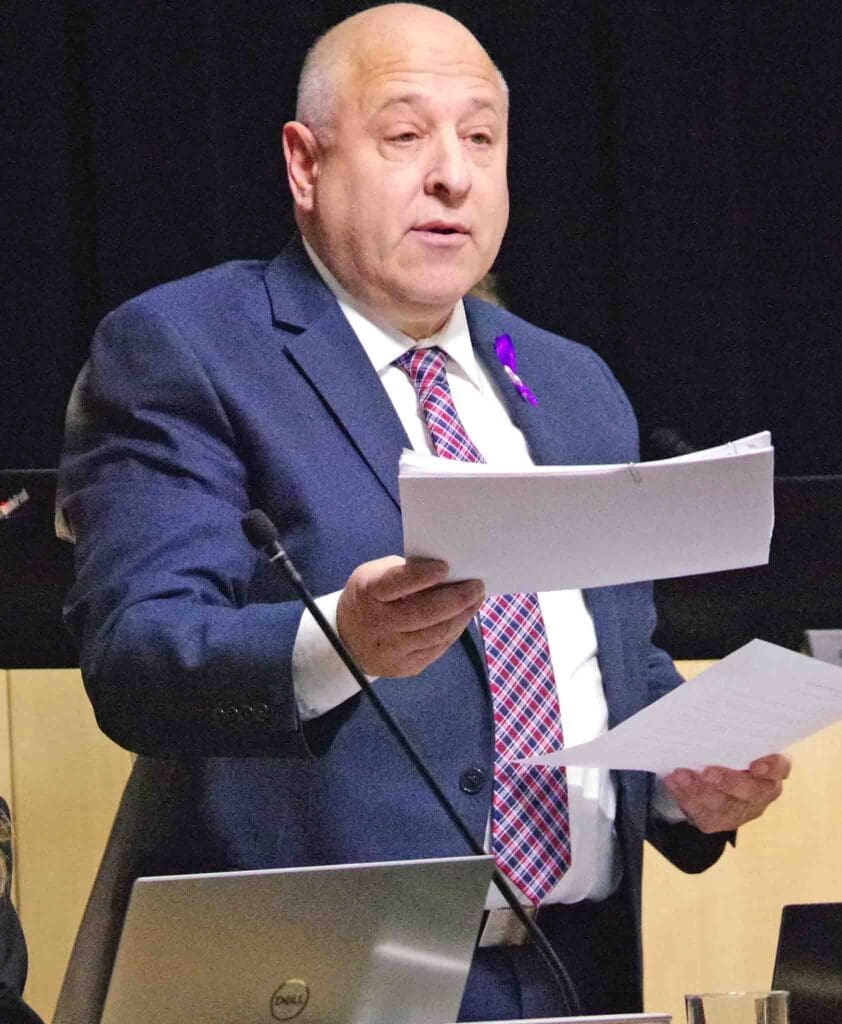
Action Laval city councillor for Val-des-Arbres Archie Cifelli, who is also the opposition party’s interim-leader (File photo: Martin C. Barry, Laval News)
While Quebec and the City of Laval seem to agree that Carré Laval is a win-win proposal, not everyone is happy with the project.
Action Laval, Laval city council’s number two opposition party, issued a statement within hours of the city’s announcement.
Critical of project
Among other things, they take the administration to task for partnering up with Société de Développement Angus, which “has never finished a project outside the City of Montreal,” Action Laval city councillors Achille Cifelli (Val-des-Arbres) and David De Cotis (Saint-Bruno) say in the statement.
They also were critical of Mayor Stéphane Boyer for being immediately unable to answer more detailed questions about the timeline or estimated total costs for the city taking on a project of this size.
“The project seems also to gloss over the exponential growth of the city’s indebtedness since the coming to power of the mayor,” added De Cotis and Cifelli, while also suggesting that Carré Laval has electoral overtones since municipal voters here will be going to the polls in 2025.
Transport failures
Although the city provided a bare outline but few specifics of its overall strategy for Carré Laval, Action Laval was critical of the project’s lack of planning for automobile traffic, that Carré Laval is located several kilometres from the nearest Metro station, and that there are no immediate plans for STL bus access.
And while the city is in fact organizing extensive public consultations, Action Laval maintained that the Boyer administration hadn’t yet consulted residents or businesses, that impact studies haven’t taken place, and that the project’s “financial improvisation leaves us in fear of a future white elephant” as housing needs demand quick action.
St-Vincent councillor Galati leaves AL caucus, withdraws from SWLSB election race
Citing media reports raising questions about his municipal spending practices, Action Laval councillor for Saint-Vincent-de-Paul Paolo Galati says he will not be running for re-election as the Sir Wilfrid Laurier School Board’s chairman, so that his role with the city doesn’t impact the SWLSB.
City councillor for St-Vincent-de-Paul Paolo Galati.
“Various media outlets have reported on reimbursement claims made by Paolo Galati in his capacity as a municipal councillor for the City of Laval,” the board said in a Sept. 19 statement.
“None of these reports involve the Sir Wilfrid Laurier School Board, of which Mr. Galati is the Chairperson,” said the statement which was attributed to Galati.
Seeks expenses review
“I have represented the people of my electoral district in Laval and the Sir Wilfrid Laurier School Board with pride and integrity for over a decade,” said Galati.
“To date, I have an unblemished record in the public service. I have asked that my expenses as a municipal councillor be reviewed once again by the City of Laval’s financial services. Once they have pronounced on the matter, I will act accordingly.
“However, in the current environment, I do not wish for my role as a municipal councillor to impact the Sir Wilfrid Laurier School Board, to which I have devoted much energy over the past decade and which I love,” he continued.
“I have therefore decided not to be a candidate in the upcoming school board elections that will be held on November 3, 2024. Furthermore, to avoid being a distraction to the governance and administration of the Sir Wilfrid Laurier School Board, I will, for the time being, be stepping back from certain public functions associated with my role as Chairperson of the board,” added Galati.
Apple Watch, iPad Pro etc.
When the Montreal daily tabloid Journal de Montréal published the results of an access-to-information investigation on Sept. 18, claiming among other things that Galati and the Action Laval opposition party had used a research budget from the city to buy him an Apple Watch, an iPad Pro tablet, an iMac desktop, a MacBook Pro, as well as a sofa bed and food purchases at Costco, Action Laval issued a statement maintaining that a number of the newspaer’s claims were misplaced or inaccurate.
According to the Journal, each of Action Laval’s four councillors was entitled to $46,000 in research budget funding in 2023. As Action Laval interim-leader Achille Cifelli noted in a statement, the term “research” – which is used when referring to the budget from which funds are drawn by the administration for councillors’ needs related to their work – can be used for up to 16 different kinds of expense.
Used for various expenses
Research funds are allotted from the mayor’s office budget to councillors who are registered members of a political party and who obtain at least 20 per cent of eligible votes. According to Cifelli, they can be used for virtually anything defined as day-to-day research, including the hiring of staff, office equipment, or even the outsourcing of public opinion surveys.
Quoting from a 2017 Quebec Municipal Affairs Ministry document providing guidelines for the reimbursement of research expenses, Cifelli maintained that the funds can even be used for advertising expenses when the purpose of the ads is to make the name of an elected official, along with his or her photo and office address, better known to constituents, and that even Mayor Stéphane Boyer does so.
According to Cifelli, other expenses the research budget funds can be used for include the purchase of special or charitable event tickets, office stationery, cell phones, computer supplies, mass mailings and maintenance of web sites.
City reviews all claims, Cifelli says
He also noted that all such expenses get analyzed and approved by staff at Laval city hall, and that the city’s treasurer has the right to reject any reimbursement claim which does not conform to accepted norms.
As well, Cifelli emphasized that each individual councillor is responsible for managing their own research budget, and that “neither the leader, nor the caucus of elected officials nor the party ever intervene in the reimbursement process.” In addition, the councillors are expected to return all purchased items and materials to the city at the end of a mandate, or to purchase them at their depreciated cost.
With that said, Cifelli announced in a statement issued shortly before midnight on Sept. 18 that he and Galati were in mutual agreement that Galati would withdraw from the Action Laval caucus, given the fact that the Quebec Municipal Commission had opened a dossier that morning to investigate the Journal de Montréal’s allegations.
Inquiry announced on ‘X’
Rather than make the principal announcement through a dedicated ministry channel such as a press release, Municipal Affairs Minister Andrée Laforest chose to trumpet the CMQ’s investigation on the social media platform X, with the added twist that all four members of the Action Laval city council caucus would be investigated.
“We favorably welcome the inquiry sought by the minister, as it will allow us to shed all the necessary light on this affair,” Cifelli said regarding the minister’s announcement. “If it were to come to light that some expenses were judged as being non-conforming, it would be clear for us at Action Laval that Mr. Galati will have to act in accordance,” he said regarding Cifelli in a separate statement, without elaborating.
More AL ‘research’ purchases
While the Journal singled out Galati in its exposé, they also noted that a $900 Apple Air Pods headset was purchased for Cifelli from research funds (after he lost a $329 pair a few months before). As well, Action Laval city councillor for Chomedey Aglaia Revelakis claimed several thousand dollars in expenses from last year’s research budget after she purchased an Apple iPad Pro for $1,900 with a keyboard for $500.
Although the Journal’s investigation focused almost entirely on Action Laval, with very little mention of research budget expenses incurred by councillors sitting with the mayor’s party, the Mouvement lavallois, TVA (the Journal de Montréal’s television counterpart at Quebecor media) reported.
EDITOR’S NOTE The Laval News, would like to point out that it does not take any pleasure in publishing this type of article, but is obliged to do so in order to inform the population and respect its mission of information and impartiality.
Officials from the City of Laval and the provincial government gathered last Monday morning at a green space in Laval’s downtown Montmorency district for a ground-turning ceremony to mark the beginning of construction of the city’s new central public library building.
Aiming for LEED Gold
The architecture of the multi-storey building will be defined primarily by sustainability, according to the city. As such, Laval is aiming to achieve LEED Gold certification.
Architect’s rendering of what Laval’s new public library headquarters and cultural centre will look like when finished.
This will be based primarily on the environmental sustainability of the building’s outer envelope, as well as the building’s cutting-edge systems for managing rainwater and its successful integration of sustainable energy sources.
The building’s interior spaces have been designed to offer maximum comfort, according to the plans, allowing in a large amount of natural light from the exterior, while also creating interesting views of the outside from the interior.
A major cultural hub
Located on de l’Avenir Blvd. near the heart of the public transit hub in Laval’s downtown core and the Montmorency Metro station, as well as the campuses of several learning institutions, the municipal library headquarters building is projected to become a major gathering place for important cultural events and activities.
Construction work is set to begin in October, with completion scheduled by early 2027, although the official opening date has yet to be determined.
“This new cultural infrastructure marks a turning point in the development of Laval, transforming out centre-city into a true crossroads for creativity and gatherings for everyone,” said Mayor Stéphane Boyer.
‘A turning point’
“It is a source of pride to be able to support a project that will not only highlight the creativity of our artists, but that will also help to energize the well-being of our community,” he added.
The Quebec Ministry of Culture and Communications is providing $44 million in funding for the project, while the Ministry of the Environment, Climate Change, Parks and Wildlife is furnishing an additional $6 million.
“Today, we are unveiling more than a library and an arts centre,” said Sainte-Rose CAQ MNA Christopher Skeete, who is the Minister Responsible for Laval in the Legault cabinet. “We are presenting an unmistakable and inspiring meeting place for gatherings for our community.
‘Major asset,’ says Skeete
“Thanks to the support of our government, the cultural diversity of Laval will be illuminated in an environment that’s modern and unifying,” said Skeete. “It’s sure to be a major asset for the region, which will strengthen our economic and touristic vitality.”
“Our government stands firmly committed towards a more sustainable and prosperous future for Quebec,” said Environment and Climate Change Minister Benoit Charette. “I salute the architectural proposal presented by the City of Laval, which is a fine example of a project leaning towards energetic efficiency and sustainability.
“By integrating green technologies, we are taking an important step towards attaining our climactic objectives, while also creating greener and more resilient living spaces for future generations,” he said.
Laval obtains VÉLOSYMPATHIQUE silver level certification
The City of Laval’s initiatives to make cycling an essential transportation option have been recognized and rewarded by Vélo Québec’s VÉLOSYMPATHIQUE movement, which has just awarded it silver certification. This is an additional step up from the previous certification, underlining the City’s ongoing commitment to active mobility.
“After obtaining a bronze level certification in 2019, this new silver level certification highlights the efforts made in recent years and marks another step towards an environment conducive to active transportation, including cycling. The City of Laval aims for efficient, active and sustainable mobility, and cycling plays a key role in this direction,” said Laval Mayor Stéphane Boyer.
A varied and constantly evolving offer
In line with the Master Plan for the Bicycle Network, the Laval network is becoming more accessible, user-friendly and better connected between neighbourhoods every year. About 10 to 15 km of new cycle links are deployed annually, bringing the total network to more than 325 km on the entire island.
The fast-growing BIXI bike-sharing network has been a growing success with Laval residents since it went live in 2019. In addition, theRoute verte cycling network, which covers more than 37 km on the territory, enhances the offer of bike lanes.
Not to mention the wide range of learning and discovery activities to learn and discover cycling, such as the two cycling education parks inaugurated in 2023 and the new Circuits actives de Sainte-Rose, which illustrate Laval’s commitment to innovating in active transportation and making it accessible to all.
Better sharing of the streets
The City has also distinguished itself in recent years with the deployment of several actions aimed at better street sharing and an increased sense of safety for all road users.
These actions include the implementation of traffic calming measures, increased safety at intersections, the implementation of new actions to promote active mobility and the reduction of speed limits.
The slogan. “Tout doux dans nos rues”, accompanied by citizen mobilization actions associated with this campaign (posters, compost bags, etc.), also helped to raise awareness of these efforts.
New downtown sector would include up to 3,500 housing units and a regional park
With a little seed money from Quebec Premier François Legault’s government, the City of Laval is set to transform another expanse of its vast but still largely underused downtown core into a new and sustainably-planned neighborhood, where residential, commercial and light industry are expected to flourish.
The Carré Laval project will be taking place over a span of 20 years at least on a more than 40-hectare site that is probably familiar to many if not most Laval residents. It’s the large mostly vacant square of land at the southwest-side intersection of Autoroute 15 and Saint-Martin Blvd.
Flanked by Sainte-Rose MNA Christopher Skeete (right) and Carré Laval project head Élizabeth Muir Lepage, Laval mayor Stéphane Boyer points at a graphic of the planned Carré Laval project during an official announcement earlier this month. (Photo: Martin C. Barry, Laval News)
Visible but vacant site
There, the most notable landmarks until now have been the Palais de Justice, the abandoned stone quarry behind the courthouse, and in more recent years the temporary staging base for the lightshow entertainment start-up Illumi Laval.
In a press release issued by the city earlier this month, Laval officials refer to Carré Laval as a “flagship project,” serving possibly as a prototype for similar developments elsewhere in Laval. The city acknowledges it is an “ambitious vision” for an area that was chosen largely because of its strategic location immediately next to the A-15, allowing widespread exposure to a steady stream of traffic passing through greater Montreal.
$10 million from Quebec
Although the Legault government agreed four years ago to provide an initial $10 million to decontaminate and remediate the lot (some of which served for decades as a snow dump), Sainte-Rose MNA Christopher Skeete, who is the Minister Responsible for Laval, played a prominent role during an official announcement with Mayor Stéphane Boyer, suggesting Quebec may have more to offer before the next election two years from now.
According to a description from the city of the future Carré Laval, it would be designed to minimize its carbon imprint. To that end, access in and around the site when completed would be primarily by “active” transportation (bicycle, light electric vehicles, and on foot), while minimizing the presence of trucks and cars.
A new regional park
During a first phase, a 22-hectare regional park (the equivalent of 30 football fields, according to the city) would be created, with the disused stone quarry dominating the middle. Eventually, 3,500 units of housing would be built in Carré Laval, although the initial plan calls for the creation of 1,000 housing units, 500 of which would be of the affordable kind.
A conceptual rendering of Carré Laval when completed. (Photo: Courtesy of City of Laval)
To reach this goal, the city has decided to work closely with the Société de développement Angus (SDA), a property developer that operates on principles of social economy. SDA’s main accomplishment to date was the redevelopment of the former Angus railway yards in the east end of Montreal into a mixed-use residential/commercial community.
New housing on site
The City of Laval has signed an agreement in principle with the Société de développement Angus, which sets out three phases for SDA’s involvement with Carré Laval: construction of 500 units of affordable housing; development of an additional 500 housing units of an unspecified type; and the realization of a public building revolving around the “One Health” concept, as well as life sciences and commercial research.
The city notes that the the plan calls for life and health sciences companies to locate their research facilities in Carré Laval. “The goal is to create an emblematic environment that reflects the values of sustainable development and inclusivity which have importance in laval,” reads a statement from the City of Laval.
The ‘One Health’ concept
The World Health Organization defines the One Health concept as “an integrated, unifying approach to balance and optimize the health of people, animals and ecosystems. It uses the close, interdependent links among these fields to create new surveillance and disease control methods.”
And the U.S.-based Centers for Disease Control calls One Health “a collaborative, multisectoral, and transdisciplinary approach – working at the local, regional, national, and global levels – with the goal of achieving optimal health outcomes recognizing the interconnection between people, animals, plants and their shared environment.”
From the left, Mayor Stéphane Boyer, Société de développement Angus vice-president and executive-director Charles Larouche, Carré Laval project leader Élizabeth Muir Lepage and Sainte-Rose MNA Christopher Skeete are seen here in early September during the Carré Laval announcement. (Photo: Martin C. Barry, Laval News)
A ‘unique place,’ Boyer says
“The vision for the development of Carré Laval prioritizes quality of life, innovation and sustainability,” said Mayor Boyer. “On this exceptional site in the heart of downtown, we are going to create a unique place where the community will be able to develop in a healthy and dynamic environment geared towards the future.
“In the end, Carré Laval will become the nerve centre that establishes the identity of Laval residents and that attracts people from everywhere,” he continued. “This project of international stature will allow the City of Laval to enter a new era. We want to create a neighborhood where there is real happiness.”
Beyond economics, says Skeete
“For our government, giving life back to a place like the Carré Laval is more than just an economic project,” Skeete suggested.
“This is also an opportunity to create areas where our community can get together and prosper. Thanks to the collaboration of numerous local players, we have a unique opportunity to rekindle our centre city as well as our region.”
The city will be launching a wide-ranging public consultation on Carré Laval with an initial presentation at 7 pm on the evening of Tuesday Sept. 24 at the Cabaret de l’Avenir at Collège Letendre at 1000 boulevard de l’Avenir in downtown Laval.
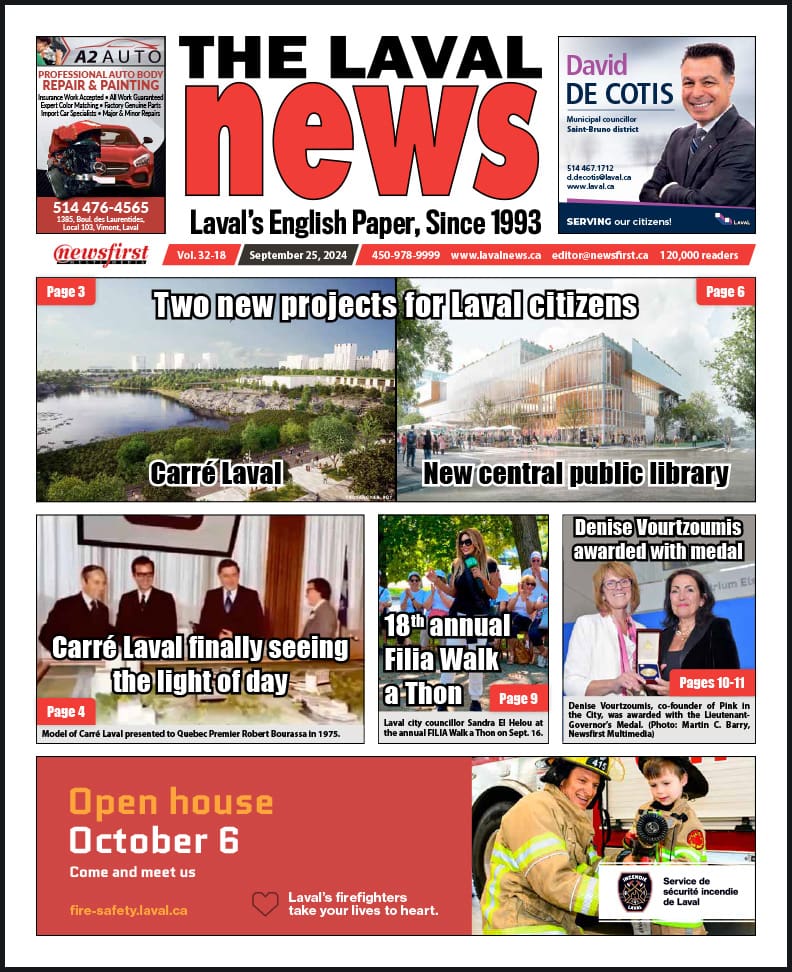
The current issue of the Laval News, volume 32-18, published on September 25th, 2024. Covering Laval local news, politics, and sports. (Click on the image to read the paper.)
Remnants of Hurricane Debby devastated Laval, Montreal and other areas of Quebec
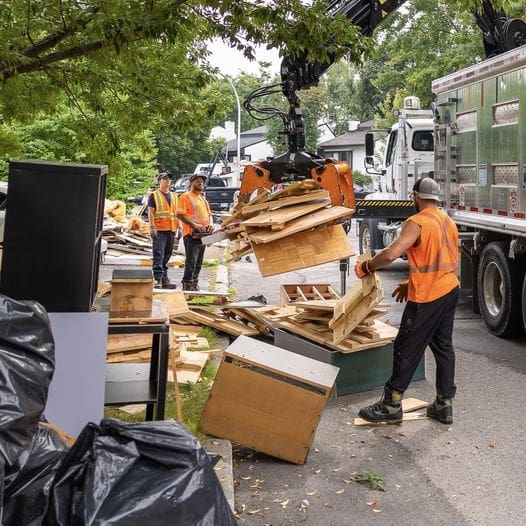
City of Laval workers cleanup on one of Laval’s residential streets following the devastating recent floods.
The remnants of Hurricane Debby that travelled across southern Quebec on August 9 and 10 are estimated to have caused nearly $2.5 billion in insured damage, according to initial estimates from Catastrophe Indices and Quantification Inc. (CatIQ).
This one flood event now ranks as the costliest insured event in Quebec’s history, surpassing even the 1998 ice storm.
“The record-breaking downpour caused by the remnants of Hurricane Debby has led to a surge in insurance claims related to flooded homes, businesses and vehicles,” said Johanne Lamanque, vice-president for Quebec of the Insurance Bureau of Canada (IBC).
“From the very beginning of this crisis, insurers deployed extraordinary measures to respond as quickly as possible to their clients’ need for financial support,” she said.
While insurers say they are continuing to assist their customers with financial support as rapidly as they can, the sheer volume of claims, coupled with skilled labour shortages and continued strains in Canada’s supply chain, means that the claims process will take time.
As IBC recently reported, Canada’s home, auto and business insurers are grappling with the most challenging summer on record for damage from severe weather events and natural disasters.
The flooding in Toronto and other parts of southern Ontario, the Jasper wildfire, the Calgary hailstorm and flooding in regions of Quebec, have resulted in approximately 228,000 insurance claims.
By comparison, last year, insurers reported 113,000 claims in July and August and 160,000 claims for the entire year amidst record-breaking wildfires across the country.
Canada’s insurers are simultaneously supporting customers impacted by the flooding in Quebec, the July and August southern Ontario floods, the August Calgary hailstorm and the Jasper wildfire. The insurance industry is on the ground in Quebec, Ontario and Alberta, assisting customers as they put their lives back together.
“Insurers are paying out more in claims for the Quebec flood event than the federal government has invested on climate adaptation over the past decade,” said Craig Stewart, vice-president for climate change and federal issues at IBC.
“Launching the promised National Flood Insurance Program is the single most-important step the federal government can take to better protect homeowners from the financial risks of climate change,” he added.
“Unless the federal government commits the necessary resources during the upcoming parliamentary session, with the backing of the provinces and territories, insurers will not be able to support the program before 2026.”
He said all levels of government must immediately take measures to stop building and rebuilding on flood plains and areas prone to wildfire, invest in disaster mitigation, including upgrades to stormwater infrastructure, and roll out programs to help fire- and flood-proof homes.
According to IBC, insured losses related to severe weather in Canada now routinely exceed $2 billion annually.
By comparison, between 2001 and 2010, Canadian insurers paid out an, on average, $701 million a year in claims related to severe weather.
The Laval Police late last week were still trying to identify several suspects who took part in a brazen early morning burglary at a designer children’s wear boutique near the Carrefour Laval mall.
According to initial reports, the perpetrators were able to get into the outlet through a commercial address next to the Kid Biz store.
They apparently broke through a wall between the two businesses, through which they managed to get into the high-end children’s clothing retailer around 1:40 am.
The store is known for selling designer kids’ apparel and accessories, retailing in some cases for more than $1,000 per item.
On its website, Kid Biz bills itself as “Quebec’s leading boutique for high-end childrenswear,” as well as “the largest children’s retail boutique in Canada.”
According to the website, the designer brands children’s wear featured in the store include Givenchy, Balmain, Moncler, Armani, Moschino, Versace and Hugo Boss.
Recent Laval Fire Dept. calls
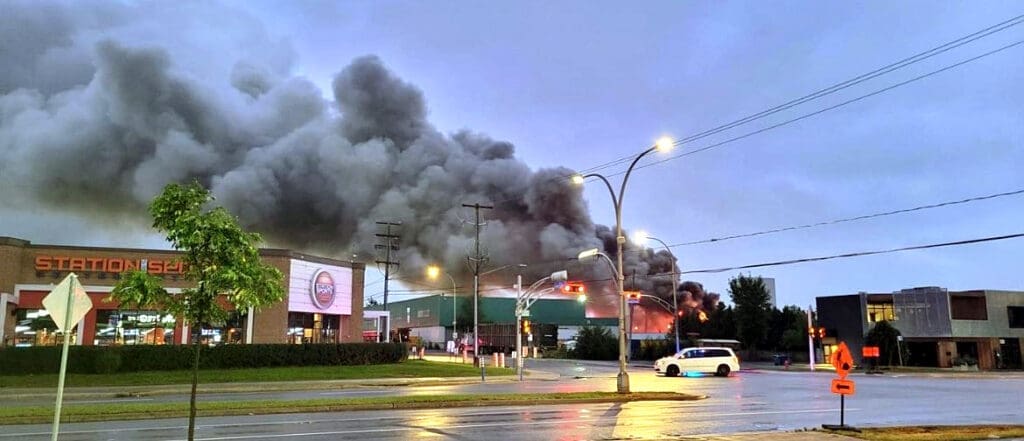
Around 5:40 pm on Friday Sept. 6, the Laval Fire Dept. was called to respond to a fire which had broken out in an industrial building located on Lachaine St. in an industrial sector of Saint-Vincent-de-Paul.
(Photo: Courtesy Association des pompiers de Laval)
Although the blaze wasn’t considered highly dangerous, smoke was spotted by firefighters as soon as they arrived, and a 10-07 code was sent in, meaning an intervention would be necessary to put out the fire.
During the early evening of Aug. 31, firefighters from the LFD responded to a fire call from a commercial address near the intersection of Industriel and Saint-Elzéar boulevards.
It turned out to be a blaze which started in a pile of debris.
(Photo: Courtesy Association des pompiers de Laval)
The firemen had some difficulty at first putting it out, directing several streams of water, before having any success. However, a large volume of smoke could be seen from a considerable distance.
On Sunday Aug. 25 just before 10 am, a shed located behind a home on Léandre-Descostes St. in Chomedey was the source of a large explosion which caused a fire that spread to several other sheds in a rear lane.
According to an initial assessment of the cause, a propane heater used improperly to warm up a swimming pool was the probable cause. Electric wiring hanging from poles near the blaze were damaged, with some falling to the ground.
Firefighters from the LFD’s No. 2 firehall on Souvenir Blvd. responded. They managed to get the situation under control within minutes and backup units weren’t necessary. Property damage was limited to the affected sheds and nearby houses weren’t damaged.
A more serious fire broke out and burned overnight from Aug. 26-27 at an apartment complex on Bois-de-Boulogne Ave. in Chomedey.
The blaze is believed to have been caused by some items of clothing which were left too close to bedside lamp in a bedroom in a third-floor apartment.
(Photo: Courtesy Association des pompiers de Laval)
The LFD received the first call just after 10 pm, and were on the scene within eight minutes, although tenants had started evacuating before the firefighters arrived.
A dog that was found unconscious in the unit where the fire had broken out was revived by the firefighters with respiratory equipment adapted to rescuing pets. Damages were estimated at $10,000 to the building and an additional $9,000 for furnishings.
Rain leaves many moms, dads and kids adrift in mid-day downpour
Many of Laval’s moms, dads, children and grandparents got just a taste of the fun normally to be had on Labor Day weekend, when the city lives up to its annual end-of-summer tradition by holding the Fête de la Famille at the Centre de la nature in Duvernay.
By mid-afternoon at the Fête de la Famille on Sept. 1, the rain was putting a damper on many families’ fun.
Unwelcome rain
Given Mother Nature’s precarious moods in recent years, the city’s highly popular Family Day was reduced roughly by half.
Rain that began slowly falling during the early afternoon quickly changed into a steady downpour that drove anyone lingering on the Centre de la nature grounds into a frantic search for cover.
A mini version of the “zip line,” a perennial favorite among kids as well as adults every Labor Day weekend at the Centre de la nature, was a shadow of its former self. (Photo: Martin C. Barry, Laval News)
Although Environment Canada had forecast rain starting no earlier than 3 pm after bright and friendly skies that morning, dark clouds were gathering by as early as two, while gusts of wind threatened to uproot tents and send them aloft like giant kites.
A scaled-down Fête
However, many of the usual sights, sounds and fun things were there, although scaled down considerably in some cases. The “zip line,” a perennial favorite among kids as well as adults every Labor Day weekend, was a shadow of its former self this year, being reduced to a mini-version.
Still, some of the Family Day’s old standby favorites, like the Laval Fire Department’s firehose and burning house simulator, were still as big a hit with the kids as in many years past.
A Jurassic Park “circus” proved itself to be very popular with kids and parents, although it and most of the other activities were cut short by mid-afternoon when the rain began falling in torrents.
‘It’s a way for us to thank our citizens while just having a great time’
More than 800 guests – most of them constituents in Vimy MP Annie Koutrakis’s riding – chowed down on hot dogs, salad and other outdoor BBQ delights on the afternoon of Sunday Sept. 1 in Laval-des-Rapides’ Bernard Landry Park.
Vimy Liberal MP Annie Koutrakis, left, helped cook and serve hotdogs during her annual summer BBQ event in Bernard Landry Park in Laval-des-Rapides on Sunday Sept. 1. (Photo: Martin C. Barry, Laval News)
Again next year
Although it was Koutrakis’s first annual BBQ since first being elected in 2019, she pledged it was far from being the last. “We plan to have this event every year,” she said in an interview with The Laval News.
“And it’s a way for us to thank our citizens while just having a great time in a family atmosphere to tell them how much I appreciate them. It’s also for them to know that they have a federal Member of Parliament who is always there ready and willing to help.”
Touching base locally
Koutrakis and her staff spent time since early August visiting more than 40 local community organizations and non-profit groups, including several senior citizens’ retirement residences.
Some of the more than 800 people who attended Vimy MP Annie Koutrakis’ summer BBQ. (Photo: Martin C. Barry, Laval News)
“Everybody knew about our annual BBQ,” said Koutrakis, noting that several buses of seniors were expected to take part in the festivities that afternoon. “For us, when I look at this, it warms my heart to know that we did the right thing.”
While there is a common misconception that MPs enjoy long summer and Christmas holidays when the House of Commons isn’t in session, the truth is that the vast majority of parliamentarians use the time to catch up on local issues in their ridings, while going around touching base with people and organizations.
Busy summer for Koutrakis
“Oh my god, I think summer is the best time for all Members of Parliament to be on the ground and visit the small businesses, family organizations, daycamps.” she agreed. “We visited many of the companies and organizations we helped this summer through Canada employment.”
A senior member of a Cadets Canada corps from Laval helped familiarize Vimy MP Annie Koutrakis with the fine points of using a computerized flight simulator during Koutrakis’ BBQ event in Bernard Landry Park in Laval-des-Rapides on Sept. 1. (Photo: Martin C. Barry, Laval News)
She said the riding of Vimy alone this past summer received nearly $1 million to provide subsidies to 66 children’s daycamps and other groups so they could create 204 jobs for students who were off during summer vacation.
“So, the good word is that summer is the best time for MPs to get some things done, when we’re not torn between parliament and other things that need to be done,” she added. An event such as a large gathering of citizens can also offer opportunities to hear what’s on the minds of constituents. Koutrakis learned what some of them were thinking.
Meeting constituents
“Today I heard from several people who wanted more information on the government’s housing strategy, for instance,” she said. “There were some who said they had reached out in the past for services at my office and they specifically wanted to meet members of my team who had helped them out.
“I can’t ask for better than that,” she continued. “So, it’s really great to be able to have these informal get-togethers to hear directly from people where you know that you’re made a difference in their life. And it makes me better as a Member of Parliament. We learn as a team.”