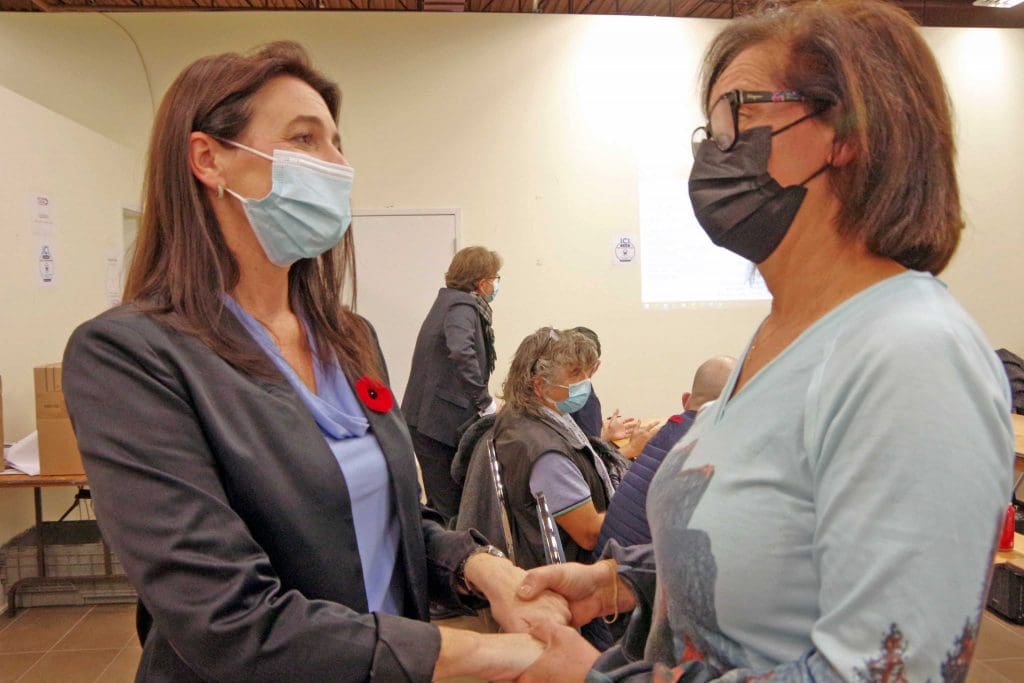
The City of Laval says its consultative committee on senior citizens’ issues is currently looking for people living in Laval with an interest in seniors’ problems who would like to become committee members.
The consultative committee on seniors’ issues studies questions having to do with a vast array of facets that affect senior citizens on Laval’s territory.
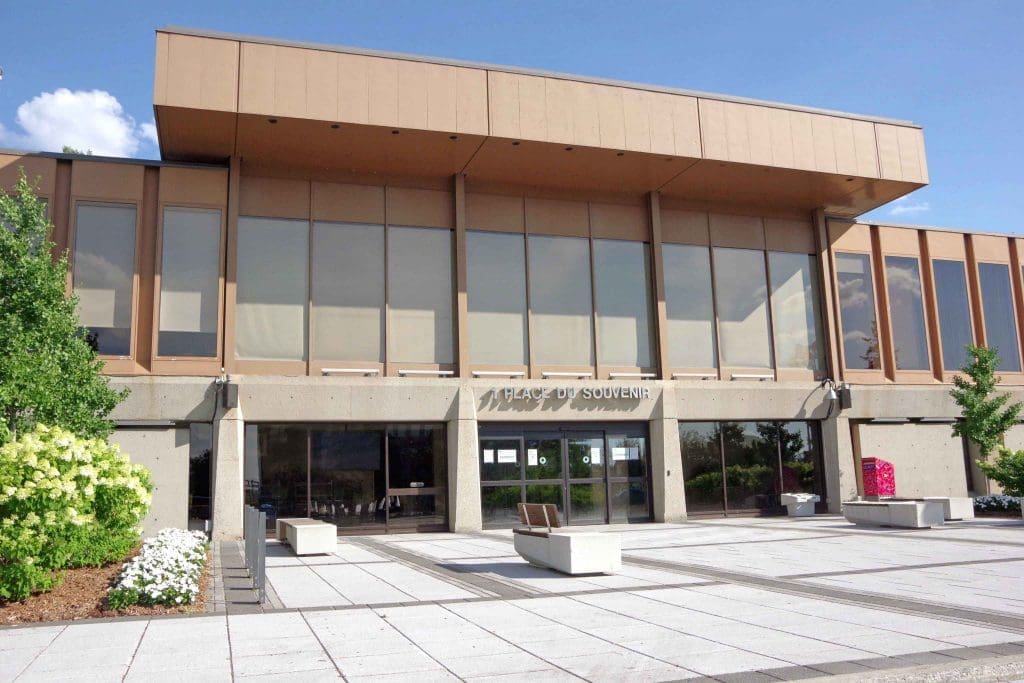
Laval City Hall.
Once chosen, the members of the committee will be representative of the diversity among senior citizens in Laval. Their duties will include:
Watching over needs of Laval’s senior citizens;
Developing knowledge of the municipal issues involving this segment of the population;
Raising awareness of the issues, while coming up with solutions the municiplaity can apply;
If you would like to become involved in the community, the City of Laval’s Secretariat for Governance is seeking individuals who are committed, available, motivated and representative of diversity among Laval’s seniors.
Additional information on how to apply is available on the City of Laval’s web site.
STL and bus drivers agreed to call off last Monday’s strike
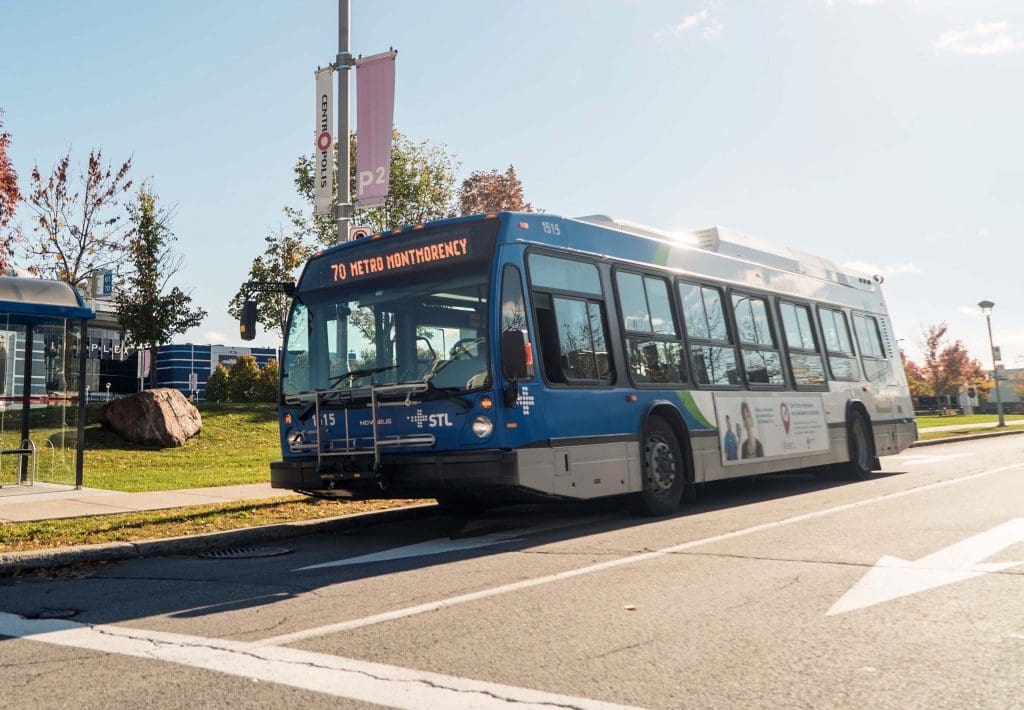
The Société de transport de Laval (STL) and the FTQ/Canadian Union of Public Employees local representing 625 STL bus drivers reached an agreement last week, resulting in a planned one-day strike last Monday being called off.
Despite this, two more strike days are still being called for on Nov. 26 and Nov. 27, which are a Friday and a Saturday. Nonetheless, essential services will be provided, as they were on the first strike day Nov. 3.
In the meantime, another hearing between the two parties was scheduled to determine the level of essential services to be given by the drivers on the upcoming strike days.
STI Logo
“There is no settlement soon, but the discussions are still underway,” said union local president Patrick Lafleur. That said, STL management isn’t happy with how things are going.
“STL management continues to deplore the decision by the Union to hold strike days, imposing very tight schedules on the clientele, while talks are still underway,” they said in a statement. At issue during the negotiations are salaries, working hours and bus schedules during off-peak hours.
Don’t kid yourself. Smiling Joe Biden is no friend of Canada. Other than Trump, he’s the first U.S. President not to visit Canada after his election. He is the first President to reach out to Australia, instead of Canada to form a security alliance. He is intervening in Canada’s Enbridge number 5 pipeline that runs through Michigan and provides heating and gas to Quebec and Ontario, but only because had that pipeline closed, the state would have to get its propane and other gases elsewhere at a much higher cost, and Joe Biden cannot afford to lose more support, especially from such a vital state like Michigan. It doesn’t matter to him what would have happened to Canadian provinces.
Buy U.S. policy completely disregards its largest trading partner, Canada, supplier of water, gas, and oil at less than wholesale prices to our neighbour. Canada to Joe Biden is just another Mexico.
And sadly, not a peep from Canada’s opposition parties. The NDP is in bed with the Liberals so it’s not expected to voice concern, but the Conservatives have not complained about American policy. There has been no outcry over the absurd rise in the cost of groceries due to inflation, expected to reach 5%, in part due to our Prime Minister’s “gargantuan and furious spending” over the last year, and no one has voiced concern over the delay in reconvening parliament. Frankly we are devoid of representation. Especially with a new government that was elected with support from fewer than one in three Canadians.
And so, the three amigos are having a sit down in Washington this week. Whatever Joe wants to discuss, Trudeau must not cave in, like he did at the ludicrous and hypocritical COP26 (26th meeting of the Conference of the Parties) in Glasgow Scotland.
Canada sent more delegates than any other country. It included “277 bureaucrats, not including the prime minister’s official photographer, official videographer and lead speechwriter, 17 press secretaries and communications directors” with the Canadian aircraft parked next to hundreds from other countries, plus over 100 private jets, and thousands of vehicles in each leader’s motorcades. A fine example by world leaders to help curb carbon emissions.
Mr. Trudeau saw fit to make his contribution on the world stage, by boastfully announcing a cap on Canada’s oil and gas emissions in a way that would decimate an already beaten and battered Alberta economy, where almost 20% of our GDP is generated. I am stunned that not one of our political leaders complained. Even Conservative Erin O’Toole was only mildly critical, actually gutless.
Why the oil and gas industry? Why not cap Canada’s aerospace empire, “one of the biggest growths of global emissions”, which happens to be centered in Trudeau’s priority electoral province, Quebec? Nor did our Prime Minister single out friendly British Columbia, where the Port of Vancouver is the largest exporter of thermal coal in North America. No, just Canada’s gas and oil industry.
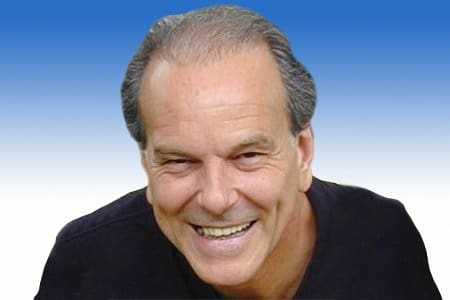
Newsfirst columnist Robert Vairo says U.S. President Joe Biden is concerned only about his country’s interests.
Why berate what is so vital to Canada instead of striking a positive note and sighting true Canadian advancements in the climate change debate.
Trudeau could have boasted about Canada’s outstanding technological achievements in capturing carbon dioxide. Alberta has two commercial-scale projects reducing greenhouse gas (GHG) emissions by 2.76 million tonnes each year. We have a phenomenal, and growing carbon capture industry, in fact Canada is a leader in carbon capture, utilization and storage.
Like him or hate him, Stephen Harper, has a realistic view, citing political will is not the issue at the COP26 Climate Summit. Harper says that wind mills and sun power cannot yet deliver the power to electrical grids to allow us to operate as we do today. Says Harper “the technological developments simply have not occurred yet, or suffer from resource deficiency”. He is right on.
And how about some transparency and accountability from COP26, when billions are donated to countries for the environment, as there were with the Paris Accord, but are often diverted to other sources. Some have called it ‘kleptocrat corruption’. None of these leaders has addressed that.
It’s easy and popular to shout about the need to reduce carbon emissions, and promise reaching zero carbon emission by 2050. What the rich world does, matters little. We all know that countries like India, the third largest world polluter, will not be able to afford this kind of radical turn around. China, the largest polluter in the world, where 60% of its energy is still produced by coal, did not even attend the Summit. So, let’s be realistic about carbon emissions and stop with these grandiose promises.
The Financial Post suggests accelerating “investment into R&D of cheaper, low-CO2 energy, from fusion and fission, solar, wind and batteries to second generation biofuels” and many other brilliant ideas will follow. Strong government incentives to extract lithium from depleted oil and gas reservoirs, and harness geothermal energy.
Wouldn’t this be cheaper, and achieve giant step results, rather than carbon taxes that increase every year, adding to the cost of everything.
The reality is, the end result will bring breakthroughs for new and greener energy, without the flowery empty promises, and the brutal cost to all taxpayers.
Incumbent Premier addresses CAQ faithful, while courting Quebec’s rural regions
Quebec Premier François Legault all but confirmed at the conclusion of the Coalition Avenir Québec’s general council meeting in Trois Rivières last Sunday what most observers had assumed already without knowing for certain.
Legault was hinting around two years into his first mandate which started in October 2018 that he felt the work he’d started a decade ago when he founded the CAQ was done and that he might be stepping away to make room for another leader.
‘Ready for another four years’
However, finishing his speech to the CAQ membership just before the end of the two-day Covid-restricted gathering held as a warmup for the provincial election next year, Legault said, “I finish by saying that I need you the activists.
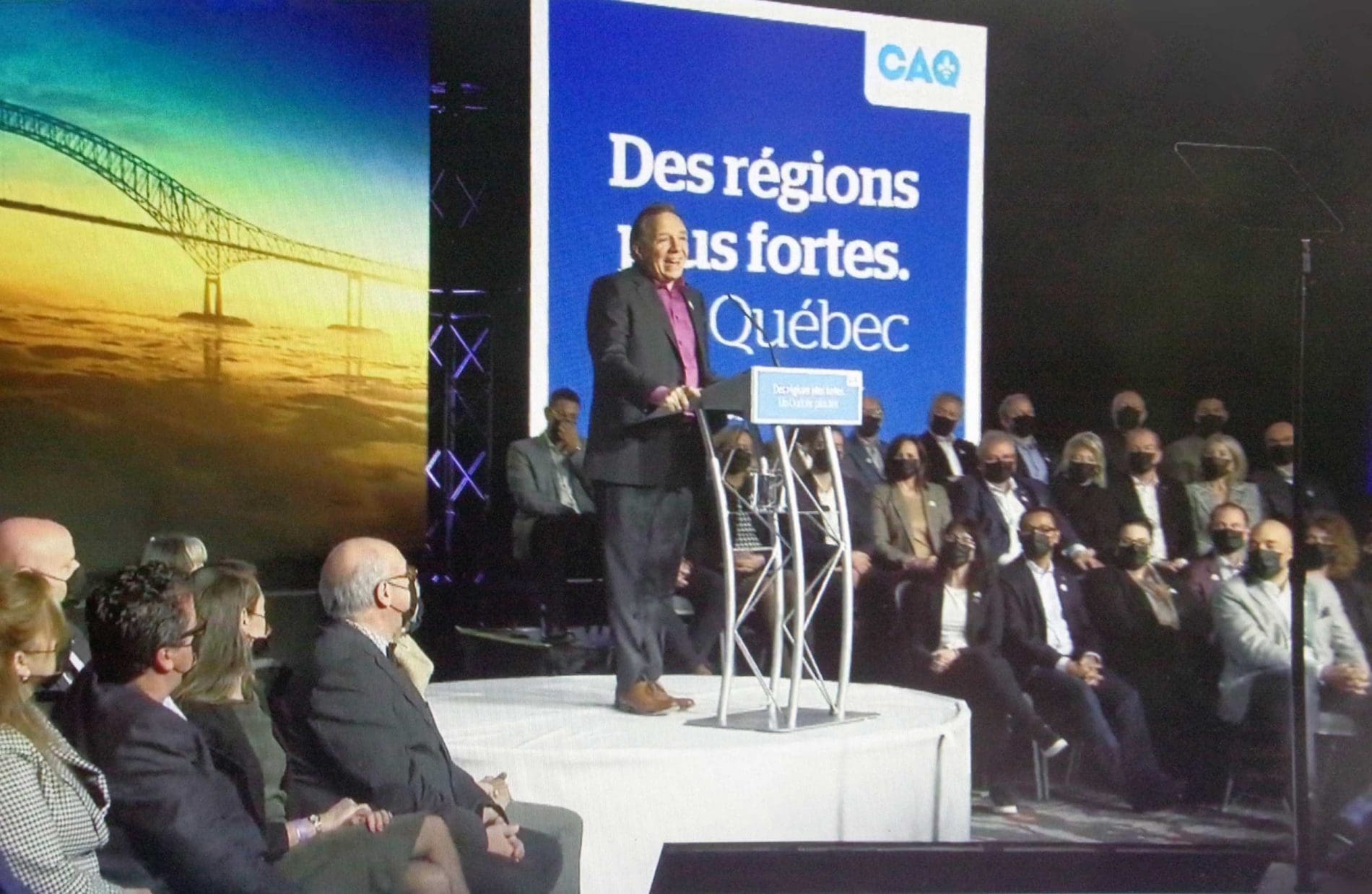
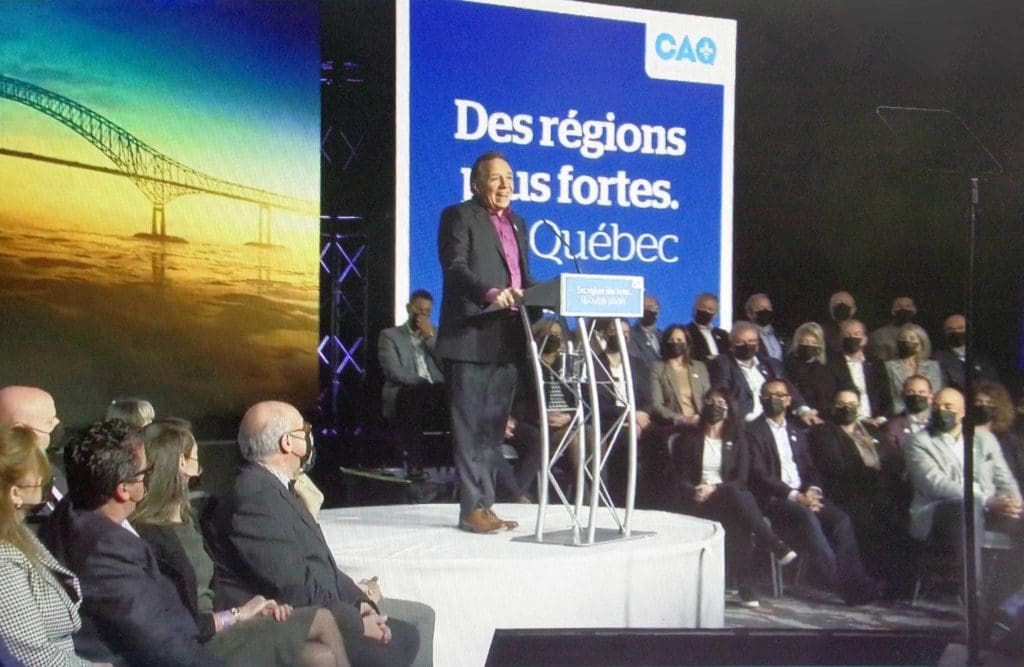
Quebec Premier François Legault speaks during the Coalition Avenir Qu/bec’s annual general congress in Trois Rivières recently.
“Together, we have already made a lot of changes, but have still many changes to make. And so, I think, I have the impression that we are going to need another mandate. It wouldn’t be great, it seems to me in any case, to break the momentum. As far as I’m concerned, I’m ready to go for another four years. Do you feel like getting on board with me?”
If the CAQ’s gathering was an indicator of what the party has in store leading towards the October 2022 election, Quebecers can expect the party will be repeating the strategy that got them elected in 2018 – an intense focus on the province’s rural regions where their electoral support is strong, with less attention paid to the major urban centres where they have thinner support.
Little focus on Montreal region
Throughout Legault’s closing speech summing up the party’s accomplishments while offering a glimpse of the future, scant reference was made to Quebec’s largest urban centres – including the greater Montreal region. And even then, it was only while referring to the “inter-dependence” of the urban centres with the regions in helping to develop and build up the overall economy of Quebec.
Whether the Premier was consciously trying to emulate the late Canadian Prime Minister Sir Wilfrid Laurier who famously said, “Let me tell you, my fellow countrymen, that all the signs point this way, that the 20th century shall be the century of Canada and Canadian development,” Legault confidently proclaimed:
“The 21st century will be the century of the green economy, and the 21st century will be the century of Quebec.” Similarly, and invoking the regional theme again, Legault said later, “My dream, as I was saying earlier, is that the 21st century becomes the century of the regions of Quebec.”
Legault’s economic nationalism
The word “nationalism” loomed at some points during Legault’s speech, although mostly in an economic rather than cultural or political context. The Premier said he was proud of how Quebecers went all out to purchase Quebec-made products so as to encourage the local economy during the pandemic.
‘the 21st century will be the century of Quebec’
“We’re going to continue – the idea is to replace other products, including products made in China with products made in Quebec,” he said, pronouncing the part about China in English.
“Sure, we won’t be able to replace all the products. But there are some where we are able to be competitive.” Regarding the province’s agricultural output, Legault observed, “When you look at what we eat, there’s just 50 per cent that comes from Quebec.”
Hi-speed Internet for regions
A significant part of the focus over the weekend (dealing again with the province’s regions) was a CAQ government plan to make high-speed Internet service available in all isolated and far-flung sectors of Quebec before the government’s mandate ends late next year.
On the issue of employment, Legault again invoked the regions, noting that there are regions of Quebec where unemployment persists in spite of a shortage of workers reported by business owners. “The best way to enrich Quebec is to enrich all the regions,” he said, while also emphasizing that job re-orientation and retraining will be made available in the regions.
Perhaps more ominously in terms of what a second CAQ mandate could mean, the Premier suggested that the province’s universal health care system could undergo a major “decentralization” comparable to the one that saw Francophone school boards abolished and converted into educational service centres during the CAQ government’s first term.
Two teenagers were beaten at the exit of classes in Laval on Tuesday by a group of young people who fired a shot during the altercation, ultimately leading to a large police deployment to arrest one of the suspects in the evening.
According to Laval police, it all started at 3:04 p.m. when a car stopped on the grounds of the Latour pavilion of Curé-Antoine-Labelle High School. On the spot, the group of suspects attacked two young men of 17 years, including one who sought to intervene to defend his friend, said Stéphanie Beshara, spokeswoman for the Laval police.
Both victims were beaten, to the point where one of them had to be taken to hospital to treat injuries deemed minor. A shot was also fired in the air by one of the suspects during the altercation.
Police say several witnesses described the suspect vehicle and license plate number. They later tracked down the vehicle in Laval’s Sainte-Dorothée neighbourhood, and the suspect was questioned overnight. To try to find out more about his role in this story of assault. The Beshara agency was not in a position to say whether he was known to the police. Police say there could still be more arrests.
The current issue of the Laval News volume 29-40 published November 17th , 2021. Covering Laval local news, politics, sports and our new section Mature Life. (Click on the image to read the paper.)
Front page of the Laval News, November 17th, 2021 issue.
The Laval police say they have arrested two men suspected of being connected to a sexual assault and say there may have been additional victims.
The LPD issued a statement on Nov. 1 saying that Jean-Michel Richard, 37, and Schnaider Toussaint, 24, had been arrested and appeared on Oct. 22 and 28 at the Laval courthouse under several charges related to sexual assault.
The allegations stem from an incident on Jan. 31, when a young woman went to the home of the two suspects to spend the evening. She was allegedly sexually assaulted by them that night.
Police say there are indications that other people may have been victims and that investigators hope to speak to them.
Anyone who believes they may have been sexually assaulted by these individuals is invited to contact Laval police confidentially at 450 662- INFO (4636) or by dialing 911. The file number is LVL 210218-057.
Laval Police find missing girl
The LPD says it has located 17-year-old Magaly Champagne who had been reported missing.
On Nov. 2, she had left her home to go to an appointment. She had not been seen since and those close to her feared for her safety.
She was believed to be somewhere in the greater Montreal area.
Montreal man charged with sexual assault and luring minors online
Police investigators from the Sûreté du Québec’s major crimes division say they have arrested a 57-year-old Montreal man in connection with several alleged sexual infractions.
Acher Sabbah appeared at the Laval courthouse last week to answer charges of sexual assault, sexual contacts, sexual coercion and child luring over the internet. The alleged offenses took place from 2015 to 2019 in Lachute, Beauharnois and Laval.
The suspect allegedly sought out his victims on various internet chat platforms, using such false names as “Adam.”
It is alleged that he would exchange text messages and have phone conversations with victims, followed by in-person meetings during which the alleged infractions occurred.
Police believe Sabbah could have more victims who have not yet been identified.
Laval-based wellness company to pay $200,000 for violating telemarketing rules
The Canadian Radio-television and Telecommunications Commission (CRTC) announced last week that CA Diffusion has agreed to pay a $200,000 penalty as part of a settlement for making non-compliant telemarketing calls.
The Laval-based company, more widely known as Physaro, specializes in the direct sale of wellness products geared toward seniors.
“This case was particularly worrisome as the products being sold targeted a vulnerable segment of our population,” said CRTC chief compliance and enforcement officer Steven Harroun.
“CA Diffusion cooperated with our investigation, voluntarily entered into an agreement, and has implemented corrective measures to ensure compliance with the rules. We continue to closely monitor organizations to uphold Canadians’ choice not to be bothered by telemarketing calls.”
The CRTC investigation uncovered that CA Diffusion committed several violations of the Unsolicited Telecommunications Rules between September 2018 and July 2019.
During that period, millions of unsolicited calls were made to Canadians – some of which were made to telephone numbers registered on the National Do Not Call List (DNCL) and outside of the permissible calling hours.
Some calls were also made during periods when the company failed to purchase a subscription to the National DNCL. The company enlisted the services of call centres based in Senegal and Morocco.
The CRTC reminds telemarketers that it is their duty to comply with the Unsolicited Telecommunications Rules, whether based in Canada or abroad, and whether they make the calls themselves or hire a third-party agency to do it for them.
The CRTC’s Unsolicited Telecommunications Rules are a strict set of regulations that individuals, companies and organizations must follow when making unsolicited telecommunications, including telemarketing calls.
The CRTC says it is continuing to monitor to ensure telemarketers follow the rules and to reduce the number of unwanted calls to Canadians.
The National DNCL was launched in 2008 to protect Canadians from unsolicited telecommunications. Canadians may register their numbers permanently on the List at no charge. Over 14 million numbers have been registered on the List.
The CRTC says that since 2008, a total of $10,716,930 has been issued in administrative monetary penalties. In 2020-21, Canadians filed 45,874 complaints with the National DNCL Operator.
Canadians can register their numbers, verify whether a number is on the List or file a complaint about a telemarketer by calling 1-866-580-DNCL (3625) or visiting the National DNCL website.
Stéphane Boyer obtains a strong mandate to become City of Laval’s next mayor
Who will form the next Official Opposition on Laval city council?
On Monday earlier this week, that was the burning question being pondered by election officials at Laval city hall, as election runner-ups Action Laval and the Parti Laval jostled in a tense neck-and-neck situation to see which would wear the mantle in the aftermath of Sunday’s municipal elections.
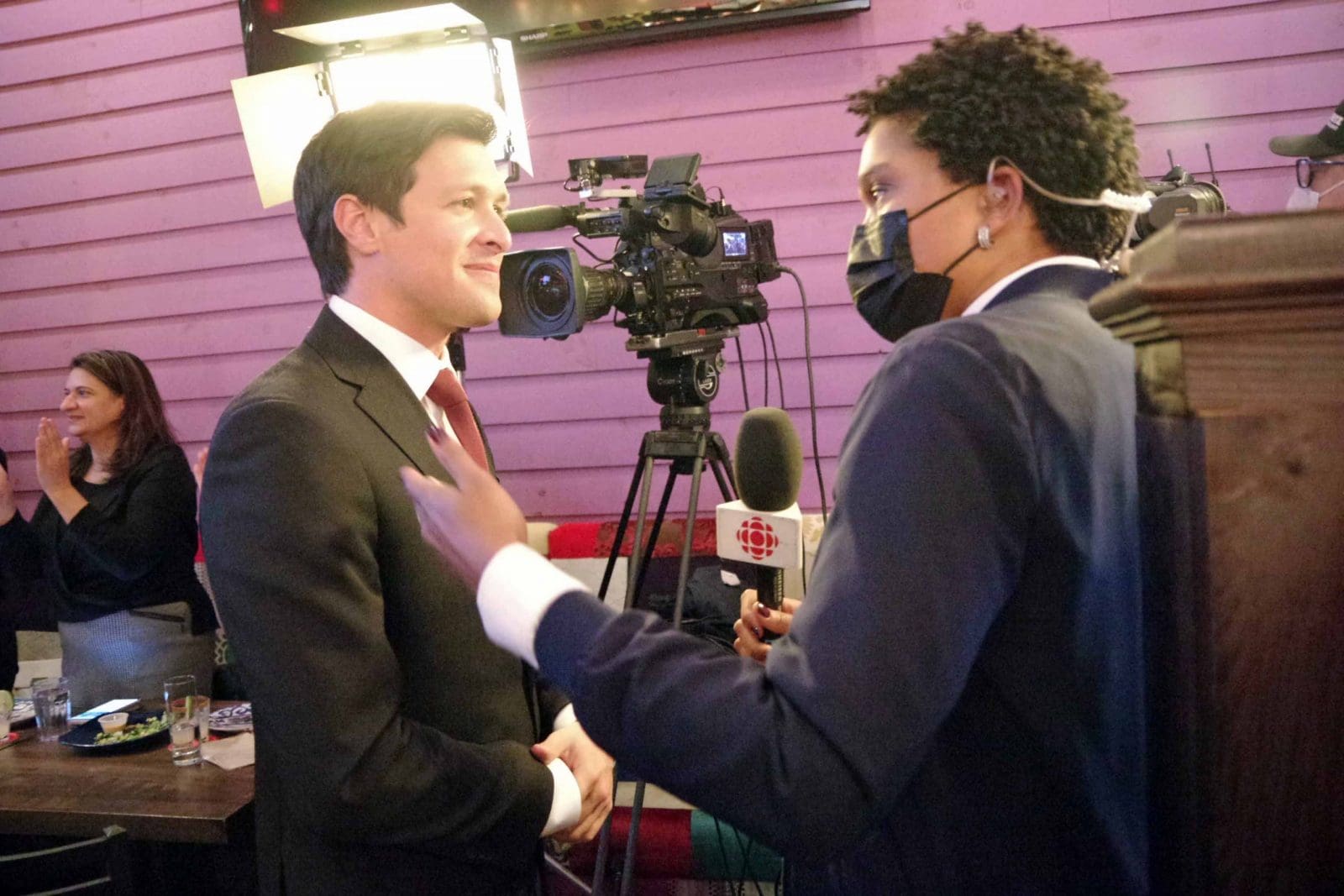
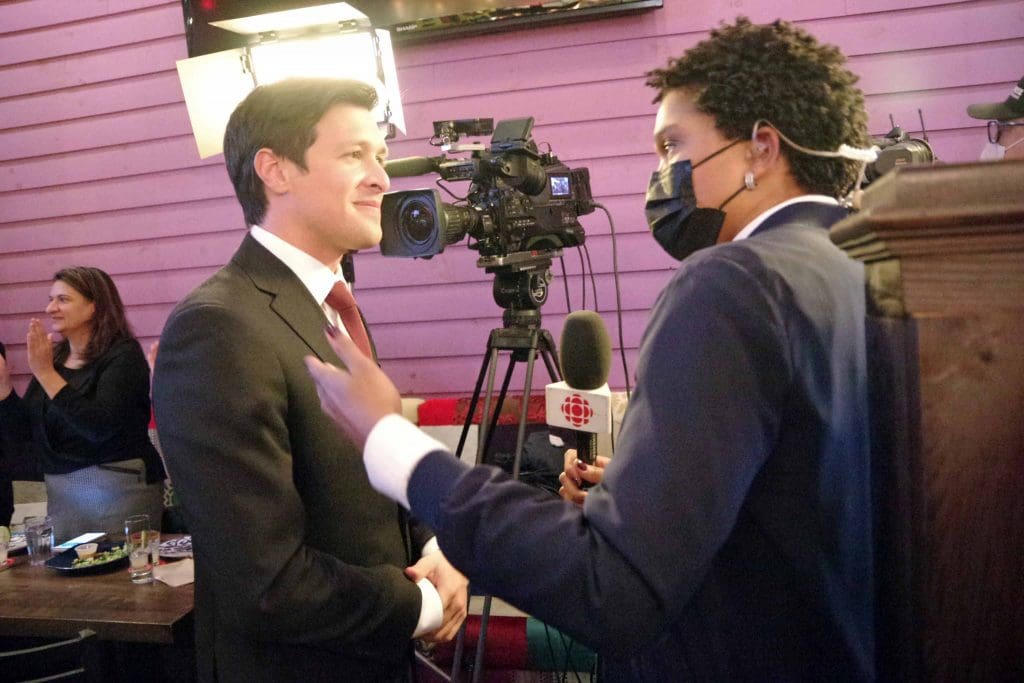
Newly-elected Laval mayor Stéphane Boyer is interviewed for television at Carlo & Pepe’s last Sunday evening. (Photos: Martin C. Barry, Newsfirst Multimedia)
Boyer decisively elected
About one thing there was no uncertainty: Stéphane Boyer clearly won the mayoralty race for the Mouvement lavallois, receiving 41.53 per cent support from the City of Laval’s voters.
However, a district-by-district vote count on Monday showed the Parti Laval and Action Laval less than 900 votes apart in overall support, with the former favoured to become the official opposition after having served in that role for the past four years.
The new council seat count
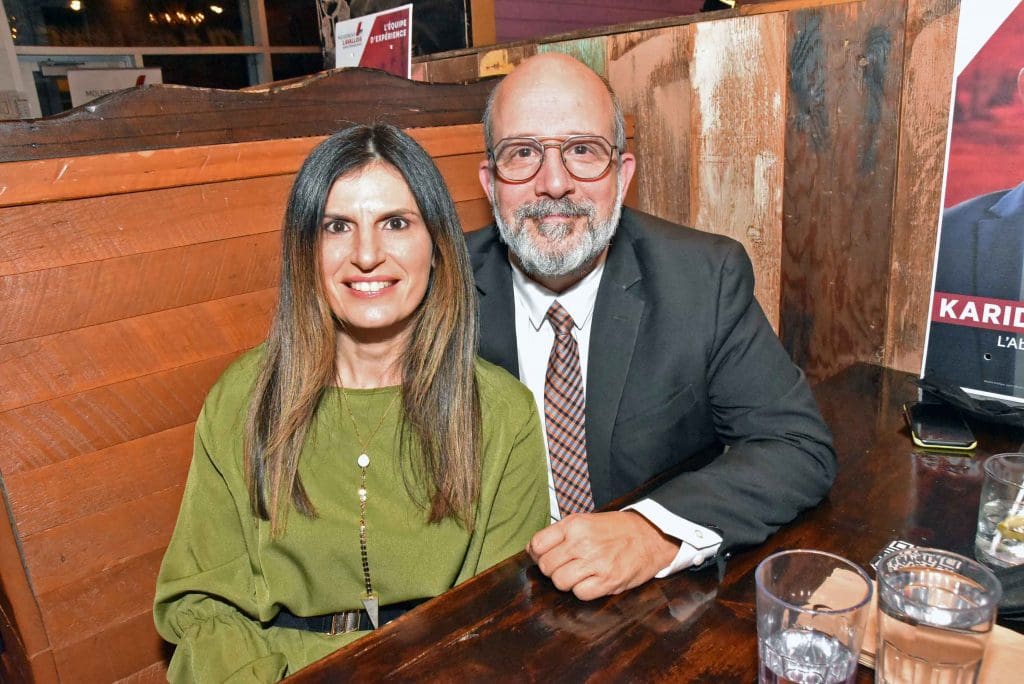
Re-elected ML L’Abord-à-Plouffe city councillor Vasilios Karidogiannis is seen here with his spouse last Sunday evening.
As the dust settled, the new seat count in Laval city council showed the Mouvement lavallois having won 14 districts, Action Laval taking five, and the Parti Laval winning two.
The five elected Action Laval city councillors are Aglaia Revelakis (Chomedey), David De Cotis (Saint-Bruno), Paolo Galati (Saint-Vincent-de-Paul), Achille ‘Archie’ Cifelli (Val-des-Arbres), and Isabelle Piché (Saint-François).
Piché is the spouse of De Cotis and their presence together on city council as part of the opposition promises to deliver some potentially-interesting “tag team” dynamics.
A sixth possible seat for Action Laval was the district of Renaud, where AL candidate Grace Ghazal and the Mouvement lavallois’s Seta Topouzian were separated by just 23 votes.
Two seats for Parti Laval
Incumbent Parti Laval city councillor for Fabreville Claude Larochelle was confirmed the winner in his district with 48.11 per cent support.
Former francophone school board president Louise Lortie won a second city district for the Parti Laval in Marc-Aurèle-Fortin, taking over the seat vacated by Michel Trottier who was the party’s unsuccessful mayoralty candidate.
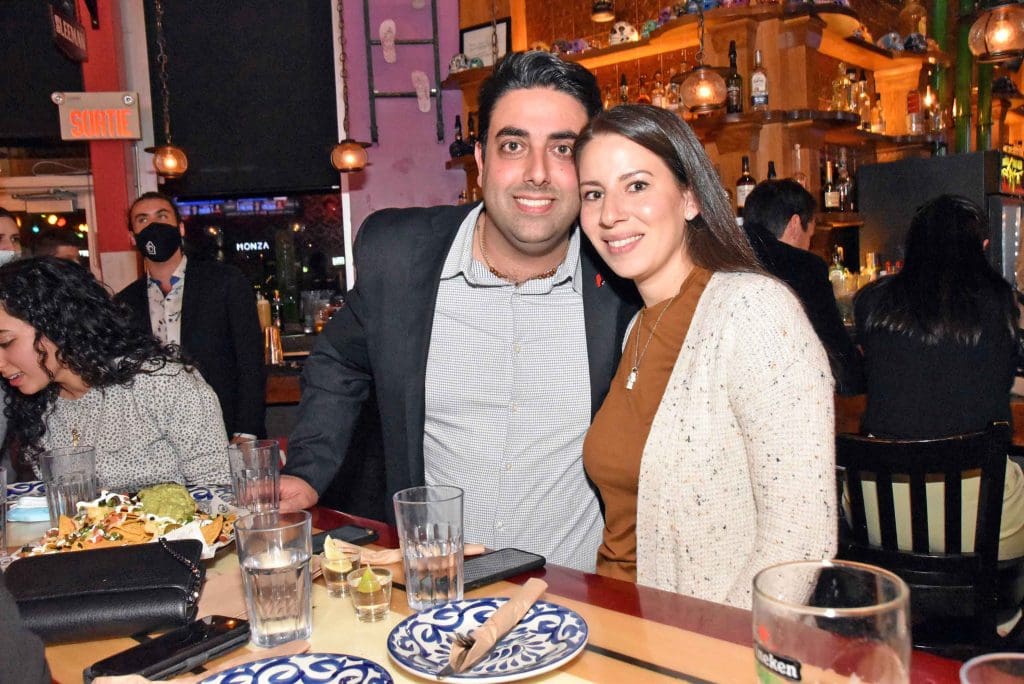
Re-elected ML Sainte-Dorothée city councillor Ray Khalil is seen here with his spouse last Sunday evening.
In an interview with the Laval News inside the Mouvement lavallois’s chosen election night venue in Carlo & Pepe’s at the Centropolis, mayor-elect Stéphane Boyer said he was “very proud of the results tonight. We see it as a vote of confidence in the Mouvement lavallois for the good work we’ve done for the last few years. We’re very happy to see these results tonight and we’d like to thank all the population.”
Boyer to follow through on pledges
While Boyer said the new administration will be following through on its platform commitments, including new sports infrastructure, and the purchase of additional forestlands and green spaces, “I also want to have a bigger focus on housing to make sure that we have affordable housing for everyone,” he added, noting that his administration would also like to improve security in all the districts with a greater police presence and increased enforcement of traffic regulations near schools.
Regarding the Aquatic Complex project to be built next to the Cosmodôme, the new mayor said the project has been submitted to a second round of tendering for bids, and envelopes containing offers from contractors “should be opened in the coming weeks. We absolutely want to move forward with this project.”
AL leader’s future uncertain
At Action Laval headquarters on Saint Martin Blvd. near de l’Avenir, the mood was more subdued last Sunday evening. In an interview with the Laval News, party leader and mayoralty candidate Sophie Trottier, who finished the race with 24.16 per cent support (one percentage point behind the Parti Laval’s Michel Trottier), was uncertain about her future.
Left, defeated Action Laval mayoralty candidate Sophie Trottier is greeted by a supporter at party HQ on Saint-Martin Blvd. last Sunday evening.
“Right now, honestly, we’re going to need to sit down and talk about the options,” she said, referring to the party membership.
(Following Action Laval’s poor results after the 2013 election, party founder and mayoralty candidate Jean-Claude Gobé gradually receded from public consciousness).
“I never abandon people in life,” said Trottier. “What’s going to be my role exactly? We’ll see. But when the time comes, we’ll be making an official statement.”
Gains a third term, while outdistancing nearest rival by nearly 30 percentage points
If there is one thing that has been consistent about Action Laval since the municipal party’s inception eight years ago, it is Chomedey city councillor Aglaia Revelakis’s ability to win the district’s Laval city council seat from the very beginning and with overwhelming support.
Won 52.19 % support
Last Sunday’s municipal elections were no exception. Revelakis, who just finished her second term, handily won Chomedey for Action Laval/Team Sophie Trottier with 52.19 per cent support.
She left her closest rivals, Omar Waedh of the Mouvement lavallois and Evangelia Tsakiris of the Parti Laval, far behind with just 22.68 and 21.55 per cent respectively each.
Surrounded by enthusiastic supporters at her Favreau St. campaign headquarters last Sunday evening, re-elected Action Laval city councillor for Chomedey Aglaia Revelakis (centre) won the district with more than 52 per cent voter support. (Photo: Martin C. Barry, Newsfirst Multimedia)
Marie-Josée Duval of Laval Citoyens/Équipe Michel Poissant obtained a little more than 3.5 per cent support, laying to rest fears a week before the election that a misprint on the Chomedey voter information card, misidentifying Duval as running for Action Laval, might give her an edge at Revelakis’s expense.
Tireless campaign work
Revelakis was surrounded by volunteers and friends at her campaign headquarters on Favreau St. on election night last Sunday as the returns came in. Even though it was her third straight win, she and her team had worked tirelessly on a door-to-door canvassing campaign over the previous weeks, knowing that no election is ever really easily won.
‘This is the district that pulls Action Laval up’
“I’m excited, but I’ve gotta tell you something,” Gus Milonopoulos, a Revelakis supporter from the start, told the Laval News. “She had supporters, phone callers, errand runners, drivers, you name it.”
An anchor for Action Laval
In an interview last Sunday evening, Revelakis acknowledged that her dominance of Chomedey in every election since 2013 has helped to anchor Action Laval and kept the party viable as a political force, regardless of what happens to their fortunes in the city’s other districts.
“This is the district that pulls Action Laval up,” she said. “I want to thank my team. I had an incredible team behind me. We did all that we had to do in order for us to win. And without my volunteers, I would not have been able to do this. One person could never do this.
Re-elected Chomedey city councillor Aglaia Revelakis (top left) is seen here with supporters watching and commenting on the results as they come in on the City of Laval’s election returns website. (Photo: Martin C. Barry, Newsfirst Multimedia)
Getting out the vote
“There has been army of people here today helping from 10 o’clock to eight this evening, making calls, trying to get out the vote,” she continued. “I have been doing continuous door-to-door for five, six hours a day to make sure that I met every single person in my district to ask them for their support.
“So, I would like to thank everybody who has been given me the opportunity to be here and represent Chomedey. Chomedey is always going to be my priority. I love Chomedey and have been living here for more than 30 years.”
But country ranks near bottom for number of doctors, hospital beds, MRIs and wait times
Despite spending more on health care than most other developed countries with universal health care coverage, Canada has some of the lowest numbers of doctors, hospital beds, and medical technologies and the longest wait times, concludes a new study released this month by an independent Canadian public policy think-tank.
We rank 21st out of 24
Among other things, the Fraser Instituite researchers found that Canada ranked 21st (out of 24) for the number of Magnetic Resonance Imaging (MRI) machines, with 10.5 MRIs per million people, and 22nd (out of 26) for CT scanners, with 15.2 scanners per million people.
Among the 10 comparable universal health-care countries that measure wait times, the study found Canada ranked last with the lowest percentage (38 per cent) of patients who waited four weeks or less to see a specialist, and the lowest percentage of patients (62 per cent) who waited four months or less for elective surgery.
‘A clear imbalance’
“There is a clear imbalance between the high cost of Canada’s health-care system and the value Canadians receive in terms of availability of resources and timely access to care,” said Bacchus Barua, Director of health policy studies at the Vancouver-based institute.
With policy analyst Mackenzie Moir, he co-authored ‘Comparing Performance of Universal Health Care Countries 2021,’which was published by the Fraser Institute on Nov. 2.
“Canada’s relative lack of critical resources and struggle with long wait times for treatment precede the COVID-19 pandemic,” said Moir. “To improve Canada’s health-care system in the post-pandemic world, policymakers should learn from other successful universal health-care countries, for the benefit of Canadians and their families.”
Health systems compared
The study compared 28 universal health-care systems in developed countries, spotlighting several key areas including cost, availability and use of resources, access to care, clinical performance and quality, and the health of Canadians.
In 2019, the latest year of comparable data, Canada’s health-care spending as a share of GDP (11.3 per cent) ranked second highest (after adjusting for population age) behind only Switzerland.
But despite Canada’s high level of spending, availability and access to medical resources is generally worse than in comparable countries (its performance in terms of utilization and quality is mixed).
We rank 26th of 28 for doctors
For example, (out of 28 countries) Canada ranks 26th for the number of doctors (2.8 per 1,000 people), 25th (out of 26 countries) for the number of hospital beds (2.0 per 1,000 people), and 24th (out of 28 countries) for the number of psychiatric beds (0.37 per 1,000 people).
The study used a “value for money approach” to compare the cost and performance of 28 universal health-care systems in high-income countries. The level of health-care expenditure was measured using two indicators, while the performance of each country’s health-care system was measured using 40 indicators representing four broad categories: availability of resources, use of resources, access to resources, and quality and clinical performance.
Second highest for costs
“Canada spends more on health care than the majority of high-income OECD countries with universal health-care systems,” the study’s authors wrote in an executive summary. “After adjustment for ‘age,’ the percentage of the population over 65, it ranks second highest for expenditure on health care as a percentage of GDP and eighth highest for health-care expenditure per capita.”
The data suggested that Canada has substantially fewer human and capital medical resources than many peer jurisdictions that spend comparable amounts of money on health care. They said that after adjustment for age, the country has “significantly fewer physicians, acute-care beds, and psychiatric beds per capita compared to the average of OECD countries included in the study.”
Performance below average
They said the country ranks close to the average for nurses and ranked eighth for the number of long-term care beds (per 1,000 over the age of 65). While Canada has the third most Gamma cameras (per million population, age-adjusted), they found it has fewer other medical technologies than the average high-income OECD country with universal health care for which comparable inventory data are available.
“Although Canada ranks among the most expensive universal-access health-care systems in the OECD, its performance for availability and access to resources is generally below that of the average OECD country, while its performance for use of resources and quality and clinical performance is mixed,” wrote Moir and Barua.
The City of Laval announced last week that it is awarding more than $394,000 in subsidies to several community sports and leisure activities organizations in order to encourage physical fitness and artistic ventures among the region’s young people.
The organizations receiving the funds – Sports Laval, the Club cycliste Espoirs Laval, the Club de Football Bulldogs de Laval and the Théâtre Fêlé – will be sharing the sums which are coming out of the city-administered Fonds Place-du-Souvenir.
According to the city, the subsidies will be helping children and teenagers from disadvantaged households by allowing them to develop sports skills, to take up bicycling, and to play football, while attending school and taking part at the same time in creative activities.
In all, $88,260 over two years is being given to Sports Laval for its Ini-Sports project, which offers children ages 7 to 12 from disadvantaged households the possibility of discovering new sports disciplines while developing themselves physically. Lasting nine weeks in three weekly cycles, the project aims to incite youths to pursue sports.
As well, the Club cycliste Espoirs Laval will be receiving $53,435 over a one-year period to support its project, known as Ça roule Laval, to assist young residents also from disadvantaged households to take up cycling. According to the city, 500 youngsters ages 4 to 12 will receive equipment kits containing materials to be creative.
Meanwhile, the Club de Football Bulldogs de Laval will be receiving $88,000 over a two-year period for its project, Plan PSO2025 Football Bantam-Midget. The goal of the project is to encourage access to football for 100 youths ages 13 to 17 who are in vulnerable situations in the districts of Chomedey, Pont-Viau and Saint-François, with a leadership program designed to help with homework.
Finally, the amount of $165,000 over a three-year period was awarded to Théâtre Fêlé to allow for the support of their Q.G. Chomedey project, which seeks to offer help for juvenile delinquincy in the district through artistic creation for youths ages 12 to 17.
The Fonds Place-du-Souvenir was created on June 19, 2017 to:
Directly reach children and youths ages 0 to 17 who are from disadvantaged neighbourhoods and households in order to improve their lives;
Improve the quality of life of young Laval residents;
Be a lever for intervention in social development terms for youths across Laval;
Be a coherent part of the City of Laval long-range development policy, Laval 2035 : urbaine by nature, as well as the regional social-development plan (PRDS) for Laval.
STL receives coveted award for management excellence
The Société de transport de Laval was recently awarded the Canada Prize for Excellence-Platinum, for its excellence in overall management.
The distinction, regarded as one of the highest in the public transit sector, recognized the STL for the quality of its management and its overall performance.
STL general manager Guy Picard, along with STL president Éric Morasse accepted the award on Nov. 4.
“It is is a genuine pleasure for us to realize that our determined will to evolve and improve continuously has been recognized and that we are receiving today this prestigious prize,” said Morasse.
“Rigorous management and performance are exercised in all our organizational and we are proud to be able to harvest the fruit of all these efforts today.” “We believe in ourselves,” added Picard. “Being at the controls of an organization as innovative and motivated towards excellence is for me a great source of pride. The STL would not be what it is without the support of its 1,100 or so employees and its 9 directors on the administrative board, who have a common passion to see big while working for the common good.”