Families enjoyed a respite from the weather at the Centre de la Nature
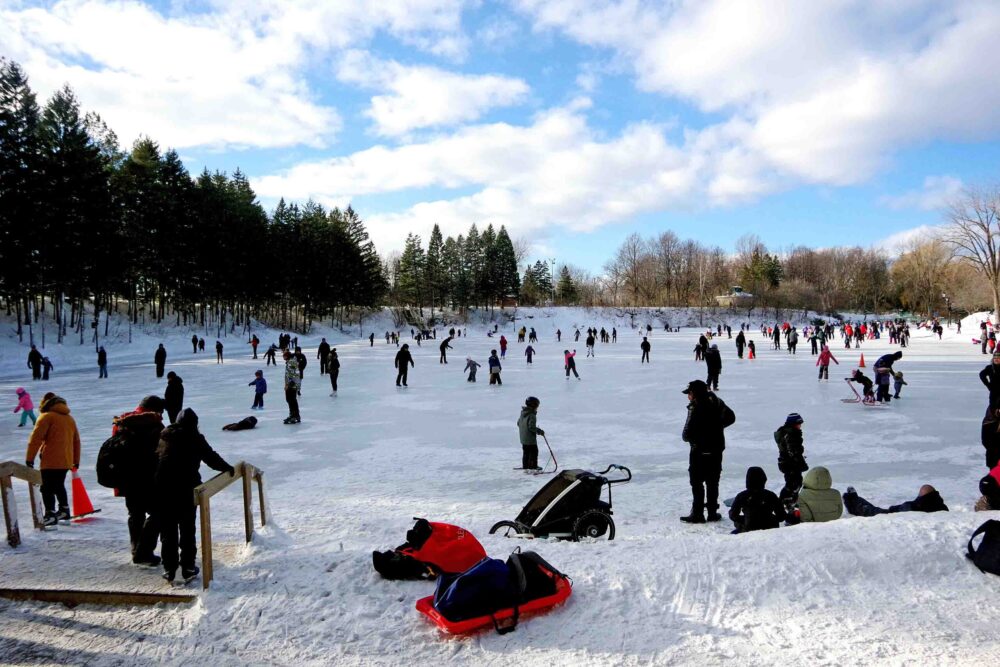
The Rubino family from Laval’s Duvernay district were among the thousands of moms, dads and children who converged on the Centre de la Nature on the weekend of January 24-25-26 for the city’s Laval en Blanc winter carnival.
As it turned out, Sunday, the final day, was also the best, with bright sun and a moderate coolness just on the edge of warmth under the gentle mid-day sunlight.
The Rubino family from Laval’s Duvernay district enjoyed a mid-winter day in the sun at the Centre de la Nature during the city’s Laval en Blanc festival. (Photo: Martin C. Barry, Laval News)
“We try to get to different events throughout the year,” said the family’s father, adding that they find it pleasant and convenient to have access so close to home to a large green space like the Centre de la Nature, where they can get out and enjoy the fresh air while also getting some exercise.
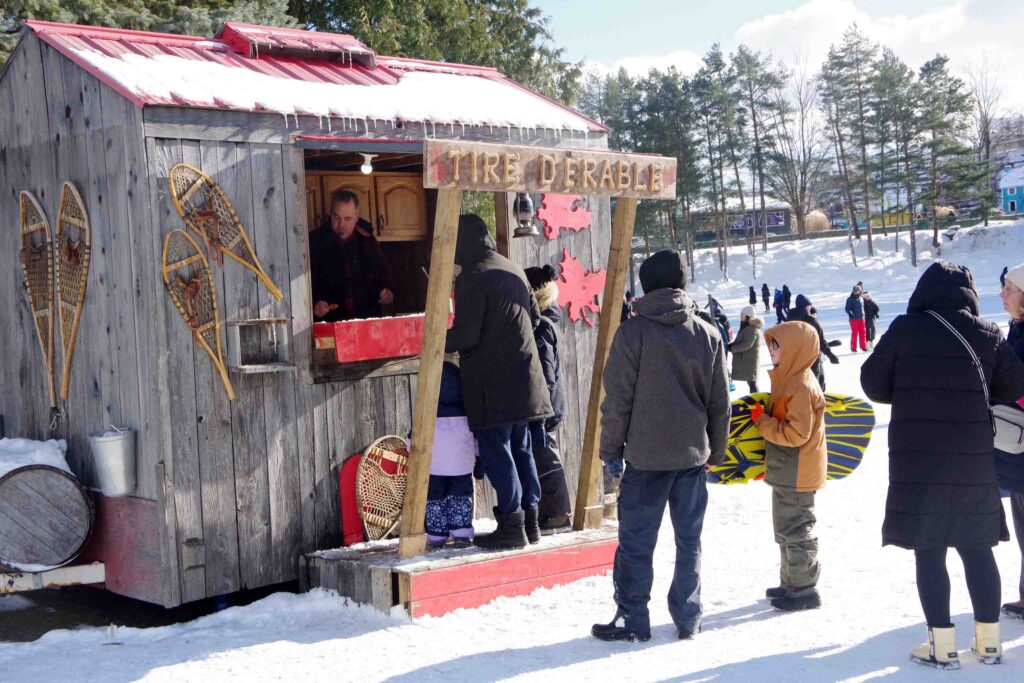
Nothing hits the spot on a cold January weekend at the Centre de la Nature like maple taffy on snow. (Photo: Martin C. Barry, Laval News)
Fun for everyone
There was snow sledding, ice skating, zip line riding, fireworks, obstacle course racing, snow sculpting, even some musical performances to be enjoyed by kids and their families in warmth inside a pavilion.
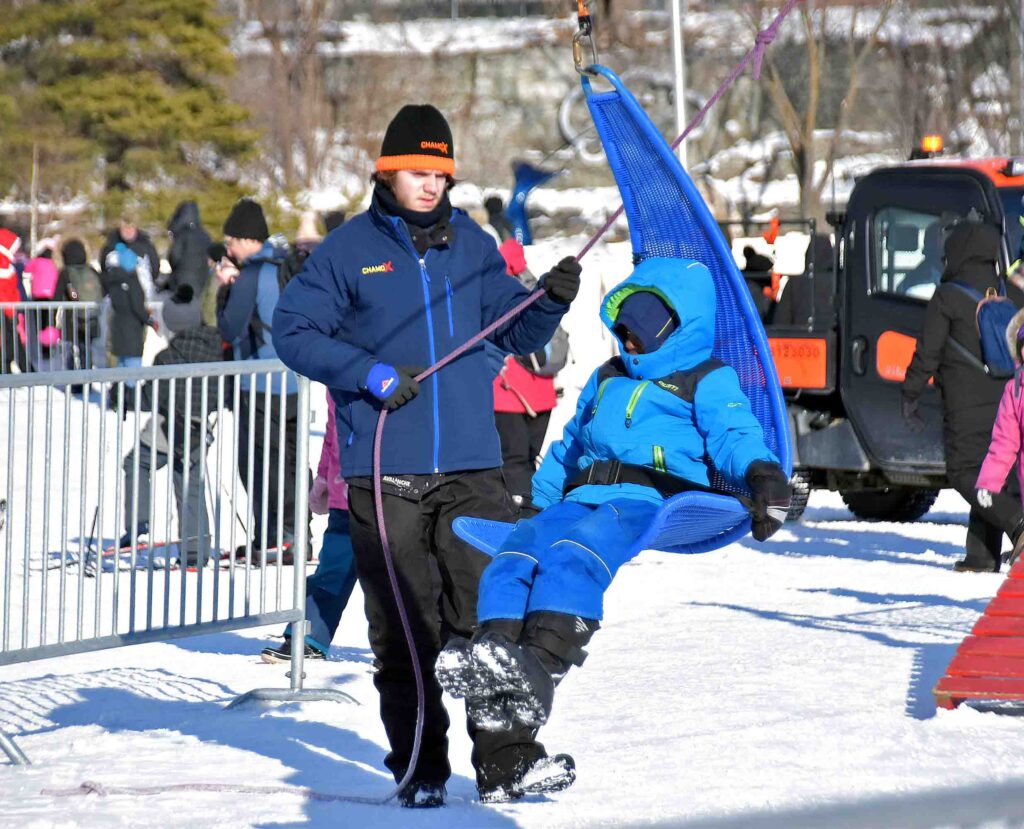
The Zip Line proved to be a popular with kids as ever during this year’s Laval en Blanc. (Photo: Martin C. Barry, Laval News)
For some, the idea of having fun outdoors during the winter, in temperatures hovering around zero degrees Celsius, is a novel concept and a discovery in itself – although it’s the very reason Laval en Blanc is organized each year by the City of Laval.
One of the many fun outdoor activities that kids and adults indulged themselves in at the 2025 Laval en Blanc.supporters of Les Jeux de la francophonie canadienne were on hand at Laval en Blanc to promote the event taking place this summer from July 15 – 19.
Laval Mayor Stéphane Boyer says he’ll be seeking a second term in the November 2 municipal elections, in spite of the fact he’s facing a health issue which is impacting the quality of his life.
Boyer, who became Laval’s youngest elected mayor in 2021 at the age of 33, made the announcement last week.
Spinal cord arthritis
The 37-year-old told journalists with several media that he was diagnosed more than a decade ago with ankylosing spondylitis, a type of arthritis that affects the spinal cord.
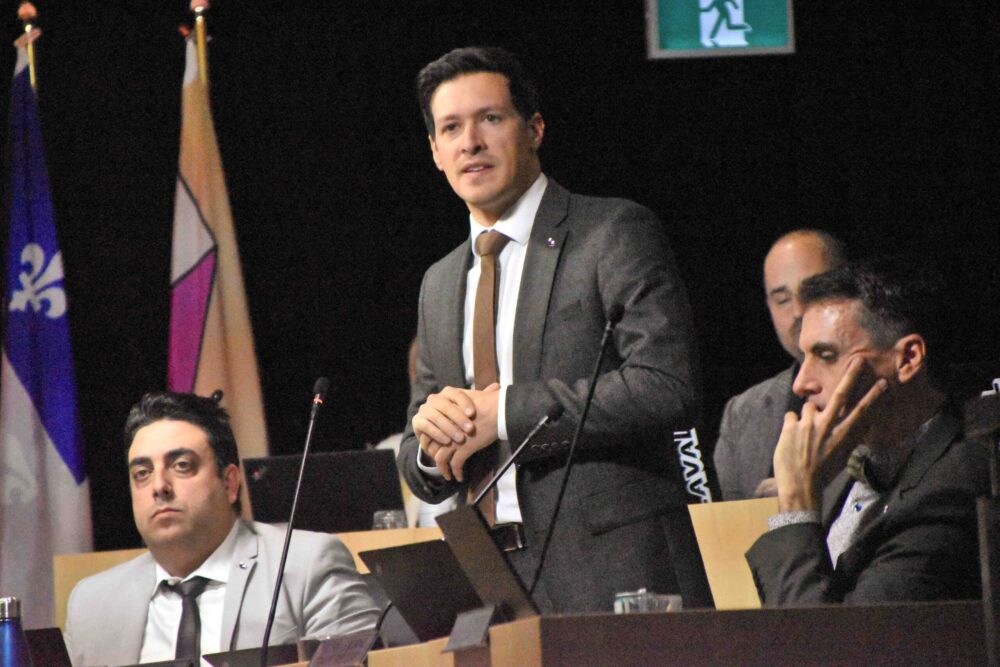
Laval mayor Stéphane Boyer (seen here during the January 14 city council meeting) says his name will be on the ballot in the November 2 municipal elections for a second term, in spite of a health problem. (Photo: Martin C. Barry, Laval News)
The condition can make it difficult to stand or walk for long periods. It is characterized by long-term inflammation of the joints of the spine, typically where the spine joins the pelvis.
He said wanted to go public about it in case anyone began to notice the symptoms. According to Boyer, it took two years for him to obtain a diagnosis for a disease he said he will have for the rest of his life.
Campaigning started
In interviews with journalists since making the announcement, Boyer suggested that some of the issues he wants to put forward in a second term as mayor would include building another major hospital in Laval, as well as expanding higher education, and providing more assistance to the homeless.
He also expressed a desire to continue initiatives for better economic development, more housing, stronger public security, and more access in Laval to arts and culture. In addition, he said he wanted to take measures to improve overall efficiency in government.
During the January 14 Laval city council meeting, officials with the city announced the release of the new Action Plan for Security and Collective Well-Being for the years 2024-2026. It was developed in partnership with a number of institutions and community groups in the region.
The plan is a more detailed version of a strategic plan for security and well-being, which was adopted by city council last June. The plan provides a framework for the City of Laval to be able to take means to deal with juvenile delinquency and violence among youths aged between 12 and 35 years.
“This action plan is the end-result of a collective and coordinated effort, denoting the City of Laval’s and its partners’ willingness to act on the issues involving juvenile delinquency and security,” said Mayor Stéphane Boyer.
(Photo: Courtesy of City of Laval)
A collective effort
“By uniting our strengths while working together, we will be able to achieve concrete results that will make a significant impact in matters of prevention. I am proud of this action plan, which aims to make our neighborhoods safer, while allowing us to invest in the future of our youths and their families.”
The project, developed through the co-leadership of the City of Laval’s culture, leisure, sports and social development service and the Laval Police Dept. (SPL), outlines measures to be implemented by the city and its partners.
According to the city, the measures were developed following multiple meetings and workshops held with program partners in the community. The city relied on the partners’ expertise in working with youths over many years to identify what actions might be necessary to accomplish goals.
Measures to be taken
In all, 45 measures are decreed in the new plan, taking into account emerging issues. They include:
Acting preventively, by advising youths and their families beforehand on issues linked to cyberspace, like online harassment and intimidation.
Providing support for programs and initiatives working towards reducing polarization and radicalization.
Providing youths with opportunities to learn more about themselves through cultural and artistic workshops in things like hip-hop music, as well as literary projects.
In addition to investments by the City of Laval, the Quebec Ministry of Public Security invested $4.6 million in the plan. As well, the federal government and the government of Quebec also provided financial support through a mutual program whose purpose is to help build more secure communities.
Canada has been acting like a poor country for the last ten years. It’s not an accident that we have been led by a government that has wanted Canadians to think small.
Members of cabinet and would-be leaders are disciples, in fact, some are board members of the World Economic Forum. The WEF used to be an impartial international think tank but has veered extremely left. Today, some call it “the mafia elite of the super-rich.” Its credo is a world without borders. Picture the former Soviet Union. The purpose is not the creation of wealth but its redistribution. Canadian Armed Forces Lt-Col David Redman sounds the alarm when he says “Canada finds itself in a far worse situation across all areas of national security than we did in 2015, with the purpose of destroying and dissolving our Canadian identity.” The retired Redman says it’s not by accident that government has allowed China to infiltrate and influence our three governing levels.
There is no one to thank more for this catastrophic erosion in our pride and identity than this most divisive federal government. It was the newly elected prime minister who declared that Canada is not a sovereign country. It was a stunning statement to the New York Times in 2015, but in line with his beliefs and those of the World Economic Forum. He said, “there is no core identity, no mainstream in Canada. We are a post national state.” No premier, no other Canadian leader stood and spoke against this treasonous verbiage. Perhaps we were too enamoured and blinded by the young man with different hair styles every six months, flashing his family brand while fresh off a winning knockout punch in the boxing ring. Our judgment became clouded enough to not realize the 2015 election results were going to lead us to a social, political, and economical quagmire. We are now only individuals, living in different geographical regions, from Newfoundland to British Columbia. The east was told to hate Alberta, despite it being Canada’s biggest revenue generator. It is the ‘have province” that finances Québec’s social programs and sustains our medical system in Canada. It is the province that produces the largest percentage of Canada’s exports. Shouldn’t we be thankful and grateful that Alberta is part of our Confederation?
Despite our love and dedication, Canada means little or nothing to many of us anymore. We sing our National Anthem before hockey games with no emotion nor conviction. Yes, at least men remove their caps for the national anthem, but only because long time and revered Habs announcer Michel Lacroix says so. The only other time is when Ginette Reno leads us into belting out O Canada at The Bell. Otherwise, we may as well be lip-syncing. We allow our Canadian maple leaf flag, that we once saluted and honoured, to be burned and ripped apart on our streets by terrorists, while police stand by and never make an arrest. We glorify terrorists who destroy our flag! Canada’s kindness is no excuse to break our laws. We offer a beacon of hope to the world, but we have permitted and tolerated the importation of international conflicts to our streets.
Never have I come close to even dreaming of this happening in my country. For the last ten years Canadians have been told that we should be ashamed because of how bad and evil history has shown us to be. No one in that government at any time, has given Canadians any reason to feel proud of who we are. Yet we have so much to be thankful and proud of in wearing our maple leaf.
The federal Liberal government has allowed repeat criminals, who laugh at our justice system and smirk in triumph at police as they are released the day after being arrested. Not once, but it happens time after time after time. Canada’s crime rate is 14% higher than the United States (Fraser Institute).
Chronic repeat offenders have to be left in prison. As citizens of this country, we need to be protected from repeat offenders, knife wielding sidewalk terrorists, gun totting car jackers, home invaders, and gang warfare where innocent bystanders are shot or injured. This is what Canada has become.
We have allowed border free entry not only to illegal migrants but to banned guns and deadly drugs. More fatal drugs, especially fentanyl, are allowed into this country as never before. Over 49 thousand Canadians have died of opioid related deaths in the last ten years, according to Canada.ca. Let that sink in. While refusing to accept diversity of opinion, this government trumpets diversity as the strength of Canada. In fact, allowing diversity to flood this country has meant the importation of every worldly ethnic conflict, and the disappearance of our values.
So, who will lead us back to the country we once loved and cherished? Who will secure our borders not because an American president tells us to but because we are proud Canadians who want to protect our traditions, principles, and sovereignty? Who will insist on a code of conduct before becoming a resident of this country, making it illegal to disrespect and not abide by our values and customs? The possibility of deportation should be an inevitable consequence of unlawful behavior. Destroying or stomping on the Canadian flag should be a punishable offence. Who will stop Chinese, Russian, and Indian interference in our democratic system in municipal provincial and federal governments? Who will stand at the laboratory door and filter those who participate in our research and development?
Before we vote, Canadians must tolerate another demonstration of political arrogance, a leadership convention. Instead, an election should have been called on January 7th.
But for now, put aside the political bravado of a tariff war and fix our border. Tariffs should get us thinking differently.
We are so anxious and ready to elect true leadership when it is needed more than ever.
Maintains dental coverage and affordable housing are threatened by Conservatives
With the prospect of an early federal election more certain by the week, Jean-Yves Duclos, Minister of Public Services in the outgoing Trudeau cabinet, is warning that a Conservative government under Pierre Poilièvre would almost certainly make deep cuts to programs introduced by the Liberals in the past nine years – including national dental care and access to affordable housing.
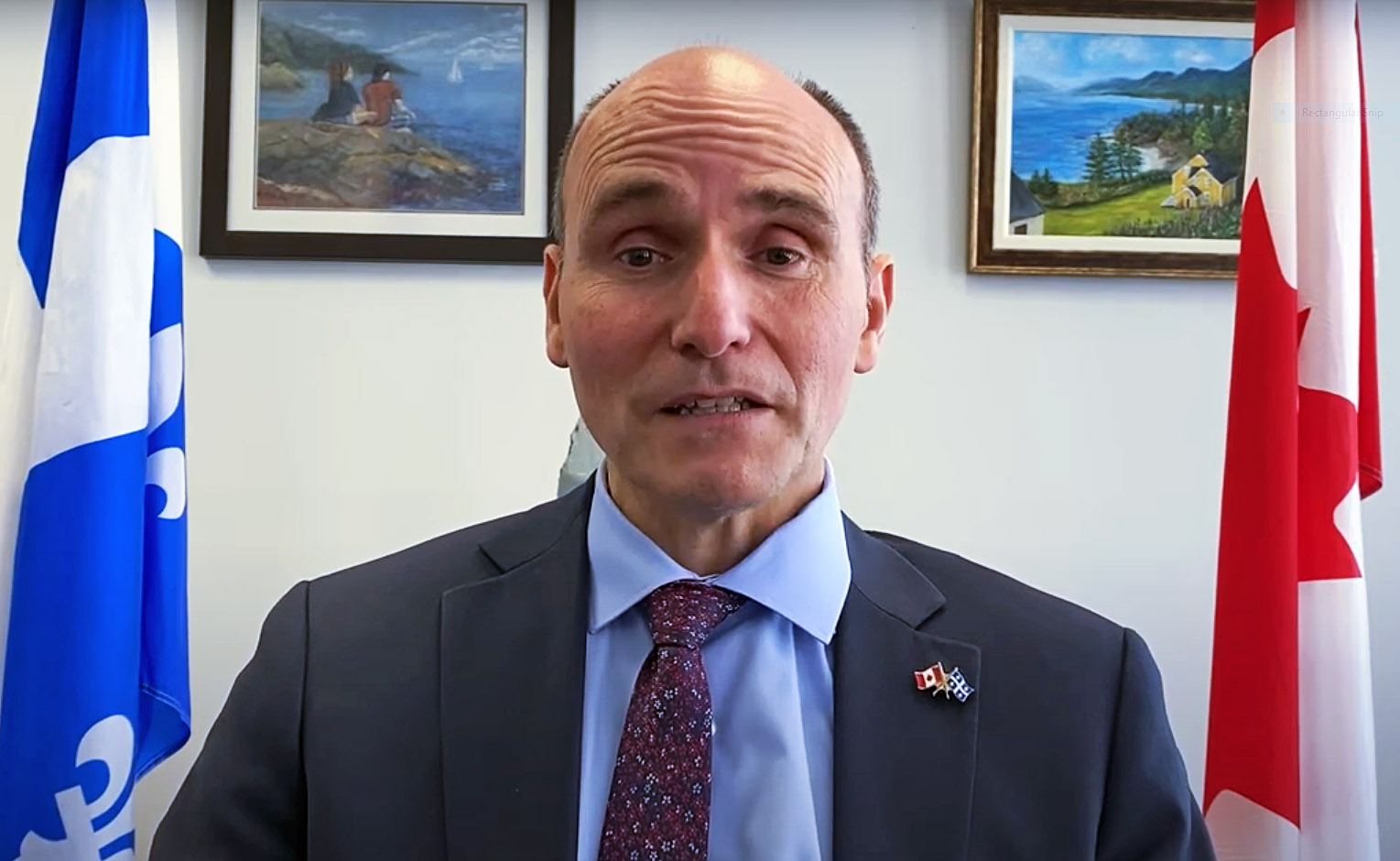
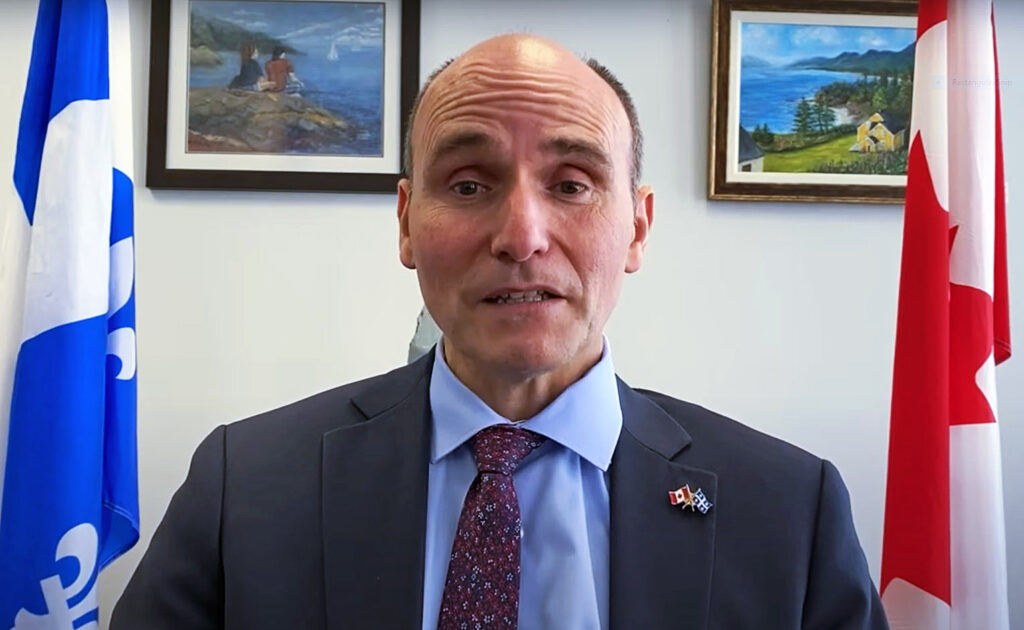
Federal cabinet minister Jean-Yves Duclos touched base with Newsfirst Multimedia on a range of pre-election issues, including national dental care, affordable housing and the Liberal government’s budget deficits. (Photo: Government of Canada via YouTube)
“Pierre Poilievre wants to take away dental coverage for millions of Canadians and leave you and your family without the health care you need and deserve,” Duclos said in an interview with Newsfirst Multimedia during a recent stop in Laval to attend a multicultural gathering.
Dental plan threatened, he says
The Liberal government’s Quebec Lieutenant said Poilièvre has gone on record several times trying to discredit the Canadian Dental Care Plan, which was adopted by the Liberals largely at the urging of the NDP minority opposition in Canada’s parliament.
“Any time someone has asked him why he is against, he has said it is because it doesn’t exist,” Duclos said, maintaining that Poilièvre, driven by right-wing ideology, has also been known to refer the dental plan as a “communist” policy.
“So, this is very strange obviously for any sensible person to understand that language,” said Duclos. “But then it’s part of the fake news argument: he pretends that people shouldn’t register because it doesn’t exist, and then because it doesn’t exist, he says we can do without it – which is obviously completely false.”
He said that, to date, more than 3.1 million dental program applications have been approved, with one million in Quebec alone. As well, he said more than 1.3 million Canadians have received dental care through the plan. “More than 95 per cent of all dentist here in Quebec have used the program,” said Duclos. “For now, it is seniors and people under the age of 18. But, in 2025, we are expected to open the program to everyone.”
Affordable housing
On affordable housing, Duclos, who was the minister responsible for the Liberal government’s first national housing strategy, maintained that since 2015 when the Trudeau government first came into office, the Liberals managed to build more than 50,000 units of affordable housing, paid for largely by the federal government.
He claimed that Pierre Poilièvre, as the cabinet minister responsible for housing in the former Harper Conservative government, “built six in total for his whole mandate across the entire country.”
On the Liberal leadership
Regarding the Liberal leadership race, Duclos declined to say whether at this point he is supporting any particular candidate.
However, an outline of his thinking on the matter, furnished to Newsfirst Multimedia by a Liberal administration staff member, noted that Duclos has “said time and time again that the next leader of the party needs to be bilingual and have the interest of all Quebecers at heart.”
Duclos acknowledged that by this definition, the field of suitably bilingual candidates becomes somewhat narrower. Of the two most prominent ones – Mark Carney and Chrystia Freeland – he noted:
“They are not perfectly bilingual, just as I am not perfectly bilingual. Perfectly bilingual Canadians are rare. But what matters is whether you are able to engage with Canadians in whatever language they use. That is absolutely essential.”
Last Friday, Duclos confirmed through a letter to Mark Carney posted on Duclos’s ‘X’ social media account that he is supporting Carney’s leadership bid.
Impact of Trump presidency
Duclos said the Liberal government had long been preparing for the eventuality that Donald Trump would be re-elected as president of the U.S. “I would say that people want to be reassured,” he said.
He said the Liberal government “started in late winter, early spring 2024, since at that time there was a high probability that President Trump would be re -elected, so it was possible. And then it became probable that he would be re-elected. So given that, we had to reactivate our engagement work in the United States.”
Dismisses deficit worries
On the country’s growing annual operating deficit – which currently stands at more than $60 billion for 2023-24, compared to $35.3 billion in 2022–23 – Duclos, who has headed the economics faculty at Laval University and has a PhD from the London School of Economics – maintained that the government’s debt is nothing to become alarmed about.
“It isn’t only the debt that matters – it’s also the size of the economy,” he said, noting that Canada’s economy has been assessed by the International Monetary Fund to be the second-fastest growing economy in 2026-27 after the U.S.
The current issue of the Laval News, volume 33-03, published on February 5th, 2025. Covering Laval local news, politics, and sports. (Click on the image to read the paper.)
On behalf of Quebec Lieutenant Governor Manon Jeannotte, Brigadier-General Stéphane Tardif had the honour of presiding over a special ceremony on the afternoon of January 29 at the Palace Convention Centre in Laval, where 63 citizens from the Greater Montreal area, including several from Laval, received the King Charles III Coronation Medal.
According to a statement issued by the Lieutenant Governor’s office, the ceremony aimed to recognize the unsung heroes of the two regions, whose contributions have made a significant impact on their community, the province, and, in some cases, on a national and international scale.
The King Charles III Coronation Medal is a special commemorative distinction designed to honour Canadians who have made significant contributions to their communities or abroad. It celebrates their achievements, dedication, and commitment to the well-being of Canadian society.
The King Charles III Coronation Medal marks a historic occasion, as it is the first Canadian commemorative medal awarded for a coronation since that of Queen Elizabeth II.
The Government of Canada will award 30,000 medals across the country to recognize significant contributions made by citizens in various fields.
The presentation of the King Charles III Coronation Medal in Quebec is part of events celebrating those who contribute, often behind the scenes, to the advancement of Canada at the local, national, and international levels.
Details of the Medal
The medal features the effigy of His Majesty King Charles III and his royal monogram and is attached to a ribbon in dark blue, bright red, and white. This ribbon is identical to that used for the Coronation Medal in the United Kingdom. The design of the medal was created by the Canadian Heraldic Authority and approved by His Majesty.
In a move they say is meant to boost trust and reinforce financial accountability, commissioners with the Sir Wilfrid Laurier School Board have unanimously adopted significant amendments to the SWLSB’s expense reimbursement policy.
The commissioners say they want to try and ensure a more transparent and accountable approach is in place for approving the chairperson’s expenses in the future.
In a statement the SWLSB released this week, the board says that under the previous policy, the director general was responsible for authorizing the chairperson’s expenses.
“However, in response to past concerns and in alignment with best governance practices, this responsibility will now fall under the oversight of the Executive Committee, along with that of the director general,” according to the SWLSB.
“This structural change aims to provide a higher level of scrutiny and ensure that all expenses align with the school board’s values of responsibility and integrity.”
“Our community deserves leadership that is not only transparent but also deeply committed to the responsible use of resources,” said James Di Sano, elected late last year as the new chairperson of the SWLSB.
“We are taking proactive measures to ensure that public funds are managed responsibly and that our leadership remains fully accountable to the stakeholders we serve.”
The board said the initiative “follows the challenges faced by the school board in the wake of the previous chairperson’s expenditures, which underscored the need for stronger financial governance.
They said the new policy “reflects a fundamental shift in the way the school board approaches financial oversight as well as a commitment to ethical leadership and responsible stewardship of taxpayer dollars.”
Key elements of the updated policy include:
Enhanced Oversight: The Executive Committee now holds full responsibility, alongside the director general, for approving the chairperson’s expenses, ensuring multi-tiered accountability. Additionally, according to the board, a resolution will be presented at the next council meeting requiring that all commissioners’ expenses be tabled at the Executive Committee, once authorized by the chairperson.
Commitment to Continuous Improvement: Ongoing reviews will be conducted to adapt to evolving governance standards.
“These changes signify more than just policy revisions; they represent a renewed commitment to ethical leadership and fiscal responsibility,” said Di Sano.
“Our focus is on ensuring that every dollar spent serves the students, families, and communities that rely on us.”
Several suspects arrested by the Sécurité du Québec in conjunction with a $1 million province-wide fraud scheme targeting senior citizens were arraigned at the Palais de Justice in Laval Wednesday.
Six out of a group of 16 suspects made court appearances in Laval as well as in Trois Rivières, according to the SQ.
All were taken in to face charges related to 250 fraud cases involving 214 victims, with an average age in the late 70s, who were fleeced out of an estimated $1 million.
The provincial police force alleges the suspects used telephone call-hosting software to modify information displayed on phone screens, while posing as familiar institutions or sometimes as police officers, in order to cheat victims out of savings.
The arrests were the culmination of an investigation, involving more than 90 police, which began in 2022.
Following a notice of a two-day strike in early February sent by Laval’s unionized blue collar workers to the city, the union has announced progress in labor agreement talks and have cancelled the planned walkout.
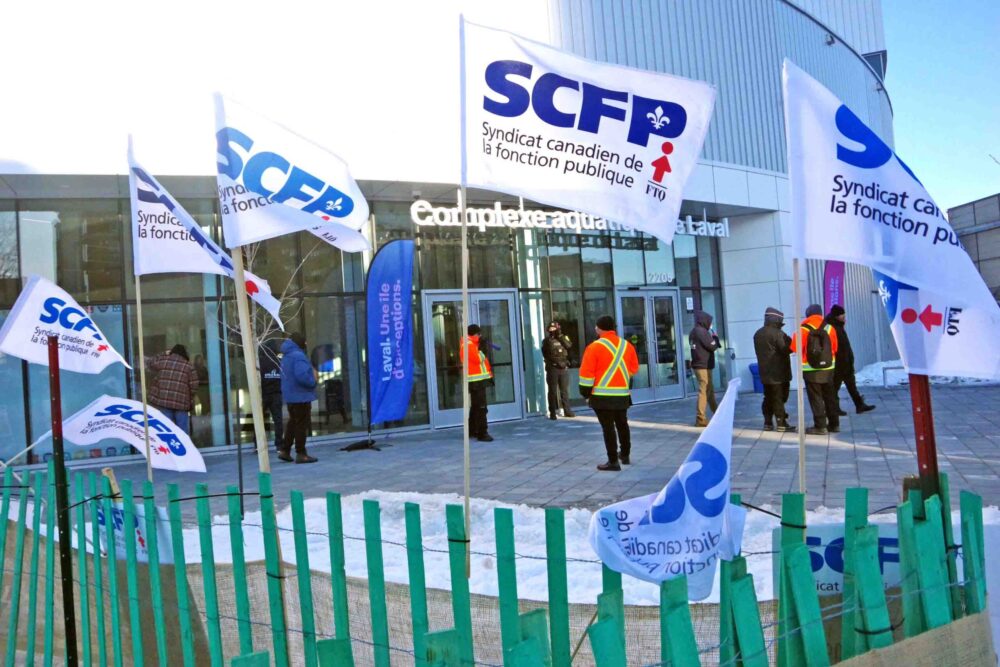
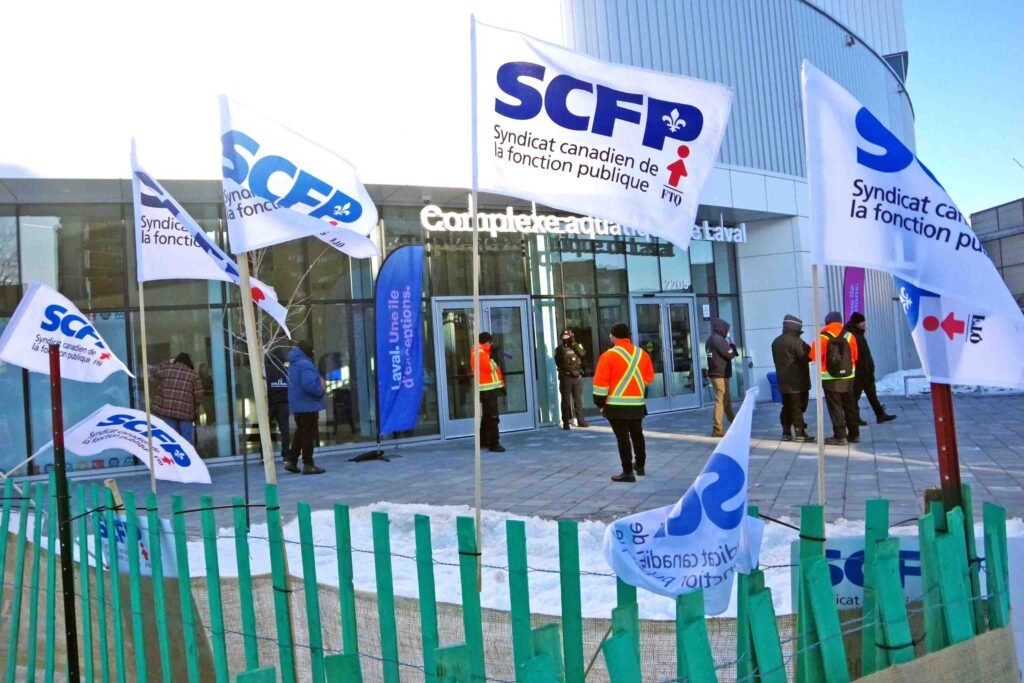
Unionized City of Laval public works employees showed their displeasure over the slowness of negotiations when they protested recently outside the opening of the City of Laval’s new Aquatics Complex.
“Negotiations with the City of Laval, which started in the spring of 2023, were proceeding too slowly,” Alexandre Prégent, a spokesman for the local chapter of the Canadian Union of Public Employees, said in a statement issued Tuesday.
“At this point, we want to focus all our efforts at the negotiations table,” he added, noting that additional meetings with City of Laval officials are planned.
He said that given the apparent progress made in negotiations, “further actions could be implemented in the coming days.”