Home Blog Page 220

Parliament enacts Canada Emergency Wage Subsidy legislation

0

Martin C. Barry

The Trudeau Liberal government’s wage subsidy legislation to counter the effects of the COVID-19 crisis moved swiftly through to passage in the House of Commons last weekend during a rare holiday session that saw MPs congratulating one another for their multi-partisan cooperation.

Help on the way

Passage of the legislation, followed by examination by the Senate and royal assent by the Governor General, cleared the way for $73 billion in immediate assistance to companies, families and individuals across Canada whose livelihoods remain seriously disrupted by COVID-19.

Although the Conservatives still had issues with the way the wage subsidy will be implemented, they agreed to allow the legislation to be passed anyway so that the recovery could get underway.

A war-like situation

In a speech to the relatively small gathering of MPs who were called together for the historic parliamentary sitting, Prime Minister Justin Trudeau compared the situation Canada now finds itself in to a war, with the enemy being a virus that is spreading everywhere silently.

“Without reservation, without pause, we must fight for every inch of ground against this disease,” said Trudeau. “We must be there for one another as we spare no effort to safeguard our collective future.”

$73 billion in aid expected to start flowing to businesses and citizens

Trudeau alluded to the battle of Vimy Ridge while speaking about the current battle being waged in Canada and around the world against COVID-19. During his address, the prime minister noted that the Canada Emergency Wage Subsidy is the “largest Canadian economic policy” since World War II.

Like Vimy Ridge

“As our generation faces its greatest challenge yet, we all stand on the shoulders of those who came before us and saw our nation through difficult, tumultuous times in our history,” he said. “One hundred and three years ago today, young Canadian soldiers found themselves in the trenches in France. The next day they took part in the final battle for Vimy Ridge.”

“On the eve of this somber anniversary we remember their courage and sacrifice. These were trials that shaped our country, and more, its citizens, and now, once again, we are being tried. Every one of us has role to play in shielding our country from the threat it now faces.

‘Modern day heroes’

“And while the battle against COVID-19 isn’t a war in the traditional sense of the word, that doesn’t make this fight any less destructive, any less dangerous,” Trudeau added. Instead, “the frontline is everywhere; our homes, hospitals, care centres, grocery stores, pharmacies and gas stations,” he continued, calling the people who work in these places “modern day heroes.”

‘While the battle against COVID-19 isn’t a war in the traditional sense of the word, that doesn’t make this fight any less destructive,’ said Trudeau

The workers, he said, “are separated from their family, and risking their own health, they head to work every day so that we can eat, heal, and do our part.”

In hard times, said Trudeau, “courage and strength are not defined but what we say or do loudly in public, but by the actions we take quietly in private, like staying home. Even as we stand apart, we stand united in our resolve to do what we must until COVID-19 is defeated.”

CEWS program enacted

The bill puts into place the CEWS, whose purpose is to encourage companies to rehire workers by offering a 75 per cent wage subsidy over the next three months to businesses that have lost 30 per cent of their revenue as a result of the crisis. Finance Minister Bill Morneau said businesses that qualify for the subsidy should start receiving money within a few weeks.

Among the Conservatives’ suggestions for future amendments to the new law would be to reduce eligibility hurdles that still stand in the way of some businesses receiving the subsidy. The NDP and the Bloc Québécois also agreed to fast-track the bill in exchange for consideration of their ideas for eventual changes.

Bill gained NDP support

NDP leader Jagmeet Singh said his party supported the legislation necessary for the subsidy to become a reality. He said that his calls to improve access to the Canada Emergency Response Benefit were reflected in the bill that ended up being tabled by the Liberal government.

Canadian Prime Minister Justin Trudeau.

Bloc Québécois leader Yves-François Blanchet said that the bill included “some very good things” for workers. In a letter to the prime minister, he wrote that he welcomed several aspects of the legislation, but noted that it did not include support for businesses struggling with operational costs.

Blanchet said that Finance Minister Morneau had acknowledged those concerns. However, he also expressed concern that temporary foreign workers arriving in Canada were not being tested for COVID-19.

MPs dealing with COVID

In Laval, two local MPs have been dealing with the impact of the COVID-19 crisis on a personal level. Laval-Les Îles Liberal MP suggested constituents continue to stock up on food and other necessities for up to two weeks at a time.

“If you go out, don’t go out until it is absolutely essential,” he said. “And, you know, once people start applying those rules it will be the best way to fight the COVID-19.

“That and social distancing: doing your job from home. And this is something that is no longer very difficult, with the technology that we have now: the e-mail, the internet and everything else. Everyone can make a large contribution by doing business from home.”

Koutrakis doing her part

For her part, Vimy Liberal MP Annie Koutrakis offered the following advice to people in her riding. “I would say stay close to each other, whether it’s through a virtual hug or daily telephone calls or texts,” she said. “Obviously none of this is easy for anyone. What I am doing personally, as well as all our family members, is to social-distance ourselves, especially because we do have elderly people in our family. The number one thing that I would say is basic for everybody is handwashing first and foremost.”

Martin C. Barry, Local Journalism Initiative Reporter for the Laval News, marty@newsfirst.ca

Robert Vairo’s ‘That’s what I’m thinking’

COVID-19 What went wrong?

Not sure I’m seeing this clearly but it seems to me the federal government and our politicians in general should have been much better prepared for COVID-19.

As we know, more than one visionary, Bill Gates for one, predicted a destructive free roaming virus would strike the world. Google Gates, and watch it if you haven’t seen it. It’s only 8 minutes long and is bang on to what we are experiencing today. It’s called “The Next Outbreak? We’re Not Ready”. I got chills when I saw it. It was the future. Now it’s the present. But the founder of Microsoft did not deliver his address a few months ago. It was in 2015, five years ago. Didn’t anybody listen to this visionary? Apparently not. Why not? Because our politicians are too busy planning for re-election and concerned with image. Example, Justin Trudeau. You have of course noticed the beard but have you noted our Prime Minister is now dying his hair? Image. We elect and pay them for this?

So some kind of a road map should have been in the works years ago. A committee of epidemiologists, a group of consulting doctors, something, ready to go in the event it happens. It did. But no plan. Our Prime Minister was too busy trying to get a seat at the UN security council, too busy taxing and spending, stopping pipelines, applying the rule of law on the west coast (Huawei’s Meng Wanzhou) flaunting it in the east (SNC Lavalin) etc. To be fair, preceding governments can also take the blame. And here’s the result. We were (still are for some) short of N95 masks, short of ventilators, short of ventilator technicians, short of nurses, short of brave and exhausted front line workers. We had no solution for the most vulnerable people in seniors’ home, knee jerk reaction to international travelers. Remember it was first

Newsfirst columnist Robert Vairo is critical of the political establishment’s approach to combatting the COVID-19 pandemic.

“No, we will not ban travelers from China into Canada because that is downright racism” from Canada’s Chief Public Health officer Dr Teresa Tam. We finally did close our all our airports to commercial international travel, but too late. Thousands had already entered the country eventually traced to many having already contracted the Covid virus. And it was the same Tam who said in January “this virus will have a minimal effect in Canada”. And we believed her. We are living our worst nightmare today.

Parliament was recalled a second time to correct a confusing finance package blunder that young Trudeau and his Finance minister got wrong the first time. What an embarrassment for Canada.

There is just a lot of essential tactical and logistical planning that never took place. The result is politicians making decisions on the fly. Not only zero planning but dumb decisions like shipping 16 tonnes of protective equipment including N95 masks to China in January. 

We elect politicians and pay them to plan. But they don’t plan for us but for themselves and their re-election. That is wrong.

And did you hear correctly when you first heard or read it? I wasn’t sure myself. Canada’s members of Parliament, including Trudeau, voted themselves a raise effective April Fool’s day. What! Over a million Canadians unemployed (more to come) and our political leaders chose to give themselves a raise. Empty stores, empty restaurants, empty airports and empty streets. Are you kidding me? This is disgusting, disgraceful. Thankfully, some MP’s donated their raise to charities responding to the COVID 19 virus.

And the carbon tax grab, a 50% increase on April 1, could have been stopped. Many argue this tax will mean higher costs to us, kill jobs, and drive up payroll. Is this really the right time? Does this all make sense from supposedly clear and forward thinking elected officials?

This mystery virus is a surprise but what should not and never should have been a surprise, is irresponsible government unpreparedness. And that has consequences my dear friends that we are living now and will continue, in likely worsening conditions. Social distancing and isolation will be nothing to what’s about to happen. Recession will be more a depression. Are you ready for this second financial virus? This one coming not from bats in a live animal market in Wuhan, but created right here in Canada by our elected politicians.

Senator Housakos says: “Get ahead of the curve!”

0

Dimitris Ilias

Senator Housakos talks about COVID-19 having a unique perspective. As a politician, being a senator in the Canadian parliament and as the husband, of a respiratory therapist fighting daily in double and triple shifts at the Jewish General Hospital during the coronavirus escalating crisis.

Parliament during COVID-19

According to Housakos there has been a revolutionary change in the Senate.

“The Senate is a very archaic body.Just to give you an idea, for committees to meet via Skype and digitally, the House of Commons had to pass special motions for those committees to have the right to do that.Same thing for the senators” said Housakos.

Senator Leo Housakos working in isolation at home during the current COVID-19 crisis.

Caucus meetings are still going on at a distance trying to support the government in this period of crisis. Senator Housakos however stressed that by the same token, as an opposition senator hehas a constitutional responsibility to provide oversight and to basically make sure that the government is kept in check.

The Greek Community

According to Sen. Housakos right now the Hellenic community of Montreal is of a certain age since the vast majority came here in the 50s and 60s. His message to his fellow Canadians of Greek descent is that they are particularly susceptible. He wished that they heed the advice of public health care officials and leaders in our country when they say stay home and isolate yourselves.

Senator’s wife in the eye of COVID-19 cyclone

“These measures have been taken to defend some of the vulnerable and susceptible members of our society, like the elderly and those that are facing other various health challenges” said Housakos. At the same time, he insisted that fear should be kept in check. As the Hellenic community celebrated Greek Independence Day on the 25th of March one must remember that Hellenes have faced many challenges as a people and they are more than capable of weathering this storm.

Spouse in the eye of the cyclone

Senator Housakos’ wife is a respiratory therapist at the Jewish General hospital. Leo Housakos has, therefore, a unique situational awareness of the crisis as it unfolds.

“I’m very proud of my wife because I see firsthand her commitment to her work as a professional and helping other human beings in time of need”.Housakos describes a new schedule with an increased number of shifts. “They’ve doubled and tripled over the last two weeks. She’s out of the house at 7:00 and she’s not home before 8:00 or 9:00 in the evening”.

On top of that, Leo Housakos described the looming immense problem that the lack of supplies could cause as they increase the risk to the lives of the health care providers.

Leo Housakos said it publicly since January – February, thatthe government had been behind the curve. “I very angry at the fact that I’m hearing now,in April, the prime-minister saying that they are ramping up production to start manufacturing masks and gowns.Two months ago, we had 5000 ventilators in Canada. It didn’t take a genius to realize that in the countries that have been hit by this virus hadtens of thousands of people being hospitalized on ventilators” added Housakos.

The Canadian Industry to the rescue

Housakos spoke with great admiration and gratitude about the Canadian industry and how it came forth to assist in the fight against COVID-19. “I trust always the private sector and their energyin times of need. They make hospital supplies, they make masks. There are companies right across the country that are transforming their industrial manufacturing capacities to make ventilators. So, I am certain, given the industrial strength of the United States and Canada and Western Europe, we will ramp up and get it done.But my question still begs to be asked, why did it take so long? And again, why are we behind the curve?”

Trudeau’s economic plan

The Canadian parliament voted on a series of economic measures meant to help Canadians during this crisis. Senator Housakos admitted that it was the best possible plan as long as it’s a short-term crisis. “They’re sort of praying that this thing somehow miraculously resolves itself within the next three months. If this goes on for four months, five months and six months, then it becomes a whole different ball of wax.”Housakos’ concern is that “the government didn’t show enough fiscal restraint in the last four years to be ready for this.My second concern is if this crisis lasts a longer period of time than just two or three months, we’re going to see hard economic difficulties and I’m afraid also of social unrest.”

Dimitris Ilias, Local Journalism Initiative Reporter for Newsfirst Multimedia

LPD issuing tickets for breaking COVID-19 distancing rule

Martin C. Barry

Officers with the Laval Police Department have been busy lately issuing tickets for at least $1,000 each to individuals seen gathered while not obeying the mandatory two-metre distancing rule decreed by the province in the ongoing struggle against the COVID-19 virus.

Up to Monday April 6, according to Laval Police spokesperson Cst. Évelyne Boudreau, the force had handed out 56 such tickets, with an equal number at least expected to be issued during the following week as the COVID-19 situation continued to evolve.

Must be approved

But as she pointed out during an interview with The Laval News, those initial tickets were issued pending their analysis and confirmation by the office of the provincial director of criminal and penal prosecutions (DPCP).

All activities bringing together more than 250 persons are cancelled until further notice
Keep your distance, or run the risk of catching this – as well as a costly ticket from the police.

“They will be the ones analyzing the information and figuring out if the tickets will be given out or not,” she said.

Since the first tickets were issued, however, the Laval Police Department received an unconfirmed directive from Quebec, effectively enabling the LPD to issue tickets in much the same way that other types of citations (for speeding etc.) are handed out, Boudreau added.

Waiting for ruling

“As of this morning, I did not have information that we were able to give a single ticket out right there and then,” she said last week. So they were still handing out the other type of tickets and waiting for word from the DPCP on how to proceed on a ticket-by-ticket basis.

“We’re supposed to be able, like Montreal and the Sûreté du Québec, to give out citations [tickets] directly to the offenders. The authorization was given out by the government to the cities and the cities must decide and then transfer the information to the police department.”

Weekly ticket updates

Boudreau said the Laval Police Department expects to issue ticket count updates on Twitter each Monday while the distancing rules are in place and the police have a mandate to enforce them.

Failure to comply brings a fine ranging from $1,000 to $6,000

According to Boudreau, the LPD’s patrol officers have been issued specific instructions on how to identify situations in which people are failing to comply with the distancing rule. The provincial government’s decree regarding gatherings and events states:

Gatherings forbidden

“In order to protect Quebecers, the Gouvernement du Québec is from now on prohibiting indoor and outdoor gatherings. The prohibition applies to all indoor and outdoor gatherings, except:

  • Those required in a workplace that is not subject to a Québec government suspension, provided that the employees maintain as far as possible a minimum distance of 2 metres between them;
  • In a public space in order to obtain a service or goods such as stores and government services and that is not subject to a Québec government suspension, provided that the customers maintain as far as possible a minimum distance of 2 metres between them;
  • In a means of transportation, provided that the users maintain as far as possible a minimum distance of 2 metres between them;
  • A gathering that assembles the occupants of a private home or a site that serves this purpose and any other person who offers a service or whose support is required. Individuals who offer a service or support must maintain as far as possible a minimum distance of 2 metres between them and the occupants.

Minimum two metres

Outdoor gatherings are permitted in the case of the occupants of the same residence or a site that serves this purpose or when one person receives from another person a service or support. Individuals must maintain, as far as possible, a minimum distance of 2 metres from each other.”

Boudreau said the LPD’s officers have been advised to evaluate each situation after intervening and questioning those they suspect are not obeying the rules. She noted that some situations can be complex. For example, parents with shared custody of children with whom they are not currently living may have to provide an explanation if stopped by the police.

Non-compliant businesses

She said the force has also been turning up at businesses in Laval where the owners aren’t respecting the general shutdown decreed by Quebec, except for those businesses regarded as “essential services.” As well, she continued, more LPD officers than ever are now out on active patrols after being requisitioned from internal or administrative duties in response to the COVID-19 crisis.

Martin C. Barry, Local Journalism Initiative Reporter for the Laval News, marty@newsfirst.ca

Laval News Volume 28-08

The current issue of the Laval News volume 28-08 published April 15th, 2020,
(Click on the image to read the paper.)

Current issue of the Laval News volume 28-07 published April 15th, 2020.

LPD seeks Laval-des-Rapides burglary suspect

The Laval Police have a pretty good idea what the suspect linked to a home burglary in Laval-des-Rapides last fall looks like, because they have a security camera image of him. Now all they need is some help from the public to identify the man believed to be in his 30s.

The Laval Police would like to know the identity of this burglary suspect whose image was taken by a security camera.

According to police, the incident took place around 7 pm one evening last fall at a home on McNamara Blvd. A window was broken and an alarm system was disabled, allowing someone to enter and search the house.

The suspect is described as a white male in his 30s with short dark hair. At the time of the burglary, he was wearing a beige coat and appeared also to have earphones on. Anyone with any information is urged to call Laval Police at 450-662-4636 or 9-1-1. The file number is LVL 191025 006.

Martin C. Barry, Local Journalism Initiative Reporter for the Laval News, marty@newsfirst.ca

Could post-COVID-19 Canada become a ‘surveillance state’?

Martin C. Barry

Although the COVID-19 crisis is probably far from over, Montreal lawyer and human rights activist Julius Grey is warning that the unfolding emergency could become permanent if attention isn’t focused on the risk of our becoming a “surveillance state” while using technology to enforce health protection.

We shouldn’t emulate China by tracking individuals, says Julius Grey

Crisis aftermath

In the aftermath of the Sept. 11 2001 terrorist attacks on the U.S., social critics took note that heightened awareness of public security grew massively, as did sometimes ruthless enforcement measures for many years afterwards – some of which are still with us.

“I have often suggested that we’re living in a post-democracy,” Grey said in an interview this week with Newsfirst Multimedia. “We are no longer a democracy. The fact that everything can be followed and preserved and nothing can be hidden means that, in effect, freedom is a thing of the past.”

Tracking technology

One technological phenomenon that has emerged during the ongoing COVID-19 crisis has been the ability by government and medical authorities to use Google and Facebook location-tracking information to plan infection containment strategies.

Julius Grey has concerns about the potential impact on personal privacy by the COVID-19 crisis.

While the data is anonymous and is furnished so that there are no personally-identifying markers, it does track people’s movements and shows foot traffic trends at different locations over time. This can help get a better understanding of whether people are adhering to orders they stay home.

China tracking individuals

It should be noted that both Google and Facebook have the ability to track locations individually, although the two companies have stated that they are not sharing their data to that degree of detail and have no plans to do so in the future.

However, in China authorities have gone ahead and taken the additional step: they are using smartphone location data to track people who’ve been identified as being infected with the COVID-19 virus. The Chinese system monitors phone signals to alert police if individuals in isolation leave their location or switch off their phone.

Technology as enabler

As Grey noted, Hungarian Prime Minister Viktor Orban, who was already regarded as authoritarian, used the COVID-19 crisis as a means to increase his power last month when the Hungarian parliament passed a law granting the government the power to rule by decree.

Political ramifications aside, Grey said that on the whole technology has now become the principal enabler of potential abuses against human rights and freedoms.

“Technology means that the rich, the powerful, the government have means that the average man does not have – that the average man has very little way of defending himself from it or of influencing things,” he said.

Freedom from surveillance

“And that’s why what we need quickly after the crisis is not an analysis of what happened with the crisis – because the crisis does genuinely deserve some special measures, which is something that is reasonable – but a discussion of the technology and of the way of maintaining freedom. And one of the things that must be is freedom from constant surveillance.”

As western countries like Canada and the U.S. continue to struggle with the COVID-19 outbreak, imposing limited restrictions on individual rights in order to control the spread, the People’s Republic of China appears to have succeeded, at least for now, in slowing or stopping the virus by electronically tracking and controlling individual carriers.

Doubts China’s claims

All the same, Grey remains unimpressed by China’s performance during the crisis. “I am very sceptical about China,” he said, expressing doubt as to the veracity of the country’s claims to have mostly overcome the virus.

“Even if there were a successful use of special powers by a country which is not democratic, I would not want to see in that the proof that dictatorship works,” Grey added, while suggesting there is an imminent danger of countries like Canada and the U.S. emulating the example.

Risk of emulating China

“I think we are heading down that road already,” he said. “It’s very difficult to argue that the countries we call democracies are really and truly democratic. They have some vestiges left. And some like Canada, Germany, France, maybe Britain, still have a lot of the old freedoms.

“But the United States, what can you say of a country which is a mass imprisonment state, where millions and millions of people are imprisoned? And that’s one of the consequences of technology: technology allows you to catch everybody.”

Martin C. Barry, Local Journalism Initiative Reporter for the Laval News, marty@newsfirst.ca

Marc Demers undecided on whether to cancel Fête nationale

Martin C. Barry

Although major public events are being cancelled all over the world to slow the spread of the COVID-19 virus, Mayor Marc Demers and other administration officials say they are waiting until next month to decide whether Laval’s Fête nationale will be taking place June 24, or what alternate celebration might be held instead.

An intense debate between administration and opposition councillors broke out during the April 7 city council meeting after a motion on the agenda called for the approval of a service contract between the City of Laval and the Corporation de la salle André-Mathieu (CO-Motion).

$662,256 contract

The non-profit corporation, which manages the municipally-supported events venue at Collège Montmorency, is set to be paid $662,256 to produce the Fête nationale show at Laval’s Centre de la nature in Duvernay.

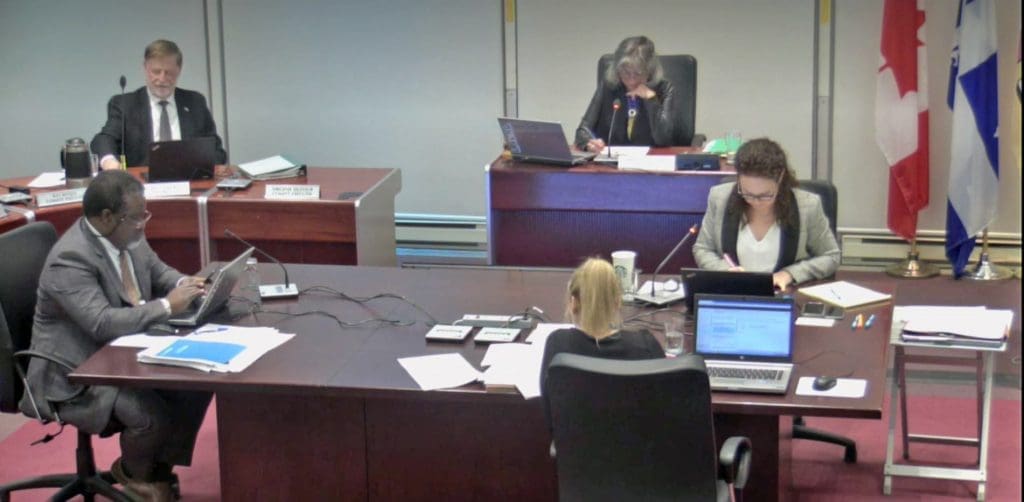
Laval mayor Marc Demers, seen in this screenshot from the televised April 7 city council meeting broadcast on the internet, says his administration hasn’t decided yet whether to proceed with a costly Fête nationale event on June 24, or hold an alternative celebration instead.

Independent city councillor David De Cotis fired the opening shot during the debate. The meeting took place through teleconferencing, with most council members calling in over speakerphones, and only the mayor, council president Christiane Yoakim, and a few administration officials present at city hall.

Be responsible: De Cotis

“We know that the City of Montreal has cancelled many summer events up to July,” De Cotis said. “I think that here in Laval we should be doing the same thing. We will be spending more than $600,000 for a celebration that will last just one day.

“I think it would be more responsible to take that money and place it in a fund or something like that to help the families in Laval – maybe parents who have lost their jobs – who have no revenue coming in. I think it would be responsible for this year to take that money and put it aside and to help Laval’s families.”

No cancellation, says Demers

While Mayor Demers said the city has an option to cancel the agreement if CO-Motion finds itself unable to fulfill its obligations, he added that to postpone the payment to next month would be the equivalent of cancelling altogether.

To cancel immediately would not have the effect of saving the city money,’ says Demers

“To cancel immediately would not have the effect of saving the city money, unless we decided to contest certain things with CO-Motion,” he continued, noting that the city has enjoyed a longstanding partnership with the organization.

Respect contracts: Demers

At the same time, the mayor pointed out that Quebec Premier François Legault advised municipalities to try to respect their agreements with artistic events production companies, because of their importance to the province’s economy, “and they will be part of the strategy for the recovery,” he said.

Executive-committee vice-president Stéphane Boyer said that allotting the money won’t necessarily mean it will all be spent.

“What we are saying is let’s look for other opportunities, other possibilities to keep jobs in the cultural sector while maintaining celebration events, even though we understand that big gatherings are maybe not possible at that time,” Boyer said.

Planet has cancelled: Trottier

Official opposition leader Michel Trottier of the Parti Laval said he was baffled by the mayor’s claim that the issue was still under study.

“The entire planet has cancelled events from now up to the month of July, but in Laval we’re still analyzing,” he said. “This isn’t even a question. In my opinion, it would be irresponsible to hold the Fête nationale on June 24.”

Trottier noted that even the Jeux du Québec (for which the finals were set to take place in Laval) were recently cancelled, although they had originally been scheduled for August. “How is it we are holding an event a month before?” he said.

Says Demers ‘out of touch’

“I can’t believe what I am hearing,” said independent city councillor for Saint-Vincent-de-Paul Paolo Galati, adding that he agreed with what De Cotis said. “The mayor is really out of touch with reality. Everyone is suffering from this illness [COVID-19].

“Everyone is cancelling events, Montreal has cancelled up to July 2, and the mayor is still of the mind that it can take place,” he continued. “So I don’t understand. Things are different this year. We must cancel. It’s the recommendation being made by the experts.”

In the end, the 13 administration city councillors present during the meeting voted unanimously for the $662,256 payment, opposed by eight opposition councillors. As to what the city eventually decides, Premier Legault confirmed on April 8 that the two-metre distancing rule will be in place “for months,” he said, even after the re-opening of some businesses.

Legault has the final say

In his April 8 statement, Legault said the eventual resumption of social and economic activities will take place gradually. Companies will have to be flexible with regard to employee work schedules so that public transit won’t be overcrowded during traditional rush hours.

Premier Legault also acknowledged that his government and public health authorities are thinking over the possibility that schools and daycares won’t re-open before the end of the school year.

Martin C. Barry, Local Journalism Initiative Reporter for the Laval News, marty@newsfirst.ca

Thumbs-up from CFIB for Ottawa’s COVID-19 wage subsidy

The subsidies ‘will maintain the link between the employer and the employee,’ says Canadian Federation of Independent Business

Martin C. Barry

Despite the fact some small and medium-size businesses across the country remain dissatisfied with Ottawa’s subsidy package for employers and employees impacted by the COVID-19 crisis, the Canadian Federation of Independent Business is giving an overall thumbs-up to the federal government for its efforts.

The CFIB issued a statement last week praising the Liberal government for the emergency measure to bolster the country’s economy during the economic pandemonium taking place as COVID-19 continues to keep businesses closed and workers home.

Bar set at 30 per cent

While the CFIB isn’t being overly critical, it did point out that the main criteria for businesses to qualify for federal assistance is that they must have suffered at least a 30 per cent drop in revenue compared to the previous year because of the COVID-19 crisis.

The Canadian Federation of Independent Business’ senior policy analyst Gopinath Jeyabalaratnam says the lobby group is pleased overall with Ottawa’s COVID-19 wage subsidies, although they still have some reservations.

For this reason, the lobby group is urging Ottawa to drop the qualifying condition for businesses that have fewer than 500 employees, as well as those which are currently being obliged to remain partly or completely closed by provincial authorities.

Still some not happy

Although most business owners are happy with the government’s offer to cover 75 per cent of lost wages, a segment of the business community finds the 30 per cent rule problematic, according to Gopinath Jeyabalaratnam, the CFIB’s senior policy analyst.

“Where we and others see a problem is on the criteria of 30 per cent loss that qualifying businesses will have to prove,” he said in an interview with Newsfirst Multimedia. “And that is indeed a problem because it will in time discriminate against many businesses we believe.”

CFIB sees discrimination

Despite this, he said the response by the CFIB to Ottawa’s move is generally positive because the organization hopes to persuade the federal government to change the rule. “The program has to go to parliament and has to become a law before being adopted. So we still hope that we can nudge the government in the good direction so that they correct the program in order to discriminate less.”

Jeyabalaratnam cited several examples of small and medium-size businesses that will not be able to benefit from the federal government’s salary subsidies with the current rules in place.

Startup businesses

“A lot of small and medium businesses will have to prove for the month of March, April, May and June that they have had a 30 per cent loss in comparison to those same months last year,” he said.

“But how would that be possible for a new business that has a startup debt and that has been functioning only since June or July last year maybe? So they would not be able to prove that.”

Another example he gave involves seasonal businesses. “Hotels or other businesses in the touristic domain must make money during summer,” said Jeyabalaratnam.

Bias against tourism

“But summer is not yet here, and so they won’t be able to prove they had a 30 per cent loss because the high season isn’t here. So we are concerned that they also will be discriminated against by the measures.”

Despite these shortcomings, Jeyabalaratnam said the CFIB looked upon the federal government’s wage subsidy as good news. “We’d been asking for that for several weeks,” he said, maintaining that the CFIB was the first interest group in Canada to suggest the subsidy program as a way of reviving the country’s economy during a post-COVID-19 recovery phase.

Employer/employee link

“It will maintain the link between the employer and the employee,” he continued. “And that will be very important when the economy will be starting up and resuming its activities. If businesses don’t have employees on the payroll, they won’t be able to start their activities. So maintaining the link is very important and the subsidy helps to do this.”

He said the subsidy program will also be helping businesses that are currently closed or are suffering from reduced activities to pay salaries until the COVID-19 crisis recedes and the economy returns to a normal pace.

Last week, the CFIB reacted favourably to changes announced on April 8 to the wage subsidy program by the federal government.

To access the subsidy in March, April and May 2020, a firm will be able to compare their sales to the same month last year or January and February, 2020. This will help new and growing firms who may not have qualified based on a comparison to 2019.

The federal government will also now require firms to demonstrate only a 15 per cent reduction in gross revenues for March. A 30 per cent reduction will still be required to receive the subsidy in April and May.

Some businesses reported that their regular accrual accounting method would mean their books would not show a loss of 30 per cent, despite a deep effect on cash flow. Now the government is proposing to allow an option to use cash accounting.

Martin C. Barry, Local Journalism Initiative Reporter for the Laval News, marty@newsfirst.ca

Former LPD chief outraged by CHSLD Ste-Dorothée’s ‘incompetence’

‘The management clearly was lacking leadership,’ Jean-Pierre Gariépy says

Martin C. Barry

The former chief of the Laval Police Department, whose wife was recently transferred to CHSLD Sainte-Dorothée to recover from a brain aneurysm, suggested last week that management at the long-term care facility was incompetent, after his wife and many other residents became infected with the COVID-19 virus.

Not told, he said

Former Laval police chief Jean-Pierre Gariépy is suggesting management at CHSLD Ste-Dorothée is incompetent given the number of deaths there from COVID-19.

Jean-Pierre Gariépy was the head of the Laval Police for 15 years up to the end of 2013 when he retired. He said in a broadcast interview with 98.5 Montreal’s Paul Arcand that his wife, Louise Bourgeois, was hospitalized at Hôpital du Sacré-Coeur in Montreal before being transferred to CHSLD Sainte-Dorothée in western Laval in late March.

“I didn’t know at the time that there were patients there who were at risk,” he told Arcand, while adding that he found out only later that she was transferred after at least one resident was known to be infected with COVID-19.

‘Incompetence’

“She became infected soon after her arrival,” he said. “The transmission took place stage by stage, through an employee who was badly prepared and badly protected. The management clearly was lacking leadership.

“They should have given out precise directives to the staff, which was not the case. They even forced attendants to stay at work despite the fact they were sick. This is appalling incompetence.”

Possible class-action

Gariépy maintained during the interview that management at the CHSLD appeared to be improvising at virtually every stage during the developing COVID-19 crisis. He suggested they didn’t seem to know what they were doing while moving infected residents into areas adjacent to where healthy residents were quartered.

“Did they have a plan for dealing with an outbreak?” he said. “Plans for separating people by floors or by sectors? Did they have facial masks, or appropriate protective gloves?” He said he was seriously considering whether to launch a class-action lawsuit in conjunction with other CHSLD Sainte-Dorothée residents or their relatives.

Martin C. Barry, Local Journalism Initiative Reporter for the Laval News, marty@newsfirst.ca

Weather

Laval
overcast clouds
29.6 ° C
30.4 °
28.8 °
63%
2.7m/s
100%
Fri
30 °
Sat
30 °
Sun
27 °
Mon
24 °
Tue
26 °