(TLN)
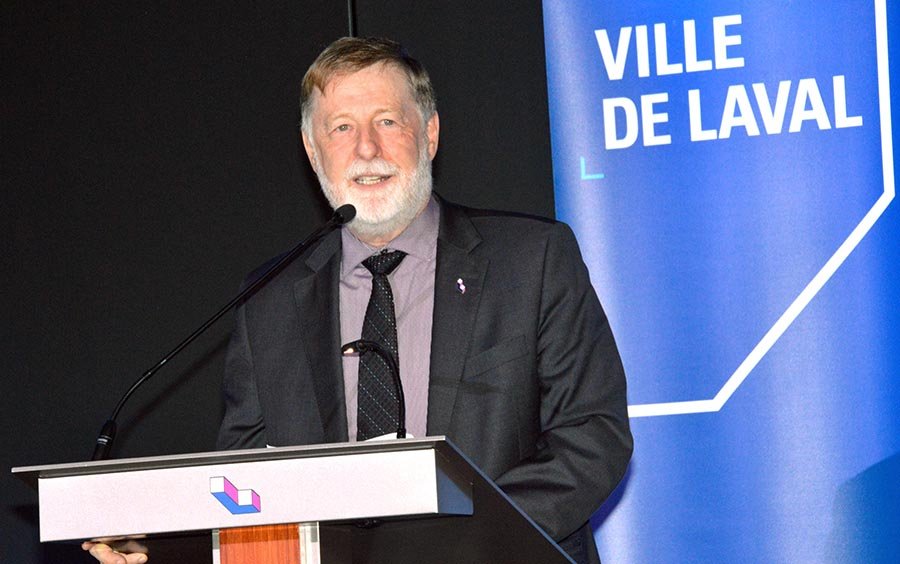
Mayor Marc Demers and executive-committee member Sandra Desmeules attended the
Federation of Canadian Municipalities’ annual convention in Quebec City
recently.
Demers meets PM
While
there, Demers met with Prime Minister Justin Trudeau and had the opportunity to
discuss the issue of financing Laval’s infrastructures, the city’s acquisition
of nature and forest lands, the future of the Old Penitentiary in
St-Vincent-de-Paul and the importance of investing in public transport.
“This
type of cordial and quick exchange allowed me to remind the prime minister of
the preoccupations of Laval residents,” said Demers. “We have major projects
and in some cases the cooperation of the other levels of government will be
essential to implement the projects expected by our population.”
Desmeules re-elected
Councillor
Sandra Desmeules was re-elected to the FCM’s board of directors. She will be
representing the interests of Laval and the rest of Quebec in the FCM.
As
part of its program to help municipalities innovate environmentally, the FCM
granted the City of Laval a $750,000 subsidy for a project to “green” over
parts of Laval in a continuing campaign against heat islands.
Laval
will be using the money to remove 3,000 m2 of paved area while
planting 7,200 plants, including 1,500 trees on private and public lands. The
work is scheduled to run from this autumn to the end of 2020.
In honor of Father’s Day and in appreciation of the millions of fathers whose daily passion for their children and their love of the gift and privilege of fatherhood often goes unnoticed, here’s a special treat – a dad and daughter story that is exceptional in its simplicity and touching in its depth. Here is the loving professional and family bond between the father/daughter singing duo of Johnny and Christina Capobianco, paying a heartfelt tribute to fathering of all children, but especially does it to celebrate the unique and important relationship between fathers and daughters.
Thirty-one-year-old
Christina Capobianco and Johnny, her renowned local singer dad, are taking
Laval, Greater Montreal, and beyond by storm with their latest CD Johnny and Christina Capobianco, 21
hits sung mostly in English and Italian.
The accomplished
duo shares two-part harmony from songs of the 60s to today, showcasing English,
French, Italian, and Spanish favorites. Fathers and daughters bond in many ways
– ice cream dates, sports, and even homework.
But this dad-daughter duo takes bonding to whole new levels with heart
felt covers of music’s most popular songs, an act so good that audiences can’t
get enough.
Here,
in their own words, as told to TLN, are the strings tugging the hearts of this
dynamic duo in their mission of gladness to every audience for which, they say,
they have the privilege to perform.
How was it growing up with a talented
dad?
“It
was special growing up in an environment that nurtured my natural musical
ability. I’m an only child, therefore,
dad became my mentor/singing coach when I was nine. As a young songstress, I performed
with dad in the community. We became a team
despite our individual tastes in music.
Although
a music career would have been an obvious choice for me, I also set my sight on
something different. But make no
mistake, we continue our duet on weekends and special occasions.”
Johnny, what is the music industry
today?
“The
industry has always been competitive at heart.
You have to keep re-inventing yourself – that’s where Christina and I
come in. We’re a duet – singers and
performers. I have a 12- piece extraordinarily talented orchestra (The Grand Show Band) which sizzles
crowds. Often, in bands, members split roles amongst the group. So, it’s important to learn different aspects
of professional music-making, and enjoy the process. Professional musicians wear
many hats these days. Making some money on the side isn’t hard, but to turn
passion into career you have to want it above all else.
Christina, with your amazing talent, why
something different?
Depending
on the music path, it’s possible that you’ll never make a stable income. Even if it is, it may take years before it’s
enough to enjoy certain luxuries. You need plan B – another pursuit on the
side. As singers/entertainers, we don’t
wait for opportunities to come to us – we seek them out or create them
ourselves. That’s our formula for
success.
What accounts for your great popularity
and respect?
Johnny: “The combination of excellent musicianship with a
stunning 12-piece orchestra and light show is the ultimate event entertainment
for celebrations looking for WOW factors.
It’s a show created by two industry professionals sharing the vision of
giving audiences unforgettable experiences. We have performed for luxury
clients and in respected venues – corporate events, private parties, weddings,
gala dinners, and fund-raising events for research into diseases and for the
less fortunate.
We are immensely proud of donating time and talent wholeheartedly
for worthy causes such as Generations Foundation, Operation Enfants Soleil, and The
Leukemia and Lymphoma Society of Canada. Over the past decade we have raised
over $300 000 in support of these crucial organizations.”
What is the objective in your musical
career?
Christina:
“To bring glamor and sophistication to venues across our beloved Laval, Greater
Montreal, Toronto, and beyond through various styles, such as pop, jazz, disco
and funk, all tailored to individual clients.
Describe your career in a nutshell.
Johnny:
“Very few people have the good fortune to be in major demand. As long as you keep making steps to improve
every day, you’ll eventually be one of the best out there. We’re lucky since I’ve been in the business
since I was 15, with Christina, 14 years.
We love singing at home and for audiences. It’s a passion. We constantly
raise the bar for ourselves. I’ve always taken the lead showcasing my fierce
vocals (he chuckles). Christina’s powerful vocals beautifully merges
our voices in perfect harmony. She’s a
very talented quality pop singer. She gets it from her dad! (chuckles again.) We love performing, it’s in our soul and
blood.”
Great to hear from you both, but what
does mom Connie think of all this?
Christina:
“She’s a trooper, constantly helping us actualize our plans and projects,
following us everywhere, often joining appreciative audiences singing along
with us. We love her involvement and are thankful for her support, which she
delivers to the fullest.”
The
Capobiancos count among their accomplishments a Certificate of Recognition Award for Outstanding Community Work,
from the House of Commons, conferred in Laval, May 12, 2017, by
Alfred-Pellan MP Angelo Iacono.
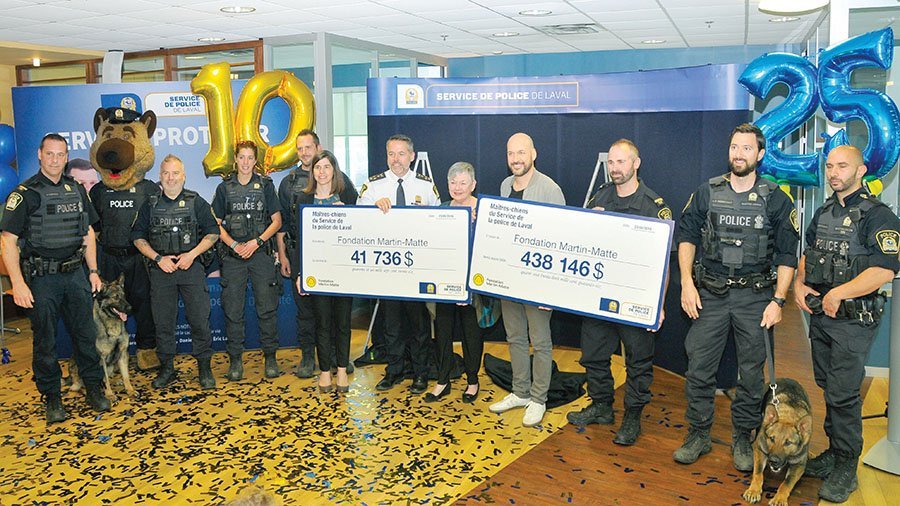
(TLN) On May 24, members of the Laval Police
Department turned over a cheque to the Fondation Martin-Matte for $41,736
collected from sales of the 2019 LPD canine squad calendar.
This marked the 10th year the popular
calendar has raised money for the foundation which provides assistance to
victims of head trauma.
“It is with great pride that we mark today a decade of involvement with victims of head
trauma,” said Laval Police chief Pierre Brochet. The LPD has been involved with
the cause since the death of former canine squad officer Éric
Lavoie, who passed away following a head trauma.
“The determination and loyalty of the police dog
handlers in Laval towards the foundation touches me deeply,” said foundation
founder and spokesperson Martin Matte.
“An enormous thank-you to all the police officers, to
the sponsors and purchasers of this beautiful calendar. You are helping to
improve life for many people who greatly need it.”
Laval mayor Marc Demers said the city’s current urban planning scheme dates from a past era and needs updating.
Martin C. Barry
Just as Rome wasn’t built in a day, the task of
revising and finalizing the City of Laval’s master urban plan is one that is
taking years to accomplish – with some additional effort still ahead.
Since first coming into office in 2013, Mayor Marc
Demers and city council have been overseeing the gradual reform and re-writing
of an island-wide urban planning layout that hadn’t changed since the late 1960s
when the City of Laval was created through the merger of 14 towns and villages
on Île Jésus.
An overdue revision
Considering
that Laval, with a population of more than 422,000, is the third largest city
in Quebec. and that its territory is complex and contains vast urban and rural
elements, it should come as no surprise that reforming the city’s urban
planning scheme is taking as long and in so many progressive stages.
As
Mayor Demers explained during a public consultation that gathered together city
councillors and more than 100 Laval residents on May 21 at Collège Letendre, the
process is also taking place within a larger context.
Compliance with CMM
That
framework is an urban planning system for the management of dozens of towns and
cities that are subject to the Plan métropolitain d’aménagement et de développement
(PMAD), overseen by the regional Communauté métropolitaine de Montréal (CMM).
Over the past two years alone, the City of Laval held
consultations, from which suggestions made by citizens were incorporated into
the plan. “The stage beginning tonight is to revise all the urban planning
regulations from one end of the island to the other,” said Demers.
“This is a colossal work for our teams. And why are we
doing this? Because several of our regulations date from a past era and
obviously are not in conformity with the needs of Laval residents. And so for
us this is important work, and we know that regulations have to be there in the
interest of citizens in order to serve them well.”
A large number of Laval’s city councillors turned out for the consultation on the urban plan revision held at Collège Letendre on May 21.
Adopting a
new outlook
Laval’s director of urban planning, Luc Paquette, said
that when the city’s last master urban plan was revised during the 1970s, it
was based on values from the 1950s and 1960s when the overall outlook among
officials and urban planners in Laval was focused almost entirely on automobile
transit.
Laval evolved along those lines until well into the
2000s, and a large part of the urban plan revision amounts to correcting this
overriding theme which visibly dominates the suburban landscape here.
Another member of the city’s urban planning team, Jean
Chartier, said some of the coding in Laval’s existing urban plan is so outdated
it’s still spelled out in imperial units (rather than metric). “It’s so old
that even professionals in urban planning and architecture have difficulty
understanding it, so it’s creating a lot of frustration,” he said.
Complaint on
farm zoning
Among those who got up to the microphone during a
public question period was Gilles Lacroix, a Laval-area farmer who maintained
(like many other farmers in Laval) that the City of Laval continues to neglect
pledges made as early as 1988 to safeguard Laval’s historic agricultural
legacy.
“You talk about protecting the agricultural
territory,” he said, noting that the city provides little incentive to keep
agricultural property owners from abandoning their land. Jean-Claude Longtin of
Duvernay Est said the city needs to do something about the ever-increasing
amount of vehicular traffic in Laval caused by drivers commuting from the North
Shore to Montreal.
“When you take the 440 in the morning, it’s not people
from Laval there, it’s people from Terrebonne and Mascouche,” he said. “It
might be necessary to develop something so that these people can take a fast
way to get to the Metro without cars. It’s not just for us, but also for people
from outside.”
The current issue of the Laval News volume 27-11 published May 29th, 2019, (Laval’s English Newspaper) covers local events such as politics, sports and human-interest stories. It features editorials and other columns. Click on the image to read the paper.
Front page of Laval News, Vol. 27-11
May 29, 2019.
(TLN) Reserve a spot in your agenda. Because on June
24 the City of Laval will be staging its own version of celebrations for
Quebec’s Fête nationale – which is always one of the
largest and most colourful anywhere in the province.
Stars on stage
Beginning
at sunset at the Centre de la Nature, the stars in the sky will become the
stars on stage, with the invited guests including Marie-Mai, Paul Piché, Hubert Lenoir, Patrice Michaud, Loud, Guylaine
Tanguay, Breen Leboeuf, Mara Tremblay, Fanny Bloom, King Abid, Ilam, Flavia
Nascimento and the 150 Petits
Chanteurs de Laval.
Later
that night, the show will culminate with fireworks. “Once again, our organizers
have outdone themselves and I am certain that our Fête nationale in Laval will once again be seen as one of the best anywhere,”
says Mayor Marc Demers.
Free shuttle
from Metro
The big event will take place at 9 pm, although the
site will be accessible starting at 6 pm. Street food trucks will be on
location to serve those who’ve worked up an appetite. A free shuttle bus will
also be available from Metro Montmorency to take event-goers to the Centre de
la Nature.
There will be other events taking place on June 24 at the Centre de la Nature, including children’s activities, face painting, inflatable games and other fun things from 10 am to 5 pm. All the events are taking place with the support of other organizations, including the Société nationale du Québec à Laval, Québecor, Rythme FM, the Mouvement national des Québécoises et Québécois, the Government of Québec, the SAQ, the journal Métro, [co]motion and Brasseries Sleeman.
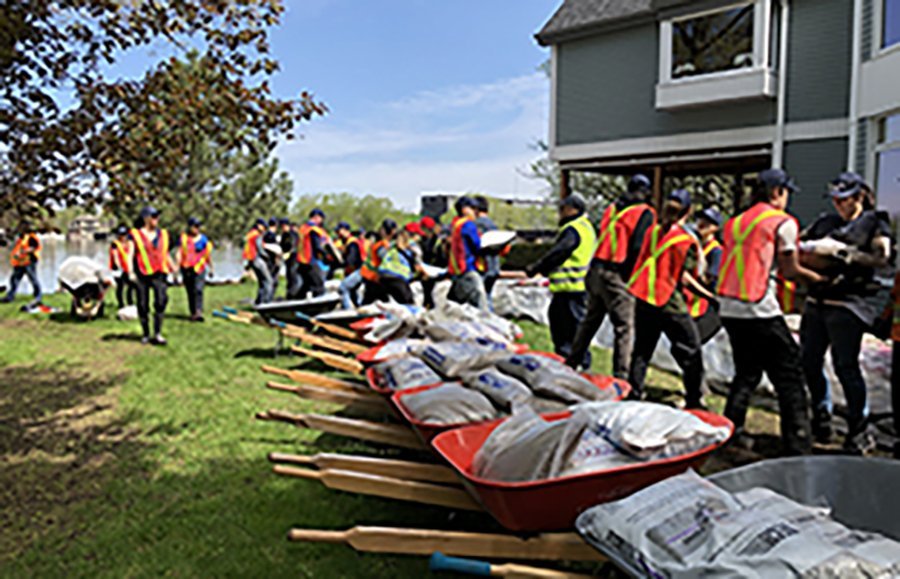
(TLN) Around 275 volunteers and 400 municipal
employees (including 350 blue collar workers) took part last weekend in a
massive two-day spring cleanup operation held all over Laval following the
floods which left damage and debris in various areas of the island.
“I would like to warmly thank all the volunteers and
all the municipal employees who came to the assistance of the victims during
this big cleanup, without forgetting the STL which furnished shuttles for
transportation,” said Mayor Marc Demers.
Thanks from
mayor
“Without your support, we would never have been able
to accomplish such a task on such short notice. I am certain that just like me,
each of the persons affected by the floods is grateful to you for your devotion
and cooperation.”
In
order to clean up properties affected by the floodwaters, volunteers and
employees formed teams that worked over the two days with unparalleled
enthusiasm. If anything, it also showed the strong sense of solidarity that
exists between people living in Laval.
A lot of work
In
all, the volunteers and municipal employees concentrated their efforts on seven
zones in Laval that suffered flooding. They recovered 83,000 used sand bags,
containing 1,500 tonnes of sand. As well, 425 households were visited and the
exteriors of 277 homes were cleaned of debris.
Last
weekend’s cleanup operation was the beginning of a regular spring cleanup the
City of Laval will also be conducting in the coming weeks. Residents who were
unable to take advantage of the assistance offered last weekend will be able to
get additional help in the coming weeks from teams continuing to operate in the
flooded areas.
While motorists from Laval and the North Shore grow increasingly impatient waiting for traffic relief from the A-19 extension project, Sainte-Rose CAQ MNA Christopher Skeete says the provincial government is still waiting for updated plans before proceeding.
Martin C. Barry
Quebec’s CAQ government will eventually take up Ottawa’s
$345 million offer to pay for extending Autoroute 19 from Laval northward to
the North Shore, says Sainte-Rose CAQ MNA Christopher Skeete.
But before that happens, Quebec will continue waiting
to see updated plans for the long-anticipated highway completion project, adds
Skeete.
Quebec was
absent
Skeete was invited by the Laval News – as he was
preparing for an announcement in Laval last week – to comment on the CAQ
government’s conspicuous absence from a press conference held in
Bois-des-Filion on the North Shore recently when the federal government
announced its funding offer.
Effectively,
the Liberal government in Ottawa has stated its willingness to open its purse
in order to release as much as $345 million for Quebec’s CAQ government to
spend on the agonizingly long-awaited A-19 project, whose history dates back to
the quasi-prehistoric 1970s.
Notably
missing at the announcement was François Bonnardel, the CAQ Minister of
Transport who is normally expected to be present for major announcements such
as that one.
Ottawa/Quebec friction?
As
some observers have suggested, the absence could be framed in the context that relations between the CAQ government and the federal
Liberals haven’t been great since Ottawa began
voicing concerns over Quebec’s controversial Bill 21 that would curtail the
display of religious symbols by public employees and officials.
“It’s not because we’re not committed to the project –
we actually are,” Skeete said last week. “We just want to make sure that we
have a completed project before we start making announcements.
“I understand the federal colleagues: they have incentives
to go a little bit faster – you know, with a looming election,” he added. “For
us, it was a question of making sure that all the i’s are dotted, all the t’s
are crossed before we start making announcements.”
Politically
convenient
Over the decades, so many government announcements
about the A-19 have been made that most observers have become cynical. Some
have also noted that the issue has been tossed back and forth with great
political convenience from the PLQ to the PQ – and now the CAQ government.
In the meantime, no one has ever taken a firm resolve
to move forward with the project. As recently as last fall when future Premier
François Legault was campaigning in Laval for the October provincial
election, he pointed out that successive governments made promises about
completing the A-19 without ever fulfilling them.
Legault
pledged it
“I think that one of the big demands being heard
concerns the 19,” Legault said then, as reported by TLN. “It’s going to be done
with us. And it’s going to be done within the parameters they want – with
reserved lanes, based on the demands of the mayors from the North Shore. It will
be done within a reasonable period of time.”
For his part, Skeete said last week that public
cynicism was “one of the reasons why we didn’t want to be there for yet another
announcement. It’s nine times the 19 was announced. People don’t want another photo-op.
What they want is some crews digging.
“The 19 will go forward,” he insisted. “My estimation
is it’s time to get to work. Our plan is to start working on that as soon as we
get the updated plans.”
(TLN) On May 15 and on May 22, the City of Laval’s
executive-committee made a number of recommendations regarding public works, as
well as the granting of subsidies to organizations and groups in Laval.
Electric work contract
Among
other things, the committee advised city council to award a contract to Néolect
inc. for $1,035,374.59 to replace lighting and other electrical work at
Paul-Marcel-Maheu Park.
According
to the city, the lighting equipment at this park have reached the end of their
usefulness, having first been installed during the 1970s.
Groups getting subsidies
At
the same time, the executive-committee granted $573,000 in subsidies for 2019
to the following organizations:
SOCIÉTÉ DES ARTS VISUELS (VERTICALE – CENTRE D’ARTISTES): $40,000
SOCIÉTÉ D’HISTOIRE ET DE GÉNÉALOGIE DE L’ÎLE JÉSUS: $25,000
SOCIÉTÉ LITTÉRAIRE DE LAVAL: $20,000
TÉLÉVISION RÉGIONALE DE LAVAL: $25,000
THÉÂTRE DU P’TIT LOUP (LE): $10,000
THÉÂTRE FÊLÉ: $5,000
THÉÂTRE INCLINÉ: $28,000
THÉATRE TOMBÉ DU CIEL: $5,000
ZEUGMA, COLLECTIF DE FOLKLORE URBAIN: $15,000
[co]motion CORPORATION DE LA SALLE ANDRÉ-MATHIEU: $150,000
ARTS ET SPECTACLES DE LAVAL: $33,000
CENTRE D’ARCHIVES DE LAVAL: $50,000
CHŒUR DE LAVAL: $12,000
CONSEIL RÉGIONAL DE LA CULTURE: $25,000
LA CENTRALE DES ARTISTES: $25,000
LA RENCONTRE THÉÂTRE ADOS: $40,000
LIS AVEC MOI: $25,000
PRODUCTIONS LE P’TIT MONDE (LES): $10,000
RÉSEAU ARTHIST: $30,000
The
executive-committee also asked city council to renew the mandate of Councillor
Sandra El-Helou as a member of the board of Tourisme Laval for two years. Tourisme
Laval is an agency at arm’s length from the city that promotes tourism in the
Laval region.
At
a separate meeting on May 15, the executive-committee made some other
decisions. The committee recommended that the Centre d’interprétation des
biosciences Armand-Frappier (CIBAF) and the Centre d’interprétation de l’eau de
Laval (C.I.EAU) receive subsidies of $150,000 and $70,000 respectively for
2019.
At
the same meeting, the executive-committee recommended granting a subsidy to the
Canadian Red Cross (Quebec and Laval division) for $10,000. This year, the
organization’s honorary president for fundraising is Councillor Sandra Desmeules.
The goal this year is $100,000. And the executive-committee recommended a
subsidy of $6,000 be made to the Fondation de soutien aux arts de Laval for the
coordination of activities concerned with the remittance of bursaries to arts
students in Laval.
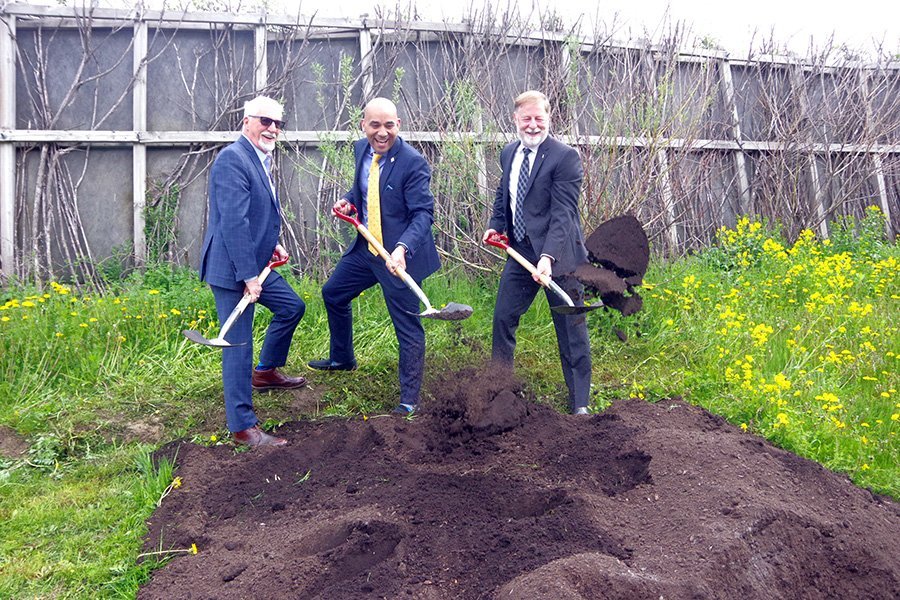
From the left, Marc-Aurèle-Fortin city councillor Gilbert Dumas, Sainte-Rose CAQ MNA Christopher Skeete and Mayor Marc Demers get into the swing of heaving the first soil to start work on the new sound barrier on Guillemette St. – with the old barrier behind them.
Martin C. Barry
Homeowners
who live on a stretch of Guillemette St. alongside Autoroute 15 in Laval’s
Marc-Aurèle-Fortin district won’t have to
put up with the constant roar of highway traffic much longer, following word
that the provincial government and the city have agreed to share the cost of a
new $5.12 million anti-noise wall.
Last week, Laval mayor Marc Demers and Marc-Aurèle-Fortin
city councillor Gilbert Dumas
joined Sainte-Rose CAQ MNA Christopher Skeete for an official ground turning near
a spot along Guillemette St. where the wall will be going up.
Residents to
benefit
“Those living alongside on Guillemette St. will be
able to celebrate now that this anti-noise screen is going to be re-built,
offering them more comfort while benefiting a large number of residents,”
Skeete said during a ceremony held near the site.
“You know, we can hear the noise of that highway right
now,” added Skeete. “So I think the citizens who live on the side here deserve
a little bit of calm. The quality of life of citizens being a priority of your
government, I am pleased that the screen will be rebuilt and extended 50 metres
south and 20 metres north.
A-15 traffic
increases
“In all, the structure will be 1.1 kilometres long and
will improve the quality of life of the citizens of Sainte-Rose,” he continued.
“The extension of this screen can also be seen in the context of the use of the
Laurentian autoroute which is an essential link and on which traffic hasn’t
ceased growing in recent years. Nearly 150,000 vehicles circulate daily on this
artery. The decision for this made-to-measure solution responds to the needs of
the city and its residents.”
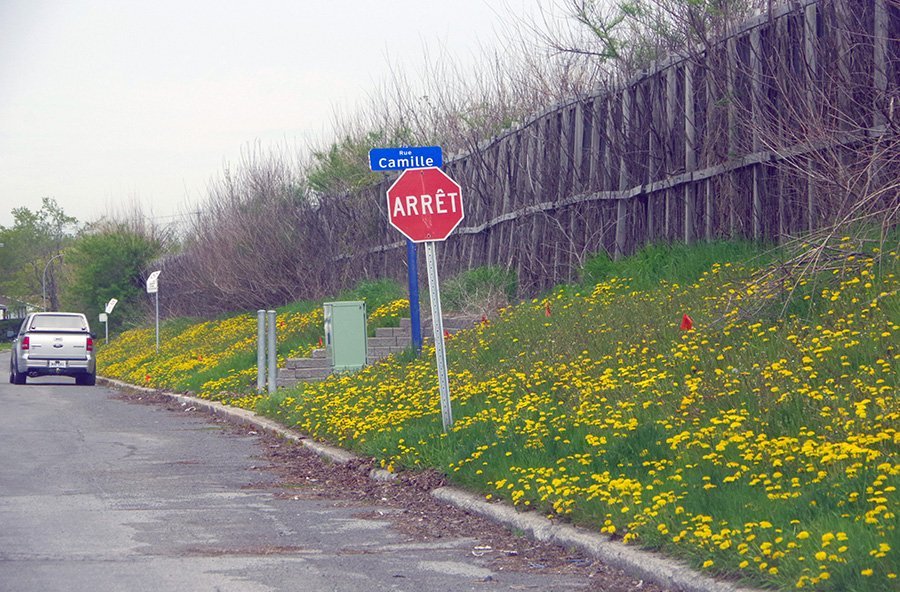
The City of Laval had previously built a wooden sound
barrier covered with vines in the same spot, although it was reported by some
to be not very adequate. Over the years, there was at least one occasion when residents
turned up at Laval city hall to complain about it during a city council
meeting. The new wall will be built of more durable
materials to exacting specifications.
The previous wooden anti-noise wall erected next to the A-15 will be replaced with a new one made of steel and other more durable materials.
Quality to
improve
“The completion of the upgrading and improvement work
of the acoustic screens along the Laurentian Autoroute on Guillemette St. will
improve the quality of life of the citizens in the neighbourhod by providing
them with more tranquility,” Demers said, while noting that the old wall had reached
the end of its usefullness. He said the new wall will be slightly longer and
have better quality.
Demers
praised the CAQ government for responding very quickly and providing the means
for the new sound barrier shortly after the provincial election last fall.
According to the mayor, the work involved should take around six months. He
said the wall’s structure will do the job primarily of deadening the sound from
Autoroute 15, while the green cover will help conceal the fact there is a wall
there.
Solid new construction
Work
on the sound barrier is expected to start around the beginning of June. Whereas
the old wall consisted primarily of plywood with some overgrowth of vegetation
and vines, the new one will built (in accordance with provincial standards and
protocols for highway sound barrier construction) of steel and rock wool.
An
overgrowth of vines will also be applied. While the current wall is 1,150
metres long, the new wall will be 70 metres longer. The City of Laval will be
supervising and carrying out the construction. According to the city, more than
150,000 vehicles per day pass along Autoroute at that particular spot.