Thursday, February 26, 2026
8 C
Laval
spot_img
Home Blog Page 231

Ottawa provides support to Laval-based Canadian Deaf Sports Association

Ottawa provides support to Laval-based Canadian Deaf Sports Association
From the left, Alfred-Pellan Liberal MP Angelo Iacono, Alain Turpin, executive-director of the Canadian Deaf Sports Association and Minister of Canadian Heritage and Multiculturalism Pablo Rodriguez are seen here at Centre Sportif Val-des-Arbres on Saint-Martin Blvd. East on May 22 when they announced a $762,800 subsidy to the CDSA.
Martin C. Barry

Minister of Canadian Heritage and Multiculturalism Pablo Rodriguez and Alfred-Pellan Liberal MP Angelo Iacono have announced a contribution of $762,800 to the Laval-based Canadian Deaf Sports Association (CDSA) through the ministry’s Sport Support Program.

Rodriguez and Iacono made the announcement at the Centre Sportif Val-des-Arbres on Saint-Martin Blvd. East on May 22 on behalf of the Minister of Science and Sport Kirsty Duncan. The support is being provided over a two-year period, with half the funds distributed in 2018–2019, and the remainder in 2019–2020.

Helping deaf athletes

The CDSA is a pan-Canadian non-profit organization that aims to support the development of the practice of sport within the deaf community and among deaf youth, in order to ensure quality Canadian representation at international competitions. The organization offers opportunities for young Canadians to enjoy a competitive experience, travel and meet other athletes who share the same goals.

“Our government is proud to invest in the Canadian Deaf Sports Association, as it gives Canadian deaf and hard of hearing athletes an opportunity to participate in international sport events,” Rodriguez said in a brief speech to a small gathering of deaf and hearing-impaired athletes.

“Offering young athletes the chance to perform, no matter their physical ability, is essential to the development of Canada’s future,” he continued. “We are proud to promote inclusive sport and help ensure that everyone can grow to their full potential.”

Access to the podium

“This is good news for deaf athletes and I think it’s an important step going forward,” Iacono said in an interview. “It’s part of giving every Canadian athlete a chance to get to the podium. Offering more opportunities to practice sport proves to the whole country that sport should have no limits and that everyone can participate. These athletes demonstrate great perseverance and deserve Canada’s support and admiration.”

“I am committed to ensuring that everyone, regardless of their age, race, gender, sexual orientation or ability, has the opportunity to participate in sport and experience all it has to offer,” the Science and Sport Minister said in a statement. “By supporting the Canadian Deaf Sports Association, our government is encouraging Canadian deaf and hard of hearing athletes to pursue their sporting dreams. I am confident that the work being done by the CDSA will make sport more accessible and welcoming for everyone.”

Ottawa provides support to Laval-based Canadian Deaf Sports Association
Sign language interpreters explained proceedings at the press conference to many of those attending the press conference who were deaf or impaired of hearing.

The invisible handicap

Through sign language interpreters, Alain Turpin, executive-director of the Canadian Deaf Sports Association, said the association’s members felt greatly encouraged by the support coming from the federal government.

Describing deafness as “handicap that isn’t visible,” unlike blindness that is often identifiable when blind persons are using white canes, Turpin said deaf athletes often need specially-adapted equipment and facilities when they practice sports such as competitive swimming or running (where the starter signal can’t be heard by athletes with impaired hearing.

Support from Sport Canada

The CDSA is a non-profit organization dedicated to the development of deaf and hard of hearing athletes. Through direct financial support, the CDSA helps athletes take part in international sport events sanctioned by the International Committee of Sports for the Deaf and the Pan American Sports Committee for the Deaf.

Sport Canada has supported the CDSA since 1993 by providing over $5 million in funding for its activities. The Sport Support Program supports the development of Canadian athletes and coaches. Funding is provided to eligible organizations for programming that is aligned with the goals of the Canadian Sport Policy.

Beware of new ‘Mexican Timeshare Scam’

Beware of new 'Mexican Timeshare Scam'

Police forces across North America including Canada have received a number of complaints related to fraudsters who’ve reached out to residents who own timeshares in Mexico and offering the opportunity to sell it.

The scam involves the owner being contacted by an individual claiming to work for an International Real Estate Company with a website that looks legit.

The scammers will then claim a buyer is in place for their timeshare, send legal documents to be signed, before asking for thousands of dollars through multiple wire transfers to cover what they say are legal fees, Mexican taxes, and various other closing costs.

After the first few wire transfers, the fraudsters will try to keep the payments coming by concocting a story about a buyer backing out of the deal, but that a new buyer is in place.

When a victim eventually realizes they were part of a scam, in some cases, they received a call from someone claiming to be a Mexican prosecutor. That ‘prosecutor’ then tells them several individuals have been arrested, and that the victim can get some of their money back. More money wire transfers are then made to allegedly cover various legal costs in order to collect the reimbursement.

Demers recaps flood control efforts during city council meeting

Martin C. Barry

At the beginning of Laval city council’s monthly public meeting on May 7, Mayor Marc Demers made a lengthy statement on the efforts by city officials and workers to deal with the devastating spring flooding that swept through Laval and other areas of Quebec last month.

“Mother Nature surprised most of the province in 2017 and also in 2019,” he said. “The City of Laval spared no effort to prepare itself well and on top of that to come to the assistance of our residents.”

Facts about flooding

In a PowerPoint presentation, the mayor shared some comparative facts about the 2017 and 2019 floods. According to the furnished charts, in 2017 Laval had 853 buildings that suffered the consequences of flood waters, while in 2019 there were 377.

However, while in 2017 160 roads and streets in Laval were affected by flood waters, the number this spring rose to 253. Two years ago, the number of properties rendered inaccessible by flooding was 1,382; this year it was just 790.

In 2017, the number of families in Laval that had to be evacuated and taken into shelter stood at 295 (of which 59 were sheltered by the Red Cross), while this past spring the number was 116 (35 of whom were welcomed by the Red Cross).

Emergency calls increased

The number of calls made to the City of Laval’s 3-1-1 central public works switchboard number was 1,782 two years ago, but rose to 3,130 this year (a sign perhaps that more residents were familiar with it and were willing to use the service).

In the meantime, the number of calls made to the main 9-1-1 emergency phone central during the flooding period remained relatively the same (382 calls in 2017, 355 in 2019).

Mayor Demers attributed some of the improvement in the city’s response to the flooding to better preparedness because of the experience from the 2017 floods, as well as the dedication of municipal employees to make great efforts to help minimize damages to the property of residents.

Prepared for flooding

While the city had identified fewer than a dozen potential sites for serious flooding in 2017, this year it had pinpointed as many as 63, according to Mayor Demers. And while 300,000 sand bags were distributed in 2017, 475,000 were given out during this year’s floods in Laval. As well, the city invested considerably in the purchase of inflatable flood barriers.

As Mayor Demers pointed out, the inflatable barriers proved to be highly effective during this year’s floods, especially in certain neighbourhoods like Laval-Ouest, where hundreds of modest homes near the waterfront were safeguarded from water damage in a much more effective way than had been the case in 2017.

Anti-flood measures

As well, large pumps were stationed in strategic locations. Not all of them were near the waterfront, but rather in places where flood water accumulated above ground in pools and small lakes. “Our plan was to prepare for any eventualities while hoping it never happened,” said Demers, while thanking all the city’s employees for their dedication during the crisis, especially the blue collar workers.

During a time period reserved for new business and statements by councillors, Chomedey city councillor Aglaia Revelakis paid homage to victims of the Pontic Genocide during and after World War I, when hundreds of thousands of Greek Orthodox Christians living under Ottoman and Turkish rule were massacred and deported. “This was a very dark period of the 20th century,” Revelakis said, noting that many descendants of these people eventually came to settle in Chomedey.

Recreation workers’ salaries

During public question period, a representative of Laval’s recreation and leisure employees, who are currently embroiled in a labour dispute with the city, asked the mayor whether they could expect to receive salary increases, taking into account that the mayor’s salary was recently increased.

Demers said the wage issue is still being negotiated and that he would not be free to talk about it in public until it’s settled. As for his salary, Demers pointed out that the mayor of Longueuil earns more than $150,000 per year, which is $20,000 more than what he receives.

He also referred to the salaries of the mayors of several other cities in Quebec which are higher than the Laval mayor’s salary. Demers attributed part of the reason for his salary increase to changes in provincial law governing municipalities.

Laval News Volume 27-10

The current issue of the Laval News volume 27-10 published May 15th, 2019, (Laval’s English Newspaper) covers local events such as politics, sports and human-interest stories. It features editorials and other columns. Click on the image to read the paper.

Front page of The Laval News Volume 27, Number 10
Front page of Laval News, Vol. 27-10 May 15, 2019.

Vimont residents stage protest over unpopular bicycle path

Vimont residents stage protest over unpopular bicycle path
Making their way along the Saint-Elzéar Blvd. bike path, the protesters want the City of Laval to fix deficiencies in the bike path network.
Martin C. Barry

More than 100 people from Laval’s Vimont district as well as from other areas of the city took part in a demonstration march along parts of Saint-Elzéar and des Laurentides boulevards early last Saturday afternoon to protest alleged negligence by the City of Laval when it set up a network of bicycle paths without taking into account local safety issues.

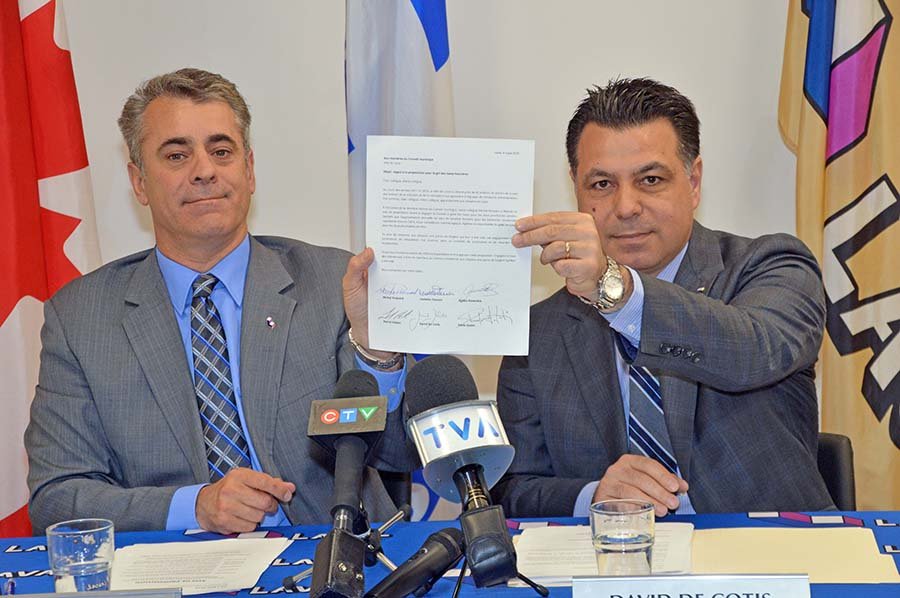
Although Vimont city councillor Michel Poissant organized the demo to draw attention to the problem in parts of his district, he received support from other elected members of the Action Laval party, including Saint-Bruno city councillor David De Cotis and Chomedey city councillor Aglaia Revelakis.

Transportation plan

Just as the city’s decision to paint blue and white safety markings on sidewalks near schools was widely criticized and eventually had to be withdrawn, Laval’s implementation of a large network of bike paths has also come under fire in some areas.

Both measures are part of a wide-ranging transportation plan implemented by Mayor Marc Demers and the Mouvement Lavallois which holds the majority of seats on Laval city council.

In an interview with the Laval News, Poissant said residents of his sector have been complaining, to the media as well as during Laval city council meetings, since the bike path was installed along Saint-Elzéar Blvd. in Vimont last August.

Vimont residents stage protest over unpopular bicycle path
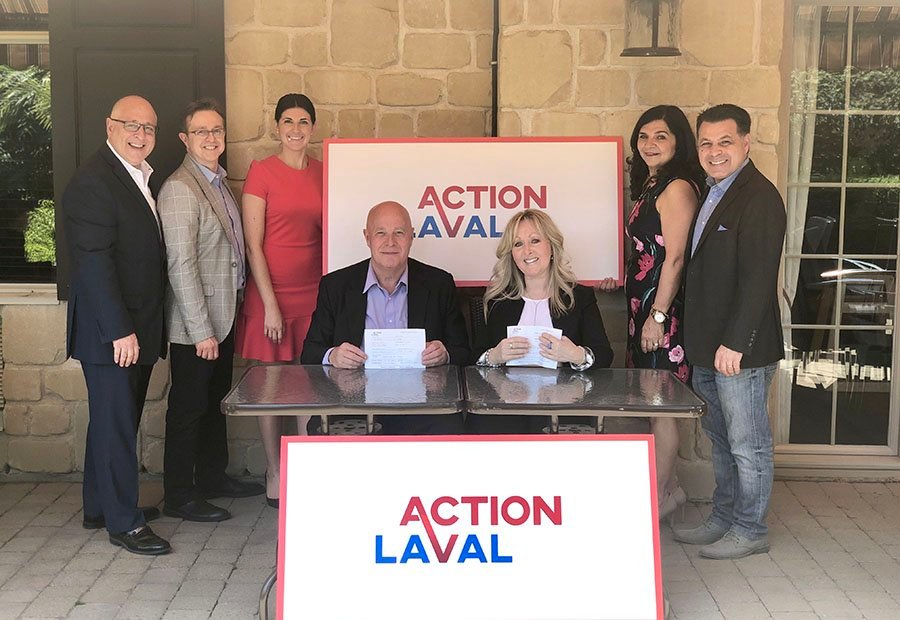
Action Laval city councillor for Vimont Michel Poissant (centre) is seen here with supporters on the steps of Saint-Elzéar church during a bike path protest last Saturday.

Bike paths criticized

Critics of the bike path along Saint-Elzéar maintain that it’s too narrow, and that it was laid down without taking into consideration the presence of senior citizens living in the area as well as people attending a community centre and Saint-Elzéar church.

According to Poissant, there is a consensus among local residents – including organizations such as the Société Saint-Vincent-de-Paul, the Chevaliers de Colomb, golden agers and others – that they never wanted the bike path and they don’t understand the city’s determination to keep it in place.

Wants city to reconsider

“It doesn’t make any sense,” said Poissant. “We are living in a democracy. But the point we are trying to make is that the city should reconsider its strategy for the deployment of bicycle paths. That’s our message.” He pointed out that Saint-Elzéar Blvd. in Vimont was formerly a narrow country road that doesn’t adapt well to the implementation of bicycle paths.

“We’re not against bike paths,” said De Cotis. “We think it’s important to get people to be out there with their bikes having physical activity. But it’s got to be done in a very responsible way to make sure that the cyclists are secure, the pedestrians are secure, the motorists are secure. And we feel that the city really didn’t take the time to make certain bike paths secure.”

Vimont residents stage protest over unpopular bicycle path
Chomedey city councillor Aglaia Revelakis, right, seen here with a bike path protester, says her district also has some dangerous bike paths.

‘Lives at risk,’ says Revelakis

Revelakis said that in her district, the safety of bike paths along Saint-Martin Blvd. remains an unresolved issue as far as Action Laval is concerned. “We’re putting lives at risk,” she said, noting that in some areas where the bike paths pass, many drivers are uncertain how they should proceed when there are bike paths.

On May 3, L’Abord-à-Plouffe city councillor Vasilios Karidogiannis (Mouvement Lavallois) issued a Facebook post in which he solicited bicycling activists to help organize a counter-protest event in response to the demo organized by Councillor Poissant and Action Laval.

Counter-protest fizzles

While there were no signs of counter-protesters in Vimont last Saturday, Action Laval reacted to Karidogiannis’s request a few days after he made it. “For Michel Poissant, Councillor for Vimont, in addition to being in ‘extremely poor judgement,’ this call for a counter-demonstration by an elected official is an affront to the democratic right to demonstrate peacefully,” said Action Laval.

Action Laval Public Safety Critic and Councillor for Saint-Vincent-de-Paul Paolo Galati called Karidogiannis’s post “irresponsible and dangerous. Mr. Karidogiannis calls on the population to block a peaceful demonstration and to ‘put Mr. Poissant in his place,’ which is intimidation.”

L’Appui invests record amounts in caregivers across Quebec

L’Appui invests record amounts in caregivers across Quebec
From the left, Sonia Lessard (executive-director of L’Appui Montérégie), L’Appui national executive-director Guillaume Joseph, and Lucie Gagnon (executive-director of L’Appui Montreal) are seen here during the organization’s press conference on May 7 in Montreal.
Martin C. Barry

L’Appui pour les proches aidants d’aînés, an umbrella group for organizations providing services to caregivers of older adults across Quebec, has announced record investments of $50 million over the next three years for caregiver support.

The sums, the largest in the history of the organization, will allow for direct services to caregivers of older adults according to their needs and depending on the different regional realities.

English caregiver support

According to L’Appui officials, who made the announcement during a press conference on May 7 at their downtown Montreal offices, the amounts will be invested throughout Quebec, to organizations offering services to caregivers of older adults in their communities.

For example, this year and next year $3,871,413 will be used to fund organizations in the Montreal region (including Laval) and $1,329,879 will go to organizations of the region of the National Capital. The investments also include sums allotted to groups providing support to English-speaking caregivers, according to L’Appui.

Services to expand

The less populated regions of Quebec will also see services expand, such as in Gaspésie-Îles-de-la-Madeleine where $558,477 will be used for projects sponsored by community organizations. In Montérégie, the organizations there will receive $2,300,000 to ensure the development of their offer while preserving their service quality.

The national executive-director of L’Appui, Guillaume Joseph, emphasized the relevance of all the projects. “We are very proud of these investments,” he told journalists. “First, of course, because the needs are there, but also because we have developed real expertise over the years. Thanks to our regional Appui offices, we are familiar with the needs and realities of the field.

Caregiver needs growing

“These are investments that will end up being converted into services directly to caregivers of seniors,” continued Joseph. “In other words, respite services, psychosocial support services and information services, as well as training.

“We are particularly proud to announce these investments because the needs are great. Caregivers are more and more numerous and will continue to be so in the coming years. Therefore it is important that there are services in place in order to answer to these needs, which can be quite different from one caregiver to another.”

L’Appui invests record amounts in caregivers across Quebec
“Caregivers are more and more numerous and will continue to be so in the coming years,” says L’Appui national executive-director Guillaume Joseph.

Resources also available

In Quebec, according to L’Appui, 65 per cent of caregivers of older adults say they don’t have access to services because they don’t know them or don’t know where to find them. This is why, in addition to funding, L’Appui says it has set up two resources to assist caregivers in their research and to support them throughout their journey.

L’Appui’s Caregiver Support Service offers personalized, free and confidential support to caregivers of older adults. The professional advisors offer support, information and references. They can be reached on weekdays from 8 am to 8 pm at 1 855 857-7784, or by e-mail at info-aidant@lappui.org. A resource directory of the organizations and their services is also available at lappui.org. It allows anyone to search by region and type of service, according to the needs of each.

An important mandate

Founded in 2009, L’Appui pour les proches aidants d’aînés is a non-profit organization funded by the government of Quebec and the family of Lucie and André Chagnon. The main mandate of L’Appui pour les proches aidants d’aînés is to help implement and fund information, training, psychosocial support and respite services that are offered by community organizations.

L’Appui also holds a role of mobilization and concertation for the various players who are dedicated to supporting caregivers of older adults and who participate in improving their quality of life. This mission is carried out across Quebec with the help of 17 regional Appui offices as well as a specific agreement for the Cree Territory of James Bay.

CAQ gov’t committee rejects planned obsolescence motion

(TLN) On May 8, a motion tabled in the National Assembly by the Liberal MNA for Bourassa-Sauvé, requesting the Committee on Citizen Relations acknowledge the petition concerning the fight against planned obsolescence and the right to repair, was unanimously rejected by members of the CAQ government.

Experts rebuffed

The adoption of the motion, supported by all the opposition parties, would have allowed four experts to be heard on the subject.

As proposed by the PQ MNA for Jonquière, they were Jonathan Mayer, lecturer at Sherbrooke University and the instigator of Bill 197 in connection with the petition, Martin Masse, founder of Zone Accro, Insertec Angus, and the Institute of the Environment, Sustainable Development and Circular Economy.

Petition by Ouellette

It might be recalled that a significant number of people from across the province supported the initiative by 51 law students from Sherbrooke University. In Fact, 45,028 citizens signed a petition tabled on April 2 by Guy Ouellette, the National Assembly Member for Chomedey.

Mr. Ouellette said he was deeply disappointed with the decision made by the government members of the Commission. The MNA for Chomedey added that “the adoption of this motion would have allowed Bill 197 to go a long way, which aims, among other things, to combat planned obsolescence and promote the right to repair.”

Against planned obsolescence

Bill 197 against planned obsolescence and the right to repair, which was tabled on April 9, aims to amend the Consumer Protection Act to ensure greater sustainability of consumer products. This Bill was completed by law students at Sherbrooke University with the help of their teacher, Jonathan Mayer, as part of a judicial interpretation course.

Planned obsolescence is a business tactic whereby manufacturers reduce the life of their products in order to speed up the replacement cycle. These practices force over-consumption and have significant and direct impact on the environment as well as the budget of Quebec consumers.

Parc des Prairies renamed Bernard Landry Park

Parc des Prairies renamed Bernard Landry Park

(TLN) During their last meeting, the members of Laval city council unanimously approved a motion to rename Parc des Prairies Bernard-Landry Park in honour of the former Quebec Premier.

“Bernard Landry was the only Quebec Premier to have also been an MNA from Laval,” Mayor Marc Demers pointed out.

In memory of

“We felt it was important to honour his memory. He was a man with heart and with convictions, a major politician and an excellent teacher. He mastered the art of teaching, of persuasion and of encouraging growth.”

Landry, who died last year, was the Parti Québécois MNA for Fabre from 1976 to 1981, and then for Laval-des-Rapides from 1981-1985. He was a key member of several governments. He served as Premier of Quebec from 2001-2003.

Toponomy commission

The decision to rename the park was following a recommendation made by the City of Laval’s toponomy commission, which is composed of residents and one city councillor.

“The toponomy commission studied the request for Bernard Landry Park and made a favourable recommendation since the new name pays homage to someone who made a significant contribution to the development, dynamism and well-being of the community,” said Councillor Yannick Langlois (district of L’Orée-des-Bois) who presides the commission.

Laval Police, SQ, RCMP mount organized crime crackdown

Laval Police, SQ, RCMP mount organized crime crackdown

(TLN) The Laval Police Department says it is working in close conjunction with the Sûreté du Québec and the RCMP following the gunning down recently of an individual suspected to be involved in organized crime at the Sheraton Laval.

During the incident in which the front door of the Sheraton was shattered by gunfire, hundreds of people, including children and seniors, witnessed as several gunshots were fired.

Project Repercussion

“We will not hesitate to double up our efforts to maintain at all cost the security of our citizens,” said Laval Police chief Pierre Brochet, noting that the gunman fired with impunity and with seemingly complete disregard for the consequences of his actions.

In response, the Laval Police, the SQ and the RCMP have launched Project Repercussion. One goal of the trilateral force will be to monitor more closely establishments in Laval known to be hangouts for organized criminals, such as bars, restaurants and other licensed establishments.

World Elder Abuse Day to be observed next month

World Elder Abuse Day to be observed next month

(TLN) Since 2017, no less than 400 citizens, partners from the municipal, community and health sectors, as well as elected officials, have been walking annually in order to underscore the importance of World Elder Abuse Awareness Day in Laval.

A seniors walk

On June 14, participants from Laval will be gathering at Parc des Prairies for the two or four kilometre walks. Participating organizations will include the Table régionale de concertation des aînés de Laval, FADOQ – Laval Region, DIRA-Laval, AQDR Laval-Laurentides and CISSS de Laval.

“To be able to provide active and quality aging to our seniors is at the heart of our priorities,” says FADOQ – Laval Region executive-director Andrée Vallée. “We thus judge it important to be a major partner on this walk which is organized with the goal of raising awareness while encouraging the proper treatment of elderly persons from the region.”

Third near now

This will be the third year for the walk, which is taking place June 14 from 8:30 am to 1 pm. The walk will be followed by a talk given by Denis Fortier, physiotherapist and author, on the importance of remaining active with aging. The walk will start from the main chalet in Parc des Prairies (5 du Crochet Ave.) beginning at 9:30 am.

To register, visit the Facebook page Laval en marche pour la bientraitance des personnes aînées, or the Web site, lavalensante.com, or phone 450 686-2339. A help line for senior abuse can be contacted at 1 888 489-2287 for additional information and support.

Weather

Laval
few clouds
-7.5 ° C
-6.9 °
-8.7 °
51 %
3.6kmh
20 %
Fri
-1 °
Sat
3 °
Sun
-7 °
Mon
-10 °
Tue
-14 °