Michel Ianri, 59, was arrested by Laval Police on July 23, 2019 on suspicion of sexual assaults allegedly committed between 1986 to 1990. Known as Mike, Ianri was the manager of an arcade during the 1980s located on Laurel Boulevard in Laval-des-Rapides. Witnesses reported that the suspect had invited minors to his home to consume drugs and engage in sexual contact. His victims were mainly young males.
Investigators from the Major Crimes Division believe that there are other unidentified victims involved. On September 18, 2019, the accused appeared at Laval courthouse charged on several counts, including sexual assault, and incitement of sexual contact (touching). He was released with conditions, and will return to court on March 24, 2020.
Anyone who has been a victim of this individual is requested to contact the Laval Police Service to file an official complaint on the INFO LINE 450-662-INFO (4636), or call 911. Please cite file LVL 180628-034.
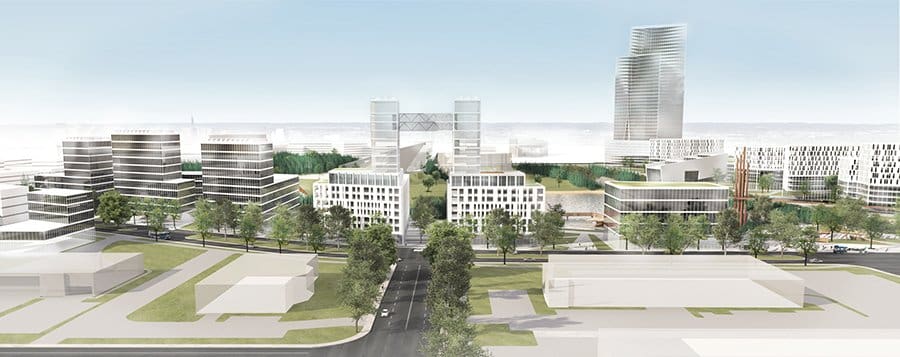
A computer-generated view of Carré Laval could look like as it is gradually developed over the next 20 years.
Martin C. Barry
The presence of two senior provincial government
ministers for an announcement that the City of Laval is pushing forward to
develop a large but underused tract of land near the downtown core was a good
sign Quebec is on board to see the project through, according to Mayor Marc
Demers.
Carré Laval, as the area is
called by Laval urban planners, is an almost perfectly square territory
measuring approximately 4 million square feet – equal to 68 football fields. It
is bounded in the east by the Laurentian autoroute, Daniel Johnson Blvd. to the
west, Saint Martin Blvd. to the north and Souvenir Blvd. on the south side.
Mostly
owned by city
While most of the 32 lots in the Carré
Laval are already owned by the city, the provincial
courthouse is located along the Saint Martin Blvd. side. As well, there is a
shopping mall occupying the corner lot at Saint Martin and Daniel Johnson.
There has also been some residential and commercial development nearby on the
site.
An abandoned and fairly deep quarry filled with water
sits behind the courthouse building. For years, the city has used a large
amount of Carré Laval’s space as a snow dump, with long lines of dump trucks making their way
on and off the site during the winter.
To develop over 20
years
The
city plans to develop the site for mixed use (residential, commercial,
institutional) over the next 20 years, with an emphasis on environmental
friendliness. For example, the Carré Laval
would be an area where automobiles would have no access, or it would be
extremely limited, although there would be lots of public transportation.
The transportation strategy calls for maximizing the
availability of public transit. As such, the plan would include the creation of
a new Metro stop in Carré Laval, which would bring to four the number of subway
stations on the City of Laval’s territory.
Among other things, Laval wants to put the flooded
quarry to good use by developing it into a lake in the middle of the city,
which would be the centrepiece of a park with a sandy beach.
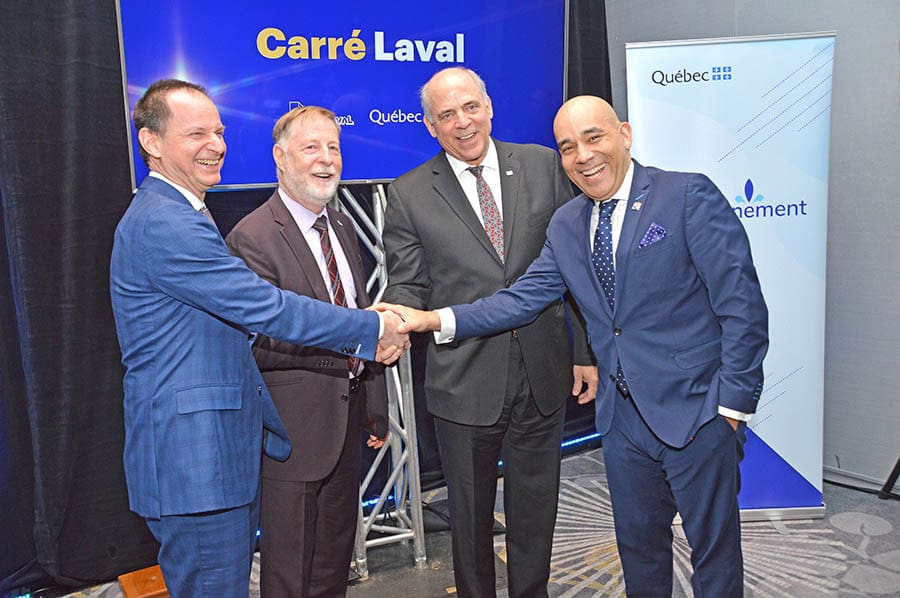
From the left, Quebec Finance Minister Eric Girard, Laval mayor Marc Demers, Economy and Innovation Minister Pierre Fitzgibbon and Sainte-Rose MNA Christopher Skeete shake hands in apparent agreement following the city’s announcement of the Carré Laval development project last Monday. Photo: Martin C. Barry
Interest
rising, says city
The city claims to have lined up as many as 20
partners interested in developing projects on the site. They include teaching
institutions and organizations with an interest in promoting
environmentally-sustainable ideas by putting them into practice in an urbanized
parkland such as the Carré Laval.
It’s perhaps also worth noting that Carré
Laval is located immediately next door to Laval’s successful Cité de la Biotech
for science-based businesses, opening the
door to potential synergies. And Carré Laval currently
has a significant amount of forest land on it that is
ideal for park development.
$10 million
from Quebec
At this early stage, Quebec is agreeing to provide the
City of Laval with a $10 million subsidy to decontaminate the land, which is
bound to be heavily soiled from years of snow dump use. However, there is
likely also to be a fair amount of additional preparation work, as the mayor
himself acknowledged that Carré Laval was used for
years to dump landfill and the ground needs to be stabilized.
Carré Laval appears to be one of the largest steps taken by
the administration of Mayor Marc Demers until now to make good on the slogan,
‘Urbaine de nature,’ which expresses the city’s long-term strategic vision of
Laval as a municipality where nature is woven closely into the urban fabric.
Members of the Sir Wilfrid Laurier Foundation board and others gathered towards the conclusion of the evening to unveil the amount raised by the 2020 Gala – $26,270. Photo: Martin C. Barry
Martin C. Barry
The Sir Wilfrid Laurier Foundation’s 202 Gala
fundraiser raised $26,270 for educational equipment, programs and resources at
schools and training centres across the Sir Wilfrid Laurier School Board’s
territory in the Laval, Laurentian and Lanaudière
regions in the coming year.
An evening
of winners
Held at the Embassy Plaza
in Laval on Jan. 23,
the popular event featured a silent
auction segment showcasing, among other things, a Montreal Canadiens jersey
signed by Habs great Guy Lafleur, sports and rock and roll memorabilia, and
many other items of art and jewelry.
The
evening’s Grand Prize (awarded to the winning “balloon” holder) was a $1,500
gift certificate for an all-inclusive trip, cruise or guided tour of the
winner’s choice. The top raffle
prizes included a $300 Apple Watch Series 3 and a Fitbit Versa worth $200. The
evening’s musical entertainment was provided by the Boogie Wonder Band.
Richard Mason, principal of McCaig Elementary School in Rosemère, must have sensed one of the raffle tickets he was buying from SWLSB chair Paolo Galati at the gala was a winner to be smiling so widely. Photo: Martin C. Barry
Laval’s
mayor attended
There was a good turnout by elected officials from all
over Laval and the North Shore areas. Among them were Laval mayor Marc Demers.
The mayor was accompanied by city councillors Virginie Dufour, Éric Morasse,
Sandra El-Hélou, Aline Dib, Jocelyne–Frédérique
Gauthier, Vasilios Karidogiannis and Sandra Desmeules.
Laval city councillors Michel Trottier and Claude
Larochelle of the Parti Laval were also guests, as were Action Laval city
councillors David De Cotis, Michel Poissant, Aglaia Revelakis, Isabella Tassoni
and Daniel Hébert. From the North Shore, Rosemère mayor Eric Westram
and Rosemère town councillor Philip Panet-Raymond were also present.
: Laval mayor Marc Demers (second from right) attended the SWLF’s January Gala accompanied by city councillors Éric Morasse, Sandra El-Hélou, Jocelyne–Frédérique Gauthier, Vasilios Karidogiannis Sandra Desmeules and others.
High
graduation rate
According to SWLSB chairman Paolo Galati who delivered
one of the evening’s addresses, the board’s schools are maintaining an 84.5 per cent graduation
rate, which is among the 10 highest scores for school commissions across
Quebec.
“We have achieved this success thanks to our 2,000
outstanding employees who ensure all our students have all they need to reach
their full potential,” said Galati, thanking the board’s teachers, staff and
administrators, many of whom attended the gala as a gesture of additional
support.
Remarkable
achievement
Christian Fréchette, chairman of the Sir Wilfrid Laurier Foundation, noted
that the foundation has raised $900,000 since it was founded. “All this would
not have been possible without you,” he said, adding that $900,000 is a
remarkable sum to be raised by a small foundation.
“I’ve said it before, but today’s students are
tomorrow’s future,” Fréchette added. “The better education they receive, the better
equipped they will be in life.”
On
December 31, 2019, a cluster of cases of pneumonia was reported in Wuhan,
China, and the cause has been confirmed as a new coronavirus that has not
previously been identified in humans. This virus is now known as the 2019 Novel
Coronavirus or 2019-nCoV.
On January
25, 2020, the Government
of Ontario reported the first case of 2019 nCoV
in Canada. The case occurred in a person who had been in the city of Wuhan in
the 14 days prior to becoming ill. Appropriate infection prevention and control
measures were followed. On January 27, the Government of Ontario reported that
the individual’s wife tested positive for the 2019-nCoV. She has been in
self-isolation at home since her husband was identified as a case. Close
contacts of these cases will be notified, monitored for signs of illness, and
given instructions for what to do if they become ill by local public health
authorities.
On January
28, 2020, the Government
of British Columbia reported the third case of 2019 nCoV
in Canada. The case occurred in a person who had been in the city of Wuhan in
the 14 days prior to becoming ill. Appropriate infection prevention and control
measures were followed.
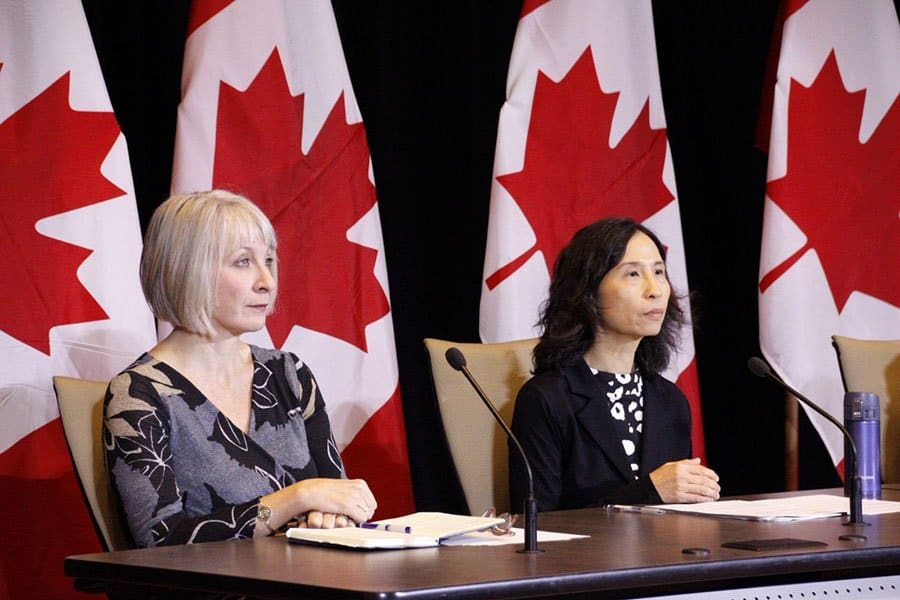
Pictured from left Health Minister Hajdu with Chief Public Health Officer of Canada Theresa Tam (photo courtesy Health Minister of Canada)
Q&A with Health Minister Minister Hajdu:
Q:
Is Canada ready to handle the spread of this novel coronavirus?
A:
Our healthcare system is well prepared to handle cases of the virus in Canada,
and we are taking all necessary precautions to prevent the spread of infection.
There are best practices in place across all Canadian hospitals to isolate
patients who are experiencing symptoms. The risk for Canadians remains low, and
our healthcare system is prepared to prevent further spread.
Q:
What is the status of the Canadian patients with the novel coronavirus?
A:
The cases in Canada are all isolated and are receiving care. The risk for
Canadians remains low. We are well prepared to deal with this virus in Canada. Hospitals
have strong infection control systems and procedures in place to limit the
spread of infection and protect health care workers.
Q:
How long does it take to confirm a presumptive case?
A:
A case remains presumptive until it can be confirmed by the National
Microbiology Lab in Winnipeg. That process is typically completed within 24
hours.
Q:
What happens if the World Health Organization (WHO) declares coronavirus a
public health emergency?
A:
Canada’s response efforts are in line with international partners. If
coronavirus declared a Public Health Emergency of International Concern, the
WHO will make recommendations to prevent or reduce the international spread of
disease. Canada is fully aligned with the WHO recommendations to date.
Q:
Is there a vaccine for coronavirus?
A:
Most people with common coronavirus illness will recover on their own. Your
health care provider may recommend steps you can take to relieve symptoms.
Consult your health care provider as soon as possible if you are concerned
about your symptoms or have a travel history to a region where severe
coronaviruses are known to occur. The sooner you get treatment, the better your
chances are for recovery.
Q:
What are you doing at the borders?
A:
Various measures are in place in the three major Canadian airports: Toronto,
Montreal, and Vancouver. Travellers going through these airports will see
additional signage in French, English, and Chinese asking them to alert a
border servicesofficer should they have any flu-like symptoms. There will also
be a health question at the kiosk for travellers coming into Canada, and border
officers are able to identify travelers that have come to Canada from Wuhan
through connecting flights.
Q:
What can Canadians do to reduce the risk of spreading this novel
coronavirus?
A:
The overall risk to Canadians remains low. If you have traveled to Hubei
province in China and develop symptoms of 2019 Novel Coronavirus infection,
avoid contact with others and follow-up with your health care
professional. Tell your health care professional if you develop symptoms,
if you have had direct contact with animals (for example: visited a live animal
market) or if you have had close contact with a sick person, especially if they
have had fever, cough or difficulty breathing.
(TLN) A fundraiser held for the benefit of the Jeux du
Québec Games
Finals being held in Laval this summer raised $141,900, according to the city.
The amount was beyond expectations.
The event was sponsored by Desjardins Entreprises and
was attended by 600 supporters. The initial had been $100,000. It took place at
the Salle
André-Mathieu at Montmorency College.
Everyone helping
Former
Olympic diver Roseline Filion, who is official spokesperson for the Finals, was
thrilled with the positive response. Mayor Marc Demers underscored the
importance of all players in the community becoming involved with their
support, including businesses.
“To
host the Finals of the Games is an honor and I am extremely proud of it,” he
said. “I am also proud to see that all the efforts made by the organizing
committee and its partners to make our region known. Proud also of all our
citizens who are preparing to warmly welcome people coming from all over
Quebec.”
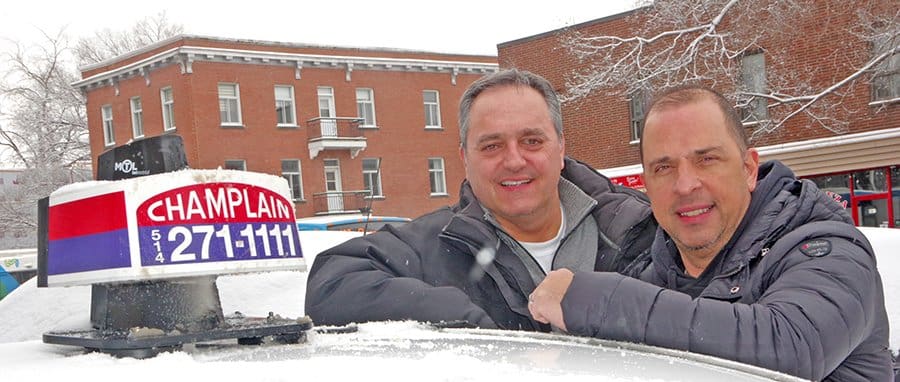
Champlain Taxi president George Boussios, right, and Champlain Taxi driver Peter Hatzis aren’t happy with the provincial government’s taxi industry, although they say it’s not going to change what they do for a living. Photo: Martin C. Barry
Martin C. Barry
With the effective elimination of any reference to
taxis in the Coalition Avenir Québec government’s Bill 17 which came into effect late last
year, a prediction Champlain Taxi president George Boussios made less than a
year ago has come true.
An accurate
prediction
In an interview with Newsfirst Multimedia in April
2019, the head of Montreal’s largest taxi service maintained that the region’s
traditional taxi industry would cease to exist within three years after the CAQ
government passed its bill to overhaul the taxi industry.
“In the law which came into effect a couple of months
ago, there’s not one mention of the word taxi,” he said last week, noting that
the overhaul now refers to “transport rémunéré” (remunerated
transportation).
As
he pointed out, the province’s new approach basically opens up the sector to
anyone willing to provide consumers with transportation services, the most
notable examples being drivers for Uber and Lyft.
No more taxi permits
Perhaps
the biggest consequence of this is the elimination of the taxi permit system.
Although the remaining taxi drivers will continue to have to pay a relatively
small sum for annual certification, drivers for car sharing services like Uber
and Lyft won’t be subject to this requirement.
More
importantly, the old taxi permits, which at one time were valued in six-figure
sums per car and driver, have been eliminated. The drastic depreciation of their
value, in conjunction with the government’s reluctance to issue decent
compensation, has left many remaining permit holders in hopeless circumstances.
Expropriated at unfair
value
Taxi
industry representatives had asked the government for a total of $1.3 billion
in compensation across the province.
Instead, according to Boussios, “they are expropriating our business at the price
of what we paid 30-40 years ago.”
He
uses this analogy: “Imagine that the government was coming to your home because
they want to build a highway, and your house is worth $500,000, but you bought
at $100,000, and they’re telling you they’re going to give you $100,000. That’s
what’s happening right now. There’s complete chaos.”
According to Boussios, some taxi drivers who are now
in their mid-80s and who originally bought their permits 50 years ago, had been
counting on being able to re-sell their permits at full value in order to pay
for their retirement.
Has to keep
driving at 85
“I have a driver who’s 85 years old who can’t afford
to stop driving,” Boussios said. “He’s working because he thought he would be
retired and re-sell it and live on that. But now he is worth zero.”
As for the future of the traditional taxi industry,
Boussios continued, “Taxi companies may be able to survive if they just change
the way they’ve been working over the last 40 years. Because now the market is
open to anybody who has a car and just a regular license.”
According to Boussios, there is an established
clientele for regular taxi service, although it is an older demographic who
like using the telephone to call for a taxi instead of an app. “That clientele
is slowly getting older,” he said.
Uber draws
younger crowd
“Every year it’s slowly going down. The younger age
group is used to the Ubers of the world, so obviously they’re going to go up
while we go down.” Still, despite the provincial government’s act of faith in
car sharing, Boussios doesn’t see much of a future for Uber and the others.
“There are just too many of drivers and not enough
work to go around,” he said, referring to the number of people who are now
driving for car share services in cities all over the globe.
As to what Uber drivers in Montreal are earning at
this point, Boussios suggested most Uber drivers are taking home around $8 an
hour after their expenses. “I personally think they’re not making any real
money,” he said.
Big
turnover at Uber
“And the actual statistics show that an Uber driver
realizes after about four months that it’s a big scam and they quit. But there
are so many new people coming in that there’s always a turnover.
“It’s manipulation in its highest form with Uber and
Lyft,” he added. “They make it sound like their drivers are partners. You’re
not a partner – you’re paying 25 per cent on every ride.”
Still, George Boussios and Peter Hatzis, one of
several hundred Champlain Taxi drivers, say they’re in it for the long-haul and
have no immediate plans to give up what they love best – providing the highest quality
taxi service to Montreal residents.
The current issue of the Laval News volume 28-03 published February 5th, 2020, (Laval’s English Newspaper) covers local events such as politics, sports and human-interest stories. It features editorials and other columns. Click on the image to read the paper.
Front page of Laval News, Vol. 28-03
February 5, 2020.
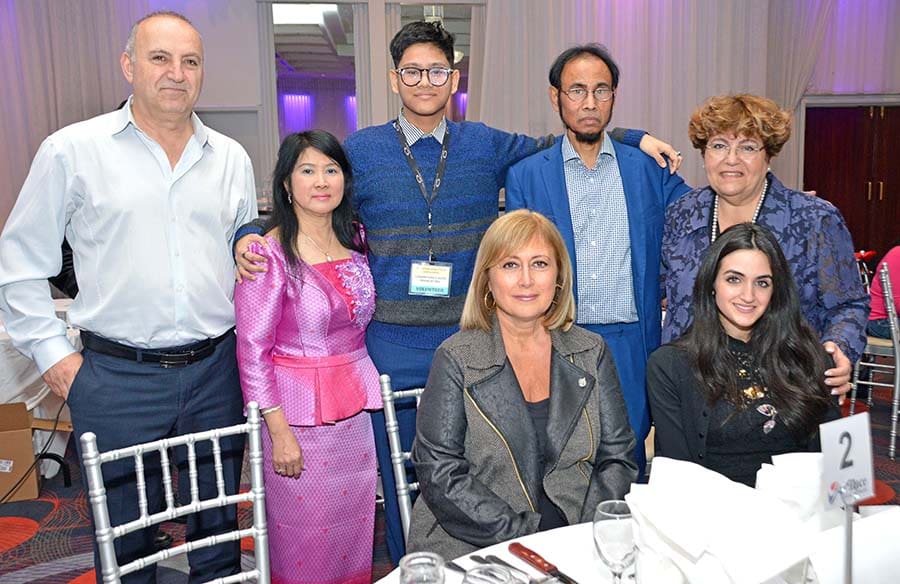
Among the guests at the Sarker Family Hope Foundation’s event (Mustaque Sarker second row second from right) were Vimy Liberal MP Annie Koutrakis (front row centre seated), Saint-Laurent MP Emmanuella Lambropoulos (far right seated), and Montreal city councillor Mary Deros (back row far right). Photo: Martin C. Barry
Martin C. Barry
The Sarker Family Hope Foundation, whose primary goal
is to create a positive living environment for children who are orphans, abused
or underprivileged in developing countries, raised thousands of dollars on Jan.
26 during the organization’s first fundraising event at the Palace congress
centre in Laval.
Children in
need
The Montreal-based group, founded by Park Extension
accounting services executive Mustaque Sarker, exists to provide shelter, food
and education to abandoned and orphaned children in several countries where
there are serious challenges.
One of the foundation’s first projects aims to build
new orphanages in identified areas of Ghana and Cambodia.
According to information provided during a PowerPoint
presentation at the Jan. 26 event, each of the planned orphanages would shelter
200 children from six to 18 years of age. The foundation hopes to raise up to
$2.2 million to establish and operate the orphanages.
Orphaned by
war
As the event’s MC, George Guzmas of Newsfirst
Multimedia, pointed out while introducing Sarker, warfare is the main reason
there are so many needy orphans in so many areas of the world.
“War is made with weapons,” he said, while noting that
in the space of just one minute, $1 million dollars worth of weapons are sold.
“And, of course, those weapons need wars, they create
wars, and wars create more orphans. The objective of the Sarker Family Hope
Foundation is to be able at least to try to save 400 children from this.”
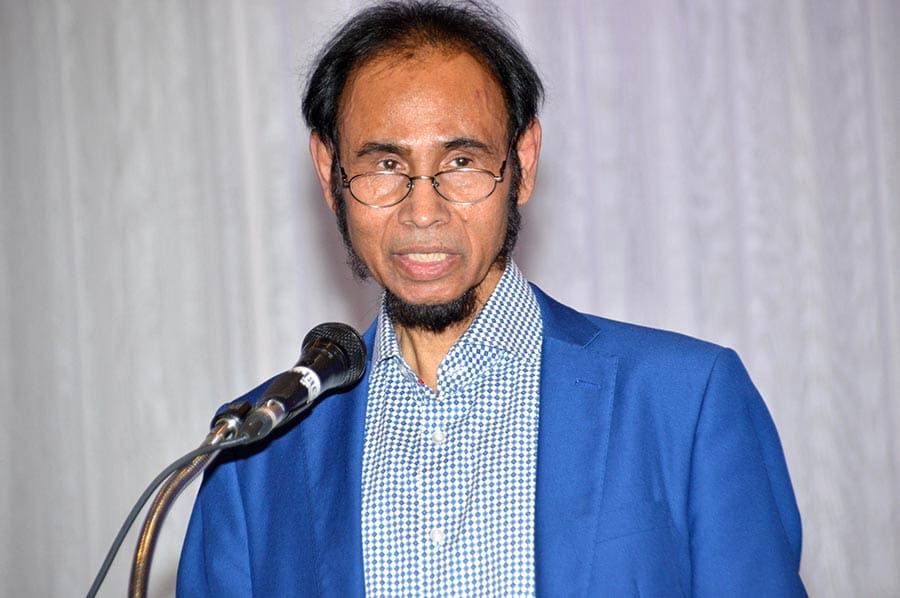
Accounting services executive Mustaque Sarker decided to launch the Sarker Family Hope Foundation after witnessing the suffering of orphaned children in developing countries. Photo: Martin C. Barry
From humble
beginnings
For his part, Sarker recounted that during his travels
to various parts of the globe, he would see children begging for money and
food. He said this marked the beginning of his efforts to create the Sarker
Family Hope Foundation.
“As a mother who has raised two sons who are 33 and 30
today, I cannot imagine the struggle and adversity that these children face
everyday,” said Vimy Liberal MP Annie Koutrakis, who was one of several
Montreal area elected officials who attended the fundraiser.
MP Koutrakis
impressed
“That is why the Sarker Family Hope Foundation is so
essential,” continued Koutrakis. “They will help to provide housing,
educational opportunities and vocational training. This is life changing for
these kids. By learning useful skills, these children will be able to emerge
from poverty and violence to contribute great things to their countries and to
the world.”
Also
among the guests, Saint-Laurent Liberal MP Emmanuella Lambropoulos, said Sarker
and the foundation were to be commended for giving children in Third World
countries a second chance.
MP Lambroupoulos
touched
“Children
who have lost their parents – who are the number one thing that every child
needs in life – they’re giving them a second chance by allowing them to have an
education, by allowing them to have some of the basic necessities of life,”
said Lambropoulos.
The
Sarker Family Hope Foundation is located at 524 Jean Talon St. West, Suite 3,
Montreal, Quebec, H3N 1R5. They can be reached toll-free at (438)795-9691, or
by e-mail at sarkerhopefoundation@gmail.com
From the left, Laval city councillor for Chomedey Aglaia Revelakis, Councillor Aram Elagoz from Renaud and Duvernay-Pont-Viau councillor Stéphane Boyer (all of whom sat on the selection committee) are seen here last week with Sainte-Rose CAQ MNA Christopher Skeete and Mayor Marc Demers at Laval city hall. Photo: Martin C. Barry
Martin C. Barry
Sainte-Rose CAQ MNA Christopher Skeete announced at
Laval city hall last week that the provincial government is awarding more than
$2 million in provincial subsidies to nine community development projects to
take place on Laval’s territory over the next two years.
Speaking on behalf of Municipal Affairs Minister Andrée
Laforest, as well as Finance Minister and Minister Responsible for Laval Éric
Girard, Skeete said a total of $2,026,074 is being allotted by
Quebec for the Laval projects.
Program’s
second year
This was the second year the CAQ government allotted
the annual subsidies under its ‘Fonds d’appui au
rayonnement des régions’ (FARR) program,
providing development funding in Quebec’s various regions.
Several Laval city councillors sat on a committee that
ultimately decided which projects and organizations should receive the
subsidies. By far the largest sum, $1.4 million, is going to the City of Laval
for the development of various local cultural projects as well as the
development of related infrastructure for cultural purposes.
Subsidy
recipients
The City of Laval is also receiving the second largest
sum, $162,000, to carry out Phase 2 of a community program to develop
entrepreneurialism in the Laval region. The Cosmodôme
is receiving $150,000 to refurbish its “space
mission” simulator for children and parents, which is a popular attraction
during space camps held at the Cosmodôme.
Other recipients of subsidies are: the Centrale des
artistes ($70,422) for a market study to develop ethnocultural annual events to
be held in various Laval neighbourhoods; Rencontre Théâtre
Ados ($45,000) to help develop new theatrical productions
for teens and children; the Office municipal d’habitation de Laval ($15,000),
to develop a new service and tools to help guide people searching for rental
housing;
“The FARR is an important instrument that allows us to support initiatives which show possibilities for positive results,” Mayor Marc Demers said regarding the subsidies received from Quebec for projects in Laval. Photo: Martin C. Barry
Local
decision-making
As well, Laval en transition is receiving $65,702 to
organize a forum bringing together various groups with ecological interests in
order to raise awareness of environmental issues; and the Réseau
des bois de Laval is getting $45,000 to build a theme pavilion for this group which
promotes the protection and interests of the various forested park lands in
Laval.
“Our government is giving to the elected officials of
Laval the means to develop and sustain promising projects for the region,” said
Skeete. “The projects which were announced today show us the vitality that
exists in Laval today in several areas: community, social, cultural, tourism
and environmental. They will without any doubt raise awareness of our region.”
“The FARR is an important instrument that allows us to
support initiatives which show possibilities for positive results for the whole
community,” said Mayor Marc Demers.
‘A major
investment’
“Thanks to the money that’s been accorded, the
organizations and partners will have the means to take positive measures
through projects that answer to the needs of the population. These projects
bear witness to the energy and creativity that thrive on our territory.
“What’s more, thanks to the agreement reached with the
Ministry of Municipal Affairs and Habitation, a total of $2.8 million will be
invested over the course of the next three years as part of the implementation
of the Plan for Cultural Development in the Laval Region. This represents a
major investment that is exactly in keeping with the cultural vision Laval has
taken.”
A citizens’ group that is lobbying the
Montreal airport authority to
cut down aircraft noise has succeeded at least in getting Aéroports
de Montréal’s undivided attention with a smartphone
app, outpacing a rival group that is currently pursuing class-action lawsuits.
Montréal-dB, which publishes the AÉROplainte app, recently
released the initial results of its airplane noise monitoring activities for
2019.
Last year, 519 unique opt-in users of the AÉROplainte app
filed 32,224 airplane noise complaints with Aéroports de Montréal (ADM), according
to Montréal-dB’s data.
Unreported
complaints
While all other airports in Canada report airplane noise
complaints that they receive, Montréal-dB founder Bill Mavridis claims the ADM has been
under-reporting airplane noise complaints since 2013 by following a policy of
only reporting one complaint per person per day.
However, Mavridis added that ADM announced in 2019 that it will start reporting all
airplane noise complaints that it receives. The data has been available since
the beginning of this year and is reported monthly on their indicators page.
Effects
of plain noise
Based on the distribution of complaints by postal codes,
potentially a total of 1,594,171 residents of the Montreal Metropolitan
Community, including Laval, are affected by airplane noise, says Mavridis.
The group plans to publish an annual report by the end of
February that will be distributed to stakeholders in an effort to encourage
effective change at the ADM. According to Mavridis, the report will present
more detailed results and make recommendations for improving Montreal’s
aircraft noise soundscape.
Mavridis said that mapping of Montréal-dB’s complaint data confirms that the problem of
airplane noise is widespread.
Support is
increasing
“This
small change would bring the airplane traffic to the Anjou industrial park area
where, at an altitude of 5,000 ft, planes will project less noise to the ground
and affect fewer residents,” Mavridis said in an interview last week with
Newsfirst Multimedia.
Founded in October 2018 as Montreal Indivisible,
Mavridis changed the name to Montréal-dB in September 2019 when the organization began
receiving several thousand dollars in subsidies from the Borough of
Ahuntsic-Cartierville and from local city councillors.
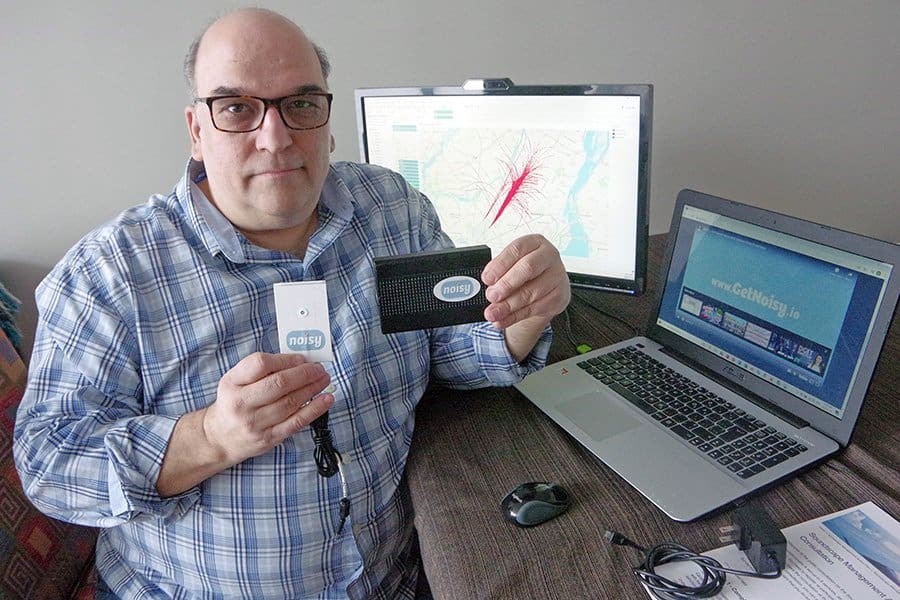
Montréal-dB founder Bill Mavridis is seen here with components for the new aircraft noise monitoring network he hopes to implement with the help of Montrealers impacted by plane noise above their homes. Photo: Martin C. Barry
Microphone
system coming
In conjunction with the AÉROplainte app, Montréal-dB plans to deploy a network of sophisticated
microphones to monitor airplane noise all over the city, in order to reduce this
to raw data that could be used to formulate scientifically-founded complaints.
A self-employed investment councillor working from
home since 2015, it was around then that Bill Mavridis first began to seriously
notice the amount of aircraft noise being cast down upon his neighbourhood in
otherwise tranquil Ahuntsic-Cartierville.
“I sat down with my son and said this is ridiculous –
the problem is getting worse,” he said. “And if it was bad for me, how bad was
it for the people living right under the flight paths? So I decided this was
something that required some activism to get the point across.”
App
forwards complaints
After examining some of the data the ADM was releasing
on the number of complaints about plane noise it claimed to be receiving,
Mavridis suspected they weren’t telling the whole truth, and so decided to do
something about it. “We needed to find out,” he said. “And we found out by
creating the app.”
Out of his own pocket, he paid an app designer $500 to
handle the task. Once AÉROplainte started to
be downloaded, anyone who wanted to report a plane noise incident could activate
the app and fill out a complaint form which was forwarded to the ADM’s automated
online complaints system.
ADM takes
notice
“All of a sudden the ADM was receiving thousands and
thousands of complaints,” said Mavridis, noting that the app saves a carbon
copy of each complaint in Montréal-dB’s database. So after initially ignoring Montréal-dB,
ADM officials finally agreed to meet and talk with Mavridis a few months after
the app started flooding them with complaints.
The next step for the technically-savvy Bill Mavridis
and Montréal-dB is the impending implementation
of the microphone system. He located a company in California which manufactures
a relatively inexpensive automated airplane noise tracking system.
Want to join the effort?
Mavridis
is currently seeking out residents of Montreal areas impacted by plane noise
who’d be willing to install one of the mics (which interface with a personal
computer) in order to contribute to Montréal-dB’s
growing database of plane noise incident data. This in turn would be used to
motivate the ADM into taking real action.
Montréal-dB isn’t the only citizens advocacy group that has been
pursuing the ADM to do something about the plane noise issue. However, the
other, known as Les Pollués de Montréal-Trudeau,
has opted to follow another route: legal action. They
currently have class actions pending against the airport authority.