(TLN) More than 500 of the 2,100 students graduating
from Collège Montmorency this spring gathered in the Salle André-Mathieu
auditorium on May 27 for a ceremony during which they received certificates and
diplomas from director-general Olivier Simard, director of studies France Lamarche
and other college officials.
In
an address, Mr. Simard congratulated the graduates, while commending them for
believing in themselves and working diligently towards their goals with passion
and perseverance.
At the same time, he paid homage to the efforts made by their professors and teachers, other members of the staff, as well as the family members and friends who provided support to the students during their studies. Since 1969 when Collège Montmorency was first established, the college has graduated 52,100 students.
The 2019 Alexandre Despatie bursary went to Laval gymnast Laurie Denommée, regarded as one of the rising hopes nationally in the highly disciplined sport.
(TLN) On May 28, a total of 234 medallions were
awarded to promising young athletes from all over Laval during the 61st
Mérite sportif lavallois ceremony.
Athletes,
coaches, family members and friends were welcomed by Laval city councillor for L’Orée-des-Bois
Yannick Langlois who was representing the mayor, as well as Geneviève Cossette,
president of Sports Laval.
In
addition, the young athletes were able to hear the encouraging words of the
evening’s special guest of honour: Jean-François
Ménard, an Olympic trainer specializing in mental preparation who has worked
with some of the world’s leading Canadian Olympic contenders.
The evening’s special guest was Jean-François Ménard, who has trained Canadian Olympic contenders in mental concentration.
Many young athletes
Among
the athletes honoured this year were track and field players, badminton
players, boxers, cheerleaders, fencers, gymnasts, hockey players, judo, karate
and taekwondo practitioners, figure and speed skaters, synchronized skaters,
cross country skiers, as well as table tennis and volleyball players. Of the
234 medallions, 12 were gold, 38 were silver and 184 were bronze.
The
2019 Alexandre Despatie bursary was awarded to Laurie Denommée, a rising star
in gymnastics. She is recognized as one of the country’s leading hopes in this
discipline. A gymnast since age four, she is hoping to become part of the
Canadian team at the 2020 Olympics.
June 7-13 – All of the police forces throughout the
province are participating in a week-long campaign aimed at reducing speeding
on the roads. Officers in Laval will be keeping an eye out for drivers with a
heavy foot during this week. Anyone caught speeding will face a heavy fine.
Speeding remains the number one cause of most accidents
involving deaths and injuries on the road.
Repercussion Takes
Shape, Affranchir Gets Results
June 5 – After the brazen murder of Salavtore Scoppa that
occurred at the Laval Sheraton last month, Laval police initiated project
Repercussion, aimed specifically at targeting organized crime operations.
Last week, Operation Affranchir mobilised 235 officers
who served 20 warrants in 12 cities including Laval, Montreal, Terrebonne,
Saint-Lin- Laurentides, Sainte-Anne-des-Plaines, Saint-Eustache and
Sainte-Adèle. The raids targeted a drug network responsible for the production,
distribution and exportation of large quantities of synthetic drugs.
The investigation began in 2018 when Canadian border
agents seized 200 packages sent from Laval that contained 200,000 counterfeit
Xanax pills, worth more than $560,000. The packages were headed for the United
States, England, and Australia.
All told, the searches yielded:
The arrest of 14 individuals,
The seizure of nearly 1 kg of cocaine, one ounce
of crack, and 19 kg of methamphetamine powder (capable of producing 400,000
pills)
23,000 pills
One industrial pill press, capable of producing
40,000 pills per hour, and one cocaine press
8 firearms, 2 assault rifles, a .12 gauge
shotgun, a bullet-proof vest, a silencer, and other weapons,
$30,000 cash.
Child Knew Her
Kidnapper
June 4 – A 54-year-old woman from Beloeil was arrested
when police found a missing 8-year-old girl handcuffed in the back of the
woman’s car.
After the school reported the child’s absence to her
mother, she immediately called for police help.
Authorities reacted quickly. By working jointly with the
Régie intermunicipal police of Richelieu-Saint-Laurent, officers were able to
rapidly locate and apprehend the suspect.
The girl from Vimont had been missing for approximately
ninety minutes. She was otherwise unharmed.
The kidnapper was known to the child, and had approached
her in a vehicle on the way to school that morning.
The woman is facing multiple charges including
kidnapping, unlawful confinement, and disguise with intent.
Cycling Cops Raise $45K for Opération Enfant Soleil
June 3 – After pedaling more than 1000 km over six days,
cyclists who took part in the Laval police fundraiser for Operation Enfant
Soleil were able to present the non-profit organization with a cheque for
$45,000.
Sixteen officers took part in this year’s 22nd annual fundraiser
for Opération Enfant Soleil.
The cycling tour has raised more than $1.6 million since
its creation in 1997, helping support intervention for child victims of
violence and therapeutic centres for adolescents living with drug problems.
People,
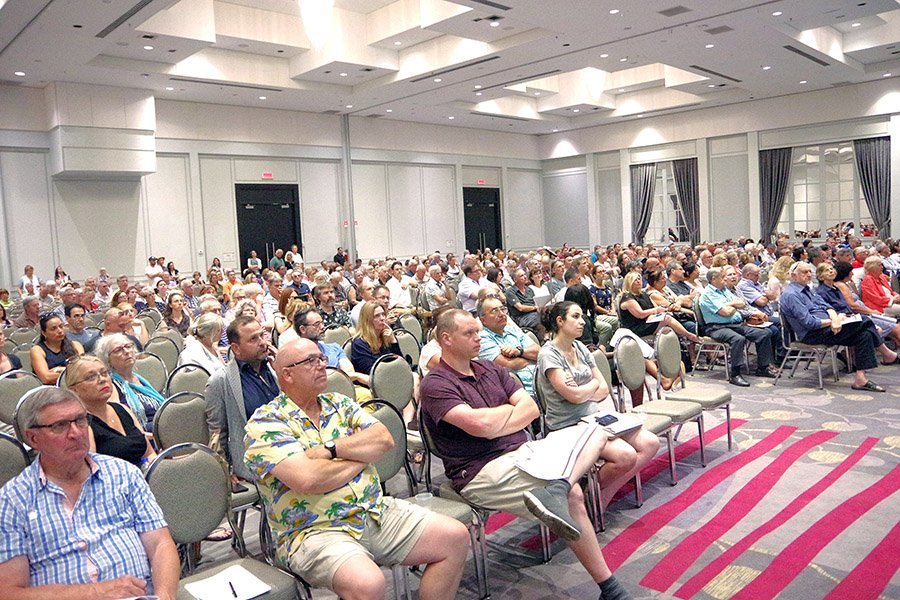
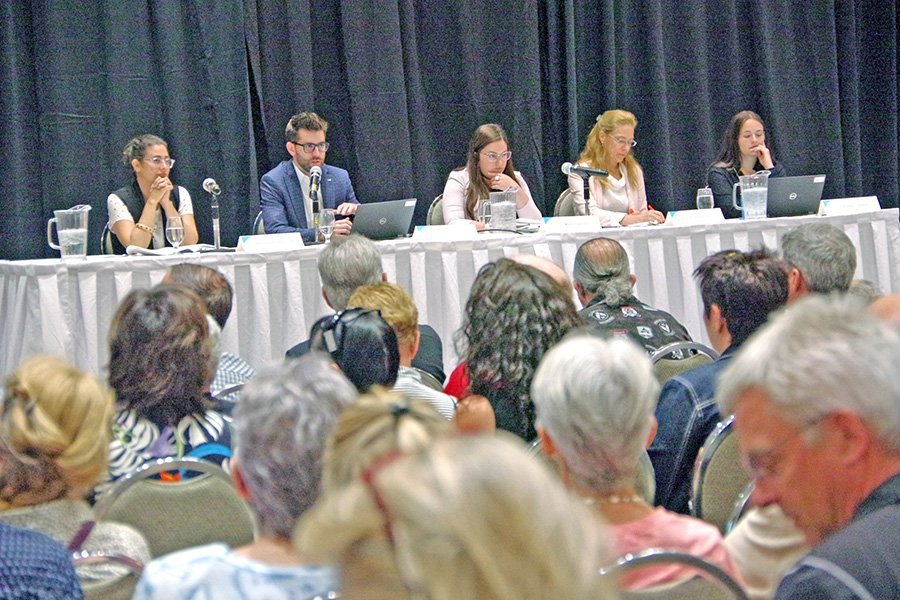
people, more curious people. At least 200 citizens crammed the June 4th
Laval City Council meeting. The opposition, under David De Cotis’s leadership, invited
taxpayers to attend the session in support of Councillor Michel Poissant’s request
to freeze municipal taxes for the next two years. Laval sits on $555.2 million
surplus, and $42 million retrieved from the financial misdealings of former Mayor
Gilles Vaillancourt’s administration.
Booming
treasury
According
to Poissant, Laval coffers have accumulated excess funds over the years. To
him, it demonstrates lack of consideration by the Demers administration for the
middle class already among the highest taxed in Canada. “Worrisome indeed,” stated
Poissant who jumped the Demers ship, joining Action Laval, last March.
Last
month, Poissant moved for a two-year residential tax freeze as of 2020. At this past week’s meeting, the debate
didn’t hit the table until 11:00 pm, since it was arguably declared out of
order. Council chair Christiane Yoakim denied comments or questions on the
surplus. The issue finally emerged, following the Ordre du Jour, a seemingly
endless agenda. By then, most attendees
had left the meeting.
Earlier
in the meeting, Councilor De Cotis was asked by a citizen when the tax freeze
would take effect. “It should take place today for two years, even four, there’s
a way to freeze taxes,” he responded, before the chair cautioned that his time
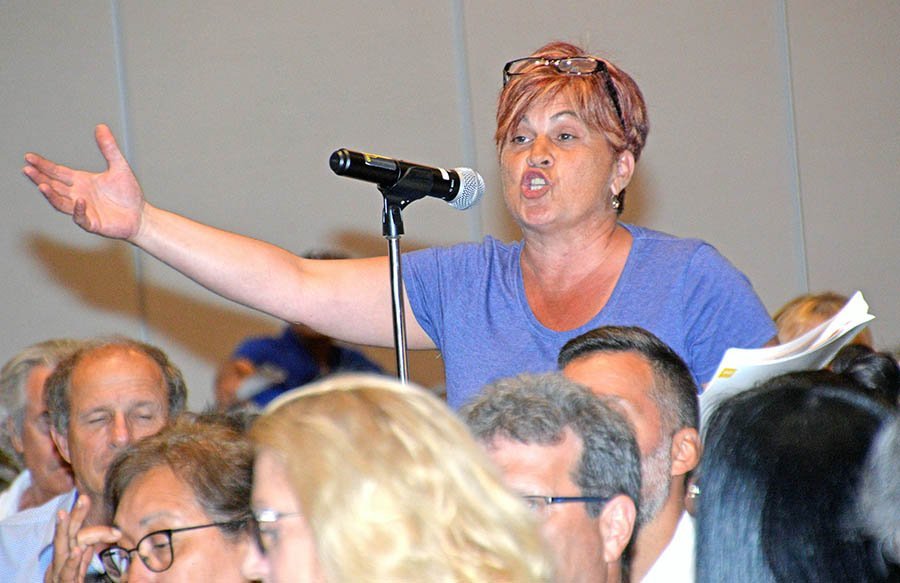
was up, ordering him to sit down. “Absolutely
not,” retorted De Cotis, standing ground, invoking his right to speak as an
elected people’s representative. Heated confrontation ensued, tension evident
in the crowd.
Indirect
returns to taxpayers?
Mayor
Demers, in his defense, stated that some accumulated funds are being dispersed
among Laval children in different forms.
He did not specify amounts or organizations. He did add that “money is already
given back in free transportation for seniors.” Councilor Stéphane Boyer
stated, “There must be a tax distinction. $42 million (from Vaillancourt) only
comes once, and that goes fast.”
Reference
of expenditures was made to roads, parks, street drains, at $400,000. $45 million for the next ten years was quoted.
Councilor Poissant quickly responded, but he too was shot down. “You don’t have
the floor, Mr. Poissant, please sit down.”
Poissant’s body language spoke tons.
The opposition
persisted, launching a war of words with the chair, with Councilor Paolo Galati
joining De Cotis and Poissant in the fray. The heat was on. Demers reminded De
Cotis that the budget was examined together.
“What will it cost to resolve all the problems brought here?” the Mayor
asked. De Cotis, attempting rebuttal, was again silenced by chairperson Yoakim
whose plea amounted to – “Are you trying to make my life difficult?”
Poissant
pointed to financial documents citing figures which would substantiate tax
freezing. “Why are you only looking at current accounts?” asked Demers.
Councilor and STL (Société de Transport de Laval) president Erik Moras told the
mayor there was no mention of a Laval Metro extension. “The project ends in
Montreal.” De Cotis added “It isn’t in the plan, not that it isn’t intended.”
Councilor
Claude Larochelle proposed an amendment to Poissant’s motion, a one-year freeze
for 2019-2020. “Not a good idea to do it
for two years since the budget isn’t known.” Poissant responded that 95% of the
budget is always known in advance, giving the Demers administration a lesson in
accounting.
The one-year
amendment was defeated, as was the two-year motion. Unsurprising to the
Opposition, the depleted Demers group which still enjoys a sizeable majority on
Council unanimously blocked the tax freeze.
Tempers
flare, citizens livid
The
June meeting was laced with multiple complaints from various sectors of the
Laval citizenry, including council members. At question period, Councilor Galati
angrily demanded that the chair apologize for stopping a citizen from repeating
a question. “It’s lack of respect. Apologize
to that gentleman,” he shouted. No apology came.
Parent
Namouner Rabah complained of discrimination and intimidation by Chomedey Soccer
Club against his child who wasn’t allowed to play and wasn’t given an
explanation. He told TLN that city hall, aware since last November, has done
nothing, his phone calls unreturned.
Action
Laval member and candidate Vivianne Monette pointed out that Equinoxe
Levesque’s zoning isn’t respected. “There are urgent issues, Mr. Mayor. You did
nothing, and that makes you no better than the Gilles Vaillancourt gang. Actions
talk, not empty words. This has become a long and complicated dossier because
of negligence. Mr. Mayor, I assure you
that if you don’t act within the law, you will find me in your way, and your
masks will fall,” she warned. Several other citizens’ complaints also seemed to
fall on deaf ears.
From the left, Laval Junior Academy interim-principal Eric Ruggi, Laval Junior Academy student Samantha Tardif and SWLSB chairman Paolo Galati are seen here with special needs service dog Wall-E.
Martin C. Barry
The outlook is positive for students with anxiety
disorders and special needs at the Sir Wilfrid Laurier School Board’s Laval
Junior Academy and Crestview Elementary School with the official arrival of two
service dogs to provide comfort and focus in moments of stress and emotional
need.
Laval-based
Asista and the SWLSB, with the help of partner Nutrience pet foods, held a
launch for the service dogs on May 27 at Laval Junior Academy, where one of the
dogs has been providing assistance for the past two and a half years.
Service dogs
Facility dogs, trained in obedience and specialty
cues, are used in work settings following training in specific techniques which
enable the dogs to serve as a tool and a motivator, thus enhancing the
accomplishment of goals.
Introduced
to the gathering of school board, company and municipal officials were the two
dogs: Hope the Labrador who will be stationed at Crestview Elementary, and
Wall-E who will be gracing the halls at LJA.
Along
with many other dogs trained by Asista, Hope and Wall-E will be doing their
part to help the students in their daily activities at both schools.
‘Out of the
box’ thinking
“At the Sir Wilfrid Laurier School Board, we pride
ourselves for thinking out of the box and finding innovative ways to ensure all
our students succeed,” said SWLSB chairman Paolo Galati, while adding that as
an educational organization the school board needed to adapt its ways to the
growing student population.
“Autism,
anxiety disorders and other mental health illnesses are on the rise and the goal
of the Facility Service dog program is to provide an open, accessible
environment for both students and adults,” said John Agionicolaitis, spokesperson
and co-founder of the Asista Foundation.
Dogs helping students
According
to LJA interim-principal Eric Ruggi, Wall-E’s role among the students is
diverse. “He helps students in difficult situations, either social or
educational,” he said. “His presence allows students a chance to interact in a
controlled setting with an animal to overcome their fears and apprehensions. He
visits classrooms to assist students with special challenges by helping them
cope with their emotions.
“He
will know if the tension in the room is rising,” continued Ruggi, “and will
instinctively seek out students who are in distress. He helps prevent the
escalation of a given situation. In a group setting where the dynamics can be
difficult, Wall-E provides first a distraction, and finally a connection in
order to ease tensions. Wall-E is part of our day to day school life.”
According
to Ruggi, Asista is in the process of training a second service dog for Laval
Junior Academy – a Golden Retriever named Enzo. “He already started last week
and he will continue until the end of this school year and into the next year,”
said Ruggi.
Wall-E, left, and Hope are seen here in the auditorium at Laval Junior Academy during the SWLSB’s service dog program launch on May 27.
Helping reduce bullying
Experts
in the training of service dogs say the
dogs help to reduce bullying in the school community, increase school spirit
and de-escalate high stress situations. Each
service dog is medically insured to cover any accidents or illnesses that may
occur. Each service dog is also vaccinated and cared for carefully to maintain
proper health and hygiene.
LJA student Samantha Tardif said she benefited
enormously from the presence of Wall-E. “I used to not really want to come to
school – I used to have really major bad anxiety attacks,” she explained.
“Without Wall-E or Asista, I don’t know what I would personally do, because
there’s not that many foundations that would actually do what they do.”
Other Asista projects
In
addition to its work with the SWLSB, Asista has also been working with the
federal government to help veterans, while also helping develop standards for
service dogs in Canada.
The
non-profit organization’s mission is to provide service dogs for people who are
dealing with mental health issues. The foundation’s primary goal is to maintain
a therapeutic relationship between the individual and the dog to help them cope
in difficult settings.
Asista
says it is the only foundation in Quebec that exclusively offers certified
service dogs for people with PTSD. Its vision is based on matching the right
dog to the right person. Their dogs come from shelters and are selected
based on their traits.
When
the foundation was established in April 2012, Nutrience (produced by a
subsidiary of the Montreal-based Hagen Inc.) became involved and has been
sponsoring Asista ever since. According to Asista, the demand for their dogs is
exceedingly high and is rising quickly.
A little more than a year after Chomedey-based Agape
social services took a bold leap forward with the opening of their new Laval
English-speaking Seniors’ Wellness Center, friends and members gathered at the facility
on Notre Dame Blvd. last week for a first-year anniversary celebration.
Something to celebrate
Nearly
40 people accepted an invitation to be there, including Chomedey’s Member of the National Assembly Guy Ouellette.
A self-serve “potluck” buffet was served. Ouellette
spoke and delivered a message of congratulations to everyone associated with
the Seniors’ Wellness Center.
The Seniors’ Wellness Center has been operating thanks
to a two-year subsidy provided through Quebec’s Ami des Aînés program, as well as guidance received from the Community
Health and Social Services Network.
Funding for another year
The
staff at Agape are hoping that a new source of funding for the Seniors’
Wellness Center materializes by next year, failing which they will be exploring
alternate ways to keep the center running.
“We’re hoping to get government programs that support
us once more,” said Ian Williams, Agape’s staff social worker.
“If not, then we may have to look into other forms of
fundraising such as membership fees, which the seniors seem to be willing to
do. But ideally it would be free at all times. We would exclude membership fees
if we could.”
English-speaking
seniors
With the new centre, Laval’s English-speaking seniors
have been able to participate in presentations on health, learn about the
resources available to seniors who prefer to be served in English, take part in
special activities, and receive referrals for their social service needs.
The center is located on the third floor at 3860 Notre
Dame just east of Curé Labelle Blvd. The building has an elevator and there is a large
parking lot on the side and in the rear.
The current issue of the Laval News volume 27-12 published June 12th, 2019, (Laval’s English Newspaper) covers local events such as politics, sports and human-interest stories. It features editorials and other columns. Click on the image to read the paper.
Front page of Laval News, Vol. 27-12
June 12, 2019.
Seen in the photo are former Laval communications employee Caroline Jodoin, Laval chief of communications Louis-Philippe Dorais and Catherine Erazola of the city’s communications department.
(TLN)
The City of Laval recently won two awards for excellence in its communications
with the public. The awards were presented during a recent evening sponsored by
the Association des communicateurs municipaux du Québec (ACMQ).
A
campaign by the city’s communications department promoting Laval à vélo won a Plume d’excellence award. The strategy included
video, social media, posters and TV coverage. Olympic track and field medallist
Bruny Surin was recruited as a spokesperson.
The city’s communications department also won an award
for a print-media campaign promoting outdoor activities, and Laval’s public
libraries won an award for using social media to promote library services among
youngsters from the ages of 10 to 14.
Laval, June 10, 2019 – Rallying Opposition Forces in Laval was a commitment made by Action Laval’s interim leader and president, Achille T. Cifelli, when he took the party’s leadership. It is therefore with great pleasure that he announces the adhesion, by signing a membership card, of Francine LeBlanc and Gilles Boudreau to his party.
“The unification of the Opposition parties is
a necessity to offer a real alternative to the actual administration, Laval
needs a team that listens to its citizens, for real“, said Achille Cifelli.
Since
the 2017 election, Action Laval has
positioned itself as a party of openness and unification against Marc Demers’
administration. Without an office paid by the taxpayers, but with a team of
committed and determined volunteers, the party was able to pull out and win
over Laval’s citizens, supporters and elected officials from all political
horizons. The party’s objective: to replace Marc Demers’ administration with an
administration that is truly attentive to the needs of Laval residents, in
order to offer them the services and a community life that meet their
aspirations.
It
is through this philosophy that Francine LeBlanc and Gilles Boudreau, both
former officers of the Official Opposition Party, have joined Action Laval.
For Gilles Boudreau, Parti Laval’s
candidate for Vimont in 2017 and former party treasurer, Action Laval
represents the best alternative to Marc Demers’ team: “Action Laval is light years away from Parti
Laval, it is not a one-man-party but a team that truly works for the benefit of
all Laval residents, that is open to ideas, new initiatives and innovation. It
is an honour for me to join this great family and it is together that we will
show the door to Marc Demers and his team in 2021!”.
For Francine LeBlanc, who until recently
was Vice-President of Parti Laval’s Board of Directors, her membership in
Action Laval is a revelation: “Action
Laval is first and foremost a team and a big family. My membership in the party
is a continuation of my desire to serve my fellow citizens and to make a real
difference in Laval, as part of a united team whose objective is not only to
promote the candidacy of a single man.
There are difficult choices that can be made, and signing my membership
card was not one of them. I encourage all Laval residents to come and work with
us, because yes, now I can say us!”.
In
conclusion, Action Laval’s Interim Leader and President, Achille Cifelli,
welcomes his two new members while reiterating his commitment: anyone of good
faith who wishes to work for his fellow citizens is welcome! “It is together, and only together, that we
will be able to make a difference in Laval”.
About Francine LeBlanc and Gilles Boudreau
Francine LeBlanc: With a very impressive professional career in health and education, Ms. Francine Leblanc, a nurse by profession, is currently a senior medical representative for a large pharmaceutical company. Until recently, she was vice-president of the Board of Directors of Parti Laval.
Gilles Boudreau, CPA: Mr. Gilles Boudreau is an accountant and a trained administrator, having held outstanding senior management positions in Canada, United States, Mexico, Switzerland and Hong Kong during his career. He is now a consultant in the administration field. Mr. Boudreau was Parti Laval’s candidate for the Vimont district in 2017, coming in second with just over 23% of the vote. He also served as treasurer of that party.
Laval auditor-general Véronique Boily notes in her annual report that tracts of protected farm land in Laval have been purchased in recent years by business interests “who were not agricultural entrepreneurs.”
Martin C. Barry
In a report on the City of Laval’s management
performance that is politely restrained despite its criticism, Laval
auditor-general Véronique Boily raises questions about
the Demers administration’s continuing failure to protect Laval’s once vast
agricultural lands – some of which have been snapped up in recent years by
development speculators, adds Boily.
City falls behind
In
a statement issued when the report was tabled last week, Boily’s department
noted that in 2016 the city adopted its first Agricultural Zone Development
Plan (PDZA) for the period up to 2020. However, the city didn’t bother to
measure the increase in the area of cultivated land, whose target set by the
plan is 10 per cent.
In
addition, she added, the city “has not taken the steps needed to acquire
regulatory tools to prevent the spread of fallow land and restore it for
agricultural purposes.”
Developers in the wings
In
an executive summary of the 186-page report, Boily points out that Laval’s
agricultural lands are located squarely in the middle of a vast market for farm
products in the greater Montreal region. Even so, the City of Laval appears to
be ignoring this.
While
noting that Laval hasn’t bothered since adoption of the PDZA to inventory the
rise and fall in the number of agricultural properties being cultivated or
lying fallow, Boily suggested that land acquisitions made by property
developers “can have important consequences” on attaining the goal set out in the
PDZA.
City officials say certain agricultural areas in Laval are protected from development, despite an auditor-general’s report indicating developers have been buying farm lands all the same.
Non-agricultural ‘speculators’
According
to Boily, in 2012 alone more than 84 hectares of land zoned agricultural in
Laval were purchased “with the possible aim of speculation by businesses whose
activities have nothing to do with the agricultural sector.” As well, she
added, in 2018 at least 62 hectares of agricultural lands were acquired by two buyers
“who were not agricultural entrepreneurs.”
The report comes in the wake of some renewed concern
among agriculturalists in Laval about the city’s neglect of the farming sector.
Farmers
critical of city
Among those who raised the issue recently was Gilles
Lacroix, a Laval-area farmer who spoke during a public consultation on May 21
on the ongoing development of Laval’s master urban plan.
“You talk about protecting the agricultural
territory,” said Lacroix, noting that the city has failed to turn its words
into action and isn’t providing any incentive to keep agricultural land owners
from abandoning their properties.
After presenting her report to journalists at Laval
city hall, Boily was asked by The Laval News to elaborate on her comments about
the involvement of development speculators in the purchase of agricultural
lands.
Land’s being
bought, says Boily
While pointing out that the status of Laval’s
agriculturally-zoned areas is officially protected and that this effectively
should prevent them from being used for any other means, she said nothing
stands in the way of development speculators purchasing farm lands.
“These lands get purchased,” she said. “On the other
hand, they cannot use them for purposes other than what is provided for in the
law.”
But the question remains: Why would property
developers, who have converted vast tracts of Laval’s more than 95-square-mile
territory from a once rural landscape to one that has gradually been urbanized,
want to acquire agricultural land if the law says they can’t use it for
anything other than farming?
Laval auditor-general Véronique Boily tabled her annual report at Laval city hall on June 5.
De-zoning
possible, says expert
Among those present during the presentation of the
auditor-general’s report was Guy Debailleul, a University of Laval
associate-professor of agricultural economics and co-president of the Institut
Jean-Garon which conducts research on the use of agricultural territories.
While agreeing that generally speaking provincial law ensures
that the status of agriculturally-zoned land can’t be changed, he suggested
applications for de-zoning can be made to remove the protected status from
certain portions of agricultural territory.
“There can be requests made to the Commission de
protection du territoire agricole, which has a quasi-legal status of sorts, and
individuals or municipalities may ask for modifications in the zoning for
particular purposes,” Debailleul said.
De-zoning
farm land now rare
He noted that de-zoning protected agricultural land
has been done more commonly for autoroute construction, for example, but in
exceptional cases also for residential development – although much more rarely.
According
to former Fabreville city councillor Michel Trottier who leads the Parti Laval,
de-zoning of farm land in Laval was fairly common under the administration of
former mayor Gilles Vaillancourt, whose discredited governance ended in 2012. Trottier
said the practice came to a halt the following year with the election of the
Demers administration.
De-zoning ‘impossible,’
says Trottier
While
acknowledging that applications for de-zoning can be made to the provincial
commission, he said the buck would stop here in Laval because of the protected
status accorded in Laval’s master urban plan by the city.
As
for the property developers who’ve purchased land in the protected agricultural
areas, Trottier suggested the acquisitions were made before the law came into
effect. “It would be impossible to de-zone as things are now,” Trottier
insisted.