Home Blog Page 18

Laval Residents Stranded Amid Air Canada Strike

By Matthew Daldalian, LJI Reporter

Air Canada passengers across Canada and abroad were left scrambling last week after more than 10,000 of the airline’s flight attendants took to the picket line. The strike, which lasted from Aug. 16 to 19, grounded flights at the peak of the summer travel season and affected nearly half a million people worldwide.

The walkout ended after a tentative deal was reached between Air Canada and the Canadian Union of Public Employees (CUPE), but backlogs continued for days as travellers tried to make their way home.

“I can’t even explain the emotional rollercoaster that we went through,” said Laval resident Rosy Trimboli, the uncertainty turned her family’s first trip to Europe into a drawn-out ordeal. “It’s been hell to say the least.”

The Flight

Trimboli’s return flight to Montreal was scheduled for Sunday, Aug. 17. On the Thursday previous, she received an early notice warning of potential disruptions. Before she knew it, Air Canada flights were grounded, and her family’s return was suddenly in question.

Attempts to reach Air Canada took hours, with spotty Wi-Fi connections and long waits on hold. When she finally connected with an agent, she was told her original flight was still technically intact— meaning the airline could not yet rebook her family onto a competitor. The only other option was to reschedule for later in the week.

“It was like a real-life gambling decision on the spot,” she said, describing the pressure of deciding whether to rebook or hold onto her original flight. Faced with uncertainty, Trimboli tested her luck: her eldest would fly alone on Thursday, while the rest of the family would follow Friday through Frankfurt. Hours later, news broke that a tentative agreement had been reached.

Under Canada’s Air Passenger Protection Regulations, airlines are required to rebook customers on other carriers if flights are cancelled. But because strikes are considered beyond an airline’s control, Air Canada is not obligated to cover additional costs like hotels or meals.

Still, the carrier expanded its policy, pledging to reimburse “reasonable” out-of-pocket expenses such as lodging and transport for travellers affected between Aug. 15 and 23.

For Trimboli’s family, the uncertainty stretched over days. As they weighed their options, they also booked a separate set of refundable tickets at a steep cost.

“Hours of searching and thinking and how can we get out of here,” Trimboli said. “We were just throwing money to get home.”

Ultimately, the family cancelled those tickets, hoping the rebooked Air Canada flights would hold. The decision added to an exhausting stretch of second-guessing and mounting costs, including multiple Airbnbs and meals for the extra days.

Air Canada expects most delayed passengers to be rebooked by the end of the week, though it acknowledged that clearing the backlog will take time.

After a Cruise

While Trimboli grappled with uncertainty overseas, other Laval residents faced similar challenges closer to home.

Christine, who asked that her full name not be published, had just disembarked from a cruise with her family of five when she discovered their return flight was cancelled the night before departure. With limited phone access on the ship, she scrambled for alternatives.

Flights back to Montreal quickly became unaffordable, so Christine cobbled together a patchwork itinerary through the northeastern United States. Her family eventually flew into Albany, New York, then drove across the border to Laval.

“It was chaotic and stressful,” she said, adding that a looming hurricane in Florida only heightened the pressure.

Part of her frustration came from how little information she could get from the airline while trying to make arrangements. She also questioned why action from authorities only came once flights were already grounded. “What’s even more disappointing, to be honest, is that the government didn’t get involved at all before this,” she said.

Despite the disruption, Christine said she had no resentment toward the crews who formed the picket line. “I totally agree that these people should be paid from the moment they get on the plane and not just when they’re in the air,” she said. “I absolutely sympathize with the flight attendants.

Labour Issues

The tentative agreement with CUPE includes annual raises over four years and, for the first time, pay for work done on the ground. Newer attendants would see a 12 per cent increase retroactive to April, while those with more seniority would receive eight per cent. Salaries would continue to rise gradually, with the cap moving from $80,000 to $88,000.

Ground pay would also be phased in, starting at half an hourly wage and rising to 70 per cent by the end of the contract. Union members are expected to vote on the deal between Aug. 27 and Sept. 6.

For Zareh Asparian, another Laval resident, the strike meant turning a weekend trip to Edmonton into a cross-country road journey. He had travelled with his wife and daughter for a skating certification event, only to find return flights to Montreal repeatedly cancelled. After exploring connections through the country and even the U.S., he and his family were left without viable options.

Instead, they extended their car rental and drove the 3,700 kilometres back to Laval over three days.

“There are worse things in life,” he said. “But where I have a hard time is… you can’t leave people stranded.”

Asparian said he supports fair pay for flight attendants but called striking as a tactic “outdated”. “I think things could be handled in a much more professional manner,” he added.

Back to Work

This summer’s unrest is not the first time Air Canada passengers have found themselves caught in the middle of a labour dispute. In 2011, flight attendants and ground crews staged separate walkouts over pensions and wages, only to be forced back on the job through federal legislation. The following year, pilots protested imposed contracts with coordinated “sick-outs,” disrupting hundreds of flights before Ottawa again stepped in.

Similar tensions have flared before, including a nationwide strike in 1998 and repeated disputes after Air Canada’s merger with Canadian Airlines in 2000. Labour unrest has been a recurring challenge for the country’s flagship carrier.

The strike was the first since 2011 to defy a federal back-to-work order. Labour Minister Patty Hajdu invoked Section 107 of the Canada Labour Code, which grants the government power to intervene in work stoppages deemed disruptive to industrial peace. Critics say the measure undermines unions’ bargaining leverage, while advocates argue it protects the travelling public.

For many passengers, the broader debates about contracts and labour law mattered less than the immediate toll of being stuck far from home. Trimboli said the hardest part was the lack of clarity. “I was just hoping for a bit more transparency as opposed to a little bit every day of like, here, you’re cancelled, we don’t know,” she said.

Air Canada has encouraged passengers to submit claims for reimbursement. However, some travellers may face long waits for resolution as CBC reported that Canada’s complaints backlog is already at more than 87,000 cases.

For Trimboli, the experience left a lasting impression. “People told me there are worse places to be stuck. But there’s nowhere in the world that you want to be stuck when you just want to get home,” she said.

Quebec MNA pushes plastic production cap

By Matthew Daldalian, LJI Reporter

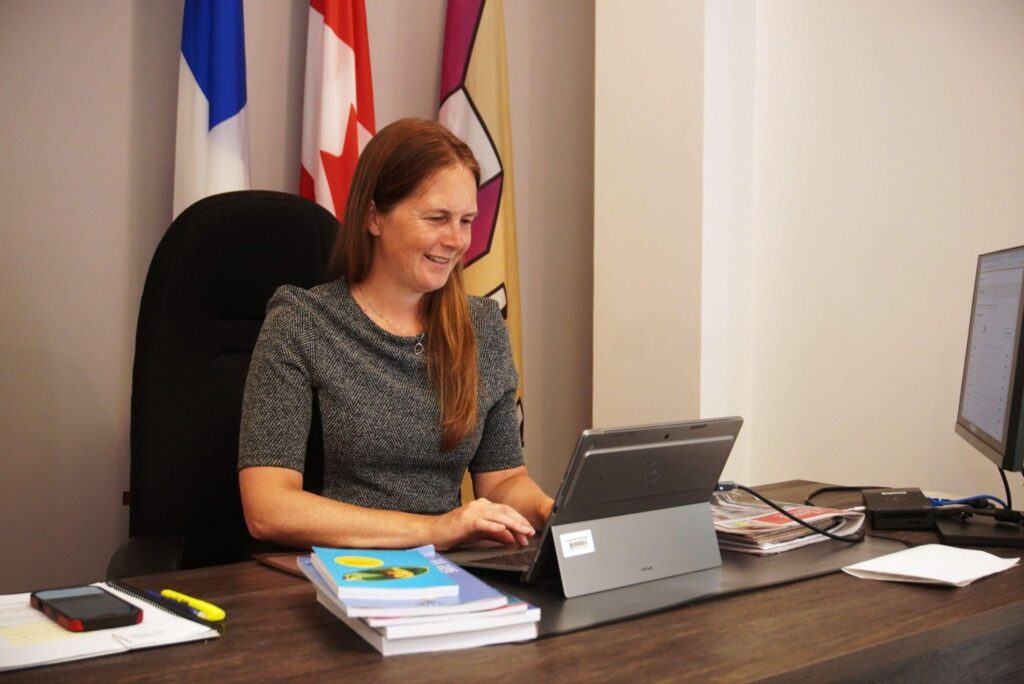
Quebec Liberal MNA Virginie Dufour sitting at her desk in her constituency office on August 18 2025. (Photo: Matthew Daldalian, Newsfirst Multimedia)

The collapse of international treaty negotiations in Geneva earlier this month has renewed calls for tougher measures against plastic pollution from Quebec Liberal MNA Virginie Dufour.

Dufour, who represents Mille-Îles and serves as the official opposition critic for the provincial environment minister, said the outcome highlights the urgency of stronger national and provincial action.

The MNA recently joined the Interparliamentary Coalition to End Plastic Pollution (ICEPP), a network of about 50 parliamentarians from more than 30 countries working to curb plastic waste worldwide.

In the lead-up to the talks, she sent a letter to federal environment minister Julie Dabrusin urging Canada to take a hard line at the negotiating table. The Geneva meetings ended without an agreement, after Canada and others rejected what Dufour described as a “really, really weak” draft treaty.

Dufour warned that relying solely on recycling will not solve the problem, noting that much plastic still ends up in the environment or is incinerated. She argued the focus must shift toward reducing production itself if the goal of ending plastic pollution is to be achieved.

“My goal was to make sure that Canada would have strong leadership in those treaty negotiations and not accept, you know, a treaty that does not address the real issues,” Dufour said.

From Plastics to Microplastics

For the MNA, the issue extends beyond waste management to a mounting public health concern.

“We don’t realize, but we all have microplastics inside, you know, our blood, in our head. And, you know, we know it’s a health issue,” she explained.

With Quebec’s health system consuming more than half of the provincial budget, she argued that a precautionary approach is necessary to limit future costs and protect public health.

Quebec’s Role

Dufour said a global reduction target would translate locally into greater responsibility for producers, pointing to recent changes that make them accountable for handling municipal recycling.

“Everything we put in the blue bin now is handled by the producers of those products. And so hopefully they will start to use less plastic or at least use those that are recyclable,” she said.

Dufour pointed to a Terrebonne pilot project where restaurants switched to reusable utensils and dishes. Initially resistant, she said many changed their minds after subsidies helped them adopt the system and they quickly saw savings from reduced waste.

Plastic Production

Internationally, Dufour is calling for a cap on plastic production. She said output keeps rising every year, and without firm limits or targets, it will be impossible to bring production down.

She warned that well-intentioned local policies can backfire if not part of a broader strategy. As a former Laval city councillor, she recalled debates over banning thin plastic bags: “Everywhere where they banned those thin plastic bags, the production of plastic increased,” she said.

Next steps

Looking ahead, Dufour said she will continue pressing the issue both internationally and in Quebec.

“I’m gonna try to have more conscience about microplastics and the risks that are linked to them,” she said. “I would like the government to invest more in [microplastic] research. Municipalities are not equipped to filter them.”

Dufour said stronger efforts are needed to develop alternatives to plastic, warning that some replacements—like chemically treated cardboard straws—can be even more harmful than the plastics they replace.

Despite setbacks in Geneva, Dufour remains committed. “I am determined to continue my involvement with the ICEPP to contribute to the fight against plastic pollution, a real poison for human health and the environment,” she said in a statement on August 15.


In a previous version of this article, Virginie Dufour was described as the official opposition critic for the federal environment minister. She is the critic for the provincial environment minister. The article also referred to a Montreal pilot project on reusable utensils and dishes. The initiative is located in Terrebonne, not Montreal.

The Laval News regrets these errors.

Laval teen builds future on two wheels

By Matthew Daldalian, Local Journalism Initiative Reporter

The future of cycling infrastructure is already here for one Laval teen – Video by Matthew Daldalian

Streets in the greater Montreal area are changing. Bike lanes continue to expand, more BIXI e-bikes are finding themselves in street corners, and debates over cycling infrastructure keep dividing residents. While critics say the changes squeeze already-congested roads, supporters argue they mark a step toward cleaner, more sustainable transportation.

For 15-year-old Marc-Anthony Mourad, that future is already here.

Childhood Hobby

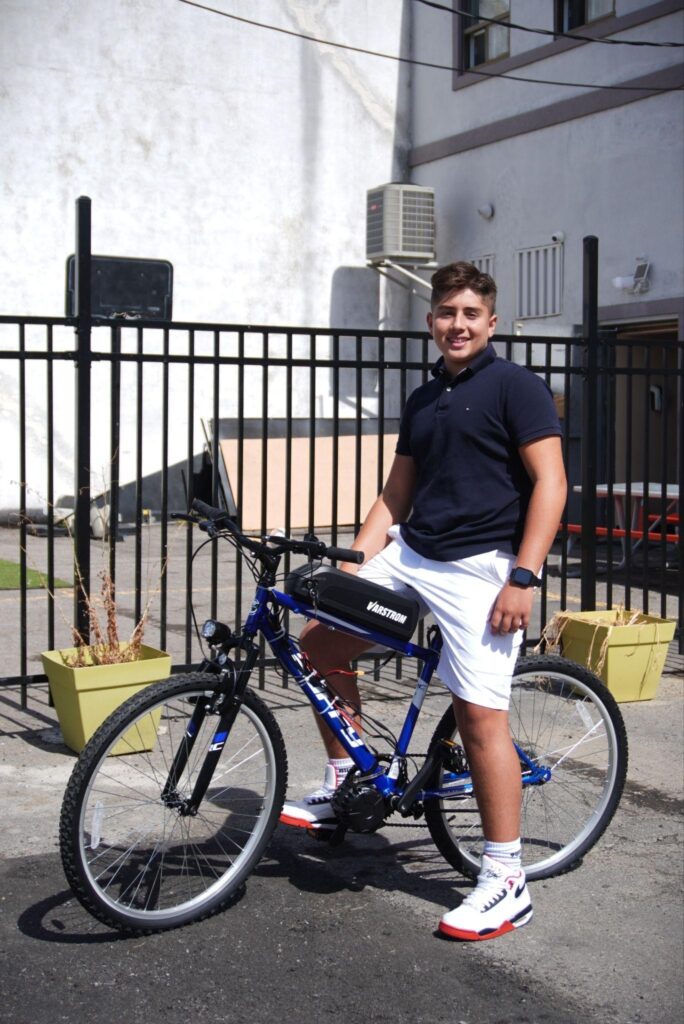
Over the summer, the Laval Senior Academy student dedicated himself to building e-bikes and showing other kids how to do the same, running workshops that turned regular bicycles into battery-powered rides.

“I was always into those kinds of things, you know, mechanics and electricity,” Mourad said. “I would always watch videos on electric bikes. I was like ‘man, I wish I had one’.”

The idea combined his childhood hobby of tinkering with power tools alongside his grandfather with his fascination for electric vehicles. He designed the bike to run on drill batteries and presented it as a project for the Hydro-Québec Super Expo-Science competition back in April.

His entry tied into five United Nations sustainability goals, from clean energy to sustainable cities, and he documented the process on his YouTube channel Marco E-Rides.

That work caught the eye of Tami Belhadj, Director of Club Techno at the Centre Lavallois de Ressources Éducatives et Culturelles (LREC).

“He actually made an e-bike by himself […] he was very autonomous, and I was really impressed with his work,” Belhadj said. “So, I invited him to come to Club Techno and we discussed: ‘can you teach other kids to do what you did?’”

The eager Mourad agreed. Over the summer, he ran workshops where participants— some younger than him, others older— built e-bikes using conversion kits. He prepared theory lessons, step-by-step slides, and even played instructional videos from his YouTube channel as students followed along.

Building Bikes

With grant funding, the centre purchased Walmart bicycles and online motor kits. Over several weeks, the workshops produced five functioning e-bikes.

“By turning a traditional bike into an e-bike, they understand the ins and outs of this technology,” Belhadj said. “Hopefully it gets them to think about career opportunities in these industries in the future.”

The next step, Belhadj added, is to build a solar charging station so the bikes can be borrowed and returned like a “BIXI-type service.”

The LREC’s Club Techno, organizes technology workshops, environmental projects and summer programs for local youth. Belhadj’s past initiatives have ranged from composting and eco-houses to hands-on STEM activities, all aimed at linking education with sustainability.

For Mourad, the project was as much about inspiring others as it was about building machines. “When you have an idea, put your mind to it and don’t stop until you get there,” he said.

Teen engineer Marc-Anthony Mourad sitting upon one of the e-bikes built by participants of the summer e-bike workshops outside the Centre Lavallois de Ressources Éducatives et Culturelles (LREC) (Photo: Matthew Daldalian, Newsfirst Multimedia).

E-bikes and Infrastructure

Experts say e-bikes like Mourad’s are transforming how people move through cities.

“[E-bikes] allow you to cover longer distances with less effort,” said Ahmed El-Geneidy, professor at McGill University’s School of Urban Planning. A regular cyclist might travel five or six kilometers in a day, he explained, but an e-bike doubles that, opening access to jobs, groceries and other opportunities without relying on a car.

El-Geneidy said Mourad’s approach— converting traditional bikes into electric ones— could make the technology accessible to more Montrealers. “If we have someone here who can commercialize it and sell it in Montreal, that will put us ahead of many places around the world,” he said.

But challenges remain. Store-bought e-bikes can cost between $3,000 and $5,000, making them a target for theft. Montreal’s cycling infrastructure also lags behind demand, according to El-Geneidy, with faster e-bikes and scooters sharing space on narrow bike paths. “We need to expand our bicycle network and make sure that we have enough space for cycling in general,” he said.

Still, Mourad is convinced electric vehicles are the path forward, with home-built models replacing gas alternatives. “If we continue on this path, our world will become a lot cleaner and we’ll have a more sustainable future,” he said.

For now, though, he’s focused on finishing secondary school, applying to CEGEP, and slowly but surely working on his next invention.

Accident shuts down A-440 westbound

By Matthew Daldalian, LJI Reporter

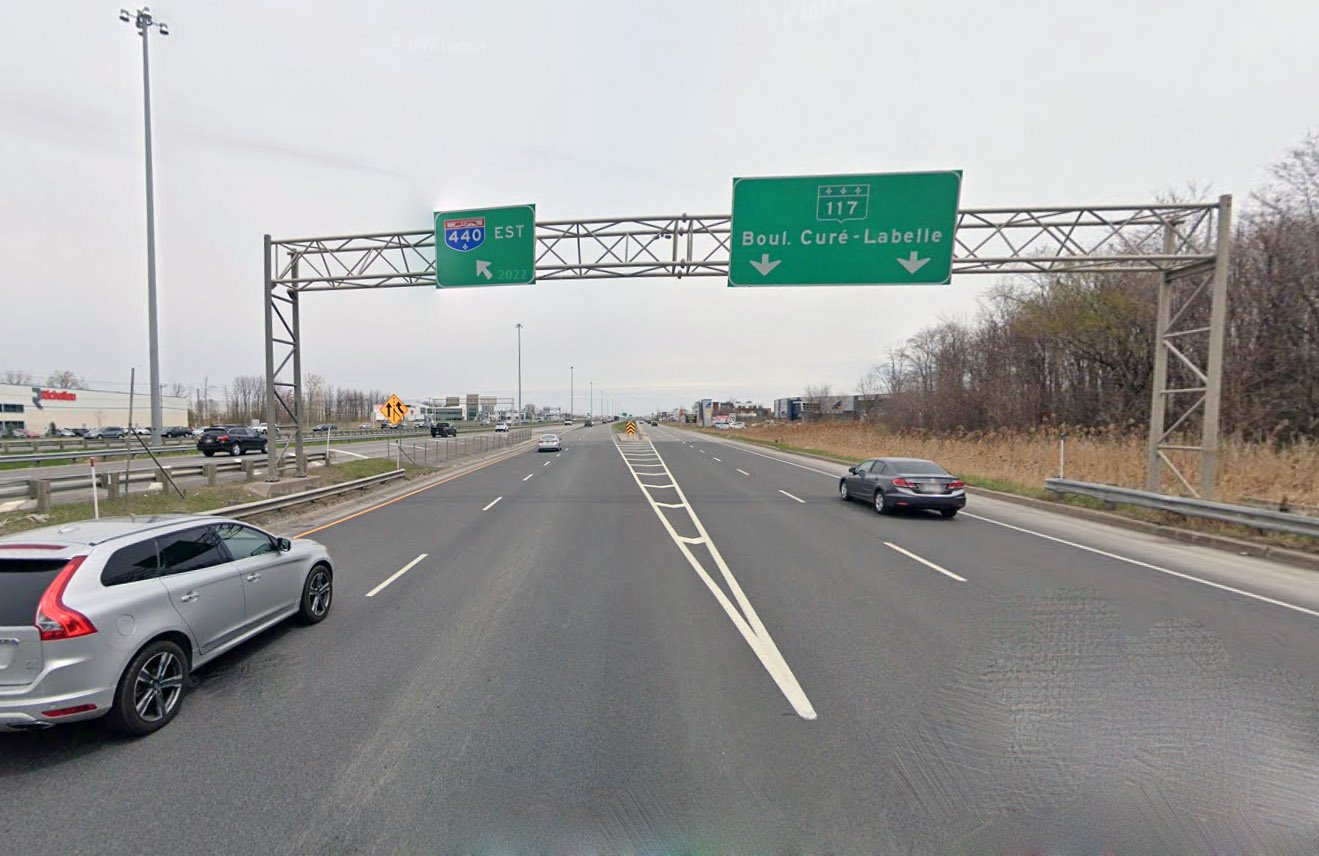
An accident shut down westbound lanes of Autoroute 440 at the height of Route 117 in Laval Thursday morning, forcing drivers onto detours as crews responded.

The closure initially involved both lanes of the highway, with officials warning it would remain in place for an undetermined period. Significant traffic congestion was reported in the area, as westbound drivers were redirected onto the local road network.

Police later confirmed the incident was caused by a container truck that snagged overhead electrical wires along the service road. The closure stretched between boulevard Curé-Labelle and Autoroute 13.

Hydro-Québec teams were dispatched to carry out emergency repairs. No injuries were reported.

By early afternoon, the service road had been partially reopened, though motorists were still advised to plan for delays as crews continued working in the area.

Laval News Volume 33-16

0

The current issue of the Laval News, volume 33-16, published on August 27th, 2025.
Covering Laval local news, politics, and sports.
(Click on the image to read the paper.)

Fire heavily damages single-story Fabreville home

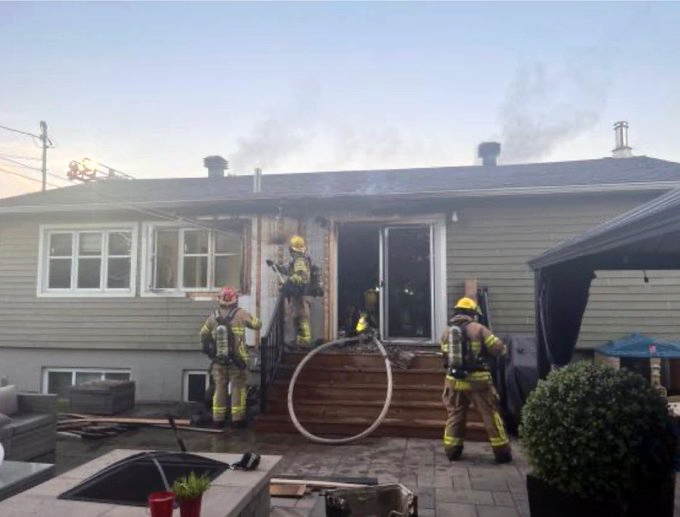
A one-story house on Éric Street in Fabreville suffered substantial fire and smoke damage on Monday August 18 after flames that started on an exterior rear balcony spread to the roof of the home.

An initial distress call from the owners was received by 9-1-1 operators around 5:30 am and the occupants were reported to have evacuated about five minutes later.

Although Service de sécurité incendie de Laval firefighters reported the situation as under control in around 45 minutes, an estimated $100,000 in fire and water damage had been done by then.

Laval Police fail to intercept Sainte-Rose car thief

On Friday August 8, the Laval Police needed the help of several officers as well as the canine squad to try and track down the perpetrator of a car theft near the Sainte-Rose neighbourhood.

Just after 5:30 am, 9-1-1 received a call notifying them that a grey 2024 Lexus had been stolen in nearby Fabreville.

With modern tracking technology being what it is now, it wasn’t long before the LPD were able to locate the vehicle, which was in motion around 6:55 am as it rolled along Autoroute 440 going west near Saint-François.

Although the police made an initial attempt to intercept the vehicle, the driver refused to stop.

Given that the morning rush-hour was coming up, the officers decided not to engage the vehicle in a chase because of the risk to the public.

Two Highland cows get loose in Sainte-Dorothée

A pair of Highland cows that escaped from their owners in Sainte-Dorothée over the weekend hadn’t yet been taken back into captivity as of last Monday morning.

The owners, who had just purchased the livestock, reported to police that the cows, which are longhaired and have prominent horns, escaped from a transport trailer on avenue des Bois.

They were last seen fleeing southward into farm land. The owners, who are from the Quebec City area, said the cows were not bred in Laval, hence they are not familiar with the territory.

The owners warned that, although the animals are not considered dangerous, it would be inadvisable to run after them.

They said they might respond to offers of apples or carrots to keep them in place until help arrives to recapture them.

Artists and sculptors showcased their best in Laval’s Vieux Sainte-Rose

More than 20,000 attended the 29th annual Symposium de Ste-Rose

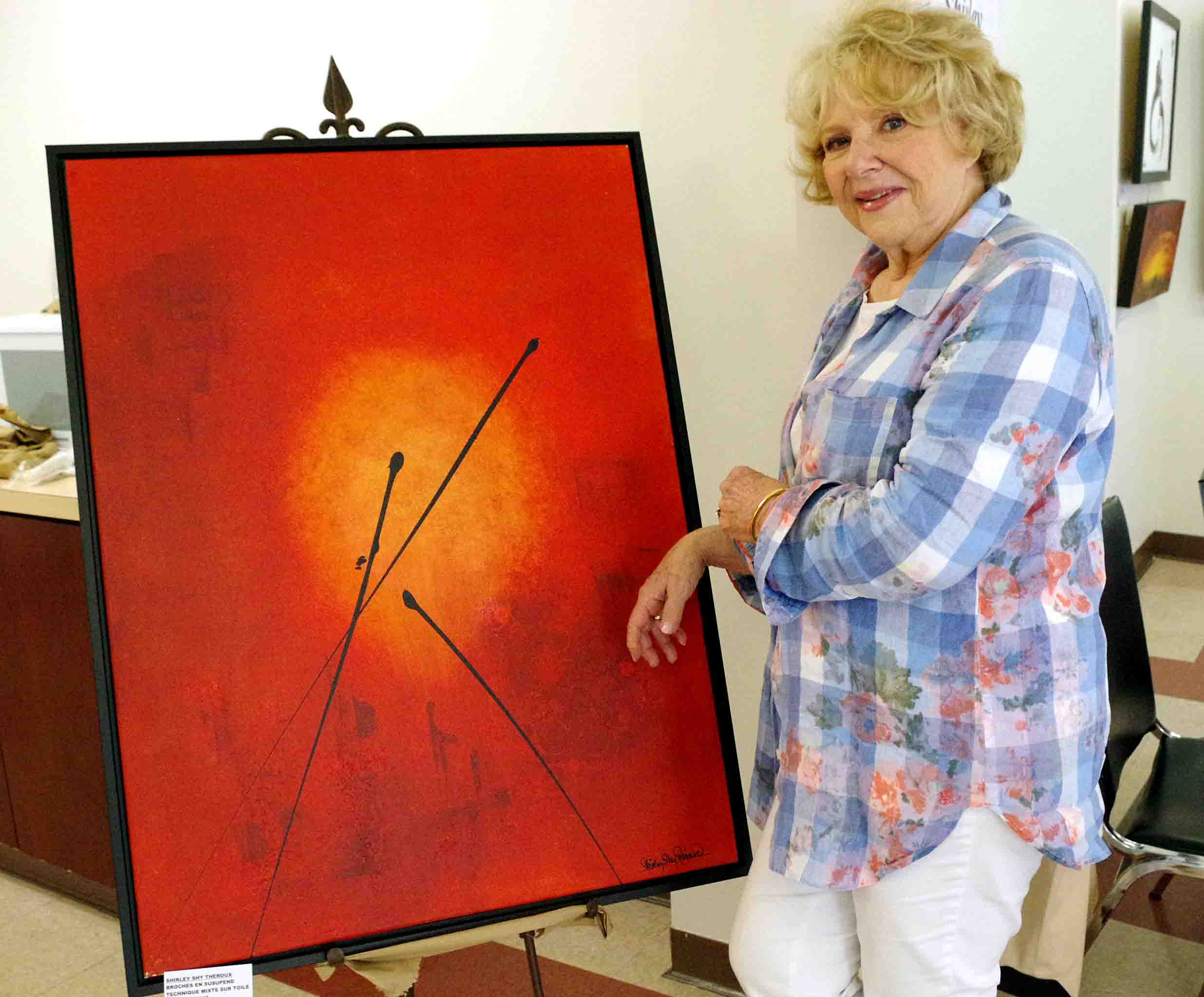
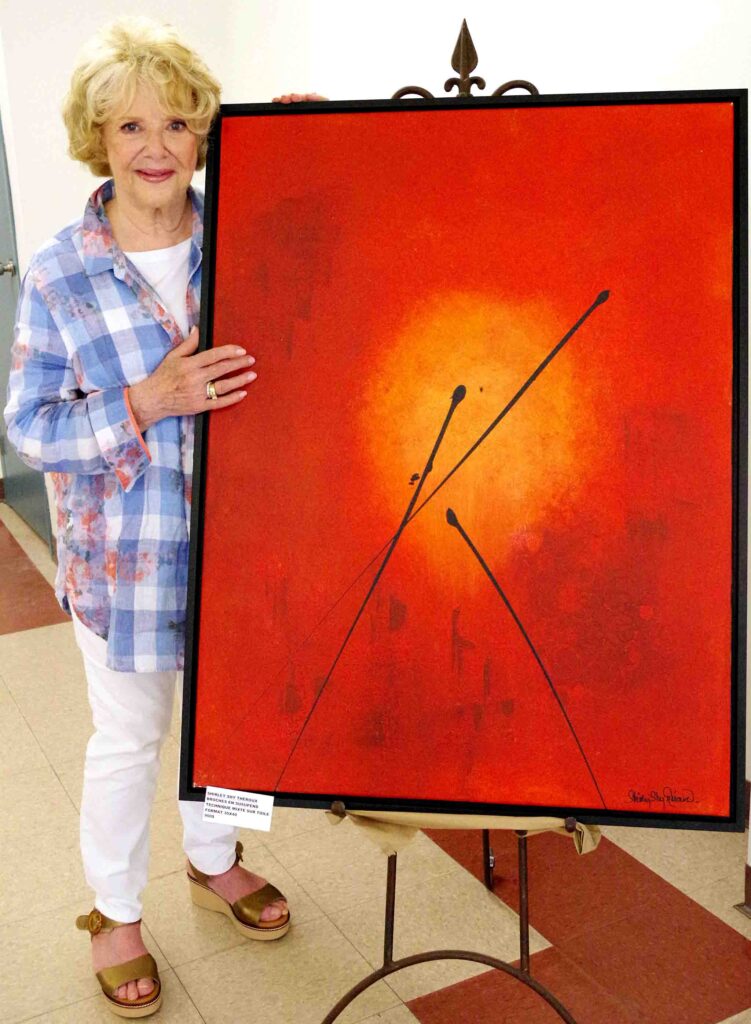
An accomplished painter in addition to her musical talents, several of Shirley Théroux’s art works were featured in a special segment of the show. (Photo: Martin C. Barry, Laval News)

Corporation Rose-Art president Oprina-Felicia Dolea was uneasy on the opening day of the 29th annual Symposium de Ste-Rose late last month as she contemplated the days ahead and the quickly-changing weather in Quebec these past few years.

All turned for the best

“We are concerned about tomorrow – they are predicting rain and wind,” she told The Laval News, while gesturing at the tents and canvas shelters the participating artists were using to display their sculptures and paintings.

As things turned out, she needn’t have worried. Compared to some of the arts group’s summertime symposiums in recent years, this year’s went off without a weather-related hitch.

The much-feared rain and wind never really materialized, and hundreds of supporters and patrons of the visual arts were able to enjoy the 2025 symposium over the entire four-day duration.

Highly historic setting

From July 24 to 27, appreciators of quality sculpture and art from all over Quebec, as well as Ontario and other parts of eastern Canada, gathered in Laval’s historic Vieux Sainte Rose for an event that has come to be recognized as one of Quebec’s leading and most prestigious outdoor art shows.

Corporation Rose-Art president Oprina-Felicia Dolea. (Photo: Martin C. Barry, Laval News)

For the second time, the organizers were able to persuade legendary Quebec singer Shirley Théroux to be the official spokesperson for the symposium.

Théroux had a string of song hits in Quebec during the 1960s and 1970s and was also a highly popular late-afternoon program host on French-language television. An accomplished painter in addition to her musical talents, several of Théroux’s art works were featured in a special segment of the show.

Home to great artists

The Sainte-Rose Art Symposium, a popular summertime gathering of artists for decades, has always been a guarantee of enjoyment for thousands of satisfied patrons. In addition to Mrs. Théroux’s support, the event’s honorary president this year was Member of the National Assembly for Sainte-Rose Christopher Skeete.

As always, the symposium took place alongside the Rivière des Mille-Îles in the charming and historic Laval neighbourhood.

The village is renowned as the birthplace of internationally-acclaimed Québécois painter Marc-Aurèle Fortin. Sainte-Rose was also at one time the home of landscape painter Clarence Gagnon. Both influenced generations of artists in Quebec as well as around the world.

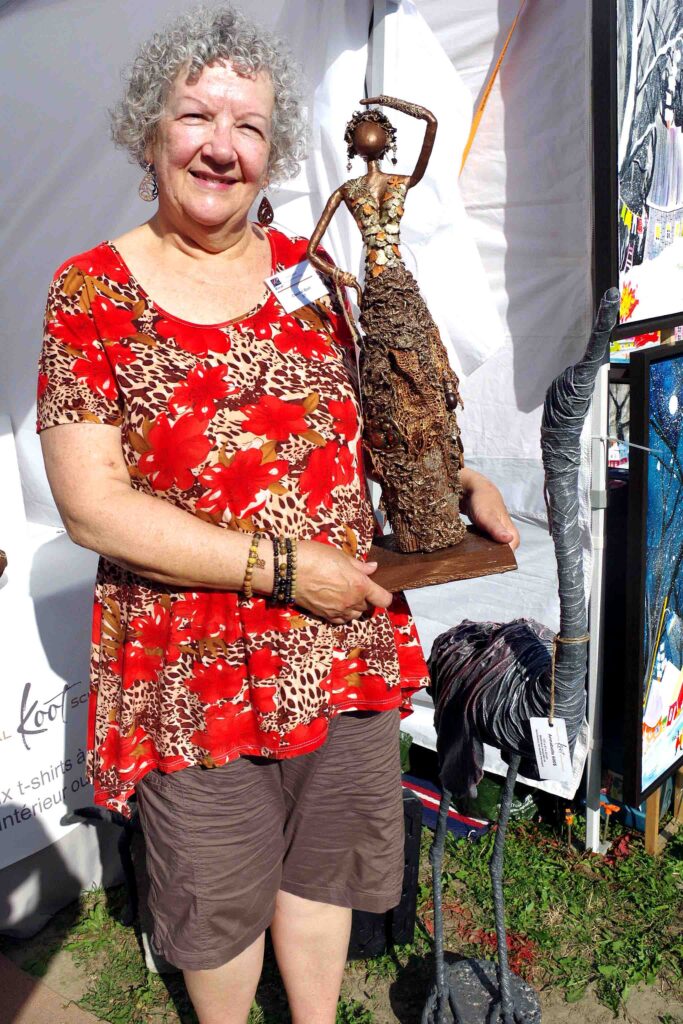
Sculptor Chantal Koot from Vaudreuil-Dorion was is seen with one of her exceptional creations. (Photo: Martin C. Barry, Laval News)

Promoting tourism in Laval

After winning a range of awards for excellence over nearly three decades, the symposium’s organizing committee continues to uphold the standards that have established the Sainte-Rose Art Symposium’s reputation for excellence in art circles across eastern Canada.

They have received some significant recognitions for their efforts. In 2019, the Laval Chamber of Commerce and Industry presented them with a Dunamis award for helping to promote tourism in Laval. They were also a finalist for a second Dunamis in 2020 and 2022, as an environmentally-sustainable organization or enterprise.

An estimated 20,000 people attended. Although most are usually from the Laval and greater Montreal regions, the busy vacation season typically also draws in visitors from Ontario, New Brunswick and Nova Scotia, as well as from the U.S. states of Vermont, New York and New Hampshire.

‘Laval, le film’ aims to be the first full-length feature shot entirely in Laval

‘We know someone’s going to buy it,’ film director Noah Trentadue says with confidence

Noah Trentadue sounded sort of hyped while being interviewed recently about one of his first big film projects. The promising young director had good reason.

It was just a few days before he began location shooting on a full-length feature film dealing with a topic with which Noah is intimately familiar – the city of Laval – which, perhaps not surprisingly, is where he was raised.

Quebec film actress Amilia Ziane is a member of the ‘Laval, le film’ cast.

Made in Laval

Laval, le film, as Trentadue and producer Alberto Georgian Mihut have titled their independent project, is being billed as the first full-length feature based on fiction to be entirely shot in Laval.

The two are developing the project in conjunction with Média Communautaire Lavallois, which is based in an office building on Saint-Martin Blvd. East in Laval-des-Rapides where a number of co-working entrepreneurs focus on media and communications.

According to a release issued by the production team, work on the film is being done mainly by young volunteers. It was inspired by the notion that a significant number of Laval residents are fed up that their city doesn’t get the respect it deserves.

Film within a film

Laval, le film director Noah Trentadue is confident there will be a buyer for their finished product.

A “mockumentary” (see the 1984 satirical film ‘This Is Spinal Tap’ for an idea of where the concept first gained traction), Laval, le film contains a “film within a film,” according to its producers, revealing some of their storyline, without giving too much of their script away.

The cast includes some well- and lesser-known Québécois film and TV actors (Diane Marie Racicot, Amilia Ziane, among others). It’s also intergenerational, in that the players range in age from young to much older.

“We wanted to stand out and leave our mark with this first film, making our Laval the focus of attention along with the community,” the film’s producer said in a promotional statement.

Looking beyond Laval

“This isn’t only a niche film about Laval, it’s also an example of community involvement,” he added. “We have no doubt that other cities will be saying, after hearing the news, ‘Hey, what about our film?’”

Noah, who is a film student at Concordia University, said in an interview with The Laval News that, ideally, they would like to see their finished product being as much as 90 minutes in length, although they’d be willing to edit it down to an hour should they sell it to a television network such as Télé-Québec.

“It’s not official yet with Télé-Québec,” he noted. “But obviously with certain local organizations like Culture Laval that have connections there, it’s a very real possibility. It’s just a question of getting execution rights.”

A serious business

Quebec actress Diane-Marie Racicot is also part of the cast.

In addition to providing audiences with entertainment, filmmaking is also a very serious business, with revenues and profits being front and centre. However, a significant shift in the process in more recent years has been the decline of theatres for in-person film screening (the recent insolvency of Cinémas Guzzo being just one example).

“Between you and me, for distributing the product, we’re trying to get the most eyes we can,” Noah acknowledged, while saying they’re doing their best to navigate the changing distribution landscape. “You have to take into account that in this day and age, streaming services are really where it’s at and as big as it gets. Which is why Télé-Québec is really one of the best places you’d want to have access to in Quebec production.

‘Someone’s going to buy it’

“Radio-Canada, TVA, those are all great channels for television where we can get our product down to an hour and get it into a nice television spot,” he continued. “But it’s really about the first buyer, if you know what I mean. We’re still shopping. And we know someone’s going to buy it.”

Digital shooting, which got underway a few weeks back, was taking place literally all over Laval, according to Noah, including at the Centropolis mall on the edge of downtown, Espace Montmorency, Place Bell, the Centre de la Nature and other places regarded as icons of Laval.

Cottages and farms give way to high-rises

Former MNA Serge Ménard recalled Laval’s rural past on its 40th birthday

As many as 32 individual municipalities once dotted the countryside of Laval in the decades preceding the formation of the island-wide city in 1965, says former Marc-Aurèle-Fortin MP Serge Ménard. Ménard, who spent his boyhood summers bicycling and swimming at his family’s country home on the Rivière-des-Milles-Îles, recounted some of his memories in view of the City of Laval’s 40th anniversary. The Laval News here republishes an interview conducted with Serge Ménard in 2005.

Serge Ménard has vivid memories of Laval before it was a bustling suburb – a golden age when it was still largely a rural retreat for Montrealers getting away from the oppressive city heat in the summertime.

“I can remember when I was a small boy, Laval was essentially cottages and farms,” the Bloc Québécois MP for Laval’s Marc-Aurèle-Fortin riding recalled recently for The Chomedey News on the occasion of the City of Laval’s 40th anniversary.

“There was a great deal of agricultural activity and a lot of fields,” he said. “Today it still has that agricultural quality. Notably, we are one of the best known flower gardens – not only in Quebec – but in the northeastern region of North America.”

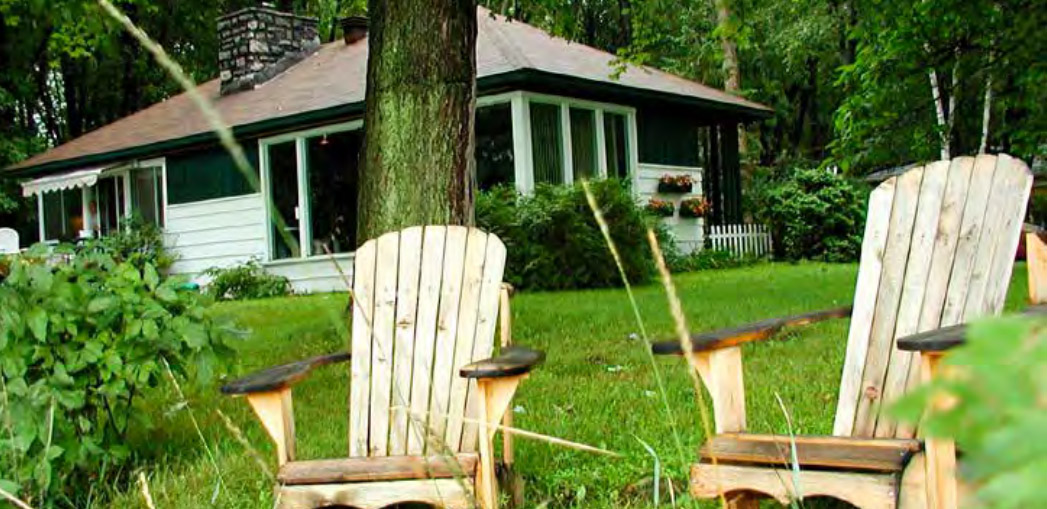
Serge Menard has fond memories of his family’s former country home, 1 Val des Bois, in Auteuil.

Around 1955, when Ménard was a high-school student in Quebec’s ‘cours classique’ educational system, his father decided to build a summer house in Laval for his family, who were living in Montreal’s Plateau-Mont-Royal district at the time.

“I was 15 when father built a summer house on the Rivière-des-Mille-Îles. It was right next to Jacques Cartier Beach, which was right next to Laval’s (public) beach. It’s still inhabited – 1 Val des Bois.

“That’s the house father had built,” said Ménard. “It was a summer cottage which was subsequently redesigned to be a year-around residence. In fact, the people who bought it and live there now live in it all year long, as do most people in that area.”

Ménard, who has never resided in Laval except during the summers of his youth, has represented constituents here since 1993, when he was first elected to the Quebec National Assembly for the Parti Québécois. Although he’s never been a full-time resident, he said his memories of the island during the summer have remained strong.

“I knew Laval during the summer, and I knew it from the vantage point of a bicycle – because, when eventually my father allowed me to get away from the house on two wheels, that was freedom,” he said, laughing. “I must have gone to every corner of Laval.”

Ménard recounted how, when he was a bit older, he worked two summers at the Hôpital du Sacré Coeur just across Rivière des Prairies from Laval in Montreal. He would travel daily from the country home to the hospital on his bike.

“I would do that by bike morning and evening,” he said. “From One Val des Bois, it would take about three-quarters of an hour. We also had a row boat and there was swimming, too. We went swimming and fishing. We were right next to a beach so we would see people who came to swim.”

But if Ménard has mostly happy memories of those bygone days, he also has at least one unpleasant one.

Former Marc-Aurèle-Fortin MNA Serge Ménard. (File photo: Martin C. Barry)

“Because we were beside a beach and saw people regularly who came to swim, among the most traumatic things a boy that age could ever see, I can tell you, was when the priest would arrive to tell children or a wife that their father had probably drowned,” he said.

According to Ménard, there were a lot of drownings off the beaches of Laval in those days.

“I remember there were some every weekend. It was because people weren’t taking precautions. Our parents used to tell us in those days, ‘You see what happens to people who don’t wait three hours after eating before they go swimming.’ They always used to tell us you had to wait three hours.”

Besides his personal recollections, Ménard vividly remembers the political turmoil that surrounded Laval’s beginnings as a city in 1965.

“I can’t help but remember the controversy over the creation of Laval – about the same as the one that surrounded the recent municipal mergers,” he said, referring to the City of Montreal’s controversial amalgamation process recently.

However, he added, once Laval’s amalgamation had been completed, it soon became a “collective success,” with important sectors such as the pharmaceutical industry playing a dominant role.

“It has become a place to live where people have all the advantages of a large metropolitan region, but also the outdoors and lots of room for children to play; a very comfortable and safe place to live.”

In hindsight, Ménard believes that the merger of the 16 small municipalities that were on Laval Island in the early 1960s, into one large city in 1965, succeeded mainly because of the determination of the provincial government, not only to carry it out, but to make sure it would hold long after it was done.

“(The merger of) Laval was done very quickly,” he said. “It was done at the end of (a National Assembly) session. There was a commission of inquiry – the Sylvestre Commission. I remember even at that time, Mayor Jean-Noël Lavoie had already brought about the merger of three towns to create Chomedey.

At one time, according to Ménard, there were as many as 32 independent municipalities on the island.

“But you have to understand that this was relative to the fact it was in an era when villages surrounded a local church. It was a time before the advent of the automobile, or just at its beginning, when that mode of transportation was available only to the wealthy. The main economic activity was farming. For that matter, Laval still has some of the best land of its kind for agriculture.”

Looking towards the future, Ménard sees Laval remaining one of the driving forces in the economic development of the Montreal metropolitan region – somewhat like the relationship the U.S. city of Boston has with its surrounding suburbs.

“And with the arrival of the Metro, that will probably also encourage development, too,” he added. “I think the Metro is going to influence the development of a downtown core in Laval.”

At the same time, he said caution would be necessary to prevent indiscriminate development from allowing uncontrolled high-rise construction. “I hope we will always be able to have urban development plans that have humane height restrictions – a little like what they have in Washington, D.C,” said Ménard.

Weather

Laval
overcast clouds
2.5 ° C
3.1 °
1.3 °
92 %
1kmh
100 %
Fri
2 °
Sat
-2 °
Sun
5 °
Mon
4 °
Tue
2 °