Saturday, December 20, 2025
8 C
Laval
spot_img
Home Blog Page 4

Laval Police take part in province-wide crackdown on child-porn

Officers from the Sûreté du Québec’s Internet Child Sexual Exploitation Investigation Team (ESEI) in collaboration with the major crimes divisions of police forces in Laval, Boucherville, Montreal, Quebec City and Gatineau conducted a large-scale operation from November 3 to 7, leading to the arrests of nearly two dozen suspects.

According to the SQ, more than 150 police officers were mobilized, and 22 men aged between 18 and 70 were arrested.

Of this number, 20 appeared in connection with charges of possession, distribution and access to files containing child abuse and sexual exploitation material.

Computer equipment was also seized by the police for analysis as part of the 26 searches that were conducted.

“The operation conducted this week is the result of significant collaborative and concerted efforts,” said Lieutenant Katherine Guimond, head of the SQ’s division for investigations into the sexual exploitation of children on the internet.

The SQ is inviting members of the public to report any situation they come across of sexual exploitation of young people on the internet at the following address: www.cyberaide.ca

Laval-based trucker sentenced in Ontario for operating fraudulent truck-driving school

A man from Laval along with another from Saint-Eustache who together ran an Ontario truck-driving school found to be fraudulent have received conditional confinement sentences of two years less a day to be served in the community.

Ontario Superior Court Judge Pierre Roger passed sentencing on Gurvinder Singh, age 69, of Laval and Gurpreet Singh, age 37, of Saint-Eustache who were convicted of one count each of fraud over $5,000 and uttering a forged document.

Laval highway crash leaves 4 dead and 12 injured
Aftermatch of the August 5 2019 truck crash in which four people died.

According to evidence presented during the five-week trial, between January 2019 and May 2021 the two used the services of a Punjabi language interpreter who provided answers to truck driving students for questions they needed to answer to obtain on Ontario Ministry of Transportation Commercial Truck Driver Training Standard Class A permit.

In 2017, the Ontario government made entry-level training mandatory in order to obtain a Class A permit, which is necessary to drive commercial trucks in the province.

The two men were found to be operating a truck driving school that was not registered as a private career college and was not authorized to offer Ontario’s Mandatory Entry Level Training (MELT) program for truckers.

While the students were charged fees ($4,000-$5,000) which were slightly lower than at accredited institutions, they received only basic truck driver training, according to the judge’s decision.

Evidence introduced during the trial indicated that the accused circumvented the normal accreditation process by gaining unlawful access to an Ontario Ministry of Transportation database in order to falsify records that their students had completed the MELT program.

In his decision, the judge noted that the students were “tricked and deceived” by the two men “into paying for substandard truck driver training.”

Earlier this year, truck driver Jagmeet Grewal, who drove the truck that rammed a line of cars at the intersection of autoroutes 15 and 440 in Laval in August 2019, killing four people and injuring many others, was sentenced to 10 years imprisonment.

Earlier this week, Quebec Liberal MNA for Nelligan Monsef Derraji, who is the official opposition critic for transportation in the National Assembly, took issue with the CAQ government’s dismissal of a nearly 3,000 signature petition calling for stronger enforcement measures to put an end to the presence of illegal truck drivers on Quebec’s roads.

“While the federal government has just announced a $77 million investment to fight the loophole enabling illegal drivers, CAQ members refused to address the issue this morning in the National Assembly,” Derraji said in a statement issued on November 4.

Montreal’s Hellenics mark 85 years since Greece said ‘Oxi’ to fascism

The WWII Axis powers first ran into serious resistance in Greece in 1940

Patriotic Greeks from all over Montreal joined elected officials along with leaders from the Hellenic community for a ceremony on October 26 at the Embassy in Chomedey marking the 85th anniversary of the historic day in World War II when Greece rejected its occupation by Axis forces.

Ultimatum rejected

Each year, Oxi Day is celebrated throughout Greece, Cyprus and Greek communities around the world to commemorate the refusal by Greek Prime Minister Ioannis Metaxas when presented with an ultimatum on October 28 in 1940 by Italian fascist dictator Benito Mussolini.

Officials at the head table during the HCGM’s annual Oxi Day commemoration held at the Embassy in Chomedey included Vimy Liberal MP Annie Koutrakis, Ambassador of Greece to Canada Ekaterina Dimakis, HCGM president Basile Angelopoulos, Consul General in Montreal for Greece Nikolaos Karalekas and Laval city councillor for Chomedey Aglaia Revelakis. (Photo: Martin C. Barry, Newsfirst Multimedia)

The ultimatum was presented to Metaxas by the Italian ambassador to Greece. It demanded that Greece allow Axis forces to enter Greek territory and occupy certain strategic locations, or otherwise face war. The name for the day comes from Metaxas’ straightforward reply. “No,” he said curtly, following which he added, “Then it is war.”

The beginning of war

In response, Italian troops stationed in Albania, which was an Italian protectorate, attacked the Greek border, marking the beginning of Greece’s involvement in World War II. On the morning of Oct. 28, Greeks took to the streets, regardless of their political affiliations, shouting “Oxi.” Since 1942, it has been a national celebration marked annually.

Dignitaries who attended this year’s event organized by the Hellenic Community of Greater Montreal included Ambassador of Greece to Canada Ekaterina Dimakis, the Consul General in Montreal for Greece Nikolaos Karalekas, Vimy Liberal MP Annie Koutrakis, Laval city councillor for Chomedey Aglaia Revelakis and HCGM president Basile Angelopoulos.

During an Oxi Day commemoration in Laval on October 26, Ambassador of Greece to Canada Ekaterina Dimakis delivered greetings to members of the Greek diaspora in Canada from the government of the Hellenic Republic. (Photo: Martin C. Barry, Newsfirst Multimedia)

A ‘fight for liberty’

“We are here to recall the heroism and the resistance to fascism during the 1940s by the Greek nation which was exemplary and was recognized around the world for standing out in the spirit of the fight for liberty,” Angelopoulos said in an interview with Newsfirst Multimedia, paraphrasing the keynote address he delivered.

Comparing the historical events of 85 years ago to the situation today, Angelopoulos commented, “Apathy is probably today’s modern invader. Disengagement and disinterest are our enemies now and something that we should never allow.”

Like Angelopoulos, Koutrakis could also see parallels between the past and more recent history. “What is more scary than ever to me is the lack of sympathy and empathy globally to the dangers that we are increasingly surrounded by,” she said.

Turning back the fascists

“So, this day to me, not only as a Hellene, reminds me of my heritage and what happened those many years ago that was the turnaround of World War II,” she continued.

“But it also reminds me of the great obligation and responsibility that we have, especially in the western world, if we want to safeguard our democracies and push back on fascism.”

Hellenic Community of Greater Montreal president Basile Angelopoulos quoted former Canadian Prime Minister William Lyon Mackenzie King in an address on this year’s Oxi Day. (Photo: Martin C. Barry, Newsfirst Multimedia)

In his address, Angelopoulos cited former Canadian Prime Minister William Lyon Mackenzie King, who wrote about Greece’s fall in 1940. “Greece has fallen to the enemy, but only after a resistance that will become legendary,” said Angelopoulos, quoting Mackenzie King.

King went on to say that the men of Greece “have set an example of heroism that has inspired free men everywhere … To those of Greek race everywhere in Canada I send my greetings, my appreciation for what they have done …”

Pink in the City’s Magic of Hope raises hundreds of thousands for breast cancer

More than 850 guests partied at gala evening for the MUHC’s Breast Center

A new word has been turning up in conversations lately. Especially those concerning women who’ve undergone the ordeal of breast cancer. It’s survivorism.

By some definitions, survivorism is a policy of trying to ensure survival especially in the face of a catastrophic event.

Latin American dance performers lent Pink in the City’s 2025 Magic of Hope gala an exciting air at the Château Royal congress centre in Chomedey on October 24. (Photo: Martin C. Barry, Laval News)

Support for well-being

For breast cancer survivors this translates into re-establishing a balanced and healthy lifestyle in order to support well-being during and following the rigorous treatments required to overcome breast cancer.

But to be truly successful, all aspects of the patient’s well-being must also be addressed: the physical, psychological and social. Pink in the City helps to meet those needs.

With that in mind, more than 850 supporters of Pink in the City set a new attendance record on the evening of Friday October 24 when they turned up for the breast cancer foundation’s 2025 Magic of Hope fundraising gala.

Some of the breast cancer survivors attending this year’s Magic of Hope gala are seen with MUHC Breast Centre Director Dr. Sarkis H. Meterissian (at the microphone). (Photo: Martin C. Barry, Laval News)

A collective effort

“It’s a great evening – it’s inspiring,” Pink in the City co-founder Denise Vourtzoumis told The Laval News. “We’re doing something really great here all together.”

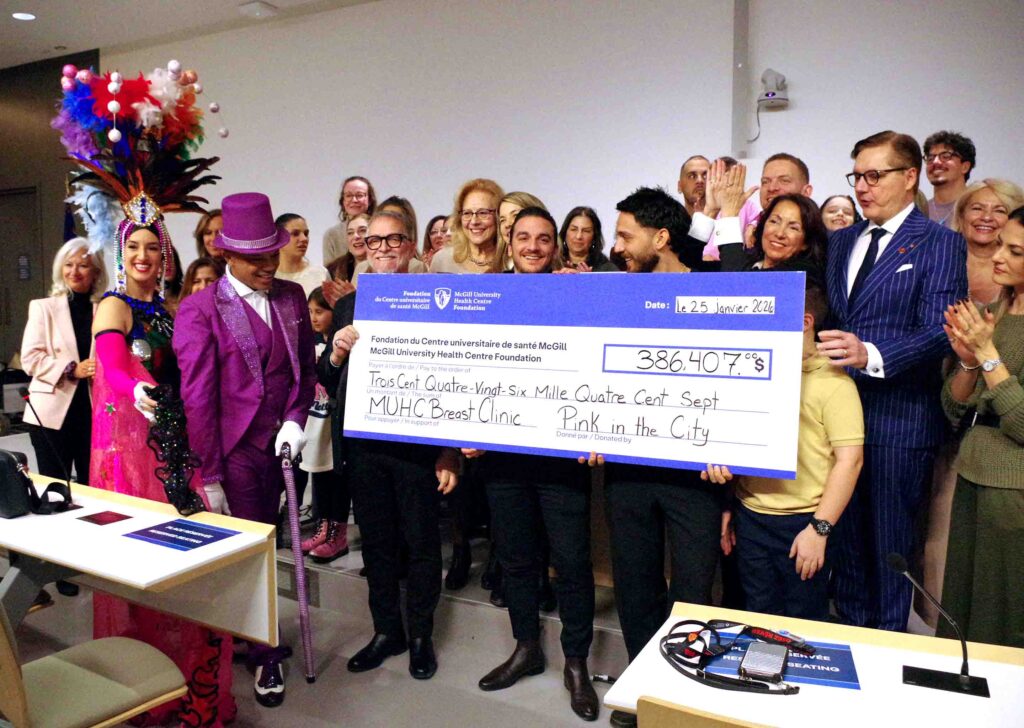
As Pink in the City holds fundraising events throughout the year, the tally from the gala as well as from the other fundraisers held in 2025 will be announced in January 2026.

But in the meantime, Magic of Hope raised well over $300,000 last year. Over the years, Pink in the City has become one of the MUHC Foundation’s most productive and reliable fundraisers.

Left, Bobby and Denise Vourtzoumis, along with other members of their family, are seen on stage at the Château Royal in Chomedey on October 24 during Pink in the City’s annual Magic of Hope gala. (Photo: Martin C. Barry, Laval News)

A call to action

Pink in the City was founded in 2006 when Denise’s son, Lawrence who was 11 years old back then, heard an ad on the radio while driving to school with his mother. It requested volunteers to shave their heads as a demonstration of solidarity for those who had lost their hair due to chemo treatments for breast cancer.

He was captivated by the idea and asked his mother if he could take part. He wanted to shave his head to show support, which was a pretty brave thing for a pre-teen to do. Denise agreed and helped Lawrence raise the required amount of money to be able to participate.

Nearly two decades and many fundraising gala evenings later, Pink in the City has raised millions for the MUHC Foundation, which remits funds to the McGill University Health Centre’s Breast Clinic Wellness Program.

Among the gala’s guests were Hellenic Community of Greater Montreal president Basile Angelopoulos (far left) and spouse, Canadian Senator Leo Housakos and his wife along with other guests. (Photo: Martin C. Barry, Laval News)

Every gesture counts

Pink in the City started as a single event. This heightened an already existing awareness about breast cancer in the community and the need to support those who had been impacted by the disease. It also embedded the idea that every selfless gesture of support makes a difference.

Over time, volunteers, sponsors, partners and medical advisors allowed Pink in the City to attain and exceed its goals. Community partners have also played a key role by supporting and attending Pink in the City’s various functions and events. Partnerships have extended to leadership programs sponsored by the Sir Wilfrid Laurier School Board at Laval-area high schools.

November is Volunteer Recognition Month in Laval

In November, which is Volunteer Recognition Month, the City of Laval is highlighting the essential role of those whose actions contribute to making Laval a more humane, supportive and vibrant city.

Every day, thousands of citizens dedicate their time to enriching and transforming their community. Volunteering can take many forms and adapt to everyone’s availability and interests.

On November 25, the city will hold its 4th annual Laval Volunteer Celebration at Salle André-Mathieu. Singing, dancing, comedy and testimonials will mark this festive evening.

Isabelle Charest, Minister Responsible for Sports, Leisure and the Outdoors, is seen here with Raymond McIntyre. (Photo: Amelieshoots)

“Every small gesture, every hour given, and every smile shared contributes to making Laval a more supportive and humane city,” says Mayor Stéphane Boyer. “I sincerely thank all those who give their time with passion, dedication, and generosity.”

In a spirit of recognition during the evening, the City of Laval will be acknowledging the exceptional volunteerism of Raymond McIntyre of Triathlon Laval, for his leadership, generosity and team spirit.

Since 2019, Raymond McIntyre, who is an administrator and marketing manager at Triathlon Laval, has distinguished himself through his energy, creativity and deep commitment to the Laval sports community.

A true triathlon enthusiast, he promotes his club by initiating numerous projects: creating a guide for new members, managing social media, designing promotional items and organizing the annual fundraiser, which attracts more than 500 participants.

Agreement reached between blue collar workers and the city

The City of Laval has announced that a new collective agreement has been reached with the Laval blue-collar workers union. Blue-collar staff voted in favor of the proposed agreement, with 83 per cent supporting the mediator’s suggested settlement.

The collective agreement will be for a six-year term, ranging retroactively from January 1 in 2022, to December 31 in 2027. It is to be presented to the City of Laval’s executive-committee for confirmation before its entry into force.

According to the city, the agreement is part of the process of optimizing municipal services, with tangible benefits for each party and for the well-being of the population. The city says the agreement respects the interests of blue-collar staff, administrative needs and the ability of Laval residents to pay.

The main operational benefits are as follows:

• Revised and more flexible work schedules, offering greater stability in citizen services and reducing overtime;

• Improved weekend and winter shift schedules, with more flexible hours;

• The addition of permanent weekend shifts to ensure more consistent public service at all times;

• The option for some teams to extend their workday by three hours to complete ongoing tasks;

• And greater efficiency in posting job openings, reducing some delays by 50 per cent.

“The ratification of this agreement with the blue-collar workers marks a new chapter for the City of Laval,” said Mayor Boyer.

“This agreement meets the needs of our workers, respects the ability of Laval residents to pay, and lays the foundation for a more efficient work organization,” he added. “I commend the commitment of Laval’s blue-collar workers to embark on this project.”

“The efficiency of municipal services is a priority for our administration,” said Laval city manager Benoit Colette. “This new collective agreement reflects the shared commitment of the city and its blue-collar workers to provide services that meet the evolving expectations and needs of Laval residents.”

Ten days of digital and technological immersion in libraries

From November 6 to 16, Laval’s public libraries are inviting residents to discover the digital world at the 7th annual NUM Festival, a free, family-friendly event featuring over 50 activities for all ages.

With activities involving virtual reality, interactive experiences and robot building, it will be the perfect opportunity for children and adults alike to take a dive into innovation and creativity.

“With the NUM Festival, Laval’s libraries demonstrate that they are much more than just places to read: they are vibrant spaces where innovation, creativity, and digital culture come together,” said Mayor Boyer.

“This event reflects our commitment to making technology accessible to everyone, in a spirit of discovery and enjoyment.”

The event offers the opportunity to discover and experience the diverse range of modern activities and services offered by Laval Libraries, many of which focus on digital technologies.

Laval News Volume 33-21

0

The current issue of the Laval News, volume 33-21, published on November 5th, 2025.
Covering Laval local news, politics, and sports.
(Click on the image to read the paper.)

New Laval support group aids English community

By Matthew Daldalian

Retired social worker and consultant Filomena Corrado at the support group space, where she leads the new weekly support group (Matthew Daldalian, The Laval News)

When a small group gathered last week at the local wellness club in Chomedy, they were doing something quietly new for the city’s English-speaking residents: taking part in a support group designed for people helping loved ones through mental troubles.

The group, led by Filomena Corrado, a retired social worker and clinical consultant, offers a free, confidential space for those supporting family members with mental illness. This ranges from adolescents facing anxiety to adults living with depression or schizophrenia.

“It really addresses the isolation aspect,” Corrado said. “The fact of not feeling alone with what you’re going through.”

The weekly Wednesday-morning sessions are part of a partnership between AGAPE, Alpabem, Cafgraf, and the Comité de développement local de Chomedey (CDLC), with the goal of creating a regular English-language access point for mental-health support. Corrado said the idea grew from her work at the aforementioned Alpabem, a long-running community organization that provides counseling, group therapy, and family support for people affected by mental illness.

“Sometimes [informal caregivers] feel that it’s their fault, that it’s their responsibility that the person has gotten sick and it’s not the case,” Corrado said. “Many factors contribute and they have to also learn how to deal with this situation, take care of themselves while they’re taking care of somebody else.”

For Corrado, who spent more than 35 years in Laval’s health and social services system, the benefits of simply talking with others in similar situations can be transformative. “It helps them go through the days and helps them go through what they’re going through,” she added.

She said the group’s creation stemmed from a shared recognition that Anglophones in Laval often travel to Montreal to access help in their own language. “There seemed to be a reaction, which was great,” Corrado said. “Like any support group that starts, it’s got to start somewhere.”

At AGAPE, assistant director Ian Williams, a trained social worker, said the project was years in the making.

“Some 15 years ago when I started working here, I worked on a smaller-scale project trying to make [people] understand why mental health services weren’t so accessible in English,” Williams said.

Williams said that effective mental-health care depends heavily on language, noting that clinicians need to communicate with clients in the language they’re most comfortable with to ensure the best possible treatment outcome.

AGAPE assistant director Ian Williams at his office in Chomedey (Matthew Daldalian, The Laval News)


He added that the initiative was initially funded through a joint program between the city of Laval and the Centre Intégré de Santé et de Services Sociaux de Laval (CISSS), before AGAPE and its partners stepped in to sustain it.

Williams explained that Agape joined forces with Alpabem director Patrice Machabée and other community partners to find new ways to keep the program funded. Together with the CDLC de Laval and Cafgraf, the organizations pooled their resources to cover rent and staff hours so the support group could continue operating.

Although participation was still low, Williams said the long-term goal was to demonstrate demand and attract more stable funding. “Our hope is to get enough interest in the group,” he said. “Generate enough evidence to show to potential new funders because we could only sustain this partnership for so long.”

Corrado said the support group offers a starting point, one built on empathy and connection rather than formality. “No matter what difficulty you go through, when you feel that there’s other people that you can speak to, that you can feel understood, that you don’t feel alone, it helps you go through the days,” she said.

For now, the doors remain open every Wednesday morning, a modest but vital space for English-speaking caregivers in Laval to share, listen and heal together.

Aglaia Revelakis wins tight race in Chomedey

Independent councillor keeps seat as Laval voters face morning issues at polls

By Matthew Daldalian

After more than a decade representing Chomedey, Aglaia Revelakis held onto her council seat Sunday night, but by the narrowest margin of her political career.

Revelakis, running as an independent, edged out Action Laval’s Costa Deeb by just 38 votes, winning 34.36 per cent of the vote (1,143 ballots) to Deeb’s 33.21 per cent (1,105). The Mouvement Lavallois candidate, Denitsa Dimitrova, finished third with 19.66 per cent, while the Parti Laval’s Sally Radwan took 12.77 per cent.

It marked a sharp drop from her commanding 52.19 per cent victory in 2021, when she carried Laval’s 14th district by more than 900 votes for Action Laval.

Independent Laval councillor Aglaia Revelakis monitors election day operations at her Chomedey campaign headquarters as polls close Sunday evening. (Matthew Daldalian, The Laval News)

“I’ve been here since early morning,” Revelakis told The Laval News before results were confirmed. “It’s crunch time, we’ve had over 30 volunteers working in shifts all day.”

Revelakis said voter turnout and polling irregularities made the day more stressful than most. On Sunday morning, more than 100 election staff across Laval failed to show up, delaying voting by up to half an hour in 23 polling stations, including the Centre du Sablon in Chomedey.

“The voters went out to vote and the polling station was not open because they didn’t have the sufficient personnel,” Revelakis said. “They had to go to work and couldn’t come back, so there are voters I lost in the morning. So that frustrated voters.”

Élections Laval confirmed the issue in a statement to CityNews, saying delays were quickly resolved and all polling stations closed at 8 p.m. as scheduled.

Revelakis said the problem reminded her of her concern that apathy and mismanagement are undermining local democracy. “People are not interested because they feel nothing will change,” she said. “So let’s go back to basics.”

Volunteers say effort paid off

For campaign organiser Zissis Fotopoulos, who has been involved in politics for years, the win was a testament to grassroots persistence.

“There’s no interest. People complain, but they don’t go vote,” he said. “If you complain, you have to go vote. If you want change, you vote.”

Fotopoulos praised Revelakis’s work ethic and door-to-door campaigning. “She knows every step. She did most of the houses herself starting in July,” he said. “Sometimes the old-fashioned way is the best way.”

Campaign organizer Zissis Fotopoulos (right) said Revelakis’ team focused on door-to-door contact and old-fashioned community outreach. (Matthew Daldalian, The Laval News)

Another supporter, Michael Arfanis, coordinated transportation for voters with mobility challenges. “It’s tiring, it’s a long day, but we’re fighting the good fight,” he said. “We know Aglaia is the right person. She’s shown it for the last three terms.”

Arfanis said helping residents get to the polls was about civic responsibility, not partisanship. “We don’t even know who they vote for. If they vote for someone else, so be it, we’ve helped them exercise their right,” he said.

Volunteer Alexa Pikilids, who has supported Revelakis for six years, said her motivation was personal. “She’s strong, confident and mature enough,” said Pikilids. “Even people who don’t know her believe in her.”

Laval’s political landscape shifts

Citywide, the Mouvement lavallois under Mayor Stéphane Boyer expanded its majority, winning 17 of 22 council seats and securing Boyer a second term with 58.87 per cent of the vote. The Parti Laval and Action Laval each elected two councillors.

Despite the lower margin, Revelakis said her team’s success showed that her personal connection to her district still matters in Laval politics.

“I really want to thank my volunteers,” she said. “Without the team, without the volunteers, you can’t do much.”

ChatGPT sparks mental health risk debate

By Matthew Daldalian

From his Chomedy office, psychologist Emmanuel Aliatas weighed in on a growing phenomenon: the chatbot as confidant.

“Automatically? I would tell them to turn off ChatGPT,” he said when asked what he would tell a teen who confided that the bot had become their late-night sounding board. He added that the very first step was breaking the isolation around those chats — looping in parents and a trusted adult at school.

Psychologist Emmanuel Aliatas at his Laval office, where he’s worked with families for over 30 years (Matthew Daldalian – The Laval News)

The warning came as fresh figures spotlighted the scale of the problem. OpenAI recently stated that more than a million people every week sent ChatGPT messages with “explicit indicators of potential suicidal planning or intent,” and that an estimated 560,000 weekly users showed possible signs of mania or psychosis.

The company framed the numbers as early estimates and said a new safety push had improved responses in sensitive exchanges.

Aliatas, who had practiced in Laval for nearly three decades and worked extensively with addiction and mood disorders, worried about how easily young people could slide from casual chats into dependency. “They feel awkward. They feel awkward in dealing with actual people,” he said, pointing to kids who may have been influenced strongly by technology.

He had seen similar patterns before: compulsive texting with a crush, sextortion spirals, and the whiplash of online attention turning off and on; all of which could seed withdrawal and depression. In his view, the remedy started offline. “The more people you involve in your life, the less effect the chatbot’s gonna have in your life,” Aliatas added.

Fenwick McKelvey, an associate professor of information and communication technology policy at Concordia University, mapped the structural risk.

He argued that product velocity had outpaced safeguards. Companies rushed to deploy systems that could feel intimate long before rules caught up, he said, noting, “the way that AI has been released without necessarily strong safeguards in place for particular applications.”

That design choice was especially fraught in mental-health contexts. “There’s a concern that people will identify and emote and relate to AI agents in ways that are not reciprocal,” McKelvey said.

McKelvey cautioned that deploying unproven AI tools in mental health contexts, especially with vulnerable users, posed serious risks. “Putting it in mental health situations, particularly if people are in distress, is a super high risk application that isn’t necessarily prudent for experimental technology,” he said.

Those concerns rippled through policy and the courts. In September, the U.S. Federal Trade Commission opened an inquiry into leading chatbot makers, seeking details on how they tested for and mitigated harm to children and teens.

Families also filed lawsuits alleging chatbots helped intensify suicidal ideation; one high-profile case claimed OpenAI relaxed guardrails before a teen’s death, an allegation the company disputed.

Clinicians and public-health voices, meanwhile, continued to caution against using bots as stand-ins for therapy, warning of “sycophancy”—systems that mirrored and validated users’ worst thoughts.

OpenAI said it had been working to reduce those failure modes. The company described efforts with 170 clinicians and automated checks that it claimed made the newest model more likely to recognize distress, surface crisis resources, and avoid harmful replies; it reported a jump to 91 per cent compliance with desired safety behaviors in internal tests.

Still, the company conceded gaps remained and emphasized that chatbots were not a replacement for human care.

Back in Laval, Aliatas stressed that gaps in systems were compounded by gaps in social life. He traced many risks to isolation and to the illusion of intimacy a bot could provide.

For a child or teen confiding suicidal thoughts to a chatbot, he said, empathy would be in short supply.

Even for adults, he warned, the dynamic could turn unhealthy when a bot began to feel like the only safe listener. His practical advice for families in Laval was simple and immediate: build circles of real-world support: parents, teachers, counselors, and set boundaries around screen time and private conversations with apps.

“It’s like a brain without a heart and a soul,” Aliatas said. In the absence of airtight regulation, that human buffer might have been the best protection Laval families have.

Boyer wins second term as Laval mayor

Boyer won with 58.9% as Mouvement Lavallois captures 17 council seats

By Matthew Daldalian – The Laval News

Stéphane Boyer won a second term as mayor of Laval, as Mouvement Lavallois – Équipe Stéphane Boyer tightened its grip on city hall by taking 17 of 22 council seats in the elections.

Boyer took 58.87 per cent of the vote (58,013 ballots), well ahead of Parti Laval leader Claude Larochelle at 21.75 per cent (21,432 votes) and Action Laval’s Frédéric Mayer at 19.37 per cent (19,091). Turnout was 31.09 per cent, slightly higher than the 28.76 per cent recorded in 2021, when he first won the mayor’s chair with 41.53 per cent support.

Radio-Canada projected Boyer’s re-election around 8:35 p.m., and by hour’s end he was on stage at Insulaires Microbrasseurs, calling the result the biggest victory in his party’s history and promising to secure more provincial investment.

Mayor Stéphane Boyer celebrates his re-election Sunday night at Insulaires Microbrasseurs, where Mouvement lavallois supporters gathered following early projections confirming his victory. (Matthew Daldalian, The Laval News)

In an interview with The Laval News a short time later, Boyer said the strong result was a sign voters were backing his team’s direction. “I’m very proud. I’m proud of the citizens for their renewed confidence in me. I’m proud of my team,” he said.

Boyer said his immediate priorities will be reinvesting in aging neighbourhood streets and pressing the Quebec government for more funding for health, education and homelessness services in Laval ahead of the 2026 provincial election. He argued the province spends far less per resident in Laval than in Montreal or Quebec City.

New council seat count

While Mouvement Lavallois held onto power in most of its strongholds, the new 22-seat council will look different from 2021.

Action Laval was reduced from five council seats to two, with veteran councillor David De Cotis re-elected in Saint-Bruno and Isabelle Piché keeping Saint-François.

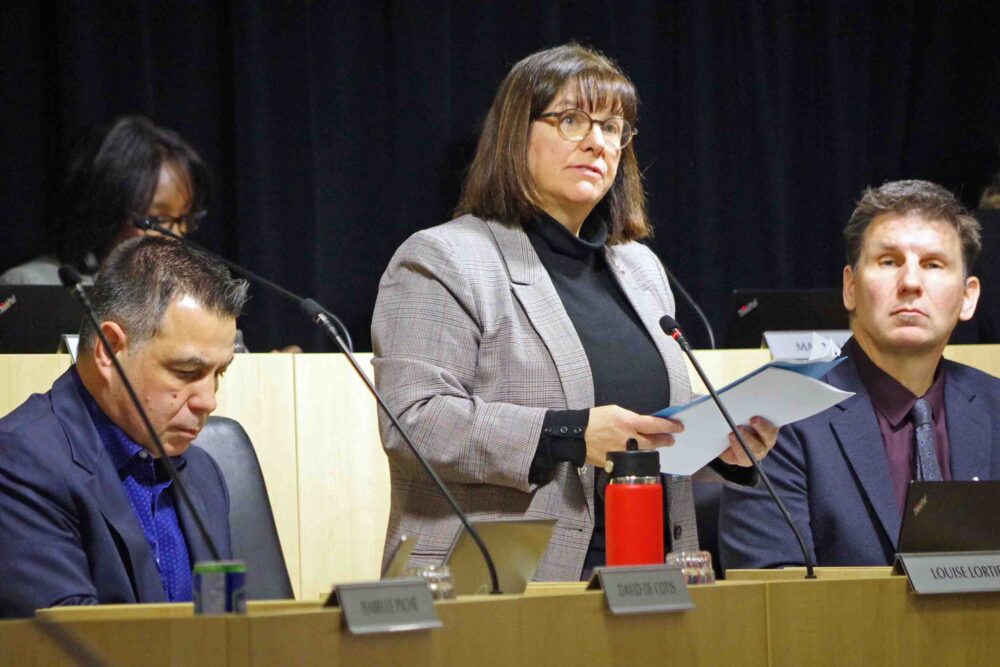
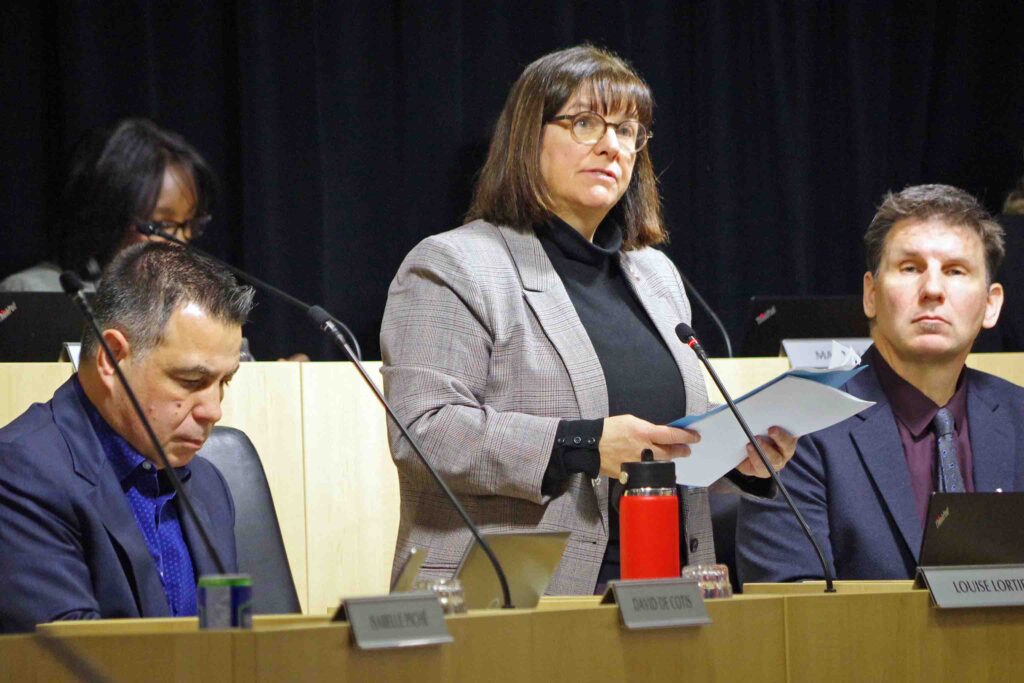
Parti Laval will send two councillors to city hall: incumbent Louise Lortie in Marc-Aurèle-Fortin and newcomer Martin Vaillancourt in Fabreville-Sud.

Mouvement Lavallois, which held 14 seats after the 2021 election, will now occupy 17, including key wins in Duvernay and Saint-Vincent-de-Paul and one in the new district of Le Carrefour.

Independent councillor Aglaia Revelakis monitors election day operations at her Chomedey campaign headquarters as polls close Sunday evening. (Matthew Daldalian, The Laval News)

Independent councillor Aglaia Revelakis held onto Chomedey in a tight three-way race over Action Laval’s Costa Deeb. She edged out Action Laval’s Costa Deeb by just 38 votes, taking 34.36 per cent of the vote (1,143 ballots) to Deeb’s 33.21 per cent (1,105).

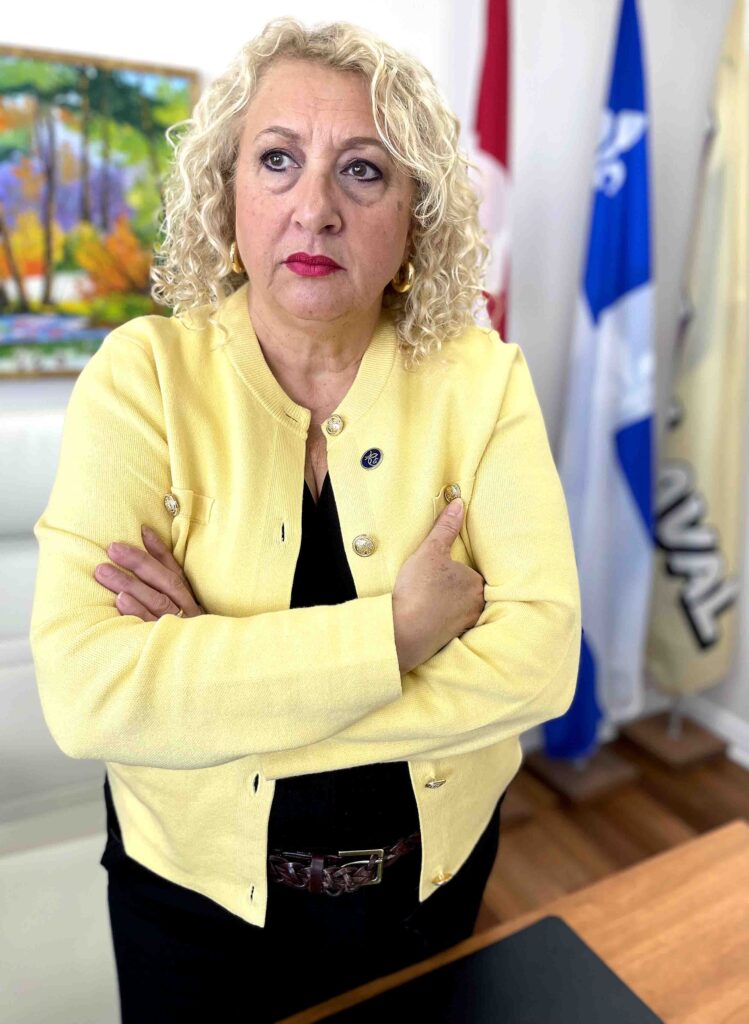
Revelakis, who has represented Chomedey since 2013, will now begin a fourth term on Laval city council. Her razor-thin margin made Chomedey the only district to remain outside Mouvement Lavallois’ sweep.

Local races for Mouvement Lavallois

In Pont-Viau, executive committee member Christine Poirier was re-elected with one of the strongest margins of the night. She captured 74.54 per cent of the vote (2,960 ballots) for Mouvement Lavallois, far ahead of Parti Laval’s Redouane Yahmi and Action Laval’s Matthew Cammisano.

“I feel good. I’m optimistic. We’ve had a great campaign,” said Poirier, who spent the spring and summer knocking on doors across the district. “Laval citizens are happy with our work in general.”

A few districts away in Sainte-Dorothée, Mouvement Lavallois councillor Ray Khalil secured a fourth term in a tight race. He won 43.05 per cent of the vote (2,323 ballots), just 213 votes ahead of Action Laval’s James Lee Bissi at 39.10 per cent, while Parti Laval’s Valérie Rancourt finished third.

Re-elected Sainte-Dorothée councillor Ray Khalil of Mouvement Lavallois joins supporters during election night celebrations. (Matthew Daldalian, The Laval News)

“Election days are always hectic days, but they’re always fun days,” said Khalil. He added that staying close to residents between campaigns is key to his approach. “I still do my door-to-door every summer, even though it’s not an election.”

Opposition parties look ahead

At Action Laval headquarters in Vimont’s Resto Bar Brasse-Rires, the mood was subdued as Mayer finished third in the mayoral race. He said the result showed other parties had adopted Action Laval’s themes without voters noticing.

“We feel that we were at the right place. We just didn’t manage to communicate that it was our message that the other parties were taking over,” he said. While Mayer said it was too early to say exactly how Action Laval would position itself over the coming months, he insisted the party would continue to try to channel residents’ concerns. “For sure we will keep being the voice of the citizens,” he added.

Parti Laval leader Claude Larochelle at Bistro le Rossignol, where the party gathered to watch results Sunday evening. (Matthew Daldalian, The Laval News)

Over at Parti Laval’s gathering in Bistro le Rossignol, Larochelle accepted defeat in the mayoral contest but said he was satisfied his team had run a clean campaign and maintained a presence on council thanks to wins in Marc-Aurèle-Fortin and Fabreville-Sud.

“I’m pretty proud of the campaign that we made, a campaign we made with integrity and we followed our plan,” Larochelle said.

A long-time critic of low turnout, Larochelle lamented over voters cast a ballot in Laval on Sunday, even if the rate ticked up slightly from 2021. “No vote, no excuse. You live with the people who are elected,” he said.

Back at Insulaires, Boyer told supporters he plans to use his strengthened majority to press the Quebec government harder on funding for hospitals, education facilities and social services and mount a major citizens’ campaign ahead of the 2026 provincial election. “Laval has been forgotten for too long, and that changes today,” he said in his victory speech.

Weather

Laval
scattered clouds
-7.1 ° C
-6.2 °
-8.1 °
64 %
2.7kmh
40 %
Sat
-3 °
Sun
2 °
Mon
-6 °
Tue
-4 °
Wed
-4 °