The
City of Laval’s executive-committee made several key decisions and
recommendations to city council during its May 1 public meeting.
Among
other things, the committee recommended to council to award a $6,398,523
contract to Uniroc Construction Inc. for rehabilitation of street
infrastructure on Conrad-Chaumont Ave., Des Prés St., Dubé St., Bon-Pasteur
Blvd., Place Montmorency, Giroux Ave., Lavoisier Ave. and D’Argenteuil St.
Street rehabilitation
The
work is for the replacement of covering on the underground water conduct and
for the rehabilitation of the roadway at the same time.
Along
the same lines, the executive-committee also recommended to council to award a
more than $6 million contract to Duroking Construction/9200-2088 Quebec Inc.
for waterworks rehabilitation and other work on Lucerne, de Bernina, de Cologne
and Pépin streets, as well as on Lévesque
Blvd.
The
committee recommended the awarding of a more than $86,000 mandate for a study
to be carried out by Université du Québec à Montréal (UQAM) on the
renaturalization of green spaces along autoroutes in order to help reduce heat
islands on Laval’s territory.
Upgrade for Jeux du Québec
In
order to improve sports facilities in Laval for residents as well as for
athletes who will be coming here in 2020 for the Jeux du Québec, the
executive-committee recommended awarding a contract to Gestion S. Forget Inc.
for more than $725,000 to bring baseball fields in Rosaire-Gauthier Park up to
standards.
The committee recommended the approval of a three-year
agreement for services with an organization known as Canopée,
whose mission is to work towards the improvement of
woods and forests in Laval. An amount of more than $190,000 is being awarded to
the organization to develop its services. They will also be receiving an annual
subsidy of $36,000 over the next three years to cover operating expenses.
The latest annual report filed by Laval’s Ombudsman
confirms that more complaints about city services were dealt with by the
Ombudsman than in any other year since the office’s creation six years ago.
According to the report on the Ombudsman’s activities
last year, 2018 set a record with 635 dossiers treated, which is 21 per cent
higher than in 2017. Of those cases, 62 per cent were dealt with in less than
30 days, while 42 per cent of that number were responded to in five days.
Case by case
The report says that 58 per cent of the complaints
concerned the public works, engineering and urban planning departments. More
than 40 per cent of the issues were resolved by directing the complainants to
the departments in question, the report added.
In
only 20 per cent of the cases did the Ombudsman’s office have to intervene
directly with the municipal administration. In 38 per cent of these cases the
office initiated an in-depth investigation. While 51 per cent of complaints
made were filed by men, 49 per cent were from women. Just 6 per cent of all
complaints received were from English-speaking persons.
Some 2018 interventions
In
its latest report, the Ombudsman’s office provided examples of some of the more
noteworthy interventions made in 2018. In one, a property owner who had been
impacted by the 2017 floods filed a complaint that he didn’t receive adequate
flood damage compensation because the value of his property was underestimated
in the latest municipal property roll.
The
end result was a substantially lower compensation payment from the Quebec
Ministry of Public Security for a flood damage claim. While the Ombudsman
determined that the time limit for contesting the property roll had already
expired, the office was still able to intervene and explain the situation to
the ministry, resulting in an increased compensation payout.
Case referred to legal
affairs
In
another more serious case, the Ombudsman’s office saw fit to forward a file to
the city’s Bureau for Integrity and Ethics (the BIEL, which interfaces with the
Laval Police Department), as well as the legal affairs department.
According
to the Ombudsman, an investigation by her office revealed that expert
consultants with the city were aware of potential traffic problems which were
likely to emerge near a major (though unidentified) real estate project being
considered for development. Among other things, said the report, conspicuous
zoning changes led the Ombudsman’s office to refer the matter to legal affairs
and the BIEL.
Caseload growing larger
City of Laval Ombudsman Nadine Mailloux
In
an interview with the Laval News, Ombudsman’s office director Nadine Mailloux
explained why the number of complaints received has been rising. “When I
started in 2013 the office wasn’t very well known,” she said. “When I first
arrived at the office there were perhaps 50 complaints waiting for me that
year.
“What
I have worked at since then is making the Ombudsman’s service more and more
well known. There is a consistency in the increase. There were some small
increases in the first few years, but since the last three years in particular
I think it’s been around 20-22 per cent increases because I think we’re
becoming more and more well known.”
Wants to resolve problems
Mailloux
said that considering the level of complexity of the complaints brought to her
office’s attention had substantially increased in 2018, “we are looking at things from the standpoint of the
citizens, our ability to put ourselves in their place and to re-explain things.
That is why, in our opinion, the only thing we can do is to be exacting,
transparent and vigilant. We are committed to finding resolutions.
“We
deal with the dossiers of persons who, like us, hope to be treated with respect
and equality,” she continued. “It is possible to act with fairness and empathy,
all the while being respectful of the regulations and logic in their
application. It is our hope to see this wisdom-filled approach in the
interventions made by the employees of the City of Laval.”
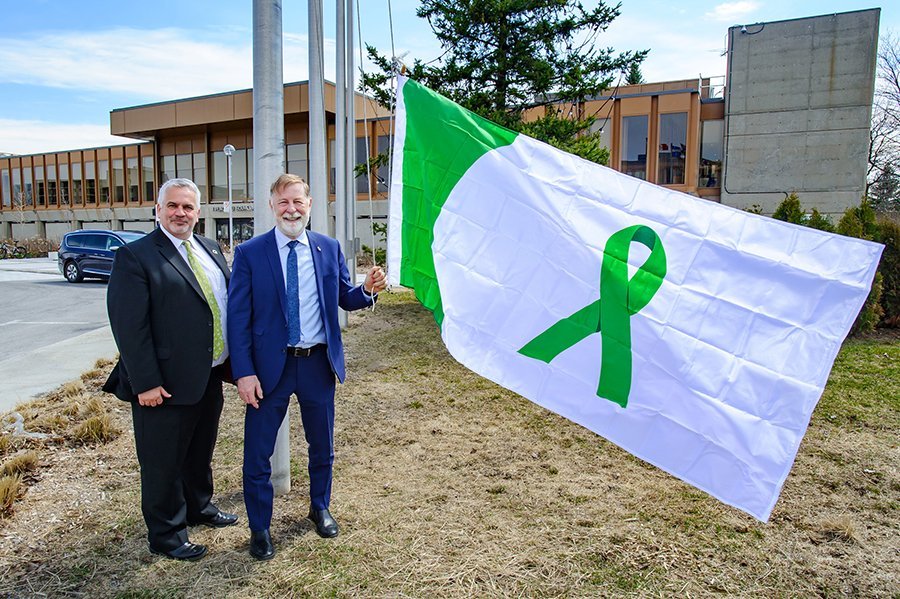
From the left, Louis Beaulieu, director of Transplant Québec and Laval mayor Marc Demers hoist the Transplant Québec flag, marking National Organ Donation Week.
(TLN) During National Organ Donation Week, the City of
Laval decided to show its support for Transplant Québec
by flying the green ribbon flag, a symbol of the transplant movement across
North America.
Laval is joining an awareness-raising movement in
which hundreds of other towns and cities are also participating.
“The more there are of us talking about this, the more
we will be increasing the chances of improving or saving lives, because organ
donation is a gift of life,” said Mayor Marc Demers. “We are inviting all Laval
residents to actively reflect on the importance of organ donation, but mostly
to speak about it with those close to them.”
Ways to
consent
There are three ways for individuals to give their
consent for donation of organs or tissue: Sign a consent form provided by the
Quebec Health Insurance Board (RAMQ); Sign a sticker provided by the RAMQ and
place it on your health insurance card; Sign a consent agreement for organ and
tissue donation with the Chambre des notaires du
Québec.
In
2018, 497 persons benefited from transplantations in Quebec thanks to tissue or
organ donations made by 164 donors. Out of this number, two donors from Laval
made it possible for four persons to have transplants. As of Dec. 31 last year,
805 persons were waiting for organ donations in Quebec, of which 51 were in
Laval.
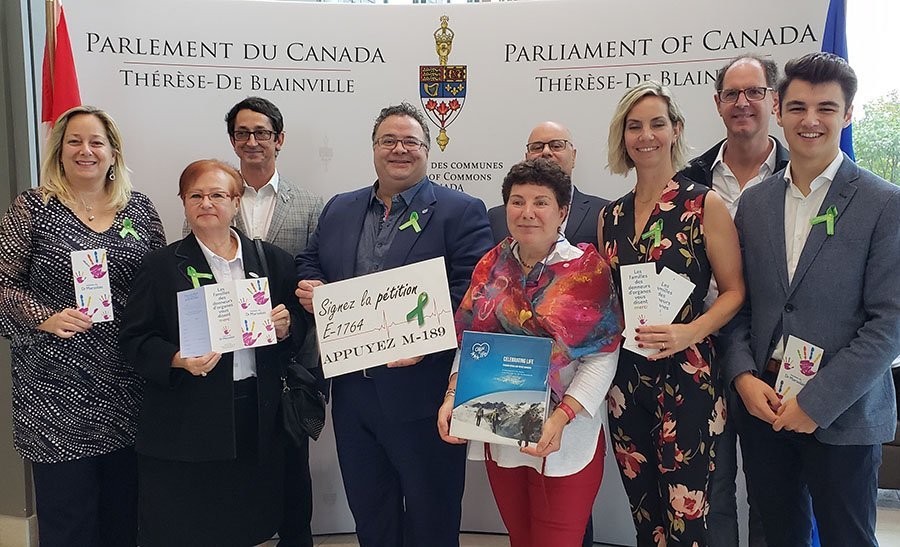
People on missions are rarely defeated, although sometimes delayed in reaching objectives. At a media conference last autumn, speaking for everyone in need of organ/tissue transplants across Canada, Federal Member of Parliament (MP) Ramez Ayoub (Thérèse-De Blainville) strongly stressed urgency of House of Commons Motion 189, specifically aimed at these medical initiatives.
Recently, to mark National Organ and Tissue Awareness Week, Ayoub re-iterated his commitment to the cause. “(This) is an opportunity to lift the veil and encourage people to sign the Régie de l’assurance maladie du Québec’s Consent to Organ and Tissue Donation form. The goal is information and awareness, hence the importance of campaigns and national weeks. I care deeply about this issue. That is why I introduced Motion M-189, calling upon the federal government to reaffirm its commitment and to encourage organ/tissue donations in Canada by supporting national efforts, in collaboration with provincial/territorial authorities and stakeholders” says Ayoub, in a press release. “I am very proud to see, through an announcement in support of Motion M-189, that our work has paid off. The Honorable Ginette Petitpas Taylor, Minister of Health, announced April 8, additional $3.4 million funding over two years for Canadian Blood Services, to improve organ/tissue donations and transplantation systems.”
This
funding, added to $3.58 million provided annually to Canadian Blood Services by
Health Canada, will support public education and awareness campaigns,
professional education, development/implementation of best practices, and
system improvements to promote effective and timely access to care.
Budget projections – 2019-2020
Ayoub is gratified for attention paid by Federal Finance Minister Morneau to this cause that’s so close to his heart, citing that in the recently tabled budget Ottawa proposes to provide Health Canada with $36.5 million over five years, $5 million annually, towards developing national data and performance systems for organ donation/transplantation, in collaborative efforts with provincial/territorial partners.
The
goal, says Ayoub, is to improve data consistency and quality, allowing more
donors and recipients to be effectively matched, ensuring that Canadians have
timely and effective access to organ transplant opportunities. “It’s more
important than ever for citizens to talk to loved ones, friends, and work
colleagues about organ donation,” he pleads.
What can we do to help?
At the September press conference, Ayoub introduced several important supporters. Chaîne De Vie, the non-profit Organ Donation National Educational Awareness Project is an integral participant. According to Ayoub, the Québec-based organization widely promotes understanding and importance of organ/tissue donations.
Prominent
individuals strengthened Ayoub’s message. Dr. Pierre Marsolais, internal
specialist and founder of the Regional Center of Organ Donation at Montreal’s
Sacré-Coeur Hospital, was transparent about the need to develop better
strategies. “Donation and transplants are not sterile medical processes, but
personal human deeds, acts which touch people personally, and intimately, giving
recipients a new lease on life, enhanced quality living, and new outlooks on
humanity.
“In Quebec, 4500 are waiting for donors,” Marsolais told TLN, pointing out that between 2006-2015 donors declined. Wait-time is four years. Québec has the least donors, although augmentation has occurred in recent years. Donors also change their minds, Marsolais acknowledged. Donors’ families need support, and he encourages everyone to share responsibility. “It’s the only way to save lives.”
Chaîne
de Vie, central to the mission of informing/sensitizing students on this
delicate issue, has an array of people committed to the cause: founder/president
Lucie Dumont; Youth Ambassador Tristan LeBlanc; Isabelle Tétrault, daughter of
a donor and ambassador to schools; and Johane Michaud, spokesperson for young
adults. Organ recipients Joe Hajj and Yves LeBlanc, Carole Du Paul, wife of an
organ donor, mayors from several cities, and medical and business associates
all strongly support the cause.
Available to all Canadians
“I sincerely believe we must do better for those whose only hope is an organ donation,” Ayoub states, emphasizing that disseminating information within schools and establishing open communication with young people are crucial. Declining organ/tissue availability is a global phenomenon. Canada and Québec face substantial shortages and lives are lost. Reasons include misinformation and reluctance to talk about death, leaving difficult decisions to families unprepared to consent when the time comes. “Although 90% of Canadians favor organ donation, only 20% manifest interest. Unfortunately, 10-15% have consent withdrawn by family at time of death,” Ayoub cautions.
A problem with a cure
All
ages can donate – youngest at 48 hours to oldest at 88. Minors need parental consent. Donor families
have different stories, such as those of Isabelle Tétrault, Carole De Paul, and
Johane Michaud. But all reflect generosity
of the human spirit, in time of grief and tragedy, to rise above personal
concern to help others. For Isabelle, Carole, and Johane it’s the ultimate gift,
the utmost act of human kindness. To give back for gifts received, they are actively
involved in promoting Dr. Marsolais’ mission in support of donors and their
families, participating in programs that inform through education in hope of
more research toward organ/tissue donation.
Saving lives through corporate support
Chain
of Life, unique and intergenerational, founded and coordinated by Lucie Dumont,
aims to educate high-schoolers on organ/tissue donations, encouraging them to
become ambassadors in family discussions. The project unites health and
education sectors to save lives.
“It
is through teaching units, integrated into English courses, that this project
mobilizes. 200 Québec teachers are on board, with potential to reach 100,000
young people province-wide,” Lucie Dumont told TLN.
Values
conveyed by Chaîne de Vie encourage
young people to demonstrate community
commitment by undertaking concrete actions.
Privately funded, major supporters are DESJARDINS ($250,000), TELUS
($20,000), and FONDATION ST. HUBERT BBQ ($15,000). Approved by the Quebec
Government, the project is accessible to all school boards.
(TLN)
The City of Laval’s executive-committee made a number of decisions during a
public meeting it held on April 24. As a result, several Laval streets will be
improved and there will be better lighting in two parks.
The
committee recommended to city council that it award a $258,693 contract to
AECOM Consultants for architectural services involved in the preparation of a
master plan for the city’s Nature Centre. The city’s goal is to eventually
develop the centre into one of the province’s most notable urban parks.
Bois de la Source
The
executive-committee also recommended to council to award a more than $458,000
contract to BC2 Groupe Conseil for the preparation of plans to improve the Bois
de la Source wooded area in Fabreville. When eventually completed, the Bois de
la Source will include multifunctional pathways integrated into the natural
setting, pedestrian walkways, protection of wetlands and the construction of a
maple sugar shack facility.
The
committee also recommended to city council to award an almost $7 million
contract to UNIROC Construction for rehabilitation work to be done on various
streets in Laval. The streets include Bazin, de la Victoire, de Medoc, Léon,
Donck, Joseph-Prévost, Saint-Luc and 14th. The work will include
replacement or rehabilitation of the underground water pipes and rebuilding of
the street. Sewers will also be replaced
Better lighting at parks
The
executive-committee also recommended the awarding of a $148,038 contact to
Ondel for work to improve lighting at Baron Park and Berthiaume-Du Tremblay
Park. The company will be furnishing services for the installation of
foundations, conducts and lighting fixtures for the project.
The
city’s executive-committee is responsible for many of Laval’s most important
decisions. The committee is led by Mayor Marc Demers. Its members are
Duvernay-Pont Viau councillor Stéphane Boyer (vice-president), Concorde-Bois de
Boulogne councilor Sandra Desmeules, Sainte-Dorothée councillor Ray Khalil,
Sainte-Rose councillor Virginie Dufour and Auteuil councillor Jocelyne
Frédérick-Gauthier.
Provincial, municipal and public safety officials in
the Laval region remained on high alert this week as spring flooding – bringing
together melted snow runoff from the Laurentians with days of steady rain –
combined to create one of the biggest weather-related crises ever seen in
Quebec and eastern Canada.
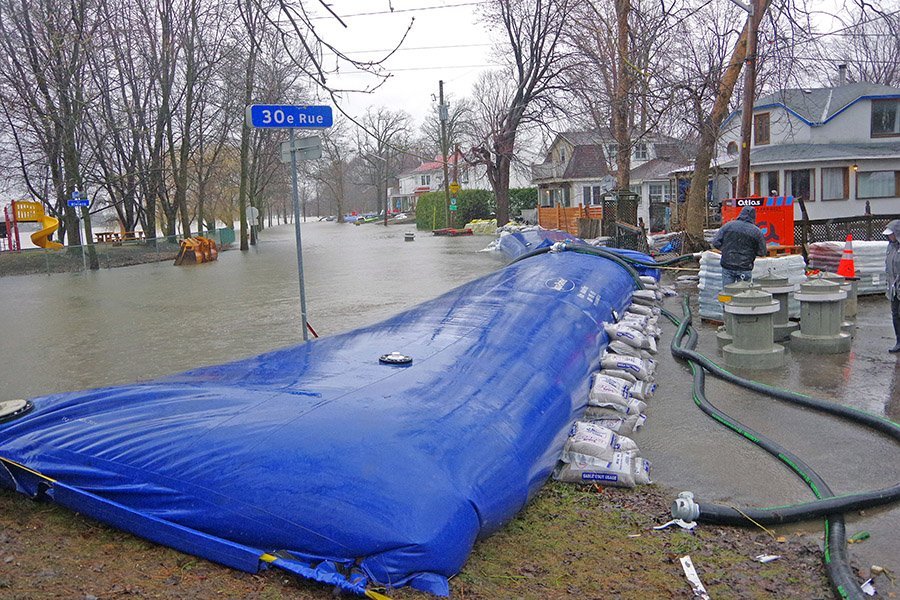
In one of several hard-hit areas in Laval – the Berge
aux Quatre-Vents just off the Rivière des Mille Îles in Laval-Ouest – the City of Laval fought back against
the rising surge of water invading some low-lying streets with an inflatable
“Aqua-Barrier” rubber dam – with encouraging results.
Help from Aqua-Barrier
This Aqua-Barrier set up at the corner of 30th and 17th streets in Laval-Ouest was useful in keeping the surging waters of the Rivière des Mille Îles in their place.
Compared
to the flooding in 2017, when many nearby streets were inundated and homes near
the waterfront suffered extensive water damage, the Aqua-Barrier appears to
have done a good job holding back the surge, while sparing many local
homeowners from what would almost certainly have been a repeat of the 2017
flooding.
It
all could be blamed on melting snow in mountainous regions north of the
Outaouais, Laurentian, Lanaudière and Mauricie regions that created unprecedented
flooding south of there. There were also massive surges on several of the
province’s waterways leading into an already waterlogged corridor between the
cities of Gatineau and Trois-Rivières.
Painful decisions
Part
of that surge became all too obvious in the City of Laval on Thursday morning
last week when civil protection officials announced that access to Île Bigras
over a temporary bridge had to be suspended because of treacherously rising
water levels.
Last Saturday, Laval Police chief Pierre Brochet,
accompanied by several members of city council, was at the Accès
community centre in Laval-Ouest for one of many
briefings that were held to keep the media abreast of the ongoing situation.
Brochet said the decision to evacuate was taken because access
was nearly impossible by an adjoining bridge.
Necessary
evacuations
It was during this briefing that Brochet announced
that the city was ordering the evacuation of all persons living in the southern
sector of Laval’s Île Verte. People living at addresses
64 to 93 Comtois St. were affected. In all, 22 dwellings were impacted by the
order, although many more homes in other areas of Laval were also feeling the
effects of the floods.
“Residents are advised that they will be compromising
their security if they decide to not comply with this order, as essential
emergency services will no longer be assured,” City of Laval officials said in
a statement accompanying the announcement.
Double duty at 3-1-1
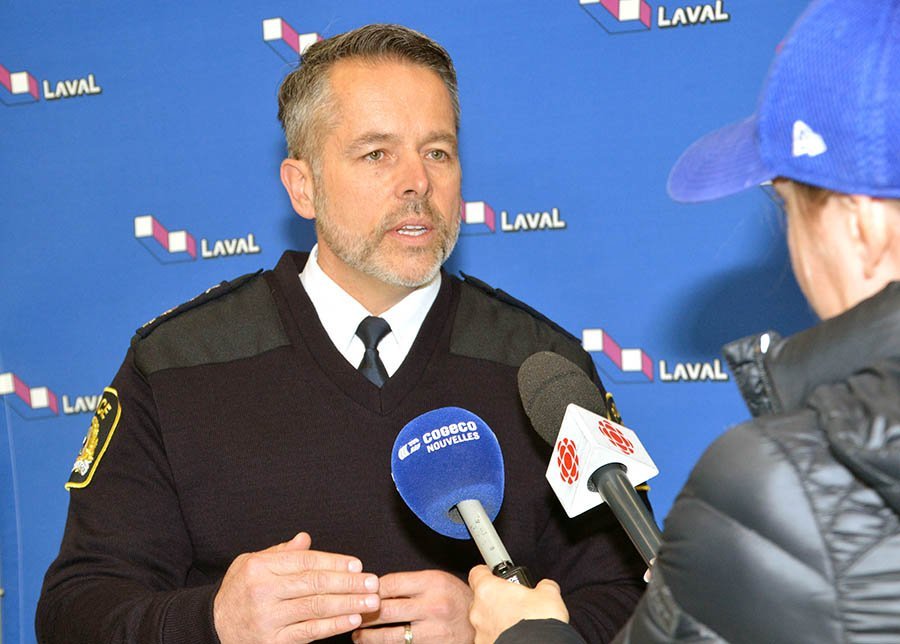
Laval Police Department director Pierre Brochet answers the media’s flood-related questions at the Accès community centre in Laval-Ouest last week.
Last
week and this week, Laval’s public safety and public works employees were on
alert, keeping a steady eye on the situation on a 24-hour basis, in order to
catch potentially unforeseen developments before they took place. The city’s
3-1-1 public works intervention hot line was doing brisk business, taking calls
from hundreds of concerned Laval residents.
The
city set up a number of web-based resources for Laval residents to keep up with
the changing conditions. They included a web page dedicated exclusively to the
flood situation (www.inondations.laval.ca, an interactive map showing the
at-risk flood zones (https://www.ville.laval.qc.ca/geo/geoweb/?config=citoyen),
and social media including the City of Laval’s Facebook page and Twitter
account.
Learning from last flood
As
early as last weekend, meteorologists and experts in river and watershed flows
were predicting that levels in the water bodies surrounding the Laval and
Montreal regions would grow higher than what they were in 2017 when flooding
problems last assailed the area.
In
Laval, police and public safety officials created specific zones where
residents were asked to plan ahead and pack some items to take with them in
case an evacuation was ordered at the last minute. The city decided to
establish special flood zones A – B – C and D following the floods two years
ago based on partly on past flood history and current data on Laval’s flood
plains.
Volunteers helped out
Last
Sunday at the Accès community centre in Laval-Ouest, the city held a volunteers-recruitment drive from 9 am
to 4 pm in an effort to provide training to volunteers 18 years of age and
older in the filling of sandbags to create temporary dikes against the flood
waters. Those participating were expected to arrive equipped with gloves,
rugged footwear and shovels.
For those seeking to protect their homes and property
from the rising waters, sandbags could be obtained at depots set up by the city
at strategic locations in Laval, including Berge
Couvrette on Bord-de-l’Eau
Rd. in Sainte-Dorothée, the parking lot at firehall #7 in Auteuil, Parc
Berthiaume-Du Tremblay in Chomedey, the Centre communautaire Bigras on Île
Bigras and the pumping station on du Parc-des-Érables St. in Auteuil. Bulk,
unbagged sand could also be picked up at the Accès community centre in
Laval-Ouest.
At
the April 24th meeting of Sir Wilfrid Laurier School Board (SWLSB), Council
of Commissioners, numerous highlights were outlined, however the peak of the
evening was a thoughtful and robust plan reflecting Director-General (DG) Gaelle
Absolonne’s decision to provide a solid framework for “stability and
consistency” ensuring “STATUS QUO” with the exception of three changes for
school administrators of the Board’s 35 schools and two centres, as of July 1,
2019.
Sir Wilfrid Laurier School Board Director General Gaelle Absolonne
In documentation presented on-screen, TLN noted it is the responsibility of the DG to recommend to Council the assignment of Principals, Vice-Principals, and Center Directors prior to May 15, annually, in accordance past-precedent. Individuals were requested to submit career plans for 2019-20 to the DG for revision. SWL Administration Associates (SWLAA) and Association Quebecoise des cadres scolaires (AQCS) are presented with the criteria for assignment and transfer of principals, vice-principals, and center directors. Governing Boards also consulted on the criteria of principals for their school, a customary procedure.
As the Assignments came on screen, Commissioner Bob Pellerin’s request to proceed in-camera was unanimously approved and the Council went behind closed doors for 75 minutes, a mystery to everyone in attendance. After the Council came out of seclusion, the meeting resumed and the Administrative Positions were posted. No opposition.
TLN asked Chairperson Paolo Galati if he had been made aware of the assignments prior to the meeting. He responded that it was discussed the week before, but it was not discussed at the Executive level although it was brought to Corporate Committee. Seven commissioners sit on the Executive, including the chairperson. “I was not part of the Selection Committee nor was I consulted on the selection,” stated Galati in a telephone interview.
Galati
referred TLN to Maxeen Jolin, Coordinator, Communication Services (SWLSB) for clarification
of procedure. When contacted by TLN, Jolin stated that she had to verify with DG
Absolonne for the protocol. TLN also made unsuccessful attempts to contact the
DG. No response at press time concerning protocol came from either Jolin or
Absolonne.
When contacted for clarification on protocol and procedures for in-school administrative assignments, former Chairperson Steve Bletas told TLN that “the DG meets with all the schools’ administrative teams to discuss career plans and objectives. The DG then brings it to the Executive on which the Chair also sits. The DG decides on the placement. Council can oppose the decision, but it must be done by vote. The decisions are vetted thoroughly prior to Council, and Commissioners can ratify at Council meeting. It was always discussed at committee level.” Bletas stated that this is how it was done when he was chair, for over 15 years
Electronic reporting of Commissioners
expenses
At the March 27, 2019 meeting Commissioner Guy Gagnon moved for transparency regarding the publishing on the SWLSB website the Commissioners’ monthly expense reports. It was tabled for Aril 24, 2019.
The motion was carried, and on the recommendation of the Corporate Committee, the Council of Commissioners will implement a public reporting process for travel and expenses retroactive to 2014-15. Commissioners’ expenses will be annexed to the Council Highlights posted on the board’s website on a monthly basis. Further published reports will include all expenses incurred by the Council of Commissioners.
School year to date
The
Board reports that they are on track with expenditures related to the
government’s protected measures to school centers ($5 million), and on track
with the overall school budget of $169 million.
Student Recognition
Two
students, Liana Tarasco, Saint-Vincent Elementary and Catherine Blackhorn, Luaurentian
Regional High School, were the recipients of the Tony Licursi bursary.
Autism Awareness Month
Four special guests were welcomed at the head office of SWLSB to celebrate Autism Awareness Month. They are Francesco Renda, Sec. IV, and Samuel Beldie, Sec. V of Laval Senior Academy. They were accompanied by English teacher Rhonda Steiner and Vice-Principal Sonia Garofolo.
And Council gives special recognition to a special student Marlorie Beaufils of Joliette High School for her special efforts on promoting and challenging her school, Council and the public to “No Phone Tuesday”. Marlorie stated to Council and to the curious observers, “Ignore your phone on Tuesday or at least one day a week.” She was awarded a certificate of recognition for her initiative.
From the left: Laval Police chief inspector for risk management Manon Ouellette, Laval Police director Pierre Brochet, Canadian Forces Lt. Col. Stéphane Tremblay and Master Warrant Officer Patrick Barriault.
(TLN)
Last week as the City of Laval was beginning to deal with spring flooding, Lt. Col.
Stéphane Tremblay, commander of operational forces in the greater Montreal
region, and Master Warrant Officer Patrick Barriault visited the city’s
Emergency Measures Coordination Centre.
The two stated their support and the determination of
the troops under their command to provide assistance to Laval residents during
this time of crisis. Laval Police director Pierre Brochet, who also coordinates
civil security in Laval, was on hand to welcome them.
Around 200 Canadian Forces personnel (around a third
of the total number of soldiers deployed in Quebec to deal with the flooding)
were brought into Laval and have been providing assistance in areas of the city
that are most impacted.
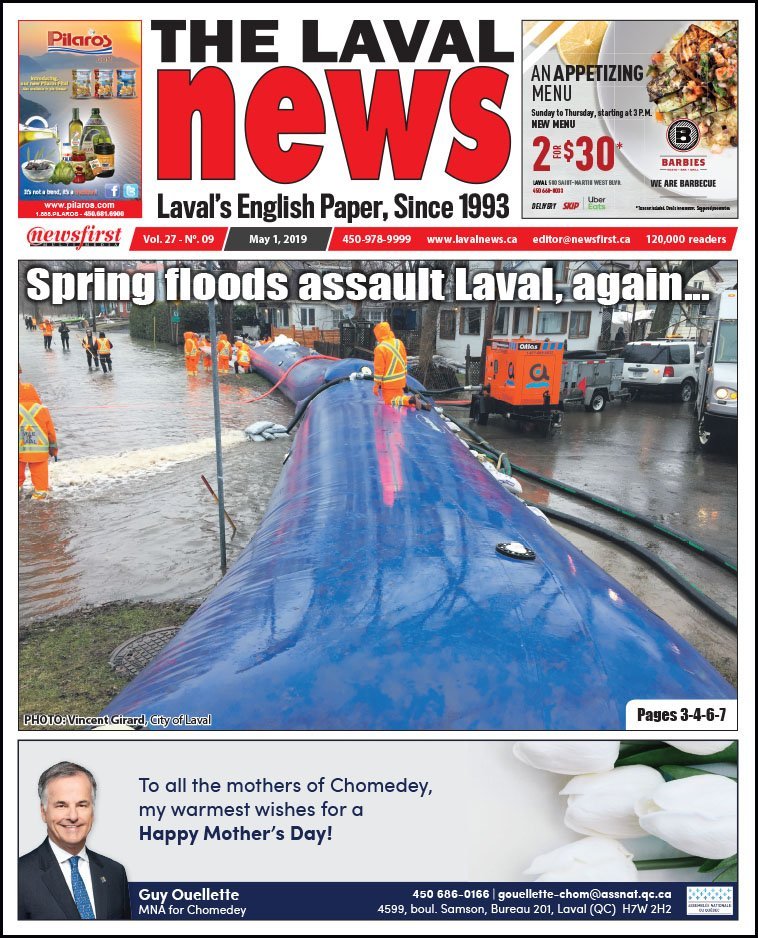
The current issue of the Laval News volume 27-09 published May 1st, 2019, (Laval’s English Newspaper) covers local events such as politics, sports and human-interest stories. It features editorials and other columns. Click on the image to read the paper.
(TLN) Quebec Minister for Seniors and Caregivers
Marguerite Blais and Sainte-Rose CAQ MNA Christopher Skeete have announced new
financial assistance to the Table régionale de concertation des aînés de Laval amounting
to $400,000 in 2023.
Budget hike
The 20 per cent increase in the TRCAL’s budget will
allow the organization to increase the availability of services to seniors,
Skeete and Blais said in a statement.
“This significant increase in funding, which was
sought for several years, shows the importance accorded to seniors issues by
our government,” said Skeete.
Subsidies for seniors
TRCAs
exist in each of Quebec’s 18 administrative regions. The TRCAL is overseen by the Conférence des Tables
régionales de concertation des aînés du Québec (CTRCAQ).
The
CTRCAQ is expected to receive an additional subsidy of more than $910,000 by
2023 to assist with its activities. In all, the TRCAL and the CTRCAQ will be
receiving $7.7 million by 2023.