The current issue of the Laval News volume 27-10 published May 15th, 2019, (Laval’s English Newspaper) covers local events such as politics, sports and human-interest stories. It features editorials and other columns. Click on the image to read the paper.
Front page of Laval News, Vol. 27-10
May 15, 2019.
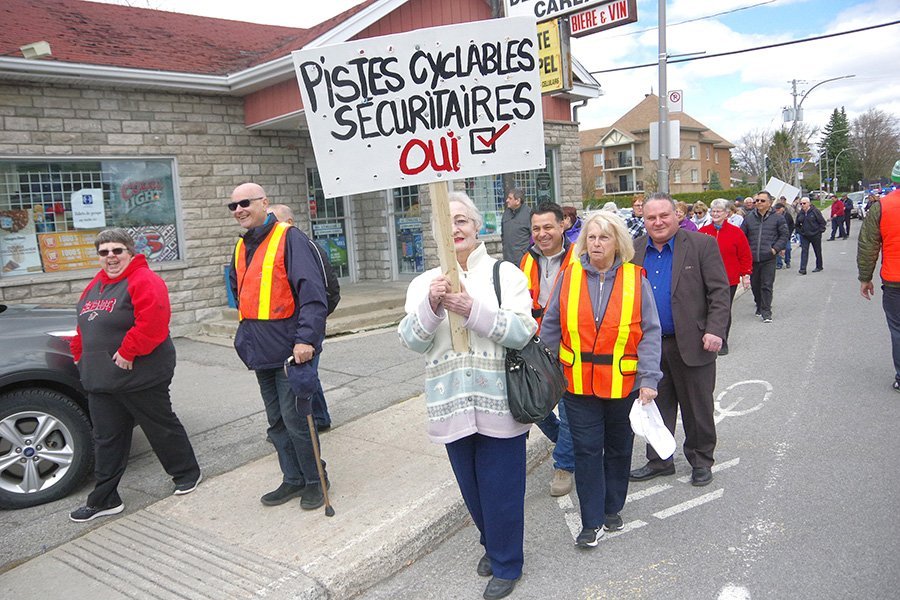
Making their way along the Saint-Elzéar Blvd. bike path, the protesters want the City of Laval to fix deficiencies in the bike path network.
Martin C. Barry
More than 100 people from Laval’s Vimont district as
well as from other areas of the city took part in a demonstration march along
parts of Saint-Elzéar and des Laurentides boulevards
early last Saturday afternoon to protest alleged negligence by the City of
Laval when it set up a network of bicycle paths without taking into account
local safety issues.
Although Vimont city councillor Michel Poissant organized
the demo to draw attention to the problem in parts of his district, he received
support from other elected members of the Action Laval party, including
Saint-Bruno city councillor David De Cotis and Chomedey city councillor Aglaia
Revelakis.
Transportation
plan
Just as the city’s decision to paint blue and white
safety markings on sidewalks near schools was widely criticized and eventually
had to be withdrawn, Laval’s implementation of a large network of bike paths
has also come under fire in some areas.
Both measures are part of a wide-ranging
transportation plan implemented by Mayor Marc Demers and the Mouvement
Lavallois which holds the majority of seats on Laval city council.
In an interview with the Laval News, Poissant said
residents of his sector have been complaining, to the media as well as during
Laval city council meetings, since the bike path was installed along Saint-Elzéar
Blvd. in Vimont last August.
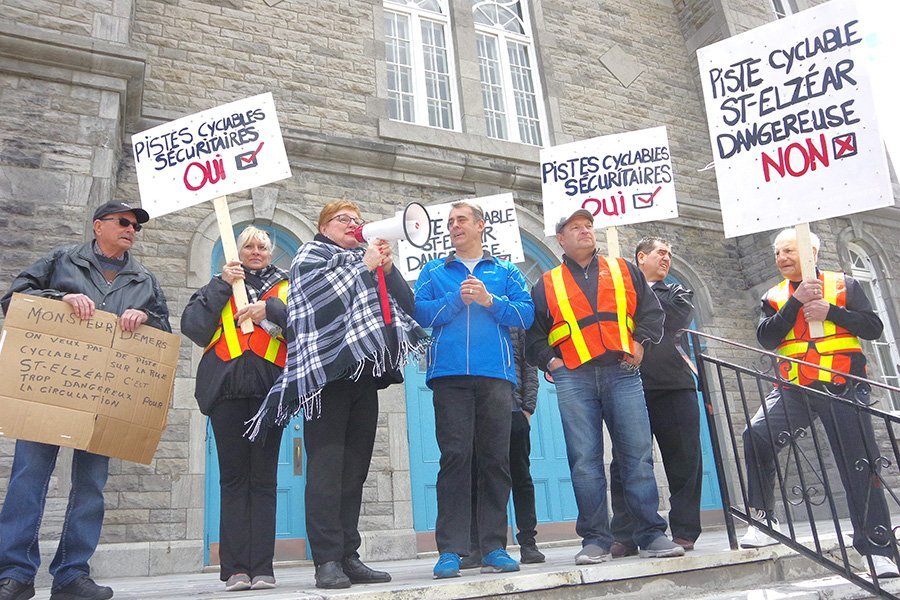
Action Laval city councillor for Vimont Michel Poissant (centre) is seen here with supporters on the steps of Saint-Elzéar church during a bike path protest last Saturday.
Bike paths
criticized
Critics of the bike path along Saint-Elzéar
maintain that it’s too narrow, and that it was laid
down without taking into consideration the presence of senior citizens living
in the area as well as people attending a community centre and Saint-Elzéar
church.
According to Poissant, there is a consensus among
local residents – including organizations such as the Société
Saint-Vincent-de-Paul, the Chevaliers de Colomb, golden agers and others – that
they never wanted the bike path and they don’t
understand the city’s determination to keep it in place.
Wants city to
reconsider
“It doesn’t make any sense,” said Poissant. “We are
living in a democracy. But the point we are trying to make is that the city
should reconsider its strategy for the deployment of bicycle paths. That’s our
message.” He pointed out that Saint-Elzéar
Blvd. in Vimont was formerly a narrow country road
that doesn’t adapt well to the implementation of bicycle paths.
“We’re
not against bike paths,” said De Cotis. “We think it’s important to get people
to be out there with their bikes having physical activity. But it’s got to be
done in a very responsible way to make sure that the cyclists are secure, the
pedestrians are secure, the motorists are secure. And we feel that the city
really didn’t take the time to make certain bike paths secure.”
Chomedey city councillor Aglaia Revelakis, right, seen here with a bike path protester, says her district also has some dangerous bike paths.
‘Lives at risk,’ says
Revelakis
Revelakis
said that in her district, the safety of bike paths along Saint-Martin Blvd.
remains an unresolved issue as far as Action Laval is concerned. “We’re putting
lives at risk,” she said, noting that in some areas where the bike paths pass,
many drivers are uncertain how they should proceed when there are bike paths.
On
May 3, L’Abord-à-Plouffe city councillor
Vasilios Karidogiannis (Mouvement Lavallois) issued a Facebook post in which he
solicited bicycling activists to help organize a counter-protest event in
response to the demo organized by Councillor Poissant and Action Laval.
Counter-protest fizzles
While
there were no signs of counter-protesters in Vimont last Saturday, Action Laval
reacted to Karidogiannis’s request a few days after he made it. “For Michel
Poissant, Councillor for Vimont, in addition to being in ‘extremely poor
judgement,’ this call for a counter-demonstration by an elected official is an
affront to the democratic right to demonstrate peacefully,” said Action Laval.
Action
Laval Public Safety Critic and Councillor for Saint-Vincent-de-Paul Paolo
Galati called Karidogiannis’s post “irresponsible and dangerous. Mr.
Karidogiannis calls on the population to block a peaceful demonstration and to
‘put Mr. Poissant in his place,’ which is intimidation.”
From the left, Sonia Lessard (executive-director of L’Appui Montérégie), L’Appui national executive-director Guillaume Joseph, and Lucie Gagnon (executive-director of L’Appui Montreal) are seen here during the organization’s press conference on May 7 in Montreal.
Martin C. Barry
L’Appui pour les proches aidants d’aînés, an umbrella group for organizations providing services to caregivers of older adults across Quebec, has announced record investments of $50 million over the next three years for caregiver support.
The
sums, the largest in the history of the organization, will allow for direct
services to caregivers of older adults according to their needs and depending
on the different regional realities.
English caregiver support
According
to L’Appui officials, who made the announcement during a press conference on
May 7 at their downtown Montreal offices, the amounts will be invested
throughout Quebec, to organizations offering services to caregivers of older
adults in their communities.
For
example, this year and next year $3,871,413 will be used to fund organizations
in the Montreal region (including Laval) and $1,329,879 will go to
organizations of the region of the National Capital. The investments also
include sums allotted to groups providing support to English-speaking caregivers,
according to L’Appui.
Services to expand
The
less populated regions of Quebec will also see services expand, such as in
Gaspésie-Îles-de-la-Madeleine where $558,477 will be used for projects
sponsored by community organizations. In Montérégie, the organizations there
will receive $2,300,000 to ensure the development of their offer while
preserving their service quality.
The
national executive-director of L’Appui, Guillaume Joseph, emphasized the relevance
of all the projects. “We are very proud of these investments,” he told
journalists. “First, of course, because the needs are there, but also because
we have developed real expertise over the years. Thanks to our regional Appui
offices, we are familiar with the needs and realities of the field.
Caregiver needs growing
“These
are investments that will end up being converted into services directly to
caregivers of seniors,” continued Joseph. “In other words, respite services,
psychosocial support services and information services, as well as training.
“We
are particularly proud to announce these investments because the needs are
great. Caregivers are more and more numerous and will continue to be so in the
coming years. Therefore it is important that there are services in place in
order to answer to these needs, which can be quite different from one caregiver
to another.”
“Caregivers are more and more numerous and will continue to be so in the coming years,” says L’Appui national executive-director Guillaume Joseph.
Resources also available
In
Quebec, according to L’Appui, 65 per cent of caregivers of older adults say
they don’t have access to services because they don’t know them or don’t know
where to find them. This is why, in addition to funding, L’Appui says it has
set up two resources to assist caregivers in their research and to support them
throughout their journey.
L’Appui’s
Caregiver Support Service offers personalized, free and confidential support to
caregivers of older adults. The professional advisors offer support,
information and references. They can be reached on weekdays from 8 am to 8 pm
at 1 855 857-7784, or by e-mail at info-aidant@lappui.org. A resource directory
of the organizations and their services is also available at lappui.org. It
allows anyone to search by region and type of service, according to the needs
of each.
An important mandate
Founded
in 2009, L’Appui pour les proches aidants d’aînés is a non-profit organization
funded by the government of Quebec and the family of Lucie and André Chagnon. The
main mandate of L’Appui pour les proches aidants d’aînés is to help implement
and fund information, training, psychosocial support and respite services that
are offered by community organizations.
L’Appui
also holds a role of mobilization and concertation for the various players who
are dedicated to supporting caregivers of older adults and who participate in
improving their quality of life. This mission is carried out across Quebec with
the help of 17 regional Appui offices as well as a specific agreement for the
Cree Territory of James Bay.
(TLN) On May 8, a motion tabled in the National
Assembly by the Liberal MNA for Bourassa-Sauvé, requesting the Committee on
Citizen Relations acknowledge the petition concerning the fight against planned
obsolescence and the right to repair, was unanimously rejected by members of
the CAQ government.
Experts
rebuffed
The adoption of the motion, supported by all the
opposition parties, would have allowed four experts to be heard on the subject.
As proposed by the PQ MNA for Jonquière, they were Jonathan Mayer, lecturer at Sherbrooke University and the instigator of Bill 197 in connection with the petition, Martin Masse, founder of Zone Accro, Insertec Angus, and the Institute of the Environment, Sustainable Development and Circular Economy.
Petition by
Ouellette
It might be recalled that a significant number of
people from across the province supported the initiative by 51 law students
from Sherbrooke University. In Fact, 45,028 citizens signed a petition tabled
on April 2 by Guy Ouellette, the National Assembly Member for Chomedey.
Mr. Ouellette said he was deeply disappointed with the
decision made by the government members of the Commission. The MNA for Chomedey
added that “the adoption of this motion would have allowed Bill 197 to go a
long way, which aims, among other things, to combat planned obsolescence and
promote the right to repair.”
Against
planned obsolescence
Bill 197 against planned obsolescence and the right to
repair, which was tabled on April 9, aims to amend the Consumer Protection Act
to ensure greater sustainability of consumer products. This Bill was completed
by law students at Sherbrooke University with the help of their teacher,
Jonathan Mayer, as part of a judicial interpretation course.
Planned obsolescence is a business tactic whereby manufacturers reduce the life of their products in order to speed up the replacement cycle. These practices force over-consumption and have significant and direct impact on the environment as well as the budget of Quebec consumers.
(TLN) During their last meeting, the members of Laval
city council unanimously approved a motion to rename Parc des Prairies
Bernard-Landry Park in honour of the former Quebec Premier.
“Bernard Landry was the only Quebec Premier to have
also been an MNA from Laval,” Mayor Marc Demers pointed out.
In memory of
“We felt it was important to honour his memory. He was
a man with heart and with convictions, a major politician and an excellent
teacher. He mastered the art of teaching, of persuasion and of encouraging
growth.”
Landry,
who died last year, was the Parti Québécois MNA for Fabre from 1976 to 1981,
and then for Laval-des-Rapides from 1981-1985. He was a key member of several
governments. He served as Premier of Quebec from 2001-2003.
Toponomy commission
The
decision to rename the park was following a recommendation made by the City of
Laval’s toponomy commission, which is composed of residents
and one city councillor.
“The toponomy commission studied the request for
Bernard Landry Park and made a favourable recommendation since the new name
pays homage to someone who made a significant contribution to the development,
dynamism and well-being of the community,” said Councillor Yannick Langlois
(district of L’Orée-des-Bois) who presides the commission.
(TLN) The Laval Police Department says it is working
in close conjunction with the Sûreté du Québec and the RCMP following the gunning down recently of an
individual suspected to be involved in organized crime at the Sheraton Laval.
During the incident in which the front door of the
Sheraton was shattered by gunfire, hundreds of people, including children and
seniors, witnessed as several gunshots were fired.
Project
Repercussion
“We will not hesitate to double up our efforts to
maintain at all cost the security of our citizens,” said Laval Police chief
Pierre Brochet, noting that the gunman fired with impunity and with seemingly
complete disregard for the consequences of his actions.
In response, the Laval Police, the SQ and the RCMP
have launched Project Repercussion. One goal of the trilateral force will be to
monitor more closely establishments in Laval known to be hangouts for organized
criminals, such as bars, restaurants and other licensed establishments.
(TLN) Since 2017, no less than 400 citizens, partners
from the municipal, community and health sectors, as well as elected officials,
have been walking annually in order to underscore the importance of World Elder Abuse
Awareness Day in Laval.
A seniors walk
On
June 14, participants from Laval will be gathering at Parc des Prairies for the
two or four kilometre walks. Participating
organizations will include the Table régionale de concertation des aînés de Laval, FADOQ – Laval Region, DIRA-Laval, AQDR
Laval-Laurentides and CISSS de Laval.
“To be able to provide active and quality aging to our
seniors is at the heart of our priorities,” says FADOQ – Laval Region
executive-director Andrée Vallée. “We thus judge it important to be a major partner on
this walk which is organized with the goal of raising awareness while
encouraging the proper treatment of elderly persons from the region.”
Third near
now
This will be the third year for the walk, which is
taking place June 14 from 8:30 am to 1 pm. The walk will be followed by a talk
given by Denis Fortier, physiotherapist and author, on the importance of
remaining active with aging. The walk will start from the main chalet in Parc
des Prairies (5 du Crochet Ave.) beginning at 9:30 am.
To register, visit the Facebook page Laval en marche pour la bientraitance des
personnes aînées, or the Web site, lavalensante.com, or phone
450 686-2339. A help line for senior abuse can be
contacted at 1 888 489-2287 for additional information and support.
(TLN) The Laval Police Department will be holding
their first annual Fraud Prevention Day event on May 18 in conjunction with the
force’s observance of Police Week.
The event will be taking place in the parking lot of
Laval Police headquarters at 2911 Chomedey Blvd. from 9 am to 3 pm.
Police officers will be on hand to provide information
on various types of fraud that have become common, such as online phishing,
fraudulent e-mails, identify theft, Web fraud and phone fraud schemes.
Destroy
confidential docs
At the same time, staff from police headquarters will
have equipment available for those who wish to shred confidential documents in
large batches free of charge.
These types of documents can include insurance forms,
personal cheques, declarations of revenue for income tax, receipts, bills, bank
statements, as well as papers on which personal information like date of birth
or social insurance numbers might appear.
According
to the Laval Police, nearly 17,000 incidents of fraud were reported by victims
last year.
May 7 – Laval police are searching for potential underage
victims of sexual exploitation following the arrest of convicted pedophile,
Michel Fradette.
Police allege 39-year-old Fradette tried to solicit
sexual favours from a 12-year-old girl.
His cellphone allegedly contained thousands of photos and videos of
child pornography.
At the time of his arrest, Fradette was on parole after
being sentenced to 10 years in prison for kidnapping and sexually assaulting a
nine-year-old girl.
Investigators say they believe Fradette may have other
victims who have yet to come forward.
Mafia Murder at
Laval Sheraton
May 4 – Laval police were called to the scene of a fatal
shooting at the Laval Sheraton last Saturday. The incident took place at around
10 p.m. in front of hundreds of witnesses, including children.
The victim was identified as 49-year-old Salvatore
Scoppa, whose criminal record includes guilty pleas for assault causing bodily
harm and breaking and entering. He was
the brother of Andrew Scoppa, alleged to be an influential figure in the
Montreal Mafia.
The shooting in Laval was the first of three fatal
shootings in the Montreal area in the span of eight days.
A 25-year-old man was fatally gunned down in a Brossard
restaurant on Friday night. Two days later, another man was killed outside a
residence in Terrebonne.
Police Seek
Possible Witnesses
May 1 – Laval police are seeking witnesses to the
homicide that took place during the evening of Thursday, April 25, in Ste-Rose
at the corner of Boul. Marc-Aurèle-Fortin and François-Baillargé St.
Police want to hear from anyone who was in that area
between 7:15 p.m. and 7:30 p.m.
Anyone with information can speak confidentially with an
officer by calling the info-line at 450-662-INFO (4636).
(TLN) As areas of the City of Laval alongside
riverfronts continue to recover following the devastating spring flooding
several weeks ago, city officials say they are continuing to provide assistance
to residents impacted by the floods.
In a statement issued by the city last week, officials
said recovery operations are getting underway as the waters recede, and that
inspection tours are being undertaken by teams composed of personnel from the
fire department and CISSS de Laval.
Recovery
underway
In all, the city expects that more than 1,600
residences affected by flooding will be visited. Last Monday evening, the City
of Laval held an information meeting at the Château
Royal in Chomedey for all residents impacted by flooding who wish to apply for
compensation from the Quebec Ministry of Public Security.
As
well, the city announced that as of May 14 a centre for the support of those
affected by flooding would be opening to offer information and answer questions
of all types. Located at 2785 Francis-Hughes Ave., the centre will also house a
temporary office for help to flood victims operated by the Public Security
Ministry.
Volunteers needed
In addition, the city is organizing a major cleanup operation taking place on May 25-26 for the collection of used sand bags and other debris left over from the flood. Volunteers are currently being sought for this operation. Visit inondations.laval.ca if you are interested.
In
the affected areas, business is starting to get back to normal, with garbage,
recycling and kitchen waste pickups gradually back to normal schedules. Special
collections are also being organized for the pickup and disposal of demolition
debris from damaged houses. According to the city, property owners will be
expected to separate the debris from their properties into categories before it
can be picked up.
An orderly cleanup
Here
are some instructions to follow: – Sand bags should be left on the edge of the property
or next to the street, with wooden pallets with bags to be thrown out. For
sanitary reasons, sand bags contaminated by flood water must be disposed of
carefully.
–
Debris from the river and from demolition should be deposited around the same
spot as old sand bags. Other items to be disposed of, such as old tires, paints
or electronics, will be collected by the city on May 25. They should be left
for pickup in the same place as the previously mentioned items.
In
all, according to the City of Laval, 85 streets in Laval suffered flooding,
while 355 buildings were flooded. As well, 117 families needed to be evacuated.
Of these, 17 families were sheltered by the Red Cross. Around 1,000 civic
address in Laval found themselves cut off by water or were impacted by the
floods.