(TLN) On June 1 and 2nd, the Centropolis is the place where many Laval residents will want to be for the 13th annual Laval Firemen’s Festival. As always the festival will start at 9:30AM with the ever popular firetruck and fire vehicles, parading from the Mondo garage (19 avenue Munck) in the industrial district till the Centropolis central area, around 10:30AM.
Motorists should consult the streets closures found on
page 11 of The Laval News.
Activities and
shows for all to enjoy
From 9:30 AM to 4PM, various shows and activities
about fire prevention will take place such as the ever-popular smoke-filled
house simulator, a lesson in how to escape a fire, a simulation of a car on
fire, and of course an exhibit of beautiful vintage fire trucks and vehicles.
For the young there’ll be mascots, face makeup, strolling clowns, inflatable
games and shows on stage such as the Kalimba Saturday show and Ari Cui Cui
Sunday show
On Saturday 5PM an open invitation to all to enjoy
musical bands Early Jazz Band and Croche Blanche at the center of Centropolis
terraces.
Firemen relays
Part of the activities is the various relay runs. It
is expected than more than 6000 runners will participate in various relays
throughout the city’s streets of 1, 2, 5, 10, 21,1 or 42,2 km. All those who
finish will receive a medal.
The “tochlight” runs of 2km and 5km will take place
Friday May 31st from the Centre de la nature at 8PM.
This year’s spokesperson and triple Olympic medalist
Marianne St-Gelais as well some of the Laval Rockets team players will
participate in the 5km run.
“The 24 hour Challenge” will start on Saturday at 2PM
and will finish -going on for 24 hours straight- Sunday 2PM.
Eight teams of 10 participants each, will be running
up and down the stairs of a two tower metallic structure of more than 12 meters
high, joined by a 18 meter bridge. All donations received will be given to the
“Fondation des pompiers du Québec pour les grands brûlés”.
Whether its going to be sunny or raining, the Firemen’s Festival will go on.
May 22 – Police are asking for the public’s help to
identify a suspect involved in an armed robbery that took place on February 14
at a Couche-Tard dépanneur in Pont-Viau.
The incident occurred at 6:35 p.m. The suspect entered
the store located at 185 Boul. des Laurentides and headed for the counter. He
took out a plastic bag and demanded the contents of the cash.
The suspect shoved the entire cash-drawer into his
plastic bag and fled through the Couche-Tard’s back door. He jumped into a
dark-coloured vehicle and took off.
Police describe the suspect as a white male, about 40
years old. He is about 1.7 m (5’7”) tall.
At the time of the robbery, the suspect was wearing a
blue coat and a black tuque.
Anyone with information on the suspect’s identity or
location is asked to call the Laval police info-line to speak confidentially
with an officer, at 450-662-INFO (4636), or 911. Mention file LVL 1902141-093.
Body Found in
Burnt SUV
May 21 – Police and firefighters arrived at the scene of
a vehicle on fire shortly after witnesses called 911 at 9:20 p.m. Monday night.
Several people reported seeing an SUV on fire on Boul.
des Mille-Îles near Highway 25. A few of the witnesses stated that the vehicle
was still moving when they saw it.
Once the flames had been extinguished, the body was
discovered inside the vehicle. Police could not immediately confirm the
identity of the victim.
The vehicle was towed away for analysis.
Police consider it a suspicious death and have begun an
investigation.
Laval Bike Cops
Ride Again
May 17 – The Laval police bike squad is on the roll once
again. Comprised of a dozen officers, the bike patrol rolled out on May 17 and
they will be pushing those pedals all summer until September 15, 2019.
Officers on two wheels will patrol Laval’s streets,
parks, bike paths, and public areas. They will also be present during cultural
events, sporting events, and other public gatherings.
The bike patrol will ride during the day and during the
evening, from Wednesday to Sunday, all summer long.
Police Seek Information
on Armed Threat
May 16 – Police are trying to shed some light on an
incident that took place in Duvernay, at about 3 p.m. on Thursday, May 16.
Officers were alerted to the possibility of an armed
assault between two individuals, and raced to the scene.
During the high-risk intervention, several individuals
were intercepted and handcuffed as a precaution, but no arrests were made.
No shots were fired.
Anyone with information about this incident is asked to
call the Laval police info-line to speak confidentially with an officer, at
450-662-INFO (4636), or 911.
With the federal government poised to release a
“digital charter” outlining Canada’s plans to deal with hate speech and
misinformation on the Internet, Liberal Heritage Minister Pablo Rodriguez says his
department is near the point of announcing an anti-racism strategy that will
also take abuses committed over the Internet into account.
Heritage Canada’s “anti-racism engagement” was
launched last year with the goal of hearing what Canadians themselves have to
say about racism and discrimination. An interactive digital platform launched
for that purpose focused on issues where racism and discrimination most
directly touch people’s lives, as well as policy areas that overlap with federal
jurisdiction.
‘Racism does exist,’ he
says
Since
then, in-person consultation sessions have been held with community, leaders,
experts, academics and other stakeholders across Canada. According to Rodriguez, his department’s anti-racism
engagement report will confirm, among other things, that there is racism in
Canada and that it is possibly also becoming worse.
“Nobody is saying that Canada is a racist country, but
racism does exist here,” he said in an interview with Newsfirst Multimedia last
week at the federal cabinet’s Montreal offices. “We’ve seen a rise in
anti-Semitism – it’s very clear – a sharp rise. In Islamophobia also. We have
to combat this rise in hate and anti-Semitism and all kinds of different forms
of discrimination online and in the real world.”
Responsibilizing
‘web giants’
“And we, the government, have a role to play at
different levels – including online – making sure that for some of the things
we do we have to responsibilize the web giants,” he added. “They have a
responsibility. There are things on the web that should not be there that
encourage people towards violence and hatred, and that’s unacceptable. So we’ll
be addressing that.”
Rodriguez said the strategy calls for anti-racism
measures to be taken as soon as possible. “We know that fighting racism is not
something that’s short, mid or long-term – you have to do it every day,” he
said. “But you have to start somewhere and you have to start now. And this is
what we’re doing with this strategy, which has different components.”
The Facebooks
of this world
Rodriguez had few specifics as to how the strategy
might directly impact major web service players, although he provided a broad
overview. “We’re talking about the Facebooks of this world, where you can easily
find hate which is online.
“Too often if something bad happens, they are saying
sorry, but the impacts are still there. I think they have to take
responsibility for who they are and what they do. They are making a lot of
money. Fine – happy for them. But that comes with responsibilities.”
In Quebec, the Coalition Avenir Québec
government hopes to pass its controversial Bill 21 banning the use of religious
symbols by public servants into law before the National Assembly breaks for the
summer. While some are suggesting the legislation foments division and
animosity, Newsfirst Multimedia asked Rodriguez how his department could react
should the bill pass.
Monitoring CAQ’s Bill 21
“We’re
following that very closely,” he said, while noting that it is within
provincial jurisdiction. “Is it going to be the same bill at the end of the
process that it is now? I understood that the government was open to changes.”
More
generally, he re-stated the federal Liberal government’s position on Bill 21.
“We consider that a government should not tell a person what to wear or how to
dress,” he said. “Also we think that nobody should have to choose between their
religion and beliefs and having access to a good job.
“With that being said we’re following very closely what’s happening and seeing if there’s changes or not. We are keeping an eye on it, but understanding very well also that it’s happening in another jurisdiction – a provincial level not at our level.”
He had
politics in his blood
Pablo Rodriguez’s introduction to politics came from
his parents who were politically active in their native Argentina during the
1960s. His father, a lawyer, ran for high office while representing political
prisoners who were jailed by the hardline Argentinian régime
at the time.
“He was imprisoned and tortured many, many times,”
said Rodriguez. Bombs were planted at the Rodriguez home shortly before they
came to Canada in 1974, injuring the two parents and three children, while leaving
no doubt it was time for them to leave Argentina.
On arrival in Canada, the family settled in Montreal’s
Park Extension district. While life for them was hard at first, both of his
parents went on to become distinguished scholars. At age 82, his father still
teaches sociology in university.
A University of Sherbrooke business administration
graduate, Rodriguez spent a good part of his early career working in public
affairs and management of international humanitarian projects. During the early
2000s he was vice-president of Oxfam Québec.
A longtime and highly-dedicated supporter of the
Liberal Party of Canada, Pablo Rodriguez was first elected MP for the Montreal
riding of Honoré-Mercier in 2004. He has won every election in the riding since
then, except for a brief hiatus in 2011 when the NDP prevailed during the
party’s sweep of Quebec known as the “Orange Crush.”
Left, Vimy Liberal MP Eva Nassif is seen here with Sandrine Gaudelet, executive-director of Dimension Travail, during their meeting at the organization’s offices in Laval last week.
Martin C. Barry
Last week, Vimy Liberal MP Eva Nassif joined staff of
the Dimension Travail women’s community employment agency on Saint-Martin Blvd.
to mark the positive impact that a $158,604 federal subsidy had over the past
two years on the lives of women who found employment through the centre.
The three-year subsidy was granted by Ottawa under the
Youth Employment Strategy (YES). According to Nassif, improvements
to the Youth Employment Strategy since 2015 have resulted in over 220,000 youths
finding good quality jobs or youths improving their skills.
Creating more jobs
“When
companies in Vimy and across Canada can thrive and grow, they create more
jobs,” Nassif said. She said the government’s new Global Skills Strategy will
give employers a faster and more predictable process for attracting top talent
and new skills to Canada, creating economic growth and more better jobs for
Canadians.
“Our
continued prosperity depends on young Canadians successfully transitioning from
the classroom to the workforce,” Minister of Employment, Workforce Development
and Labour Patty Hajdu (who oversees the subsidy programs) said in a statement.
“Giving Canadian youth a fair chance at success is how we will grow our economy
and strengthen the middle class.”
Summer jobs season
With
the annual summer youth employment period nearly upon us, Nassif noted that
“the summer work experience stream includes the ever-popular Canada Summer Jobs
Program, a program that offers Canadian youths more summer opportunities than
ever before.
“By
working together,” she continued, “we will make a difference for young people
everywhere. Our plan is to give every Canadian a real and fair chance at
success. Supporting youths as they transition into the workforce and giving
them the training they need to succeed is how we will strengthen the
middle-class and build a strong workforce and an economy that everyone has a
part in.”
Vimy Liberal MP Eva Nassif is seen here with Sandrine Gaudelet, executive-director of Dimension Travail and organization staff at the organization’s offices on Saint-Martin Blvd. last week.
Services free
of charge
Sandrine Gaudelet, executive-director of Dimension
Travail, noted that the organization will be celebrating its 20th
anniversary next year. Dimension Travail’s services are offered free of charge
to women living in Laval who are 18 years of age and older.
Among other things, Gaudelet said Ottawa’s subsidy
from the Connexion Compétences
program allowed Dimension Travail to help women aged 16 to 30 years who were in
vulnerable situations to be reintegrated into the workforce over a three month
training period while being remunerated through the program.
85 per cent success
“In
all, the first group of 16 women were able to come to us 30 hours per week
during a period of 10 weeks, and 85 per cent of these women either returned to
the employment market or benefited from this training which enabled them to
subsequently find work,” she said.
“Through
this project, we were truly able to help these women. It was a great success
for us, and even more so for them. It was a program which was very appreciated,
because the support was very intense with a lot of interaction between the
women. We have employment councillors who were able to help them with their
needs.”
Modernizing the program
According
to Nassif, the Liberal government’s budget 2019 proposes to invest $49.5
million to support the ongoing modernization of the YES. This will be in
addition to investments made in budget 2016, 2017 and 2018 in the Youth
Employment Strategy to help youths gain the skills and work they need to find
and maintain good employment.
She
said the YES is currently also being modernized, informed by the
recommendations of the Expert Panel on Youth Employment and extensive
engagement with youth, service delivery organizations and other stakeholders.
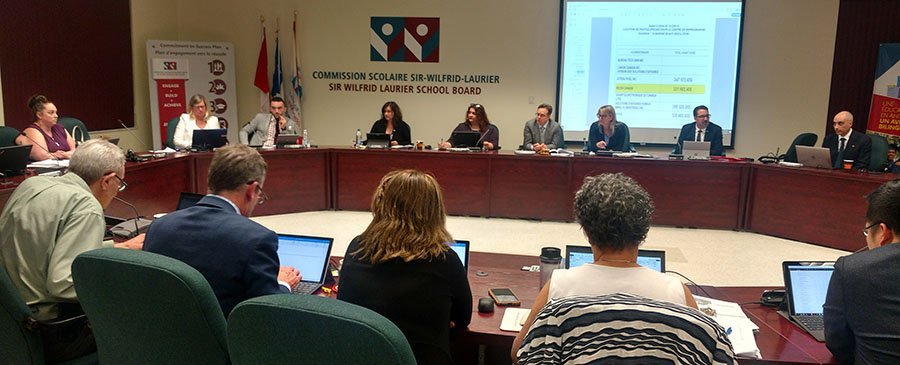
The May 22 Council of Commissioners meeting of the Sir
Wilfrid Laurierr School Board (SWLSB) featured potpourri of information ranging
from the 2017-2018 budget report to a summary of accomplishments from the same
year. The sparse audience was also
treated to a detailed account of the board’s strategic priorities, student
achievement data, and more.
Director General (DG) Gaelle Absolonne looked at
academic achievement with new eyes, reflecting on what teaching and learning
looked like in 2017-2018, and speculating on the future. “I’m very happy with
our strategic success plan to ‘engage, achieve, build’ – basing our efforts on a vision for student
learning,” she made public, affirming
that the 85.9 success rate continues to thrive and achieve
accomplishments
“With this percentage, we can say mission almost
accomplished. It demonstrates that students are engaged in authentic meaningful
learning. We have a lot to celebrate, we have the 10th highest average in the
province,” Absolonne specified.
Fred Greschner expresses enthusiasm for
Constru-Plus
Assistant DG Fred Greschner complimented the bilingual
Constru-Plus Vocational Training Center for High Pressure Welding and
Construction. “It’s important to educate
as many students as possible.” Heritage
Canada provided $4 million funding for the St. Eustache center, inaugurated
June 2018 in partnership with Commission Scolaire de la Seigneurie-des-Mille
Iles.
Big dollar budget
The overview of the 2017-2018 budget reflected
allocation of public funds over the school year: lease of copiers, $354 524.54;
lockers, $128 245.93; Rosemere High roof, $1 364 676.58; renovation project
(windows and doors) at Joliette High, $625 999,09; repair of four structures
,$432 891.34 – just a few of incurred
costs.
TLN asked Council why the Aesop Substitution Call
System was not reported. Absolonne stated that it will be presented at the
June 26 meeting. TLN also noted that
QESBA (Quebec English School Board Association) membership fees were not
listed. Maxeen Jolin, Laurier Board Communications Coordinator, told TLN in a
telephone conversation that the budget is an overview. “We did go over every budget line.”
Hope for status quo resonates in chairperson’s report
In his report, Council Chairperson Paolo Galati, noted
that Appelle Quebec has immobilized 16 organizations in an alliance for
preservation of school boards, in view of the Quebec government’s stated
intention to abolish them. Galati was very confident and pleased with the
movement and with the results of the polls taken by Leger and Leger indicating
that Anglophones still favor the status quo, although he did not reveal
specific figures uncovered in the polls.
Commissioners’ remuneration remains uncertain until
amount distributed is published. DG
Absolonne stated that since there is no accurate amount established, the
specifics will come at a later date.
Appointments of personnel
Effective July 1, 2019, The Board’s new Director of
Corporate Affairs/Secretary General is
lawyer Anna Sollazzo. “I’m very happy to have been selected, and look
forward to working and collaborating with the SWLSB staff, “ She said, thanking
everyone present. Current Interim
Secretary-General Stephanie Krenn will move to Director of Human Resources July
1, 2019.
There was a standing moment of silence in honor of
teacher Anthony Boyce and student Chris Tummillo of Laval Senior Academy, who
recently passed away.
From the left, Louis Marineau of Ferme Marineau, Catherine Beaulieu and Donald Beaulieu of Agneaux de Laval, Ray Khalil, member of the executive-committee and responsible for agriculture issues, Mayor Marc Demers, Patra Andrianopoulos and John Rodousakis of Tulipes.ca and Stéphane Lalande of the City of Laval.Photo credit: Martin Alarie
(TLN) Last week, Mayor Marc Demers accompanied by
members of the executive-committee and the city’s economic development team,
took part in the Laval Tulip Festival.
They were greeted by agricultural producers from
Laval, including Saveurs de Laval, Ferme Marineau and Agneaux de Laval. Another
event – Samedis à la ferme (Saturdays at the farm) –
opened the following day, bringing together artists and painters in an event
that continues until June 2.
Laval is the only city in Quebec, and possibly also in
Quebec, that offers the opportunity to handpick tulips. The tulip field
contains 520,000 bulbs in 14 different varieties. At the same time, local farm
products are available for sale. Last year, more than 30,000 people dropped by.
Seen on stage last weekend, teenaged and young adult members of the War Amps CHAMP program help provide support and encouragement to child amputees.
Martin C. Barry
Like a big family brought together for a gathering
filled with love and warmth, more than 100 child amputees, along with moms,
dads, brothers and sisters, met at the Laval Sheraton for two-and-a-half days
last weekend during the War Amps of Quebec’s annual child amputee seminar.
This year’s theme, “Just the Way I Am,” encouraged the
young amputees, who are members of the War Amps “CHAMP” program (Les
Vainqueurs), to embrace their amputation and overcome hurdles on their road to
independence.
There to
learn
The event drew young amputees and their parents from
across the province. They learned about the latest developments in artificial
limbs, how to deal with teasing and staring, as well as how to parent an
amputee child.
It was not the first time the Quebec chapter of the
War Amps chose Laval for the annual child amputee seminar. With children young
and old running freely around a meeting hall at the Laval Sheraton, the
ambiance of the opening welcome session was as relaxed and spontaneous as an
afternoon gathering of friends and family who had known each other for years.
Louis Bourassa, director of the Quebec War Amps CHAMP program, is seen here last weekend at the Sheraton Laval during the opening gathering of their annual child amputee seminar.
Helping young
amputees
“When they come here they feel like they are part of a
big family,” said Louis Bourassa, director of the CHAMP program in Quebec, who
is an amputee himself. Bourassa lost his leg at age four in a lawn-mower
accident near his home in Sherbrooke where he lived at that time. He’s been a
full-time employee at the War Amps Quebec region offices in Montreal since the
early 1990s.
The CHAMP program is organized in a way that
encourages the mentoring of very young amputees by others who are teenagers or
young adults and whose experiences serve as confidence-builders. According to
Bourassa, the program offers something to child amputees that even parents
sometimes can’t give.
A second
family
“My parents were always there for me,” said Bourassa.
“They could love me and provide me with whatever parents can give their
children. But as for understanding what it’s like to live with an amputation?
This is not always so easy for them. That’s why this is my second family here:
people who have been through the same situations and with whom I can share my
experiences.”
A young amputee from Laval, Antoine Eoan of
Sainte-Dorothée, has been
receiving help from the War Amps and the CHAMP program since early childhood.
He was born with a condition that necessitated the amputation of a leg. With
the help of War Amps, he was able to get a scholarship at Concordia University
and is now pursuing film studies leading towards a filmmaking career.
From the left, Alfred-Pellan Liberal MP Angelo Iacono, Alain Turpin, executive-director of the Canadian Deaf Sports Association and Minister of Canadian Heritage and Multiculturalism Pablo Rodriguez are seen here at Centre Sportif Val-des-Arbres on Saint-Martin Blvd. East on May 22 when they announced a $762,800 subsidy to the CDSA.
Martin C. Barry
Minister
of Canadian Heritage and Multiculturalism Pablo Rodriguez and Alfred-Pellan
Liberal MP Angelo Iacono have announced a contribution
of $762,800 to the Laval-based Canadian Deaf Sports Association
(CDSA) through the ministry’s Sport Support Program.
Rodriguez
and Iacono made the announcement at the Centre Sportif Val-des-Arbres on
Saint-Martin Blvd. East on May 22 on behalf of the Minister of Science and
Sport Kirsty Duncan. The support is being provided over a two-year period, with
half the funds distributed in 2018–2019, and the remainder in 2019–2020.
Helping deaf athletes
The
CDSA is a pan-Canadian non-profit organization that aims to support the
development of the practice of sport within the deaf community and among deaf
youth, in order to ensure quality Canadian representation at international
competitions. The organization offers opportunities for young Canadians to
enjoy a competitive experience, travel and meet other athletes who share the
same goals.
“Our
government is proud to invest in the Canadian Deaf Sports Association, as it
gives Canadian deaf and hard of hearing athletes an opportunity to participate
in international sport events,” Rodriguez said in a brief speech to a small
gathering of deaf and hearing-impaired athletes.
“Offering
young athletes the chance to perform, no matter their physical ability, is
essential to the development of Canada’s future,” he continued. “We
are proud to promote inclusive sport and help ensure that everyone can grow to
their full potential.”
Access to the podium
“This
is good news for deaf athletes and I think it’s an important step going
forward,” Iacono said in an interview. “It’s part of giving every Canadian
athlete a chance to get to the podium. Offering more opportunities to practice
sport proves to the whole country that sport should have no limits and that
everyone can participate. These athletes demonstrate great perseverance and
deserve Canada’s support and admiration.”
“I
am committed to ensuring that everyone, regardless of their age, race, gender,
sexual orientation or ability, has the opportunity to participate in sport and
experience all it has to offer,” the Science and Sport Minister said in a
statement. “By supporting the Canadian Deaf Sports Association, our government
is encouraging Canadian deaf and hard of hearing athletes to pursue their
sporting dreams. I am confident that the work being done by the CDSA will make
sport more accessible and welcoming for everyone.”
Sign language interpreters explained proceedings at the press conference to many of those attending the press conference who were deaf or impaired of hearing.
The invisible handicap
Through
sign language interpreters, Alain Turpin, executive-director of the Canadian
Deaf Sports Association, said the association’s members felt greatly encouraged
by the support coming from the federal government.
Describing
deafness as “handicap that isn’t visible,” unlike blindness that is often
identifiable when blind persons are using white canes, Turpin said deaf
athletes often need specially-adapted equipment and facilities when they
practice sports such as competitive swimming or running (where the starter
signal can’t be heard by athletes with impaired hearing.
Support from Sport Canada
The
CDSA is a non-profit organization dedicated to the development of deaf and hard
of hearing athletes. Through direct financial support, the CDSA helps athletes
take part in international sport events sanctioned by the International
Committee of Sports for the Deaf and the Pan American Sports Committee for the
Deaf.
Sport Canada has
supported the CDSA since 1993 by providing over $5 million in funding
for its activities. The Sport Support Program supports the development of
Canadian athletes and coaches. Funding is provided to eligible organizations
for programming that is aligned with the goals of the Canadian Sport Policy.
Police forces across North America including
Canada have received a number of complaints related to fraudsters who’ve
reached out to residents who own timeshares in Mexico and offering the
opportunity to sell it.
The scam involves the owner being contacted
by an individual claiming to work for an International Real Estate Company with
a website that looks legit.
The scammers will then claim a buyer is in
place for their timeshare, send legal documents to be signed, before asking for
thousands of dollars through multiple wire transfers to cover what they say are
legal fees, Mexican taxes, and various other closing costs.
After the first few wire transfers, the
fraudsters will try to keep the payments coming by concocting a story about a
buyer backing out of the deal, but that a new buyer is in place.
When a victim eventually realizes they were
part of a scam, in some cases, they received a call from someone claiming to be
a Mexican prosecutor. That ‘prosecutor’ then tells them several individuals
have been arrested, and that the victim can get some of their money back. More
money wire transfers are then made to allegedly cover various legal costs in
order to collect the reimbursement.
At the beginning of Laval city council’s monthly
public meeting on May 7, Mayor Marc Demers made a lengthy statement on the
efforts by city officials and workers to deal with the devastating spring
flooding that swept through Laval and other areas of Quebec last month.
“Mother Nature surprised most of the province in 2017
and also in 2019,” he said. “The City of Laval spared no effort to prepare
itself well and on top of that to come to the assistance of our residents.”
Facts about
flooding
In a PowerPoint presentation, the mayor shared some
comparative facts about the 2017 and 2019 floods. According to the furnished
charts, in 2017 Laval had 853 buildings that suffered the consequences of flood
waters, while in 2019 there were 377.
However, while in 2017 160 roads and streets in Laval
were affected by flood waters, the number this spring rose to 253. Two years
ago, the number of properties rendered inaccessible by flooding was 1,382; this
year it was just 790.
In 2017, the number of families in Laval that had to
be evacuated and taken into shelter stood at 295 (of which 59 were sheltered by
the Red Cross), while this past spring the number was 116 (35 of whom were
welcomed by the Red Cross).
Emergency
calls increased
The number of calls made to the City of Laval’s 3-1-1
central public works switchboard number was 1,782 two years ago, but rose to
3,130 this year (a sign perhaps that more residents were familiar with it and
were willing to use the service).
In the meantime, the number of calls made to the main
9-1-1 emergency phone central during the flooding period remained relatively
the same (382 calls in 2017, 355 in 2019).
Mayor Demers attributed some of the improvement in the
city’s response to the flooding to better preparedness because of the
experience from the 2017 floods, as well as the dedication of municipal
employees to make great efforts to help minimize damages to the property of
residents.
Prepared for
flooding
While the city had identified fewer than a dozen
potential sites for serious flooding in 2017, this year it had pinpointed as
many as 63, according to Mayor Demers. And while 300,000 sand bags were
distributed in 2017, 475,000 were given out during this year’s floods in Laval.
As well, the city invested considerably in the purchase of inflatable flood
barriers.
As Mayor Demers pointed out, the inflatable barriers
proved to be highly effective during this year’s floods, especially in certain
neighbourhoods like Laval-Ouest, where hundreds of modest homes near the
waterfront were safeguarded from water damage in a much more effective way than
had been the case in 2017.
Anti-flood
measures
As well, large pumps were stationed in strategic locations.
Not all of them were near the waterfront, but rather in places where flood
water accumulated above ground in pools and small lakes. “Our plan was to
prepare for any eventualities while hoping it never happened,” said Demers,
while thanking all the city’s employees for their dedication during the crisis,
especially the blue collar workers.
During a time period reserved for new business and
statements by councillors, Chomedey city councillor Aglaia Revelakis paid
homage to victims of the Pontic Genocide during and after World War I, when
hundreds of thousands of Greek Orthodox Christians living under Ottoman and Turkish
rule were massacred and deported. “This was a very dark period of the 20th
century,” Revelakis said, noting that many descendants of these people
eventually came to settle in Chomedey.
Recreation
workers’ salaries
During public question period, a representative of
Laval’s recreation and leisure employees, who are currently embroiled in a
labour dispute with the city, asked the mayor whether they could expect to
receive salary increases, taking into account that the mayor’s salary was
recently increased.
Demers said the wage issue is still being negotiated
and that he would not be free to talk about it in public until it’s settled. As
for his salary, Demers pointed out that the mayor of Longueuil earns more than
$150,000 per year, which is $20,000 more than what he receives.
He also referred to the salaries of the mayors of
several other cities in Quebec which are higher than the Laval mayor’s salary.
Demers attributed part of the reason for his salary increase to changes in
provincial law governing municipalities.