Home Blog Page 203

COVID economy recovery is already underway, Quebec International Relations Minister tells Laval C of C

Citing an economic prediction made recently by the International Monetary Fund (IMF), Quebec International Relations Minister Nadine Girault told an online gathering of members of the Laval Chamber of Commerce and Industry last week that the year 2020 could see the worst global recession since the 1929 crash and the Great Depression that followed it.

“It’s going to be worse even than the economic crisis in 2008,” said Girault, a member of Premier François Legault’s Coalition Avenir Québec cabinet, who was the Laval C of C’s guest speaker during the teleconference.

Girault maintained that the upcoming recession stands to be worse than the 2008 downturn, because this time we aren’t dealing with a financial crisis, “but a crisis that concerns a real economy,” she said.

Consumers shaken

“Industries are unable to have access to their work places, businesses are undergoing breakages in their supply chains,” said Girault. “You can see it in consumer spending on goods and services: spending has either been cancelled or postponed. So, the confidence of households has been very, very shaken up because of confinement and because of the loss of salaries.”

Seen here in a screenshot from the Laval Chamber of Commerce and Industry’s teleconference presentation last week are (clockwise, from the left) C of C executive-director Caroline De Guire, Quebec International Relations Minister Nadine Girault, and Laval C of C president Michel Rousseau.

According to Girault, the gross domestic product (GDP) for developed nations will be shrinking by 6.1 per cent in 2020, following which they may see renewed growth of up to 4.5 per cent in 2021. In emerging nations, the GDP decrease will be 1 per cent in 2020, with a possible rebound of 6.6 per cent next year.

China to keep momentum

“So what we are seeing is that we will be facing some important challenges on this level,” she added, saying that China and India will maintain their positions as the two driving forces of the global economy. However, nations in general won’t be regaining their pre-pandemic momentum of growth quickly, said Girault.

With regards to the economic situation in Canada and Quebec, she said the IMF is forecasting a dip in the overall Canadian economy of around 6 per cent this year. Despite this, she insisted that a recovery in Quebec’s economy is already underway, although it will take several months before beginning in earnest.

New Panier Bleu program

Manufacturing is at least one of the Quebec-based industries Girault suggested the CAQ government wants to focus on. This would especially be the case in certain targeted areas such as pharmaceuticals, medical equipment and food production. In particular, she emphasized the provincial government’s new Panier Bleu program, which encourages consumers to buy products made in Quebec.

However, she cautioned that the CAQ government isn’t taking a “protectionist” stance with this policy. “Not at all,” she said. “Quebec will continue to be free trade. So, in that respect, international relations will become even more important than ever after the crisis.”

Import/export situation

Regarding imports and exports, Girault said, “We have a lot of work to do and we have many opportunities to take to be able to bring up even more our exports, even if we reduce by a lot our imports … Yes, we must be autonomous, yes we must promote local buying, but presently the re-start of exports is important if we want to create wealth in the long term.”

With the recently-ratified United States-Mexico-Canada Agreement on free trade coming into effect on July 1, Girault acknowledged to Chambre de Commerce et d’Industrie de Laval president Michel Rousseau and executive-director Caroline De Guire that the agreement will be playing a major role in Quebec’s economic fate.

New trade agreement

“What’s obvious is that if there is one thing that won’t change in all of this COVID event it is geography,” said Girault. “The United States is our principal partner at the level of exports. Presently we export more than $66 billion of goods and services to the United States. So, they are by far our principal partner, it is the national border of the country with which we share the most and this will not change.”

She said the coming into force of the United States-Mexico-Canada Agreement “will facilitate exchanges on the one hand. And on the other hand, they too are very open and very conscious that we must conserve the stability of supply chains. So we must conserve the same continuous production capacity and production exchanges during a time of crisis.”

Action Laval accepts councillors Galati and Tassoni back into caucus

Chomedey councillor Aglaia Revelakis won’t be party’s lone presence on council

With the announcement by Action Laval last Monday that councillors Paolo Galati and Isabella Tassoni are being accepted back into the caucus, Chomedey city councillor Aglaia Revelakis won’t be Action Laval’s only elected representative on Laval city council as she was at one time.

On Monday, Action Laval interim-leader Archie Cifelli announced that councillors Isabella Tassoni and Paolo Galati were being reintegrated back into the party caucus. An Action Laval spokesperson said that a provincial government investigation has now cleared Tassoni, while also pointing out that Galati was never under investigation.

Expect De Cotis to be cleared

As for Action Laval councillor David De Cotis, the spokesperson said an announcement was expected, but that he anticipated De Cotis also would be cleared. The development came after the announced departure last week of two other Action Laval caucus members.

Vimont city councillor Michel Poissant has decided to leave Action Laval.

“I’m not going anywhere – I’m staying here,” Revelakis said in an interview with the Laval News shortly after councillors Michel Poissant and Daniel Hébert announced last week that they had decided to leave the party. In a statement Poissant and Hébert issued, they said they were leaving Action Laval to pursue their mandates as independents.

First elected with Mayor Marc Demers’ Mouvement lavallois in 2013 when Demers’ party first swept into office, Poissant and Hébert were part of a group of dissidents who broke away from the mayor, citing a lack of transparency in the administration, deciding later on to join Action Laval.

In a weakened position

Despite the fact the Action Laval council caucus had grown to six city councillors by March 2019, the departure of Poissant and Hébert had left Action Laval in a weakened position once again.

In February, Action Laval’s De Cotis, Tassoni and Galati had resigned from the Action Laval caucus following leaked information suggesting they were in a potential conflict of interest involving real-estate deals. The three denied any wrongdoing and their situation was being investigated by the Commission municipale du Québec.

A loyal follower

Had Tassoni and Galati not returned this week, Revelakis would have been the only remaining Action Laval city councillor. Originally elected in the 2013 breakthrough, she is the last elected Action Laval councillor from that time.

Marigot city councillor Daniel Hébert is leaving Action Laval.

In March 2013, Revelakis was one of the very first candidates selected by party founder Jean-Claude Gobé to run in the first truly open elections the City of Laval had seen in the more than a decade since former mayor Gilles Vaillancourt had held onto power at Laval city hall.

Isolated on council

While she and Paolo Galati were the only Action Laval candidates elected in the 2013 Mouvement lavallois sweep, the two managed nonetheless to form the Official Opposition at that time. However, Galati later decided to jump over to the ML, leaving only Revelakis with Action Laval. Galati would later defect back to Action Laval as one of the group of five ML dissenters.

In the 2017 election, Revelakis continued to hold the Action Laval banner high as the party’s only candidate elected that year. She remained alone until March 2019 when councillors Galati, Hébert, Poissant, De Cotis and Tassoni left the ML, giving Action Laval the appearance at least of being the de facto opposition, even though the title officially belonged to the Parti Laval.

Future of three councillors

Revelakis said Action Laval had been waiting for the pending conclusions of the provincial inquiry to decide whether the exclusion of De Cotis, Tassoni and Galati would stand. “They had to step down from the party until their status was cleared,” she said. We’re going to rebuild this party and make sure that we win the next election.”

On Poissant’s departure

Regarding the departure of Poissant, who became Action Laval’s principal spokesperson soon after joining, Revelakis maintained that Poissant’s ambitions within the party ultimately weren’t entirely in keeping with Action Laval’s plans.

“He had the intention in the future to run as the leader of the party,” she said. “And when he saw that within our caucus and within our membership he was not the chosen one, I think he decided to go on his own.” As for Hébert, she suggested he may have felt compelled to follow Poissant out as the two were friends and allies.

Refundable can event raises funds for Société St-Vincent de Paul

Signs of life as people in Laval emerge, while COVID-19 crisis continues

While face masks and distancing measures are something we might all wish to forget eventually, Vimy Liberal MP Annie Koutrakis told the Laval News she was feeling optimistic about the future during an outdoor fundraiser held last Saturday in the parking lot of IGA Le Corbusier on Le Corbusier Blvd. in downtown Laval.

A new beginning

The fundraiser was one of the first public gatherings to be held in Laval since the beginning of the COVID-19 crisis. It was conducted in conjunction with IGA Michaud on de la Concorde Blvd. East.

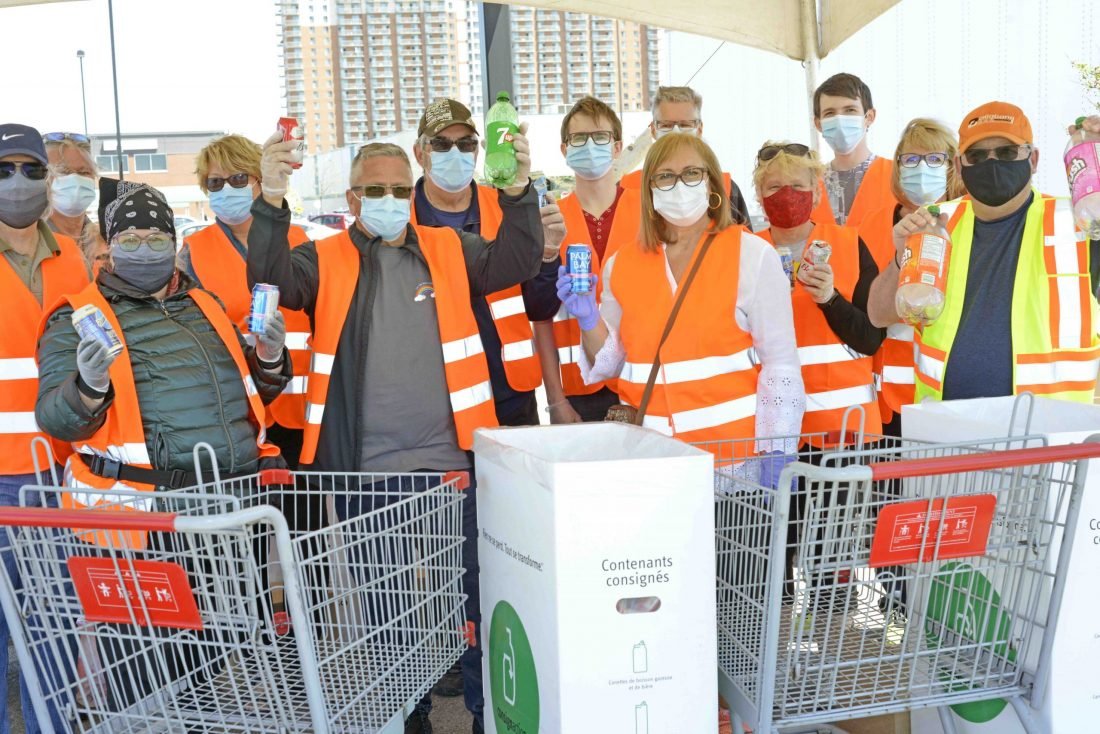
Guess who? While it’s hard to know for certain who’s behind those masks, it was all for a good and socially-distanced safe cause last Saturday in the parking lot at IGA Le Corbusier when hundreds of people in Laval accepted in invitation to donate the proceeds from their refundable cans and bottles to the Société Saint-Vincent de Paul Saint-Martin. Photo: Martin C. Barry-Newsfirst

In the previous days, the message had gone around on social media and by word of mouth that refundable empty cans and bottles could be brought in and the sums gathered would be donated to the Société Saint-Vincent de Paul Saint-Martin.

Koutrakis was one of several elected officials from Laval, including Laval city councillor Aline Dib, who came out to contribute empties and to lend a hand while at it.

Doing their part

“When my team and I found out that this was happening, we wanted to come and do our part and raise awareness that there are people who have needs through the year – but especially now with the COVID,” she said.

Still, she noted the importance of continuing to follow the current distancing protocols and guidelines in place. “We have to continue to do the right things and make sure we are listening to our scientists and the guidelines that are there,” said Koutrakis.

“Of course, everybody wants to be able to be with their families and to have barbecues and go to the parks. Eventually we’ll get there. But in the meantime, we don’t to risk going back to where we were eight weeks ago and we have to start all over.

‘Do the right thing’

“So I am encouraging everyone to do the right thing, make sure you are washing your hands and wearing your mask when you’re out. Most importantly, when we’re doing all this we’re saving lives and helping our heroes: the doctors, nurses and others who are out there on the frontline who never stop working so that our lives can eventually get back to normal.”

The two IGA franchise owners, Roland Lavallée of IGA Le Corbusier and Pierre Michaud of IGA Michaud et Fils, would be matching the funds gathered from the can and bottle deposit refunds up to $1,000. “This is something we decided to do to give back to the community, which is particularly in need at this time,” Lavallée said.

Laval City-Watch

Key Laval street intersections to be upgraded for safety

During its most recent meeting on May 20, the City of Laval’s executive-committee gave the go-ahead for a contract to be awarded to a traffic safety consulting firm to conduct a preliminary feasibility study before the development of traffic safety solutions at 14 key intersections throughout Laval – including some in Chomedey and Fabreville.

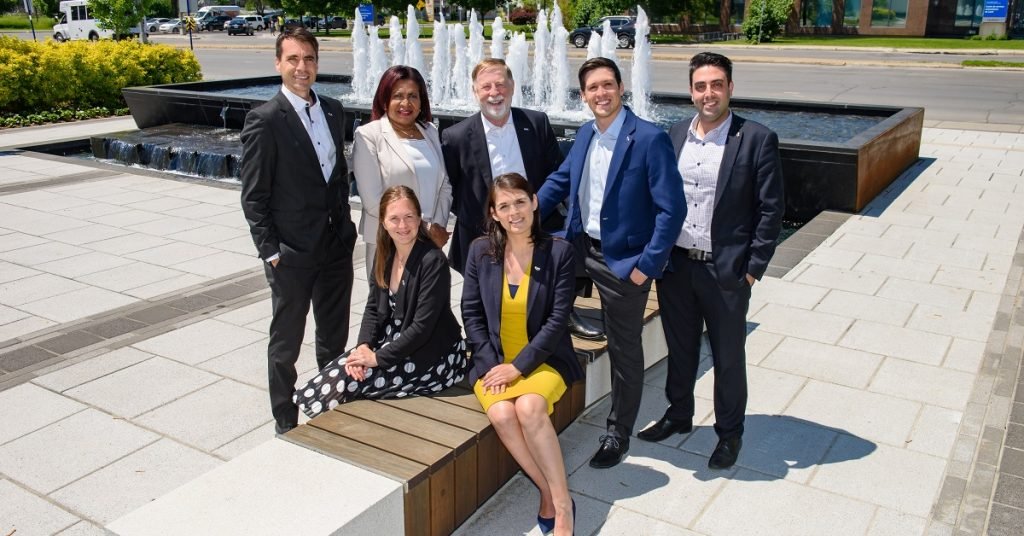
The members of the City of Laval’s executive-committee.

The executive-committee sent its recommendation to city council to award the contract worth $239,194.71 (all contracts include tax) to SNC-Lavalin for specialized professional engineering services involving traffic and circulation.

Part of agreement

The requested work fulfills a condition the City of Laval had to meet with the provincial transport ministry to improve security at municipal intersections under the ministry’s Plan d’intervention de sécurité routière en milieu municipal (PISRMM).

The following eight intersections are involved: boulevard Lévesque and montée Saint-François; boulevard Saint-Elzéar Ouest and avenue Francis-Hughes; boulevard de la Concorde Ouest and boulevard Laval; boulevard Notre-Dame and avenue Haïfa; boulevard Dagenais Ouest and rue Ovide; avenue de la Renaissance and avenue Marc-Aurèle-Fortin; boulevard de la Concorde and boulevard Cluny; boulevard Notre-Dame and rue Montgolfier.

14 intersections in all

The following six intersections are also involved: boulevard Saint-Martin Ouest and avenue Pierre-Péladeau; boulevard Notre-Dame and 100e Avenue; boulevard Cartier Ouest and avenue Laval; boulevard Dagenais Ouest and boulevard Gabriel; boulevard Saint-Martin Ouest and boulevard Chomedey; boulevard de la Concorde Est and croissant de Callières.

At the same meeting, the executive-committee also recommended to council to award two contracts to Pavages Multipro. The contracts are worth $1,620,783.78 and $1,310,894.66. They concern 15 street blocks located in Auteuil, Souvenir-Labelle, L’Abord-à-Plouffe, Chomedey, Saint-Martin, Marc-Aurèle-Fortin, Fabreville and Sainte-Rose.

Repairs and resurfacing

As well, the committee recommended awarding a contract worth $1,393,858.02 to Eurovia Québec Construction. The work involved will take place on 14 street blocks in Saint-François, Saint-Vincent-de-Paul, Val-des-Arbres, Auteuil and Laval-les-Îles. The work will include street repair and resurfacing, but subterranean sewers and water pipes won’t be upgraded as the city says they haven’t reached the end of their usefulness. The city expects the street work to last from seven to 12 years.

Finally, the executive-committee gave the go-ahead for a contract to be awarded to Entreprises Miabec for $867.597.90 to extend Gascon St. to Guénard St., including sewers, drains and household water infrastructure, in the district of Saint-François. Additional work for paving, street curbs and street lighting are also part of the work.

Laval restaurants file lawsuit against their insurers

Class action launched alleging non-respect of ‘business interruption’ clause

A group of Quebec restaurant owners, including some in Laval, have joined forces to file a class action lawsuit against their insurance companies after the latter refused to honor claims stemming from damages caused by the COVID-19 pandemic.

Ordered to shut

The COVID-19 pandemic forced bar and restaurant owners across Quebec to shut completely on March 23. This came about following an order issued by the government of Quebec. The effect has led to enormous losses for the restauranteurs and bar owners, however.

“Unfortunately, quite a number of insurers that cover restaurants are refusing to honor their obligations by denying the fact that the impact of this pandemic was an insurable risk,” said lawyer Laurent Debrun of the firm Spiegel Sohmer who is representing three of the claimants.

Three claimants

The claimants are the Bâton rouge and l’Elixor in Laval, as well as 21st Century Foods of Montreal. They are respectively suing insurers Allianz Global Risks, Promutel Assurance and Intact Assurance in Quebec Superior Court.

The Bâton Rouge is among the restaurants that have jumped on board a class action lawsuit against insurers refusing to pay out compensation for businesses losses caused by the COVID-19 pandemic.

For their part, the insurers are claiming that the restaurant owners didn’t suffer any physical losses caused by a disaster (such as a fire or flood), but rather are victims of a governmental decree. At least one of the insurance companies replied as such to a claimant, suggesting that compensation should be sought instead from government assistance programs that have been set up.

Claim not among exclusions

On the other hand, their lawyer maintains that the policies held by the restauranteurs were for comprehensive coverage, including all possible risks, except for certain specific exclusions. He pointed out that “interruption of business” is not among the exclusions and that it should be considered a valid claim during a pandemic.

The lawyer is asking for $739,314 for Bâton Rouge, $570,000 for Elixor, and $270,000 for 21st Century Foods. Some other restauranteurs in the province have also come forward to say they too might want to join the class action suit.

Columnist Robert Vairo’s ‘That’s What I’m Thinking’

What’s Next?

Robert Vairo

I wonder, and worry about what comes next. We have been shut down and shut out approaching three months and finally some parts of the economy are coming back to life. Some provinces have clearly done better than others in ‘flattening the curve’, but so far very few regions and countries have actually declared the virus ‘dead’.

New Zealand has, so has Taiwan, South Korea, Singapore, and Hong Kong. It will never be dead or completely eradicated. Under control, is a more realistic phrase. There will always be new cases, until there is an effective vaccine. And there is hope. Canada’s Dalhousie University as you know is approved for first clinical trials for the coronavirus vaccine. But it’s in cooperation with a government controlled Chinese firm. Not at all to my liking. The manufacturer is CanSino Biologics Inc., a Chinese vaccine company.

“The intellectual property rights for the vaccine will stay in Chinese hands” according to the Canadian Center for Vaccinology. It may work. If it does, it would be a very proud moment for Canada. Although I’m not sure how many Canadians will want a China made vaccine. How many of us trust authoritarian China today. There’s also US Moderna labs partnering with a Swiss group, and OXFORD U. is with a Montana firm, all in search of THE vaccine. So there is a lot of hope. But hope needs an audacious and robust plan of action.


This has been a horrific shock. After all this suffering, isolation, strained and broken relations, conjugal violence, unemployment, and a world economy on its knees, this had better not happen again, but it might.


Many, including Dr Tony Fauci are predicting a resurgence of the virus this autumn. Developing countries South Africa, and Brazil, combined populations of 270 million, are just starting to see the virus appear. The Canada US border may be reopened too soon. So something like this could happen again in Canada. It may be worse. Dr. Robert Glatter, an emergency physician at Lenox Hill Hospital in New York City says “Combined with the usual autumn influenza, the intensity of both.

There are issues we must confront now to prevent it. For example, some scientists are fearful of our over sanitizing. All our attempts against COVID-19 by cleaning, sanitizing, spraying city sidewalks, buses etc. could lead to a super bug resistant to alcohol. Scientists are already talking about diseases whose names even my computer spell check can’t get right. Sanitizers may not work or be as effective the next time.


And then there is drug resistance. Bacteria change and evolve so that a drug we once knew and saved us, can no longer perform miracles.


We can not afford to go through this again. Canada’s money has been spent. An RBC newsletter says we have “no more fire power” if we are hit again. So what’s the solution? The best way to stop a pandemic is to never let it start. We can’t enforce good hygiene in a Wuhan wet market. But we can look at home. This virus exposed Canada’s weak chief physician who is re-active and not pro active, and exposed weak top doctors in Quebec and Ontario. It exposed woeful inadequacies in our health care system, the worst being nursing homes, where our seniors led the number of fatalities across the country. This must not happen again. There is just too much pain.


Is the answer global cooperation? The WHO is racked with politics and can’t be trusted. Neither can the world’s two super powers, the US and China. Canada must first become as self-sufficient as possible in as many areas as possible. Mr. Trudeau, please stop these daily media managed appearances and return to Parliament. We must absolutely develop our own supply chain in health, food, and energy and stop relying on others. This is a health care crisis. We absolutely must focus and spend in our health care system and health care workers.
Remove the layers of crippling health department bureaucracy that prevent provinces like Quebec and Ontario from responding swiftly and effectively.


I’ve been reading a Dr. Jim Yong Kim a British physician and anthropologist with a list of credentials the length of a gurney. He suggests the five-pronged “weapons” we have been using. We all know them by now. Social distancing, contact tracing, testing, isolation, and treatment. Says Dr. Kim, “Do this over and over and you will defeat the virus”. CONTACT TRACING jumped out at me. It has to be done without violating our privacy rights, especially if using a smart phone app. It’s very labour intensive and involves a lot of detective work.

BC got it. It ramped it up early, increased its staff six-fold, and now attributes CONTACT TRACING as one of the main reasons it has been
able to control this virus. We have to be on the offensive for the next enemy. We must do our part. Continue distancing, hand
washing, masks. And our governments must rectify health care, secure our supply chains, reduce layers of bureaucracy. We will then have the confidence as Canadians to attack the next wave, or new virus, quicker and more efficiently, and save precious Canadian lives.


That’s what I’m thinking

Premier Legault meets with Laval Mayor Demers

‘The pandemic hit us with full force and created a humanitarian challenge,’ said Mayor Demers

With Marc Demers – the mayor of one of Quebec’s cities with an especially high concentration of families – seated beside him, Premier François Legault announced in Montreal last week that children’s summer daycamps will be allowed to open in June, as efforts continue to turn the coronavirus crisis into a recovery effort.

Daycamps opening

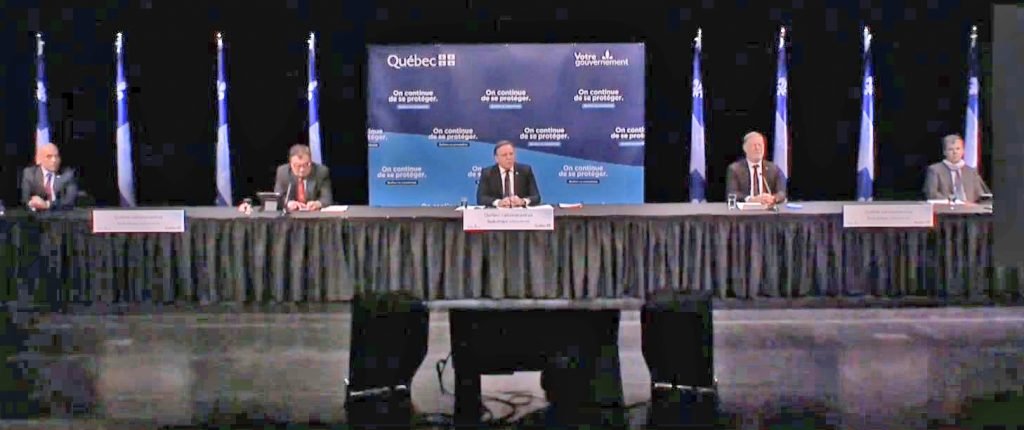
Quebec Premier François Legault, centre, with Laval mayor Marc Demers to the right, announced last week the re-opening of daycamps as COVID-19 measures are relaxed.

“I know many people are concerned about daycamps for kids,” Legault said during a COVID-19 webcast and press conference held at Place des Arts in downtown Montreal.

“I’m happy to announce that the public health authorities have given us the green light to re-open the daycamps on June 22,” Legault said. “Of course, it will be with distancing rules. But it’s very important for kids to play outside, to play together.”

The announcement was sure to be greeted with great relief in Laval and across the province by the many parents who’ve been diligently caring round the clock for children without a break, because daycares and schools have been closed since mid-March.

Camp monitors needed

While noting that social distancing protocols will be applied in the daycamps, Legault acknowledged that the government is currently facing a challenge recruiting enough monitors to supervise the children, principally because a larger than normal number of monitors will be needed.

Still, Legault warned, “The crisis isn’t over. It’s still hard. There are still many adjustments to be made. Not everything is perfect. I see some who are being critical and I ask you to be patient. We are living through a crisis.”

Answering journalists’ questions on the distancing rules to be enforced in the daycamps, Dr. Horacio Arruda, the director of public health for Quebec, said the emphasis will be on ensuring that groups of children remain small. He said there would be twice as many monitors for the children than would normally be the case.

Reducing the impact

“With more monitors, this will, in my opinion, facilitate the reduction of the impact of transmission in these camps,” Arruda said.

“On the other hand, what needs to be understood is that the coronavirus is circulating, although children get off relatively easy. So it’s not to say that just because some cases turn up in a daycamp that it will be a catastrophe. I would like people to understand that this too will be part of life returning to normal. But we will be keeping a close eye on things.”

Regarding the COVID-19 situation in Laval, which was the Quebec community hardest hit last week by the coronavirus, Legault said he had met that morning with Mayor Demers and they agreed the situation was getting better.

Use face masks, says Legault

“But we must stay vigilant,” said the Premier, advising that wearing a face mask while using public transit is one of the best ways people in general can do their part to keep COVID-19 from spreading.

Concerning the recovery process, Legault said, “We continue to gradually re-open. But if the contagion re-starts, we’ll have to come back to a pause. So nobody wants that and the best way to avoid it is to respect the instructions. To win this battle we must play as a team. I’m counting on you all.”

For his part, Mayor Demers noted that on Monday May 25, the beginning of the end confinement measures would be starting in Laval and the first of a series of businesses that were closed would be re-opening.

“The pandemic hit us with full force and created a humanitarian challenge, a sanitary challenge, and one that is economic,” said Demers.

Recovery underway, says Demers

“In Laval, our solidarity allowed us to create over the past few years a lively, united community, a strong economy and sound finances. I am convinced that this same unity is essential to confront the current pandemic. This will allow us to ensure a full recovery and to succeed with relaunching our economy.”

Demers was also asked by journalists for his explanation as to why the COVID-19 situation in Laval has become so troublesome and with a much higher infection rate.

“Right now I cannot answer that,” he said. “But one thing that my previous job taught me is to make sure that we have less victims as possible from now on, and making sure we are helping everybody who is in trouble. Later on we will be trying to find out why all those things happened.”

Laval News Volume 28-11

The current issue of the Laval News volume 28-11 published May 27th, 2020,
(Click on the image to read the paper.)

Current issue of the Laval News volume 28-11 published May 27th, 2020.

Laval distributing 250,000 face masks, while reopening municipal installations

Beginning this week, the City of Laval is handing out 250,000 protective face masks to some of its most vulnerable residents in an ongoing campaign to slow the spread of the COVID-19 virus.

According to the city, the distribution is being done primarily through community organizations, including food banks and mental health supporters, as well as organizations that assist victims of conjugal violence, the homeless and families living in low rental housing buildings.

The city says special attention is being paid to COVID-19 “hot zones” on Laval’s territory. Earlier this week, the city was coordinating the delivery of 5,000 boxes with 50 masks each to the non-profit organizations. The masks were donated by the provincial government.

On Monday May 25, elected officials and others were out assisting with the STL’s distribution of face masks.

At the same time, the City of Laval is announcing the re-opening of select municipal facilities following the two-month COVID-19 lockdown. As of May 26, dog parks and skateboard parks are once again open, although provincial distancing rules still apply while using these facilities.

Additional information (in French) on the COVID-19 pandemic can be obtained at this web site: pandemie.laval.ca. And a video on the subject by Mayor Marc Demers can be viewed at this web address: https://youtu.be/3AkJqArJRwI

Asphalting work begins June 1 on Autoroute 15 service roads

The Quebec Ministry of Transport is advising motorists that, beginning on June 1, asphalting work will be carried out on the service roads of Autoroute 15 between Cartier Blvd. and Autoroute 440 in Laval.

Taking place during the night in order to minimize the impact on traffic, the work will necessitate the complete closure of entrance and exit ramps on the A-15 along this stretch and the service roads. In addition, the service road of Autoroute 440 headed east will be closed, as well as some nearby streets in the City of Laval.

According to Transports Québec, the work will be taking place from June 1 to mid-July. During those times when the service roads and ramps are closed completely, detours will be set up, the ministry said. Unfavorable weather conditions or other operational constraints could postpone the work or cancel it altogether, added the ministry.

Weather

Laval
broken clouds
0.7 ° C
0.7 °
0.7 °
80 %
4.6kmh
77 %
Sat
10 °
Sun
8 °
Mon
14 °
Tue
15 °
Wed
16 °