Officers with the Laval Police Department’s organized crime investigation unit were on the scene outside the Mr. Puffs outlet on Notre Dame Blvd. near the corner of Melville Ave. Friday Dec. 5 after gunshots were fired on the bakery around midnight the previous night, leaving at least one bullet hole in a shattered front door window.
Friday morning, a police security tape cordoned off all the stores in the strip mall near the corner of du Sablon Rd. in Chomedey where the Mr. Puffs is located, as the investigators continued their analysis of the crime scene.
Local media report that the night before, two similar gunshot incidents took place at commercial establishments located in Laval’s Vimont and Duvernay districts.
Laval Police organized crime investigators were on the scene outside the Mr. Puffs on Notre-Dame Blvd. after an early morning December 5 shooting incident. (Photo: Martin C. Barry, Laval News)
This latest firearms incident followed the slaying of Charalambos Theologou, a reputed local organized crime figure, who was shot to death in broad daylight in early October inside a Starbucks coffee shop on the Autoroute 440 south service road, notably just a short distance from the Mr. Puffs head office also on the A-440.
The shattered front door (including a bullet hole just above the door handle) of Mr. Puffs on Notre -Dame Blvd. on Friday Dec. 5 after an overnight firearms incident. (Photo: Martin C. Barry, Laval News)
Several media, including CBC Montreal and La Presse, have claimed Theologou was the head of an extortion racket that had set up a base of operations in the Notre Dame Blvd. Mr. Puffs.
Mr. Puffs head office issued a statement denying categorically any connection, as suggested by La Presse in an article.
“The article published suggests that an individual known to police had been associated with criminal activity and had ‘established a headquarters’ within one of our Laval restaurants,” said the company.
“Mr. Puffs categorically denies any business, financial, or operational ties to this individual or to any criminal organizations.”
They went on to say that Mr. Puffs franchise locations “are operated by independent business owners under strict agreements with Head Office.
“At no time has Mr. Puffs authorized, condoned, or been aware of the alleged activities described in the media report. We are deeply troubled by the implications and wish to reassure the public that Mr. Puffs had no involvement in these matters.”
Among the measures Mr. Puffs head office said it had taken, they said they:
Reached out to law enforcement to offer full cooperation.
Reviewed internal franchise compliance protocols to ensure strong oversight across all locations.
Communicated directly with the franchisee concerned to reaffirm contractual obligations and brand standards.
“We strongly condemn any suggestion of links between Mr. Puffs and organized crime,” said Tom Bountis, president and chief executive officer of Mr. Puffs Canada.
This latest incident comes just a few days after the City of Laval and the Laval Police announced a new program of public safety and law enforcement measures to deal with a renewed wave of extortion attempts, punctuated by gunshots, against Chomedey and Laval business owners.
Proposed Quebec constitution law would prioritize French, secularism and collective rights
After reading and analyzing the Legault government’s Bill 1, the Task Force on Linguistic Policy has concluded the proposed constitution legislation “is a threat to the 1.25 million English speaking Quebecers, a threat to Quebec’s future in Canada, and “sends a clear message to all non-francophones: ‘you do not exist.’”
Since its founding in 2021, the Task Force, led by Andrew Caddell, has organized public meetings and rallies, submitted legal briefs to courts, the National Assembly and Parliament, and held expert panel discussions to oppose both Bill 96 and the use of the Canadian constitution’s controversial Notwithstanding Clause.
Their Bill 1 reaction brief submitted to elected officials at the Quebec National Assembly stated the concerns of the Task Force.
Fleeting mention of Anglos
Mentioned in the 11-page document is the draft legislation’s fleeting mention of Anglophone institutions. “In doing so, it fails to recognize the enormous contributions of English-speaking Quebecers for three centuries and more,” stated the Task Force.
“The bill places collective rights, secularism and the French language above human rights,” they maintain. “This creates an inverted pyramid of rights where the collective supersedes the individual.”
The brief outlines Bill 1’s objectives, the Task Force’s objections, legal issues and recommended changes. Among other things, it notes that the United Nations Declaration of Human Rights does not recognize collective rights, stating rather that “All human beings are born free and equal in dignity and rights.”
The brief refutes the CAQ government’s claim of Quebec being self-determined, the ability to hold a referendum with a winning margin of 50 per cent plus one, and denounces Bill 1, saying “the contempt for our federal system runs throughout this legislation,” as the proposed law refers to Canada as a “loose federation of autonomous states.”
‘Radical and unconstitutional’
The Task Force concludes that Bill 1 “is a radical and unconstitutional blueprint for provincial autonomy. It is a blueprint for a controlled demolition of the existing federal system.”
The Task Force stated in its conclusion, “We recognize and encourage the flourishing of French as the majority language in Quebec. But we stand with those who do not speak French: the elderly, visible minorities, the rural poor, the indigenous people, the physically and mentally challenged.
“These are the people who require government services. Many were not educated in Canada, and therefore could be denied government services according to Bill 96 and would be permanently discriminated against in Bill 1.
The Task Force on Linguistic Policy’s Andrew Caddell.
“That is unfair, egregious, immoral and unconstitutional. It is not the Quebec that we know, and it is not the Quebec we see evolving into the future. Quebec will be a pariah in the western world by adopting such a fundamental law. And we will join in the criticisms of it until it is withdrawn.”
Narrow-minded laws
The Task Force maintains that Bill 1 “promises to ‘define the Quebec nation,’ but rather than describe a dynamic, multilingual society within a majority Francophone province, it entrenches its three most narrow-minded pieces of legislation – Bill 21 on secularism, Bill 84 on identity, and Bill 96 on language – outside challenges of the courts, so their privileged place in this ‘Constitution’ protects them from judicial appeal.”
“This bill places collective rights, secularism and the French language above human rights,” they continue. “It also prevents the use of taxpayers’ dollars for court challenges, a fundamental undermining of democratic principles that any party should be able to challenge any unfair law.”
The Task Forced noted that in Quebec, “scholars and premiers, both indépendantiste and federalist, have advocated for a written Quebec Constitution to underline its autonomy and difference. However, the Liberals, Parti Québécois and Québec solidaire all voted against tabling the bill.”
The Task Force noted that the Barreau du Québec has also criticized Bill 1. “It is time this legislation be shelved, amended enormously or thrown in the recycling bin, where it belongs,” they said.
‘Dangerous, unconstitutional’
Recommending changes, the Task Force said it “sees this bill as dangerous, unconstitutional and inconsistent with the Constitution of Canada and its Charter of Rights and Freedoms. Any and all sections that are beyond the reach of the National Assembly should be withdrawn.”
“The Task Force, as a representative of the 1.25 million English-speaking Quebecers, demands recognition of the non-francophone community as builders, leaders, scientists, doctors, and enormous contributors to the growth of Quebec for the last three centuries,” they continued.
“A chapter of the law should be dedicated to this recognition. If not, this legislation creates a structure of a purely ethnocentric ‘nation,’ comparable to a 19th century nation-state, and not a dynamic, open society of the 21st century.”
But not everything is covered, Marjorie Michel admits after announcing additional funding
“Thanks to the CDCP Canadians are now receiving the preventive care they need,” says Liberal Health Minister and Papineau MP Marjorie Michel. (Photo: Martin C. Barry, Newsfirst Multimedia)
While acknowledging that the Canadian Dental Care Plan may be leaving some users with a relatively small sum to pay off whenever they go to the dentist, federal Health Minister Marjorie Michel says it’s up to the dentists themselves to decide whether they’re willing to shoulder that extra cost.
More funds for oral health
Michel, who is the Liberal MP for the riding of Papineau, held a press conference in Villeray in Montreal on November 24 to announce additional funding of more than $35 million over three years for 30 projects under the Oral Health Access Fund (OHAF).
According to a press release issued by the federal health ministry, the projects will improve training for dental students by allowing them to obtain the hands-on experience they need to provide care to Canadians across the country while strengthening efforts to improve access to care.
According to the ministry, close to six million Canadians are now covered under the Canadian Dental Care Plan (CDCP). “The CDCP is making life more affordable by saving eligible Canadians an average of $800 per year on their oral health care services,” says the ministry.
Most dentists are on board
The health ministry says that currently more than 27,000 dentists and other oral health providers are participating in the CDCP, offering a wide range of services that include cleanings, fillings and dentures, representing close to 100 per cent of active providers in Canada.
In Quebec alone, according to summary data posted online by the CDCP, 1,653,165 Quebecers have signed up for the program. The total number of approved applicants in Quebec who received care for benefit year 2025 to 2026 stands at 552,621 users.
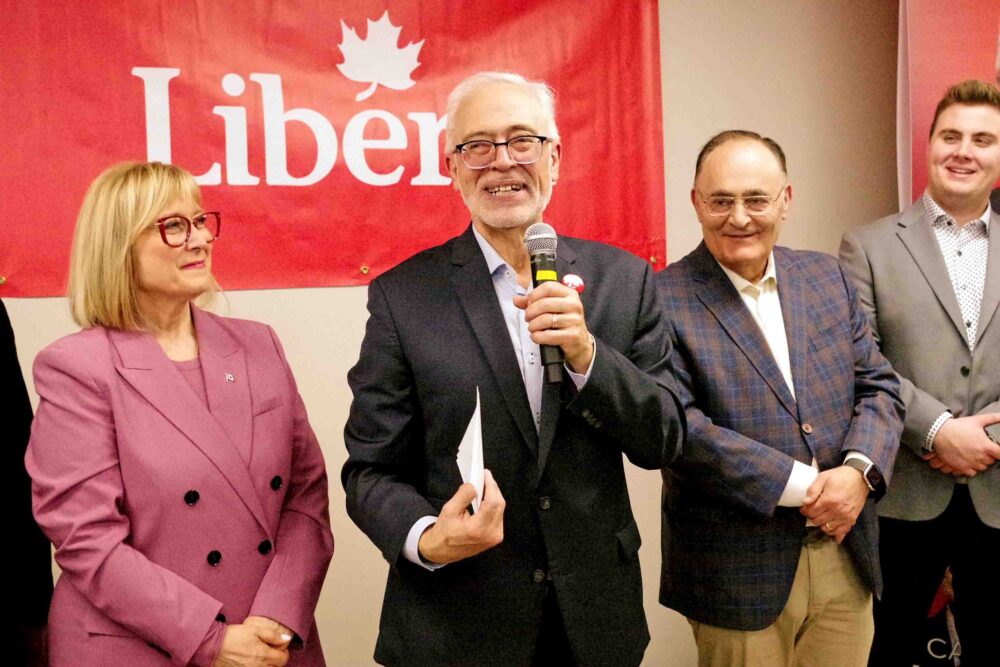
Canadian Health Minister and Papineau Liberal MP Marjorie Michel (third from right) is seen here with Marc-Aurèle-Fortin Liberal MP Carlos Leitão (third from left) and representatives from various local community groups during Michel’s announcement in Villeray on November 24. (Photo: Martin C. Barry, Newsfirst Multimedia)
According to the ministry, some CDCP program subscribers saw an oral health provider for the first time in decades after signing on. The ministry notes that without access to dental care, many people visit medical emergency rooms for dental issues that could be treated in a dentist’s office. Hence, the CDCP is helping ease pressure on Canada’s health care system, they claim.
“Thanks to the CDCP Canadians are now receiving the preventive care they need, and this program is only possible because of the commitment and participation of almost all oral providers across the country,” Michel said in a statement. “Our support to new training projects will not only empower the next generation of oral health professionals, but also contribute to lower costs for families.”
Not everything is covered
As for the users’ leftover billing fees, CBC News Ottawa reported in July that some dentistry patients were under the impression all their dental work was free. The reality is that the program reimburses dentists’ rates as determined by provincial billing guidelines.
It might also be noted that Health Canada describes the Canadian Dental Care Plan as “helping make the cost of dental care more affordable,” while making no claims about providing full and comprehensive coverage.
As a result, many dentists’ offices charge the difference between the price of the procedures and what CDCP pays them. For example, a recent bill for a total of $257 issued for basic treatments by a practitioner at a west-end Montreal dentists’ office left the patient on the hook for $57.39 after CDCP paid $199.61.
Marc-Aurèle-Fortin Liberal MP Carlos Leitão (who is a Parliamentary Secretary) and Health Minister Marjorie Michel announced improvements to the Canadian Dental Care Plan on November 24. (Photo: Martin C. Barry, Newsfirst Multimedia)
Answering journalists’ questions, Michel maintained that the program was never conceived to cover 100 per cent of costs. She suggested that those enrolled in the CDCP should shop around for a dentist who is willing to waive or charge less for the stub.
How to apply for CDCP
All eligible Canadians can apply to the CDCP. To qualify, applicants must: Not have access to dental insurance; Have filed their individual 2024 tax return in Canada (and their spouse’s or common-law partner’s (if applicable); Have an adjusted family net income of less than $90,000; And be a Canadian resident for tax purposes.
More than 300 experts gathered at Château Royal to discuss Laval’s economic future
The spectre of U.S. president Donald Trump and his disruptive economic policies figured prominently in the words of several speakers during a one-day conference on the Laval region’s economic prospects held on November 20 by Laval économique, the City of Laval’s development arm.
Laval mayor Stéphane Boyer was among several speakers who addressed members of the city’s business community during the IMPACT Économique Grand conference at the Château Royal in Chomedey. (Photo: Martin C. Barry, Laval News)
For several hours at the Château Royal, Laval was an epicenter of discussions on international trade during the IMPACT Économique Grand conference. More than 300 export experts, visionary entrepreneurs and economic and political decision-makers accepted the agency’s invitation to gather for a day of strategic discussions.
On the agenda were growth prospects, innovative business strategies and concrete opportunities for companies with a base in Laval seeking to establish themselves in national and global value chains.
Experts and stakeholders
The event brought together stakeholders, such as Mayor Stéphane Boyer, Marc-Aurèle-Fortin MP Carlos Leitão who is Parliamentary Secretary to the Minister of Industry, as well as high-level experts.
They included former Radio-Canada news correspondent Jean-François Lépine, senior Desjardins economist Benoit Durocher, vice-president for exports at Investissement Québec International Marie-Ève Jean, and Frédéric Legendre, director general of Trade Policy and External Relations at the Ministry of Economy, Innovation and Energy.
In opening remarks, Mayor Boyer outlined Laval’s role as an economic hub and the importance of exports in regional development. Lidia Divry, executive-director of Laval Économique, suggested some concrete solutions to support Laval’s businesses during these challenging economic times.
A ‘wake up’ from Trump
“If I’m here today with you, it’s because I want Laval to prosper and grow,” said Boyer, while adding that the well-being of Laval’s nearly 450,000 residents depends largely on the capacity of the region’s businesses and industries to excel.
He called the Trump administration’s actions since the Republican president took office last January a “wake-up call for Canada,” while noting that for the longest time, the U.S. was the country’s most important trading partner.
Still, he suggested that changing world events and a shifting political landscape also hold the potential to create new economic opportunities, and that one of the reasons for the gathering was to see “what we can do” to maximize the potential benefits for the Laval region’s industries and businesses.
A change in values
While noting the emergence of India as an economy poised to become the world’s third largest, and the impact of the Covid pandemic which disrupted the global economic system, Jean-François Lépine said Trump’s re-election a year ago led Canadians to discover that “our best best friend had become a sort of enemy, a figure with whom we no longer share the same values.”
Event moderator Isabelle Maréchal is seen here with former Radio-Canada broadcast journalist Jean-François Lépine, who was one of the speakers during the IMPACT Économique Grand conference. (Photo: Martin C. Barry, Laval News)
Apart from the economic impact, Lépine said Trump’s arrival may also have brought about the beginning of the end of the U.S.’s military global domination, which peaked after the late 1980s following the dissolution of the Soviet Union when the U.S. was perceived to have become “the world’s policeman.”
“You can see how American democracy has been evolving at great speed towards something we weren’t expecting at all,” Lépine continued. “The rules are being less and less respected. The conflicts are becoming more and more unpredictable with consequences that also are more and more unpredictable.”
Contending with China
Lépine, who was for many years Radio-Canada’s foreign correspondent in the People’s Republic of China, contrasted the authoritian communist nation’s market-driven surge that leveraged 800 million people out of poverty, with western nations like the U.S. where government intervention often is constrained by political quarrels over democratic values.
As well, he noted the emergence of China’s megacities, like Shanghai, populated by 25-35 million or more inhabitants in some cases, with matching mass transit systems to accommodate legions of workers. As he noted, the People’s Republic of China’s middle-class now includes 400 million citizens out of PRC’s 1,408,280,000 population.
However, as Lépine also pointed out, all is not well in China, where economic overreach has resulted in massive overdevelopment of housing, with potential blowback felt by non-Chinese investors. “If all of that were to collapse, there’d be the risk of China’s economy being in a situation from which no one knows whether it would be able to get out,” he said.
For the fifth consecutive year, S&P Global Ratings has confirmed the City of Laval’s AA+ credit rating, recognizing the strength of its economy and the rigor and prudence of its financial management, despite an economic context marked by widespread infrastructure cost increases and tariff uncertainty.
The rating, the highest awarded to a municipality in Quebec, “is further proof of Laval’s best practices in governance and fiscal discipline,” the city says in a statement issued last week.
Ensuring a balance
“The prudence and discipline that guide the City’s financial decisions have ensured a balance between structural investments and debt control,” said Mayor Stéphane Boyer.
“After delivering long-awaited sports, cultural, and community infrastructure projects to Laval residents, we are now focusing our efforts on upgrading our municipal assets,” he added.
According to the mayor, the City of Laval faces numerous financial challenges in the coming years, “and we must make the necessary responsible decisions to ensure we continue to provide excellent service to the public while maintaining sound financial health,” Boyer said.
The credit rating agency noted Laval’s responsible use of municipal reserves and a controlled adjustment of debt financing to support development priorities.
A diversified economy
The city notes that Laval remains one of Quebec’s most dynamic economies, distinguished by its robust and diversified economy, stable governance supported by clear financial policies, a predictable and favourable institutional framework and excellent access to financial markets.
While the city says it continues efforts to consolidate its financial position and ensure the sustainability of municipal finances without compromising the quality of services provided to the public, it says it remains fully aware of the various scenarios presented by S&P Global Ratings for the coming years.
“With its rigorous planning, Laval intends to pursue proactive management of its liquidity and responsible optimization of its debt, in order to support the confidence of financial institutions and sustainable budgetary stability,” says the city.
Laval donates a record amount to Centraide
The 27th annual United Way campaign for active and retired City of Laval employees surpassed last year’s total and the ambitious goal of $421,000. The mobilization of 801 City of Laval employees resulted in a donation of $428,534 to United Way of Greater Montreal.
“In a context of numerous challenges, the solidarity and collaboration of the City’s teams made all the difference,” said Aline Dib, City Councillor for Saint-Martin. “Their remarkable commitment reflects a sincere desire to support those most in need. I express my deepest gratitude for this exemplary generosity.”
Under the co-chairmanship of Mathieu Monfet, Director of the Environment Department, and Tania Fonrose, Director of the Citizen Experience Department, the 2025 campaign was distinguished by strong participation and several community-building activities. Among these initiatives, we note the City of Laval’s first-ever participation in the Centraide Soccer Cup.
In Laval, Centraide assists nearly 88,000 people annually. In 2024 and 2025, Centraide supported 26 Laval community organizations equipped to create a significant and lasting impact on the lives of vulnerable individuals.
New roles for elected officials in Laval
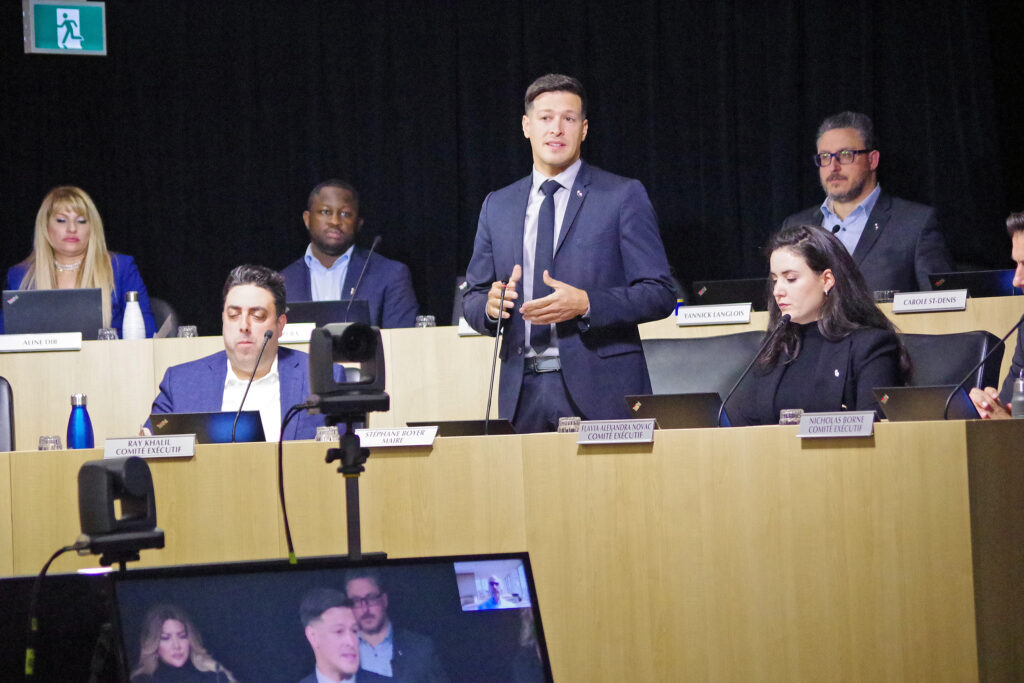
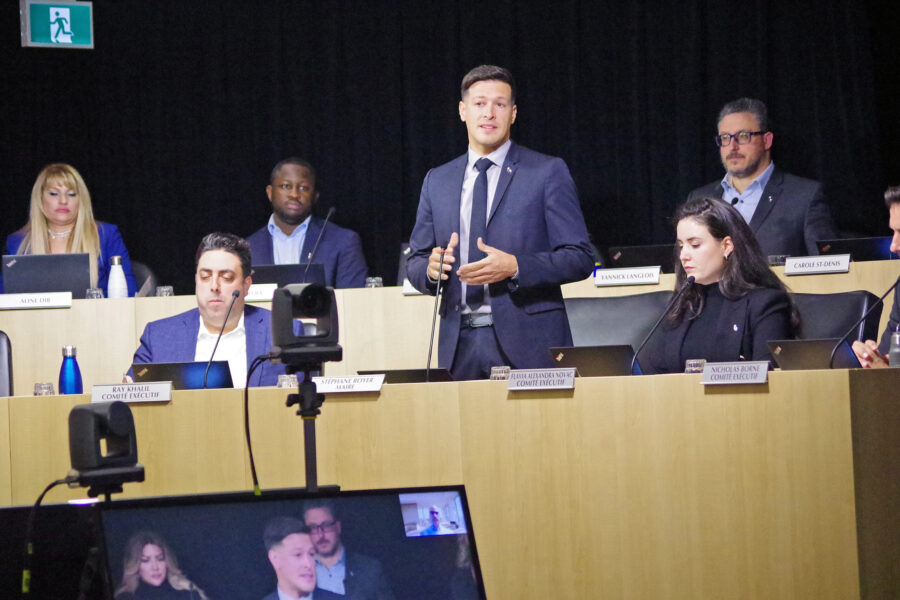
At a special meeting of City Council on December 2, Mayor Stéphane Boyer, accompanied by the 22 City Councillors of Laval, appointed associate members to the Executive Committee and the boards of directors of various municipal bodies.
“I am pleased to be able to count on experienced individuals, who are well-versed in municipal administration, to successfully manage the priority files for the residents of Laval: maintaining the city’s financial health, initiating the general upgrading of our infrastructure, continuing our extensive efficiency project, and accelerating the construction of affordable housing,” said the mayor.
The Executive Committee, composed of Mayor Stéphane Boyer, Ray Khalil (Vice-President), Christine Poirier, Nicholas Borne, and Flavia Alexandra Novac, welcomed four associate members. These councillors, appointed by City Council on the Mayor’s recommendation, support the work of the committee.
Associate members of the executive committee for the 2025-2029 term: Aline Dib (Saint-Martin);
Laval Transit Corporation (STL) Board of Directors:
Pierre Brabant (Vimont) is appointed Chair of the STL Board. He will be joined by Vasilios Karidogiannis (L’Abord-à-Plouffe) as Vice-Chair, and Martin Fiola (Laval-des-Rapides), Seta Topouzian (Renaud-Coursol), and Sylvain Yelle (Auteuil).
‘Water is an essential service for families,’ Guilbault says during announcement at City Hall
Residents on streets in Laval’s Fabreville and Chomedey districts will be getting an upgrade in the quality of their drinking water, as well as the efficient flow of storm and wastewater flowing into their sewers, thanks to a more than $26 million grant announced by the Quebec Municipal Affairs Ministry last week.
Minister of Municipal Affairs Geneviève Guilbault and Minister responsible for the Laval region Christopher Skeete, were in Laval on November 28 to announce that $26,074,021 has been granted by the CAQ government to the city for the water infrastructure work.
Quebec Municipal Affairs Minister Geneviève Guilbault (seen with Laval mayor Stéphane Boyer and Sainte-Rose MNA Christopher Skeete) last week announced millions in subsidies to the City of Laval to upgrade water and sewer infrastructure on a range of local streets. (Photo: Martin C. Barry, Laval News)
Upgrading sewer and water pipes
A total of 13,520 metres of drinking water, stormwater and wastewater pipes will be replaced under dozens of streets in various neighbourhoods of Laval. The investment will allow for the replacement of aging pipes in several areas where outages and emergency interventions were becoming increasingly common.
In all, 13.5 kilometres of water and sewer infrastructure will be upgraded. The work will be conducted in Chomedey on a grid of streets lying between des Prairies and McNamara boulevards, as well as between Estelle St. and de Normandie Blvd. in Fabreville and Chomedey.
The work will improve the reliability of the drinking water system, its drainage capacity during heavy rainfall, and the quality of service for hundreds of families. It also aligns with the government’s efforts to support municipalities in maintaining their essential infrastructure.
Water ‘essential,’ said Guilbault
“Water is an essential service for families,” Guilbault said during the announcement at Laval’s interim city hall on Saint-Martin Blvd. “With over $26 million in support, our government is keeping its promise, in Laval as throughout Quebec, by giving municipalities the means to provide reliable and efficient water systems.
“More than 13 kilometres of pipes will be replaced,” she added. “And this is exactly the kind of investment that prevents costly outages and improves the services that citizens depend on every day. It’s common sense, and I commend the city for its work on this project.”
“I am very pleased to see that the public will benefit from water systems that are less vulnerable to breaks and from better stormwater management during periods of heavy rainfall,” said Skeete. “This significant grant for our region is proof that we are here to support the City of Laval’s projects.”
“Modernizing our municipal infrastructure is a priority for my administration and will require sustained efforts over the coming years,” said Mayor Stéphane Boyer.
Quebec Municipal Affairs Minister Geneviève Guilbault (fourth from left) is seen here with Mayor Stéphane Boyer, Sainte-Rose MNA Christopher Skeete and members of the city’s executive-committee and municipal council at city hall on November 28 following the $26 million announcement. (Photo: Martin C. Barry, Laval News)
Reducing breaks and backups
“I am pleased to have Quebec’s financial assistance to support our sewer and water main modernization projects,” the mayor added. “These investments allow us to reduce breaks and prevent backups in our territory, which has a direct impact on the quality of life of Laval residents.”
The financial assistance comes from the provincial government’s 2023-2033 Municipal Water Infrastructure Program (PRIMEAU), part of the Quebec Infrastructure Plan (PQI). The plan provides for investments of up to $7 billion in the municipal infrastructure sector for the period 2025-2035, under the auspices of the Ministry of Municipal Affairs and Housing (MAMH).
As the overseer of municipalities across Quebec, the provincial government provides support to towns and cities to improve the performance and management of their drinking water systems.
“Through the PRIMEAU 2023-2033 program, municipalities can benefit from increased funding when they commit to better understanding the condition of their infrastructure and planning its maintenance responsibly,” the municipal affairs ministry said in a statement.
Importance of infrastructure
“Infrastructures are the foundation of everything in the proper and figurative sense,” Guilbault added. “So, when we talk about infrastructures, it’s of utmost importance, whether it’s our buildings, our roads, schools, etc. But even more essential and importantly, our water infrastructure is a constantly recurring topic with our municipalities, a topic that keeps coming up again and again.”
According to Guilbault, a lot of water and sewer infrastructure across the province dates back to the 1960s, 1970s and 1980s. As a result, most of these networks are reaching the end of their usefulness at around the same time. “This leads to major inconveniences for our citizens,” she said. “We are all working above all else for the quality of life of our citizens, regardless of the level of government we are in.”
The glass-fronted Sainte-Dorothée REM station during weekday peak return hours. (Matthew Daldalian, North Shore News)
The REM’s new Sainte-Dorothée station is quickly proving essential to Laval commuters, with packed park-and-ride lots and steady afternoon ridership suggesting the service has taken hold just weeks after launch.
Between 3 p.m. and 6 p.m., the station saw a continuous stream of returning students and workers. Nearly every parking space surrounding Avenue des Bois was filled, forcing late arrivals to circle for openings or park farther out on residential streets. For many riders, the convenience outweighs the growing congestion.
Luis Canon, an internet technician who lives nearby, said the REM fits naturally into his routine. “It’s amazing. It’s convenient,” he said. Canon takes the train roughly four times a week, often at peak hours. He said the new system is a welcome return after years of replacement buses. “I used to take [the old line], then they shut it down. Now it’s okay.”
The REM restored direct rail to the North Shore after the former exo Deux-Montagnes line closed for conversion in 2020. The new infrastructure promises faster travel and fewer bottlenecks, with trains running automatically every five to ten minutes during peak periods. Travel to downtown Montreal now averages under 30 minutes once aboard, cutting commute times in half for many west-end Laval residents.
The accessibility has made Sainte-Dorothée a busy endpoint on the line. Parking lots at Sainte-Dorothée were near capacity during the afternoon peak, an early sign of strong demand. Similar patterns occurred when the South Shore REM opened in 2023, when ridership climbed steadily during its first months of operation.
For Dawson College student Ricardo Rodriguez, the REM is now non-negotiable. “I use the REM every day to go to school,” he said. Rodriguez said the line significantly reduces his travel time into Montreal. “It’s very fast. I like that. It’s very quiet. It’s way quieter than the Metro.”
Sainte-Dorothée station’s role is expected to grow further when future REM phases connect west to Anse-à-l’Orme and south into Montreal-Trudeau airport by 2027. The station’s strategic location has already shifted commuting habits in Sainte-Dorothée, where car-dependent neighbourhoods long relied on slow multi-transfer bus connections to metro stations.
The REM’s off-peak schedule remains a limitation, particularly for late-night users. Service between Côte-de-Liesse and Deux-Montagnes currently ends at 9:30 p.m., with continuing evening travel handled by replacement bus service.
University student Yanni Athanasoulias takes the REM daily to reach Place-Bonaventure. The speed has changed his mornings. “It comes every five minutes. It goes to where I need to go,” he said. He once spent over an hour in traffic. Now his travel time is cut by more than half. “This takes about 30 minutes when you’re actually on the REM, so it’s good.”
Like others, Athanasoulias planned for the change long before it arrived. “Ever since I heard it was opening, I’ve been planning to take it,” he said. He drives to the station, then transfers to rail downtown.
By late afternoon, the Sainte-Dorothée lots were full up quickly.
A steady flow of passengers moved from the platforms toward the parking rows, many heading directly to their cars. Trains arriving between 3 p.m. and 6 p.m. were busy, with most seats occupied and some passengers standing through portions of the route; not overcrowded, but consistently full.
The REM was built to shift more commuters away from car-dependent travel and toward electric rail service. Early usage at Sainte-Dorothée would suggest the demand exists, but long-term performance will depend on how well the network accommodates rider growth, travel patterns and future branch openings.
So far, the station is being used. People are boarding, returning, parking, and adjusting their routines around the new service. The next test is endurance, whether the system can support this level of traffic as months pass and peak travel intensifies.
Screenwriter Kosta Kondilopoulos sits during an interview at a Tim Hortons in Saint-Eustache, reflecting on the writing process behind The Perfect Gamble and his upcoming projects. (Matthew Daldalian, Laval News)
North Shore screenwriter Kosta Kondilopoulos, a longtime Laval resident now based in Saint- Eustache is stepping into new creative territory with his latest feature, The Perfect Gamble, marking a shift away from the true story/true-crime storytelling that defined his recent work.
The film, now streaming in Canada on Apple TV and YouTube, follows two gamblers whose dream of running a casino quickly entangles them with the Russian mob. Unlike Mob Cops, his 2025 film based on the real story of two NYPD detectives caught working for organized crime, this script was built from fiction rather than headlines.
“This one was a lot more freeing to not be confined to true events,” Kondilopoulos said in an interview. The project began when director Danny A. Abeckaser approached him with a premise: two ex-convicts open an underground casino, only to find themselves outmatched by the criminal world around them.
Kondilopoulos took the concept and wrote a script designed to move fast and entertain.
A new creative stretch
After several movies rooted in real cases, Kondilopoulos said the switch to fiction demanded a different writing process.
It wasn’t easy, but unrestrained. Without historic timelines or documented characters to follow, he focused instead on structure, rhythm and escalation.
He said the only real constraint was budget and schedule, with filming completed over just 10 days across two separate locations. “They did a great job… I was shocked when I found out it was 10 days,” Kondilopoulos said.
The film’s tone draws lightly from Scorsese’s Casino, a reference point the director encouraged during development, but Kondilopoulos stresses that The Perfect Gamble is not a homage picture. Instead, he aimed for something more playful, a crime story driven less by message and more by movement.
“It’s very gritty, quick, funny — not like the movies that are out today,” he said.
Rather than a morality tale, he describes the movie as “two guys getting into trouble and having fun.”
Screenwriting instinct
After years of writing crime-based scripts, Kondilopoulos said structure comes naturally. He followed a discipline familiar to most screenwriters: a change every few pages, a protagonist pushed forward by conflict.
Kondilopoulos cited Save The Cat, a widely used screenwriting blueprint for story structure, but said instinct matters more than math. “As a storyteller, you just know you’ve got to get the audience back every five pages,” he said.
The film’s release adds another entry to the screenwriter’s expanding portfolio, which now includes both factual and fictional crime narratives.
His work with Abeckaser continues to shape his direction, but he said he wants future projects to push further beyond the constraints of reality-based stories.
What’s next
Kondilopoulos is already at work on another script, one he says lets him mix real history with imagination in a way he hasn’t before. He called it faster, looser and more playful than his past crime projects, a chance to try something new.
He also has two completed films approaching release: 12 Hours in October, a dramatization of the October 7 attacks, and The Pager, expected next summer.
Despite growing recognition, including screenings in Los Angeles and continued collaborations with established actors, Kondilopoulos framed success in simple terms: keep the story moving, keep audiences engaged, and never let a script feel slow.
Kondilopoulos will host a local screening of The Perfect Gamble at Cinéma St-Eustache on Dec. 7, an event he says is for “friends and family and anyone who just wants a good time.”
The crime may be fictional this time, but for the Laval-grown screenwriter, the gamble appears real and deliberate.
Federal, provincial and municipal partners inaugurate 101 affordable units
By Matthew Daldalian
Officials take part in the ribbon-cutting ceremony for the new housing project (Matthew Daldalian, The Laval News)
A new affordable housing development has officially opened in Laval, located at 605 boul. Curé-Labelle.
The newly-opened project brings 101 units to residents seeking lower-cost rental options under a long-term affordability framework backed by federal, provincial, municipal and financial partners.
On a windy Monday morning, the joint opening featured Quebec Minister of Housing Caroline Proulx, Vimy MP Annie Koutrakis, Laval Minister Christopher Skeete, Laval Mayor Stéphane Boyer, and representatives from the Fonds de solidarité FTQ alongside Société de Gestion Querbes (SGQ) and Regroupement des Organismes du Montréal Ethnique pour le Logement (ROMEL).
The building has already begun receiving tenants, with officials presenting the development as a model for social housing delivery in the region.
The total capital budget is $45.5 million, including $20 million from the Government of Canada and $17.6 million from Quebec through its partnership with the Fonds de solidarité FTQ.
The City of Laval also invested $7 million.
65 of the 101 units include rent-supplement eligibility through Programme de Supplément au Loyer Québec (PSL), allowing a limit of rent payments to 25 per cent of the tenants’ annual income.
The remaining cost funds 90 per cent by the Société d’habitation du Québec and 10 per cent by the City of Laval.
“We’re talking about 101 affordable rental units, with many already occupied,” Proulx said. “The Government of Quebec is proud to have contributed nearly $18 million.”
Quebec Housing Minister Caroline Proulx delivers remarks at the opening (Matthew Daldalian, The Laval News)
he building operates under long-term affordability regulation. According to the Fonds de solidarité FTQ, affordability must be maintained for 35 years. Rental price thresholds are indexed annually based on provincial standards set below market median rates.
“All of the units are affordable because they receive subsidies from both the Quebec and federal governments,” said Josée Lagacé, vice-president of communications and marketing for the Fonds immobilier de solidarité FTQ. She added that affordable rent is defined as “roughly 20 per cent below the median rent for a given area.”
The regulatory model ensures the building cannot shift to market-rate rental and that price increases are capped to remain consistent with affordability frameworks over the long term. “We cannot raise the rent as if we are in the private sector,” said project partner Mazen Houdeib, general manager for SGQ and ROMEL. “It has to remain affordable.”
Local demand and development origins
The building stands on the former site of a large restaurant, acquired after negotiations with a private developer. The objective was to convert the lot into a non-profit housing complex rather than a market-priced residential project.
Houdeib said the purchase was driven by demand in the area and concerns that private development would fail to meet low-income needs.
“We convinced him to sell us the project,” he said. “Because our clientele is the people who are in need.”
Mazen Houdeib, director general of Société de gestion Querbes and ROMEL, speaks during the inauguration (Matthew Daldalian, The Laval News)
Units are available in varying sizes, with officials expecting occupancy to continue over the coming months. Federal MP Annie Koutrakis said 15 households have already moved in, noting that the building supports diverse family structures, including singles, parents and multi-person households.
“Everybody needs to make sure that they have an affordable, safe place to call home,” she said.
Municipal targets and regional strategy
The project contributes to Laval’s broader housing strategy, which aims to expand social infrastructure to meet population-growth pressures.
Mayor Stéphane Boyer said the city recently reached a milestone of one thousand social units built this year and plans to double that target over the next four years.
“What we want to do in Laval is to facilitate the construction of housing,” Boyer said. “We want to make sure that we have affordable options.”
Laval Mayor Stéphane Boyer speaks on the city’s role and housing priorities during the opening ceremony (Matthew Daldalian, The Laval News)
He noted that although the city did not select the site, it contributed through incentives, subsidies, and regulatory support. The property was purchased independently by the aforementioned non-profit developer, with government involvement focused on financing and approvals.
Minister Christopher Skeete spoke on the project’s significance particularly for families in Chomedey and surrounding neighbourhoods.
“This neighbourhood has always needed affordable housing,” he said, calling the complex “good news” for residents facing rising rent pressures.
Federally, the opening is part of a larger national housing mandate intended to increase below-market rental supply across Canada.
A growing stock
Affordability is said to be secured for 35 years — meaning units are expected to remain below market rate well into the 2050s under program terms. Lagacé also signalled additional projects in the pipeline.
Officials pose together after inaugurating the newest housing project in Laval (Matthew Daldalian, The Laval News)
“We currently have $4 billion worth of real estate projects underway in Quebec,” Lagacé said. “And in Laval, we have plenty more announcements coming soon.”
Nearly two months into Quebec’s pilot project allowing stores in Laval, Gatineau and Saint-Georges to remain open until 8 p.m. on weekends, most retailers are still closing at 5 p.m. — but Carrefour Laval is preparing to break from the pack.
Beginning Nov. 29, the day after Black Friday, CF Carrefour Laval retailers are allowed to stay open until 7 p.m. on Saturdays and 6 p.m. on Sundays, according to Cadillac Fairview’s vice-president of operations.
It marks the first large-scale adoption of the extended-hours pilot in Laval.
The provincial project, which began on Oct. 2 and runs for one year, lets non-food retailers voluntarily stay open later on weekends.
But uptake has been limited, with hesitation high among store owners and managers who fear low foot traffic and higher payroll costs.
Retailers said they were reluctant to act alone.
As Andréanne Marquis of Womance said in a previous interview with La Presse, “If everyone follows suit and there’s a party, we’ll join the party… On our own, we won’t be able to generate enough traffic.”.
Her comments reflect a wider sentiment that shoppers aren’t yet expecting later hours and may not show up if only a few stores participate.
Other chains tested the late-closing hours with little success. Club Chaussures and Chaussures Panda said their trial runs in Gatineau and Laval did not produce enough evening traffic to justify staying open.
Many store owners said consumer habits haven’t shifted enough to make later hours profitable.
Despite the mixed results, Quebec’s Minister Delegate for the Economy, Samuel Poulin, maintained confidence in the pilot. He’s announced he’s open to letting more cities participate.
Poulin said the project launched during a traditionally slow period and that results may change during the busier retail months of November and December.
Carrefour Laval’s decision is the first major sign of coordinated participation from a large shopping centre.
For many businesses, knowing all neighbouring stores are open is the deciding factor in whether later hours make sense
The move also reflects the scale and appeal of Carrefour Laval, one of Quebec’s highest-traffic malls. Retailers there may see more reliable evening traffic compared to standalone stores or in quieter residential pockets.
Still, some business groups argue that extended weekend hours aren’t a universal solution. They note that regions differ widely in shopping patterns, and that weekday evenings already underperform.
Economic pressure is also a concern. Longer hours mean higher staffing needs but not necessarily higher revenue.
Managers interviewed in earlier reporting have warned that spreading the same number of customers over more hours could dilute sales peaks without generating new ones.
If the pilot eventually expands beyond the three test cities, it could reshape how Quebec regulates retail hours; it’s a system shaped decades ago by “blue laws” that once required Sunday closures.
Although those rules loosened over time, Quebec still relatively maintains one of the strictest weekend closing policies in Canada.
The government said at the time that the pilot will help answer a broader question: whether traditional regulated hours still make sense in a province where online shopping is available around the clock.
Some Laval retailers have already experienced this debate firsthand.
Several shop managers told The Laval News previously that extended hours might simply scatter existing foot traffic rather than generate new customers. Others said they welcomed the flexibility, arguing it better reflects the schedules of modern shoppers.
But all eyes are now on Carrefour Laval as the first major test of the pilot in a high-traffic retail hub.
Its results may offer the clearest indicator of whether Quebec consumers are truly ready for evening weekend shopping — or whether the old 5 p.m. closing time still holds its grip.
The province expects the project to run for one year from Oct. 2, 2025, ending in fall 2026.