Monday, February 23, 2026
8 C
Laval
spot_img
Home Blog Page 174

Laval passes resolution recognizing Republic of Artsakh

Local Armenian community fears another genocide

More than 135 supporters of the Republic of Artsakh, which is currently involved in an armed conflict with Azerbaijan, held a rally outside Laval city hall last Thursday evening, a day after Laval city council passed a motion recognizing the independence of Artsakh while condemning aggression by Turkey which is backing Azerbaijan in the conflict.

City supports Artsakh

In passing the resolution, Laval became the first city in Canada to do so. In the past, Laval has also been among the cities and governments all over the world that took strong stands acknowledging the planned systematic genocide of as many as 1.5 million Armenians by the Ottomans during World War I, followed by Turkish denial.

Armenians think that the only way to stop this potential genocide is in the recognition of the Republic of Artsakh as an independent state

The participants, carrying glass-enclosed candles – with many also wearing clothing bearing the Armenian national colors and slogans like “Artsakh Strong” – walked more than a kilometre in a torchlight procession, accompanied by a police escort, to the Armenian Community Centre of Laval on des Prairies Blvd.

Many in the Armenian community are hoping that the Canadian government will also recognize the legitimacy of the Republic of Artsakh, where more than 99 per cent of the population is ethnically and linguistically Armenian, with close ties to the neighbouring Republic of Armenia.

Fears of renewed genocide

“We’re here to give thanks to the City of Laval for the courage they had to acknowledge the independence of the Republic of Artsakh, where as we speak a second genocide is boiling,” said Hovig Tufenkjian, president of the Armenian Community Centre of Laval.
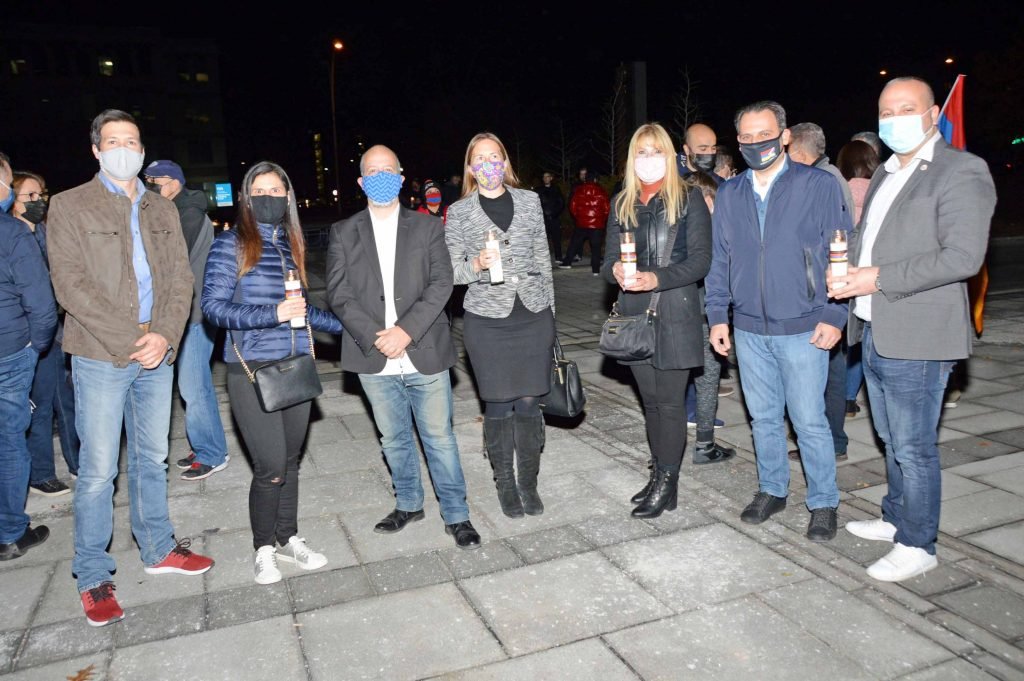
Laval city councillors and members of the local Armenian community are seen here during the vigil for Artsakh held outside Laval city hall last Thursday night. Photo: Martin C. Barry

“Armenians think that the only way to stop this potential genocide is in the recognition of the Republic of Artsakh as an independent state,” he continued. Tufenkjian said the Armenian community has every intention now of bringing the issue to the attention of elected officials at the provincial and federal levels.

Unity needed, say councillors

“We must be united on this,” said Laval city councillor for Saint-Martin Aline Dib, noting her own Lebanese roots, while pointing out the solidarity that traditionally unites Lebanese and Armenians who share cultural roots. “It is important for us to stand up for the fundamental values we share and that we find peace.”

Laval-Les Îles MP Fayçal El-Khoury (seen centre with Laval councillor Aram Elagoz to immediate right) was among the elected officials who expressed their support for the Republic of Artsakh outside Laval city hall. Photo: Martin C. Barry

“I feel this is an issue which has become lost in the news, what with the American election and the COVID-19 pandemic,” said Laval city councillor Virginie Dufour who sits on the executive-committee.

“Unfortunately, it isn’t getting the coverage it should,” she added. “What we would like is that our federal government would a lot more outspoken on this situation which is truly appalling for the people over there.”

STL wins AQTR Award for its online bus crowd estimator

The Société de transport de Laval (STL) was presented on Nov. 5, during an online “virtual gala,” with the Association québécoise des transports’s Grand Prix d’Excellence en Transport award for the STL’s online tool that tells riders how crowded their bus could be.

Launched last June, the digital tool provides riders with an estimate of the number of passengers they should expect not only when they board, but also during the course of their entire bus trip – which is a first in Canada.

As the COVID-19 pandemic has made social distancing in public transit situations a core concern for everyone, the crowd estimator supplies information tailored to individual transit users.

With the crowd estimator, they can make informed decisions based on the level of bus crowdedness they are comfortable with, such as taking an earlier or later bus, getting on or off at a different bus stop, or using another bus route nearby.

STL buses have been equipped with GPS technology and passenger counters for years, which record on a daily basis how many passengers are on the bus at each stop, for each bus route, or at each scheduled bus time.

The new tool uses this information to determine the level of bus occupancy at a stop, at a specific time, for the entire length of a commute, based on the averages trending over the previous five business days. These calculations are updated daily. The estimator is available at stlaval.ca/passengers for use on computers or smartphones.

“We appreciate being recognized by the industry for an initiative we are especially proud of, developed during these unusual times, for the purpose of reassuring users so they may continue using public transit for their commutes as always,” said STL president Éric Morasse.

“By democratizing access to green transportation, and doing so affordably while many families contend with tighter budgets, we are continuing to fulfill our mission of facilitating mobility for the Laval population,” he added.

Quebec launching new register for funeral pre-arrangements

0

Funeral directors will have to state if services have been pre-paid

The Quebec Ministry of Justice and the Quebec Consumer Protection Office have announced that a new register for funeral prearrangement service contracts will soon be launched by the province to protect consumers when arranging for funeral services. New provincial regulations will henceforth allow a notary, lawyer, estate executor or appointed representative to find out beginning next January from funeral service directors or cemetery operators whether someone has a pre-existing funeral services contract.

Pre-arrangements info

‘The register will allow the relatives to avoid spending sums for services and goods that are already paid,’ according to Quebec Justice Minister Simon Jolin-Barrette
 

“With help from the register, the relatives of someone who has died will be able to know if pre-arrangements were already made and they will more easily be able to make sure that the last wishes are respected,” said Quebec Justice Minister Simon Jolin-Barrette, who is responsible for the Consumer Protection Office. “The register will allow the relatives to avoid spending sums for services and goods that are already paid,” he added. With the register, funeral service directors and cemetery operators will have to provide consumers with a proof that a consultation of the register was made. Consulting the register will be free of charge.

Won’t be open to all

According to the new rules, only certain persons will be able to find out whether a pre-existing funeral services contract exists. While the law currently allows only the buyer of the pre-arrangement plan to know, the new regulations will allow the estate executor, a curator or someone with a power of attorney for a living person to have access. The provincial government is giving funeral service providers and cemeteries up to 30 months to sign up for the new register and to update information on pre-existing contracts for funeral pre-arrangements.

LPD Blue: Police news from the Laval region

Demers rules out Laval/Montreal police merger

The City of Laval issued a statement last week, essentially rejecting the City of Montreal’s recent proposal to merge their respective police departments.

The Montreal Police Department had recently recommended that provincial authorities consider the possibility of merging the police departments of Montreal, Laval and Longueuil.

Not what Laval wants

The City of Laval declared in response that the proposal “doesn’t correspond to orientations currently being pursued by Laval.” Laval maintains that it wishes to maintain its local police service and to keep it within close proximity.

However, Laval did come out in favour of some elements in the City of Montreal’s report. These included increased sharing of information and expertise while working more closely as a team on special dossiers; and finding more equitable means to finance police services, in accordance with needs of the population.

Room for improvement

In its response, the City of Laval noted that it is currently paying for services provided by the Sûreté du Québec and the Montreal Police Department. “The memoirs tabled by Laval and Montreal bear some similarities,” said Laval mayor Marc Demers.

“Could we improve some of our work by increasingly sharing our expertise?” he continued. “I am certain of it. So, there is no question of merging our police services and abandoning our autonomy.”

‘Impaired’ woman leads SQ on a wild chase along A-440

Alcohol or drugs are believed to have been an important factor in a police chase that took place in Laval on Oct. 30, ending with the arrest of a woman in her 20s.

The Sûrteté du Québec (SQ) received a call at 2:45 a.m. early one recent morning about a car that had been spotted driving on the shoulder on Highway 440 East in Laval.

When the car sped away, officers began pursuing, but eventually called it off around Pie IX Blvd. following an approximately four-kilometre chase. Police say that when they finally caught up, the woman was agitated and needed to be transported to the hospital.

The investigating officers suspected she was impaired by alcohol or drugs and tried to obtain a warrant for testing to confirm it. The woman was taken into custody on suspicion of being impaired while driving and charges were pending.

LPD nabs suspected drug dealer in Pont-Viau

A man in his 20s was scheduled to make a court appearance for arraignment at the Laval courthouse earlier this week after a weekend encounter with the Laval Police, during which he fled from them after being seen in possession of narcotic substances.

The LPD had spotted his vehicle just after 2 am near the corner of de la Concorde Blvd. and J.J. Joubert Ave. in Pont-Viau. They noticed his car after seeing one of its rear lights wasn’t working.

While he initially didn’t show any resistance and voluntarily turned over his driver’s license and car registration, it was after this that the officers saw what they believed was evidence of narcotics in his car and questioned him.

The driver decided to flee, driving up to 80 kilometres per hour at one point along streets that included Meunier, Cousineau and Proulx. The police finally caught up to him in front of his home, where the officers determined he was in possession of narcotics.

Searching the vehicle, the officers found several dozen plastic bags of what appeared to be drugs, including crack and ecstasy, after which the suspect was placed under arrest.

According to the LPD, the suspect had a previous record for drug-related offenses and breaking court-imposed conditions, and they took him into custody.

2020 Dog Handler Calendar raised over $ 40,000 for the Martin-Matte Foundation

Laval police (SPL) has given the Fondation Martin-Matte the proceeds for the 2020 edition of its dog handler calendar. The amount raised this year is a generous $ 40,529.62, bringing the SPL’s contribution to the Foundation over the past eleven years to almost half a million dollars.

“After more than a decade of involvement, our desire to contribute to the well-being of brain injury victims and their families is still going strong. Year after year, the members of the Cynophile Squad, in collaboration with many partners, dedicate themselves to carrying out this campaign. The success of this calendar is a reflection of the commitment and dedication of our dog handlers. An extraordinary example of solidarity, “stated director Pierre Brochet.” The Service Police de Laval (SPL) has been associated with this cause since the death of dog handler Éric Lavoie, following a head trauma. He was injured in a traffic accident while answering to an emergency call.

The Martin-Matte Foundation helps provide a better quality of life for children and adults living with head trauma or physical disability. In 2007, Martin Matte created the Foundation to help his brother who suffered a head trauma in a car accident in 1986. Christian has lived in the very first Maison Martin-Matte, located in Laval since 2008. Citizens may still obtain the 2021 Dog Handler Calendar at a cost of $ 5 at one of the Laval police stations or on the Foundation’s website during the month of November at fondationmartinmatte.com.

Ottawa plans to boost economic recovery through immigration

But Quebec will set its own immigration levels, under a separate accord

Federal Immigration, Refugees and Citizenship Minister Marco Mendicino tabled the Trudeau government’s latest Immigration Levels Plan last week, setting a path for moderate increases to immigration to help the Canadian economy recover from COVID-19, while also trying to stimulate future business and employment growth.

“Immigration is essential to getting us through the pandemic, but also to our short-term economic recovery and our long-term economic growth,” said Mendicino. “Canadians have seen how newcomers are playing an outsized role in our hospitals and care homes, and helping us to keep food on the table.

Labour shortages

“As we look to recovery, newcomers create jobs not just by giving our businesses the skills they need to thrive, but also by starting businesses themselves,” he continued. “Our plan will help to address some of our most acute labour shortages and grow our population to keep Canada competitive on the world stage.”

According to a statement issued by the government last Friday, the pandemic has pointed a spotlight on the contribution of immigrants across all sectors of the economy.

Quebec to set own levels

Canada’s Immigration and Refugee Protection Act requires a new Immigration Levels Plan to be tabled in the House of Commons in Ottawa each year. The levels plan is a projection of how many permanent residents will be admitted to Canada, setting targets and ranges for overall admissions, as well as for each immigration category.

The levels plan also takes into account extensive engagement with provincial and territorial representatives, as well as public opinion research and stakeholder consultations. However, under the Canada-Quebec Accord, Quebec establishes its own immigration levels.

Health care staffing

“Our health-care system relies on immigrants to keep Canadians safe and healthy,” says IRCC. “Other industries, such as information technology companies and our farmers and producers, also rely on the talent of newcomers to maintain supply chains, expand their businesses and, in turn, create more jobs for Canadians.”

Our plan will help to address some of our most acute labour shortages and grow our population to keep Canada competitive

Federal Immigration, Refugees and Citizenship Minister Marco Mendicino

Although Immigration, Refugees and Citizenship Canada said it continued to accept and process immigration applications throughout the pandemic, the global travel restrictions and capacity constraints led to a shortfall in admissions over the last several months.

Immigration to increase

To compensate for the shortfall and ensure Canada has enough workers it needs to fill crucial labour market gaps and remain competitive globally, the 2021 to 2023 levels plan aims to continue accepting immigrants at a rate of about one per cent of the population of Canada, including 401,000 permanent residents in 2021, 411,000 in 2022 and 421,000 in 2023. The previous plan set targets of 351,000 in 2021 and 361,000 in 2022.

While maintaining that the health, safety and security of Canadians remains a top ministry priority, IRCC says it has strengthened health screening at the border as well as monitoring and enforcement, and will continue to closely follow the advice of public health officials as newcomers arrive in the country.

According to the ministry, the multi-year plan incorporates a recognition of the importance of family reunification and Canada’s continuing commitment to protecting potential immigrants considered to be most at risk through refugee resettlement provisions.

Some highlights:

  • An increase in admissions over the three years of the plan to make up for a shortfall in 2020 due largely to the COVID-19 pandemic.
  • A focus on economic growth, with about 60 per cent of admissions to come from the “economic class.”
  • A continued focus on innovative and community-driven approaches to address diverse labour and demographic needs across the country.
  • A renewed commitment to capacity-building and digital transformation in Canada’s immigration system, to support operations and mitigate the impacts of COVID-19 on the processing of applications.
  • Additional points for French-speaking candidates under Express Entry, to promote the growth of Francophone communities outside of Quebec.
  • A commitment to admit up to 500 refugees over the next two years through the Economic Mobility Pathways Project, which the ministry refers to as “an innovative approach that helps qualified refugees apply for permanent residence through existing economic immigration pathways.”
  • And a pathway to permanent residency for eligible asylum claimants who were working on the front lines of the pandemic between March 13 and August 14 2020, providing direct care to patients in health-care institutions.

Foundation for growth

The Trudeau government claims its 2021–2023 Immigration Levels Plan “will help cement Canada’s place among the world’s top destinations for talent, creating a strong foundation for economic growth while reuniting family members with their loved ones and fulfilling Canada’s humanitarian commitments.”

According to figures provided by IRCC, immigrants make up 33 per cent of all business owners in Canada with paid staff, and 25 per cent of workers in the health sector are immigrants.

Giant Steps school’s online fundraiser sets a new record

$516,000 raised for students with autism spectrum disorders

An online fundraiser held Oct. 27-28 for the benefit of the Giant Steps School of Montreal raised $516,000 for the school’s programs for students aged 4 to 21 years with autism spectrum disorders (ASD).

According to Giants Steps board president Nick Katalifos, it is the single-largest amount ever raised at a Giant Steps fundraiser. He said the sum might even grow larger as some last-minute pledges and donations were expected.

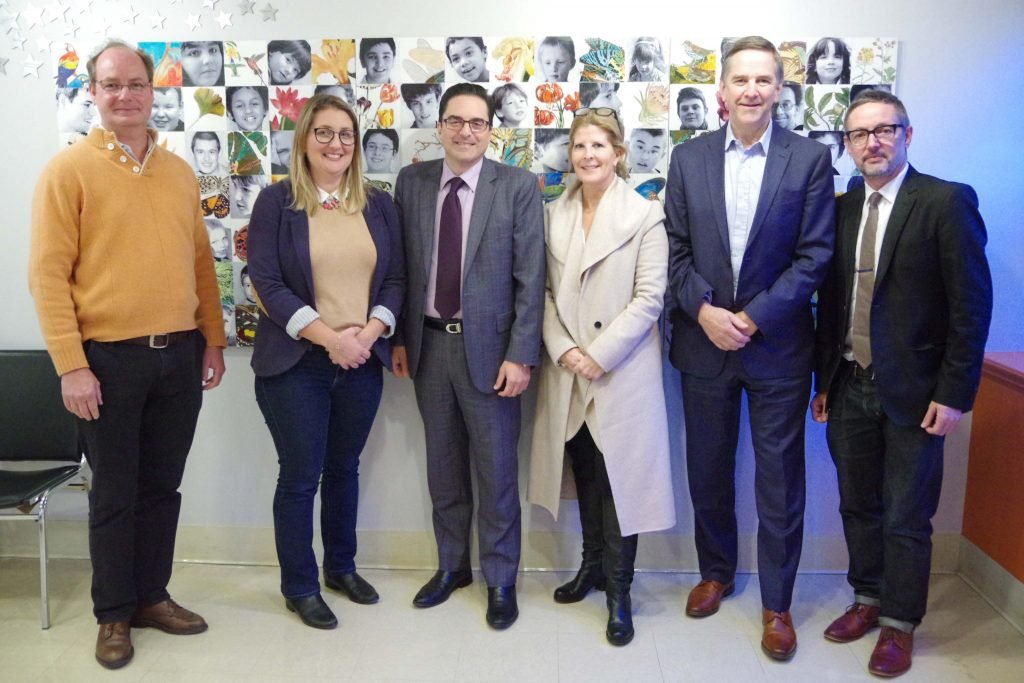
Seen in this photo (left to right) from November 2018 are Giant Steps board members at that time: Jean de Mailly Nesle (vice-president), Tracy Pennimpede (Foundation director), Nick Katalifos (administrator), Andrée Dallaire (administrator), André Pagé (Treasurer) and Thomas Henderson (school director).

Awareness growing

Katalifos attributed the success of the fundraiser to various factors, including rising awareness of the cause. “The issue of autism obviously has really become a major one for our society,” he told the Laval News.

“We’ve all heard about the stats with the numbers of kids today who are getting diagnosed. And Giant Steps is, to my knowledge, the only school in Quebec that deals exclusively with autistic students.

“So, I think more and more people in the community have become aware that Giant Steps is also working hard on projects and programs beyond the student body and is geared towards working the autistic community as a whole.

An exceptional response

Katalifos said Giant Steps had been doing this type of fundraiser for the past four to five years, but this year was by far the best. He agreed the response was exceptional, considering the difficult circumstances most people have been struggling with since the beginning of the COVID-19 pandemic.

‘The issue of autism obviously has really become a major one for our society,’ says Giant Steps board president Nick Katalifos

“We’re all living through very difficult and challenging times with the COVID-19 crisis,” he said. “So, we’re particularly grateful to the community for supporting us in such a big way.”

Polaris Enterprise Series

Giant Steps recently launched the Polaris Enterprise Leadership Series with an interview with José Velasco, Head of SAP’s Autism at Work Program. Throughout the month of November, the series will feature interviews with international and local organizations, working to accelerate employment of autistic adults. According to Katalifos, the school has developed a relationship with the Loblaw Companies to provide training to students. “The goal is for them to be offered full-time jobs with full benefits,” he said. “And we hope the company will expand the project well beyond Quebec eventually. That’s a hope on our part. That’s the plan at least

End of life and bereavement are everyone’s business, say experts

Compassionate Ottawa’s online gathering drew hundreds of followers

Is end of life care everyone’s responsibility? Are some people, seniors perhaps, more uncomfortable when dealing with end of life issues? And how can the idea of end of life care be fostered with compassion in the community?

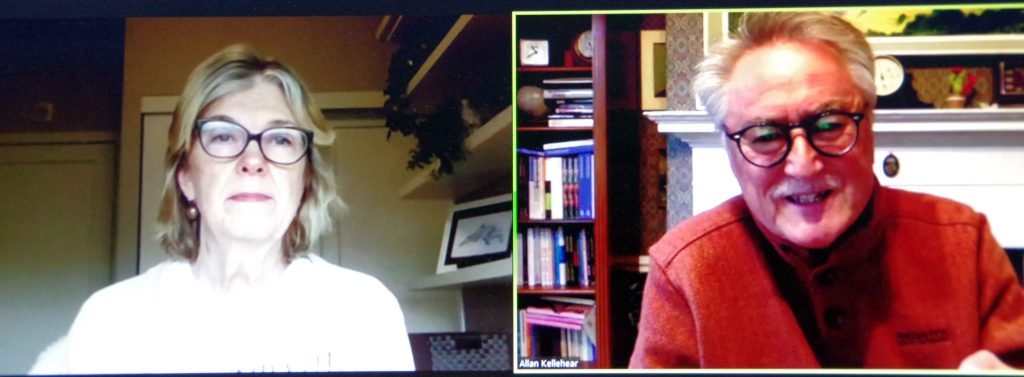
These were some of the questions that came up during an online conversation on Oct. 28 between between Dr. Allan Kellehear, a British public health sociologist specializing in end of life care, and Dr. Mary Lou Kelley, a Canadian expert in gerontology and palliative care, with practice, teaching and research experience dating back to the early 1970s.

Followed by hundreds

The live Zoom presentation, the first of a series of conversations planned by Compassionate Ottawa, was followed by several hundred people across Canada and around the globe. Compassionate Ottawa is an umbrella group in the nation’s capital for several healthcare provider organizations that promote a grassroots community-based model of care for those facing life threatening illnesses.

From the left, Dr. Mary Lou Kelley and Dr. Allan Kellehear

Dr. Kellehear founded and developed the main public health model for care of the dying, the bereaved and caregivers. This model is based on the application of health promotion, community development, and social ecology ideas and principles. He is the author of a number of books on dying, death and the compassionate community movement. He also developed the Companionate City Charter.

Everybody’s business

Dr. Kelley’s research has used participatory and community development approaches to empower and support community members and front-line workers and create changes to improve end of life for people, their families and communities. Her major research contributions have been in rural and First Nations communities and long-term care homes. She is a member of Compassionate Ottawa’s advisory council.

Bereavement is something that goes on for more than just weeks, months or years – it lasts forever


renowned end of life expert Dr. Allan Kellehear

So, why should end of life care be everybody’s business? As Dr. Kellehear pointed out, health today is increasingly everybody’s business. “Most people understand that, and that’s why they try to eat better, and why they exercise, and why there are policies in the workplace to protect workers and policies in schools to protect student,” he said.

Bereavement continues

He said these principles apply to end of life care. “When there’s a crisis, we have services. And that is exactly the same for end of life care.” He said bereavement is a phenomenon that doesn’t last for just a period of weeks or even months or years. “It lasts forever. And the response to supporting people is grief and bereavement is not service provision. If it was, every second person would be a grief counsellor.

“So, unless we understand that outside the very specific acute model of palliative care and hospice care, the people who live with lasting illnesses and long-term caregiving and grief and bereavement and advanced aging are all around us – they’re all around us.

We are all responsible

“And it’s not dying, and it’s not bereavement per se which is the problem, but the companions that follow those two journeys: the anxiety, the depression, the social isolation, the loneliness, the stigma, the social rejection, the job loss, the lost school days, the suicide, the sudden death. All of these things are amenable to prevention and harm reduction and they can be done by you and me.”

Dr. Kelley, who worked extensively with Indigenous communities in Canada, noted that they tend to support one another with issues such as caregiving as families, rather than through institutions like hospitals or retirement residences. She said there is a similar attitude in the Netherlands, where the dying are often cared for at home.

Cultural changes

Dr. Kellehear said that in Japan, care for the dying and the bereaved was at one time “a family affair,” although now “there’s stigma if you don’t send grandma to the hospital as soon as she looks pale. The idea of a good son [in Japan] is to make sure your parents get the best medical services.”

However, he added, there’s been a change in attitudes since the Second World War and the weight of responsibility has been shifted to the health care system. “And that’s not only in Japan,” he continued. “It’s been happening all over the world.”

Vimont councillor Michel Poissant running for mayor in 2021

Ex-administration turned opposition councillor launches ‘Laval Citoyens’ party

In the seven years since he first won a seat on Laval city council, independent city councillor Michel Poissant has gone from being one of the first councillors elected under Mayor Marc Demers’ Mouvement lavallois, to an independent dissident disagreeing fundamentally with Demers, to an Action Laval opposition councillor, then back again to independent status.

Mayoral candidate

Clearly a man who doesn’t stay in one place for too long, Poissant has announced his next goal – to become mayor of Laval in next year’s municipal elections which will be taking place on Nov. 7, 2021.

Opposition councillor Michel Poissant, centre, who is running for mayor helped organize several protests against what he and supporters claimed were poorly-conceived bicycle paths.

In an interview this week with the Laval News, Poissant said the party will be taking a “client-driven” approach to municipal affairs, basing policies and decisions on the need to meet the standards expected by the residents and overs in the City of Laval.

“We have to have a listen-up approach,” he said, suggesting his party will be emphasizing the necessity to carefully listen to people from Laval, while adding that he’s already started gathering a considerable number of supporters who agree with the philosophy.

According to the Élections Québec website, Poissant has registered the Laval Citoyens/Laval Citizens as the name of a political party he’ll be leading going towards election day.

It’s been around six months since Poissant broke away from Action Laval, the opposition party he’d decided to join after leaving the Mouvement lavallois to sit as an independent.

Was with Mouvement lavallois

Poissant had bolted from Mayor Demers’ party along with four other ML city councillors who complained they found the mayor too authoritarian.

After sitting with Action Laval since late 2019, in May this year Poissant, who represents the district of Vimont, and his council colleague Daniel Hébert (Marigot), who had been one of those who left the Mouvement lavallois, announced they were leaving Action Laval, without saying what their intentions were beyond that.

Accounting background

Michel Poissant’s professional background is in accounting. A member of the Order of Professional Chartered Accountants of Quebec, he has 30 years experience in his profession and worked for the Fonds de solidarité des travailleurs du Québec as an administrator for around half that time.

According to the Élections Québec website, Poissant has registered Laval Citoyens as the name of a political party he’ll be leading going towards election day next year

During the time he sat as a Mouvement lavallois member of city council, Poissant presided two council committees responsible for overseeing auditing and accounting issues within the administration as well as the municipal employees’ retirement fund.

Joined then left Action Laval

Since becoming an independent opposition councillor, Poissant has actively taken part in protests organized by Action Laval to draw attention to what the party claims was the haphazard way the city created bicycle path networks all over Laval.

When Poissant left Action Laval, at least one leading party member confided to the Laval News that his decision may have been spurred by a disagreement over who should lead the party, and Poissant’s failure to secure for himself a higher-profile leadership role in Action Laval.

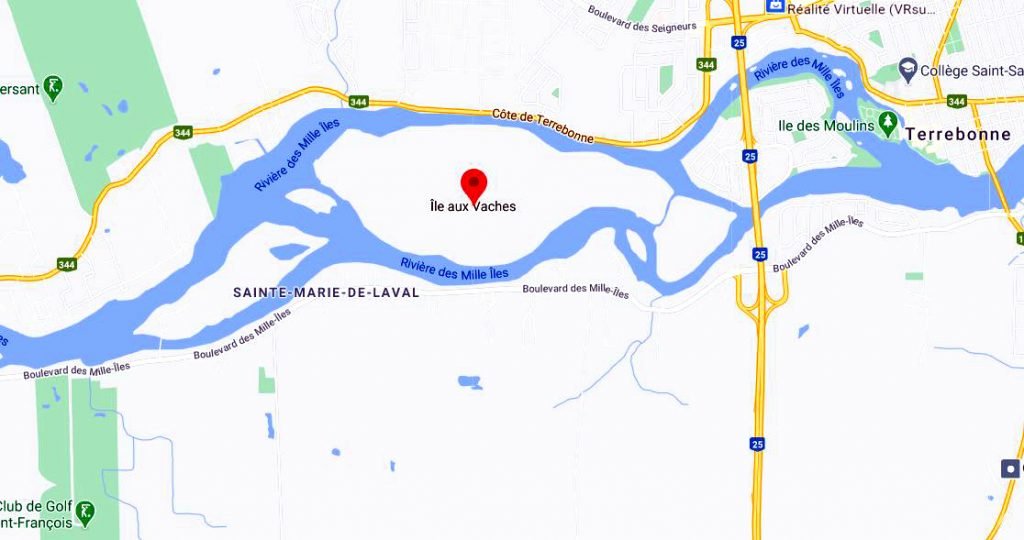
Laval purchases islands in Mille Îles River for future park use

Quebec to help pay $21.9 million cost for Île aux Vaches and Île Saint-Pierre

The City of Laval announced last week that it is buying two islands situated in the Rivière des Mille Îles in order to better protect them environmentally while preserving them for future public use.

Located just north of Île Jésus below Terrebonne, Île aux Vaches and Île Saint-Pierre have long been coveted by environmentalists and land preservationists as they are home to a good number of rare or endangered species of flora and fauna.

Group’s efforts paid off

The two islands, part of the Saint-François archipelago, are also known for their woodlands, shores, marshes, swamps and grasses, as well as for an abundance of amphibians and large mammals. Over the past several years, the environmental group Sauvons nos trois grandes îles had been lobbying intensely to have the islands declared protected territory.

A decade ago, they submitted a petition with more than 41,000 signatures to the Quebec National Assembly. The province’s department of Municipal Affairs and Housing contributed $7 million towards Laval’s acquisition of the two islands.

Will be used for activities

The rest will be coming from land sales worth $10 million. The city plans to use the islands for ecologically-sound activities such as bicycling, paddling and hiking. The islands were previously owned by Montreal-based Monit Investments. The company will be paid $4.9 million as part of the deal.

‘I admit that I was stunned to learn the good news,’ said Huguette Larochelle, president of the organization that spearheaded efforts to buy the islands for eventual public use

In a common statement issued on Oct. 26, Mayor Marc Demers, Municipal Affairs Minister Andrée Laforest, and Environment Minister Benoit Charette who is also responsible for the Laval region, said the acquisitions would cost a total of $21.9 million, some coming from Quebec, while other sums would come from the sale of city-owned land on des Pélicans St. in Duvernay.

“The purchase of these two islands confirms a commitment by the city with regards to protection of the environment,” the City of Laval said in the statement. According to the city, a plan will be developed for the future of the islands.

A pledge fulfilled

“We are very proud of how this project worked out,” said Mayor Marc Demers, noting that buying the islands was one of his first electoral pledges when he first ran for office in 2013. “The purchase of these two islands represents two giant steps forward with regards to protection of the environment.

“I would like to thank the government of Quebec, especially the Ministry of Finance and the former minister responsible for Laval, Eric Girard, as well as Municipal Affairs and Housing Minister Andrée Laforest, for contributing largely to turn this project into a reality,” the mayor added.

Municipal Affairs and Housing Minister Laforest said, “We will remember an announcement like this for a long time. It isn’t every day that two large islands located right in the middle of the metropolitan Montreal region are returned to the public. This is a $7 million contribution from our government that will be benefiting everyone from Laval and I am very proud of this.”

‘Good news,’ said Charette

Explained Charette, “Residents of Laval will be able to benefit from these places which are well-endowed in terms of their eco-systems. At the same time, this is very good news for all the community, and I salute the City of Laval for its initiative and its commitment in protecting our environment and our green spaces. These islands will add to the richness of the Laval territory, while becoming part of the heritage for future generations.”

According to the City of Laval/Quebec government press release, Sauvons nos trois grandes îles started lobbying in 2008 for the public protection of the islands. The group, led by Huguette Larochelle, felt vindicated by the outcome of its efforts after 12 years.

“I admit that I was stunned to learn the good news,” Larochelle said. “The purchase of ’île aux Vaches and île Saint-Pierre marks an important milestone in my commitment, going back to the early 1990s.

Lobbied for decades

“As you may imagine, over the past few decades we presented this project to several elected officials at all levels of government,” she continued. “And so, it seems to me only natural to warmly thank Mr. Demers, Mrs. Laforest and Mr. Charette. At last we can say that present and future generations will be able to celebrate an exceptional environmental heritage.”

Mayor Demers said he took it upon himself to personally call Larochelle in order to deliver the good news. “After nearly 30 years of working towards this, her efforts have borne fruit,” he said. “At this stage, I think Mme Larochelle could teach courses in university on determination and citizens commitment.”

Council of Laval Women to develop policy for equality of sexes

Council committee expected to ignite debate with recommendations

Laval city councillor for Souvenir-Labelle Sandra El Helou

The City of Laval’s executive-committee announced on Monday that it is giving a mandate to the Council of Laval Women to produce an opinion to serve as an orientation towards creating a policy for the equality of the sexes.

Recommended actions

Acccording to a statement issued earlier this week by the executive-committee, the mandate will see the council analyzing the various equality policies between women and men in other municipalities and MRCs throughout Quebec.

In the end, the opinion will be accompanied by recommendations on the actions to be taken towards formulating an eventual policy in this matter by the City of Laval.

“I am anxious to read their recommendations,” says Laval city councillor for Souvenir-Labelle Sandra El-Helou. “We want to send a signal that equality between the sexes is not subject to debate in Laval. It’s an obligation.”

Will respond next spring

The executive-committee is expected to receive the recommendations from the Council of Laval Women by the spring of 2021. The Council of Laval Women was founded earlier this year and is made up of 13 women chosen to represent diversity among women in Laval.

The council’s mandate is to study and propose concrete solutions along three axes: adaptability and accessibility to municipal services; the equity of work conditions, access to employment and professional advancement; and the mechanisms and conditions for citizen participation, in order to encourage better representation of women in politics.

Weather

Laval
overcast clouds
-4.4 ° C
-3.7 °
-5.6 °
76 %
3.6kmh
97 %
Mon
-3 °
Tue
-7 °
Wed
-0 °
Thu
-2 °
Fri
-7 °