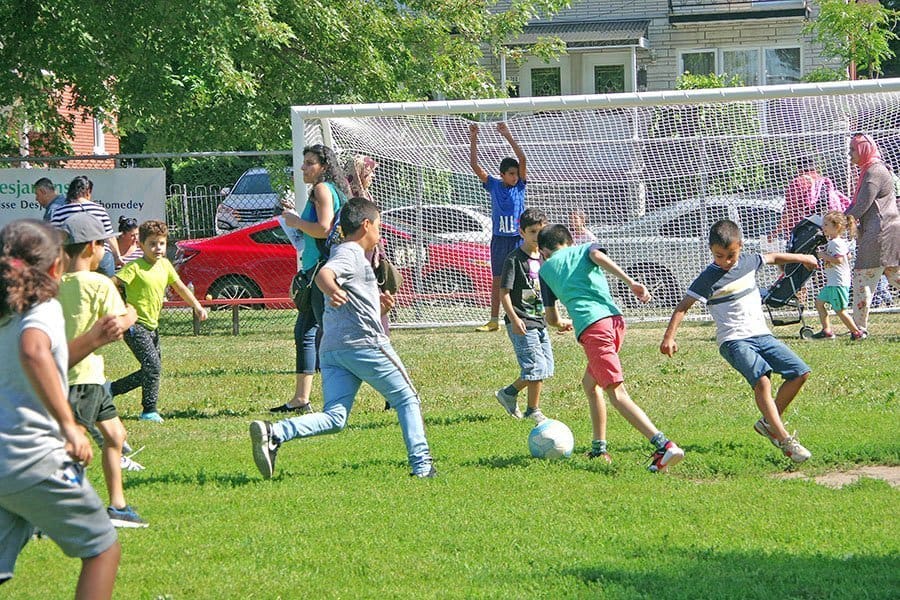
Students will share outdoor grounds with École internationale high school
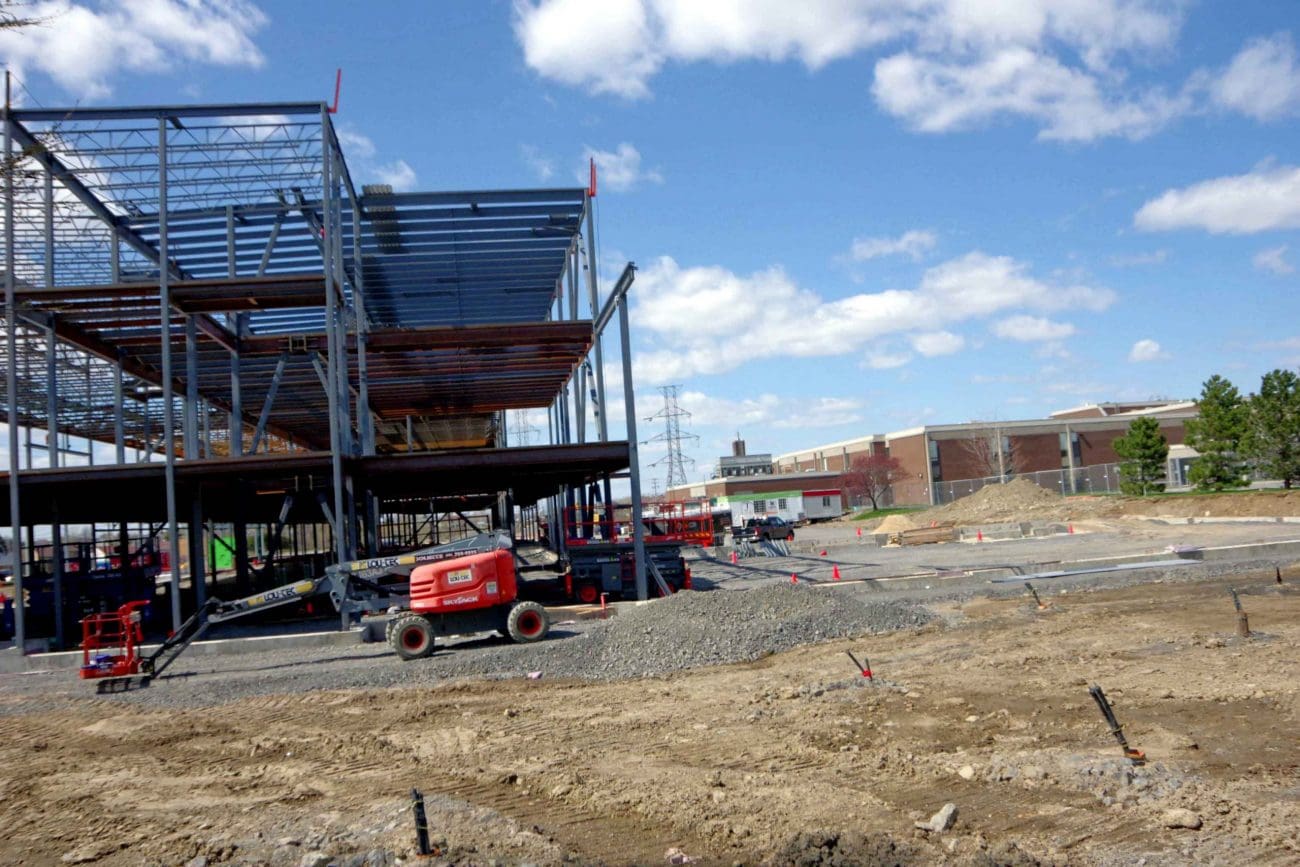
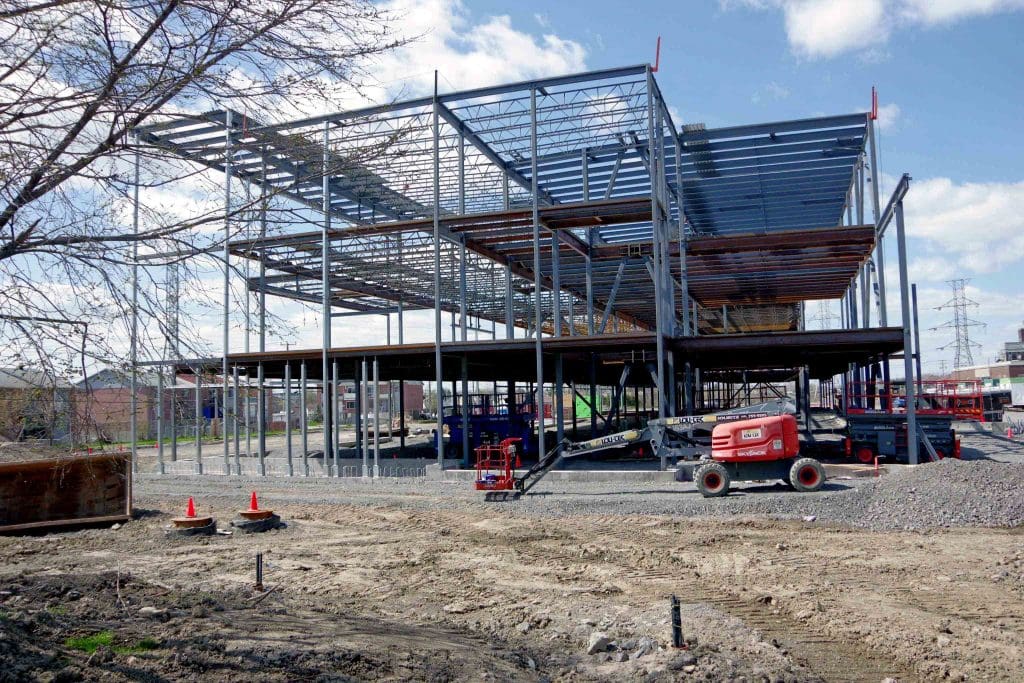
Work is well underway on Souvenir Rd. in Chomedey on a new grade school being built by the Centre de services scolaire de Laval next to the CSSL’s École d’éducation internationale de Laval secondary school.
As one of several new school building projects previously announced by the CSSL, the educational services centre says the new school is being built to fill a need for French-language grade school space which has been lacking in Chomedey.
Sept. 2022 opening
According to the CSSL, the new building is expected to open in time for back-to-school in September 2022.
When completed, the school will have room for 700 students, ranging from pre-school (four and five years old) up to grade six.
The CSSL says the school has been designed to let in a maximum amount of natural light, in accordance with a request made by parents during a public consultation.
As the two schools will be located next to each other, they will be sharing some outdoor space for activities. The CSSL is expected to upgrade the grounds so as to include improvements to benefit students at the high school.
Work still needed to achieve equality, suggests city manager Jacques Ulysse
For the first time in its 56-year history, the City of Laval held a summit for diversity and ethnocultural inclusion on April 22, bringing together more than 400 participants on an online platform, while providing an open forum for speakers to express what were at times some very frank views.
Led by Francophone radio and TV host Rebecca Makonnen, the guest list included Quebec Minister for International Relations Nadine Girault, Environment and Anti-Racism Minister Benoit Charette, Sainte-Rose MNA Christopher Skeete, Mayor Marc Demers, executive-committee vice-president Stéphane Boyer and city councillor for Auteuil Jocelyne Frédéric-Gauthier.
D-G Ulysse speaks
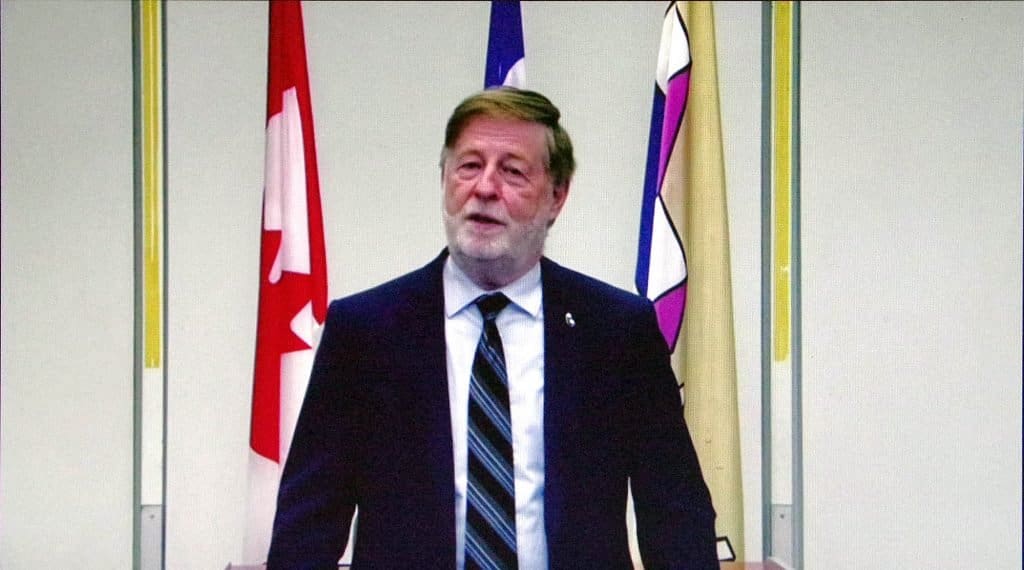
While the provincial ministers, the mayor and other elected officials delivered remarks shedding light on the issues, a highlight of the meeting turned out to be an address by Laval director-general Jacques Ulysse, the city’s first Black general manager. Hired by Mayor Marc Demers three years ago, Ulysse grew up in Laval.
Mayor Marc Demers said the summit was useful in bringing together people from different backgrounds, while also allowing the city to explain the progress it has made towards achieving inclusion and racial diversity.
Although Laval is regarded today as one of the province’s most culturally diversified communities, Ulysse recounted that while growing up in Laval he was the only Black person at his grade-school, in high-school and while participating in team sports.
More efforts needed
“I am pleased to see that many years later, the City of Laval has truly become a diversified city,” said Ulysse, noting that in recent years the city has accelerated the pace to make greater efforts than ever to reach out to cultural minorities, while attempting to give them a stronger voice.
Quoting from a mission statement defining Laval’s aspirations over the next 20 years, Ulysse suggested that a fair amount of work still needs to be done to even the playing field for people of all races and cultural backgrounds.
Intention to action
While noting some key words in the mission statement referring to “aspirations which reflect the population,” he said that as director-general he was in a position to see that, despite the good intentions, “we’re not there yet, and we will have to double up our efforts in the coming years to get there. But believe me: the leadership and the will are there.”
‘We will have to double up our efforts in the coming years to get there,’ city manager Jacques Ulysse said of the work ahead to achieve multicultural equity
The summit provided an opportunity for City of Laval employees and department heads to showcase the various programs and efforts they’ve made in recent years to create a more accommodating environment for the many ethnic and cultural minorities that make their home in Laval.
‘The right track,’ Demers said
“For Laval, the holding of this event was important for two reasons,” Mayor Demers said. “Firstly, one purpose of this summit was to bring together citizens and partners around the issues raised by immigration, inclusion and ethnocultural diversity.
“Secondly, it allowed us to make an accounting of our achievements, including an assessment of what we have achieved in more than five years, while demonstrating clearly that we are on the right track towards actively favouring citizen participation and social inclusion.”
A ‘responsibility,’ said Boyer
Stéphane Boyer noted that Laval is currently the second most important city in Quebec for taking in immigrants. At the same time, he pointed out that the city has set aside $1 million this year alone on programs to encourage inclusion and diversity.
“This reality comes with a responsibility: that we do everything to make our city a model for living together,” he said. “And this with the constant support our partners and employees. This summit was an opportunity to renew our sense of determination to work towards favoring inclusion while struggling against discrimination.”
The City of Laval announced last week that it has taken yet another step towards completing work on its Master Urban Plan.
“Our urban planning experts set the bar very high and worked non-stop over the past three years to reach this result,” said alternate mayor Stéphane Boyer, vice-president of the executive-committee and city councillor for Duvernay/Pont-Viau.
Leading the way
“This work will certainly allow us to become positioned among the leaders in Quebec in the use of practical, innovative and sustainable urban planning practices,” he added. This is a project that started in 2018.
The new Master Urban Plan brings together all of the urban planning regulations (including zoning, construction rules, etc.) in a form the city claims will be easier for most property owners to understand. More than 500 illustrations have been added, along with explanations to make zoning issues easier for professionals and private owners to understand for construction or renovation projects.
Comes out May 3
A first version of the new publication, to be called Info-règlements, will be available to the public beginning on May 3. It will allow Laval residents to identify their own property through an interactive map, by address or by lot, in order to find applicable regulations. A longer version is expected to be released on a future date.
On March 3, the city is expected to begin the last phase towards adopting the new plan, with an online consultation. Public meetings will be held on May 18 and 19. Memorandums on the plan will then be accepted from May 3 until June 14, followed by public consultations during the week of June 14.
Analysis and comments
The public consultations will be presided by a committee of elected officials chosen by the mayor, including executive-committee vice-president Stéphane Boyer, executive-committee member and Sainte-Rose councillor Virginie Dufour, and Marigot councillor Daniel Hébert.
Following the public consultations, the city will be proceeding with an analysis of the comments and contributions made by residents in order to possibly add to the plan.
Following recommendations of several committees overseeing the project, city council will decide whether or not to integrate the recommendations into the new plan.
A report on the consultation process will be made public at that time. The new Master Urban Plan will come into effect after being adopted by city council.
Executive-committee allots $150,000 for sports support program
During their April 21 meeting, the members of the City of Laval’s executive-committee decided to approve the implementation of a new program of support for sporting events in Laval under the auspices of the city, Tourisme Laval and Sports Laval.
The executive-committee has approved a disbursement of $150,000 for the Programme de soutien aux événements sportifs (Program to support sporting events).
According to the executive-committee, the program’s purpose will be to provide support for sporting events during the second half of 2021, and possibly other sports events taking place in 2022.
During the same executive-committee meeting, the members decided to allot a $75,000 subsidy to the Conseil régional de l’environnement de Laval. The subsidy is payable over three years ($25,000 annually).
The CREL is seen by the executive-committee as a positive agent for change in environmental matters in Laval.
City believes pandemic could stimulate an upswing in science research
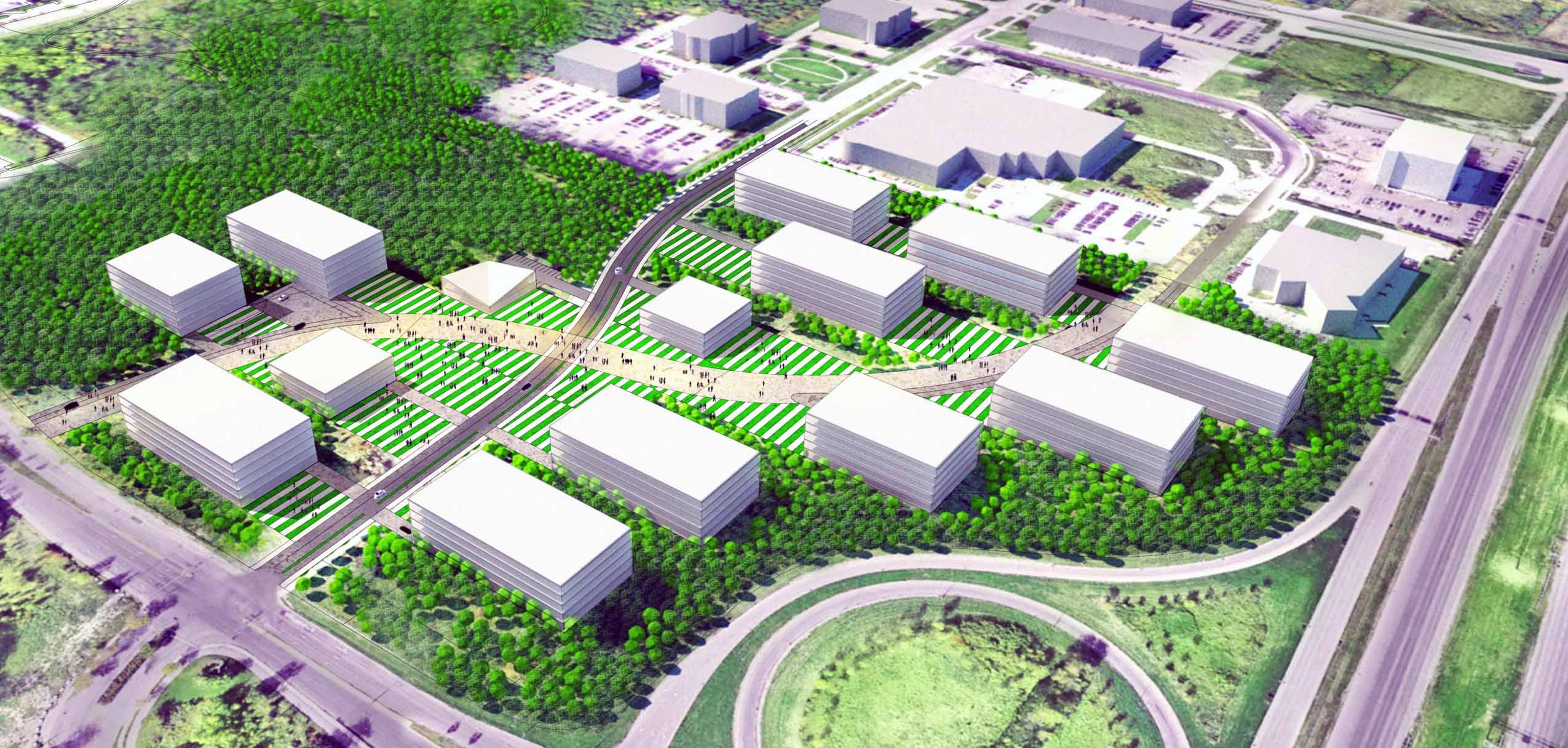
The City of Laval says it is going ahead with a second phase of its Cité de la Biotech (Biotech City) industrial science park project, which was first launched with Phase I two decades ago.
Since its creation, according to the city, Biotech City has seen phenomenal growth.
$1 billion in investment
Based on this success, Laval says it is launching Phase II of the real estate development project with more than 100,000 square metres to become available on the current grounds of the Institut national de la recherche scientifique (INRS).
The city says that Phase II of Biotech City will be ready to welcome businesses in the life sciences sector, and biomedicine in particular (vaccines, antibodies, proteins, cell therapies). Laval anticipates investments of over $1 billion and the creation of 7,500 new jobs over the next decade through this development project.
Meeting objectives
“There can be no doubt that this promisingly innovative project meets Ville de Laval’s objectives with regard to economic recovery and the acceleration of major projects,” said Laval executive-committee vice-president Stéphane Boyer, who is city councillor for Duvernay-Pont Viau and responsible for economic development dossiers.
Located near the Metro and downtown Laval, Phase II of Biotech City, according to the City of Laval, should be an ideal location to offer companies and workers an environment to complement the initial Phase I site. “We are very pleased to further our collaboration with INRS, one of our long-time partners,” Boyer said.
A growing demand
The city considers Biotech City Phase II to be a major project and expects the expansion will make it possible to meet a high demand for development space in the biotechnology sector. The city believes the pandemic has increased the need for resources offered to this critical sector. Laval says Phase II of Biotech City will bring together entrepreneurs, researchers and employees who will be able to collaborate in one location and foster innovation.
The City of Laval believes the pandemic has increased the demand for scientific research resources of the kind that will be made available in Phase II at Biotech City
The city maintains that the life sciences sector is one of Laval’s major economic drivers. With a large pool of world-class companies, the city says Biotech City will be an attractive location for multinational companies with off-continent home bases to set up operations in North America.
The INRS is on board
“The INRS is proud to partner with Ville de Laval to promote the development of high-tech companies,” said Luc-Alain Giraldeau, CEO of INRS. “This initiative is part of our mission to contribute to developing our society through research. Phase II of Biotech City will allow INRS teams to multiply research partnerships in currently critical sectors.”
The City of Laval says it has two tax credit programs available for real estate owners who wish to undertake major construction projects. Land in Biotech City is eligible for these programs.
Here are some quick facts about Biotech City:
Expected to create 5,500 jobs at over 110 companies and institutions operating within a 3 km radius;
Home to the Centre québécois d’innovation en biotechnologie (CQIB) [Quebec biotechnology innovation centre], the first biotech incubator in Canada (created 25 years ago);
Home to the INRS Armand-Frappier Santé Biotechnologie Research Centre;
Offers access to a large talent pool;
Has seen over $4.5 billion in private investments since 2001;
Has seen 4,000 new jobs created since 2001;
Offers a 1.3 million square metre science park;
Is home to International companies such as Sanofi, GSK, Servier, Bausch Health, Roche, Charles River, Altasciences and Bio-K+.
U.S. announces recognition of historic tragedy on 106th anniversary of its start
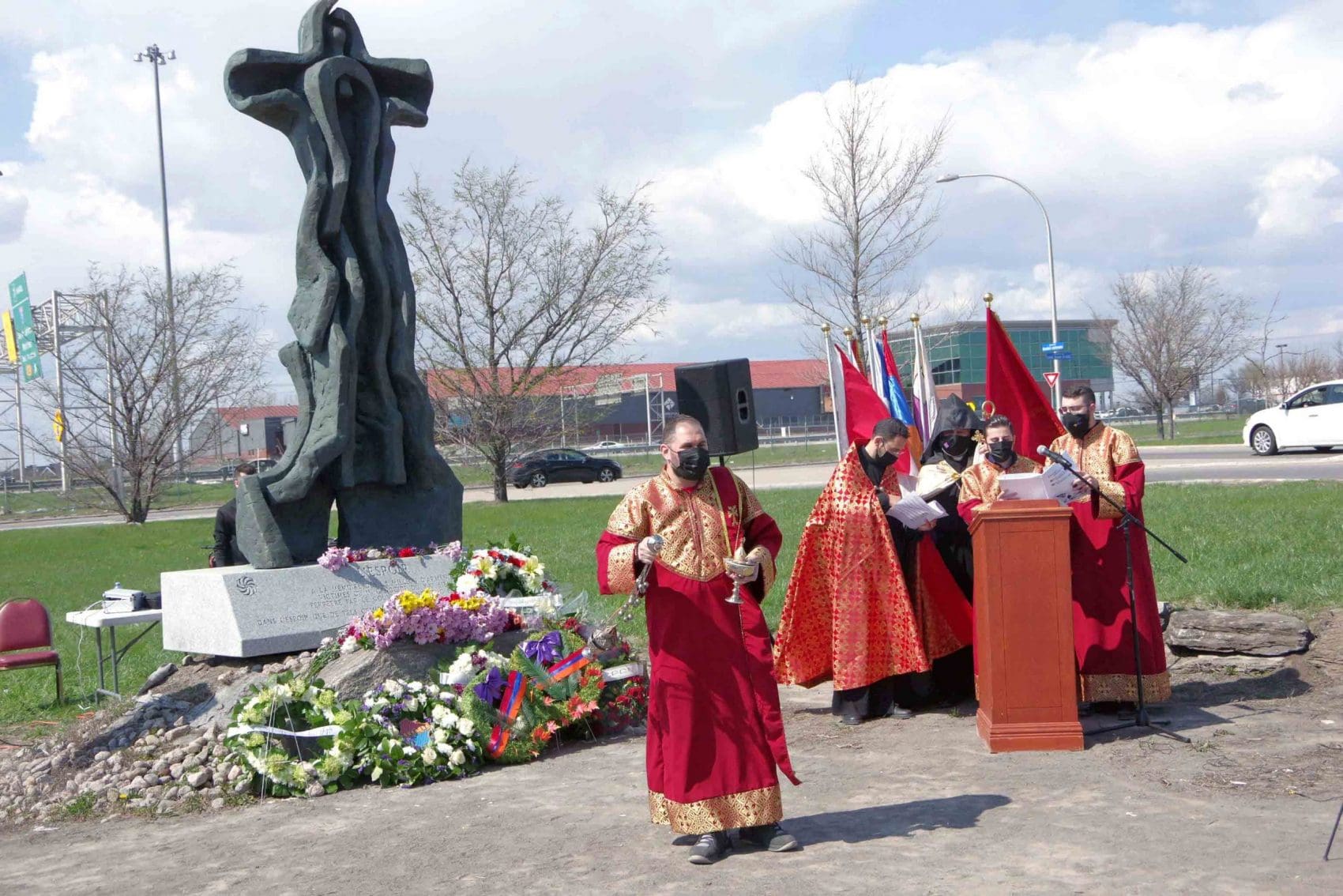
U.S. president Joe Biden’s historic declaration last Saturday that the Ottoman Empire’s systematic killing and deportation of 1.5 million Armenians in the early 20th century was a genocide came just a few hours before Montreal-area Armenians gathered at the Armenian monument on the edge of Autoroute 440 in Laval to mark Armenian Genocide Remembrance Day.
Official U.S. position
The mid-afternoon event drew not only people of all ages from the Armenian community, but also many elected officials from the federal, provincial and municipal governments.
Biden’s declaration, which now reflects the official U.S. government position, came after five successive U.S. presidents danced for decades around the Armenian issue, while specifically avoiding use of the word “genocide.”
Most observers have seen this long-standing non-commitment as the result of the U.S. government’s not wanting to alienate its long-time ally, Turkey, which succeeded the Ottoman Empire after World War I.
A strategic decision
Since the end of World War II, the Americans have maintained a U.S. Air Force presence of 5,000 personnel at Incirlik Air Base in Turkey (which has been a NATO ally since 1952), and the U.S. continues to value the base for its strategic placement between the Middle East and Europe.
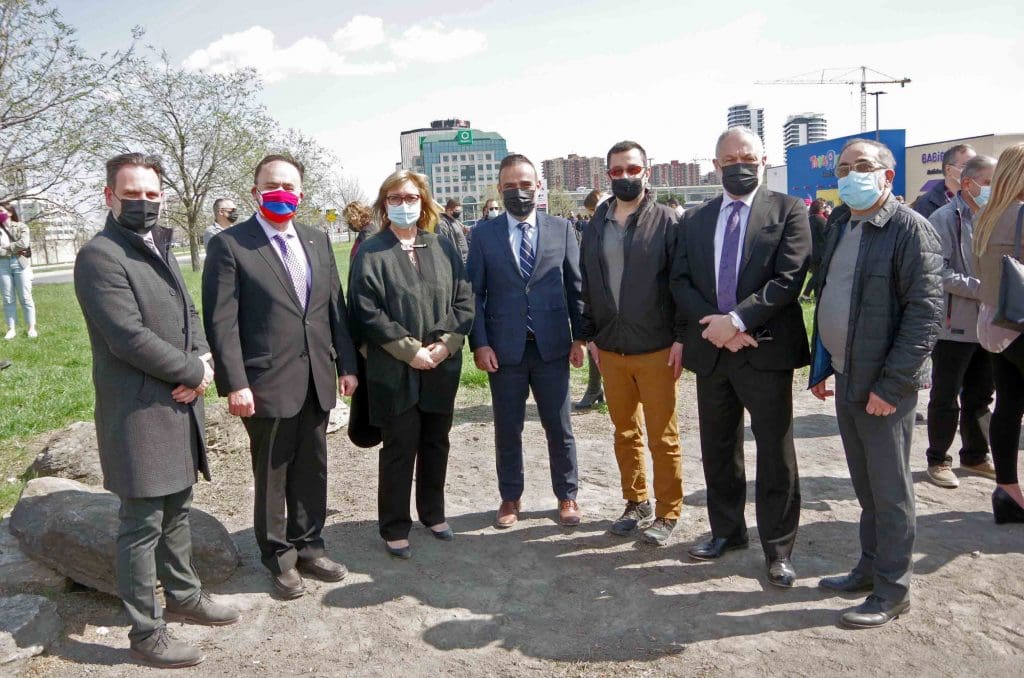
Officials with the Armenian National Committee of Canada as well as from the Laval-area Armenian community are seen here with Laval-Les Îles MP Fayçal El-Khoury and Vimy MP Annie Koutrakis (second and third from left) during the Armenian Genocide Remembrance Day ceremony last Saturday in Laval. (Photo: Martin C. Barry, Newsfirst Multimedia)
According to the U.S.-based Armenian National Institute, at least 30 countries have now recognized the Armenian genocide. However, the United Nations has yet to do so. The UN’s position is that it does not comment on events which took place before its founding in 1945.
Laval’s support for Armenians
Laval, which is home to a sizeable community of Armenians, has been at the forefront in taking positions with regards to Armenia’s past and more recent history. The Armenian genocide monument was erected on a small parcel of land donated by the City of Laval.
As well, in 2004, former Laval-Centre MP Madeleine Dalphond-Guiral successfully guided the adoption of a motion in the House of Commons overwhelmingly acknowledging the 1915 Armenian genocide while condemning it as a massive crime.
And last year, when a jurisdictional dispute between Azerbaijan and Artsakh escalated into warfare, Laval became the first Canadian city to pass a resolution expressing recognition for the independence of the predominantly Armenian-populated Artsakh, which is supported by the Republic of Armenia.
Overdue acknowledgment
In an interview with the Laval News, Maher Karakashian, chairman of the Armenian National Committee of Canada, noted that last year the U.S. Senate and the House of Representatives recognized the Armenian genocide. It remained only for the country’s president to follow. No American president had referred to the Armenian genocide since Ronald Reagan during the 1980s.
‘Both morally and politically, this puts pressure on Turkey’
“We’ll see in the future if it will have repercussions with the superpowers of the world,” Karakashian said. “Both morally and politically, this puts pressure on Turkey. Because Turkey being a member or NATO, and NATO being led by the United States, there will be pressure. Although I see today that Ankara again officially objected or refused this recognition.”
Support from local MPs
Laval-Les Îles MP Fayçal El-Khoury, who attended the ceremony with fellow-MP Annie Koutrakis, said the U.S. government’s statement was important not only for Armenians, but for justice as a whole.
“I and my colleague, Annie, will always stand up for the Armenian cause, just as we do for the Greek cause because they are so similar,” he said, alluding to the oppression the two peoples suffered under Ottoman rule.
“I would like to congratulate the entire Armenian community worldwide for the announcement and position taken by President Biden – I believe that it was a long time coming,” said Koutrakis.
“As my colleague Fayçal mentioned, being of Hellenic origin, this is a cause that is especially close to my heart. “For, as you may know, as Greeks, we also have struggled to get the Pontic genocide, or even the greater Greek genocide, recognized worldwide, and we will continue towards that,” she added. “We share a history with our Armenian brothers and sisters. The Armenian community is very close and in my heart.”
President Joe Biden’s Statement on Armenian Remembrance Day, APRIL 24, 2021
Each year on this day, we remember the lives of all those who died in the Ottoman-era Armenian genocide and recommit ourselves to preventing such an atrocity from ever again occurring. Beginning on April 24, 1915, with the arrest of Armenian intellectuals and community leaders in Constantinople by Ottoman authorities, one and a half million Armenians were deported, massacred, or marched to their deaths in a campaign of extermination. We honor the victims of the Meds Yeghern so that the horrors of what happened are never lost to history. And we remember so that we remain ever-vigilant against the corrosive influence of hate in all its forms.
Of those who survived, most were forced to find new homes and new lives around the world, including in the United States. With strength and resilience, the Armenian people survived and rebuilt their community. Over the decades Armenian immigrants have enriched the United States in countless ways, but they have never forgotten the tragic history that brought so many of their ancestors to our shores. We honor their story. We see that pain. We affirm the history. We do this not to cast blame but to ensure that what happened is never repeated.
Today, as we mourn what was lost, let us also turn our eyes to the future— toward the world that we wish to build for our children. A world unstained by the daily evils of bigotry and intolerance, where human rights are respected, and where all people are able to pursue their lives in dignity and security. Let us renew our shared resolve to prevent future atrocities from occurring anywhere in the world. And let us pursue healing and reconciliation for all the people of the world.
The American people honor all those Armenians who perished in the genocide that began 106 years ago today.
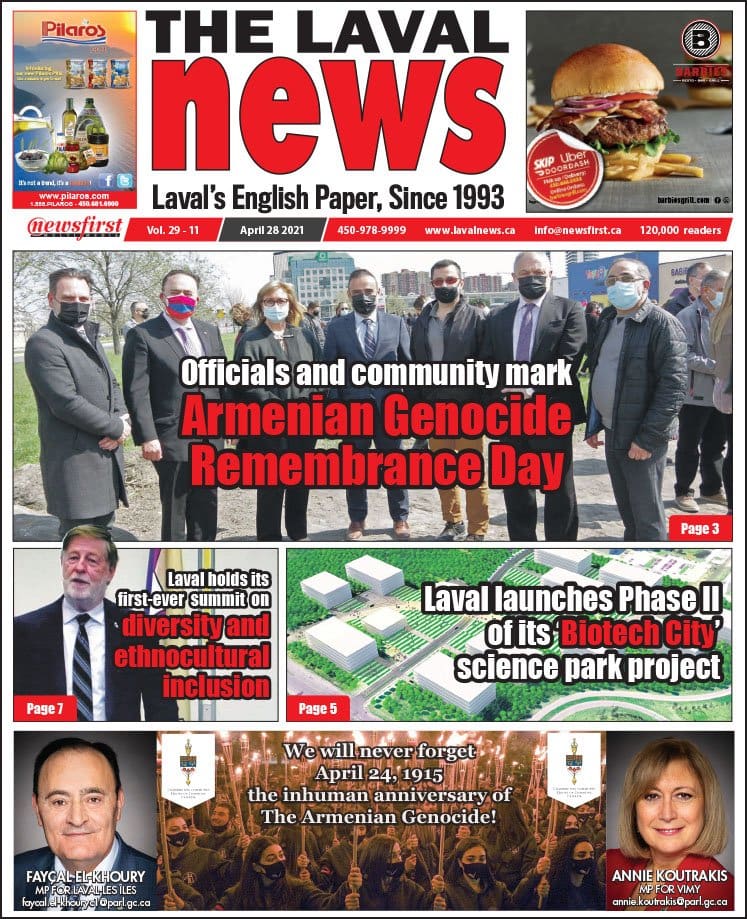
The current issue of the Laval News volume 29-11 published April 28th, 2021. Covering Laval local news, politics, sports and our new section Mature Life. (Click on the image to read the paper.)
The Quebec Office for the Protection of Consumers has announced that Canada Pardon Services, a company specializing in obtaining judicial pardons for people with criminal records, has been found guilty by a tribunal of violating provincial consumer protection law.
According to a release from the provincial agency, the Ontario-based company pleaded guilty in October 2019 to charges. While the company will be paying a $12,123 fine, its owner, Hicham Chirdi, will be paying a fine of $7,314.
The consumer protection office says the company presents itself on its online web page in a manner suggesting deceptively that it is a government branch. The office says that over the years, Canada Pardon Services has been the object of hundreds of complaints about its practices.
The company was accused of not respecting terms in its contracts, namely not disclosing all requested information, of not sending a written contract to clients within 15 days of transactions, of receiving sums before fulfilling contract obligations, and of not reimbursing sums to clients within 15 days when asked, as required by law.
All the charges stem from activities by the company from October 2017 to March 2018 in Laval and in Saint-Eugène-de-Grantham. The company’s head office is located in Toronto.
A 25-year-old woman was taken to hospital with serious injuries towards late afternoon on Monday last week after losing control of her car on Marcel Villeneuve Ave. in Laval’s Saint-François district and leaving the road.
According to reports, the driver was proceeding east on Marcel Villeneuve around 4:35 pm when she suffered a medical emergency, causing her to lose control of her vehicle.
The police and the fire department responded to the scene near Montée du Moulin.
According to witness reports, the driver was pinned inside the wrecked car following the accident and the fire department had to intervene with special equipment to free her.
Fourteen firefighters from the Laval Fire Department responded, beginning at 4:38 pm, according to the reports, and they took 20 minutes to free her.
Witnesses say the vehicle flipped several times after leaving the road, before ending up in a ditch alongside Marcel Villeneuve Ave.
According to the witnesses, the responders had initial difficulty getting the woman out through the car’s doors, which were damaged during the tumble, and ended up having to extract her through the rear trunk.
Around 5 pm, she was transported by Urgences-Santé to hospital where she was found to have suffered non-life threatening injuries.
Two new soccer clubs will serve east and west areas
As part of a recognition accord reached with Soccer Canada as well as with six Laval-area soccer clubs, the City of Laval and the Laval Regional Soccer Association are agreeing to acknowledge the grouping of the six clubs into two entities that will operate henceforth in Laval’s eastern and western areas.
Two clubs from six
According to a statement issued by the city, from now to the end of the year the six current clubs will cease to exist in order to form the two new clubs.
“This unification of the clubs will encourage accessibility to soccer by youths,” said city councillor and executive-committee member Nicholas Borne, who is responsible for sports and leisure dossiers. “Very good news for Laval’s families,” he added.
Improved efficiency
The western club, to be known as FC Laval, will begin operations this summer, and will bring together under its umbrella Fabrose, Delta and Chomedey.
Meanwhile, the three clubs in the east, Monteuil, Centre-Sud and Étoiles de l’Est, will be replaced by the new entity beginning this autumn which will be named at that time.
The creation of the two new clubs is expected to lead to sounder financial practices and better governance, as well as better economies of scale leading to savings and better services.
The late legendary crooner always acknowledged his beginnings in Laval
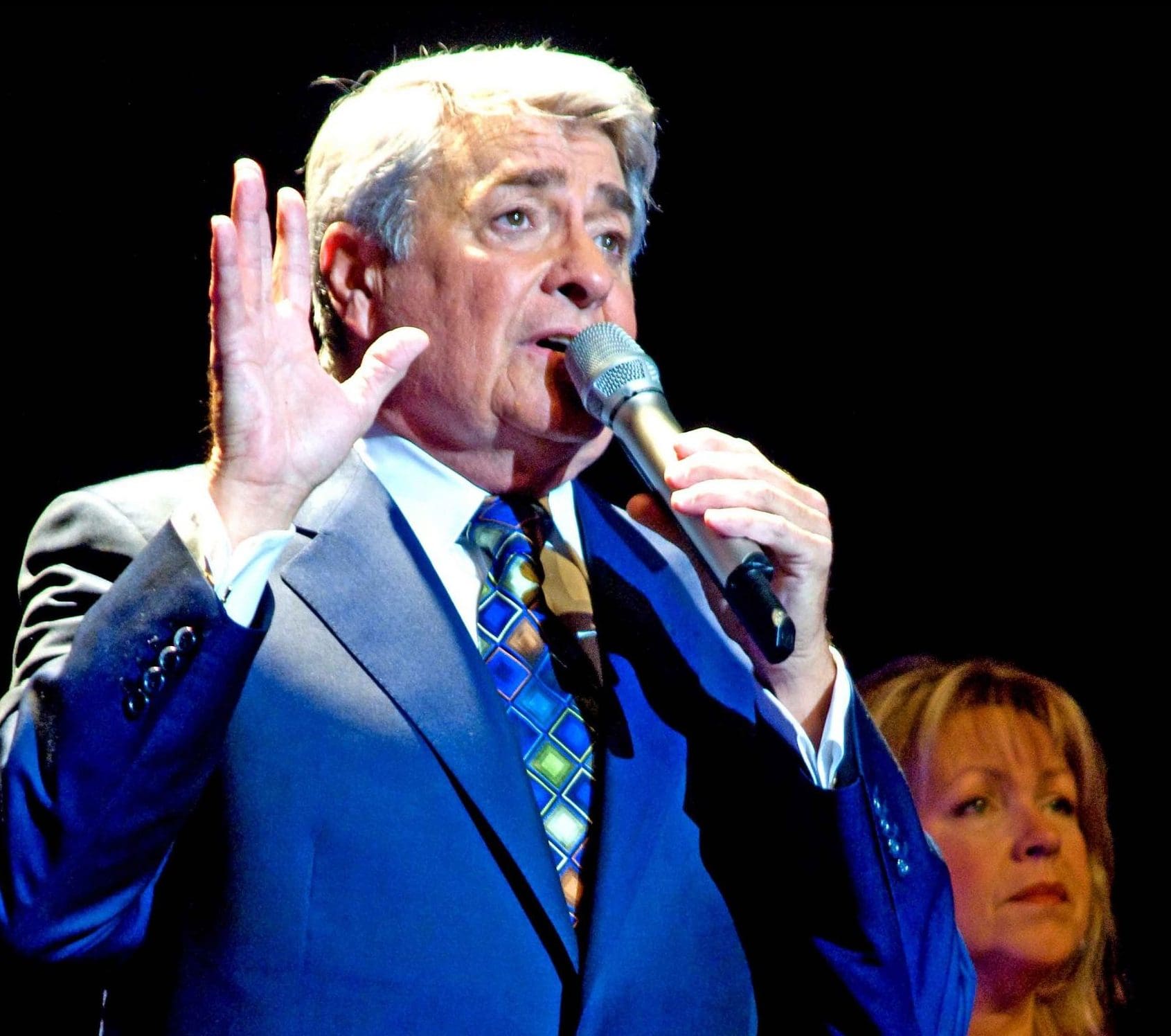
After more than a half century as one of Quebec’s biggest singing superstars, legendary crooner Michel Louvain proved once again during a concert he gave for senior citizens in Laval in 2009 that he still had the knack for charming ladies of all ages – and they never stopped loving him.
Louvain, whose meteoric career in show business was launched in the late 1950s at a hotel and night club near Curé Labelle Blvd. in Chomedey, passed away in his sleep last week while being treated at a Montreal hospital for throat cancer.
Always looked younger
On that storied evening at the Salle André-Mathieu performance hall at Collège Montmorency in October 12 years ago, Louvain was the featured performer during a spectacular musical event held at the conclusion of Laval’s annual Senior Citizens Week.
The old Hôtel Central, where Michel Louvain’s career started, has become Place Elle et Lui at 1600 Robinson near Curé Labelle Blvd. in Chomedey. (Photo: Martin C. Barry, Newsfirst Multimedia)
While he was then just a few years into his 70s, from the audience Louvain looked at least 20 years younger, and he could still belt out a full program of songs, supported by some of Quebec’s top musicians and backup singers.
Still primed to perform at age 83, Michel Louvain had been scheduled to give a series of concerts at the Salle André-Mathieu in April and in May as part of a lengthy touring schedule all over Quebec, when he was hospitalized recently after learning quite suddenly of his cancer diagnosis.
Career started in late ‘50s
Louvain, whose original name was Michel Poulin, was born in July 1937 in Thetford Mines QC. He started to be noticed as a singer and performer in 1958 with his first album, the self-titled Michel Louvain, recorded on the Apex record label. He would eventually become one of Quebec’s reigning matinee idols. His first hit, Buenas Noches Mi Amor, launched his career.
Louvain would often recount how he got his big break at Chomedey’s old Hôtel Central when he was in his early 20s
During the 60s and 70s, Louvain’s popularity soared, especially among young women and girls. His biggest hits included La Dame en Bleu (which he performed often, and which also inspired the title of a 2009 film documentary (Les dames en bleu) focusing on the latter part of Louvain’s career), and Je Déclare l’Amour au Monde Entier. He also worked as a host for numerous shows on French-language TV and radio.
The night clubs in Laval
As the legend of his life goes, Michel Louvain wanted to be a singing star from an early age. However, his parents, concerned by the kind of lifestyle that might lead to, weren’t pleased. But when he turned 18, they relented and allowed him to perform in church basements and small hotels.
On stage at the Salle André-Mathieu more than a decade ago, Louvain recounted how he recived one of his biggest breaks at Chomedey’s old Hôtel Central when he was in his early 20s. Some of the names of nightclubs that flourished in Laval in those days, like the Feuille d’Érable and the Faisan Bleu, drew oohs and aahs of recognition from the mostly retired crowd during his 2009 performance here.
The 2009 documentary film Les dames en bleu gave a close-up and behind-the-scenes view of Michel Louvain as he toured and performed during the later years of his career.
Michel Louvain always insisted that the region of Laval played a key role in his ascent to the top. He recalled how, during the late 1950s, his manager booked his very first professional engagement at the Hôtel Central, which was owned at that time by Rodolphe Girard. It was also at the Hôtel Central that Michel Louvain was first spotted by a music producer who signed him to record what would become his first hit song.
Remembered Rodolphe Girard
As it happened, Girard’s daughter was in the audience during the October 2009 performance, and Louvain strode down the stage steps, then up to her seat for an emotional reunion. “Your dad was like a father to me,” he told her.
“He gave me my first break. I’m so happy to see you.” Located just off Curé Labelle Blvd. at 1600 Robinson Ave. near Saint Martin Blvd., the Hôtel Central where Louvain’s career was launched survives today in another form, having been transformed long ago into the Place Elle et Lui multipurpose mall, which was owned until 2010 by Yves, the son of Rodolphe Girard.