Saturday, February 21, 2026
8 C
Laval
spot_img
Home Blog Page 157

New coalition asks Quebec for estates-general on senior citizens

‘Now is the time to act,’ says Coalition for the Dignity of Seniors

Six major associations representing 150,000 senior citizens in Quebec have joined together in a coalition to ask the Legault government to convene an estates-general meeting to consider major issues concerning the lives of senior citizens in Quebec.

The Coalition pour la dignité des ainés (Coalition for the Dignity of Seniors) (CDA) says the COVID-19 pandemic uncovered major shortcomings in the health system, especially with regards to services for senior citizens.

“This neglect can no longer go on,” said Rose-Mary Thonney, president of the Association québécoise des retraité(e)s des secteurs public et parapublic (AQRP) and spokesperson for the coalition.

“We must immediately take a path towards dignity for seniors and put everything on the table. Turn over every stone and have a real conversation on the quality of life of seniors. This deplorable situation, most notably in the CHSLDs, has been going on too long. The seniors of Quebec have concrete proposals to make. We should listen.”

The CDA is proposing 38 solutions to the problems. They include:

  • Increasing budgets for at-home care;
  • Freeing up some doctors from hospital duties so they can make more house calls;
  • Improving worker conditions in CHSLDs;
  • Modifying the Charter of Rights and Freedoms so there are more provisions for seniors;
  • Create a new type of pension supplement for seniors who don’t have enough revenue.

“Estates-general will allow points to be made about the services offered to older people while hearing from a wider range of other people,” added Thonney. “Our 38 solutions a first step towards sensibly improving the living conditions of seniors.

This neglect can no longer go on,’ says Rose-Mary Thonne, president of the new coalition

“The government has the duty to listen and to enlarge the debate. Now is the time to act.”

The coalition is made up of the following organizations: The Association des retraitées et retraités de l’éducation et des autres services publics du Québec (AREQ-CSQ); the Association québécoise des retraité(e)s des secteurs public et parapublic (AQRP); the Association québécoise de défense des droits des personnes retraitées et préretraitées (AQDR); the Alliance des associations de retraités (AAR); the Regroupement interprofessionnel des intervenantes retraitées des services de santé (RIIRS); and the Association québécoise des directeurs et directrices d’établissement d’enseignement retraités (AQDER).

City preparing to allow enlarged outdoor terraces at restaurants

List of outdoor ‘halts’ will also be expanded in public places and parks

In preparation for the reopening of restaurants in Laval with the lifting of some COVID-19 restrictions, the City of Laval says it is preparing a variety of new measures to be implemented in time for the coming summer season.

Firstly, the city says it has begun to reach agreements with several restauranteurs for the implementation of temporary outdoor terraces.

In a statement, the city says the terraces proved to be very popular last summer and will allow restaurants to serve clients outside safely again this year.

Outdoor ‘halts’

As well, says the city, eight outdoor public “halts” will be set up this summer, where nearby restaurant owners will be allowed to post ads to promote their food delivery services.

Nearly 400 restaurant businesses offering indoor dining are said to still be seriously impacted by the pandemic. The city is encouraging residents to support them, remembering that it remains important to support local businesses.

“Restaurants are part of the economic vitality of our territory, and that’s why we have developed concrete measures to support their re-launch,” said Mayor Marc Demers. “In addition to the announced measures, we are studying other initiatives whose goal is to make our restaurants better known so as to stimulate the demand for them.”

A success last summer

Last year, in order to help relaunch Laval’s economy during the pandemic, the city had authorized several restaurant operators to enlarge their commercial spaces in order to accommodate the installation of temporary outdoor terraces.

For example, these restaurant operators could ask for a temporary permission to enlarge a terrace on their private land or into an adjacent parking lot. Should the current provincial sanitary measures be lessened, the city says it will allow enlarged terraces again this summer.

According to the city, a dozen or so business owners who took advantage of this last year have already been contacted, and most have expressed their interest in doing it again. The city says that others who may be interested this year can call 311 and make a request along with a proposition and a business plan.

This year’s summer ‘halts’

Their dossiers will then be studied in order to determine if the requested configuration respects certain conditions, including fire regulations, as well as traffic flow should that also be involved.

In the meantime, the city also says that public halts, a few of which were in place last year, will allow Laval residents to find relaxing outdoor spots when they can rest and socialize, keeping sanitary measures in mind.

In addition to being places where lunches can be taken and eaten, some halts will also offer local products for sale, such as fruits and vegetables, coming from farms in Laval. There will also be receptacles to dispose of trash when required.

The 2021 outdoor halts will be located at the following spots:

  1. Parc Marcel-Gamache (rue de la Place-Publique), in Sainte-Dorothée;
  2. Émile-Nelligan Library, in Laval-des-Rapides;
  3. Centre communautaire Saint-Louis-de-Montfort, in Pont-Viau;
  4. Église Saint-Vincent-de-Paul, in district of the same name;
  5. Berge aux Quatre-Vents, in Laval-Ouest;
  6. Place publique at métro De la Concorde, in Laval-des-Rapides;
  7. Berge des Écores, in Duvernay;

Centre communautaire Saint-Noël-Chabanel, in Saint-François.

Laval City-Watch

Laval adopts new ‘zero waste’ policy for residuals recycling

Laval city council recently a new five-year strategy for the management of its residual waste, establishing the city’s policy to achieve “zero waste” by the year 2035.

“This strategy is part of a process for change that was initiated with the Laval 2035 plan, which aims to develop Laval into a big city for the 21st century,” says Mayor Marc Demers.

Glimpse of the future

“It invites us to look forward into the future and to glimpse larger share of environmental responsibility taken by the community, out of a desire to live in a healthy environment as well as one that favours social economy,” said Mayor Marc Demers.

The new policy ‘invites us to look forward into the future and to glimpse larger share of environmental responsibility taken by the community,’ says Mayor Marc Demers

The city’s new strategy is in line with provincial objectives for managing residual waste. The strategy rests on an ambitious vision that revolves around five principal axes, which break down futher into 21 measures to be taken and to be followed. Here are a few of them:

  • Working closely with citizens and elected officials;
  • Reducing waste at the source;
  • Including in municipal contracts and permits an obligation by contractors to gather and recycle waste;
  • Obtaining “ICI on recycle” certification on all municipal buildings and keeping it;
  • Promoting domestic composting and developing into community composting;
  • Encouraging leaf and garden waste recycling;
  • Acting against food waste;
  • Making public events more eco-responsible;

Assurer une offre en écocentres desservant l’ensemble des citoyens et petites industries, commerces et institutions (ICI).

City to acquire wooded lots

During meetings held on March 3 and 10, the City of Laval’s executive-committee decided to approve the acquisition of several wooded lots in various areas of Laval for conservation as nature preserves.

The executive-committee members authorized the purchase by the city of lots equivalent in size to three tennis courts placed side-by-side (0.18 hectare), thus increasing the amount of wetland in Laval set aside for conservation.

Strategic purchases

According to the city, the lots in question (known as the Bois Sainte-Dorothée, the Bois d’Auteuil and the Bois de la Source) are located in zones defined as ecologically-significant by the province.

The city says that based on a municipal plan for conserving and improving natural areas, the purchase of the Bois Sainte-Dorothée will help strengthen the natural aspects of the identified area, while the acquisition of the Bois d’Auteuil will help consolidate the ecological corridor along the Mille-Îles River.

As for the portion of territory acquired in the Bois de la Source, it will serve as the location for a pathway, says the city.

The City of Laval’s executive-committee meets regularly to make decisions on a variety of issues. The executive-committee includes the following people: Mayor Marc Demers, vice-president Stéphane Boyer (also councillor for Duvernay–Pont-Viau) councillors Sandra Desmeules (Concorde–Bois-de-Boulogne), Ray Khalil (Sainte-Dorothée), Virginie Dufour (Sainte-Rose) and associate members Nicholas Borne (Laval-les-Îles) and Yannick Langlois (L’Orée-des-Bois).

Students team up with Agape Senior Wellness Centre to prepare care packages for seniors

On March 4, students from The Sacred Heart School of Montreal and Loyola High School got together to prepare nearly 150 care packages for Laval seniors.

Care packages contained Passover cards and Easter cards as well as boxes of cookies, tea, cereal, word puzzles, earmuffs, health passports, make up bags and more.

“Both schools have wonderful student volunteer programs and have a great focus on community service,” said Kevin McLeod, Agape’s Executive Director. “We are so happy that students choose to work with our organization. Brianna, Tristan, Marco and Julius as well as all the students who helped with card-making and preparation of boxes did a fantastic job. It’s so important for seniors to know that even though they might be self isolating, they are not forgotten.”

Boxes will be delivered in time for Passover and/or Easter and for this round of surprises, it could only be delivered for those which the SWC had their physical address.

“We are also very thankful to the Community Health and Social Services Network for all their support as well as to FedEx for being so generous in offering to deliver these packages to seniors,” said McLeod.

Laval seniors wishing to receive mail-in newsletters and calendars of activities from the SWC can give their name and address to the SWC by calling 450-934-1122.

Canada no longer ‘strong and free,’ says Newsfirst opinion columnist Robert Vairo

I can not see clearly because there is just too much misinformation about vaccines out there. When was the last time you heard someone say factually, definitively, without any doubt, the efficiency of the AstraZeneca vaccine?

62%, 72% or 76% after the first dose? You have heard that several countries have stopped using it because of blood clot formation in some vaccinated. South Africa stopped as well because it found AstraZeneca was not effective against its variant.

In the end, no matter how little its efficacy, especially against the South African variant, nor its negative effects on some, the less likely variants will be a problem. Even with the Johnson and Johnson vaccine, at only 72% efficacy, U of T’s Dr. Noah Ivers writes “the virus will still have less opportunity to jump from host to host, replicating and potentially mutating” and preventing serious illness.

All said and done, we do have a vaccine, after only one year!

And late last week came news that oh so generous US President Biden, is sending Canada one and half million of these AstraZeneca vaccines out of the 50 million stock piled in the US. But the fact remains, AstraZeneca vaccine is still undergoing clinical trials in the US. So, our dear friend and closest ally has not even approved it. Compare it to gifting an item to a ‘friend’ because he has plenty more, in the event that it becomes safe to use. Some friend.

But what is most disheartening, is the fact that our inexperienced folks in government have failed us, failed to procure sufficient life saving Pfizer and Moderna vaccines, and now going begging for some vaccines, any vaccines from the US. I never thought in my lifetime that my Canada would go begging, begging for vaccines. First to India, now the US.

So much for “Canada is back” – Justin Trudeau 2015. So much for Canadian sovereignty. We are allowing Russia and China to stake claim in our Canadian arctic, and now we are on our knees for vaccines. Whenever I hear the national anthem before a hockey game, (hopefully sung as a pre game requirement and not the singer’s self glorification) I wonder about the lyrics, Canada “strong and free”. We are not strong. In fact, we are likely at the weakest point in our history. And we are not free. We have to rely on others for our survival.

52% of Canadians believe Canada is “broken” (Ipsos). If you need to ask why, let me list the reasons.

The National Post recently wrote an excellent piece on Canada’s failures. “We’re an energy superpower that can’t build a dam or a pipeline. A champion of reconciliation where Indigenous people are poisoned by their own drinking water. A self-proclaimed “honest broker” in world affairs that can’t get its phone calls returned by foreign leaders.” We can not properly equip our military, (WW2 revolvers that jam and have injured the shooter) We can’t even renovate a house, 24 Sussex, usually home of a prime minister, nor build a pipeline within our own borders let alone crossing somebody else’s border.

Bombardier, Canada’s major transportation company can’t build reliable LRT’S (Light Rail Transit) in Alberta, and the contract for street cars in Toronto ended in court. And now Chevron has quit the LNG (Liquid Natural Gas) project in BC, because of continuous opposition from indigenous tribes.

Poor Canada. So rich in resources that could fund green energy development, but can’t get to first base and losing billions monthly because of it. All Canadians lose.

The Americans don’t like, or want our pipelines but they sure love our natural gas. Alberta’s Tourmaline, Canada’s biggest natural gas producer was ready for the Texas polar vortex, shipping (via pipelines) millions of extra cubic feet of gas to southern states including during their February deep freeze.

Will you listen to China’s ambassador to Canada! Better still, let’s not listen to this arrogant bully and send him back to Beijing after giving Canada an ultimatum to “cooperate with China or else”.

The good news, we have some very good Canadians. Have you done something for someone during this pandemic? Thank you to you who has regularly called a socially restricted neighbour or friend. That fellow who cleared the snow off health workers’ vehicles at the Saint-Jérôme hospital this past winter, thank you. The nine-year-old from West Vancouver who raised $6,400 to buy granola bars and electrolyte drinks for workers at Lions Gate Hospital. And many more of you who deliver groceries to immobile seniors, restaurants and corporations who donate. Thank you.

And to all of you who are kind, care, and do something for others, a big warm virtual hug.

That’s What I’m Thinking.

Robert Vairo

Laval’s Governance Commission issues latest annual report

Twenty-six non-profit groups received funds from city in 2020

In the City of Laval’s latest Governance Commission report released during the March 9 city council meeting, the city reaffirmed its dedication to providing support to many different non-profit groups in Laval – especially over the past year during the COVID-19 pandemic.

Managing public funds

“I am proud upon seeing that since the beginning almost five years ago, the work of the Governance Commission has been contributing to better management of public funds invested by the city in the non-profits, and that the citizens of Laval are the first to benefit as taxpayers, but also as users,” said Val-des-Arbres councillor Christiane Yoakim, president of city council and president of the Governance Commission.

‘The work of the Governance Commission has been contributing to better management of public funds invested by the city in the non-profits,’ said Councillor Christiane Yoakim who oversees the commission’s work

According to the Governance Commission’s 2020 report, the commission dealt with 26 non-profit groups in Laval last year, representing an increase for the third consecutive year.

The commission’s recommendations will allow the groups to improve certain aspects of their operations, including cash management, credit card conflicts of interest, internal controls and diversity on their boards of directors.

In the coming year

The city says that over the coming year, in addition to the Governance Commission’s 2021 work plan, the commission will be carrying out a follow-up of all non-profits on the list, and the city’s Secretariat for Governance will accompany them during an implementation of recommendations as well as in the training of their administrators.

Created in 2015, the Governance Commission is mandated to create more transparency and sound management in non-profit organizations which receive funding from the City of Laval, in order to ensure that public funds get used wisely. In addition to auditing them, the commission also has a mandate to look into questions arising about the non-profits’ management.

Joly announces nearly $44 million in support to COVID-impacted businesses

Laval Chamber of Commerce and Industry to receive $344,165 from Ottawa

The Laval Chamber of Commerce and Industry will be receiving $344,165 from the federal government as part of a $44 million pandemic recovery subsidy package to Montreal-region business development agencies announced last week by federal Economic Development Minister Mélanie Joly.

Resilience during pandemic

For a year now, Joly’s ministry said in a statement issued in conjunction with a webcast press conference, “Quebec entrepreneurs have demonstrated great resilience and ingenuity in adapting to the crisis and pursuing their activities. The Government of Canada made a commitment to support them and is renewing its assistance today.

“It is a priority of the Government of Canada to assist Quebec’s small and medium–sized businesses so they can rebound vigorously after the health crisis,” said Joly, who is also Minister for Official Languages, while making the announcement.

Backbone of the economy

“And we will continue to support them as long as this crisis lasts: Our SMEs are the engine of our communities and the backbone of our economy. They create and maintain good local jobs and guarantee regional vitality. The government is committed to accompanying them so that our economy can come back even stronger than before.”

The government’s support – amounting to $43,931,000 – is going to the Réseau des SADC et CAE (a network of not-for-profit organizations working for economic development in the regions of Quebec), PME MTL and eight regional organizations to ensure funding and technical assistance services are offered up to the end of June to needy businesses.

Joly a former entrepreneur

“Those who are involved in economic development now are faced with one of the biggest challenges of our careers,” Joly added during the conference. “As a former entrepreneur myself, I can understand that what’s most important during a crisis is to be able to manage risk.

“And this pandemic has become something like a fog: We are having trouble seeing the challenges before us. So, the goal of the federal government since the beginning of the economic crisis and the pandemic has been to take care of the health and security of our fellow citizens, even though at the economic level it’s been to take care of our entrepreneurs during this crisis.”

CCIL pleased by announcement

In a statement issued by the Laval Chamber of Commerce and Industry following Joly’s announcement, CCIL CEO Caroline De Guire said, “The CCIL is pleased that its federal partners are continuing their direct financial support to Laval’s SMEs.

‘The CCIL is pleased that its federal partners are continuing their direct financial support to Laval’s SMEs,’ says Laval Chamber of Commerce and Industry CEO Caroline De Guire

“They recognize that the technical assistance offered by the Chamber is turning into an efficient means to help them concretely in the field, whether they are businesses, retailers, or small manufacturers, who remain very fragile from the impacts of the pandemic on Laval’s economy.”

Help for Laval’s businesses

“This technical assistance is offered at no cost through experts who operate service-oriented businesses in Laval,” added CCIL board president Michel Rousseau. “These efforts are not only necessary, but they are part of our vision to assure a durability, resilience and inclusiveness in Laval.”

According to Joly’s department, the new assistance, granted under her ministry’s Regional Relief and Recovery Fund (RRRF), will enable close to 1,930 businesses to make it through the crisis while maintaining 7,095 jobs and playing a key role in the economic recovery.

Other funds from Ottawa

The Réseau des Sociétés d’aide au développement des collectivités (SADC) et Centres d’aide aux entreprises (CAE) is receiving two additional contributions totalling $28.4 million to continue to bolster businesses and Organizations in Quebec’s rural communities.

The Chambre de commerce du Montréal Métropolitain, Québec International, Promotion Saguenay, Investissement et Développement Gatineau, Développement PME Chaudière–Appalaches, Pro-Gestion Estrie, Développement économique de l’agglomération de Longueuil and the Chambre de commerce et d’industrie de Laval are sharing support of up to $3.4 million.

With the support, they believe they will be able to continue to offer their technical support services to businesses and NPOs in their sectors.

Laval News Volume 29-06

0

The current issue of the Laval News volume 29-06 published March 24th, 2021.
Covering Laval local news, politics, sports and our new section Mature Life.
(Click on the image to read the paper.)

Front page of the Laval News.
https://lavalnews.ca/wp-content/uploads/2021/03/TLN-29-06-WEB.pdfFront page of the Laval News, March 24th, 2021 issue.

PLQ surveys Laval’s wants and needs for a future ‘Charter of Regions’

City still fights its image as a suburb, despite population of more than 420,000

As Laval is Quebec’s third-largest city, it goes almost without saying that the Quebec Liberals included it on a list of regions where the National Assembly Official Opposition party has been holding online consultations on the wants and needs of people across the province.

During a consultation held for people in Laval on March 9, more than 50 persons decided to participate, although most did so as observers, leaving just a relative few who spoke and actively took part.

A regional charter

The consultations are being held by the PLQ as a prelude to the party’s preparation and adoption of a new and wide-ranging policy to be known as the Charter of Regions (Charte des régions).

According to a description of the project on a PLQ website, the Charter for Regions will include new recognition for regional governance bodies and will protect the individual regions’ political representation.

“It will strengthen each region’s right to development and prosperity on the basis of individual equality,” the PLQ states.

‘A tool to modernize’

“Indeed, it seeks to be an additional tool to ensure access to innovation throughout the territory, while acknowledging the regions’ contributions to Quebec’s prosperity through their differences and specificities. More broadly, this project would be a tool to modernize and enhance our relations with First Nations and Inuit peoples who inhabit Quebec’s regions.”

In some opening remarks, PLQ leader Dominique Anglade said Laval has aspects, including transportation and other economic factors, which sets it apart from other regions and which merit being treated from a much closer perspective.

A regional approach

Anglade suggested the Charter of Regions would eventually evolve from PLQ party policy into a full-fledged piece of legislation, focusing on each region in Quebec for its individual merits and economic potential, should the Liberals form the next provincial government.

On hand to wade into the issues from Laval’s perspective were four of the region’s MNAs who are Liberal: Monique Sauvé (Fabre), Jean Rousselle (Vimont), Francine Charbonneau (Mille-Îles) and Saul Polo (Laval-des-Rapides).

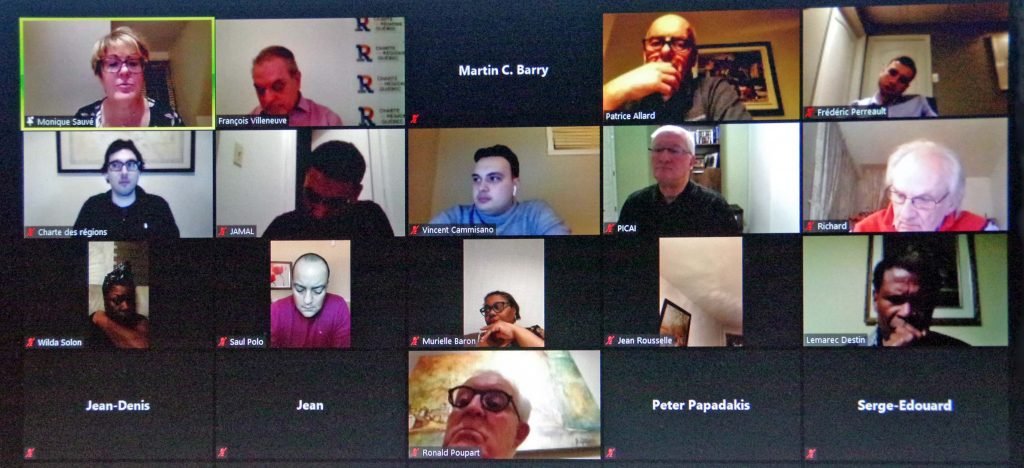
Some of the online participants in the PLQ’s Charter of Regions consultation held on March 9.

Sauvé suggested that in recent years, the Laval region has lost some of its sense of connection between groups and people and that she would like to see it restored.

Reflecting Laval’s uniqueness

“There is something in particular that is very meaningful that we have lost over the years,” she said, while adding that Laval is different from Montreal in that most people still know each other here, compared to Montreal where there is a great deal more anonymity.

Jean Rousselle agreed that there is a greater sense of kinship in Laval. “It may be a big city, but somehow we all know each other,” he said. “There are a lot of groups and organizations in Laval and they all know each other. I think we could maybe make an effort to get a little closer to these organizations and learn about people’s needs at the grassroots.”

He also suggested that the PLQ should conduct consultations on a regular basis. “Things change, reality changes, and sometimes opinions can change from one day to the next,” Rousselle said.

Only one hospital here

Patrice Allard of Sainte-Rose noted that even though Laval has a population of more than 422,000 residents, there is still just one hospital, just one CEGEP, and up to 30 per cent of the territory is still used for agriculture. He also pointed out that Laval is criss-crossed by one of the most extensive autoroute networks in the province and more than 300,000 vehicles pass through the A-15/A-440 intersection daily.

‘We are a city which is unique and we are entitled to take our rightful place,’ said Mille Îles Liberal MNA Francine Charbonneau

Francine Charbonneau pointed out that Laval is located in such a way that it acts as a buffer area between metropolitan Montreal and the rural regions of the province. “Often, people pass through us,” she said, noting that people from the regions north of Laval often come here or to Montreal to get better quality hospital service which is not available in their own area.

‘We are not Montreal’

“We are not Montreal and we are not a suburb either,” she continued. “We are a city which is unique and we are entitled to take our rightful place. The Charter of Regions would offer to us in Laval the possibility of accessing sums of money without being lumped together with Montreal.”

For his part, Saul Polo said recent indications suggest Laval is in the midst of an economic transformation that will have an impact on social conditions and the population in general. “Debates such as this one on the Charter of Regions help bring together the various players who are involved,” he said.

Quebec, Laval, CISSS officials pay homage to Laval’s COVID-19 victims

‘Far too many people left us far too quickly,’ said CAQ Minister Benoit Charette

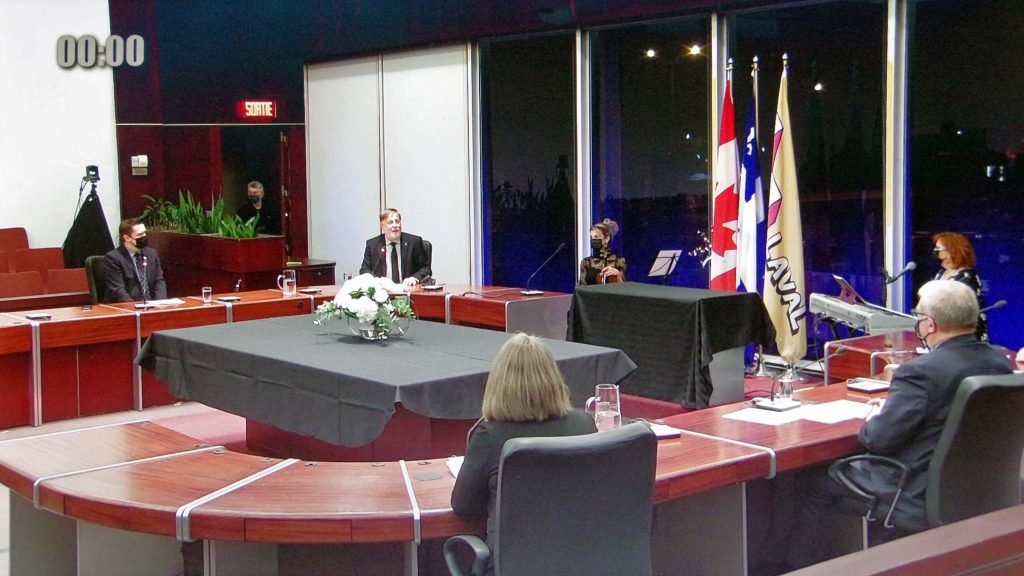
The lights inside Laval city council’s meeting chamber at city hall were kept on until daybreak, while spotlights outside city hall remained illuminated, as officials from the city gathered with their counterparts from the Quebec government and Laval’s health care agency to observe the first anniversary of the beginning of the COVID-19 pandemic.

Remembering the victims

During a webcast on March 11 from city hall, Mayor Marc Demers, Quebec cabinet minister Benoit Charette (who is Minister Responsible for the Laval Region), Director of Public Health for Laval Dr. Jean-Pierre Trépanier, CISSS de Laval CEO Christian Gagné and CHSLD Sainte Dorothée head nurse Mary-Sylvia Gédéon paid homage to the people from Laval who died of COVID-19 to that date.

“We take the time to gather here to reflect securely on the names of the 876 victims from Laval of the pandemic a well as their families,” said Demers.

Risked their health

“We are pausing to think of the caregivers, as well as the employees, and the volunteers with community groups who did great work on the frontline. We are thinking of you. We take off our hats to you. You did work that was essential, and this for more than a year while endangering and risking your own health.”

Charette noted that “far too many people left us far too quickly because of this virus. There is no way to avoid thinking of the families who in many cases were unable to experience their grief as they normally should. It is normal for people to have grief, but unfortunately many people’s lives were disrupted because of the circumstances.

Strength and endurance

“We never would have expected that a year later our daily lives would still be disrupted,” he added. “But as the Premier said a little earlier, Quebec and its people have shown incredible strength during this ordeal, and it allows us today to see some hope, whether it’s from the experience acquired over the past year, or from the increasing availability of the vaccine. We can, of course, hope that the worst is behind us, but we must still be aware of the lives that were interrupted and the lives that have been lost.”

A year ago, ‘an enemy arrived in our lives unannounced, unidentified, covertly and for the purpose of taking lives,’ said CHSLD Sainte-Dorothée head-nurse Mary-Sylvia Gédéon

Christian Gagné said that over the past year, the pandemic took an enormous toll on work at the CISSS de Laval, as well as on the lives of hundreds of people in Laval who suddenly found themselves in mourning. At the same time, he commended the many hundreds of health-care workers in Laval who put their lives on the line while struggling to deal with the pandemic.

Importance of compassion

“This has been a year when it was necessary to have compassion and, as citizens and colleagues, we must reorient our lives taking into account what we have been through,” said Gagné. “We will no longer be the same at the end of this pandemic.”

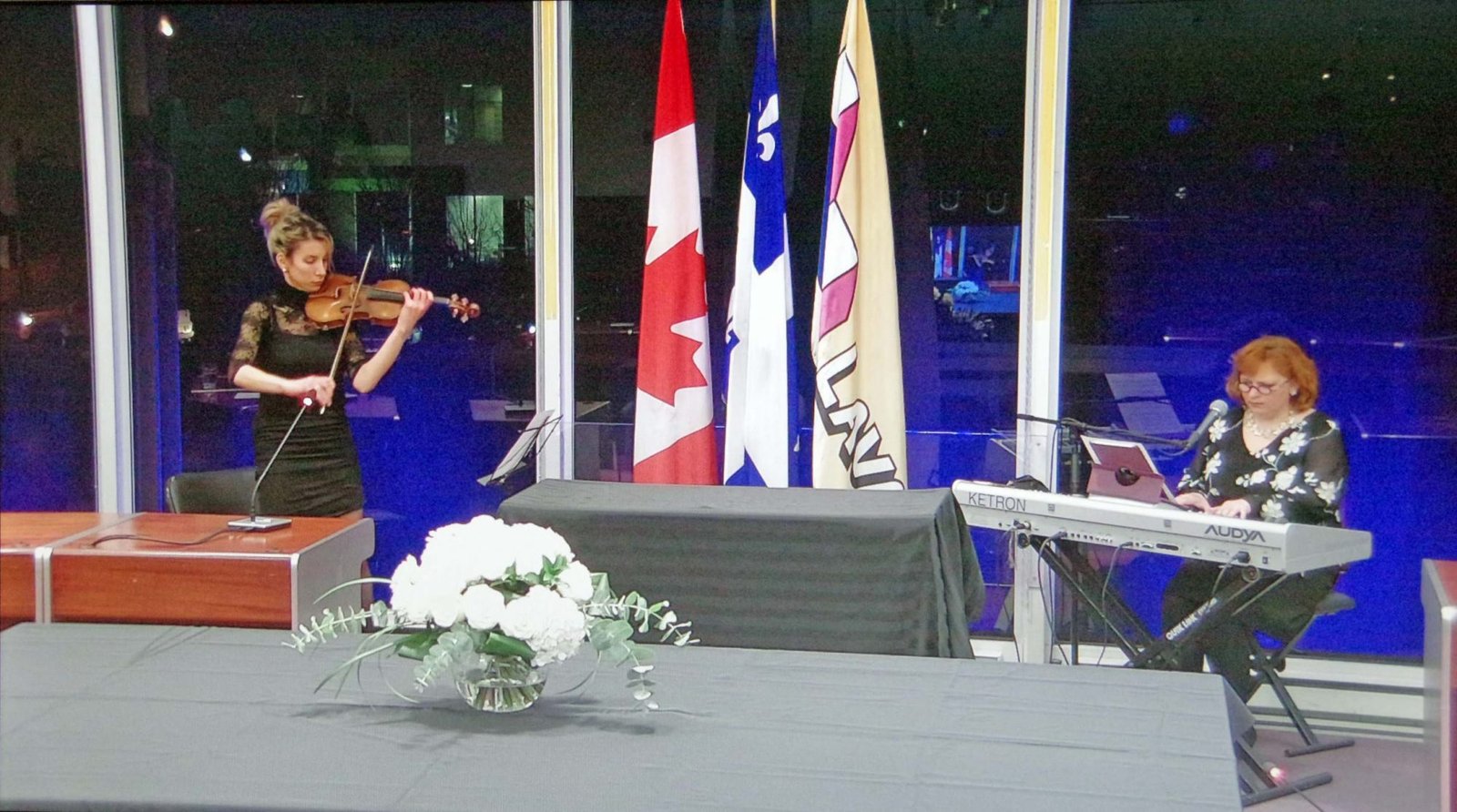
Left, Quebec Minister Responsible for Laval Benoit Charette, Mayor Marc Demers and others are seen here at Laval city hall during the recent ceremony to remember victims of the COVID-19 pandemic.

Mary-Sylvia Gédéon said, “I would like to express on behalf of all the staff in the health and social services network, and to all families impacted by this tragedy, all my heartfelt sympathy for the suffering and heartbreak they’ve endured, seeing their fathers, mothers, brothers and sisters leave without being able to hold their hand.

Impact on caregivers

“I, too, felt that suffering, that helplessness, when faced with the sudden death of several of your loved ones from this virus,” she continued. “This unscrupulous enemy tore loved ones away from you. For you they may have been parents. For us, they were residents to whom we felt attached profoundly.”

Gédéon said that March 2020, “the year, the month, the hours, the minutes and the seconds, will remain forever engraved in my memory. An enemy arrived in our lives unannounced, unidentified, covertly and for the purpose of taking lives. We knew nothing of him when he arrived, nor how he chose his victims or how he spread.”

Weather

Laval
clear sky
-9.3 ° C
-8.1 °
-11 °
67 %
1kmh
0 %
Sun
-1 °
Mon
-3 °
Tue
-6 °
Wed
-7 °
Thu
-8 °