Home Blog Page 147

AIPDP launches journal dedicated to improving global education

El-Khoury and Guertin praise Africa-focused movement for its efforts

Although the central African nation of Bénin is more than 4,000 miles from Canada on the other side of the Atlantic Ocean, the two countries were brought closer together by communications technology last week for the launch of a new educational studies journal, which has the support of a current and a former elected official from Laval.

The Canadian branch of the Association for Educational Innovation and Professional Development (AIPDP) held a Zoom web press conference on June 29 to launch the new journal, Passer des approaches d’enseignement d’hier à celles d’aujourd’hui et de demain.

Côte d’Ivoire and Bénin

Among the guests taking part virtually were Laval-Les Îles MP Fayçal El-Khoury, former City of Laval executive-committee member Jocelyne Guertin, government representatives from the Republic of Bénin and the Republic of Côte d’Ivoire, and a representative of Marc-Aurèle-Fortin MP Yves Robillard. Guertin is an active member of Montreal-based AIPDP Canada as a general councillor and advisor.

The AIPDP is made up of Quebec, Canadian, African and European professionals from the educational and related fields. The association says it offers an innovative development approach that allows today’s and tomorrow’s generations to be creative and to respond to the different realities that undermine the development of societies in general, although Africa in particular.

Professional members

The AIPDP has followers in Canada, in several African countries (Cameroon, Benin, Ivory Coast and Togo, among others) and on other continents. Because of the support it receives from professionals, the AIPDP says it has expertise in the analysis and restructuring of education systems in African countries, according to the standards of the competency-based approach (PCA).

“This gathering today marks an important step forward in the history of the association with the launch of its pedagogical journal,” said Guertin, while adding that the COVID-19 pandemic has drawn attention to the need for improvements in the primary and secondary levels of education.

COVID impact on schooling

She said the pandemic is depriving hundreds of millions of children around the world of formal schooling, and that the AIPDP has a role to play in solving this dilemma. At the same time, she noted that many problems involving gender equality in education remain unresolved and are an area the association might also explore for solutions.

El-Khoury, who has received political advice from Jocelyne Guertin during his election campaigns in Laval-Les Îles, praised Guertin for her skills in public relations and political strategy, while saying the AIPDP stands to greatly benefit from her presence in their organization.

Useful tool, El-Khoury said

“I have no doubt that through this important project, educators will have in their hands a useful tool to support them throughout their pedagogical mission,” he said regarding the new journal.

‘This journal aims essentially to activate, improve and enrich the teaching and learning practices through in-depth research and studies,’ El-Khoury said

“This journal aims essentially to activate, improve and enrich the teaching and learning practices through in-depth research and studies in order to build bridges while uniting and unifying teaching and learning methods all over the world.

“I would also like to add that this journal’s goal is to promote the presence of women in decision-making positions,” El-Khoury continued, “and to encourage them to insist on their rights while making a difference in their respective communities.

Role of women

“And there is something else I would also like to mention: I am proud to be a member of the federal Parliament, where women have a rightful place. We have a cabinet with parity where women have 50 per cent of the seats and a very important number of them had their beginnings in the House of Commons.

“And before closing, I would like with your permission to draw your attention to the fact that women, through your journal, are playing an important role in the fight against climate change and how to better protect our environment. With all that said, I wish that all of you can get all the benefits from this educational project. Let us with and hope that this project will become exemplary – an example to follow.”

Agape sees light at the end of the tunnel, after a challenging year

Chomedey social services provider plans expansion to Duvernay-Laval

“It’s been a tough year or two, to say the least,” Agape executive-director Kevin McLeod said at the beginning of the Chomedey-based social services organization’s annual general meeting on June 29, as he emphasized the challenges they’ve faced since the beginning of the COVID-19 pandemic around 17 months ago.

Rainbow in view

“The good news is that we can see the rainbow at the end of the tunnel – it’s looking good,” he added. According to Agape’s 2020-2021 report, the COVID 19 pandemic made community support stronger, given the emergency funding that was provided by numerous sources at different governmental levels.

However, there was a slight decrease in demand for food and other material assistance seeing that Agape was closed (except for its food bank) from March to July 2020, and potentially new resources started providing food assistance.

Christmas requests cut

Agape said it had to scale back requests for Christmas baskets in December 2020. All the same, some 400 were prepared. Those who did not qualify for Agape’s services were asked to register at the Centre de Bénévolat and Moisson Laval. McLeod said that surplus food donations have helped and will sustain Agape’s food bank for the remainder of 2021.

Since August 2020, 28 new individual and family client files were opened at Agape for assistance, of which 20 were retained. This represents 32 adults and 21 children. Among these, a total of five were single-parent families who were responsible for 5 children in total.

Fewer refugees as clients

Although Agape did not have as many refugees for clients as in recent years, they still served six new sponsored refugee families as well as one refugee-claimant family. As in the past, a large portion of families served represent those who were recent immigrants.

Seven countries were represented among the files that were opened during the 2020-2021 time period. Agape still served clients who opened files for assistance in previous years and the average ranged from 15-20 food orders per month, including basic non-perishable food items and frozen bread and pastries. Some families requested help 2-3 times per month.

Psychotherapy not being used

In an outline of some of Agape’s other activities, the annual report noted that a psychotherapy service offered within a mental health project conducted in conjunction with the CISSS de Laval “continues but has seen a slight decrease and continued decline in clients mainly because of a need for more promotion and reminding partners about the availability of this service. The counsellor was seeing about 2-3 clients in a given month throughout the year.”

According to the annual report, Agape agreed initially with its health partners that Agape would phase this part of the project out once the Quebec government implemented a public psychotherapy program that was announced in 2017, although “this project is not yet activated,” says Agape.

No PQPTM yet in Laval

With regards to planning for the same program in 2021-2022 (which is scheduled to end on March 31 in 2023), the annual report says, “The therapist is still available seeing that the public Psychotherapy program (PQPTM) is still not fully implemented, and is gradually being phased in, in different regions, but not yet in Laval.”

(On a Quebec health ministry website, the Québec Program for Mental Disorders: from Self-Care to Psychotherapy (PQPTM) is described as relying on “a range of services, including self-care, groups, professional support interventions or psychotherapy.” Once it has been deployed, the PQPTM will be available free of charge to all Quebec residents covered by the province’s public health insurance plan.)

Eastern satellite office

As previously announced in the Laval News, Agape will be hiring an additional project coordinator who will focus on community development in the eastern part of Laval. Through the secretariat for relations with Quebec English-speakers, Agape was offered funding for a three-year project that will mainly consist of continuing to represent the needs and priorities of Laval English-speakers.

Agape is contemplating opening its new satellite office somewhere near the Centre Duvernay shopping centre on de la Concorde Blvd. East

The project will also see Agape opening a satellite office in eastern Laval which will be used as a resource, activity and donation centre, although this might not be for several years. McLeod said the organization was contemplating opening the location somewhere near the Centre Duvernay shopping centre on de la Concorde Blvd. East, where the presence of several English-language schools indicates there is a significant English-speaking population.

Positive financials

Despite the enormous challenges presented by the pandemic over the past year-and-a-half, Agape’s financial picture for 2020-2021 is positive.

The organization’s total reported revenues for the period were $776,074, while expenses amounted to $751,245, leaving a surplus of $24,829. Provincial grants provided 37 per cent of revenue, while federal grants accounted for 43 per cent.

Twenty per cent of Agape’s revenues came from donations, self-financing, sales, rent revenues and other sources.

Laval News Volume 29-21

0

The current issue of the Laval News volume 29-21 published July 7th, 2021.
Covering Laval local news, politics, sports and our new section Mature Life.
(Click on the image to read the paper.)

Front page of the Laval News.
https://lavalnews.ca/wp-content/uploads/2021/07/TLN-29-21-WEB.pdfFront page of the Laval News, July 7th, 2021 issue.

Crash on Industriel Blvd. sends two to hospital

The Laval Police have opened an investigation into a car crash early last week that sent two people, both in their early 20s, to hospital after their vehicle violently struck the side of a building on Industriel Blvd in central Laval.

According to the LPD, the two sustained severe but non-life-threatening injuries in the crash. Their SUV had been travelling southward on Industriel Blvd. For reasons not yet understood, the vehicle suddenly jumped the median, crossed into the oncoming lane and crashed into the side of a building.

Although the vehicle caught fire following the collision, police say it was extinguished by firefighters who came to the scene, while the building itself sustained light damage. While the police say excessive speed was probably a factor leading to the collision, they have ruled out drugs or alcohol use as causes.

LPD seeks two suspects after Chomedey firearms incident

The Laval Police say they are seeking two suspects following a gunfire incident which took place in Chomedey on June 3.

The LPD is looking for Leslie Fosu, 19, and Jeremy Kahilu, 21, who are alleged to have fired shots from handguns at a vehicle in a restaurant parking lot.

Fosu is 5’11” tall and weighs 177 pounds, while Kahilu is 5’11” tall and weighs 155 pounds. Arrest warrants were issued for both of them. They face charges of possession of a prohibited weapon and pointing and firing a firearm.

In a press release, the LPD says Fosu and Kahilu pointed a handgun and fired more than one shot towards the other vehicle in which there were passengers at the time, although no one was injured.

The LPD has issued a warning that Fosu and Kahilu are considered dangerous as they are armed and only police officers should intervene.

Anyone who thinks they have information on the pair is asked to call the LPD’s special Info-Line at 450-662-INFO (4636) or 911. The file number is LVL 210603075.

As an aside, the LPD notes that it recently launched Projet Paradoxe following a noted increase in violence in Laval involving firearms. As a result, the force says residents can expect to see more police presence in places throughout Laval, such as parks and areas where there are businesses.

Laval election candidate rescues distressed plane pilot

A former Laval mayoralty candidate and current candidate for a city council seat had a key role recently in the rescue of an aircraft pilot whose light plane crashed following a failed takeoff from the Rivière des Prairies.

After seeing the plane fail in an attempt to take off from the river’s waters just off Sainte-Dorothée last week, Lydia Aboulian jumped on her personal watercraft and headed out towards the distressed aircraft.

Before heading out, Aboulian could see that the pilot didn’t seem to be getting out as the plane was sinking in the powerful current.

As she approached, she spotted the 73-year-old pilot, identified as Bernard Cardinald, partly submerged in the water.

After confirming that there was no one else aboard the sinking plane, she helped him out of the water and took him ashore. A Transportation Safety Board of Canada investigation has been launched into the accident.

QCGN highly critical of CAQ government’s Bill 96

Panelists suggest Trudeau’s support is motivated by ‘political calculation’

After more than a half-century of rising and falling tensions between Quebecers over the use of English and French, concerns are rising among stakeholders that some rights and protections Quebec anglophones fought for since the introduction of Bill 101 more than 40 years ago are threatened by Quebec’s proposed Bill 96 and changes to Ottawa’s Official Languages Act.

‘Our Place in Quebec’

On the evening of June 21 and the morning of June 22, the Quebec Community Groups Network hosted a policy webconference entitled ‘Our Place in Quebec and Canada.’ It brought together English-speaking Quebecers to discuss the rights of Canada’s official language minority communities as well as overall human rights.

The speakers and moderators included Minister of Official Languages and Economic Development Mélanie Joly, Sainte-Rose MNA Christopher Skeete, former Ahuntsic MP Eleni Bakopanos, former Liberal political advisor Warren Kinsella, and human rights lawyer and McGill University professor Pearl Eliadis.

‘Charter-free,’ says Jennings

“Bill 96 effectively creates a Charter-free zone with respect to a wide range of interactions between individuals and the state in Quebec,” QCGN president Marlene Jennings said in introductory remarks, referring to the Canadian and Quebec charters of rights.

She maintained that Bill 96, which some are now referring to as the new Bill 101, will make a major impact on areas of everyday life such as commerce, employment, education, access to public services, free expression and the operation of the province’s legal system.

Undermining the courts

“Where rights that would otherwise be protected are infringed, the courts under Bill 96 will not be able to review and remedy the conduct under either the Canadian or the Quebec Charters,” she said. “Further, this bill positions the Quebec Nation as holding collective rights, although these rights are not defined. And the bill places the National Assembly, not our courts, as the arbiter between these collective rights and individual human rights.”

Warren Kinsella suggested that both the provincial and federal governments were motivated by political expediencies to propose Bill 96 and changes to the Official Languages Act respectively at this particular time.

“[Premier François Legault] was aided and abetted in that regard by Prime Minister Trudeau, who in my opinion is seeking seats in the province of Quebec at the expense of not just the federation, but also the anglophone minority in the province of Quebec and to hell with the consequences,” Kinsella said, alluding to a possible snap election being called by the Trudeau government this fall.

Courting Quebec’s votes

Pearl Eliadis agreed. “I completely agree that Prime Minister Trudeau is courting Quebec votes. And given the timing, his initial response of, you know, ‘there’s not much to see here folks, let’s move on,’ I think is a political calculation,” she said.

Kinsella pointed out that at 100 pages in length, Bill 96 contains “some extraordinary provisions,” just one of which would be the ability of Quebec’s language police to enter business premises and “demand that you hand over your cell phone in order to determine whether an insufficient amount of French has been communicated on it. You know, accessing private messages with individuals and personal information. It’s just extraordinary. It is, in my view, completely unconstitutional.”

Right of seizure in Bill 96

Eliadis said that up to 1982 in Canada, federal police authorities could be conferred with extraordinary power through a Writ of Assistance, which allowed them to enter homes and businesses and seize whatever they wished without any prior judicial authorization such as a warrant.

‘Where rights that would otherwise be protected are infringed, the courts under Bill 96 will not be able to review and remedy the conduct under either the Canadian or the Quebec Charters,’ said QCGN president Marlene Jennings

While noting that the Canadian Charter of Rights and Freedoms came into force in 1982 and put an end to this when it declared Canadians have a right to be free of unreasonable search and seizure, Eliadis said Bill 96 “does not require any prior judicial authorization for any form of search and seizures. I mean, that is only one of the many measures.”

Who is a Quebecer?

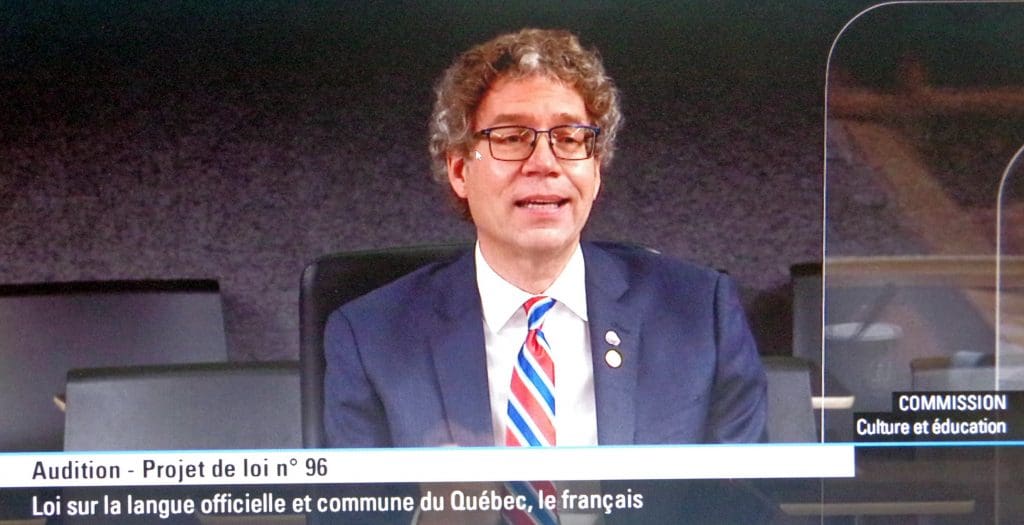
On day two of the conference, federal Official Languages Minister Mélanie Joly and Sainte-Rose MNA Christopher Skeete who is responsible for English-language community relations in the CAQ government, vigorously defended the proposed language reforms, without declaring much more than what they’d previously said.

While Skeete maintained he had no time to answer questions as he had to be at another engagement, Bakopanos asked him to define who is included in the Quebec Nation.

“I hear that question a lot – we’re all Quebecers,” he replied without further elaboration. “I don’t think a lot of the members of the English-speaking community feel that way,” Bakopanos responded.

Anglo ‘Task Force’ ready to tackle Bill 96, Bill C-32 language issues

They maintain Bill C-32 will establish ‘asymmetrical bilingualism’

In the wake of the Quebec government’s planned language law reform, a group of English-speaking Quebecers who say they are “from all walks of life” has emerged “to defend individual and language rights and cease attacks on the freedoms of all Quebecers and their institutions,” says the group.

“The ‘White Paper’ and Bill C-32, Bill 96 and the proposed Constitutional amendment, taken as a whole, are a fundamental restructuring of the Canadian constitution, language policy and our basic human rights and freedoms,” says Colin Standish of Cowansville, founder of Language Equality/Égalité linguistique, while adding they “will fervently oppose Bill 96’s excesses.”

Over 200 amendments

Like other critics of the CAQ government’s proposed language law reform, the Task Force maintains that Bill 96 contains over 200 amendments, including vast search and seizure measures, restrictions on who is entitled to receive government services in the language of their choice, a cap on English CEGEP enrolment, and a false definition of who qualifies as a member of Quebec’s English-speaking community.

They say Bill 96 also seeks to eliminate the bilingualism of more than 50 of the 89 bilingual-status municipalities across Quebec, and effectively “deinstitutionalizes the English language and its speakers in Quebec.” They say the Task Force was formed when members recognized that they were being abandoned by the major political parties in Quebec’s legislature and in the federal Parliament.

Asymmetrical bilingualism’

The group maintains that the Trudeau government’s Bill C-32 proposes changes to the Official Languages Act that will establish asymmetrical bilingualism – a unilingual French Quebec and a bilingual rest of Canada – by placing the status of the French language ahead of the promotion of bilingualism, the protection of linguistic minorities and access to public services and justice.

They claim Bill C-32 will also extend French-preferential laws to federally regulated businesses across Canada and entrench flawed provincial language laws in federal legislation nationwide.

An unconstitutional rewrite

“Bill 96 intends to unilaterally and unconstitutionally rewrite the Canadian constitution,” says the Task Force. “It declares that Quebecers form a nation, with French the common and only official language of Quebec, and boldly proclaims the ‘Quebec nation.’

“This would reshape and distort the Canadian Constitution. The proposed amendment cannot be passed unilaterally by Quebec. Furthermore, Bill 96 is shielded by the notwithstanding clauses of the Canadian and Quebec Charters to prevent judicial scrutiny.”

The Task Force says it believes that the only truly threatened languages and cultures throughout Quebec and Canada are those of Indigenous peoples. They are appealing to more community leaders from across Quebec, from all backgrounds, to join the Task Force.

EP’s Henderson on board

A number of former and newly-awakened Quebec anglophone rights activists have waded into the growing language controversy and have stated their support for the Task Force.

“The Canadian Constitution is the bedrock of our civil liberties and national unity,” says former Equality Party leader Keith Henderson. “We cannot allow it to be adulterated by the excesses of a Quebec government hellbent on violating our unity and freedoms.”

“The unconstitutional aspects of the Bill are flagrant, and extend far beyond the amendment,” says Brent Tyler, a constitutional lawyer and veteran of numerous court challenges involving Bill 101. “The Quebec government is seizing jurisdiction over federally regulated trademarks and workplaces. That’s not allowed, period.”

‘We are all Quebecers’

“We are all Quebecers,” says Andrew Caddell, a former Canadian diplomat and journalist. “We must be treated equally before the law. There are no groups more important than others. Rights and freedoms are not negotiable. We can fight back, but we need people of good faith to pitch in.”

“If Bill 96 and C-32 are adopted there is no guarantee that parents of students in English schools will receive information and services in English,” says Marcus Tabachnick, former chairman of the Lester B. Pearson School Board.

Sonia Baudelot drops out of City of Laval’s mayoralty race

Action Laval set to announce new contender four months from election date

With four months to go before voters in Laval head to the polls for a municipal election, the Action Laval opposition party dropped a bombshell late last week with the announcement that their mayoralty candidate, Sonia Baudelot, has decided to pull out of the race.

Action Laval president Archie Cifelli said the party’s executive-committee met with Baudelot and that both sides had reached a mutual agreement she should withdraw.

A statement by the party suggested that Baudelot felt it had become impossible for her to live up to her family responsibilities and run for mayor simultaneously.

New candidate TBA

“We wish her success in her other endeavours,” said Cifelli. “Our candidates are out there on the terrain meeting with the citizens.”

Sonia Baudelot, who was leading Action Laval towards the November 2021 municipal elections as its mayoralty candidate, has decided to drop out of the race. (Photo: Martin C. Barry, Newsfirst Multimedia)

This week, Action Laval announced that Sophie Trottier, a provincial government civil servant who worked at the Office québécois de la langue française, is now Action Laval’s mayoralty candidate.

In Chomedey, where city councillor Aglaia Revelakis regularly wins the district for Action Laval with overwhelming voter support, Revelakis said in an interview that she remains determined to see that Action Laval become Laval’s next administration on election day.

“I just want all our supporters to know that Action Laval is very much still here and we’re running in the upcoming election,” she said.

Boyer tables report for city’s post-COVID recovery

Laval deputy-mayor and executive-committee vice-president Stéphane Boyer recently tabled the third of a series of reports on public consultations for the city’s post-COVID economic recovery. The latest report focuses on social solidarity.

During the consultation, Boyer, who was mandated by Mayor Marc Demers to oversee the consultation, met representatives of more than 50 community organizations, leading to recommendations based on their feedback.

“What struck me the most during these meetings was the extraordinary resilience shown by the volunteers and employees at these organizations who provide help to our most vulnerable fellow-citizens,” said Boyer.

The report focuses on four areas: improving accessibility to services, contributing to the development of the community, improving the expertise of organizations in Laval, and expanding community infrastructures.

The report contains 15 recommendations, some of which can be implemented in the short term, others in the medium and longer terms.

Among the recommendations is that the city should create a comprehensive platform for leisure activities registration, that it should provide financial assistance to low-income families for their children to take part in sports, and that the city should provide financial help to organizations to train volunteers.

Setting off fireworks in Laval is illegal

In as much as fireworks are openly available and can be purchased at many stores in Laval, the city is issuing a warning on the eve of Canada Day that setting off fireworks anywhere within the municipality’s limits is strictly forbidden, unless you have a permit from the Laval Fire Department.

The city maintains that using fireworks carries major risks, including injuries, for users as well as for spectators, while at the same time raising risks of setting buildings and other property on fire when fireworks are misused.

Additional information on legitimate fireworks use and on how to obtain a license can be found on the city’s website (www.laval.ca). The Laval Fire Department can also be reached by phone for emergencies by calling 9-1-1, or at 450 662-4450 for information on fire prevention.

City tightens security at Berge aux Quatre-Vents

The city is reminding residents who may sometimes be dropping by the Berge aux Quatre-Vents park and beach in Laval-Ouest that it is located in a quiet residential area and that certain rules should be followed out of respect for those who live nearby.

According to the city, this comes following a recent surge in the number of people spending time at the green space since the beginning of the summer. As a result, city officials say that security will be tighter than usual.

Here are some points (as set out in city by-law L-4510) concerning order, security and hours of operation in public parks:

  • Swimming (as defined in art. 6.09);
  • Drinking of alcoholic beverages (as defined in art. 6.05);
  • Use of loudspeakers for playing music (as defined in art. 6.15);
  • Lighting of campfires (as defined in art. 6.13).

The city notes that the use of marijuana remains illegal in all of Laval’s parks, and that the Berge aux Quatre-Vents is open only from 7 am to 10 pm as are all other public parks in Laval.

Sainte-Rose MNA Skeete announces $2.7 million in funding for Senior Wellness Centres

Chomedey’s Agape Senior Wellness Centre to receive up to $160,000 over three years

The Chomedey-based Agape Senior Wellness Centre is one of several dozen existing and planned wellness centres across Quebec which will be receiving $2.7 million in provincial government financial assistance that was announced last week by Sainte-Rose MNA Christopher Skeete, parliamentary assistant to Quebec’s Premier with responsibility for relations with English-speaking Quebecers.

According to a press release issued on June 21 by the Secretariat for Relations with English-Speaking Quebecers, the money is being provided over a three-year period to the Community Health and Social Services Network (CHSSN) to implement a program that will reduce social isolation for vulnerable English-speaking seniors.

Wellness centre model

Modelled on an existing plan for day centres for seniors, Senior Wellness Centres offer a variety of activities, services and educational programming to promote physical and psychological health and prevent health problems among seniors whose housing needs are already being met. The centres’ offerings include physical activities, nutrition workshops and educational sessions on legal issues and access to care.

“The Community Health and Social Services Network is delighted that the government of Quebec has announced its financial support to ensure the sustainability of the existing Wellness Centres for English-speaking seniors and to establish new centres of this kind throughout the province,” Jennifer Johnson, executive-director of the Quebec City-based CHSSN, said during a webcast announcement last week.

A community approach

“This initiative, with its innovative, cost-effective, community-based approach to breaking down isolation among seniors, builds on the rich history of volunteerism in Quebec’s English-speaking community. The network is ready to take this initiative under its wing and to contribute all its expertise to ensure that these investments succeed.”

Sainte-Rose MNA Christopher Skeete, parliamentary assistant to the Quebec Premier with responsibility for relations with English-speaking Quebecers, announces the $2.7 million in funding for Senior Wellness Centres, with CHSSN executive-director Jennifer Johnson on the right.

“With a much lower rate of bilingualism than other age groups, English-speaking seniors are among the most vulnerable people in Québec society, and the COVID-19 pandemic has made them only more vulnerable,” said Skeete. “With its varied offering focused on prevention, the Senior Wellness Centres program will enable English-speaking Quebecers to receive suitable care and services and thus alleviate their needs in this regard.”

An aging English population

The secretariat says the investment will strengthen the program’s funding in the 43 existing wellness centres across the province, while supporting the program’s implementation at 32 new centres in Quebec regions where access to services is limited, including Gaspésie, Côte-Nord and certain areas of Estrie and Outaouais.

The secretariat notes that more than a quarter of all English-speaking Quebecers are now age 55 or older, and many are especially isolated and vulnerable and have major needs for health and social services.

The secretariat says the funding will help to achieve four main goals: keeping the Senior Wellness Centres program sustainable, extending its coverage to areas of Quebec that are less well served, increasing the centres’ capacity so that they can serve more seniors, and ensuring the deployment and coordination of new and existing centres.

Funding over three years

Kevin McLeod, executive-director of the Youth and Parents AGAPE Association Inc., said the Agape Senior Wellness Centre will be receiving $45,000 for 2020-2021, $45,000 for 2021-2022, and $70,000 for 2022-2023 (the latter figure being contingent on developing a program for seniors in the eastern part of Laval). According to McLeod, the funds will be managed by the CHSSN “with all their experience,” he said.

“Together, with the CHSSN and many other English-speaking organizations across Quebec, Agape has been working with the Quebec government for several years now to fund these much-needed senior wellness centres,” said McLeod, noting that Agape’s efforts to open an SWC started back in March of 2017 and continued through 2019, including a consultation, hosted by Agape, that was held by Christopher Skeete and the Secretariat for relations with English-speaking Quebecers in Laval in October of 2019.

Shared vision of SWCs

McLeod said Agape had opened a smaller version of the SWC in March 2018 with the help of Mille-Îles MNA Francine Charbonneau who was then Minister for Seniors, and MNA Guy Ouellette with help from “Québec Ami des Ainés” program funding. This sustained the centre until March 2020.

With the CHSSN and many other English-speaking organizations across Quebec, Agape has been working with the Quebec government for several years now to fund the much-needed senior wellness centres

“For the last year, we have been sustaining our centre with the help of personal ‘MNA funding’ from Guy Ouellette and Christopher Skeete,” added McLeod. “We have also had financial support from Desjardins Caisse de Chomedey and city councillor for Chomedey Aglaia Revelakis. In 2021 we’re so happy that the Quebec government shares our vision for these SWC’s.

Sources of funding

“Their funding will cover many activities that are related to health and wellness such as presentations, exercise, drama therapy and iPad courses. But know that we are still counting on other funding sources and supporters, such as CHSSN/Health Canada, Canadian Heritage, Guy Ouellette, Christopher Skeete, The Laval News, Desjardins Caisse de Chomedey, Aglaia Revelakis and membership fees which will help pay for activities, workshops, courses and clubs.”

McLeod said that through the pandemic, the Agape Senior Wellness Centre contact list of seniors doubled from 350 to 700 English-speaking seniors. “These are exciting times,” he noted. “We estimate that yearly costs to operate this big centre including salaries, rent and all of its many activities will require over $140,000 per year. With everything now in place, we expect to re-open the bigger and improved Agape English-speaking Senior Wellness Centre in August 2021.

Oh! My! Canada! Your Canada! Our Canada, despite the challenges, is still worth it!

Should Canada Day be a point of celebration? Or a day of mourning and somber reflection?

With the recent discovery of 215 Indigenous children’s remains near a residential school in Kamloops, B.C., and another recent ghastly discovery of 751 unmarked graves at a former residential school in Saskatchewan, the recent deadly attack against a Muslim family in London, Ontario, the Italian Internment apology from Trudeau coming only too late but better than nothing, Black lives, Migrant lives, Women and Trans, men and Trans – should debate be brewing over whether it is appropriate to hold Canada Day celebrations this year?

This is a challenging moment as a Canadian nation. How can we celebrate Canada’s violent history on July 1st? Canada Day needs to turn into a day of mourning, not celebration. Canada Day almost needs to be cancelled in the way we celebrate it today, the way we observe Canada Day as this day of pride. We’re Canadians, and we’re not better than the rest of the world.

It’s starting to stink and sink. We now know that’s not true at all. That past is very much connected to the present. The history of oppression, colonization and genocide, is just reflected in different areas, like the overrepresentation of Indigenous children in foster care, and of Indigenous people in the prison system.

We’re in an ugly moment in Canada. With this disgusting face of ours, how can we on Canada Day stand up and celebrate who we are? The only way to move forward is if we turn Canada Day into a day of remembrance.

In fact, it should be the Day of Reconciliation, a day to be solemn and sad and spread awareness about the existing inequalities. Canada Day is a powerful way to educate our Canadian citizens. It is something how immigrants did survive and held on to what we have. They paid greatly for the existence of what is now called Canada. This is where acknowledgment of Canada’s true history can be brought to light showing that there needs to be a new way of thinking.

We need to stop and not celebrate because there are so many things we need to fix before celebrating Canada. As Canada prepares to celebrate its 154th birthday, we should be interested in understanding how current conversations, including those about reconciliation and multiculturalism, intersect with the myth of the vanishing Indian and all nationalities.

In precisely this way, the legal foundation of Canada is built on the premise that Indians do not exist as people. The state has a strong interest in upholding this lie: its legitimacy – its very existence – depends on it.

Canada as a nation was therefore born out of a tenuous balancing act. On the one hand the new state denied Indian personhood; on the other its founding acts acknowledge our problematic (for Canada) existence. The preoccupation of the state – Canada’s attempt to reconcile its original contradiction.

And really, where do you even start to celebrate? Do you invite the kid you’ve been bullying for 154 years, expecting a present and a pat on the back for being so thoughtful? When the kid arrives, do you pretend like nothing ever happened? Do you apologize?

The bullying, as I call it, has been going on for nearly 500 years, starting with Jacques Cartier’s kidnapping of Chief Donnacona of the St-Lawrence Iroqouis, and two of his sons, Domagaya and Taignoagny, from the village of Stadacona. Cartier took them to France in May of 1536. Donnacona never made it back to the St-Lawrence, dying in France in 1539.

And what do you expect in return? It’s a birthday, after all – it’s a party. It would be very unkind of your guest not to accept an apology and eat some cake. If you’re going to be a spoilsport, maybe you just shouldn’t have come.

The prime minister, Justin Trudeau, recently reopened bitter memories for Italian Canadians with a formal apology for what many consider a longstanding injustice: the detention and internment of hundreds of Italian Canadians whose lives were thrown into chaos during World War 2.

For decades, the Italian community had called on the government to recognize that it acted improperly when it detained hundreds of Italian Canadians, some of whom were Canadian citizens. In total, 634 men were picked up by the police. Other nationalities were also treated unkindly.

We must celebrate even what immigrants of the last 154 years have achieved. We must accept that the mistakes were made, but now is the time to sit down and talk about it and reconcile and make sure that every ceremony, everywhere we go we acknowledge the people of this land and all those who contributed in making Canada t the great country it is.

And Canada is what? In your view or perception? Maybe it isn’t as racist, oppressive, evil, irredeemable, and unworthy of celebrating its 500 years of European influence and 154 years of existence as a united political entity as some would like you to believe.

We need Canada to give us something to celebrate on marking our 154th birthday. We need people to go into July 1st and beyond — eyes wide open accepting our reality and who we are as a country. But it’s also a time to recommit– a time to re-energize and to care.

Happy Canada Day to all Canadians — thanking Canada for our home and native land.

Renata Isoporenata@newsfirst.ca

Pfizer, Moderna or a Habs Vaccine?

The only void in these series is RDS’s Pierre Houde “..et c’est le buuuuut”, as well as his impeccable and accurate use of the French language. This ridiculous contract with the NHL, only allows Houde and ‘les boys’ to broadcast 60 (41) Canadiens games per season under the 12-year deal. The rest are blacked out. Houde is part of the Habs family and he is not there for this spectacular climb. So sad. But otherwise…

How about those Habs! Can you not think of a better vaccine for us? For the first time in a quarter century, we are this close to hoisting Lord Stanley’s silver chalice. Yvan Cournoyer nailed it in his pre game broadcast taped appearance prior to the Habs 6th game against the Vegas Golden Knights. After this pandemic, its multiple restrictions, so many of us stuck indoors, these series are not only a phenomenal uplifting for the province, but the best vaccine, not for the body but for my head space. We’re alive again! The results are making us so happy. Demolishing the Maple Leafs, sweeping the Jets from Winnipeg, and then defeating the team so many broadcasters predicted would win the Cup, the Vegas Golden Knights. In the words of Jackie Gleason, “how sweet it is”.

Is it because we did so poorly during the regular abbreviated 56 game series? Is it because we were able to clinch a playoff spot by only one point? Is it because our expectations were so low? Is that the reason for such explosive excitement today? Call it serotonin, call it dopamine, we are experiencing euphoria, and the best may be yet to come.

“Happiness is associated with reduced neuroendocrine, inflammatory and cardiovascular activity” -The National Academy of Science. Aside from promoting a healthy lifestyle, happiness, such as the Habs have been delivering since the series against Toronto began, some scientific journals claim “happiness may even increase your life expectancy.”

And this is much more than happiness. Beating all odds, three times in a row, when none of the well-known broadcasters predicted the Habs would beat any of these teams. Did the Golden Knights’ Mark Stone actually say the series against the Habs “…will be like playing an AHL team, 4 easy wins”? Did a bunch of Leaf players really LOL when Quebec presumed the Habs would be alive after 5 games, and announced 25 hundred fans would be allowed at the Bell Center for game six? Total underdogs. Maybe that’s why it’s jubilation, cloud nine, rapturous, ecstasy! Maybe even a bit of good sportsmanship revenge.

Add to this, the elevation of Carey Price to some kind of God like figure. Even Chris Cuthbert and his colour commentator were forced to conclude several times during the games’ broadcasts, that opposing players’ shots were missing the net because they were in awe of Price. They know Price will make the save, unless the puck is perfectly launched and placed, leading to so many misses.

A stand-up goalie seems to be a must.

It was with Ken Dryden, who won so many trophies, he became the most decorated goalie of the 70’s winning 6 Stanley Cups between 1971 and 1979. And certainly with Patrick Roy. Roy was stopping the unstoppable when the Habs won their 23rd and 24th Stanley Cup in 1986 and 1993. He won the Conn Smythe trophy for the Most Valuable player in the post-season in his rookie year (1986), and won the Conn Smythe again in ‘93. Four games to one win in both series. The first against Calgary, the second against Wayne Gretsky’s L.A. Kings.

And the current Habs penalty kill has to be mentioned as a vital ingredient of a winning team. Says TSN’s Travis Yost “This is the best penalty-killing unit we have seen in the postseason in the Real-Time Scoring System era”

True, it’s not the miracle fix of a Pfizer or Moderna, but a Habs vaccine sure makes us feel good, very good, and an immense relief, after such a long, frustrating, stressful pandemic journey.

What a difference a summer makes. I don’t even want to think about life a summer ago, neither do you, I’m sure. But it’s a new world. Armed with at least one if not a double vaccine, please remain cautious. And now with a Habs vaccine, enjoy this brand-new summer, the summer of ’21.

Thank you, merci, Montreal Canadiens!

That’s what I’m Thinking

Robert Vairo

robert@newsfirst.ca

Weather

Laval
overcast clouds
3.8 ° C
3.8 °
3.8 °
38 %
3.4kmh
100 %
Tue
9 °
Wed
8 °
Thu
11 °
Fri
10 °
Sat
14 °