The current issue of the Laval News, volume 30-14, published on May 4th, 2022.
Covering Laval local news, politics, sports, and our new section Mature Life.
(Click on the image to read the paper.)

The current issue of the Laval News, volume 30-14, published on May 4th, 2022.
Covering Laval local news, politics, sports, and our new section Mature Life.
(Click on the image to read the paper.)


Prime Minister Justin Trudeau issued the following statement Friday afternoon following the death of former Montreal Canadiens hockey legend Guy Lafleur.
“I was saddened to hear of the passing of hockey legend, Guy Lafleur,” Trudeau said. “He was unlike anyone else on the ice – his speed, skill, and scoring were hard to believe.

“Throughout the 1970s and 1980s, Mr. Lafleur enthralled fans across the country and throughout North America in the old Montreal Forum, winning five Stanley Cup championships while playing with the Montreal Canadiens. He went on to play with the New York Rangers and Quebec Nordiques, becoming only the second player to play in the National Hockey League after induction into the Hockey Hall of Fame.
“As a child, Mr. Lafleur loved the game so much that he would sleep in his hockey equipment so that he could jump on the rink as soon as he woke up. Later in life, his impressive shot and skating prowess earned him the nickname le ‘Démon blond’, and won his adversaries’ admiration, winning him three Lester B. Pearson Awards for most outstanding player, as decided by fellow players. To this day, he remains the all-time points leader of all those who have worn ‘la Sainte-Flanelle’ of the 24-time Stanley Cup champion Montreal Canadiens.
“In 1980, Mr. Lafleur was appointed an Officer of the Order of Canada. He was also inducted into Canada’s Sports Hall of Fame in 1996, and appointed a Knight of the Ordre national du Québec in 2005.
“On behalf of all Canadians, Sophie and I wish to express our deepest sympathies to Guy Lafleur’s family and friends. My thoughts are with all who are mourning this tremendous loss – in Quebec, across Canada, and around the world. We’ll miss you, Number 10.”

Saying that she wanted to send out a warning to potential sexual predators, a judge last week sentenced a male massage therapist from Laval to seven years imprisonment and a lifetime on a list of sexual offenders.

In sentencing Jean-François Morrison, age 41, at the Laval courthouse on April 15, Quebec Court judge Sandra Blanchard followed a recommendation made by the prosecution that the accused be given a sentence that would be “severe” as well as “exemplary.”
Morrison was found guilty in February of sexually assaulting 20 women between 2015 and 2018, most of whom were massage clients. According to evidence presented during his trial, he had also posted a compromising photo on Facebook of another woman without her permission.
In a pre-sentencing report, the judge called Morrison a “predator” who lied about his qualifications as a massage therapist and who manipulated his clients.
Prosecutor Stéphanie Gilbert said the Crown felt it was necessary to send out a warning message to anyone who might feel tempted to act as Morrison did towards his victims – at least one of which was under the influence of alcohol or drugs when assaulted.
Statements heard in sexual assault by woman on boy
Impact statements were heard last week at the Laval courthouse in a case involving a 43-year-old woman who pleaded guilty last year to sexually assaulting an eight-year-old boy she had been hired to improve his grade-school marks.
According to a statement taken from the boy, he now suffers from insomnia, nightmares, learning difficulties, and obsessive-compulsive disorders, as a result of the sexual abuse by the woman, identified as Josianne Lévesque.

After two years, the boy decided to tell his mother what was going on, even though, according to testimony, Lévesque warned him that she could go to jail if he were to tell anyone about their relationship.
Lévesque had been the boy’s school teacher at a Montreal-area private school the year before the abuse started. She was later hired by the parents as an academic tutor for their son over a period of 17 months, according to evidence heard by Judge Serge Cimon.
Lévesque is scheduled to be sentenced in May. The prosecution is seeking a jail sentence of two years or more.

The United Brotherhood of Carpenters (UBC) held its 2022 Tax Fraud Days of Action (April 11-16) last week to raise awareness among Canadians about construction industry tax fraud.
The Winnipeg-headquartered UBC is not alone in complaining about the construction industry tax fraud phenomenon.
Construction tax fraud
In Canada, government taxation authorities at the federal and provincial levels have maintained for years that the highest levels of tax evasion and tax fraud they deal with take place consistently within the construction industry sector.
“The underground economy is thriving in Canada, especially in the construction industry, stealing billions of dollars every year,” says Jason Rowe, vice-president of the UBC’s Canadian district. “Tax fraud is robbing honest and hardworking Canadians and their families of the services they have worked for and deserve,” he maintains.
Evading responsibilities
The UBC says communities and Canadians suffer as funding for essential programs and infrastructure is lost to dishonest contractors who operate in the underground economy, while evading their tax responsibilities and breaking the law.
They say dishonest employers also intentionally misclassify workers as independent contractors or pay them in cash to ensure workers do not appear on official employer payroll records and are not covered by employment insurance and workers compensation.
According to the UBC, when employers shift their tax burden onto their employees, the employees are forced to pay their employer’s employment taxes, which places a substantial financial burden on working families.
Honest firms can’t compete
The UBC says construction industry tax fraud also punishes honest, fair-minded construction firms that cannot compete with fraudulent labour costs.
Statistics Canada says the underground economy accounted for $61.2 billion in economic activity in 2018 and that the most significant slice of Canada’s underground economy activity in 2018 was in the residential construction industry (26.2 percent or $16 billion).
The United Brotherhood of Carpenters points out that this represents billions of dollars in lost tax revenue that would otherwise be used to repair roads, bridges, schools, care for veterans, and fund other essential public programs.
Statistics Canada defines the underground economy as consisting of market-based economic activities, whether legal or illegal, that escape measurement because of their hidden, illegal or informal nature.
Impact on the economy
According to figures released by the federal agency in late 2020, the estimated gross domestic product (GDP) at market prices for overall underground economic activity in Canada reached $61.2 billion, or 2.7% of total GDP, in 2018.
The underground economy is thriving in Canada, especially in the construction industry
UBC’s Jason Rowe
However, the agency goes on to say that the Canadian underground economy decreased 0.8% in real terms in 2018 on a year-over-year basis, compared with a year-over-year growth of 1.9% in 2017.
Although the underground economy data published nearly two years ago pre-dated the COVID-19 pandemic, they provided an important benchmark to measure the full effect of the pandemic on the Canadian economy.
Residential construction
In 2018, four industries accounted for more than half of underground economic activity: residential construction (26.2%), retail trade (12.3%), finance, insurance, real estate, rental and leasing and holding companies (10.3%), and accommodation and food services (9.1%). These industries have been the main contributors to underground economic activity in Canada since this study began in 1992.
Wages and undeclared tips Of the $61.2 billion in unreported income in 2018, the largest share went to employees (42.4%) in the form of labour compensation. Wages that are not accounted for in payroll records and tips on undeclared transactions were $26.0 billion, equivalent to 2.3% of official compensation of employees.
The remaining portion of underground income went to unincorporated business owners (28.6%) and incorporated business owners (26.1%).

Canadian Space Agency astronaut Jeremy Hansen joined students from across Canada last week for ‘Let’s Talk Lunar: Exploring the Moon,’ a virtual event organized by Let’s Talk Science.
Canada’s space mission
Hansen was selected to join the CSA in the 2009 CSA selection of future Canadian astronauts. Let’s Talk Science, a non-profit educational venture, focuses on education and skills development for children and youth in Canada through science, technology, engineering and math (STEM) based programs.

During the 90-minute event on April 2, done in conjunction with the CSA, Hansen talked to more than 1,000 students from grades 9 to 12 about lunar exploration, including Canada’s role in the Artemis program, the Lunar Gateway and how astronauts are preparing for missions to the Moon.
Lunar Gateway project
Just as Canada has been participating for decades along with other countries in supporting the International Space Station (ISS) which is in low Earth orbit, Canada is also participating in the planned Lunar Gateway, another space station that will be placed in lunar orbit.
The current goal is to land humans on the Moon by 2024. The last time we were on the Moon was in December 1972, when the U.S.-sponsored National Aeronautics and Space Administration (NASA) led the final mission of its Moon exploration program with Apollo 17.
Moon secrets revealed
“We learned a lot about the Moon in the late ‘60s and early ‘70s, but we have a lot more to learn,” said Hansen, adding that when the Moon was explored that last time, it was only around the equatorial region. However, now because of improvements in technology, astronauts will be able to reach other locations, including shadowed craters and the Moon’s south pole because trapped water-ice is believed to be located there.
“We need to go back,” he said. “We want to learn more about the Moon to figure out where we can build bases in the future, where we can get resources to help us explore. We want to learn more about the geology of the Moon and how we can leverage that geology.”
We learned a lot about the Moon in the late ‘60s and early ‘70s, but we have a lot more to learn
Tech advances in space
So, even though humans are returning to the Moon, Hansen said the technical advances made over the past 50 years are such that robotics will be playing an immensely more important role in the coming Moon mission.
“This human/robotic collaboration is super-important,” he said, noting the important contribution Canada made in the past to space exploration programs with development of the Canadarm1 robotic arm deployed on the Space Shuttle beginning in the early 1980s, followed by Canadarm2 in 2001 on the ISS, and Canadarm3 which will be fitted to the Lunar Gateway.
Goals important

Hansen said that if there was one thing he hoped the web conference’s participants would take away, it would be the importance of setting goals. “I don’t necessarily want you to desire being a space explorer, but I want you to set goals. Short-term goals, long-term goals, to understand that if you set goals and share those goals with others, people will enable you to accomplish amazing things.”
Hansen said that as a youth, he wanted to be a space explorer. “But I didn’t get here because I was special or better than others. I got here because I was surrounded by people who lifted me up. And that’s exactly what’s happening with our program today: we set big goals and the team is coming together and we are accomplishing incredible things.”

Laval-area officials from the federal, provincial and municipal governments gathered with local community representatives last week on Dumouchel Ave. in central Laval to mark the start of work on the new Avenir de femmes housing project, which is being led by the Bureau d’aide et d’assistance familiale Place Saint-Martin.
A three-way deal
The 23-unit building has been designed for low-income single mothers in Laval. The project represents a total investment of more than $10.1 million from the three levels of government.
“This project marks a new era for the Place Saint-Martin neighbourhood,” said Martin Badia, president of the Bureau d’aide et d’assistance familiale Place Saint-Martin, which will be welcoming the housing project’s first tenants as early as winter 2023.

Meeting local needs
He said the project “will not only provide better prospects for many single-parent families, but also perpetuate the presence of our organization in the neighbourhood, which will be better equipped to meet the needs of the community.”
“Safe and affordable housing is essential to the health and prosperity of communities,” said Laval-Les Îles Liberal MP Fayçal El-Khoury.
“Today’s announcement is another step toward addressing the housing crisis. Through the Rapid Housing Initiative, we are expanding the supply of affordable housing for women and their children right here in Laval.”
A better quality of life
“I congratulate the Bureau d’aide et d’assistance familiale Place Saint-Martin for this wonderful initiative that will help single mothers regain an active place in their community,” said Sainte-Rose CAQ MNA Christopher Skeete. “This investment clearly demonstrates our intention to improve the quality of life of citizens across the Laval area.”
“The City of Laval is pleased with the development of the Avenir de femmes housing project, which aims to promote the provision of a housing supply adapted to the needs of the Laval population, including vulnerable people,” said Laval city councillor for Souvenir-Labelle Sandra El-Helou, who is responsible for the status of women, youth and seniors on the executive-committee.
Improving local conditions
El Helou said access to affordable housing “is one of our administration’s priorities, and this project is a concrete example of what we can do to sustainably improve the housing conditions of Laval residents.”
‘This project is a concrete example of what we can do to sustainably improve the housing conditions of Laval residents,’ said Sandra El Helou
The Société d’habitation du Québec (SHQ), through its AccèsLogis Québec program, is contributing more than $4.8 million, including $2 million as part of the Canada-Quebec Agreement under the federal government’s Rapid Housing Initiative.
As well as securing the organization’s mortgage loan, the SHQ will provide additional assistance to help tenants pay their rent by providing a rent supplement. For its part, the City of Laval is providing more than $1.2 million for the construction of the building.
Further phases expected
The construction of the new social housing units will make it possible to implement phases I and II of the Implantation d’Avenir de femmes project, which is being carried out thanks to more than $235,000 in funding from the City of Laval and the Government of Quebec.
The Fonds québécois d’initiatives sociales (FQIS), under the Alliances pour la solidarité and in collaboration with the Ministère du Travail, de l’Emploi et de la Solidarité sociale, also contributed to the agreement.
Some project highlights
The Bureau d’aide et d’assistance familiale Place Saint-Martin also received over $448,000 in financial assistance from the SHQ’s Rénovation Québec program.

Whether it was in Laval, where Mike Bossy spent an important part of his early life, or in Elmont NY, where he spent his entire hockey career (1977-1987) playing for the NHL’s New York Islanders, hockey pros and sports writers alike were remembering him last week following the Hockey Hall of Famer’s death on April 14 at age 65.

Known as “Mike” to English language sports writers and as “Michel” by their counterparts in Quebec’s French-language sports media, Bossy was versatile – just as he was warmly embraced by people on each side of the linguistic divide – because all wanted to claim him as one of their own.
Attended Laval Catholic H.S.
Mike Bossy was the fifth in a family of ten children, and spent part of his childhood in the Ahuntsic-Cartierville district of Montreal. He later attended Laval Catholic High School in Laval. Former Pittsburgh Penguins head coach Pierre Creamer (for whom the City of Laval renamed the Chomedey Arena in 2019) was Bossy’s brother-in-law.
Mike Bossy started his junior career with the Laval National of the Quebec Major Junior Hockey League (QMJHL) at the age of 15. After the Laval National moved to New Brunswick in 1998 to become the Acadie-Bathurst Titan, Bossy’s No. 17 sweater was retired in recognition of his excellence. After joining the Islanders, he helped propel them to four consecutive Stanley Cups during the early 1980s.
A major record holder
Mike Bossy was inducted into the NHL’s Hockey Hall of Fame in 1991, after which his No. 22 Islanders sweater was retired. He holds several NY Islanders team records, including as the all-time regular season goals leader with 573. He is also the Islanders’ leader in career playoff goals with 85, and he holds the team single-season record for playoff goals, which he achieved in three straight playoffs starting in 1980–81.
In January 2017, Bossy was named one of the 100 Greatest NHL Players in history. As of 2022, he held or shared the following NHL records:
Tributes from near and far
In Montreal, the Gazette’s veteran sports writer Stu Cowan paid homage to Mike Bossy last week, quoting Montreal Canadiens head coach Martin St. Louis (another hockey great with roots in Laval) as saying, “It’s a sad day for the hockey community.”

“He’s somebody that did so much for the game of hockey, so much for the community – even after he was done playing,” added Habs right-winger and alternate captain Brendan Gallagher.
In New York last week, the venerable New York Times considered Mike Bossy’s passing significant enough to warrant not just one, but two articles.
New York Times pays homage
“The Canadian-born Bossy was among the N.H.L.’s fastest skaters, and he possessed an uncanny ability to get off wrist shots before opposing goalies had any notion that the puck was coming their way,” wrote NYT sportswriter Richard Goldstein. In an article published on the same day last week, NYT sports columnist George Vecsey referred to Bossy as “the indispensable artiste — as they say in his native Quebec — of the greatest team I ever covered: so many superb players and mentalities who came through, game after game.”

Officials with the City of Laval now have at least one more thing they can boast about to colleagues from other municipalities.

On April 11, Forbes Media LLC, which publishes Forbes Magazine on business as well as several prestigious lists of top companies and wealthy individuals, said that Forbes was recognizing the City of Laval “as one of Canada’s Best Employers” in 2022, based on the results of an independent survey.
The city was recognized by Forbes within the category of Government Services, with the following parameters being taken into consideration:
Direct Recommendations (employee willingness to recommend their own employers to friends and family), and Indirect Recommendations (employee valuation of other employers in their respective industries).
Action Laval’s Piché and Revelakis say new skateparks coming along
Action Laval city councillors Aglaia Revelakis (Chomedey) and Isabelle Piché (Saint-François) say work is well underway on new skateparks in their districts: at Moulin à Saint-François Park in Saint-François and at the Centre du Sablon in Chomedey.
The two city councillors noted that they had each pledged to build the facilities, to promote healthier living for youth through exercise and physical activity, when they were campaigning for office in the last municipal election.
“The City of Laval still has a lot to do so that our parks become spaces where sports and social activities are up to date, interesting and accessible to all our citizens,” said Revelakis. “Nonetheless, it is projects like this one that give me cause to celebrate,” she added.
“Centre du Sablon and its park are spaces that bring people together, and the imminent opening of this pump track is sure to attract even more youths. I am pleased to see that our youths will be able to enjoy their favourite activity with friends and in their own neighbourhood.”
“I am all for this initiative to offer skateboarders this new dynamic and accessible facility in their neighbourhood,” said Piché. “I am proud that this idea, which I shared with citizens of the Saint-François district during the last elections, is finally taking shape. The enjoyment that these young people will get from these new facilities is the main reason why we are involved in municipal politics.”
STL warns riders to expect service disruptions
The Société de transport de Laval (STL) issued a statement last week, in which they said they were advising transit users to expect service disruptions last week, due to illegal pressure tactics by the bus drivers’ union.

The STL said it condemned “the concerted action to boycott overtime and school route assignments,” while adding that “the STL also regrets the intimidation that some drivers were subjected to following the order to refuse overtime.”
The STL maintained that over a period of three days last week, nearly 450 trips had to be cancelled because of the labour dispute, “which is exceptionally high, and unfortunately left more than 6,000 riders without bus service.”
The transit agency said “these actions violate the safeguard order obtained through Québec’s administrative labour tribunal in November.” The STL said that as a result, it will be taking legal action to stop the pressure tactics.
STL drivers insist city officials should take action
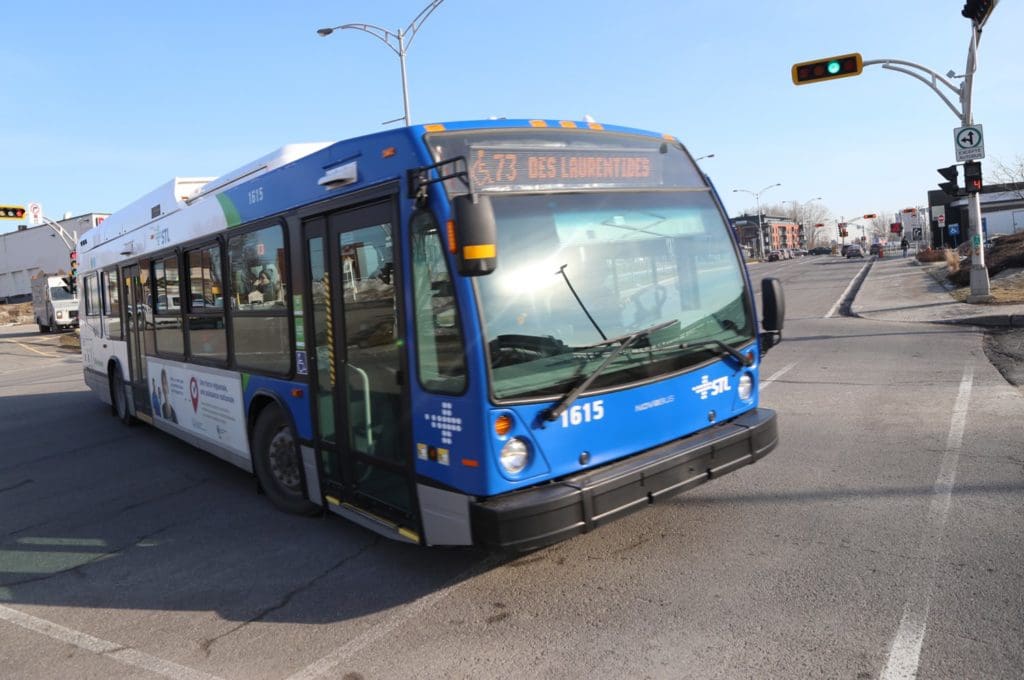
For its part, the union representing Société de transport de Laval (STL) drivers noted that they demonstrated in front of Laval City Hall recently to demand that the mayor and city council provide the STL with necessary mandates to get negotiations back on track and come up with a satisfactory agreement for the employees affected.
“Elected officials must show they really believe in the importance of public transit in Laval,” said Patrick Lafleur, president of CUPE 5959. “This mobilization of drivers is intended to ensure sustainable public transit service in our municipality. Investing in public transit also means investing in employees.”
The union claims that a recent CROP survey in which 473 of the 625 STL bus drivers participated uncovered some notable management deficiencies and serious problems affecting the working environment.

It was time to get down and party at Place Bell on Wednesday morning last week as organizers and politicians gathered for an official kickoff for the 55th Jeux du Québec Finals – exactly one-hundred days before the amateur provincial sporting event is scheduled to start in Laval.
Although the Jeux du Québec Finals were originally supposed to take place here in 2020, the outbreak of the Covid pandemic in late 2019 delayed the event for two years.
Be there in July!
The multidisciplinary sports event, bringing together 3,300 young athletes from all over the province, will be taking place from July 22 to July 30 at venues throughout the Laval region. The games’ official spokesperson is someone most people from Laval should know at least a little by now – Alexandre Despatie.
The Canadian Olympic silver medal diving champion is a long-time Laval resident and an eager promoter of the upcoming sports competitions in Laval. It was at a past Jeux du Québec that Despatie got his start in diving.

Can lead to the Olympics
“I am honored to represent the Finals, which are taking place in city of my birth next summer,” said Despatie, noting that the Jeux du Québec tend to motivate participants to want to move upwards into Olympic competition. “The athletes are getting ready to experience something they’ve never seen in their lives, whether it’s on the sports or personal levels,” he added.
Regardless of the two-year delay, city councillor Nicholas Borne said Laval is ready. “Finally, after two years of postponements, we are almost there,” he said. “It is truly with great pride that out city is hosting this important gathering celebrating youth and sports.
130,000 visitors expected
“The entire community of Laval is coming together to warmly welcome the 130,000 visitors who will be arriving from the four corners of Quebec next July,” Borne continued. “The athletes will be able to enjoy first-rate sports infrastructures, while being able to depend on the support of enthusiastic spectators, as well as devoted volunteers and a sporting environment where nothing has been spared for this celebration.”
The multidisciplinary sports event, bringing together 3,300 young athletes, will be taking place from July 22 to July 30
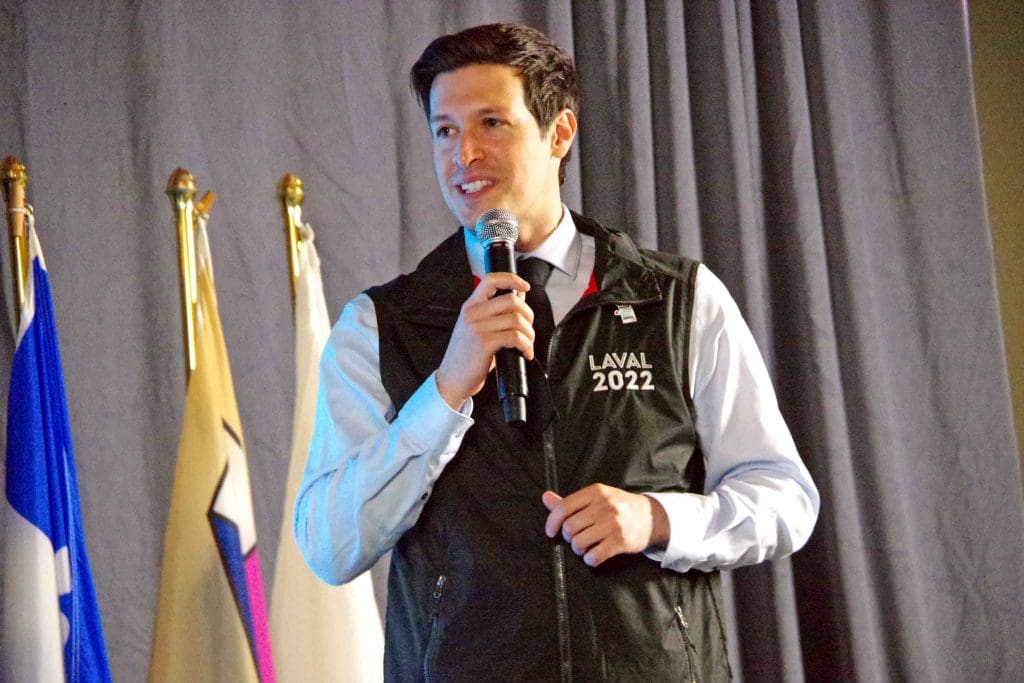
Mayor Stéphane Boyer, who arrived late to the launch because of a pressing earlier engagement, said he felt confident that the games would be taking place smoothly, after the delays that held things up over the past 24 months.
Laval hosted games in 1971
Coincidence or not, it was just a little more than 50 years ago that the City of Laval (which had only come into being in 1965) hosted the 1971 Jeux du Québec Winter Games – which were the first ever. A few months later, Rivière du Loup was the place to be for the first-ever Jeux du Québec Finals.
Former Laval mayor Marc Demers, who was a key player in getting Jeux du Québec organizers to agree to stage the 2022 Finals in Laval, was on in the audience during last week’s kickoff, and he received a warm round of applause in acknowledgement of his efforts.
Games sites all over Laval
In all, the 55th Jeux du Québec Finals will be taking place at 14 competition sites all over Laval, including Place Bell where cycling events will be on an outdoor track, and competitive swimming events, which will be staged at the Centre de la Nature. The complete schedule of events and programming can be viewed online at https://laval2022.jeuxduquebec.com/fr/sports.html. The opening and closing ceremonies will be taking place at Place Bell. Tickets for the events are being sold for $20 each.


After another tough week, an optimistic Dominique Anglade remains adamant that “there’s absolutely no reason to question the raison d’être of the Parti libéral du Québec.”
The Liberal leader’s party had a dismal showing in last Monday’s by-election in MarieVictorin where candidate Émilie Nollet came in fifth place, garnering only 7 per cent of the popular vote. Polls show the Liberal Party in continual decline among francophone voters. If last week’s by-election is a precursor for things to come, it could spell disaster for the party come election day on October 3.
Anglade understands the optics, but she’s staying upbeat. She owns the fact that up until now, her party does not seem to be resonating with a large part of the electorate, but that it’s only a question of making her message clear. “We have to be really clear about what our party stands for,” she says.
Marie-Victorin was never a Liberal stronghold and the CAQ win in Longueuil mayor Catherine Fournier’s old riding is a defeat for the Parti Québécois, Anglade says. Even if the Conservative Party outperformed the Liberals, Anglade says she is not worried about the rising support for Éric Duhaime’s party in the polls. Both parties may be federalist, but only one of the two is progressive, she says, in reference to Conservative Party candidates who have openly said they are anti-abortion.
Amateur and tone-deaf
But the Liberal Party is facing more challenges than just reconnecting with francophone voters. For weeks, it’s also been in turmoil with its own base. A wave of backlash from anglophones, historically loyal to the Liberal party, came after a major gaffe many have qualified as amateur and tone-deaf.
Earlier this session, the opposition proposed an amendment to the government’s French language reform Bill 96, which would require English CEGEP students complete three courses in French to receive their diplomas.
The amendment was accepted by all four parties represented at the National Assembly without any consultation of the community. CEGEP directors, parents and students were quick to denounce the modification to the bill, saying such a strict requirement could lead to students failing classes or getting poor grades that could affect their chances of getting into the university of their choice.
Another humiliating defeat
Anglade apologized and the Liberal Party tried to convince the committee to walk it back, but to no avail. Then, after being mocked by the media and other parties, the Liberals endured another humiliating defeat last Thursday.
The committee voted against a new Liberal amendment, which would have required students to complete three classes of French instead of three classes in French. That would have meant that students who are not as proficient in the language of Molière would have been permitted to take three French as a second language courses.
“It was incumbent on everybody to find a solution,” says André Fortin, Liberal MNA for Pontiac, who said “it was a shocking turn of events” that French Language) Minister JolinBarrette voted against the new amendment.
Fortin insists there is still a possibility to make changes to the bill, although that seems less and less likely with the end of the session just around the corner. The Liberal Party will vote against Bill 96, what it calls “a deeply-flawed bill,” but it will require more than that to appease frustrated Quebec anglophones and win back indifferent francophones. Anglade is well aware of this.
“I think I need to be a lot more vocal about a number of (positions) that we’ve taken,” she says.
Anglade says under her leadership her party would focus on both the economy and fighting climate change, but above all, she says her party is about promoting inclusion. She says Premier François Legault is pitting Quebecers against each other with “politics of division.”
“The premier is saying that there are anglophones and francophones. Immigrants and not-so-good immigrants. People who are making $56,000 a year and the other ones,” she says.
“The future of Quebec needs to be outward focused. We have to be looking at opportunities for every single person. We have to be thinking about an economy that is modern and progressive. And we have to stop dividing Quebecers and look at how Quebec can be a beacon for the rest of the world.”
She admits she’s running out of time to get her message across but is not deterred.
“I’m extremely motivated. If anything, this week proves to me that we need to work harder. There’s no question about that.”
Raquel Fletcher is QCNA’s News Matters columnist on provincial affairs.