There is a Laval Police Operation in progress at the McDonald’s on the corners of Notre-Dame & Cure-Labelle in Laval. No news as of yet what the operation is about.
Laval Police operation Update: March 17, 2016. 5.33 pm.
The operation came to and end around 5:00 pm Thursday and everything is now back to normal. According to the Laval Police Department, they received a distress call from a payphone in the area. No details have been released as of yet.
The ministère des Transports, de la Mobilité durable et de l’Électrification des transports wishes to inform all travelers that the Honoré-Mercier Bridge will be completely closed towards Montréal from Friday March 18th at 10 p.m. to Monday March 21st at 5 a.m.
This closure is required to repair the structural damage due to the accident on February 18th. For security reasons, the bridge will be completely closed along with the acces ramps from Routes 132 and 138. However, the two lanes towards the south shore will remain opened.
The road users will be able to cross by the other bridges or tunnel to access the island of Montréal.
Those interventions might be shortened or cancelled due to work progression, weather conditions or operational constraints.
Respecting road signs is vital for the safety of road users and workers.
(SOURCE: Ministère des Transports, de la Mobilité durable et de l’Électrification des transports)
When the weather is cool, it’s nice to light up a fire to keep warm. Often we throw any log or wood that is handy into the fire. Be careful though, that you don’t throw pressure treated wood on the fire. Burning pressure treated wood in your fireplace, or even outside in your fire pit, can release toxic chemicals that are dangerous to your health.
Pressure treated wood contains wood preservatives, which are pesticides that are used to extend the product life of wood. These chemicals help to reduce rot, wood-eating insects, and weathering.
Burning treated wood concentrates and releases these preservative chemicals in the ash and smoke of a fire, which can pose both health and environmental risks.
What you should do
You should never burn treated wood. You should be able to easily determine if your wood is treated as it usually contains dyes or stains in various shades of brown or green. Chromated Copper Arsenate (CCA) treated wood is no longer sold for use in residential settings, but may still be available in older structures; it has a light green colour and should not be burned either.
Report health and safety concerns
If you have been exposed to burning treated wood for prolonged periods, and feel ill, you should seek medical attention immediately.
Up to know when resident’s living in Laval have any type of emergency, big or small, they dial 911 or 311 for city related issues. “COMING SOON”, by dialing 211, the residents of Laval will have access to a wealth of information. The “Information and Referral Centre of Greater Montreal” (IRCGM), has agreed to provide the service on a contract basis which will have an average cost of $60,000 per year.
The service is offered in both official languages. The service will be able to assist people with information regarding simple items like food and shelter, where’s the nearest clinic or hospital, or with assistance with more serious issues like mental health issues. The “211” service will be available to all Laval residents, by phone, seven-days-a-week, from 8 a.m.-6 p.m.
This is a archived copy in PDF format of the the Laval News that was published and distributed January 9, 2016. In this issue read the Year in Review 2015.
In This issue of Laval News read:
Giant Steps celebrated Xmas with Alex Galchenyuk.
This issue covers local events such us politics, sports and human interest stories. It features editorials and other columns.
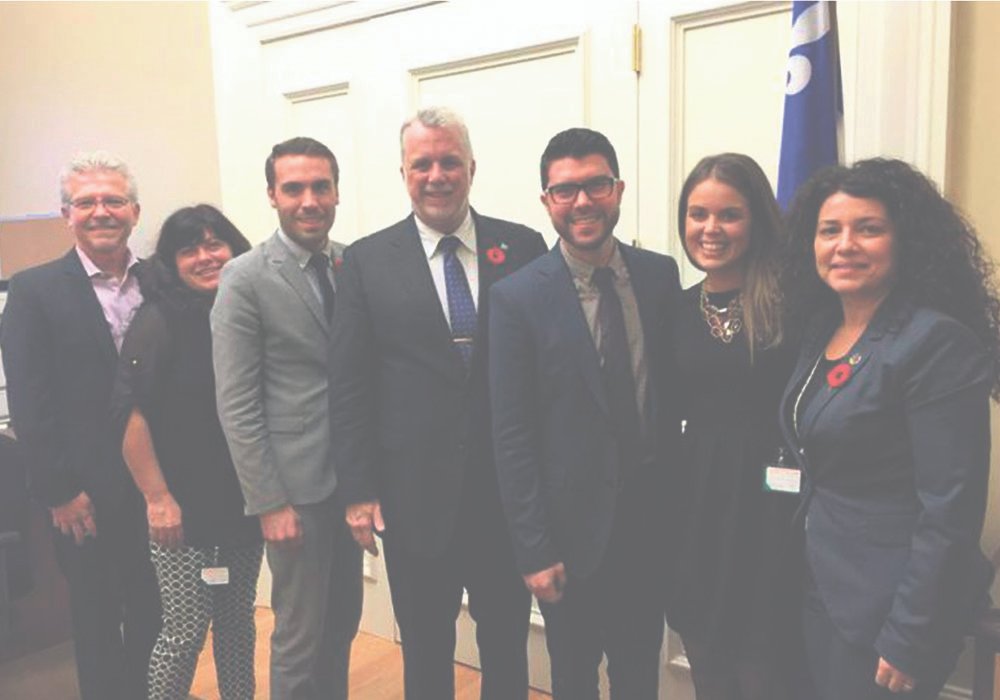
(TLN) Just before the Christmas holidays, Sainte-Rose Liberal MNA Jean Habel paid tribute in a speech in the Quebec National Assembly to the courage of Matthew Schreindorfer and his wife. Habel then had a surprise for them: a special meeting with Quebec Premier Philippe Couillard.
“One the one hand, I had wanted to thank Mr. Habel for his second statement as an MNA that he made in my honour,” Schreindorfer said. “I would also like to thank him for the meeting with our premier and for his support through all these ordeals.”
As previously reported in the Laval News, Matthew Schreindorfer was diagnosed with acute lymphoblastic leukemia (ALL) in June 2014. Since then, he underwent all the treatments possible within the Canadian medical system.
He underwent a further experimental treatment in New York City at a cost of more than $800,000 that he and his wife, Katia Luciani, raised from donors. Although he was declared cancer-free last September, Schreindorfer learned earlier this month that cancer cells have again been found in his bone marrow.
Habel said he was impressed by Schreindorfer’s ordeal. “I wanted to point out the combativeness, determination and strength of Mr. Schreindorfer and his wife which is an example and a source of inspiration for us all,” Habel said. “They have shown courage out of the ordinary all through this sickness and I wanted to show this.”
(TLN) The New Year did not start well for four Laval women caught in Albany NY for a “Grandparent Scam operation”.
On January 7, Christina M. Antonakakis, 29, Sophia Mikelakis, 57, Nora Apkarian, 42, and Anahid Apkarian, 61, traveled from Laval, to the Albany area to pick up cash packages at a UPS store sent by their various victims, or have a legitimate carrier pick up the package and bring it to them at a hotel, but they were arrested before the operation was completed.
In the police operation took part the New York State Police Special Investigations Unit in Albany, the Menands Police Department, the U.S. Postal Inspector’s Office and U.S. Homeland Security Investigations which they say they made the arrests after an investigation into an organized criminal operation based out of Laval.
Police say the operation targeted the elderly community in what is known as a “Grandparent Scam”.
How the Grandparent Scam works
In this scam, an anonymous person contacts an elderly person either by phone or email, and identifies himself as their grandson. He indicates that he has been arrested in another state and needs money quickly to pay for bail. He advises that the grandparent cannot tell his parents because he doesn’t want to upset them. A second person then gets on the phone and identifies himself as a police officer. The alleged police officer advises where and how to send the cash to pay for the bail. The officer then advises the grandparent if another agency contacts them, the other agency is scamming them, and they should not provide any information to them.
The four women face charges of third-degree criminal possession of stolen property. Antonakakis and Mikelakis are also charged with 3rd degree attempted grand larceny. Antonakakis and Mikelakis were granted bail of $30,000 US each while the mother and daughter Apkarians were given bail of $35,000 US each, said to The Laval News New York State Police trooper William Duffy.
“It is interesting that here we have two mother-daughters duo”, added trooper Duffy
Phone scam capital
It turns out, that the area code 514 and 450 is to phone scams what Nigeria is to email fraud. Vancouver, Toronto, and bilingual Montreal have long been hubs of call centers for reputable firms—for catalog sales or orders for parts—and less-than-reputable enterprises pushing, say, credit cards to the financially vulnerable. (In the mid-2000s, some of those legitimate call centers were outsourced to places where labor is cheap, such as India, the Philippines.) The metropolitan area of Montreal which includes Laval, is the Queen City of the grandparent scam, as well as a whole litany of other frauds, many of them aimed at telephone numbers in the U.S.
It is estimated that phone scams targeting USA citizens surpass annually 3 billion dollars.
A public consultation held last week by Vimy Liberal MP Eva Nassif to determine people’s wants and needs for the upcoming federal budget led to a lively round of discussion by a group of more than two dozen of the riding’s constituents.
Vimy Liberal MP Eva Nassif’s pre-budget public consultation on Jan. 13 drew more than two dozen people who discussed their needs and wants for the 2016 budget.
Emphasis on economy
“As we promised an open and transparent government, we are consulting the citizens across the country,” Nassif said in an interview with the Laval News. “This is what the Minister of Finance had promised. Mostly we are here to listen to business owners, to citizens and to everyone’s point of view as to what they would like to see in the 2016 budget. We want to know what they want as priorities.”
Nassif said the budget will include things such as placing environmental sustainability at the heart of Canada’s resource sector, and supporting growing firms to help them secure the talent, capital and strength they need to realize opportunities in the global marketplace.
Budget measures
In addition, she said the budget will contain measures ensuring that Canada’s tax system is competitive for foreign investment while attracting global research and development mandates, as well as elements to encourage a closer relationship with the provinces for a skills and labour strategy emphasizing better participation of under-represented groups.
Among those attending the meeting at Holy Cross Armenian Church on Saint-Martin Blvd. were Laval city councillor Sandra Desmeules, along with councillors Daniel Hébert and Pierre Anthian. Desmeules, who sits on the executive-committee, said the city’s number one request to the federal government is that it provide financial support to deal with an “emergency” in social housing.
Among those attending the consultation were (from the right) Laval city councillors Sandra Desmeules, Daniel Hébert and Pierre Anthian.
Social housing ‘emergency’
“The City of Laval has an immense backlog in providing social housing whether it be for young people or families or people 65 years of age or older,” Desmeules said. According to Desmeules, the city needs 3,000 units of social housing. “We have some projects underway, but we need federal support. In the past, we held negotiations with the former government. Unfortunately the money was not forthcoming.”
In contrast, Desmeules said she and other city officials were pleased with what they are hearing from the new Liberal government, but that a working relationship needs to be developed so that ideas can be transformed into reality. “We have to work together with the federal government, as well as with the Quebec government,” she said.
Economic challenges
In a speech prior to beginning the discussion, Nassif said she would focus on the economic context leading towards the upcoming budget. “The global economy is weak, and Canada’s economy is facing an uphill battle,” she said. “The period since the end of the 2009 recession has been characterized by low global economic growth.
“The main reason for the decline in GDP in the first half of 2015 was sharply lower oil prices. But the good news is Canada is facing these challenges from a position of strength, despite the fact that the last number of years have been characterized by low economic growth. There are untapped opportunities to further improve Canada’s economic performance.
Employment to be key
“With the demographic changes that are expected, continued strong labour force participation will be key to sustaining growth,” she continued. “Canada is already doing well here, but there is room for improvement. Canadians with disabilities, indigenous peoples, women with young children, and recent immigrants are all under-represented in the labour force. Now, more than ever, we need a plan to grow our economy, support the middle class, and return to long-term, sustainable growth.
“Maintaining our position of strength is not enough to grow the economy,” said Nassif. “Growth will absolutely require investment. We also need to be sure we’re investing in people. Specifically, in the middle class and those working hard to join it. We simply can’t call ourselves prosperous as a country if our middle class is struggling.”
Infrastructure investments
According to Nassif, the new government will be emphasizing public infrastructure investments to stimulate the economy. “Over the next decade, we have pledged to invest $125 billion in public infrastructure. Our investments will be aimed at getting Canadians moving, and opening up more cost-efficient trade options for our exporters. Well-designed investments in public infrastructure would provide immediate economic benefits and support long-term economic growth. All of this will be rooted in a careful assessment of needs, and a clear articulation of the federal role.”
Canada Child Benefit
Nassif said that in the budget, the government will introduce the new Canada Child Benefit, another measure that will provide increased support to nine out of 10 families and assist hundreds of thousands of children currently living in poverty. “In contrast to the existing regime, the Canada Child Benefit will be simpler, more generous and tax free,” she added.
“Put together, these measures will help strengthen the middle class, putting more money in their pockets to save, invest and grow the economy. More broadly, they will help grow our economy in the context of a difficult global economic climate so that all Canadians benefit.”
In a speech prior to consulting constituents, Nassif went over the major elements to be contained in the 2016 budget.
A Chomedey man who has become a self-appointed “watchdog” over the official opposition at Laval city hall had questions about their annual expenses last week at city council’s first meeting of the year, after first raising the issue last fall.
Not satisfied with answer
Action Laval city councillor for Chomedey Aglaia Revelakis responded to questions about her party’s annual expenses with a prepared statement.
During one of the monthly city council meetings last October, Natale Polito had asked whether the Action Laval opposition party could provide specific information on its spending and budget allocations.
Chomedey city councillor Aglaia Revelakis, who is currently Action Laval’s sole elected representative, said at the time that the information would become available in the city’s annual budget which was tabled in December.
Responding during the Jan. 12 council meeting to Polito’s complaint that he still didn’t have an answer, Revelakis read out a prepared statement in which she said all the opposition’s expenses are supervised and accounted for by the city’s financial services department. She also noted that the expenses are completely in line with the Quebec municipal affairs ministry’s legal requirements.
Freedom of Information
Chomedey resident Natale Polito questions the official opposition’s expenses during the Jan. 12 city council meeting
Polito, who was active as a volunteer with Action Laval during the 2013 election but has since grown disillusioned with the party, made a freedom of information request to the municipal clerk’s office for details on the opposition office’s expenses over the past two years.
Although the opposition has only briefly had more than two elected members on city council, that number was reduced when Councillor Paolo Galati jumped in August 2014 from Action Laval to the governing Mouvement Lavallois. Councillor Michel Trottier decided in July that same year to join the official opposition, but remained only until last fall when he decided to sit again as an independent.
Staff salaries top expenses
According to the document released by the city clerk, the opposition office received a more than 3 per cent allotment increase in 2015, raising its overall budget to $677,600. By far the most outstanding expense was for support personnel salaries: they amounted to more than $420,000 in 2014, and thousands more for social benefits.
Although the opposition councillors each earned a base salary of around $30,000 a year, the report reveals that former chief of staff Jean Desautels’ pay was almost three times greater ($88,000) during the opposition office’s first year. Former Action Laval political attaché Emilio Migliozzi’s salary was $65,000 before he departed.
Gobé was paid $42,700
The four other opposition office staffers’ 2014 salaries ranged from $65,000 to just below $43,000, with Action Laval leader and mayoral candidate Jean-Claude Gobé receiving $42,700 as a “special advisor.” Although some staffers left by the following year, the record shows that those who remained in 2015 saw their remuneration increase slightly or more steeply if they were promoted. While there were seven staff at the opposition office in 2014, there were only six in 2015.
In an interview with the Laval News, Polito said that even though he was ultimately able to get the information, he had hoped to hear it first from Action Laval. “Why are there so many people on the payroll for a one-person show?” he said. “Where is the money going? They’re paying salaries, but what are we getting in return? Where are the benefits for the citizens of Laval? Or are they just paying salaries for something that’s not benefiting the citizens?”
Coupal axed from commissions
Mayor Marc Demers justified his removal of former Mouvement Lavallois councillor Jean Coupal from committees since Coupal became independent.
In other developments during the Jan. 12 city council meeting, Mayor Marc Demers was forced during the residents’ question period to justify his decision to remove former Mouvement Lavallois councillor Jean Coupal from his position as a member of two council commissions. Coupal recently decided to leave the ML and sit as an independent.
“[Coupal] left because he wanted to be able to speak freely,” said the mayor, while adding that Coupal’s commitment to the two commissions he previously sat on included an oath of secrecy. Demers also suggested that his duties as mayor include making sure that “the right person for the job” was appointed to work on commissions.
Airport shuttle resolution
Councillor Aglaia Revelakis tabled a resolution on behalf of her party calling for the Société de Transport de Laval (STL) to study the possibility of implementing a special shuttle bus between Laval and Montreal International Airport.
Noting that it is currently impossible for Laval residents to get to the airport by any means other than a personal car or by taxi, that the cost of a taxi to the airport is very costly and that the Société de Transport de Montréal (STM) currently offers an airport shuttle service, the motion asks the STL to take a serious look at the issue.
Regarding a proposed zoning change for the preservation of Laval’s Bois-de-l’Équerre urban forest, Sainte-Rose councillor and executive-committee member Virginie Dufour said a by-law for that purpose will only be ready for the next council meeting on Feb. 2. The city will be setting aside 216 hectares of the territory as a protected green space, while another portion would be designated for development.