Home Blog Page 286

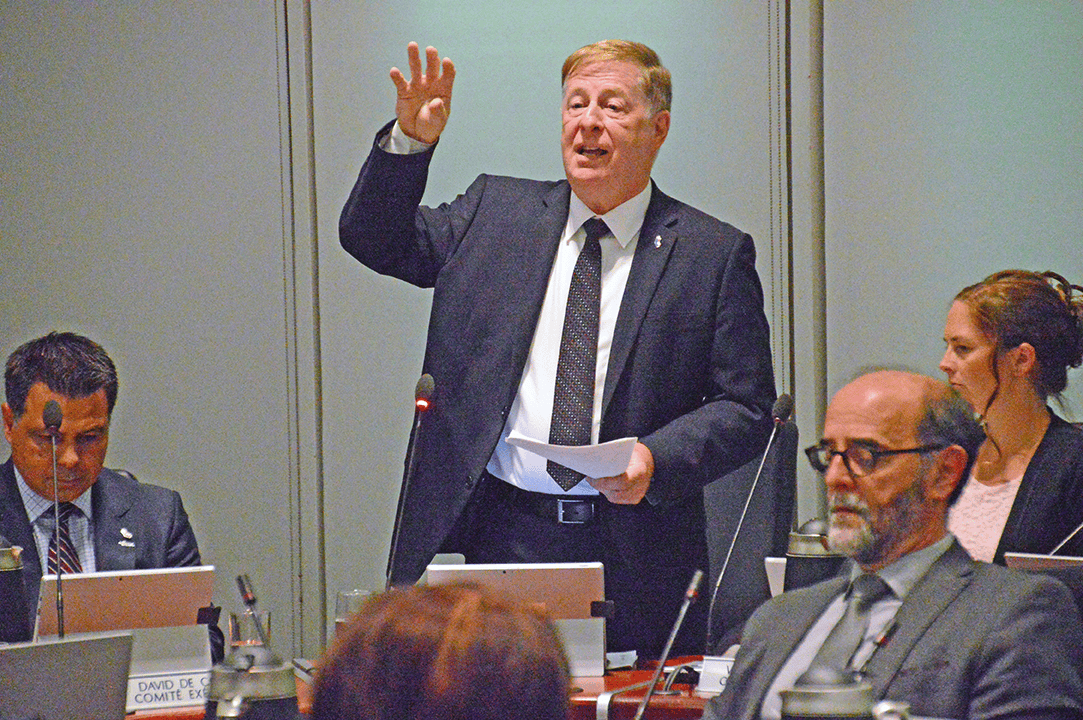
François Legault trades sovereignty for economic nationalism

As a co-founder and leader of the Coalition Avenir Québec, François Legault leads a political party which currently ranks third in seats in the Quebec National Assembly. While the CAQ has taken part in two general elections since its founding in 2011-2012, the party has yet to even come close to fulfilling its greatest ambition –forming a provincial government.

Newsfirst Multimedia had the opportunity last week to sit down for an at-length interview with Legault, who is also the co-founder of Air Transat, at our editorial offices. What follows is an edited transcript of what he had to say on issues ranging from the province’s need for an economic boost, to the renewed and thorny question of whether we also require a Charter of Quebec Values.

NM: There are currently CAQ MNAs just across the Mille Îles River on the North Shore and in the Lower Laurentian region, but still none in Laval. What is the difference between these two regions which makes this so?

FL: First, there’s a higher percentage of anglophones and allophones in Laval. That’s being direct, but that’s the reason. These people think that there’s only one party who would like to stay within Canada and that it’s the Liberal Party. That’s the reason. But it’s about time we discussed other priorities and discussed about the economy, education and the welfare system. It hasn’t improved for 15 years. But people from different communities, and from the anglophone communities, they vote for the Liberal Party since 50 years. We have to tell them that there’s an alternative, and that’s why I started the CAQ five years ago. And five years is not a long time, it’s not enough for everybody to know us, and that’s why I’m here today.

NM: Do you not see anything demographically different between Laval and the Lower Laurentians/North Shore that explains why one votes CAQ and the other not?

FL: No, I think that the francophones of Laval they vote as much for the CAQ as anywhere else. But because 90 per cent of the anglophones and the allophones vote for the Liberal Party and they have a higher percentage in Laval, that’s why. You can see the difference when you compare a riding like Chomedey and a riding like Laval-des-Rapides or Sainte-Rose. The francophone community supports us. And it’s about time we change that. And it’s about time we offer an alternative to the anglophones, the allophones and the different communities.

NM: Not everyone who lives in this province can relate to the concept of political nationalism. But Quebec economic nationalism is something that a great many more people can more easily understand. Can you tell us something about the CAQ’s spin on this?

FL: First you have to understand that when you have a headquarters in Quebec, the jobs at the headquarters are well-paid. The economic difference between Quebec and Ontario, for example, is not the number of jobs, but the quality of jobs. At a headquarters you have better jobs. At a headquarters you also have people who give some contracts and choose the suppliers. So it’s easier for Quebec companies to become suppliers of a company having its headquarters here. Everywhere in the world they try to protect their headquarters. I’ll give you my personal example: when I was with Air Transat I tried to buy a company in U.K. like Thomas Cook because we were buying travel agencies, and we found out that some pensions plans owned a block of 34 per cent of the shares and those shares were not for sale whatever price we offered. Same thing in France with Nouvelles Frontières, same thing in Germany with TUI. Look at what’s happening with Donald Trump: if there’s somebody who’s protectionist it’s Donald Trump. So we must not be naïve – we have to protect our headquarters. Of course we will not be able always to succeed. But look at what happened to Rona. Suppliers are seeing right now a reduction in their sales to Rona because [new owner] Lowe’s in the United States buys for everybody including Rona. It’s important to have headquarters.

NM: So there definitely is an economic impact from foreign ownership.

FL: Yeah. What you also have to understand is that in Quebec owning a company is not a long tradition. Especially in the French community it was against the religion to be an entrepreneur, because it was seen that if you made money it was because you took it from somebody else. But right now the worldwide economy is played in terms of billions of dollars. In Quebec, you have less than 10 per cent who are able to write a cheque of one billion – less than 10. So you don’t have that many rich people in Quebec. There are a lot more in Europe or in the United States.

NM: On that note, late last year you were reported to have suggested raising income taxes in Quebec for the very wealthy in order to subsidize the middle-class and less well-off. At least one editorialist noted at that time that there are relatively few people with this kind of wealth in Quebec.

FL: This was something that was badly reported. To be clear, what I said is that we want to decrease income taxes for all people earning less than $150,000. For all the ones earning more than this we want an indexation of tariffs and taxes – like tariffs for Hydro Quebec, for example. For me indexation is not an increase. In actual money it’s the same thing. I want to be clear that with a CAQ government nobody will have an increase of taxes, tariffs or income taxes by more than inflation. And the people earning less than $150,000 a year they’ll get a tax reduction.

NM: While the Liberals appear to have played both sides of the fence when it comes to adopting a Charter of Quebec Values, the CAQ seems more definite. You believe that such a charter is needed.

FL: I think we have to protect our values. Some people worry – not based on something substantial – but they still worry about protecting our values. Let’s talk about equality between men and women. Some people they come and live in Quebec and they don’t agree with equality between men and women. And some other people they worry about that. And I think, yes, we need a kind of Charter of Values. Not the way the PQ tried to do it, but a Charter of Values to make sure we protect our values. Our common values. For me, we have to be open, but we have to draw a line. And the line is that we have to protect our values.

NM: Turning to a more local issue, we have a hospital in Laval, Cité de la Santé, in which the Liberals have invested quite a bit of money over the years. Despite this, waiting times remain problematic, especially in emergency.

FL: At Cité de la Santé the average waiting time at emergency is 17 hours. Seventeen hours doesn’t make sense at all. Why is that? Because 40 per cent of the people going to emergency at Cité de la Santé should not be there. They should be seeing a family doctor. The problem with family doctors is that most of them work four to five days a week. Not at night, not on weekends. For a year I was the Minister for Health and I started what we called the GMF – Groupe de Médecine de Famille. And they were supposed (at least it was the case for the first one I opened) to be open seven days a week. But Dr. Couillard and Dr. Barrette they decided that they will not be open seven days a week, and they put instead what they called a super-clinic – and these are the only ones to be open. But most of the people on Saturday and Sunday if they get sick but they have to go to the emergency because they don’t have a family doctor. So if family doctors were taking charge of patients seven days a week, we would have 40 per cent less at Cité de la Santé, so of course it would change completely the picture. So we need to force the family doctors to take charge of patients seven days a week. They can be 10 doctors together and every weekend it would be a different one taking charge of the patients. But I think it’s about time that we forced them, and we should pay them this way. Right now doctors in Quebec are paid per service rendered. In some places in the world they are paid per patient. First, if they were paid per patient they would have an incentive to delegate some services to the nurse. Right now if they delegate a service to the nurse they are not paid. So I can’t understand that.

ML: Here we are not much more than a year before the next provincial election and it looks as if the Liberals are reasonably well-positioned. What’s your take?

FL: I think that right now two-thirds of Quebecers are against the sovereignty of Quebec. So if it was Liberals against the PQ they [Liberals] would be in a good position. But there’s a problem, there’s a new party – the CAQ. The CAQ proposes staying within Canada. So we’ll have to have a debate about the last 15 years. Next year it’ll be 15 years [for the Liberals]. Is it going better in health care since 15 years? Is it going better in education? Is it getting better in the economy? Do we have more money in our pockets? I think they will have to defend what they did. Because it’s almost the same thing with Mr. Couillard as the team we had with Mr. Charest. So I think we are in a good position. But people they have to understand that it’s not a battle about the sovereignty of Quebec. It’s a battle about who has the best program in economy, education and health care. And especially in economy because you need to have the means to do what you have to do.

NM: The Liberal government’s education minister has changed more times than we care to mention. Why is that?

FL: Because they don’t have a plan. We have a plan. First we think that we should switch the power from school boards to schools like in the model of private schools. The full budget should be given to the schools and the schools they are the ones who would decide if they want more social workers or classrooms or whatever. It should be managed at the school level. And schools should put together some services like transportation of pupils. But right now it’s the opposite. The schools work for the school boards. The school boards must work for the schools. That’s the first point. The second point is that if we want to have more children succeeding we have to start earlier. In Ontario, school starts at four years old. One of our proposals – and it costs a lot of money, it’s $290 million a year – but we think that all children of four years old they must have access to school. They must have an evaluation. And right now we have between 15 and 20 per cent of the children having some kind of difficulties. They must be helped sooner – at four years old instead of five years old. So we need a program. But the only program of the Liberal Party is their one line: ‘I’m against the sovereignty of Quebec.’ What is their program in education? ‘I’m against the sovereignty of Quebec.’ What is their program in health care? ‘I’m against the sovereignty of Quebec.’ C’mon, it’s not a program. It’s about time we have a real debate. Since 45 years all provincial elections have been about are we for or against the sovereignty of Quebec.

NM: The CAQ in the past has come out proposing the outright abolition of the province’s school boards. Would a CAQ government still do this?

FL: We will replace them by service centres. They will be the equivalent of schools boards. And instead of having an election where nobody goes to vote for commissioners, they will be chosen within the conseils d’établissements [governing boards] of every school. So they will choose people to take charge of the board for the service centres, but there will be no more elections. But the English community would keep their schools, keep their service centres, no change, but instead of having an election where nobody would vote they will be chosen with the boards of the different schools.

NM: We are not very far from Autoroute 13 where there was a traffic and public safety crisis following a snow storm in March. Although the matter remains under investigation, what went wrong there according to you?

FL: Bad management. It’s incredible when you have a Minister of Transport saying, ‘I’m sorry, nobody called me.’ C’mon, I was in business. And when a flight from Air Transat was late I would not have answered sorry nobody called me. You make sure that somebody calls you when there’s something very wrong happening. Plus you must read the [Quebec] auditor-general’s report, chapter five about management: nobody is accountable. They say that in many areas within the Ministry of Transport, two, three or four people are in charge. When you have more than one person in charge there’s nobody in charge. They don’t have the expertise. They lost the best engineers. So it’s a big lack of management. The same thing with health care and education. But the Ministry of Transport is not different. We really need to have some business people taking charge of those ministries. But we don’t have enough business people in politics. We have many lawyers, many people who are good in talking, but we need to have more business people. Because right now the ministers are managed by the civil servants instead of the other way around. That’s what happened: a lack of management with Autoroute 13.

NM: Quebec’s fertility rate continued to decline last year. Some of the latest numbers indicate the rate falls as low as 1.4 children per woman in some regions. How do you fix that?

FL: First we will need more immigrants – that’s clear – with our values. But we need also to help more families. We are right now preparing our program for next year. Do we have to put back into place more family allocations? But we also have to encourage more people to have children. We have to give them more money. It has to be easier to have children.

NM: Are you considering maybe a program like they have in certain countries in Europe where they pay mothers or fathers to stay home to take care of their children?

FL: Indirectly. If you give a family allocation, if you give them good cheques, they will stay at home. But I think right now you have to have more children in Quebec. 1.4 does not generate pérénité.

NM: Being an entrepreneur and a former insider in the airline industry, perhaps you have some thoughts on the current state of affairs at Bombardier.

FL: First, we need to help companies like Bombardier. So I have no problem with that. It’s a manufacturing business, they export goods so it’s a key for our economy. Let’s talk about Alain Bellemare and Pierre Beaudoin – I know them very well. In 2016, they suffered a loss of $1 billion. So how can you propose to increase salaries and bonuses of Alain Bellemare from $8.5 million to $12.5 million? And Pierre Beaudoin he’s been fired as a CEO. He’s now chairman of the board at $5 million a year. I don’t know of any chairman of the board earning more than a couple of hundred thousand dollars a year. You have 11 or 12 meetings to manage a year for $5 million. So for me it doesn’t make sense. And also we must have asked for some guarantees regarding the number of jobs, and we must have invested not only in the C-series but in the whole company. And look at the jobs: in Quebec you have 16,000 jobs with Bombardier, 2,000 with the C-series and 14,000 in other divisions. We’ve put a full $1.3 billion in the C-series. And I’m from the airline business. I can tell you the C-series is an aircraft of 150 seats in competition with the Boeing 737 and the Airbus 390. And Airbus and Boeing they offer also aircraft of 250 seats, of 350 seats also. So honestly for me it’s a big risk. If I was at Bombardier I wouldn’t have invested in the C-series. I think that trains, tramways, jets, fine. But competing against these two giants. And the only aircraft they sold in the last year were sold to Air Canada and Delta with a loss of $500 million. And those guys we are paying them bonuses? That’s what happens when you have a party that’s in power for too much time. The Liberal Party is in power since 15 years and now they help their friends. They’ve given also $400 million in Gaspésie for Cimenterie McInnis. We already have three cimenteries that are not at full capacity. So $400 million for 200 jobs. $2 million a job. I understand it’s in Gaspésie, but come on. Why? Because it’s their friends.

DEKA recognition received by ten leading Greek Montrealers

Martin C. Barry

Ten outstanding businesses in the Montreal region whose owners are of Greek heritage received Deka Awards from the Hellenic Board of Trade of Metropolitan Montreal during a gala evening which took place at Le Windsor in downtown Montreal on May 10.

The DEKA Awards were created to recognize outstanding Hellenic individuals and businesses in greater Montreal who through their creativity and excellence have contributed to the enrichment of the region.

Hellenic Board of Trade hosts annual awards gala at Le Windsor
The Hellenic Board of Trade of Greater Montreal recognized 10 Hellenic individuals and businesses this year for their outstanding performance.

A special night

The 10 award winners were chosen by a selection committee made up of professionals and business people. The 21st annual awards gala was hosted by well-known local broadcast journalist Orla Johannes. The gala was attended by 280 members of the board of trade along with their guests.

“The Deka Gala is a special night for our business community as we pay tribute to companies and individuals of Greek origin who have excelled and contributed to the enrichment of the greater Montreal area,” John Charalampopoulos, president of the HBOT, said in a speech.

“We received over 55 nominations that formed part of the selection process,” he added. “The quality of this year’s nominees was outstanding and showcases the vitality of our business community. To tonight’s Deka winners congratulations to each of you.

Hellenic Board of Trade hosts annual awards gala at Le Windsor
In an ongoing tradition, gala attendees hoisted a glass of bubbly to the success of the coming year.

HBOT stimulates business

“The Hellenic Board of Trade is a great organization that would not be as dynamic as it is today without the active involvement of all of you,” Charalampopulos continued. “Our activities create business opportunities for our members to meet, network and foster business relationships. Our objectives are to promote Hellenism, and to unite professionals, entrepreneurs and businesses.

“As president this year, one of my personal objectives was to attract and engage our young Hellenes. I am very happy to say that we have seen a significant increase in participation at our events throughout the year from our young future leaders.”

Young Greeks welcome

Charalampopoulos said he wanted to “personally encourage our young Hellenes to continue to be involved, so they can carry this wonderful organization for many more years to come. Truly a great testament to our founders.”

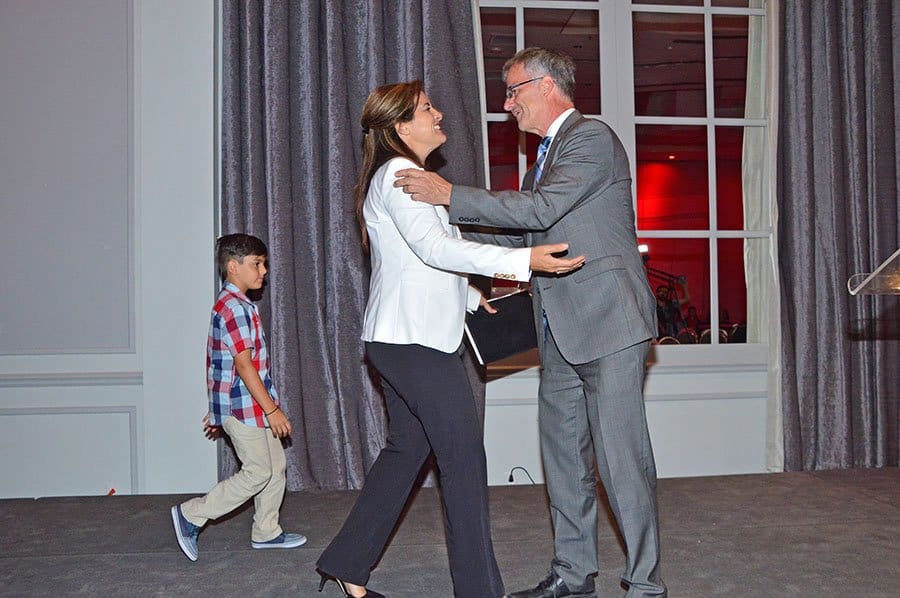
The Businesswoman of the Year award was presented by Evan Kiousis, vice-president for marketing at Planète Mobile and a Platinum Sponsor of the HBOT, to Chris Ann Nakis of the Nakis Group. Tony and Costa Antonopoulos, co-presidents of the Antonopoulos Group, were the recipients of the 2017 Deka President’s Award. Dr. Peter Limniatis, a dentist in Chomedey and longtime supporter of the Hellenic Appeal Foundation, was presented with the Deka Community Services Award.

Hellenic Board of Trade hosts annual awards gala at Le Windsor
Tony and Costa Antonopoulos, co-presidents of the Antonopoulos Group, were the recipients of the 2017 Deka President’s Award presented to them by HBOT president John Charalampopoulos.

More Deka Award winners

Other 2017 Deka Award winners: Bill Boriamos, president of Sunbec (Manufacturing & Processing Award); Harry Drakopoulos and Angelo Destounis, co-owners of Off the Hook (Young Entrepreneur of the Year); Jimmy Nikolidakis, president Miron Food Group (Distribution Industry Award); John Limniatis (Personality of the Year Award); Sam Erimos, co-owner of Supermarché PA (Retail Industry Award); Jim Alexopoulos, president of Stanex (Entrepreneur of the Year); Jim, Anthony and Adam Tzemopoulos, co-owners RD3 Restaurant Group (Restaurant Innovation Award).

Laval City Hall Watch – May 17 2017

Laval City Hall Watch - May 17 2017

 Landscaping green spaces on promenade Paton

The members of the executive committee approved a contract awarded to the Cusson-Morin Construction company for the modification of a green space on de la promenade Paton. The works include the installation of decorative lighting as well as the reengineering the landscaping in order to reduce heat islands. An urban heat island is an area that is meaningfully warmer than its surroundings because of human installations and activities. The temperature difference is often greater at night and is most apparent when winds are weak. Summer and winter months are most affected. It is suggested that the exchange of natural environments for concrete structures is the main cause of this effect while waste heat generated by energy usage is a secondary contributor. The return to natural environments is believed to result in the reversal of this effect.


Tree Planting project receives financing

Le Collectif de verdissement PlantAction is a nonprofit corporation whose mission is to educate residents about the importance of planting trees to beautify the landscape and counter heat effects of urban development. Since 2012 PlantAction has realized various projects that has resulted in the planting of 545 trees in the districts of Champfleury, Sainte-Rose and Fabreville East.

The city administration has contributed in these efforts by financing the purchase of 423 trees. The organization wishes to continue its mission in 2017 and has again asked the City for assistance. The Executive Committee has approved the awarding of a grant of $ 12,545 before taxes for the planting of 80 trees. This expense not only covers the purchase of up to 80 trees but also the materials and expertise needed to coordinate these installations.


MCCQ grant for the development of library collections

The Ministry of Culture and Communications of Quebec (MCCQ) has approved a grant of $ 1,093,300 destined for the city of Laval. This funding is from the 2016 budget under its project assistance program for the development of literary collections of autonomous public libraries whose objective is to enrich existing collections through the acquisition of books, periodicals, audiovisual documents and databases. The agreement requires the recipients of this financing to provide a contribution equivalent to at least 50% of the amount of this subsidy.


On the job training

The Executive Committee has authorized the City of Laval’s administration to receive several unpaid trainees over the next few months in various municipal departments. This on the job experience is an important element of the students’ professional development.


Improvements to the road network: bicycle paths and traffic calming measures

On the recommendation of the Engineering Department, the Executive Committee granted the Center for Urban Infrastructure Expertise and Research (CERIU) a contribution of $ 7,000 for the development of a guide for the maintenance of bike paths. This guide will enable Laval to develop an effective maintenance program to better prolong the life of this important network asset. The report will also provide recommendations addressing measures to improve cyclists and pedestrian safety. The City of Laval extends the green cycling network by an average of 25 kilometers a year.

In addition, the executive committee has also awarded a contract for professional fees of $ 128,351 (before taxes) to Aecom Consultants. They have been given the mandate to prepare preliminary plans and estimates in order to realize the projects that have been earmarked for installation in 2017.  Development of the bicycle path is an important element of the city of Laval’s active mobility plan. The plans are scheduled to be completed by May with construction scheduled to begin in June of 2017.

The executive committee awarded a contract of $ 103,939 (before taxes) to SNC-Lavalin for professional consulting services. The firms mandate is to prepare preliminary plans and estimates for traffic calming measures planned on various streets and intersections of the city.


Cultural development plan for the Laval region

In April 2015, the City of Laval adopted its strategic vision and plan for urban development for the next two decades. The Department of Culture, Recreation, Sport and Social Development began forecasting its priorities and strategies for future interventions. Among the issues identified the development of the cultural sector has emerged as a priority for the City and for local stakeholders.

In light of this fact the executive committee has awarded a professional support contract to Alexandre Warnet for $ 24,472.43 (before taxes). This mandate funds the realization of a cultural development plan for the Laval region which will be based on recommendations and findings of the cultural diagnosis undertaken by the Regional Council of Culture of Laval to be filed in 2017. The report will be the foundation of future negotiations with the Ministry of Culture and Communications for the signing of a multi-year cultural development agreement. The mandate also includes the organization of Laval’s Culture Summit which is scheduled for June 10th 2017.


Extension of the agreement Mobilization-Diversity program 2016-2017 with MIDI

In June 2016, the City of Laval and Quebec’s Department of Immigration, Diversity and Inclusion (MIDI) signed an agreement to provide a $ 400,000 budgetary envelope funded equally by both parties for projects and services geared towards the integration and inclusion immigrants in Laval society.

The Executive Committee has approved an extension of this agreement until June 30th for an additional three months. With this resolution, MIDI will allocate an additional $50,000 to be matched by the city to ensure continuity of funding while the details of the new agreement which will cover the period 2017-2019 and take effect on July 1st  2017 are finalized.


Grants of $170,000 to professional cultural organizations

As part of the Cultural Development Agreement between the City of Laval, the Quebec Ministry of Culture and Communications and the Laval School Board funding the 2017 Partnership Initiatives Program the executive committee has awarded subsidies to nine professional cultural organizations in Laval for the realization of various projects.

The list of organizations receiving grants include; Bluff Productions for RADICART an amount of $25,000, La Centrale des artistes (The Artist Central) for Parallel passage an amount of $25,000, Société d’histoire et de généalogie de l’île Jésus (Society of History and Genealogy of Jesus Island) for the History of Laval: A Time Line an amount of $10,000, Réseau ArtHist (ArtHist Network) for Ouimet and Smallwood: a story to be restored an amount of $20,000, Société des arts visuels de Laval  (Laval Visual Arts Society) for the Digital Creation and Mediation Laboratory an amount of $25,000, Les productions Le P’tit Monde (Productions Le P’tit Monde) for the Motivation and pleasure of writing: the great writing contest an amount of $22,000, Lis avec moi (Read with me) for The challenge: the great play of reading aloud an amount of $8,000, Centre d’archives de Laval (Laval Archives Center) for A living past an amount of $10,000 and Théâtre incline (Theater inclined) for Nordicity: second digital component an amount of $25,000.


Play Ball!

Martin C. Barry

For the second year in a row, the Pirates 440 Chevrolet de Laval and the Laval Regional Amateur Baseball Association – better known to fans as Baseball Laval – have announced their rosters of activities and events for the coming summer and fall.

The Pirates, who are part of the Ligue de baseball junior élite du Québec, played their season opener away from home last weekend against the Royal de Repentigny.

‘Les Pirates’ and Baseball Laval seasons have begun
According to Baseball Laval president Richard St-Amour, the number of players with the club has risen to more than 860 registrations for the 2017 season.

Pirates home opener

The Pirates have 43 scheduled games this season, according to Pirates president Jacques Continelli. They play their first home game on May 27 against the Gatineau Hull-Volant at Paul-Marcel Maheu Park in Laval. Continelli made the announcements during a press conference held by the two sports organizations on May 8 at 440 Chevrolet de Laval.

A special guest was French-language baseball sportscaster Rodger Brulotte, who is actively involved in the promotion of the sport among young athletes and who is also working behind the scenes for the return of major league baseball to Montreal. Sainte-Rose MNA Jean Habel also re-stated his commitment to encouraging sportsmanship in Laval in conjunction with the Pirates and Baseball Laval.

Baseball Laval president Richard St-Amour said that for the fourth consecutive year the number of baseball players (both male and female) who have registered with the organization has risen – suggesting that the sport may be undergoing a significant revival in Quebec and the region of Montreal.

Registrations are up

“It is with pride that I announce that we have more than 860 registrations for the 2017 season,” said St-Amour. In keeping with a longstanding tradition at Baseball Laval, the 2017 baseball season will open for the A and B minor divisions at Laval’s Centre de la Nature on the long weekend of May 20, 21 and 22.

“The Laval-east baseball club will once again host this event,” he continued. “All the teams should play a match during that weekend opening the season. As well, a match between the two Mosquito AA teams is on the program that weekend.”

This year, the Associés de Laval will have two teams in the Mosquito AA division, as well as one team in each of the other divisions, without forgetting a girls’ team in the Midget division. The inter-city baseball league began its activities on May 12.

Mother’s Day match

On May 14, which was Mother’s Day, the Associés held their very first Baseball Pink Day for the benefit of the Quebec Breast Cancer Foundation. The goal was to raise $3,000 for the foundation. For this very special occasion, players on the Associés team wore pink jerseys during their five matches which took place at Laval’s Chénier Park.

With regards to girls’ baseball, St-Amour made another important announcement. “We are very happy to announce that this year we will have four teams entirely for girls,” he said. “It’s in the Atom, Mosquito, Pee Wee and Midget divisions where you will find these teams made up of players coming from all the associations in Laval.”

Adapted baseball program

At the same time, St-Amour made a point of noting the important contribution made to regional girls’ and women’s baseball in Laval by Sonia Massicotte. He went on to explain that for a third season, Baseball Laval’s adapted baseball program will be back. This groundbreaking program is specially designed for youths with an interest in baseball, but who are physically challenged or have another type of limitation that would prevent them from participating if not for the efforts of Baseball Laval.

St-Amour said he was confident that the number of participants in the adapted baseball program should increase this year. “As provincial representative for the program, I would like to point out that we took steps with the Association québécoise pour le loisir des personnes handicapées in order to make the adapted baseball program known,” he said. “We believe that this should generate dividends beginning this year.”

Baseball clinic in June

As Baseball Laval’s president suggested, the 2017 Laval season promises to be an exciting one. For example on June 9, the Pirates 440 Chevrolet de Laval will be holding their Soirée Laval at the ball stadium in Paul-Marcel Maheu Park. At that time, the Pirates will be welcoming all the amateur baseball players and supporters in Laval.

On June 17, the Pirates 440 Chevrolet de Laval will be holding a baseball clinic aimed at improving the skills of ball players from all associations in Laval. This event will also be taking place at Paul-Marcel Maheu Park.

A season of activities

Then on August 12, the Vimont-Auteuil Baseball League will be holding its Festival Rallye Cap at Prévost Park. According to St-Amour, the focus of the day will be to get young players to simply enjoy the game. As such, six-on-six matches will take place and there will be complementary activities in an ambience of family fun.

Although the season’s end is still far off, that will happen in October when Baseball Laval will hold its traditional season closer – the 440 Chevrolet de Laval Gala. As Baseball Laval’s president put it, the gala will offer an opportunity to honour all the players, coaches, teams, match officials and baseball volunteers in Laval who distinguish themselves the most over the course of the coming season.

Super-Clinics for Laval

Barrette and Charbonneau announce six ‘Super-Clinics’ for Laval

(TLN)

Quebec Health and Social Services Minister Gaétan Barrette and Minister Responsible for the Laval Region Francine Charbonneau announced on May 1 the creation of six super-clinics under the umbrella of CISSS de Laval, as well as the start of a pilot project to speed up appointment-making at the new facilities.

As part of the arrangement, six existing family medicine groups (GMF) have been authorized by the ministry to begin operating as super-clinics. The six facilities are GMF Concorde, GMF Centre Médical Laval, GMF Médi-Centre Chomedey, GMF Sainte-Dorothée, GMF Sainte-Rose and GMF Polyclinique Fabreville.

Longer hours

According to a statement from the government, the super-clinics will be tailored to Laval’s specific needs. Two of the facilities will be open 84 hours per week, while the others will operate 76 hours per week, allowing clients to have access 12 hours per day, seven days a week at two of the super-clinics.

The pilot project, Rendez-vous santé Québec (RVSQ), will allow clients to make appointments online with family doctors. The project was actually announced in early April. It is being implemented in Laval first, before possibly being deployed in areas of the province. RVSQ will be available in June at GMF Concorde, GMF Centre Médical Laval, GMF Médi-Centre Chomedey, GMF Sainte-Rose and GMF Polyclinique Fabreville.

Appointments made online

“With the implementation of these six super-clinics and the first phase of Rendez-vous santé Québec, the population of Laval is at the forefront of changes we want to make overall to the network as concerns access to family medicine services,” said Barrette.

“These are things we are doing in order to make services more accessible to most Quebecers. With this project we are offering a concrete option other than a hospital, notably during evenings and on weekends. I salute the doctors and other health professionals who decided to become involved in this project which should have a positive impact on the population.”

Another option, says Charbonneau

Charbonneau said: “These six super-clinics will complement the service offer which already included family medicine groups in Laval, thus offering one more point of entry to access services. All this demonstrates that our government listens to the population and that it proposes concrete solutions which are adapted to their needs. I am proud that this project saw the light of day here in Laval.”

According to the health and social services ministry, the super-clinics will offer service to patients who are not registered with a family doctor. Patients will be entitled to a medical consultation on the same day or the day after by calling at least in three hours before closing.

Doctors working within super-clinics must use an electronic medical dossier and must also be prepared to handle increased demand for medical services in cases such as flu outbreaks. Additional information on the super-clinics can be obtained on the web at this address: www.msss.gouv.qc.ca/presse.


Petition to stop the split of Greek vote

Martin C. Barry

Several members of the Quebec National Assembly from western Laval have started a petition supporting the Hellenic Community of Greater Montreal’s bid to persuade the Quebec Electoral Commission to abandon a plan to restructure the ridings of Fabre and Chomedey which would split the Greek vote and render it less powerful electorally.

Greek natural community

“Since the beginning of work in Quebec on the reform of the electoral map, we have been very busy defending the Greek natural community,” said Fabre Liberal MNA Monique Sauvé who took part with Chomedey Liberal MNA Guy Ouellette in a press conference on the issue at HCGM headquarters in Montreal on April 19.

“In as much as we respect institutions, it’s very clear that our position is that the division of the Hellenic community in virtue of Article 15 of Chapter 1 of the Elections Act for us is a priority,” she continued. “Well above the mathematical equations, and above the calculations which might be made, the essence of this community which we all value must be respected.”

Ouellette said that he, Sauvé and Sainte-Rose MNA Jean Habel made representations on the issue to the electoral commission last September. “As Monique said earlier, the Greek community in Chomedey is the largest in the province of Quebec,” he said.

‘This is something that is going to diminish our political clout,’ says Hellenic Community of Greater Montreal president
“The essence of this community which we all value must be respected,” said Fabre MNA Monique Sauvé

Against electoral law

“The simple way that the Commission électorale split the Greek community was denounced by Monique, by Jean Habel from Sainte-Rose and by myself. It goes against our own electoral law and it goes against Article 15 that we pleaded in September 2016.

“That is the reason why there will be a petition on the National Assembly network which will be grandfathered by Monique,” Ouellette continued. “There will also be a petition in churches in Laval and in Montreal just to make sure that the voice of the Greek community will be heard at the electoral commission.”

Text of the petition

The text of the petition reads:

In consideration of the Quebec Electoral Commission’s (QEC) March 2nd 2017 decision to modify the electoral boundaries in the Laval-area ridings of Chomedey and Fabre respectively;

In consideration of the definition of a ‘natural community’ as defined in Article 15 of the Quebec Elections Act, being “an electoral division, which represents a natural community established on the basis of demographical, geographical and sociological considerations, such as the population density, the relative growth rate of the population, the accessibility, area and shape of the region, the natural local boundaries and the territories of local municipalities…”

In consideration of the QEC’s disregard of the above-noted Article 15 in the electoral boundaries redistribution process, We the undersigned, residents of the Chomedey and Fabre ridings in Laval, are opposed to the Quebec Electoral Commission’s March 2nd 2017 decision and request a reversal of said decision.

Laval MNAs launch petition to stop planned split of Greek vote
“This is something that is going to diminish our political clout,” said HCGM president Nicholas Pagonis.

HCGM letter to QEC

In a letter to the QEC from the Hellenic Community of Greater Montreal signed by HCGM president Nicholas Pagonis, he says boundary reform alternatives proposed by the HCGM ought to have been considered by the commission. He also noted that Ouellette, Sauvé and Habel supported the alternatives and remain dissatisfied with the new map being proposed by the commission.

“This is something that is going to diminish our political clout,” Pagonis said during the press conference, “something which should not be allowed to happen because it is our natural right to maintain that ability that we had up to now.” Pagonis also pointed out an irony in the redrawn riding map: two Greek Orthodox churches located in the same riding until now would henceforth be split between Chomedey and Fabre.

‘Easy way out,’ says Ouellette

While Ouellette acknowledged that an important reason the map of Chomedey is being redrawn is that the riding is growing fast and the size of its population is no longer within electoral norms, he said the QEC took the easy way to making its reform: they based it largely on an arbitrary line drawn at 100th Ave. in Chomedey, which is the virtual heart of the Laval Greek community.

“They have to work a little bit harder in dividing the six ridings in Laval in some other way, because I’m way above average, Fabre is under average, Laval-des-Rapides and Mille-Îles are under average, so we need to divide Laval in some other way,” Ouellette said. “But it takes time and a lot more work to do.”

‘Short term solution,’ says Sauvé

Sauvé added that the solution the QEC is proposing “is only a short-term solution. Because of the growth of the population in Chomedey they will have to do their homework again after the next election. The scenario that Guy proposed was on a long-term basis reality rather than just doing their homework again, doing it not the right way, and splitting again the community.” She said that what the three MNAs and the HCGM are proposing “is harder work, but also a long-term solution.”

Vimy MP Nassif announces $50,000 grant to Bio-K Plus

Martin C. Barry

Vimy Liberal MP Eva Nassif has announced that Bio-K Plus International Inc. has been approved for a grant of up to $50,000 to allow the company to reach new markets in the United States with their probiotic capsules and beverages.

According to Nassif, who made the announcement on April 24 at Bio-K’s headquarters on Armand Frappier Blvd. in Laval, the funding will be used to help raise consumers’ awareness about the health benefits of probiotic products, while increasing Bio-K Plus exports to the United States.

Rising awareness of product

With well-targeted promotional activities such as product demonstrations and tradeshow exhibits, the company hopes to increase demand for their products in all regions of the U.S. Probiotics are microorganisms which are believed to provide health benefits when taken orally. Since the late 1990s, the market for consumable probiotic products has grown as the public’s awareness of their benefits has also become greater.

The funding is being provided through the federal government’s Growing Forward 2 AgriMarketing program. Nassif said the Liberal government is committed to helping farmers and food processors grow their businesses, expand existing markets at home and abroad and create jobs to benefit the sector and all Canadians.

Expanding into global market

“Advances in innovation, such as this line of probiotics, help to keep Canada on the cutting edge,” said Nassif. “The government of Canada proudly contributes to expanding markets globally, which improves agricultural business competitiveness, creating jobs, helping grow the middle class and fostering long-term growth for the sector in Vimy and all across the country.”

Nassif praised the company for the progress it has made over the past two decades. “In 20 or so years, you have built a world-class business, while introducing consumers throughout the world to your products,” she said, while noting that Bio-K grew from 10 employees in the beginning to 100 now.

Company creates jobs

Nassif said the company is an example of the ability of small and medium-sized enterprises to create employment in the Canadian economy, and that Bio-K is considered a pioneer in its domain through the development of cutting-edge and scientifically-based production methods. “If Canada remains at the forefront, it’s thanks to your advances in innovation – your range of probiotics being a good example. I have a lot of respect for everything you do.”

“This financial assistance will help with our development in the United States,” said Isabèle Chevalier who is co-president of Bio-K Plus International along with her brother François-Pierre. “The funding will be used, among other things, to hire a resource in the U.S. territory and to develop our worldwide innovation, which is recognized by Health Canada for the primary prevention of Clostridium difficile infections in order to reduce infections and alleviate the suffering of patients in hospitals,” she added.

What do you know about ants?

Species known to invade homes in Canada include the carpenter ant, the little black ant, the odorous house ant, the thief ant, and the pharaoh ant. While some of them can sting, most of them are not aggressive. However, carpenter ants are well known for their ability to damage wooden structures and they can become a nuisance.

Here are some tips to find carpenter ants:

  1. Completely inspect areas of high moisture, wood in contact with the soil, areas where ventilation is poor, and exposed structural lumber.
  2. Figure out if there is actually an infestation of carpenter ants or if it is just individual ants wandering in the house. Look for a high concentration of ants in a particular area like under the kitchen sink.
  3. Pay attention to foraging ants and the patterns of their movement. For example, there may be a trail communicating with a parent colony outside. (Note: ants are most active after sunset.)
  4. Notice if there are swarms of winged ants trying to escape to the outdoors, usually in the spring.
  5. Look for piles of sawdust-like borings outside galleries dug by ants.
  6. Listen for the sound of an active colony, which will create a dry rustling noise that can be heard best at night during high ant activity and quiet time in the house. Use a wine glass or stethoscope to listen to the walls.

Ants

What are they?

Ants are tiny insects and may be black, brown, red, or yellow. Adult ants range in size from as small as 1 millimetre (1/16 to 1/32 inch), like little black ants and thief ants, to as large as 13 millimetres (1/2 inch), like carpenter ants.

Should I be concerned?

Most ants commonly found in Canada are not aggressive, although some can sting. Ants should be tolerated as much as possible since they cause little damage in the garden. They can even be considered beneficial because they eat other insects like young silverfish and moths.

Species known to invade homes in Canada include the carpenter ant, the little black ant, the odorous house ant, the thief ant, and the pharaoh ant. Pavement ants can become a nuisance in lawns, gardens, and pathways, as well as indoors.

Carpenter ants are larger than other species, although the sizes of the workers vary. They can cause structural damage to homes as they destroy wood to make room for their nests. Piles of sawdust may mean you have carpenter ants.


How can I get rid of ants?

Prevention

Ant colonies send out scouts to search for food. Ants are attracted to many types of food. They enjoy eating sugary and greasy foods (like peanut butter or crumbs) and are also attracted to the “honeydew” produced by aphids on infested houseplants. A successful scout leaves a scented trail for other workers to follow back to the food source.

Removing access to food and water is the easiest way to avoid pest problems:

  • Store ant-attractive foods in glass jars with rubber gaskets, or in plastic containers with lids that snap tight.
  • Keep kitchen countertops clean. Sweep or vacuum the floor often, especially around pet dishes.
  • Rinse containers before putting them in the garbage or in recycling bins.
  • Empty kitchen garbage containers often.
  • Place composters at a reasonable distance from your house.
  • Place pet food dishes in a shallow dish of water. Ants can’t swim, so they won’t be able to get at your pet’s food.

Physical control

  • Repair and seal as many visible cracks in the foundation and exterior walls of your house as possible.
  • Indoors, caulk along baseboards, cracks, and crevices to keep ants from passing through your house. If needed, use duct tape or petroleum jelly to temporarily seal cracks.
  • Ants will not cross sticky barriers. Try placing two-sided tape around the legs of plant stands.
  • Flood ant nests repeatedly with a garden hose to encourage the ants to move farther away from your house.
  • Pour boiling water and detergent down the nest to temporarily reduce the population of a colony.

Non-chemical products

  • Diatomaceous earth can be placed in cracks and crevices as a non-chemical means of control. This powder is made up of crushed microscopic marine fossils that scratch the outer “skin” of ants, causing them to dehydrate and die. Diatomaceous earth will remain active as long as it is kept dry. It is non-toxic to humans and pets, but be careful not to inhale the dust when applying this product.
  • Natural gum resins can be applied around the base of trees and vines.

Important!

If you use a pesticide to control your pest problem, read the label to make sure you are choosing the right product for the right pest. Follow all label directions and warnings carefully. Always look for a Pest Control Products (PCP) number on the label so you know the product has been approved by Health Canada. See Use pesticides safely for more information on using pesticides safely.

Many chemical products can be used by consumers to control ants:

  • Chemicals, sprays, and dusts can be used effectively as barrier and nest treatments. Applying a chemical directly on the nest may eliminate colonies. Anthills show where the colony has built a nest, so look for anthills in your yard or follow the ant trails back to the nest. Nests located indoors in wall voids can be treated with dusts that can be puffed into the area.
  • Chemical barrier treatments can be applied to baseboards or door and window frames to keep outdoor nesting species from searching for food indoors. Spraying indoors where trails have been noticed may cut off food and water sources for an indoor nest and encourage the colony to split into multiple new colonies. If the treatment seems to increase the number of ants, try using a bait system to control them.

Did you know?

Some provinces and municipalities have placed more restrictions on the use of certain approved lawn and garden pesticides. Please check with your city, province, or local lawn care centre for more information.

Bait systems

Ants gather food and bring it back to the nest to feed ant colony members. So a bait system must work slowly enough to allow the poison to be fed to all members of the nest. This is a highly effective way of getting rid of nests. Baits containing boric acid are generally of low toxicity to other animals.

  • Place bait stations directly in the path of foraging ants, but out of the reach of children and pets. Ant trails are commonly found along baseboards, the carpet edge along walls, or along the edges and inside corners of cabinets.
  • Use plenty of bait stations. Two different baits at the same time will give better results.
  • Keep baits available for at least two weeks. Repeated bait applications may be needed.
  • Do not use chemical sprays to kill ants while using a bait system, or the bait system will not work. Reapply the bait if needed.


Carpenter ants

What are they?

The red carpenter ant and the black carpenter ant are two of the most common types found in Canada. The red carpenter ant has a dark brownish-black body, with a reddish-brown upper body. The black carpenter ant is dark brownish-black all over.

Carpenter ants are from 6 to 25 mm (.24 to 1 inch) long. A carpenter ant’s body is divided into three segments, with a very slim waist separating the upper body and lower body. Their antennae are bent and in sections. Male and female adults have wings at mating time.

Should I be concerned?

Carpenter ants are well known for their ability to damage wooden structures. They are also a nuisance in homes as they search for food. Carpenter ants eat both plant and animal matter. Their natural food sources are insects, other small invertebrates, and sweet body fluids from aphids and other insects. Protein and sweet foods found in and around homes also provide food for foraging workers.

Carpenter ants build nests by burrowing into wood. They dig tunnels (called galleries) much longer than those created by termites. The wood is not eaten, but thrown from the nest as sawdust-like shavings.


Did you know?

Carpenter ants are sometimes confused with termites, but it is easy to tell the difference between them. The termite has straight antennae and a thick waist, and the carpenter ant has a very narrow waist and “elbowed” (bent) antennae. Termites are found only in certain areas in Canada.

Carpenter ants live in large colonies with hundreds of workers (all sterile females), several males and females that reproduce, and one or more queen. When part of an established colony goes into a nearby structure, it sometimes establishes a smaller satellite colony there. Some experts believe this is the main way carpenter ants invade houses.

How do I know if I have a problem?

Outdoors, carpenter ants are found in dead trunks of standing trees, stumps, or logs, or under fallen logs and stones. They can sometimes mine sound wood, but they usually choose a soft type, like pine.

Indoors, because they prefer moist, decaying wood, carpenter ants can signal a moisture problem, or wooden structures that are decaying. As well as tunnelling in the trim of buildings, wooden steps, and window sills, ant colonies can nest in houses without attacking structural timbers, using hollow spaces like wall voids, attic spaces, and hollow doors. They can even be found behind books in libraries, behind drawers in dressers and cabinets, and in styrofoam insulation.

Carpenter ants get into houses by several ways:

  • windows
  • holes in foundations
  • heating ducts and air-conditioners
  • power or telephone cables
  • points where tree branches or other vegetation come in contact with the house
  • wooden structures attached to houses (like porches and sheds)
  • firewood brought into the house

To find carpenter ants:

  1. Completely inspect areas of high moisture, wood in contact with the soil, areas where ventilation is poor, and exposed structural lumber.
  2. Figure out if there is actually an infestation of carpenter ants or if it is just individual ants wandering in the house. Look for a high concentration of ants in a particular area like under the kitchen sink.
  3. Pay attention to foraging ants and the patterns of their movement. For example, there may be a trail communicating with a parent colony outside. (Note: ants are most active after sunset.)
  4. Notice if there are swarms of winged ants trying to escape to the outdoors, usually in the spring.
  5. Look for piles of sawdust-like borings outside their galleries and slit-like openings in woodwork.
  6. Listen for the sound of an active colony, which will create a dry rustling noise that can be heard best at night during high ant activity and quiet time in the house. Use a wine glass or stethoscope to listen to the walls.

How can I get rid of carpenter ants?

Physical control

  • Clear away any decaying or infested wood from around buildings.
  • Remove firewood from inside buildings and away from the sides of buildings.
  • Do not bury stumps or other wood debris close to your house.
  • Pay attention to the state of landscaping props (like decorative bark, retaining walls, and driftwood).
  • Correct humidity problems in your home.
  • Replace decaying or infested structural wood with sound material.
  • Remove food sources to discourage ants from invading buildings.
  • Keep food in sealed containers and regularly sweep up all crumbs and other food fragments.
  • Keep your home clean to prevent re-infestation.

Products

Important!

If you use a pesticide to control your pest problem, read the label to make sure you are choosing the right product for the right pest. Follow all label directions and warnings carefully. Always look for a Pest Control Products (PCP) number on the label so you know the product has been approved by Health Canada. See Use pesticides safely for more information on using pesticides safely

Chemicals can help you eliminate existing nests and prevent new nests from forming. Chemical control works best when you use it along with physical control.

Once a colony is well established, you usually need to locate and treat the actual nest site for permanent or long-term control. In the case of a satellite colony, the parent colony should be located and destroyed for most effective control. In difficult situations, use a professional exterminator.

Various pesticide products for are available for homeowners, and can help reduce the number of ants infesting your house. If you plan to do an indoor application, check the product label to make sure it is registered for use inside your home. There are also several other commercial products available to professional pest control operators.

For commercial food processing or preparation, use products specifically labelled for these areas. Carefully follow all label directions and warnings. Remove or cover all food, packaging material, and utensils before treatment. Afterwards, wash all surfaces that may be in contact with food and rinse thoroughly with water before re-use.

Please note: When applying pesticides, you should leave any dead ant bodies where they are. Other scavenging ants will either eat or bring the dead ant back to the nest to feed the rest of the colony. In this way, the pesticide’s effect is passed on.

For more information on ants:
https://www.canada.ca/en/health-canada/services/pest-control-tips/ants.html


Laval News Volume 25-10

Laval News Volume 25-10


Click here to read the Laval News Volume 25-10 online 


Front page image of The Laval News Volume 25 Number 10
Image of Laval News Volume 25 Number 10

This is a archived copy in PDF format of the Laval News Volume 25-10 that was published and distributed May 17th, 2017.

This issue covers local events such us politics, sports and human interest stories. It features editorials and other columns

Laval News Volume 25-09

Laval News Volume 25-09

Front page image of The Laval News Volume 25 Number 09
Image of Laval News Volume 25 Number 09

Click here to read the Laval News Volume 25-09 online 


This is a archived copy in PDF format of the Laval News Volume 25-09 that was published and distributed May 3rd, 2017.

This issue covers local events such us politics, sports and human interest stories. It features editorials and other columns

Weather

Laval
scattered clouds
29.5 ° C
30.4 °
27.7 °
65%
1.8m/s
38%
Thu
30 °
Fri
31 °
Sat
28 °
Sun
28 °
Mon
26 °