The City Councillor for Saint-Bruno and Opposition Critic for Sports, Culture and Recreation, David De Cotis, is delighted that work will begin soon to revitalize the Odyssée-des-jeunes school park with the construction of a new state-of-the-art athletics facility.
Supported by
the Councillor since its conception, the construction work should begin next
month and be completed in time for the June 2020 Jeux du Québec, for which Laval will be the host city. However, for
David de Cotis, this should not only
be seen as an expense for the Jeux,
but also for the years to come, and for the benefit of all the young people and
active citizens of the sector.
“I supported this project and participated in
its design as soon as it was suggested by the municipal services in 2017! It is
not only for the Jeux du Québec, it is a legacy that will allow our young
people to practice their sports in their environment and in their
neighbourhood, without having to travel elsewhere in the city or in Montréal.
This is the main reason for my support to the project”, he said.
The
Councillor for Saint-Bruno considers this project to be one of his main
achievements in the neighbourhood, in addition to the Lausanne Community
Centre, which, he says “create a sense of
belonging and a real neighbourhood life. Having the Jeux du Québec in our
neighbourhood is an honour”.
As for the
removal of about twenty trees, as communicated by the public works department
to make way for the site, the Councillor considers this “unfortunate” but necessary, given
that most of these trees are affected by the emerald ash borer.
“I will ask and ensure that they are
replaced quickly, it is a school ground and a huge green space, the presence of
trees is important”.
In
conclusion, David De Cotis reiterates his will to work tirelessly for the
citizens of his district and for better neighbourhood infrastructure throughout
Laval. “Citizens are asking us to improve
and add local sports infrastructures, rather than focusing everything in the downtown
area. Our caucus and our party, Action
Laval, are committed to this approach, you can count on us!”.
The Honourable Mélanie Joly, Minister of Tourism, Official Languages and Francophonie
The Honourable Pablo Rodriguez, Minister of Canadian Heritage and Multiculturalism
Madam Minister, Mr. Minister,
The Association de la presse
francophone (APF) and the Quebec community Newspapers association (QCNA) were
looking forward to the tabling of the 2019 Federal Government Budget with great
hope. Since 2016, the APF and QCNA have shared their expectations with the
government so that newspapers in our official language minority communities
(OLMCs) can continue to protect democracy and serve the public interest within
their respective communities.
The measures proposed in your
budget to support Canadian journalism show that the government has not considered
the most vulnerable Canadian newspapers that serve OLMCs in Canada’s ten
provinces and three territories. The proposed eligibility criteria for an
eligible Canadian journalistic organization (OJCA) do not consider the needs
and realities of the smallest newspapers in our OLMCs.
Due to decisions made by the
federal government in the past decade, including the virtual disappearance of
federal advertising in OLMC media, most of our newspapers have been forced to
adapt their business model by reducing the number of journalists. To be
considered an OJCA and to be eligible for the tax credit, the media must employ
at least two journalists at least 26 hours per week. The media will not be able
to access the tax credit if it is already receiving a grant from the Canada
Periodical Fund’s Aid to Publishers program. These criteria disqualify many of
our newspapers twice rather than once.
However, Part VII of the Official
Languages Act (OLA) requires federal institutions to apply criteria that consider
the realities and needs of OLMCs when developing programs and services.
Community media play an essential
role in the development and vitality of OLMCs and are often the only source of
written information in official languages in a minority situation for an entire
province or territory. The report of the Standing Committee on Canadian
Heritage (June 2017) eloquently demonstrates this. The conclusions of the
Office of the Commissioner of Official Languages’ final investigation report
(June 2017), agree with the same conclusion.
While the 2018-2023 Action Plan
for Official Languages offered us some support to better serve OLMCs in terms
of civic journalism, the measures only partially meet the pressing needs of our
newspapers, which, despite their sustained efforts, are unable to cover the
substantial losses of the past ten years.
At this point, the status quo is
not acceptable as it will result in the most vulnerable being very
disadvantaged and some of our media will not survive. We will contact your
office in the coming days to obtain an emergency meeting to identify, with you,
winning solutions to ensure that the government respects its obligations under
Part VII of the OLA and allows official language minority community newspapers
to benefit from the positive measures to support Canadian journalism announced
in your budget this week.
LILY RYAN FRANCIS SONIER
Interim President President
Quebec Community Newspapers Association Press Association Francophone
On March 26th, in a show of support for a teacher who was allegedly insulted and degraded by a parent member of the Laval Senior Academy (LSA) governing board, about 40 teachers quietly gathered in the school library in anticipation of the board’s regular monthly meeting. The alleged altercation, which turned into a war of words, according to the teacher, occurred in the staff parking lot prior to the governing board’s September meeting.
Waiting with
others for the March 26th meeting to start, Laurier Board
commissioner James Di Sano was asked by TLN if he was aware of the reason for
the unusually large crowd in attendance. “I have no idea,” he answered.
As everyone waited for the meeting to begin, tensions rose. By 7 pm, four parent representatives were no-shows. At 7:15 pm governing board chairperson Douglas Howarth dismissed the meeting, simply noting – “no quorum.”
As the gathering began to disperse, TLN asked Mr. Howarth if he was advised beforehand that the parents would be absent. “Not all of them,” he answered. LSA Principal Nathalie Rollin, added that there was a last minute call. “I guess they all have the flu,” she stated.
TLN spoke with several teachers in attendance, on condition of anonymity. TLN was told that the teachers had prepared a letter to be read into the record. Addressed to the Governing Board, the letter contained specific requests. The letter will be presented at the April 29 meeting.
Before the
meeting was to begin, two teachers requested that TLN refrain from publishing
pictures of them in any forthcoming reports. Although no explicit reason was
given for the request, it appears to stem from a fear of reprisals from the
employer, the Laurier School Board. TLN has also learned from several sources
that the LSA principal made a plea for teachers to stay away from the meeting.
Another source,
who also asked for anonymity, told TLN “It’s in everyone’s best interest to
develop and foster positive and professional working conditions with all governing
board members. This begins with
effective communication, which seems to be lacking on the Laval Senior Academy
Governing Board.
Next day, on
March 27th, following the regular monthly meeting of the Laurier
School Board, TLN asked Chairperson Paolo Galati if he was aware of what was
happening at the Laval Senior Academy Governing Board. “I’m not aware, but I
will definitely look into it,” he assured. “I was in the building for another
event that evening, but it wasn’t brought to my attention. I should have dropped
in,” he added. Asked his opinion on the prospect of having to deal with
governing boards who would eventually become the ‘bosses’, according to the
government’s intention to abolish schoolboards, Mr. Galati expressed concern
and recommended that TLN transmit its view of the situation to Christopher
Skeete, the Québec cabinet minister responsible for services to Anglophones.
TLN informed Mr. Galati that the tramsmission of these concerns is the purview
of the schoolboard, not the press.
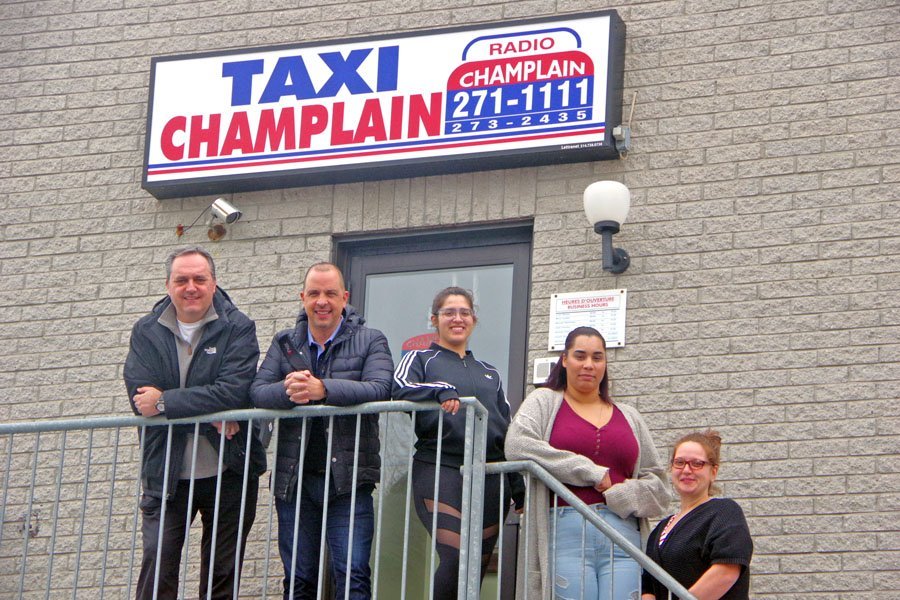
Champlain Taxi president George Boussios and taxi driver Peter Hatzis are seen here with support staff who are likely to lose their jobs sometime after Bill 17 passes.
Martin C. Barry
The head of Montreal’s largest taxi service is
predicting that the region’s traditional taxi industry will cease to exist
within three years after the Coalition Avenir Québec government passes Bill 17 to overhaul the taxi industry and level
the ground for alternate taxi and ride-sharing services like Uber and Lyft.
‘Inhumane’
treatment
“It’s an inhumane law,” George Boussios, president of
Champlain Taxi, said in an interview with Newsfirst Multimedia. “It is going to
get 22,000 families, 8,000 permit holders into bankruptcy.”
Not only will the businesses they operate be
eventually forced shut because the legislation, he added, but the operators
will also end up unemployed “because most of these people know nothing else but
driving a taxi.”
Says
law favours Uber
Boussios
maintains that CAQ Transport Minister François Bonnardel was greatly influenced
by lobbyists for Uber Quebec into drafting Bill 17 (whose full title is ‘An Act
respecting remunerated passenger transportation by automobile’) in a way that
favored global ride-sharing services.
“Just
to please these ride-sharing companies – these multimillionaire Ubers and Lyfts
that come into cities, are terrible corporate citizens, they don’t follow the
rules and don’t follow regulations, they destroy everything – to please them,”
Boussios said.
A loss for real taxi drivers
While
Bonnardel has stated that the basic purpose of the legislation is to level the
field for all types of taxi transportation services, Boussios claimed the
actual outcome will be to turn the traditional taxi driver into a driver for
Uber or Lyft.
While
the previous Liberal government had created some initial regulations of its own
for the new ride-sharing sector – including 35 hours of driver training and a
Class 4C license (taxi and limousine operation) – Bill 17 will require only a
Class 5 license (automobile operation). As well, the “T” license plate system
for taxis ends, and there will no longer be annual inspections.
Champlain Taxi president George Boussios and taxi driver Peter Hatzis say Bill 17 unfairly favours the ride-sharing industry at the expense of conventional taxi services.
Toll on the economy
Boussios
pointed out that Caisse Desjardins has already reacted to the elimination of
the taxi operation license system by noting that this will leave the
Quebec-based banking institution on the hook for millions of dollars in liens
and loans taken out by taxi drivers and fleet operators. They borrowed to pay
the sometimes six-number cost for an operator’s license, which will effectively
become worthless with the passing of Bill 17.
Although
the CAQ government has added $250 million to a previous $250 million fund the
Liberals set up to compensate for the loss of value of existing taxi permits,
Boussios said it is not an actual buy-out of permits. “If this government wants
to buy back our permits, it’s $1.3 billion they have to give us, and then they
can get rid of us,” he said. “But we don’t even want that. We just want to keep
our work.”
A struggle for survival
With
a little more than two months to go before a deadline the CAQ has set to pass
Bill 17, Boussios said he and others in the taxi sector have barely been able to
think about a strategy for their survival. “We’re trying to figure out how we
can survive, but we haven’t gone into depth about our future. But just looking
at this Bill 17, it’s not good for the whole taxi industry.”
In
addition to the taxi drivers who will be impacted, Boussios said taxi company
dispatchers and other support staff will also be affected. Recent immigrants to
Quebec and Canada (who historically have worked as taxi drivers) will be particularly
affected, he added.
Says there will be social costs
And
if the government thinks it’s going to save money in the long-run, he said they
have another thing coming. “They’re going to pay for it with welfare and social
services, with unemployment. In the long-term, it’s probably going to cost the
state more than it would cost to buy them out. Don’t forget: these people are
often driving a taxi because they can’t do anything else. So what will they
do?”
While
the traditional taxi industry has been portrayed during this conflict as
reacting particularly strongly against Uber, Boussios insisted, “It’s not about
Uber – it’s about eliminating 10,000 jobs and businesses to make a terrible
corporate citizens that doesn’t pay its taxes the main transportation in
Montreal.”
Sees communists behind it
Peter
Hatzis, who sits on the Champlain Taxi board and also drives a taxi, loathes
Bill 17 so much that he sees it as the work of communists. “As far as I’m
concerned in a communist country you have no choice,” he said.
“What
I see here in this province is we don’t know what our choices are. One day it’s
like this, the next day they sweep the carpet right out from under our feet.
They change from day to day without consulting us, without asking us.”
March 29 – The province’s independent
investigations bureau (BEI) is investigating how Laval police conducted their
intervention of a suicide last Thursday.
The incident occurred at 1 a.m. when
Laval police answered a call about a potential jumper from the Viau Bridge.
Officers tried to talk to the man in his
twenties, but he did not respond before he jumped.
Police officers in a second patrol car
parked on the bank of the river saw the man sink into the river. His body has
not yet been found.
The investigation was handed over to the
BEI since the incident occurred during a Laval police department intervention.
The Sûreté du Québec is providing
technical support for the independent investigation.
Driver
Charged in Passenger’s Death
March 28 – Police arrested 28-year-old
Nicolas Pineault after receiving conclusive toxicological reports concerning a
violent car crash that claimed the life of the passenger in the vehicle that
Pineault had been driving.
Early in the morning of October 24,
2018, Pineault had been at the wheel of the vehicle that crashed into a
street-cleaning vehicle on highway 335, south of Boul. des Mille-Îles. Pineault
survived, but the passenger in his car did not.
The toxicology tests revealed that
Pineault had consumed a large quantity of drugs prior to the fatal collision.
The 28-year-old was arrested and faces
multiple charges, including dangerous driving causing bodily harm and death. He
was released on bail with conditions. Pineault is next scheduled to appear in
court on June 12.
Police
Seek Bank Robber Suspect
March 22 – Laval police are asking for
the public’s help to locate 55-year-old Jean-Guy Vallière, wanted in connection
with an armed robbery at a National Bank branch in Pont-Viau.
The incident occurred at 11:15 a.m. on
February 18 at the National Bank branch located at 61 Boul. des Laurentides
near Boul. Cartier and the Cartier metro station.
The robber entered the bank and made his
way to the first teller where he demanded cash. He went to the second teller
and repeated his demand.
He managed to steal about $1500 before
fleeing on foot.
Laval police issued an arrest warrant
for Jean-Guy Vallière.
He is described as a white, 55-year-old,
French-speaking male.
He stands 1.75 m (5’9”) tall and weighs
113 kg (250 lbs). He has grey hair and a flower tattoo on his right hand.
During the robbery, he wore a black
coat, a grey hoody, gloves, and a Toronto Blue Jays baseball cap.
Vallière’s image was captured by metro
surveillance after the robbery.
Anyone with information on Vallière’s current
whereabouts is urged to call the police info-line and speak confidentially with
an officer at 450-662-INFO (4636), or 911, and mentioning file LVL 190218 036.
From the left, Agape social worker Ian Williams, statistical research consultant Joanne Pocock and Agape executive-director Kevin McLeod
Martin C. Barry
A statistical report prepared for the Agape
Association, comparing the developmental delays of kindergarten children
enrolled at French and English school boards across the province, paints an
alarming picture of the higher vulnerability of English-speaking pre-school
children in Quebec.
The report – Selected Characteristics of Laval’s
English-speaking Children 0-5 – was compiled and written by Dr. Joanne Pocock,
an Ottawa-based statistical research consultant who has also produced
statistical reports for the Quebec Community Groups Network. It was released on
March 22 during a gathering of Laval-area social services providers at the
Centre Jeunesse de Laval on Cartier Blvd.
Development
delays
“Here we are looking at kindergarten children
experiencing developmental delay in at least one domain,” Pocock said in an
interview, while pointing to some PowerPoint graphics she said illustrate the
situation.
“This is the French-language system. This is the
English-language system over the same territory. If you look at all of Quebec,
what is red is where there are high levels of delay, and so vulnerable
children. And the dark green is where there are low levels.”
Contrast
is startling
As Pocock pointed out, not a single green spot is to
be found in the French chart, although it shows some patches of red. By
contrast, the English chart – illustrating the same problem for developmental
delay in 0-5 year-old kids speaking English – is solid red.
“To me the two contrasts here are quite shocking,”
said Pocock. She was asked whether she drew any conclusion from the picture
drawn by the data. “I could only hypothesize,” she said cautiously.
Socio-economic
decline
“One thing we know about developmental delays in 0-5
children, one thing we look at in socio-economic status of the community but
also of the family, at 0-5 your life is kind of still wrapped up in your
parents, in your mother, what have you. So we’ve seen socio-economic decline in
the Anglophone communities. It may be playing out in this developmental delay.
That’s a speculation entirely, though.”
She also offered the following tentative explanation. “The
other thing is access to services. Usually if you didn’t get your pre-natal
classes, if you don’t have health literacy, if you’re not engaged with your
health system, if you’re not getting an early diagnosis and treatment for your
0-5 child, then that can show up in developmental delay at the kindergarten
level.”
Change
needed, says McLeod
Agape executive-director Kevin McLeod agreed the
findings are alarming. “It’s overwhelming,” he said. “So many delays across
Quebec for English-speaking kindergarten children. We already knew this in
Laval, but to see it all across Quebec like that really says that we need to be
making changes.”
He maintained that more early intervention may offer
the solution, although there are other problems in the system. “One of the
biggest issues we’re facing in Quebec is waiting times for diagnosis. Whether
you’re English or French-speaking it’s unacceptable. Children nowadays wait for
evaluations and can be waiting for up to a year-and-a-half for diagnosis.”
Lone
parent impact
Some other findings from the survey: In
2016 in Quebec’s English-speaking communities, there was a greater tendency for
females to be living in lone parent families compared to males. In the Laval
region and in all four CLSC territories, there are more English-speaking
females living in lone parent families than English-speaking males.
The
greatest proportion of children 0-5 living in a lone parent household for both
the French and English language communities of Laval are located in CLSC
Pont-Viau. In 2016, there were high levels of low income among Quebec’s English
speakers aged 25 to 44. In the Laval region, 28.8 per cent of English speakers
aged 25 to 44 were living on an annual income under $20,000.
Some other findings
In
2016, the tendency to be earning over $50,000 was lower among Quebec
Anglophones aged 25 to 44 compared to Francophones of the same age. In Laval,
this holds true although the gap between the minority (35.2 per cent) and
majority group (38.4 per cent) is somewhat smaller.
Provincially,
English-speaking children aged 0-5 are more likely to be living below the low
income cut-off (LICO) compared to Francophone children of the same age. In
Laval, the tendency of children 0-5 to be living below LICO varies across CLSC
territories for both language communities.
Mayor Demers pleased with CAQ government’s first budget
(TLN) Laval mayor Marc Demers says he is pleased with
the Coalition Avenir Québec government’s first annual budget which was released last week by
Finance Minister Éric Girard.
Demers said he was impressed by the $16.6 billion
amount over 10 years that the government allotted to public transit.
Pleased
with measures
“This measure squares perfectly with the vision at the
Forum on Mobility and public transit to develop an integrated network of
transport for Laval-Lower Laurentians with the goal of countering road
congestion,” said Demers.
“Also, I am happy to see that several measures which
emerged from the Forum can be seen in the Quebec Plan for Infrastructures,” he
added.
More changing stations
The
CAQ government’s extension of its ‘Roulez vert’ program, which facilitates the
purchase of electric vehicles, as well as the acquisition of electrical
charging stations, were both greeted eagerly by the mayor. The measures are
added to similar ones announced in the federal budget recently.
Laval
has a considerable number of households on its territory with low revenue,
while also suffering from a deficit of social housing units to meet that need.
As such, Demers said he also welcomed the government’s supplementary investment
of $250 million. “With this amount, we hope to be in a position to support the
realization of social, community and affordable housing projects on our
territory,” he said.
Integrating immigrants
Laval
is the second-most important area in Quebec where new immigrants first arrive.
In the context of a growing Laval economy, the mayor said the government’s
announcement of $733 million to further integrate the new arrivals in the work
force is encouraging.
“Laval is among the leaders in its making available
cultural activities to children,” continued Demers. “As such, we can only
rejoice at the investment of $135 million for cultural outings in school
settings. What’s more, in a city that positions culture as an important vector
of its development, the measure linked to creativity and cultural
entrepreneurialism that was announced will allow to better support cultural
artists and players from Laval.”
Budget reactions from Laval Chamber of Commerce and Industry
(TLN)
The Laval Chamber of Commerce and Industry issued statements last week reacting
to the new budgets issued by the federal and provincial governments.
Ottawa ignores deficit
Regarding
the federal budget, the CCIL said it is concerned about Ottawa’s continuing
practice of not dealing with the growing federal deficit. Among the federal
government’s measures the CCIL felt were most important were those affecting
the availability of labour and improvements for transportation.
“The
Chamber feels that all initiatives helping business to face an urgent shortage
of labour, as well as development of skills for workers and access to
employment, must remain priorities for our government and put forward so that
our businesses can answer adequately to the needs of the markets in an
extremely competitive environment,” said CCIL president and executive-director
Louise Leroux.
Sustainable measures
Regarding
sustainable mobility, the CCIL said it recognized efforts in the budget to
encourage businesses to use electric vehicles with zero or low emissions
through subsidies. The CCIL was also impressed by federal measures to encourage
low energy use in building and construction, as well as by the government’s
encouragement of sustainable development practices within businesses.
While noting that Ottawa
expressed its intention to invest substantially in the deployment of high-speed
Internet everywhere in Quebec, the CCIL said that industrial parks should be a
major focus of this. “The automation and
digitalization of businesses demands fast access to information and new
technologies,” said Leroux, while adding that some businesses in Laval’s
industrial parks don’t yet have access to high-speed Internet at a price that
is competitive.
No plan for deficit
Regarding the federal deficit
of $19.8 billion, the CCIL said it was concerned the government has no plan for
eventually reducing the debt. “Given the favourable economic circumstances
these past few years, we would have wished to see in this budget a more
concrete plan to favour a return to budgetary equilibrium,” said Leroux.
Regarding the
highly-publicized situation of regional print media in recent years, the CCIL
said it was disappointed the federal government didn’t include measures to help
regional media who have suffered from steep losses of advertising revenue.
Pleased with CAQ
budget
Regarding the provincial budget, the CCIL said it was
pleased by measures introduced by the new CAQ government that will help with a
labour shortage being felt particularly by businesses located in Quebec’s
outlying regions.
The Chamber said it was happy about provincial budget measures designed to help businesses retain employees older than 60 years who are experienced. Another measure that pleased the organization was integration of immigrants. As well, the Chamber said it was happy about investments being made by the CAQ government to strengthen the position of the French language in the sphere of business, manufacturing and services.
Sir
Wilfrid Laurier School Board Satisfied with the 2019-2020
Québec Budget
The Sir Wilfrid Laurier School Board (SWLSB) is pleased with the outcome of the 2019-2020 budget announced yesterday. Although it is too early to communicate specific details as to the outcome this budget will have on the SWLSB, the 5.1% increase announced for the education sector demonstrates that the government is making education a priority. The school board looks forward to seeing the new budget rules.
“I am pleased with the government’s budget and
I am reassured that education remains at the forefront. I am confident that this
new injection of funds will allow us to expand certain services and programs
that will benefit our students.” stated Mr. Paolo
Galati, SWLSB Chairperson. The school board is also pleased that this budget
includes additional funding towards investment and maintenance of
infrastructure, which is much needed. Another positive element is that funds
will be dedicated to measures to support teachers and promote the teaching
profession.
The
Sir Wilfrid Laurier School Board is the third largest English school board of
the Province of Québec and boasts an 85,9% graduation rate. Its territory
comprises the administrative regions of Laval, Lanaudière and the Laurentides.
It provides preschool, elementary, secondary, adult education and vocational
education services to over 14,000 students in 35 schools and 4 centres, as well
as a business training division (Service
aux entreprises). The school board has a workforce of nearly 2,000
employees.
The current issue of the Laval News volume 27-07 published April 3rd, 2019, (Laval’s English Newspaper) covers local events such as politics, sports and human-interest stories. It features editorials and other columns. Click on the image to read the paper.
Front page of Laval News, Vol. 27-07
April 3, 2019.
The Quebec English School Boards Association
(QESBA) expressed its deep disappointment with and opposition to Bill 21, An Act respecting the laicity of
the State, which prohibits broad categories of government
employees, including public school teachers and principals from wearing
religious symbols.
“Bill 21 is a divisive and an unnecessary piece of legislation that can
only lead to societal discrimination. Once again, this government is claiming
there is a problem that clearly does not exist. Québec’s public schools have a proud record of inclusion,
of celebrating the different ways to be Quebecers and Canadians. Our teachers’
unions and our school boards have always found ways to strike a positive
balance between religious differences and common values. QESBA and its member
Boards would far prefer the government to be working with us to address the
real issues, such as student success and increased services in the classroom,
that matter to the future of the students,” said QESBA President Dan Lamoureux.
Going further than the 2008 Bouchard-Taylor report entitled “BUILDING THE FUTURE: A Time for
Reconciliation,” the draft law proposes to ban the wearing of religious symbols by
public sector employees in a position of authority, including teachers and
administrators in our schools. The fact that the prohibition would not apply to
current employees does nothing to make it more acceptable. The use of both the
Canadian and Québec
“notwithstanding”
clauses in Bill 21 is a clear indication that even the Government of Québec
recognizes that the proposed measures are an infringement on individual rights.
“Inclusion, inquiry and fairness are basic principles that guide the
teaching we do in all nine English school boards across Quebec. QESBA sees
nothing in Bill 21 that strengthens these principles. QESBA will insist on
presenting its thoughts on the key aspects of this bill when Parliamentary
Committee hearings are set. We will do so after speaking with teachers,
administrators, parents and communities served by our nine member Boards. We
will look at the draft law with a clear focus on what is best for our students
and employees and with a steadfast commitment to the values of openness,
tolerance and mutual understanding so crucial to our society,” concluded the
President.
A one-day Advanced Student Leadership Summit took
place at Laval Junior Academy on March 19, drawing hundreds of grade four to
grade eleven students as participants from Laval and other areas of the Sir
Wilfrid Laurier School Board’s territory.
According to SWLSB leadership program
consultant Daniel Johnson, 500 student leaders from 17 different schools
gathered at LJA to take part in the all-day event, dealing with the
environment, governance and many other current issues.
Spreading the TED message
The
summit was held leading towards
a “TEDX” learning conference in mid-April. TED stands for
Technology, Entertainment and Design, with X added to denote it is an
independent TED event following TED principles. TED is a U.S.-based media
organization which posts talks online for free distribution under the slogan ‘ideas
worth spreading.’
“It’s all about empowering and engaging the next
generation of leaders to be able to take positive action at their schools and
in their communities,” Daniel Johnson said in an interview with the Laval News.
He
said students from the SWLSB’s Joliette High School in the Laurentian community
of Joliette, as well as Laval Junior and Laval Senior academies, had been
working together to put on the event.
Many SWLSB schools
There
were students from Rawdon Elementary School in the Laurentians, SWLSB students
from Mountainview and Saint-Jude schools in Deux-Montagnes, and McCaig
Elementary in Rosemère. From Laval, students came from Saint-Paul, J.F.K.,
Genesis, Jules Verne, Souvenir, Hillcrest, Twin Oaks, and Terry Fox Elementary
School.
“This
is a showcase,” SWLSB chairman Paolo Galati told the Laval News. “We had one
student give his TED talk from last year so that everybody could see what TED
was about. So the schools can now take these TED talks, which are online, to
see them in their classes and teach with them. This is just one way that the
students are learning.”
‘Latitude and commotion
This
year, the TEDX Laval theme is “latitude and commotion.” The TEDX concept is
based on the idea that leadership instills confidence and helps solve problems
creatively, while contributing to team work and promoting collaboration between
people.
As
well, supporters believe that the opportunity to develop self-confidence in
problem-solving paves the way towards social and emotional development on a
life-long journey of trying to make the world – and the community – a better
place to live in.
SWLSB chairman ‘inspired’
“You
inspire me,” Galati told the students. “You are tomorrow’s generation of
leaders. Your actions and your dedication inspire me to be better, to do
better. Passion, purpose, listening and meaning help make a leader
inspirational. It is our role to help you become the best you can be. You have
so much potential. Anything is possible if you work hard and persevere.
“Be true to yourself,” he added. “Don’t be afraid do
dream big. Dream and continue to dream. And dream to be the best that you can
be. Enjoy every minute of this day and remember: If your actions inspire others
to dream more, learn more, do more and become more, you are a leader.”
‘Heed
the voice,’ says speaker
Katherine O’Neil, a nurse from Montreal who recently returned from Haiti where she was part of a group doing humanitarian work, addressed the TEDX student participants.
Katherine O’Neil, a nurse from Montreal who recently
returned from Haiti where she was part of a group doing humanitarian work, also
addressed the TEDX students. “In life we have a little inner voice that nudges
us along the path,” she said. “And sometimes we ignore that voice. It’s there
speaking to us, but we don’t actually stop to listen to it.”
She said that one thing she learned in life was that
“we take many detours, but we end up arriving where we’re meant to arrive. We
end up going where we’re meant to go.” Saying she went to Haiti to do
humanitarian work, she suggested to the students they could do the same thing
here if they wanted to. “We’re all called to do something,” said O’Neil, urging
them to “listen to that voice.”