Home Blog Page 215

Demers takes heat over delayed fallout from aborted ‘Commodore’ project

City agrees to $13.7 million settlement to resolve jilted developers’ lawsuit

“When the chickens come home to roost” is an old saying, meaning roughly that actions taken by someone in the past come back to haunt them and they have to deal with the consequences.

On the defensive

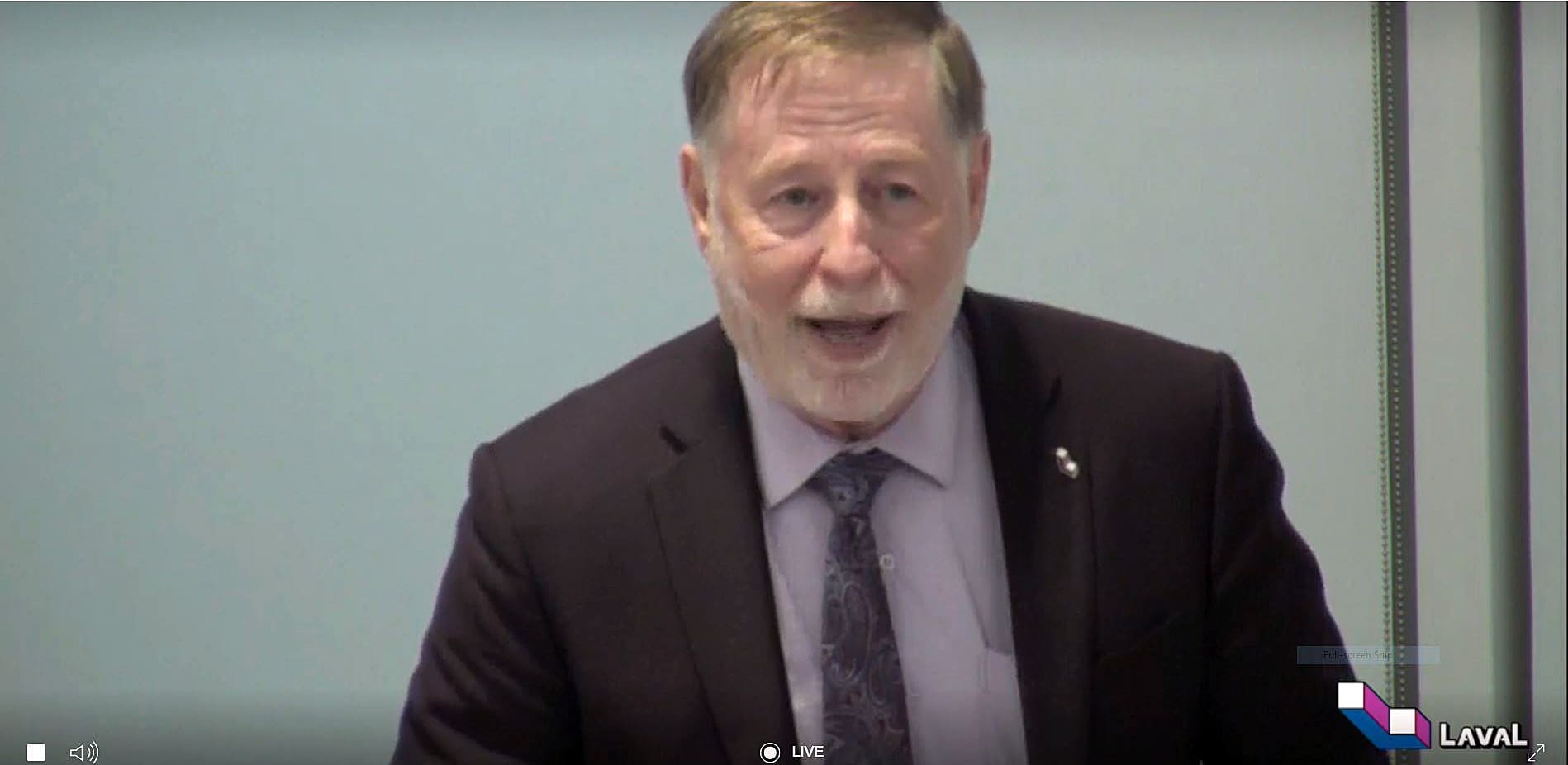
This might best describe the predicament Mayor Marc Demers faced during the May 5 meeting of city council. He saw himself forced to defend the city’s position on the losing side of a lawsuit that was launched by the developers of the aborted Le Commodore high-rise condo project on Lévesque Blvd. East near the junction of Autoroute 19.

The out-of-court settlement, reached between the City of Laval and Construction Lafleur and Construction Aldo, leaves the city $13,772, 257 poorer, but puts an end to legal proceedings by the two companies. The settlement takes into account the value of two municipal buildings – including the Intercultural Library on Chomedey Blvd. – that the City of Laval has agreed to cede to the claimants as part of the compensation.

Took sides in conflict

This brings to an end a saga that began just before the 2013 election – the one in which Demers first came into office. At that time, people living on streets near the site of the two developers’ proposed Commodore condo project had been actively protesting for years to the previous municipal administration, led by Mayor Gilles Vaillancourt, that they were deadset against the project, essentially because the height of the twin towers would ruin their view of the riverfront.

Only Mayor Marc Demers, council president Christiane Yoakim and a few staffers were able to be at Laval city hall for the May 5 council meeting because of COVID-19.

While the Vaillancourt administration, in a typically arrogant stance, after decades in power, adamantly refused to budge and confidently insisted the project would proceed, Demers, facing his first election and perhaps not entirely aware of the potential consequences, took sides with the residents and altruistically pledged that once elected he would cancel Le Commodore.

Past decision brought lawsuit

As most people know, the disgraced former mayor’s Parti PRO des Lavallois was swept clean from office and Demers kept his promise. But this led, in turn, to the lawsuit which dragged on until last week’s announced settlement.

During the public question period at the May council meeting (which took place online because of the COVID-19 lockdown, with only the mayor and a few employees at city hall, with the councillors scattered all over Laval), the first person to broach the issue of the fallout from the settlement was a lady by the name of Mélanie Guimond.

Giving up library building

“How could you sacrifice our beloved multicultural library that we love so much to compensate for your serious error of judgement in the saga of Le Commodore,” she asked in an e-mailed question. Replying, Mayor Demers insisted, “It is absolutely false to say that we will be sacrificing the library as such. It is the building.

The settlement takes into account the value of two municipal buildings – including the Intercultural Library on Chomedey Blvd.

“The library will be changing address, but will be staying in the Chomedey sector,” he added. “And this eventuality was almost unavoidable because the building that houses the library required investments in the coming years of around $5 million to $7 million, or else they would move. And during the time that the work would have had to be done, it would have been necessary to close the library.”

‘A fiasco,’ opposition says

Demers suggested that any new building the new owners may now choose to erect on the site will be worth more than the current Intercultural Library building, and will thus bring in more property tax revenue. He said the city has four years to relocate the library to a setting that will be more modern and appropriate.

When the settlement came up on the council agenda and was opened for comment, official opposition leader Michel Trottier of the Parti Laval called it “a fiasco right along the line, it’s very bad news for the people of Laval.”

Justifying his actions seven years ago, Demers said there were other factors in the city’s decision to cancel the project, including what he claimed was inadequate planning by the builders, as well as the fact the mayor’s Mouvement lavallois party had already stated its intention to safeguard riverside properties for future public development.

Revelakis angered

Action Laval city councillor for Chomedey Aglaia Revelakis said she was disappointed and angered by the agreement. “It’s now the citizens who will have to pay a lot of money for this decision,” she said. “This library is the largest and the only library for the people of Chomedey.

“This is not only the largest library in Laval, but also the only one where anglophone and allophone citizens can find books in their native language,” she continued. “Lots of people from Chomedey go there regularly. Maybe the library is going to be moved, but once again it will be the citizens who will be paying.”

During the same meeting…

Perhaps anticipating that the matter would be raised during the public question period, Laval-Les Îles city councillor Nicholas Borne explained beforehand why a lengthy corridor of trees along the north side of Avenue des Bois in Fabreville recently had to be clearcut, obliterating a foot trail that was popular with many people from the area.

The cut started several months back in preparation for the creation of a prioritized public transit lane that is being created along the semi-rural stretch for buses that will be carrying passengers from the North Shore who normally use the Deux-Montagnes commuter rail line.

The line is closing for the next three years while the new REM line is being built. According to Borne, the mature clearcut trees are going to be replaced by more than 8,500 trees and saplings. Mayor Demers acknowledged that the city was a little guilty of being asleep at the switch, since it knew about the situation and the level of communication could have been better, he said.

Fiber optic network

During another portion of the meeting, there was debate over the administration’s plan to borrow more than $9.5 million for the cost of implementing a fiber optic network to improve communications between municipal employees and departments. Opposition councillors questioned the value of the system, saying fiber optic technology is continually changing and the costs are also in flux.

“I don’t see why this fiber optic project has to be declared a priority project,” said Action Laval councillor for Chomedey Aglaia Revelakis. “Why not wait a month or two, after the COVID-19 pandemic passes, to make a decision?” Revelakis suggested the project as presented “lacked transparency,” while adding that “I cannot in good faith ignore the fundamental rights of the citizens, which is the reason I am voting against.”

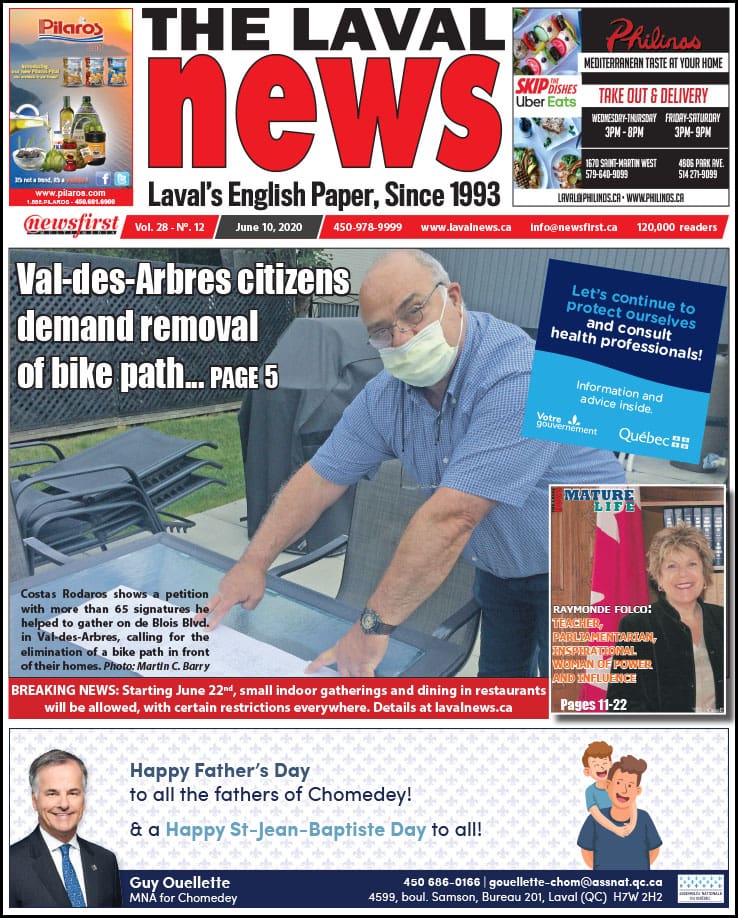
Laval News Volume 28-10

The current issue of the Laval News volume 28-10 published May 13th, 2020,
(Click on the image to read the paper.)

Current issue of the Laval News volume 28-10 published May 13th, 2020.

STL to increase bus service as COVID-19 pandemic recedes

The Société de transport de Laval (STL) says it is ready to take on the challenges lying ahead as deconfinement is set to gradually begin and activities resume under a climate of uncertainty caused by the COVID-19 pandemic.

To guide the implementation of new measures, the STL says it has prepared a work plan to protect its users and employees in accordance with recommendations from the Commission des normes, de l’équité, de la santé et de la sécurité du travail (CNESST) and provincial public health authorities.

The STL says it has reprioritized projects in order to better focus its resources on new priorities created by the pandemic.

“The current situation requires all of our units at the STL to work together and pull out all the stops to provide our employees and users with a safe environment,” STL president Éric Morasse said Tuesday in a statement. “We fully believe our joint efforts will see us through this unprecedented crisis.”

“We are asking users, businesses and employees to embrace a spirit of solidarity and collective responsibility for the common good,” said the transit agency’s general manager Guy Picard. “We must all adapt to this new reality, which we will have to contend with for many months to come. Adhering to the directives and recommendations requires changing how we do things so we may continue providing this essential service.”

The STL says it is taking the following measures for transit users to follow to help ease the way back towards normalcy.

1.  More bus service

As of May 9, they’ve upped regular bus service during the week by 50% to reach 80% of the service usually provided this time of year. Although ridership numbers are still well below pre-pandemic levels, they increased bus service to minimize overcrowding, foster social distancing and meet users’ commuting needs, all in keeping with the availability of resources. As the economy gradually reopens, the STL expects ridership levels to increase in the coming weeks, which will further complicate practicing social distancing when using public transit. 

2.  Wearing face covering strongly recommended

As per recommendations from public health authorities, the STL strongly urges public transit users to wear face coverings. To encourage this practice, the STL, jointly with Exo, the RTL and the STM, will start distributing some reusable face coverings to users. As a reminder, posters are installed on buses and in bus terminals. The STL says face coverings constitute an extra preventive measure when in public, which must be paired with all other appropriate protective measures (coughing in elbow, frequent handwashing).

3.  Maintaining increased cleaning

Since the pandemic began, the STL has adapted its cleaning procedures and upped its cleaning frequency across its operations, i.e. vehicles, terminals, offices and garage. The transit agency says these exceptional measures will remain in effect for as long as the situation warrants it.

4.  Measures in terminals

In addition to increasing cleaning operations in the three Laval terminals under its charge, the STL has also made benches in waiting areas off limits and will station hand sanitizer dispensers in waiting areas for users and in rest areas for employees.

5.  Measures for paratransit service

In cooperation with its paratransit service providers Chartrand inc. and Taxi Co-op Laval, the STL says it is getting ready for the reopening of activities in Laval while maintaining specific precautionary measures to protect employees and users, including:

·         Wearing of mask and goggles or visor by drivers

·         Hand sanitizer for users before boarding

·         Cleaning of minibuses and taxis between trips

·         Thorough disinfection of minibuses daily

·         Limit of 2 users per minibus / 1 per taxi (backseat only)

·         Some taxis are outfitted with a plexiglass barrier separating the front and back of the vehicle

·         Wearing a face covering strongly recommended to users

6.  Additional measures being evaluated

The STL says certain extra measures are also being evaluated, such as posting the number of riders on buses, to help users plan their commutes.

In the meantime, the STL is asking users for cooperation for the protection of other passengers and drivers. Users are therefore required to avoid using public transit:

·         If under mandatory isolation

·         If taking the bus is not absolutely ESSENTIAL

·         If they have Coronavirus symptoms (fever, new or worsening cough, difficulty breathing, sudden loss of smell without nasal congestion – with or with loss of taste)

Businesses are also being encouraged to continue to opt for working-from-home arrangements for employees and rescheduling shifts to avoid overcrowding buses during peak hours. Similarly, the STL is asking users to avoid commuting during peak hours when possible. Laval residents are also being encouraged to avail themselves of the many sustainable mobility alternatives at their disposal: biking, electric BIXIs, carpooling with people living together, etc.

NEW PUBLIC TRANSIT ETIQUETTE RULES

In addition, to avoid spreading the virus aboard STL vehicles, they are asking for everyone’s cooperation on these requests:

·         Do not eat on buses

·         Do not leave any trash behind

·         Wear a face covering

·         Practice social distancing whenever possible (especially when purchasing passes and tickets, while waiting for the bus or to board the bus, while walking)

·         Avoid touching surfaces as much as possible

·         Apply recommended hygiene measures (coughing in elbow, frequent handwashing, discarding tissues safely, avoiding touching your face, etc.)

PLQ announces Dominique Anglade as party’s new leader

Liberal MNA for Saint-Henri/Sainte-Anne Dominique Anglade, has won the race for the Quebec Liberal Party’s leadership.

The Quebec Liberal Party’s executive-committee announced on Monday that, following the withdrawal of Alexandre Cusson from the PLQ’s leadership race, Dominique Anglade (who was the only other contender) has been declared the winner and is now the Quebec Liberal Party’s new leader.

Anglade, who is currently Liberal MNA for Saint-Henri/Sainte-Anne, becomes the first woman in the Quebec Liberal Party’s history to lead the PLQ.

Laval COVID-19 death toll hits 387, says CISSS

The CISSS de Laval reports that as of Monday May 11, 387 persons in Laval had died of COVID-19 since the beginning of the pandemic, while there were 4,233 confirmed cases of infection, 128 people in hospital, 23 people in intensive care, and 1,739 persons who recovered.

CISSS de Laval has broken down COVID-19 data for Laval into six districts.

Staff tested

In addition, according to the regional health authority, 408 CISSS de Laval employees had tested positive for the infection as of May 7.

The CISSS noted that the above data, compiled for six geographic sectors within the Laval region, doesn’t include results for CHSLDs, retirement homes and other closed residences, which account for 1,273 cases, according to the agency.

Per establishment

For these establishments, the CISSS broke down the results as follows:

Centre d’hébergement et de soins de longue durée Sainte-Dorothée: Cases – 204, Deaths – 86.

Centre d’hébergement et de soins de longue durée La Pinière: Cases – 71, Deaths – 42.

Centre d’hébergement et de soins de longue durée Fernand-Larocque: Cases – 71, Deaths – 24.

Centre d’hébergement et de soins de longue durée ldola-Saint-Jean: Cases – 7, Deaths – 2.

Centre d’hébergement et de soins de longue durée Sainte-Rose: Cases – 4, Deaths – 1.

Restrictions eased for caregiver visits to CHSLDs in Laval

Beginning on May 11, it will be possible for a caregiver with a close relationship to someone living in a CHSLD to provide help and support for that person in a long-term care residence within the CISSS de Laval network.

The CISSS de Laval is easing some restrictions on caregivers to allow them more access to loved ones in CHSLDs as the COVID-19 pandemic goes on.

Despite the current COVID-19 pandemic, the CISSS says it has put into place new measures to better welcome and protect caregivers who had previously been making regular visits to loved ones living in a CHLSD.

According to the CISSS, recognized caregivers will be contacted by a CISSS representative for an appointment. Those who are not contacted but who also wish to care for a loved one must take an appointment by contacting the CHSLD on the phone. A social worker will follow up and provide information on the rules that must be followed.

Restrictions apply

There can be no visits without first making arrangements during an appointment. The CISSS says that for the health and safety of residents and staff, a caregiver who does not respect the rules could be denied access to the CHSLD. Here are some of the rules to be followed:

• Only one caregiver at a time may be present (and the caregiver must also be someone previously known for their significant relationship to the resident).

Only recognized caregivers to be allowed visits, says CISSS

• It will be forbidden to freely walk around the unit at the CHSLD.

• Cargivers will not be able to attend if they have symptoms that include fever, cough, difficulty breathing, or lost of taste or smell).

More rules

• It will be mandatory to respect all the protection and prevention rules (hand washing, wearing protective gear, including mask, visor, gown and gloves).

• Caregivers must use only the protective gear furnished by the CHSLD (personal masks not allowed).

• Personal belongings (handbags, phones, etc.) not allowed in the CHSLD.

• During the first visits, a staff member will accompany caregivers to the room of the resident.

• During each visit, caregivers must submit to a screening process that is obligatory. Staff will be available to answer questions and guide caregivers around.

• A social worker will meet the caregiver before the caregiver leaves the CHSLD in order to hear comments and answer questions if there are any.

At private residences

Regarding private CHSLDs, intermediary resources and private retirement residences in Laval, the CISSS de Laval says it is currently assisting the management at these institutions in order to assure that appropriate measures are in place.

Additional information (in French) can be found on the CISSS web site: https://www.lavalensante.com/soins-et-services/information-pratique/info-covid-19/proches-aidants. For information about caregivers, the following online publication (also in French) is available from the Quebec Ministry of Health and Social Services:  https://publications.msss.gouv.qc.ca/msss/fichiers/2020/20-210-46W.pdf.

Laval calls off summer 2020 events, because of COVID-19 pandemic

The City of Laval confirmed on Thursday May 7 that it is cancelling or postponing all of its special cultural events that had been planned for the coming summer – including the June 24 Fête nationale celebration – saying they can’t be done safely during the COVID-19 pandemic.

The City of Laval has postponed or cancelled major cultural gatherings like this one, because of widespread restrictions to safeguard against the spread of COVID-19.

This after Mayor Marc Demers said during the April city council meeting last month that neither he nor other officials at city hall had made up their minds yet as to whether they should cancel a more than $662,000 deal with a sub-contractor hired for the Fête nationale show at the Centre de la Nature, and that artists and performers had to be consulted first.

According to the city, that consultation has now been done and Laval will be putting together a support program to compensate artists and performers suffering a drop in revenue because of the change of plans.

“Following discussions, we took this decision by common agreement,” Demers said Thursday in a statement. “In effect, it is evident that it would be difficult to get the recommendations by public health respected – notably concerning social distancing – during activities where there are large gatherings. We are, of course, completely aware of the impacts of this decision on citizens, cultural organizations, workers and artists.”

In addition to the Fête nationale, two other major events that are also cancelled are the annual Fête de la Famille at the Centre de la Nature in late summer, and the Laval à Vélo bicycling event at around the same time. In all, 600 or so cultural events which had been planned for this summer are now also cancelled or delayed to a later date.

Martin C. Barry, Local Journalism Initiative Reporter for the Laval News, marty@newsfirst.ca

Health Canada issues warning about unauthorized COVID-19 test kits

Health Canada issued a warning to Canadians on Thursday May 7 not to buy home diagnostic test kits, including mail-in sample collection kits claiming to diagnose or detect COVID-19, because they may provide inaccurate or false results.

“These products have not been authorized by Health Canada, which means they have not been reviewed for safety, quality or effectiveness,” the federal ministry said in a statement. However, Health Canada says it has authorized COVID-19 test kits intended for use only by healthcare professionals or trained operators.

Health Canada says it is continuing to monitor websites for false claims and is working with online retailers to ensure that unauthorized COVID-19 diagnostic or detection test kits are removed from their websites.

Health Canada says it is also working with the RCMP to take action when unauthorized test kits are found to be sold in Canada, including a recent seizure of over 1500 test kits in B.C.

The federal ministry warns that selling or advertising health products that make false or misleading claims is illegal in Canada, and that it takes the issue seriously and will use all mechanisms and tools at its disposal to stop such activities.

What to do: If you have purchased an unauthorized test kit that claims to diagnose or detect COVID‑19, Health Canada advises you not use it or rely on its results. They say you should consult your local health authority for recommendations on testing and testing services for COVID-19. And if you have any information on the potential false or misleading advertising or sale of products that have not been authorized by Health Canada, you are advised to report it.

Martin C. Barry, Local Journalism Initiative Reporter for the Laval News, marty@newsfirst.ca

Laval Police has issued at least 380 COVID-19 tickets

The Laval Police Department is reporting on its Twitter feed that the force had issued a total of 380 tickets related to COVID-19 infractions, such as non-distancing or gathering in groups, up to May 4.

According to the Laval Police Department’s community relations department, the LPD’s officers have been advised to evaluate each situation after intervening and question those persons they suspect are not obeying the rules, following which tickets can be issued. Those tickets start at $1,000 and increase for repeated offenses.

Martin C. Barry, Local Journalism Initiative Reporter for the Laval News, marty@newsfirst.ca

Two now charged following rash of cell phone tower fires

This cell phone tower in Chomedey, behind a shopping mall on Samson Blvd., was among the towers set on fire since last week.

Sûreté du Québec officials in Sainte Adèle said on Friday that they have now charged a man and a woman suspected of having set up to seven cellular telephone service towers on fire in the Laurentians and in Laval – including cell towers in Chomedey and Fabreville.

Following reports of more cell tower fires in Sainte Jérôme and Blainville this week, the SQ said it had arrested Justin-Philippe Pauley, 28, and Jessica Kallas, 25, described as being in their 20s, around 1:30 am on May 7. Over the past week, there were also fires at cell phone towers in Prévost and Piedmont in the Laurentians.

In recent years there have been incidents in some parts of the world involving vandalism to 5G cell phone towers. The incidents are thought to be linked to unfounded rumours 5G towers help spread COVID-19. As well, there has been controversy over the Chinese government’s high-pressure campaign to have its 5G system made by Huawei installed in western countries. In some incidents, it is believed, vandals mistook 3G and 4G towers for 5G.

They are charged with setting fire to Telus cell phone towers in St-Jerome and Blainville, according to the court filing. Pauley and Kallas were also charged with mischief. Provincial police say there have been seven such blazes in the past week.

On Wednesday night, Prime Minister Justin Trudeau tweeted about the fires. “Vandalizing cellphone towers does nothing but threaten emergency services and impact the daily lives of Canadians across the country,” Trudeau wrote. “These recent acts are serious criminal offences and carry severe penalties.”

Weather

Laval
scattered clouds
21.9 ° C
22.2 °
21.3 °
45%
1.3m/s
28%
Mon
27 °
Tue
22 °
Wed
20 °
Thu
24 °
Fri
20 °