Up to four LPD police cars and an Urgences Santé ambulance converged in the parking lot of the Centre Commercial Saint-Martin on the morning of June 30 to arrest a hit-and-run suspect.
Up to four Laval Police Department cars and at least one Urgences Santé ambulance converged in the parking lot of the Centre Commercial Saint-Martin near the corner of Curé Labelle and Notre Dame boulevards around 9:45 am on Tuesday June 30 shortly after a hit-and-run incident a few blocks east at the corner of Chomedey and Notre Dame.
Although the driver of one of the three vehicles involved in the crash fled the scene, he was found by the police shortly afterwards just a few blocks west where his car was surrounded by police.
While the suspect driver was placed under arrest, he and a passenger were transported by Urgences Santé to hospital where they were treated for minor and non-life-threatening injuries, said Constable Julie Marois, a spokesperson for the LPD.
“In all, three vehicles were involved,” Cst. Marois told The Laval News. “We learned that one of the vehicles had fled the scene. With a description of the suspect who had fled, our officers proceeded to make the arrest of this individual.”
A Quebec provincial body mandated to look into potential breaches of privacy in Internet use says it is joining three other similar agencies across Canada in an investigation of Tim Horton’s and its owner, Restaurant Brands International, because of recent allegations of privacy violations through Tim Horton’s mobile app.
The Commission d’accès à l’information says it is joining efforts undertaken by similar agencies in Alberta, British Columbia and by the federal government to look into allegations contained in a recent Financial Post exposé that raised questions as to whether the Tim Horton’s smartphone app is respecting federal and provioncial laws that regulate the collection and use of data on people’s movements.
The Financial Post reported recently that the app’s use of geolocation enables it to silently monitor a user’s whereabouts and digital activities, even when they are not actively using the app.
The Post discovered that the app was keeping a log of everywhere its reporter went, even when the app was not in use, while transmitting the data back to Tim Horton’s. For its part, Tim Horton’s has in the meantime denied any wrongdoing, while claiming its app was designed in keeping with privacy regulations.
Food inspection authorities with the provincial government as well as the City of Montreal are advising consumers not to eat a recent batch of smoked salmon sold by Lester’s Deli because of a labelling error involving the “best before” date.
According to an advisory issued on Friday by the provincial authority, 225 gram packets of Lester’s Deli smoked salmon were labeled as being for sale up to June 25 and only within Lester’s Deli which is located on Bernard Ave. in Montreal. It was sold in a refrigerated state in a plastic bag with a black backing.
Lester’s Deli voluntarily agreed to the recall, while also agreeing that Quebec and the city would issue the advisory as a measure of precaution. Persons who have this product are advised not to eat it, and either to return it to Lester’s Deli or to throw it out.
The provincial food inspection authority noted that no cases of illness attributable to eating the recalled smoked salmon have been reported up to now.
Dénomination du produit
Format
Lot visé(date d’emballage)
« Saumon fume – smoked salmon »
225 gr
Unités vendues jusqu’au 25 juin 2020
Quebec’s food inspection authority says the specific lot of Lester’s Deli smoked salmon can be identified by this label on it.
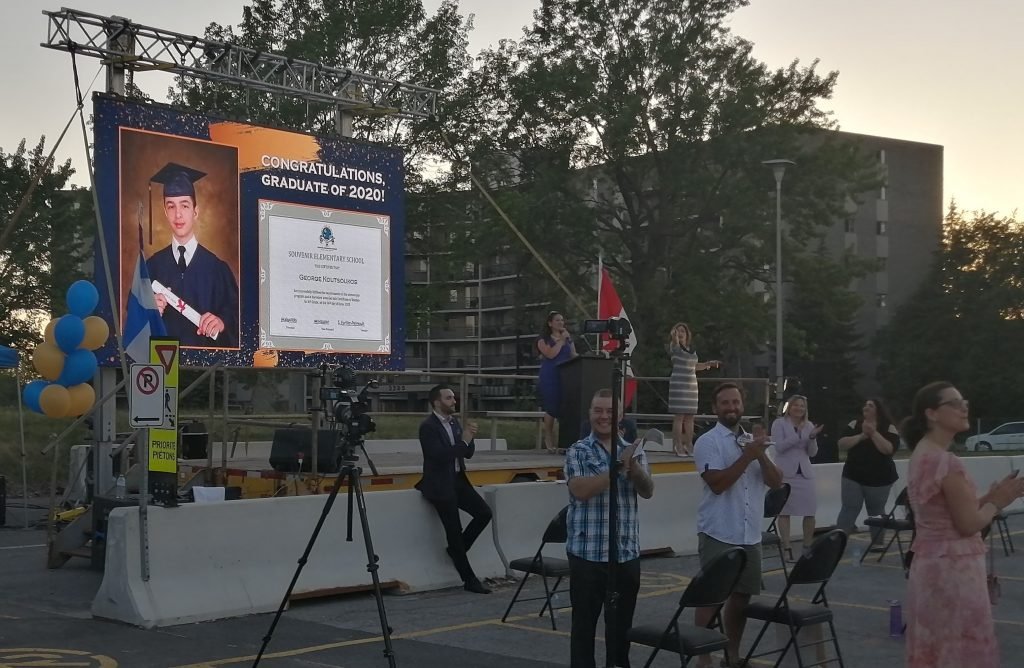
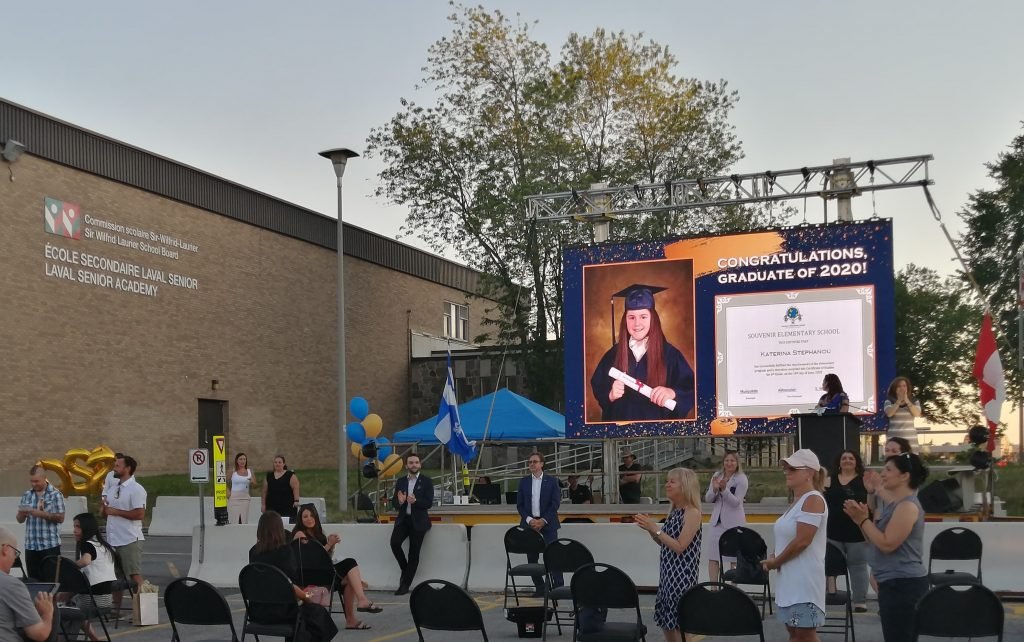
As the sun began to set on June 17th, 2020, cars lined up to capacity with a graduate and family members: mom, dad, brothers, sisters, grandparents. They arrived eager & excited to witness a rite of passage from one step to another. They rolled in greeted by their school’s administration (Principal Kalipolidis & Vice Principal Khozozian) and met by Sir Wilfrid Laurier School Board Commissioners Mr. Galati, Mrs. Kaliotzakis, Mr. Di Sano, and Director General Ms. Absolonne before being guided by staff to park in a physically-distanced manner from one another. The parking lot was filled to its maximum, windows were rolled down and sunroofs were fully open. Graduates sat on window ledges, stood through sunroofs and even sat on car roof tops. Those in convertibles had a 360-degree view. The stage was set; the 16’ x 9’ LED screen was hoisted up high and the sound system guaranteed everybody was able to hear from anywhere in the parking lot. Souvenir Elementary’s Grade 6 Drive-In ceremony was ready to roll.
No one left their car yet each graduate was singled out on screen, honored by all with many applause, cheers & honks. One by one their graduation picture and personalized diploma were viewed as the graduate waved to everyone from their car and was praised. The valedictorian and salutatorian speeches were pre-recorded and presented on the big screen and every other honor and award bestowed to a student was also displayed for all to see.
It was a picture-perfect evening. Ms. Kalipolidis told Laval News, “We believe that graduation is a time where students and families come first and this evening’s aim was to give a collective commemoration to be remembered by all for the rest of their lives. This underlying motivation inspired staff members to put together a creative, acceptable, original and memorable way for our 87 graduates to see to see each other, as a group, for one last time, to include their family, and be recognized for their achievement by maintaining the Ministry’s physical-distancing guidelines.” Souvenir Elementary’s objective to celebrate this milestone together was met even though at no time during the event did anyone shake hands or hug. There was a close-knit atmosphere felt by everyone on this important day. It made this special ceremony a ‘once-in-a-lifetime’ unforgettable memory!
The City of Laval announced on Tuesday that a temporary ban on watering lawns which was set to expire on June 23 is now being extended to July 8.
According to the city, the ban, which began on June 17, applies at all times of the day everywhere on Laval’s territory. Watering of plants and vegetable gardens is still allowed, as long as it is done with a hose equipped with a nozzle that has an automatic hand-controlled on/off mechanism.
Bill 55 will also allow victims to file claims against estates
Members of the Quebec National Assembly voted unanimously last week to pass Bill 55, a new provincial piece of legislation that effectively abolishes statutes of limitations in civil cases involving sexual assaults that were committed decades before being reported or prosecuted in court.
Quebec Justice Minister Sonia LeBel, right, is seen here with Premier François Legault.
Promise kept
The change will henceforth apply to lawsuits involving allegations of sexual assault, sexual assaults against children, as well as spousal violence. Following the bill’s unanimous passage, Quebec Justice Minister Sonia LeBel said the CAQ government had fulfilled one of the key campaign pledges it made before coming to power in October 2018,
“I am extremely proud to have sponsored, on behalf of the government, this draft law which once again placed the interest of victims and their needs at the heart of our actions,” LeBel said.
“We had made a firm commitment to eliminate the statute of limitations obstacle to allow them to obtain redress, at a time when they feel ready to confront the past. A promise kept: supporting victims is a priority for our government.”
Fewer time limits
Before Bill 55 was passed, a statute of limitations applied in these sorts of cases. As a result, many civil suits were automatically considered inadmissible for due legal process. A three-year statute of limitations that had previously been in force was extended to 30 years in 2013 when the Parti Québécois formed the provincial government.
“Taking into account that the victims, because of the particular nature of the crimes against them, may sometimes only become aware many years afterwards of the harm caused by the assault, they will henceforth have all the time they need to put together a court case against the person responsible for that assault,” LeBel’s ministry said in a statement.
Claims against estates
As well, Bill 55 will henceforth allow victims to file damage claims against the estates of individuals who have committed sexual assaults, but who have died, although this must be done within three years of their death.
However, the law draws the line here, stating that damage claims in such circumstances will not be possible against religious orders, businesses or organizations, which cannot be held responsible for acts committed by any of their members or employees who have died since the assault took place.
Apologies possible
The new law will also allow persons accused of sexual assaults to make apologies to their victims, although such an admission will not constitute acknowledgement of culpability in the eyes of the Quebec Civil Code. However, this aspect will be applicable only in civil cases, the Quebec justice ministry points out.
The full text of the new law can be viewed on the Quebec National Assembly’s website: www.assnat.qc.ca, as well as on the Quebec Ministry of Justice’s website: www.justice.gouv.qc.ca.
The Laval Police Service is asking the public to cooperate in identifying a person suspected of fraud in the Sainte-Dorothée area. Towards the end of May, five purchases of precious metals, valued at more than $12,000, were made online using a fraudulent credit card.
Once the packages were delivered to the post office, the suspect reportedly went to the counter to retrieve them, with a false ID. The fraud was noticed soon after when the person, whose name was used fraudulently, presented himself at Canada Post following a notice of receipt of goods that he had never ordered.
Description of the suspect:
Caucasian woman -Approximately 20 years old
Long Brown hair -Wore a blue jeans coat with a black sweater Any information enabling this woman to be located or identified will be treated confidentially on the Info Line at 450-662-INFO (4636) or 911, mentioning the file LVL 200604 016.
Dominique Anglade addressed PLQ members during recent online event
In her first address to the PLQ membership since first being selected as the Quebec Liberal Party’s new leader, Dominique Anglade suggested during a recent online meeting that she will be emphasizing the defense of the French culture and language in the coming years, while also focusing on the Coalition Avenir Québec government’s questionable response to the COVID-19 crisis.
Anglade became the PLQ’s leader 153 years after the party was first formed in the mid-19th century. She steps into the leadership at a time when many are questioning the Quebec Liberal Party’s future, given its poor performance in the last provincial election and the CAQ government’s success at holding the fort up to now.
First speech as leader
The Liberal Party of Quebec’s new leader, Dominique Anglade, gave her first speech to the membership during an online event recently.
“Leading the Liberal Party of Quebec is a privilege – a privilege that demands that one is constantly listening to you, the party activists,” said Anglade. “My heart must beat at the same pace as yours.
“As you may know, I was raised in Quebec, I did my studies and raised my family here.” Noting that her parents wanted their family to grow up in a just and prosperous society, she said they also wanted their children to be raised in a French-speaking environment.
Pointing out that Quebec is now emerging from the first wave of the COVID-19 pandemic, Anglade said the Liberals are currently also facing major challenges. “It is our duty to win the support of all Quebecers in all the regions of Quebec,” she said, alluding to the fact it was the Quebec Liberals who launched the Quiet Revolution that led to a wide range of new policies and reforms.
Challenges ahead for PLQ
“We propelled Quebec into an era of progress and modernity never seen before,” said Anglade. “Sixty years later it’s still us who must continue to stand up against the divisiveness and the populism that can be seen every day. I hope that my leadership of the Liberal Party of Quebec helps to put forward a vision for a Quebec that is modern, unifying and that is the envy of people in other parts of the world.”
Anglade said she sees several principal challenges for the PLQ in the coming months and years. Firstly, renewing relationships with activists within the party and the parliamentary wing.
“We have an opportunity to make a profound reflection on our past which is truly remarkable … There are bridges to rebuild, and new are also new bridges to be built. We must listen better to our activists, open doors and re-establish links with all the regions of Quebec.”
Focus on regions, says Anglade
While insisting that the PLQ wants to continue its longstanding tradition of welcoming people from all walks of life, from all regions of Quebec, from around the world, and both in French and English, Anglade said the party needs to pay more attention to the province’s regions, while avoiding “wall to wall” solutions for too many things.
‘It is clear that the Liberal Party of Quebec must defend an open and authentic vision of the Quebec identity,’ said Anglade
“On the other hand, I know too that our ambition for and love of Quebec are important and as Liberals we have a heritage to defend, especially in terms of progress to be made. As a political party that aspires to govern Quebec, we also have a duty to set an example. Quebecers are watching us and the bar is set high.
“In the Quebec of today, no party can afford to criticize the government while waiting for power to come to it naturally, and we are well aware of this. So every day, we must be able to demonstrate that our ideas truly correspond much more to the hopes and expectations of Quebecers and that our integrity and devotion to the public interest are irreproachable.”
French language and culture
Regarding the French language and culture, Anglade said, “We must have the courage to ask fundamental questions. It is clear that the Liberal Party of Quebec must defend an open and authentic vision of the Quebec identity. This will mean embracing without hesitation our distinct character as a Francophone people in North America, to acknowledge our history and defend our language, to preserve our values which include tolerance and liberty.”
Regarding the CAQ’s economic record, Anglade said the PLQ had always prided itself on being the party for economic development, although the CAQ had attempted to take over that role in recent years. “But the CAQ has an archaic vision of the economy,” she continued. “François Legault is talking about an economy from another era, another decade.” She said the PLQ would be proposing an economic vision that is more modern and updated.
Laval-based Glycovax Pharma has partnered in the research
Professors Nicolas Doucet and Yves St-Pierre of the Laval-based Institut national de la recherche scientifique (INRS) are contributing their expertise in structural and cell biology to the race for a vaccine against COVID-19.
In partnership with Glycovax Pharma, a company with operations also in Laval, the two researchers will evaluate the feasibility of a vaccine strategy targeting carbohydrate molecules located on the surface of the coronavirus Spike protein.
A fortunate coincidence
Professor Nicolas Doucet, researcher and expert in structural biology at the INRS. (Photo: courtesy INRS.)
“It was a fortunate coincidence that the carbohydrate molecules on which the biopharmaceutical company has been working on since 2017 are present on the Spike protein. Glycovax Pharma is one step ahead because antibody development is already ongoing,” says Professor Doucet.
Even if antibodies are currently being synthesized, two key issues need to be considered. First, the antibodies must be able to reach the targeted carbohydrates on the Spike protein. Researchers also need to ensure that these carbohydrate molecules are present on the Spike protein at all times, regardless of the type of infected cells in the host.
Essential steps to follow
“For instance, SARS-CoV-2 is known to attack the respiratory system, so if the lung cells do not attach the proper carbohydrates of interest to the coronavirus Spike protein after infection, the strategy may not be effective,” he cautions.
“These are essential steps in validating a vaccine approach. Our results will allow Glycovax Pharma to prioritize certain antibodies or to put forward other complementary approaches,” he says.
The research project in partnership with Glycovax Pharma is funded by a Mitacs Accelerate grant that will support the work of postdoctoral fellow Yossef López de los Santos over the next year.
An exciting project
“It’s exciting to be part of a talented team that is committed to fighting the COVID-19 pandemic,” he says. I see our goal as quite ambitious, but at the same time, it’s a great opportunity to use our expertise in structural biology to help address a global problem.”
“This partnership with INRS experts in structural and cellular biology represents an important contribution in the pursuit of our work,” says Dany Valiquette, president of Glycovax. “Their contribution will help us take essential steps in the development of a new vaccine to counter COVID-19.”
David De Cotis says he has no regrets for deserting the Mouvement lavallois
While a common piece of wisdom maintains that time heals old wounds, former Laval executive-committee vice-president David De Cotis says he has no regrets for giving up the city’s second most powerful job. He says that in doing so two years ago, he was pursuing a more principled vision, compared to the outlook of Mayor Marc Demers’s Mouvement lavallois.
A date to remember
June 5, 2018 is a date that stands out significantly in the long timeline of events since the Mouvement lavallois was first swept into office in the November 2013 municipal elections.
Although Mayor Demers’s party had smooth sailing during its first five years, the June 2018 city council meeting marked the first time that a major rift opened up within the administration’s ranks. And it was a fissure that hasn’t completely healed to date.
In the June revolt, Demers saw his party reduced temporarily to minority status during a momentous city council meeting that was nothing less than a meltdown.
Surrounded by opposition city councillors, former Laval executive-committee vice-president David De Cotis speaks to journalists following the June 2018 council meeting when a group of Mouvement lavallois councillors decided to break away from the party. Photo: Martin C. Barry, Laval News
At the boiling point
In a manifestation of what seemingly had been building for months, De Cotis – who was executive-committee vice-president at that point, as well as founder of the Mouvement lavallois – emerged as the apparent leader of a dissident faction of councillors who decided to break away from the Mouvement lavallois.
To refresh people’s memories, the ML council dissenters at that time included De Cotis, Michel Poissant, Daniel Hébert, Vasilios Karidogiannis, Aline Dib, Paolo Galati, Sandra El-Hélou, Isabella Tassoni, Jocelyne Frédéric-Gauthier and later also councillor Aram Elagoz.
A sudden shift in events
With the 10 ML defectors, opposition councillors Aglaia Revelakis of Action Laval and Claude Larochelle of the Parti Laval brought the total number of opposition councillors to 12, leaving the Mouvement lavallois in a very sudden and perilous minority position on the 21-member council (not including the mayor who technically has a tie-breaking vote).
On the morning of June 6, the mayor removed De Cotis from the executive-committee. While noting that he had appreciated being deputy mayor and vice-president of the executive-committee, De Cotis refused at the time to say what specifically led to the rift between himself and Demers.
Why De Cotis left?
In subsequent interviews, De Cotis has suggested that he was simply fed up with the direction the administration was going in – although, as it turns out, there was a specific breaking point. Part of the reason at least appeared to be tied to the mayor’s decision not to reappoint De Cotis as president of the Société de transport de Laval, a position De Cotis had held during the ML’s first mandate from 2013 to 2017.
As such, on June 7, 2018, when the newly-strengthened council opposition gathered for a morning sitting of city council and seemed poised to flex their collective muscle for the first time, De Cotis tabled a resolution, calling for him to be placed back in the presidency of the Société de transport de Laval.
Preparing for the meltdown
At the same time, a notice of motion was adopted stating that a resolution would be tabled calling for future nominations to council committees to be handled by the members of city council, rather than only by the mayor and the executive-committee.
All of this seemingly was only a preparation for the unprecedented meltdown De Cotis would undergo during the September 2018 meeting of city council. By this time, the mayor was on the verge of reversing De Cotis’s previous appointment as head of the STL in order to name a councillor of his own choosing.
This development came about only after the mayor was able to persuade some of the dissident ML councillors, following several weeks of closed-door meetings and discussions with them, to return into his camp.
Demers cast doubts on De Cotis
All the same, the vote during the September council meeting was almost deadlocked. Council speaker Christiane Yoakim, who normally doesn’t vote, was forced to support her party, the ML, so that the motion could pass. (It should be noted that councillors Vasilios Karidogiannis, Aline Dib, Sandra El-Hélou, Jocelyne Frédéric-Gauthier and Aram Elagoz have since then returned to the Mouvement lavallois.)
Following this, and after the mayor gave explanations for appointing Morasse, while casting serious doubts on De Cotis’s abilities while in charge of the STL, De Cotis gave full vent to what he had obviously been holding back for months.
Said mayor was telling lies
Speaking out of turn, and in defiance of the official speaker’s admonishments, De Cotis said, “What he [the mayor] is saying is lies. You are accusing me of having badly managed the STL and it is exactly the opposite.” De Cotis continued in this vein until Yoakim was about to signal two Laval Police officers that he should be removed. He then gradually contained himself and finally went silent.
After this, things were looking up for Action Laval. By March 2019, and nearly a year after bolting from the Mouvement lavallois, the five remaining ML dissenters, who had been sitting as independents, finally announced they would be joining the Action Laval caucus. They joined Action Laval city councillor for Chomedey Aglaia Revelakis. While the Parti Laval had Official Opposition status, Action Laval now outnumbered the Parti Laval caucus.
Action Laval loses its edge
However, Action Laval’s favourable position was not to last. This past May, Poissant and Hébert announced they were leaving the party to sit once again as independents. This followed the suspension from the Action Laval caucus of Galati, Tassoni and De Cotis who were the object of claims (originating in e-mails leaked from city hall) that they were involved in ethically questionable real estate transactions.
While the three have to date been cleared by the Quebec Municipal Commission, De Cotis is still waiting to hear from UPAC (Quebec’s Unité permanente anticorruption), who interviewed him but who are admittedly better at publicizing their interventions than they are at exonerating those they investigate.
Would do it again, says De Cotis
Looking back during an interview this week with The Laval News on his decision two years ago, De Cotis said, “I would do the same thing over again. It was a decision based on principles and moral values.
“I have a much clearer state of mind now because of that, knowing that what I did was for the right reasons and knowing full well what it would cost me,” he continued. “But I was never there for the titles or for the prestige, the position or salary.”
De Cotis maintained that the Mouvement lavallois’s founding principles aren’t being followed in the way they were originally conceived in 2008, and that the party is no longer “going in the right direction, is not doing things for the right reasons and not doing things for the citizens of Laval. I think they’ve lost track of that.”
Mayor satisfied with his caucus
For his part, Mayor Marc Demers issued the following statement to The Laval News when asked for his thoughts on everything that has happened since 2018. “I am fully satisfied with the caucus I have now,” he said.
“Each member plays a useful part, is devoted, diligent and efficient. Our team spirit is strong, we work together in respect and collegiality. And I feel entirely satisfied to be working at the heart of a group that is determined to see our beautiful city progress.”