Laval-based classic car club starts a new year in May 2022
For the second time since Les Bolides du Nord was founded seven years ago, the Laval-based classic car collector’s group had to cancel their annual automotive show which was scheduled for Saturday Sept. 4.
Covid takes a toll
“Our one major annual event had to be cancelled because of the Covid,” said Christian Danis, the Club Automobile les Bolides du Nord’s vice-president and webmaster, noting that the next major show will be on Sept. 3 2022.
“Last year, we also didn’t do it because of Covid. But prior to that, in 2019, we had 248 cars and at our first event we had 158 cars.” The club’s regular Friday evening meets in the parking lot outside the Tim Horton’s at 460 Curé Labelle have also come to a close until the first Friday of May next year.
Classic car territory
Quebec it would seem is prime territory for classic car clubs. There are two just in Laval, according to Danis, as well as clubs in Saint Eustache, in Saint Jérôme and several more on the island of Montreal.
Among the outstanding vehicles owned by members of Les Bolides du Nord is a 1955 Chevy Bel Air in immaculate condition. “The engine is chrome from A to Z,” said Danis, adding that the vehicle probably has an estimated value of $125,000.
Some amazing details
“It just packs in people. When he arrives at one of our shows, everybody just goes over to that car right away.” Describing the individual approach that each member has for the care and detailing of his or her prized vehicle, he said, “Everybody personalizes their car their own way.
“For some it might be more the paint job. If you look at some of the low-riders, they have some simply amazing paint jobs – the details are amazing. Each person personalizes his car his own way. That’s what brings people out to see cars like that.”
Model T’s to Oldsmobiles
While the definition of a “classic car” will vary from one club to another, Les Bolides du Nord defines it as any vehicle produced up to the year 2011.
“We’ve had people coming with an old Ford Model T 1926. I myself have an Oldsmobile ’76.”
Complete information on the Club Automobile Les Bolides du Nord is available on their Facebook page or on their website: https://www.lesbolidesdunord.com/.
The members of the City of Laval’s executive-committee were busy making decisions on a range of issues during public meetings held on Aug. 11 and Aug. 25.
As part of a community planting program, the City of Laval has for several years been offering free trees to groups in Laval who ask.
In order to accelerate the planting of these trees and to be proactive towards these groups, the executive-committee approved a mandate to CANOPÉE, an organization that will be planting 2,000 trees in Laval this year and next year.
The tree plantings will be taking place on lands belonging to municipal and public groups. The trees will be paid for by the city.
Renovations to historic house
The Maison André-Benjamin-Papineau, located at 5475 Saint-Martin Blvd. West in western Chomedey, is classified as a heritage building by the Quebec Ministry of Culture and Communications, as is an annex building next to it.
Both buildings are currently considered to be structurally unstable due to flooding in the basement, mould and other damage.
In order to restore the historic buildings, the executive-committee members adopted By-law L-12572, decreeing a loan of $4,705,000.
The historic Maison André-Benjamin-Papineau in western Chomedey will be renovated thanks to funding provided by the City of Laval.
The sum will allow phase one of a work program to begin, which will consist of renovating, restoring and enlarging the main house, while also renovating a café located in the adjacent building.
The city says the work will make the buildings universally accessible to disabled persons, while preserving an important piece of heritage architecture in Laval.
Laval’s public libraries will be open for longer hours
Beginning Sept. 13, branches of the City of Laval’s library network will become accessible seven days a week, meaning there will be 55 additional hours per week to visit the library.
As well, says the city, 65 free activities (in-person and online) will be offered as part of the library system’s fall programming.
“With these additional opening hours, we are keeping our pledge with regards to accessibility to activity spaces in our libraries,” said Stéphane Boyer, deputy mayor and vice-president of the executive-committee.
“The Covid confinement measures were a splendid occasion to maximize the digitalization that we carried out in our libraries and that is becoming an essential tool in this context,” he added.
“With the new website, the YouTube network, the abolition of late fees, and now the addition of more hours, we are pursuing these efforts.”
Boyer said the administration also plans to expand the opening hours of The Studio, and the media lab for digital creation at the Multicultural library this autumn.
Beginning Sept. 25, the public libraries will be offering a range of programs and activities free of charge. Among them:
Seven conferences and workshops given by Agence Science-Presse;
A dozen youth activities, including Story Time;
Special activities during Public Libraries Week, from Oct. 16 – 23;
The 3rd annual Festival NUM (registration starting Oct. 15);
Registrations are being accepted beginning Sept. 15 at noon.
Carlos & Pepe’s is first to sign up for ‘Commande un Angelot’
In response to rising apprehensions among some women about aggressive sexual advances sometimes leading to assault and rape, the City of Laval has decided to throw its support behind a growing network of “safe” bars where staff are trained to intervene and help clients when they feel threatened or are in uncomfortable situations.
In all, 15 bars have decided to take part in the initiative, which is also supported by Collège Montmorency and the Centre for the Prevention and Intervention for Victims of Sexual Agression (CPIVAS), under the leadership of Collectif social, a student-centered collective.
Making a night out safe
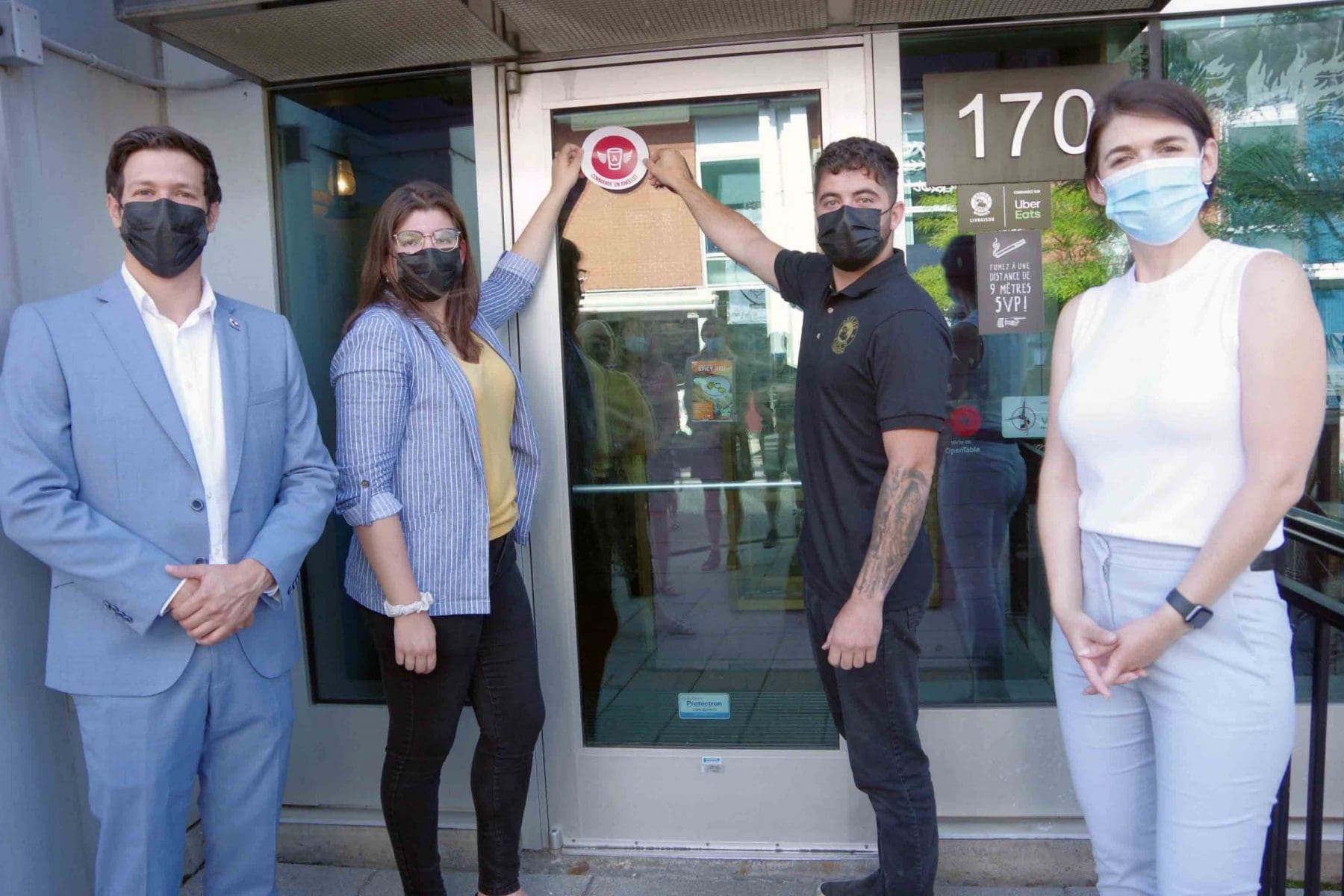
Carlo’s & Pepe’s at the Centropolis is the first Laval restaurant and bar to get with the program. The announcement was made at the restaurant last week, with Laval’s Deputy Mayor Stéphane Boyer and executive-committee co-member Sandra Desmeules on hand for an official launch.
“We are proud to be the first bar in Laval to become accredited for Commande un Angelot,” said Harold Brunet-Stringer, co-owner of the Laval Carlo’s & Pepe’s. “For us, it is important that our clientele should feel they are safe with trained staff to come to their assistance in case it’s needed.”
Accreditation and training
Decals will be clearly posted outside and inside the bars that are participating. At each, staff members will have received training in how to spot behaviour among the clientele that could lead to violent situations. The staff will also be able to offer help to clients if they feel they need assistance.
The program (known as ‘Commande un Angelot’ in French) is based on a campaign launched in England five years ago called ‘Ask for Angela,’ as well as the similar ‘Angel Shots’ program launched in the U.S.
‘Order an Angelot’
When a bar takes part in the program, a client who believes they are in danger can ask for Angela, a fictitious name. The staff are instructed to help the client get home discreetly and safely by escorting them to a different room, or calling a taxi, or by asking the other party member to leave.
The way the program works in Quebec, clients who feel threatened are instructed to “Order an Angelot,” and the staff follow the protocols they learned in their training. In all, 30 bars across Quebec now participate in Commande un Angelot, and 1,500 staff in drinking establishments have been trained. The bars in Laval are expected to become fully accredited over the coming year.
Creating a safe space
Laval’s Deputy Mayor Stéphane Boyer said he decided to join his city council colleagues, Councillor Sandra Desmeules who is responsible for public security on the executive-committee, and Councillor Sandra El-Helou, who oversees women’s equality issues, to support the effort to make a night of bar-hopping safe for all concerned.
The program is based on a campaign launched in England five years ago called ‘Ask for Angela,’
“Acts which are sexually violent impact mostly women, but also everyone else who goes to bars,” said Boyer. “They are unacceptable, and the training provided to the staff in bars will be a tool for prevention to counter something that is intolerable.”
One out of three women
According to Collectif social executive-director Andréanne St-Gelais, in Quebec one woman out of three will be a victim of a sexual assault during her lifetime, and bars and similar entertainment establishments where lively socializing takes place are where such incidents are most likely to take place.
“The Commande un Angelot protocol is a way of increasing the safety of the clientele,” she said.
“We acknowledge the participating establishments who recognize this reality and wish to do their bit to be part of the solution.”
“Prevention of sexual forms of violence is a priority for Collège Montmorency and we are proud to support this important project, which will allow our young people to frequent these places while feeling secure,” said the college’s executive-director Olivier Simard.
‘We’re not endorsing anyone specifically, right?’ says national labour lobby’s president
Although the Canadian Labour Congress doesn’t formally endorse any particular political party during elections, the national trade union lobby group makes no secret of its colossal disdain for Conservative Party leader Erin O’Toole, and what the CLC claims is his “record of letting down workers.”
A focus on issues
“We’re not endorsing anyone specifically, right?” CLC president Bea Bruske said during a phone interview on Labour Day weekend with Newsfirst Multimedia.
“Because, of course, we represent many different unions that have many different thoughts on these particular issues. And so, what we really want to always focus on is the issues. And really the issues are that we have significant problems in our country that affect workers, that affect our communities.
Pandemic’s election impact
“We know from the last 18 months that the pandemic has really laid bare some of those existing inequalities that labour has been talking about for a long time. And so, we have things we want the parties to address and we want workers who are voting to think about when they mark their ballots.”
Still, the CLC’s head acknowledged that the Ottawa-based lobby group has historically maintained close links to the left-wing NDP, much more than any other party.
Building connections
But at the same time, she downplayed the CLC’s relationship to the Liberals, in spite of the Trudeau government’s appointment this past summer of the CLC’s immediate past president to the Senate.
“No matter what party is governing, we need to have a relationship with that party, right?” said Bruske. “And so, what that means is that when they make decisions that we believe are the best course of action for workers, we would support that.
“When their decisions are not in the best direction for workers, we’re going to speak to that, as well. And so, you know, we need to be able to have that open door kind of connection with anyone who is forming the government.”
Conservatives ‘dangerous’
That said, there’s no doubt how the CLC feels about the Conservatives and their leader. “Our message to hard-working people is simple: Conservatives are dangerous for working Canadians – don’t risk our future on Erin O’Toole,” Bruske said, holding nothing back in a media release earlier this month.
“We have seen his rhetoric around supporting working people,” added Bruske, who became the CLC’s new president in June, succeeding Hassan Yussuff who was appointed to the Senate that same month by the Trudeau government.
“But when you look at his record, you start seeing the real O’Toole. While he clearly will now say anything for votes, the fact is Erin O’Toole is a former Bay St. lawyer for giant corporations. And it shows.
Taking aim at O’Toole
“Sadly, Mr. O’Toole cannot be counted on to stand up for workers. This election, he’s proposing policies that fail to protect workers’ pensions during commercial bankruptcies and start privatizing EI and public pensions. And during the pandemic, while Alberta premier Jason Kenney made it easier to bust unions and attacked nurses, Erin O’Toole was silent.”
Bruske and the CLC contend that O’Toole’s anti-worker record includes: Voting against extending emergency pandemic help for workers; saying the government should have given less to working families and more to businesses instead; proposing a law making it easier for corporations to walk away from pension obligations; voting to make it harder for workers to refuse dangerous work; and supporting trade deals that lost Canada thousands of manufacturing jobs.
An historic election
Bruske suggested that after 18 months of working people facing unprecedented health and economic challenges during the COVID-19 pandemic, the outcome of election 2021 could be historical.
Bruske downplayed the CLC’s relationship to the Liberals, in spite of the Trudeau government’s appointment this past summer of the CLC’s immediate past president to the Senate
“The pandemic and economic crisis laid bare the inequality in our society,” she said.
“Many families are struggling to afford housing and essentials like food and medicine. The stakes are high in this election. Canada’s unions are urging Canadians to support candidates who are putting working families at the centre of their recovery plans.”
I watched the French debate on TVA last week, the first of two French debates. Why is that? French Canadians and French Quebecers form less that 25% of the population, yet there are twice as many French debates as there are English. Another French debate today, Wednesday the 8th, and the other, finally in English, on Thursday. If we are to respect Canadian demographics, shouldn’t there be three English debates to one French debate? Not sure of the reason but I can guess. Quebec is vitally important to any party that wants to win a majority. Justin Trudeau failed to take home all the chips in Quebec in 2019, because a newcomer, with an at home forum to display him, the Bloc’s Yves-Francois Blanchet, ‘un gas de Chambly-Beloeil’, stole the show, in French. And stole Trudeau’s majority.
If Canada purports to be officially bilingual, why don’t we have a bilingual debate? Interpreters of course required, but it’s feasible. I agree it could get messy when one leader talks over another as we often see and hear, but if that’s how they are going to conduct themselves, that’s the way it’ll be seen, and heard.
Do all these debates really serve all Canadians. Certainly not. This first French debate highlighted the pandemic, social issues and ‘le Canada de Demain’. We could have a debate on each of these topics. Discussion on the handling of the pandemic, and the billions of unaccounted expenditures could easily take up an hour or two. A debate on the pros and cons of free and lavish spending in the weeks leading up to the election call, another two hours. We could have a debate on Afghanistan. Despite its initial noble purpose, and some last-minute heroic efforts, it was a catastrophic miscalculation, and considered a 20-year failure by the Americans and all those who helped out. That would definitely include Canada. We deployed 40 thousand members of the Canadian Armed Forces, lost 168 men and women, and sustained two thousand injuries.
The west does not give a damn about Quebec, but it should when it comes to Bill 96. It not only affects western Canada but all Canadians. As the respected former Quebec minister Clifford Lincoln puts it, the bill is “the substitution of the National Assembly for the courts of law, as the arbiter of language provisions in the bill.”. This could easily apply to other provinces, not necessarily affecting language, but our sacred Canadian rights. That’s why all Canadians should pay attention.
How about a debate just on our Public Health system? But the moderator(s) has to probe when there is mention of those billions of dollars given to the provinces. This should not be an exercise in accounting. It’s about what is relative and meaningful to you and me the viewers. We want to know how this money would be used, and how it would benefit you and me when God forbid, we are sent to emergency, or admitted for surgery. Would it reduce wait time in the ER? Would it eliminate having to seek medical assistance in the US, Mexico, or Europe? Would it add more nurses? How would it raise the poor standards, and medical professionalism in long term care homes?
Debates can be extremely useful as a means of informing the electorate. Instead, this quick two-hour debate we are exposed to, whether French or English, is centered on who won and who lost. Who cares? The vote results will determine that. It should not be about whether the debate results advance a leader in the polls because he/she articulated their position well, but rather what did I learn as a tax paying viewer about their respective program content, its viability, and credibility. It’s about leadership qualities, and whether the head of that party will deliver for me as a Prime Minister. That’s what it’s all about, or should be.
The process of mail in votes will start soon. It will be a new experience for many of the over 27 million Canadians registered. I’m still in the dark about why we are holding an election at this time when the majority of us do not want to go to the polls during the 4th wave of a Covid 19 pandemic. No one has adequately answered that question, especially the person who called this election.
The nearly 80% of us who have been vaccinated wonder why, and frankly want these impudent hooligans, anti vaxxers, screaming vitriol in front of hospitals, to stop. STOP. It’s the height of disrespect for the health care workers, crying out their frustration and fatigue. And it’s rude and disrespectful to the patients in those hospitals trying to recover from surgery, and Covid-19.
However, Châtelaine Ave. owner may never collect the damages settlement
While a Chomedey landlord recently won an almost $30,000 judgement against a tenant who was held liable for extensive damages to an apartment, the owners say they still have numerous hurdles to jump before they can even hope to collect a settlement from their former tenant.
“Honestly, this could be the worst tenant of all time,” said Bill Choudalos, whose father, Stelios, has owned and lived in a Châtelaine Ave. duplex in Chomedey for half a century.
Three years ago, the father, who has 2 1/2 room basement apartment, decided to rent it out to a middle-aged Chomedey man who claimed he was a former international DJ who had begun working for an Australian security company.
Signs things weren’t right
“About ten, fifteen years ago, he would travel even to Europe to DJ,” said Bill, surmising that the former tenant’s heyday was apparently over by the time he arrived on his father’s doorstep seeking to rent the apartment.
Being essentially kind in nature, the father decided to rent out the unit at a fairly low cost – around $500 a month, as his son recalled.
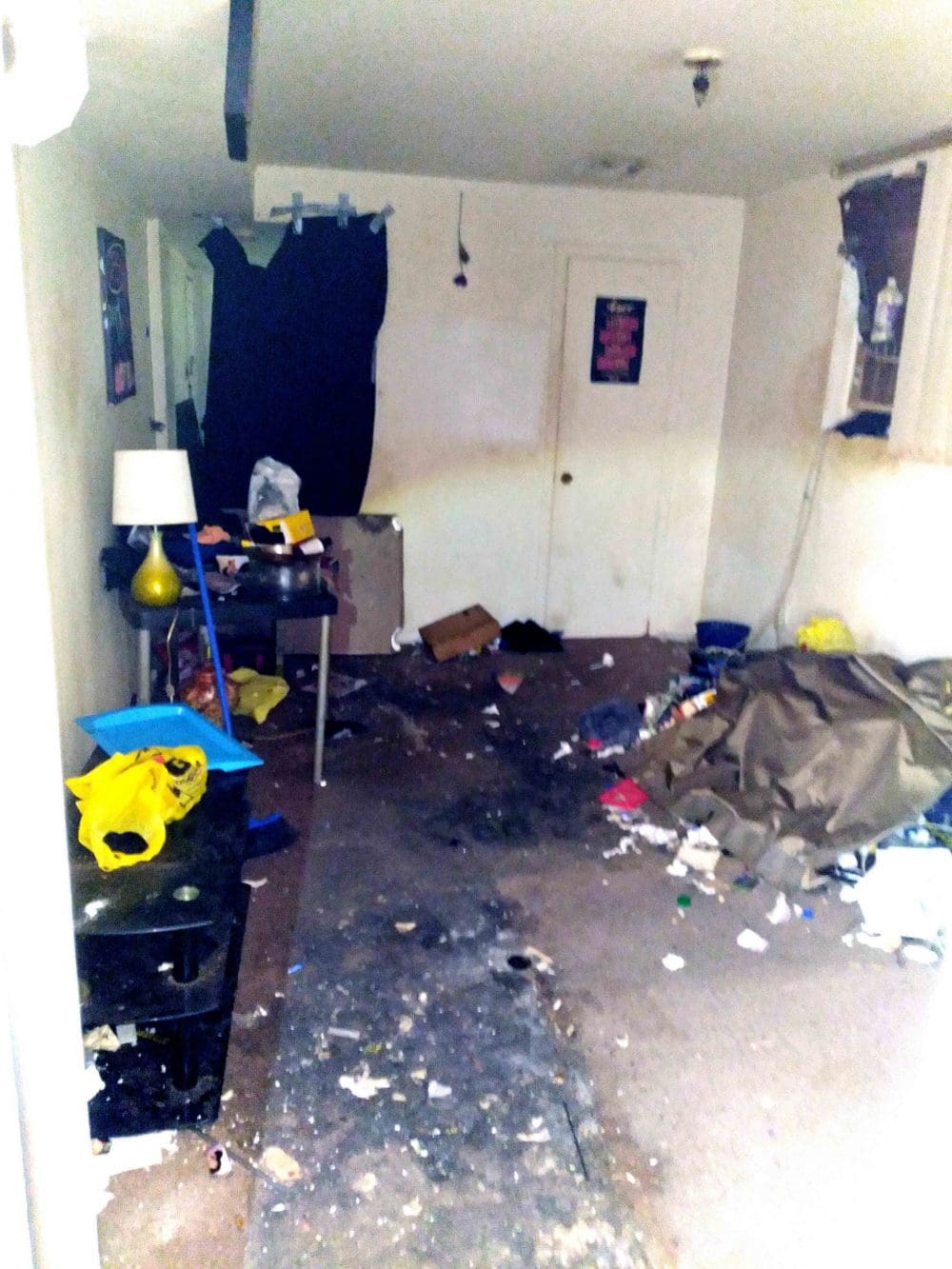
However, they sensed something was going wrong when one of the first things the new tenant did after moving in was to tape large black cloth coverings over the basement apartment’s windows. As a result, no one on the outside could see the gradually-deteriorating state of things inside.
Living in a garbage heap
“His curtains weren’t opened for three years,” said Bill. Much worse, it would appear he almost never bothered to clean up and put out his garbage, which accumulated in large piles inside.
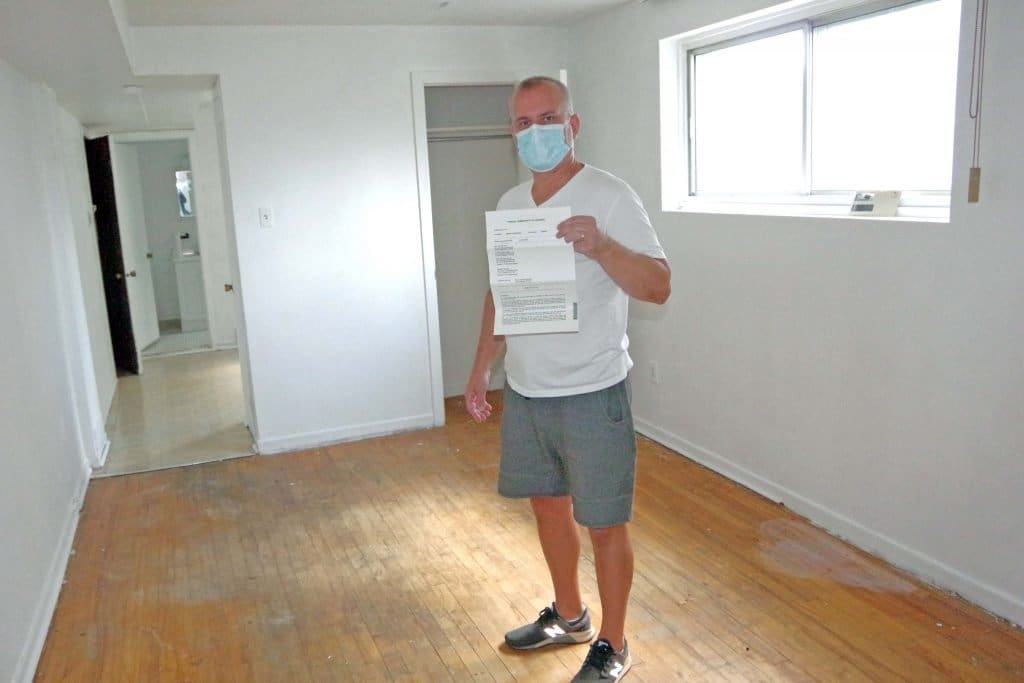
The apartment after, seen here with Bill Choudalos who is holding the judgment issued by Quebec’s Régie du Logement.
“He had his mattress over here in the corner, and he had garbage beside the mattress, but it would stay there for weeks and weeks. When I first came in here after he left, the smell was unbelievable. I couldn’t stay in more than five minutes. How does a human being live under those conditions?”
Then came the rats. The accumulation of garbage became so bad over the three-year period, that the four-legged vermin were living openly in the apartment, claims Bill, who furnished The Laval News with photos showing a dead rat on the floor of the vacated apartment.
Cleanup took two months
“There was a stove and there were rats living in the drawer of the stove and there were thousands of rat droppings in there,” he said. “This is all because he [the tenant] would hoard garbage. It took us two months after he left just to get rid of the rats. After he left, we removed 35 garbage bags.”
The infestation grew worse when the rats began spreading from the basement through the walls upward into the rest of the house. The family could hear them scratching behind the walls as the rats moved around at night. According to Bill, the tenant always refused during his three years of occupancy to allow the apartment to be inspected.
‘Honestly, this could be the worst tenant of all time,’ says Bill Choudalos
“Things came to a head one summer afternoon when we saw a rat on the windowsill,” he said. “We were walking through our backyard and it was daylight. There we could see between the curtain and the window was a rat on the windowsill. We couldn’t believe it. He was in the apartment and there was a rat in there with him.”
Would be up all night
Bill said the tenant would typically be up all night, smoking cigarettes and marijuana – even though Bill claims the tenant had agreed to smoke only outdoors – while burning candles that were later found burned down to their stubs, creating a potential fire hazard.
Matters finally came to head when Bill and his father decided to call the Laval Fire Department, which conducted an inspection, following which an inspector issued an order to the tenant to remove the garbage from the apartment within a two-week deadline.
One of the many rats from a vermin infestation that the owners discovered in their Châtelaine Ave. basement apartment as a result of garbage that an abusive tenant refused to remove during his three years living there.
“That’s how we were finally able to get rid of him,” said Bill. “He knew it was pretty much impossible to clean up the mess that he created. So, last Oct. 8, he finally moved out. My 80-year-old dad who’s been here for 50 years and never missed a day of work in his life, did the cleanup himself.
Appliances ruined
“The fridge and stove were ruined. The stove was covered in rat droppings. It took two months to finally get rid of the rats.
The tenant is currently living in an apartment complex on Chomedey Blvd. in Laval. He promised my dad he would return to pay the last month’s rent, which he didn’t, he never came back.”
Despite the Quebec Régie du Logement tribunal judgement in his father’s favour, Bill notes that his family will have to hire a bailiff at their own expense and take other legal avenues if they hope to collect the $29,500 amount.
The current issue of the Laval News volume 29-30 published September 8th, 2021. Covering Laval local news, politics, sports and our new section Mature Life. (Click on the image to read the paper.)
A 20-year-old male suffered non-life-threatening injuries last Sunday evening in Chomedey during a firearms incident that is now under investigation by the Laval Police.
Gun shots were heard around 9 pm on 63rd Ave. However, when summoned to the scene, officers with the LPD were unable to find the victim.
A short time later, while passing the corner of Daniel Johnson and Cartier boulevards, they spotted him in a vehicle, suffering from what appeared to be a gunshot wound.
The teenager, apparently known to the police, was driven to hospital where medical staff determined the injuries were not life-threatening.
Back on the shooting scene, a security perimeter was set up, as the police searched for evidence and clues regarding the circumstances of the shooting incident.
Laval man faces charges after fleeing in stolen car
A male resident of Laval was injured the night of Aug. 26 following a high-speed police chase that started in Terrebonne north-east of Laval and ended in a crash on Highway 40 in east end Montreal.
The chase began on Montée des Pionniers in Terrebonne around 7:30 p.m. that evening, after police noticed a car had been reported stolen in Quebec City two days earlier.
The police pursued the vehicle after the driver refused to stop, speeding away on local streets, then onto the island of Montreal and highway 40 near exit 89.
The suspect vehicle’s airbag deployed when the car hit a construction cone, a median and then a lamp standard. According to a police account of the incident, the vehicle spun around several times before coming to a stop.
The injured driver was taken to hospital under police escort with some minor neck and back injuries. According to a spokesman for the Terrebonne Police, the driver is probably facing charges for dangerous driving and possibly also car theft.
Laval man nailed in Windsor ON for possession of stolen vehicle
A male Laval resident allegedly caught inside a vehicle stolen in Manitoba was arrested in Windsor, Ontario last week.
Police officers with the Windsor Police Service were on patrol on at 7 p.m. on Aug. 24 when they spotted a white Hyundai Elantra parked in the area.
They soon discovered that the vehicle had been reported stolen in Winnipeg, Manitoba.
The Laval resident, identified as Jean-Francois D’asti Brideau, 26, of Laval, was found inside the vehicle.
The Windsor Police reported that he was arrested without incident and is now charged with possession of property obtained by crime with a value more than $5,000.
‘Meant to Be’ recounts John and Sonja Franken’s joint-destiny, while continents apart
Members of Chomedey’s Congregation Shaar Shalom were taken on a riveting journey back in time last week, as author Roslyn Franken recounted the unforgettable story in her book, ‘Meant to Be,’ about how her parents, as Jewish teenagers, survived captivity during World War II, continents apart, to find everlasting love while triumphing over tragedy.
Parents’ joint-destiny
Franken’s book was the subject of a Zoom webcast presentation on Aug. 25. (The title comes from the Yiddish word ‘bashert’ signifying, among other things, soulmates and their joint-destiny).
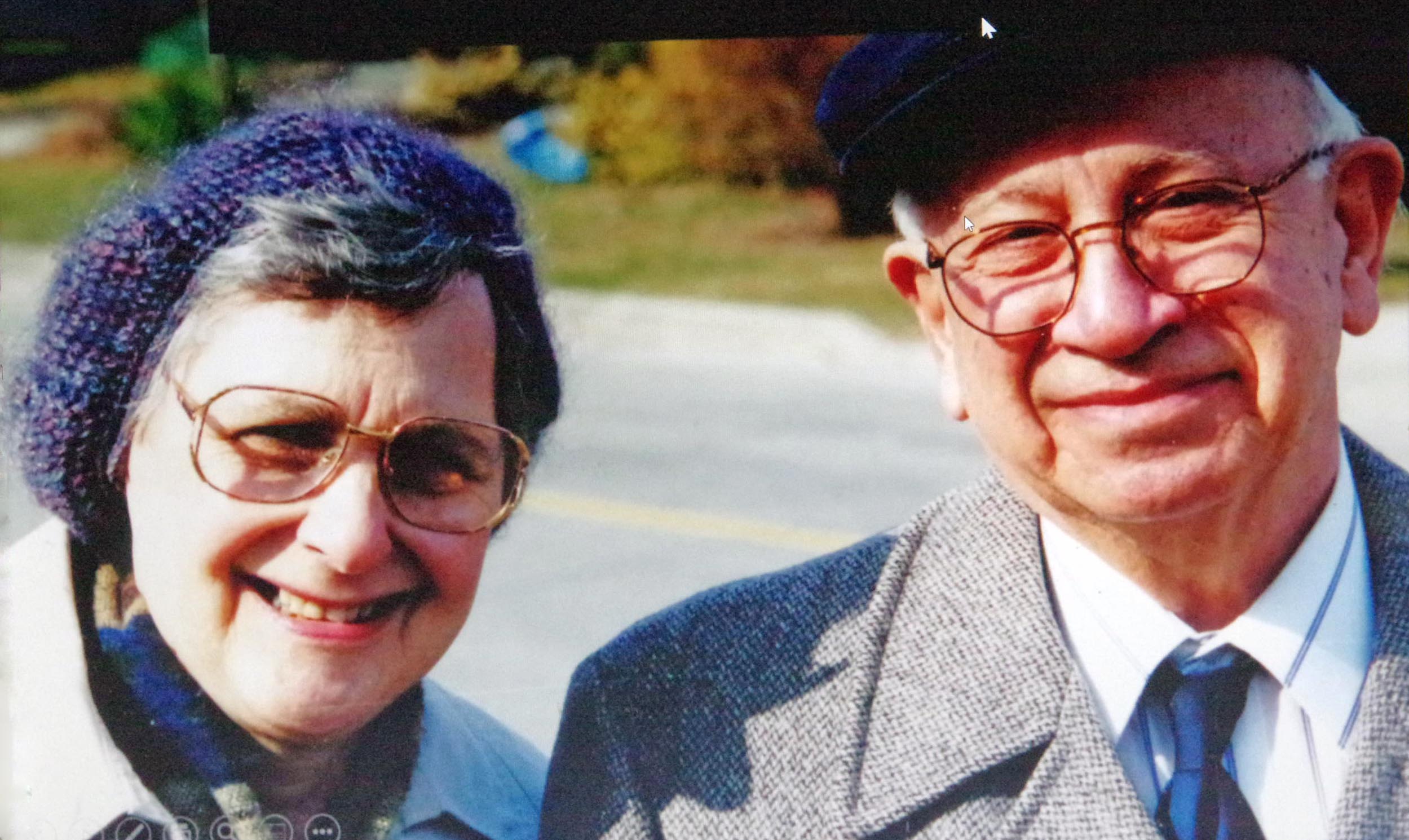
While her mother survived several concentration camps in Nazi Europe – she faced death in the gas chambers three times and survived – her father, who was a prisoner of war in Japan where he was used as a slave laborer – survived the atomic bombing in August 1945 of Nagasaki.
Luck or ‘bashert’?
How did they survive? How did they meet? How did they end up in Montreal where they married and made a beautiful life together despite the trauma of their past? Their daughter revealed the answers to these questions and more in a presentation that was at once uplifting, inspiring, breathtaking and emotionally charged.
“People say things to me like, ‘Were they ever lucky,’ ‘Talk about coincidence,’ and I’m saying ‘really?’ Was it really just luck and coincidence that both my parents would survive in the most extraordinary ways you’re about to discover?
“No, not according to my parents,” she continued. “They would tell you it was all ‘bashert,’ that wonderful little Yiddish word with many meanings, one of which is ‘meant to be’.”
Both suffered ordeals
While John, a young naval recruit in the Dutch East Indies, was captured at sea by the Japanese and had to fight for his life as a POW, Sonja was taken by the Nazis from her home in The Netherlands to endure the horrors of Auschwitz and other Holocaust concentration camps.
“Three times there was either a malfunction in the gas supply, or they had gassed so many people through that day they had run out of gas,” Roslyn said, describing part of her mother’s survival ordeal. “And before they could fix the problem, she was being put on a train and being shipped off to the next camp. She was in eleven different camps in total.”
‘Meant to Be’
If this had happened once, she added, “You could maybe say she was lucky. Two times very lucky. Three times, she would tell you it was bashert: meant to be.”
John spent three-and-a-half years as a war captive of the Japanese. During the last phase of this period, he was being worked as a slave labourer at a subterranean mine in Nagasaki. It was one of two cities over which U.S. forces detonated atomic bombs, to bring about Japan’s surrender at the conclusion of World War II.
“Where was my father when the bomb was dropped on Nagasaki?,” said Roslyn. “He was hundreds of metres underground. It saved his life. Again, he would tell you it was meant to be.”
Finally together
After enduring many tests of faith and personal strength at the hands of their captors on opposite sides of the world, the two were brought together at war’s end in the most extraordinary of circumstances to rebuild their lives, eventually arriving in post-war Montreal where they started a new life and raised a family.
Roslyn provided a powerful combination of masterful storytelling along with compelling audio-visual elements, including family photos, video clips from a Gemini award-nominated CBC television documentary about her parents, for a very memorable and meaningful evening.
Her book is the subject of a pending feature film currently in development. Roslyn is selling her book through her own website: roslynfranken.com. It is also available through Amazon and Kindle.
Petrari, D’Anello, Pettas and El-Helou will all be on the ballot on Sept. 20
While unveiling a slate of candidates running for the Laval region’s federal seats in the Sept. 20 general election, a senior official with the Conservative Party noted that the four chosen runners are entrepreneurs, business managers and professionals who are truly representative because of their dedicated community involvement in Laval.
Pledging to serve Laval
“I can tell you that from the moment they are elected as representatives in the Parliament of Canada, the team that is here today will take the interests of Laval to Ottawa, and not the interests of Ottawa and the Liberal Party to Laval,” said Senator Leo Housakos, who has been a member of the Senate since being appointed 13 years ago by former Prime Minister Stephen Harper.
A life-long Conservative, Housakos said he could remember back in the 1980s when the Conservatives succeeded in scoring a major breakthrough in Laval by electing Conservative MPs over a span of eight years.
Conservative Senator Leo Housakos. (Photo: Martin C. Barry, Newsfirst Multimedia)
“And when we did it in 1984-88, it was the same type of individuals: people connected to the community, professionals, business people and people who were doing politics for the right reasons,” added Housakos.
Petrari in Marc-Aurèle-Fortin
Sarah Petrari, an administrator for a biopharmaceutical company, is running for the party in the riding of Marc-Aurèle-Fortin.
The eldest of five children, she immigrated to Canada at the age of twelve. She was born in Southern California of a Mexican migrant family. She spent the vast majority of her youth in the Laurentians north of Laval, where she quickly learned French, a language she says she has grown to deeply cherish and love.
“The Conservative Party of Canada is the only choice before us that would bring common sense back to Ottawa and secure Canada’s future in these still very uncertain times,” she said. “I am offering you my candidacy to participate in a recovery of our country on all levels. Erin O’Toole has my all my respect.”
D’Anello in Alfred-Pellan
Angiolino D’Anello is running in the riding of Alfred-Pellan. According to some biographical notes furnished by the Conservative Party, D’Anello has over 40 years worth of established skills in entrepreneurship and corporate business, with a diverse background in several fields and industries.
He holds two degrees from Concordia University, a Bachelor of Arts in Political Science and legal studies, and a Post-Graduate Diploma in Community Politics and the Law. He is a member of the Knights of Columbus and president of Club Richelieu Bourassa/Club Bourassa.
He said he has actively participated in several political campaigns at all three levels of government as an adviser, among other roles. However, he said he withdrew his support from the federal Liberals, “deceived by the incompetence and the unacceptable track record of the Trudeau government,” D’Anello’s biography states.
Pettas in Laval-Les Îles
Spyridonas Pettas is running in Laval-Les Îles. With 30 years experience in management and leadership of private and publicly held enterprises, he is currently president of a small enterprise, ARCA Logistics Solutions Inc., a privately held armoured car and security guard company.
More recently, he says he has been working closely with Batshaw Youth and Family Centres, the provincial government-funded social services organization in Montreal that is devoted to the welfare of children and their families.
“I came to the decision to run for office with the Conservative Party of Canada after a great deal of contemplation,” he said, while adding that running was his ambition for many years and he hoped, if elected, to help improve Canadians’ livelihoods, their health, women’s rights, freedom of expression, First Nations rights, veterans who risked their lives for freedom, real environmental solutions and taxpayers’ rights.
El-Helou in Vimy
Rima El-Helou is running in Laval’s Vimy riding. With a Master’s of Business Administration from ESCP-EAP in Paris, as well as degrees in public health, midwifery and marketing, she has a diverse professional background and a wealth of work experience.
‘The team that is here today will take the interests of Laval to Ottawa, and not the interests of Ottawa and the Liberal Party to Laval’
With regards to the 2021 federal election campaign, she feels especially strongly about issues involving provincial rights and jurisdictions and the potential decentralization of power from Ottawa to the Quebec government, including a better deal for the management of medicare in the province.
“The contract with all Quebecers addresses many of the wishes of the population with respect to their federal government: granting more power to Quebec and the means to finance its health system,” she said in a statement issued by the Conservative Party.