Home Blog Page 124

SWLSB votes unanimously to support EMSB Bill 96 challenge

The Council of Commissioners of the Sir Wilfrid Laurier School Board (SWLSB) voted unanimously on Thursday evening to declare support for the English Montreal School Board’s legal challenge of Bill 96 (An Act respecting French, the official and common language of Québec).

Laurier School Board showcases 2017-2018 budget overview
(File photo: Newsfirst Multimedia)

According to a statement issued by the SWLSB, the board considers that parts of Bill 96 contravene the English-speaking community’s rights to manage and control their educational institutions as per section 23 of the Canadian Charter of Rights and Freedoms.

The SWLSB says the commissioiners “do not believe that the Quebec government has acted in the best interest of its citizens, whether English-speaking or French-speaking,” with the adoption of Bill 96 on May 24.

“We have always proudly promoted our school board tagline of An English Education, A bilingual Future,” said SWLSB chairman Paolo Galati.

“Although we agree that we must protect the French language, this bill clearly violates our constitutional rights and that is why the Council of Commissioners is supporting EMSB, in this legal proceeding.

“Bill 96 is divisive and we are very concerned about the repercussions it will have on English-speaking Quebecers,” added Galati. “We need to stand united now more than ever.”

Sanofi Canada closing its Laval operations by year-end

Seen here from an eagle’s-eye point of view, the City of Laval’s Cité de la Biotech is home to more than a dozen science and research companies in the bio-technology and pharmaceuticals sectors.

Nearly 85 employees who work at Sanofi Canada’s operations in Laval and in West Island Montreal will be unemployed by the end of 2022, following an announcement that the company is relocating to Toronto.

According the Montreal daily Le Devoir, the multinational pharmaceutical company also closed a laboratory and a production facility in Laval in 2012.

The City of Laval’s economic development office has been making great efforts in recent years to persuade major players in the global bio-technology and pharmaceutical sectors to locate operations in Laval’s Cité de la Biotech industrial park.

Man shot to death in Vietnamese restaurant on des Laurentides

The Laval Police have handed over investigative responsibility to the Sûreté du Québec after a 42-year-old man with suspected ties to organized crime was shot to death in a Vietnamese restaurant on des Laurentides Blvd. in Vimont on Wednesday evening.

Police were called to the scene at the Perle Vietnamienne on des Laurentides near the corner of de Catane Street just before 7:30 p.m. Wednesday, where they found the victim had been shot in the head.

According to media reports, two gunmen entered the restaurant where other diners, including several children, were seated and fired at the victim’s head.

Although attempts to were made to revive him, he was rushed to hospital where he was declared dead on arrival.

The Journal de Montréal and other media identified the man as Bernard Cherfan. The Journal claims Cherfan had ties to the Lebanese underworld and had survived an assassination attempt in 2015.

The Laval Police turned the investigation over to the SQ as it involves organized crime.

Laval among cities where police raids net $32.5 million worth of meth

Laval was one of several cities across Quebec where police officers conducted a series of sweeping raids last week, during which large quantities of methamphetamines trafficked by organized crime were seized in a record haul said to be worth more than $32.5 million.

In all, 28 warrants were executed in Laval, the Laurentians, the Montérégie, Centre-du-Québec and in Mauricie. Major amounts of illegal drugs were seized in Saint-Léonard, Boucherville, Chambly, Val-David, Yamachiche, Lanoraie, Saint-Anne-des-Plaines, Saint-Hubert, Sainte-Thérèse and Belœil.

Eight suspects were arrested and the drugs seized included:

·         6.5 million tablets of amphetamines;

·         21 firearms;

·         481 kg methamphetamine powder;

·         11 kg of pure meth;

·         5,000 tablets of MDMA (ecstasy);

·         Several hundred tablets of Cialis and Xanax;

·         13 presses for making tablets;

·         1,002 cutters for shaping tablets;

·         250,000 bags for wrapping;

·         10 cell phones and one computer;

·         Nearly $300,000 in cash.

According to the police, around a million tablets of illicit drugs were withdrawn from circulation as a result of the raids. The investigation had been underway since September 2021. Among other things, it revealed that around $5 million per week was being earned by the suspects from sale of the drugs. The clients for methamphetamines are typically teenagers and young adults.

LPD pass suspicious death in home invasion over to SQ

Investigators with the Laval Police Dept. opened a file following the discovery of the lifeless body of a man in his early 20s inside the Sainte-Rose home of a well-known UFC ring fighter on May 24 following what is believed to have been an attempted home invasion.

LPD officers received a 911 call at 1:55 a.m. from a couple who had fled the home and took refuge at a family member’s nearby home. The two people, a man and a woman, told police they had just been robbed at their home on Place du Cormoran in the Champfleury sector.

When officers arrived at the scene, they found the alleged home invasion suspect’s body. It was later revealed that it bore signs of having been stabbed multiple times.

The Journal de Montréal identified one of the people in the house during the incident as Eduardo «Icho» Larenas, a UFC fighter, while the other was identified as his spouse, Gladys Rosana Lopez.

According to the French-language tabloid, the 250-pound, 6’3”, 42-year-old Larenas, who is said to have contacts with organized crime, called the police to report that a home invasion had taken place. The file has been handed over to the Sûreté du Québec because of the alleged organized crime connection.

Crown seeks six-year sentence for woman who molested boy

A crown prosecutor told a judge in a Laval courtroom last week that the courts need to send out a clear message that sexual assault is unacceptable and won’t be tolerated, regardless of whether the perpetrator is a man or a woman.

As such, the prosecution is seeking a six-year jail sentence for Josianne Lévesque, a 43-year-old former grade-school teacher, who was previously found guilty of sexually abusing an eight-year-old boy who had been one of her students.

Over a period of 17 months, while tutoring the child, she took advantage of him sexually. It was only after he complained to his parents that the abuse stopped. Before then, Lévesque had told the boy not to reveal what had been going on because it would get her into a lot of trouble.

While the prosecution was demanding the higher sentence, Lévesque’s lawyer was seeking 25 months, claiming that she had shown signs of remorse. The judge is scheduled to render a decision in October.

Laval man among those charged in alleged truck training fraud

A Laval resident and a man from neighbouring Saint-Eustache are among a group of six people facing fraud charges linked to a two-year investigation in Ontario into allegations related to commercial motor vehicle driver training.

In March 2019, the Ontario Provincial Police was advised by the Sûreté du Québec (SQ) of fraudulent passenger and licensing activities, which led to a criminal investigation.

The investigation revealed three major components of a serious fraudulent scheme, said to significantly impact the safety of Canadian highways.

  • Use of an interpreter to fraudulently complete required licensing knowledge tests;
  • Non-Ontario residents applying for an Ontario driver’s licence;
  • And circumvention of Ontario’s Mandatory Entry-Level Training (MELT) standard.

The investigators identified more than 200 incidents in which students had committed a variety of fraudulent activities to obtain a commercial vehicle licence.

It is alleged that the suspects allowed their foreign clients to obtain a class 5 (passenger vehicle) and possibly a class 1 (heavy goods vehicle) driver’s license using falsified documents.

Laval Police set off on long-distance bike tour

From May 30 to June 4, 14 officers with the Laval Police Dept. are bicycling more than 1,100 kilometres in six days in order to raise funds for Opération Enfant Soleil.

The cycling officers set off from Laval city hall at 8 am last Monday and are scheduled to get back to LPD headquarters around 4 pm on Saturday June 4.

Their route during the five days will take them through 80 municipalities between Laval and Quebec City, while travelling through Montreal, the Montérégie region, the Eastern Townships, the Beauce, Mauricie and Lanaudière.

“Over the coming week, our police officers will be facing a major sports challenge,” said LPD chief Pierre Brochet. “For every pedal stroke, each kilometre travelled, they hold out the hope of a healthy future for all the children and parents in need.”

Since 1997 when the event was first held, the LPD’s cycling tour has raised more than $1.7 million. As they pass through the Beauce and the provincial capital, the LPD officers will be accompanied by colleagues from the Quebec City Police Dept.


Quebec National Assembly officials open new CHSLD Val-des-Brises

Long-term care facility will take in up to 232 residents by autumn

Several elected members of the Quebec National Assembly from the Laval region managed to abandon partisan divisions momentarily on May 18 to gather just north of the city’s Duvernay district for the official opening of the new CHLSD Val-des-Brises long-term health care facility on Robert-Bourassa Boulevard.

Will be full by fall

Mille-Îles Liberal MNA Francine Charbonneau joined Sainte-Rose CAQ MNA Christopher Skeete, as well as Minister Responsible for Senior Citizens and Caregivers Marguerite Blais, and Minister Responsible for the Laval Region Benoit Charette, for a tour of the new and state-of-the-art facility.

CHSLD Val-des-Brises has welcomed more than 100 residents since early May and is expected to reach a capacity of 232 by this autumn.

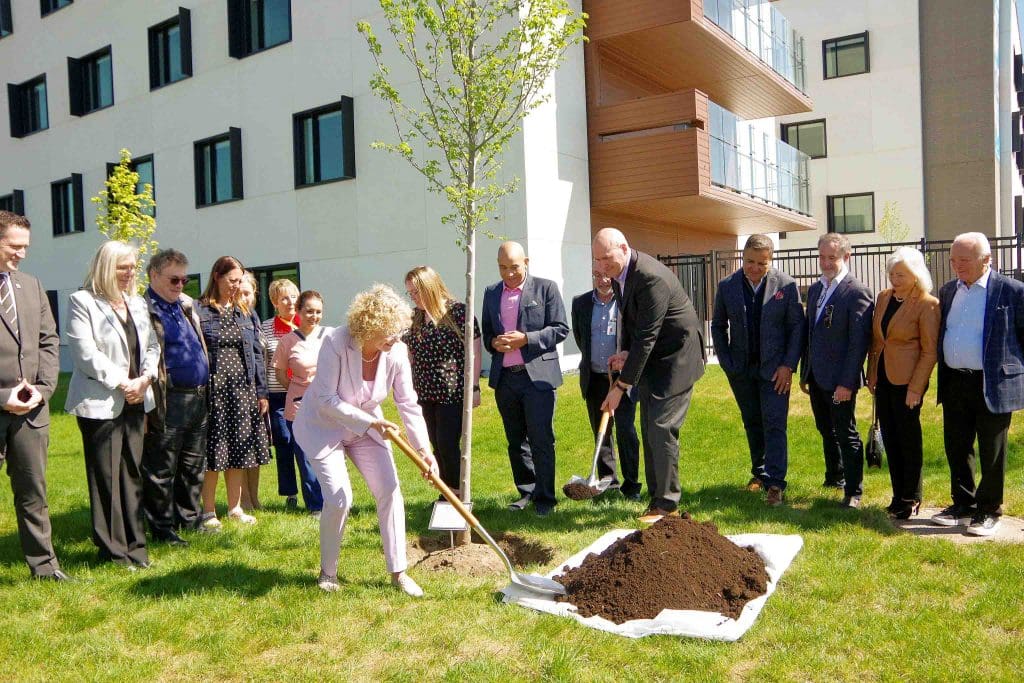
Quebec Minister for Senior Citizens and Caregivers Marguerite Blais wields a shovel during the planting of a tree on May 18 outside the new CHLSD Val-des-Brises. (Photo: Martin C. Barry, Newsfirst Multimedia)

By and large, the residents will be those suffering from moderate to severe neurocognitive disorders, often associated with Alzheimer’s disease, although they may be caused by other medical conditions such as Parkinson’s and traumatic brain injury.

Feeling at home

The residence’s living units were designed in a manner so as to make those living in them feel truly as though they are at home. The building is divided into units, each with 11 residents, with a warm and welcoming atmosphere.

Quebec Senior Citizens Minister Marguerite Blais, left, walks alongside Mille-Îles Liberal MNA Francine Charbonneau during the opening of the new CHSLD Val-des-Brises on May 18. (Photo: Martin C. Barry, Newsfirst Multimedia)

The presence of personal caregivers is being encouraged to promote relationships and to sustain the morale of residents. Following a tour of the CHLSD, employees and officials gathered on the lawn on Robert-Bourassa Blvd. to plant a sapling tree symbolizing the open spirit of the new facility.

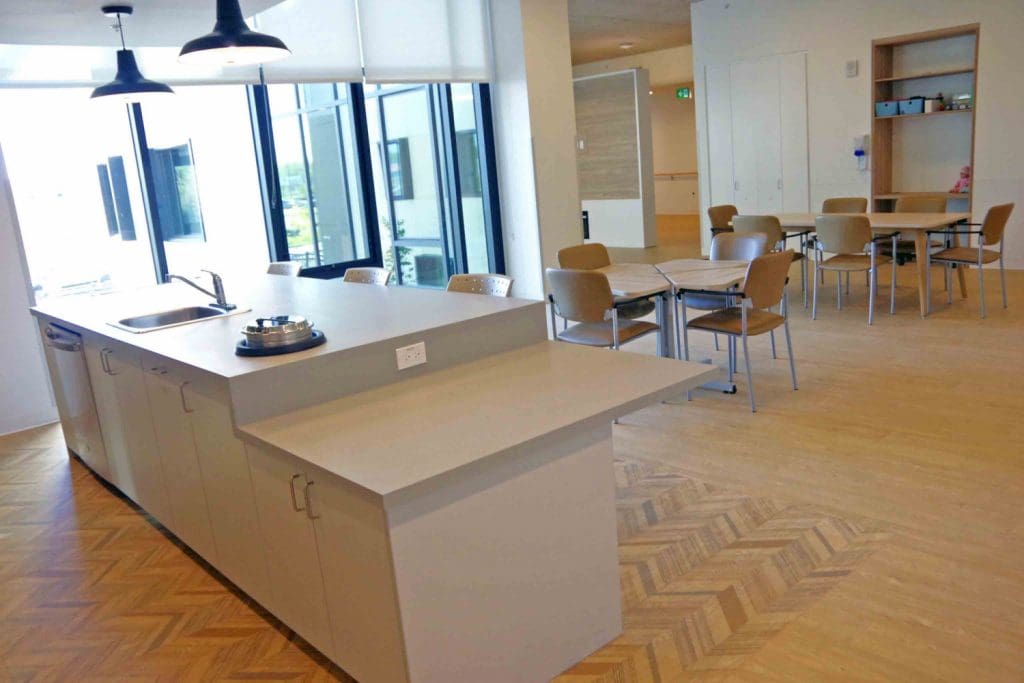
Each room has its own bathroom and common areas, including a kitchen and dining rooms, which look and feel very much like what the average person might find in their own home. There are also several gardens on the exterior grounds and a pond where apparently fishing will be possible.

Will be leased 15 years

The building contractor, Montoni, managed to complete the project in time, in spite of the challenges over the past two years from the Covid pandemic. The CISSS de Laval is leasing (rather than owning) the facility from Montoni under terms of a PPP agreement over the next 15 years.

“The official opening of the new CHSLD Val-des-Brises in Laval will offer a quality lifestyle to its residents,” said Blais, who had been under fire for more than a year over shortcomings in the response to the Covid pandemic in the network of CHSLDs. (Still, Blais’ name only came up once in Quebec coroner Géhane Kamal’s recent report on the province’s slow response to the first wave of the pandemic in 2020.)

A winning combination

Common areas at the new CHSLD Val-des-Brises were designed to resemble the interior of a home as much as possible. (Photo: Martin C. Barry, Newsfirst Multimedia)

“They will be able to live in a secure environment that is adapted to their needs,” Blais added. “I am pleased to see that this project is promoting a clinical approach as well as elements resembling those found in seniors retirement homes.”

Charrette said he was pleased to see the new facility had been designed and built to offer its residents a welcoming, secure and warm environment.

“I would like to thank all the teams who combined their efforts to complete this magnificent project for the Laval region,” he said. “This will make a big difference for the persons living here and their caregivers.”

Mille-Îles MNA impressed

Charbonneau (a former Senior Citizens Minister under the Liberals) was especially impressed by the warmth and homelike atmosphere of the new facility.

She said the residents are sure to feel as though they are indeed in a place that is welcoming when soup is made in the kitchen area and the aroma reminds them of what home is really about.

“The coming together of this major project is in itself an important advancement for our community,” said Skeete. “This new and modern facility will contribute without any doubt to the well-being of our seniors, while seeing that they are in a place that is pleasant and better adapted to their needs. A project like this bears witness to the efforts which are made collectively to improve the quality of life of persons suffering from a loss of autonomy.”

Laurentian Public Health warns of carbon monoxide hazards from generators

Advisory also issued about consuming food after six hours without refrigeration

Following the numerous electric power blackouts that swept the Laurentian region after major rain and wind storms, the public health director at CISSS des Laurentides has issued a reminder of the various risks attached to operating gasoline-fueled electric generators.

Carbon monoxide is a toxic gas which is invisible and odorless. Carbon monoxide poisoning can leave permanent damage or can even cause death. Only a carbon monoxide detector can alert you to the presence of this dangerous gas.

Never indoors

The public health office is warning that appliances which operate on fuels such as natural gas, gasoline, propane etc., and which include hotplates, heaters or barbecues, should never be used inside a dwelling.

As well, electric power generators should never be installed and operated inside a dwelling or even from inside a garage, and they should be run at a considerable distance from the nearest doors or windows because exhaust fumes containing carbon monoxide can accumulate and enter a residence without your being aware of it.

Carbon monoxide detector

In these times when gas operated generators are being used frequently by many people in the Laurentians, the best way to protect against this type of hazard is to be equipped with a battery-operated carbon monoxide detector and alarm which will remain activated even during power blackouts.

In addition, it should be noted that smoke detectors are not equipped to detect carbon monoxide and cannot protect you should carbon monoxide build up in significant concentrations in your dwelling.

Beware food spoilage

The Laurentian region’s public health office is warning at the same time that the freshness and safety of foods requiring refrigeration or which need to be kept frozen can become compromised during electric power outages lasting more than six hours.

It is recommended that you take no risks and that you not consume food products which may have been spoiled, in order to avoid coming down with poisoning from foodborne bacterial pathogens.

Continued gov’t deficits threaten economic recovery, Fraser Institute claims

Think-tank warns of ‘significant long-term consequences’ from deficit spending

As the Covid pandemic appears to be passing and public relief programs are winding down, questions are starting to be asked as to when governments across Canada will be moving towards balancing their budgets and paying down their massive debts.

In that vein, a new essay released by the B.C.-based Fraser Institute notes that the federal government recorded a $327.7 billion deficit in 2020-21 and a deficit of $113.8 billion in 2021-22.

Deficit larger than 2008

This, the conservative-leaning public policy think-tank notes, is 27.8 per cent larger than the deficit incurred in the aftermath of the 2008 subprime mortgage financial crisis despite a strong recovery.

The Fraser Institute feels that while there was some justification for emergency spending and deficits during 2020 and 2021, “there is little or no justification for a $52.8 billion deficit in 2022,” states the report’s author.

“Some people may think that deficits don’t matter since governments across Canada racked up so many before and during the COVID-19 pandemic,” says Matthew Lau, an adjunct scholar with the Fraser Institute and author of ‘When is it Appropriate to Run Budget Deficits?’

Deficit consequences

He and the institute maintain that there are significant long-term consequences to deficit financing – even if they’re not immediately visible.

The essay acknowledges that there are times when deficits are unavoidable for governments, such as during recessions and other economic shocks like the COVID-19 pandemic.

During such times, unemployment rises, which increases government spending at the same time that government revenues fall, resulting in deficits.

Crowding private sector

However, once the economy starts to recover, such as it is starting to now, government spending normally should decline while revenues increase, allowing for balanced budgets and even surpluses.

The Fraser Institute and its contributing analysts claim that continuing to run deficits during periods of recovery and growth can crowd out and compete with the private sector, which they believe actually can harm recovery and economic growth.

A second essay published recently by the institute, authored by Professor Donald J. Boudreaux of George Mason University in Virginia U.S.A., regarding James M. Buchanan and the Political Economy of Debt Financing, emphasizes theories of public spending first set out by Buchanan, a Nobel-laureate economist.

Burden of repaying deficits of today may fall on future generations, the Fraser Institute maintains

Burden on the future

The essay attempts to explain how the burden of repaying government deficits of today may fall on future generations of taxpayers, who will either have to pay higher taxes or forego other government programs in order to repay public debt.

Boudreaux also sets about to explain how Buchanan warned against deficits because of their corrosive effects on democracy, in that the bills of today’s spending are passed onto the next generation who have no current political voice or decision-making authority.

Spending others’ money

“Buchanan’s warning on government deficits and debt was crystal clear: we spend other people’s money less wisely than we do our own, and that lesson still holds true today,” says Boudreaux.

“It is almost always politically advantageous to spend now and pay later. But doing so unfairly punishes future generations. And so, governments should be restrained in how they spend other peoples’ money.”

Quebec to open ‘project office’ for potential Metro orange line extension

Rapid transit buses also under study for Notre-Dame and Saint-Martin axes

The provincial government has announced it will be setting up a project office in Laval in order to study the feasibility of implementing an improved north-south public transit axis between Laval and Montreal – including a Metro orange line extension from Montreal to the western and northern districts of this city.

The announcement was made on Thursday last week by CAQ Transport Minister François Bonnardel, along with Laval mayor Stéphane Boyer and Sainte-Rose CAQ MNA Christopher Skeete.

Although they were vague as to the form the project will take, they said the project office will be mandated to carry out studies to determine the best way to implement efficient service, while seeking ways to reduce road traffic congestion.

Transit improvements

“We are giving ourselves the means to support sustainable mobility in Laval through projects that will be complementary in the north-south and east-west axes,” Bonnardel said, adding that the provincial government has been spending record sums on public transit since first being elected nearly four years ago. “These projects will help provide efficient public transit options for citizens,” he said.

At the same time, Bonnardel announced the implementation of a new rapid transit bus service (BRT) to be located on Notre-Dame and de la Concorde boulevards in west and central Laval. The route would be set up between Curé-Labelle and des Laurentides boulevards.

According to the government, the Transport Ministry will also examine the feasibility of creating another BRT on Saint-Martin Blvd. to relieve congestion on this very busy artery.

Improved mobility

Mayor Boyer said the three announcements hold the potential “to positively change the daily lives of the entire Laval population since they will completely improve our mobility.”

He said the Saint-Martin Blvd. public transit project alone would connect half the neighbourhoods in Laval to one another, and would promote the development of the city.

A statement issued by the transport ministry said the government was expressing its “willingness to support” the Notre-Dame/de la Concorde SRB project though the creation of the project office, without offering any specific commitment.

Overseen by project office

It might be noted that in the past, similar offices have been created for projects such as the extension of Cavendish Blvd. in west-end Montreal, even though the Cavendish project, after a multitude of announcements, is still far from going ahead, fifty years after first being proposed.

The projects hold the potential “to positively change the daily lives of the entire Laval population,’ said Mayor Boyer

The Société de transport de Laval currently provides 600 bus service transits per day in the areas the Laval project office will be studying, transporting 13,500 passengers daily. The STL says that it has already established a project office of its own, in conjunction with the City of Laval, the Ministry of Transport and the Autorité régionale de transport métropolitain (ARTM).

Taking action, says Skeete

“In fifteen years or so, Laval has seen itself transformed into a true centre of employment,” said Christopher Skeete. “Therefore, it is necessary to take significant actions for mobility in order to improve the quality of life of all Laval residents. These three important projects will help support sustainable and responsible development in the region.”

Planning ahead

In the decade from 2011 to 2021, the City of Laval has seen its population increase by 9 per cent. According to projections made by the Institut de la statistique du Québec, the acceleration in population will reach 15 per cent in the coming two decades.

Officials at the municipal and provincial levels believe that this rate of demographic growth will place a heavier burden on basic local infrastructure, including public transit services.

Streets to close June 5 for ‘Course des pompiers de Laval’

In order to ensure the best possible security during the 10th annual Laval Firemen’s Race taking place on June 5 from 6 am to 1 pm, certain streets in some Laval neighbourhoods will be closed and not available for parking.

The city is asking motorists, bicyclists and pedestrians to plan ahead in order not to have nasty surprises on the day of the event.

A schedule and details on the streets that will be affected are available on the website (https://coursedespompiers.org/fermeture-de-rues/) set up for the event.

Volunteers and police officers will be overseeing the safety of one and all. All the intersections where the runners will be heading through will be subject to special supervision.

City of Laval’s libraries are the place to be this summer

Staff at the City of Laval’s public libraries are getting into gear for a long summer of fun, educational and free activities through the coming months.

In all, 215 activities are planned. In addition to some 30 activities taking place within the library branches, library personnel will also be going out into local parks and to swimming pools where other activities will also be held.

“This summer, it’s a big return to activities taking place in person,” says Laval city councillor for Sainte-Rose Flavia Alexandra Novac, who is responsible for library services, noting that the Covid pandemic appears finally to be ending.

“We will also have the great pleasure of welcoming the new Bibliomobile, which will allow the population to browse books from outside the libraries,” she added. “Our teams can’t wait to be in contact once more with families in order to present to them the diverse program of programming and activities planned for young and old alike.”

For kids, the TD Summer Reading Club is back this year, with reading suggestions and free activities for children 12 years of age and younger, until the end of the summer.

Children can register for the program beginning on June 16, after which they will be able to pick up a complimentary theme bag containing an information booklet, a games book and a coupon to take part in a raffle draw to win books, board games and a free family pass for a fun activity.

‘Cercle des fermières’ receives National Assembly Medal

Sainte-Rose MNA Christopher Skeete presented members of the Cercle des fermières de Laval with the National Assembly Medal last week, on the occasion of the group’s 100th anniversary, having been founded in 2022 by Anna et Rita Ouimet.

Receiving the medal were relatives of the Ouimet sisters, Brigitte, Chantal and Christine Fournier. Attending the ceremony were city councillor for Sainte-Rose Alexandra Flavia Novac and city councillor for Auteuil Jocelyne Frédéric-Gauthier.

One hundred years ago, the mission of the Cercle des fermières was to help improve conditions for women and their families through the promotion of local heritage, culture and values.

In those days in mostly rural and agricultural Laval, the women were frequently heavily burdened with chores, and the Cercle des fermières offered opportunities to relax and enjoy moments of leisure. The two Ouimet sisters grew up on Sainte-Rose Blvd. in Sainte-Rose – in fact, in the house which is today the Dame Tartine breakfast restaurant. They both were musicians, and Rita was the organist at the Sainte-Rose parish church.

Montreal lawyer Julius Grey to head legal team challenging Bill 96

Constitutional expert sees key areas he believes will not stand up to legal scrutiny

Almost as soon as the Coalition Avenir Québec government’s Bill 96 was passed into law on Tuesday last week, Montreal constitutional rights lawyer Julius Grey was announcing the creation of a legal team to contest the legislation updating the province’s 45-year-old Bill 101 language law.

Wide ranging measures

Montreal human rights and constitional lawyer Julius Grey will be leading a legal team to challenge the Quebec government’s Bill 96.

The sweeping measures contained in Bill 96 stand to affect everything under provincial jurisdiction, including immigration, education, health care, business, municipalities and the legal system.

Perhaps most controversially, the legislation grants the Office québécois de la langue française (OQLF) search and seizure powers without the need for a warrant to ensure compliance.

Long fight ahead

In several interviews with media since last week, Grey has said he expects a long and drawn-out fight over the constitutionality of Bill 96, possibly going beyond the Supreme Court of Canada to international courts.

Two days after the bill was passed in the National Assembly, the English Montreal School Board announced it would be launching a legal fight of its own, while the Quebec Community Groups Network, which represents dozens of English-language groups across Quebec, is also joining the fray.

QCGN’s position

“We will also be supporting upcoming legal challenges to the law, while ensuring that its nefarious impacts on Quebecers are brought to the public’s attention and are debated in the upcoming election campaign,” the organization led by Marlene Jennings said in a statement.

Although the exact nature of legal challenges to Bill 96 hasn’t yet been revealed, last week Julius Grey highlighted several important areas of Bill 96 that his legal team will probably be focusing on. Here are two of them:

‘We will also be supporting upcoming legal challenges to the law,’ says QCGN regarding its role in upcoming court contestations

● Bill 96 would make citizens pay for French translations

According to Grey, the basic right to justice in Canada can’t be overruled by the notwithstanding clause, which the Legault government is relying on to pre-emptively defend Bill 96 against constitutional challenges. As such, he believes forcing people to pay to translate certain documents submitted to courts in Quebec won’t withstand a challenge.

● The OQLF could search lawyers’ and notaries’ offices

The OQLF monitors the use of French in Quebec at workplaces and in public settings, such as on signage. Although its powers are made greater in Bill 96, including searching business computers for materials that violate the language law, Grey believes some things in the work of lawyers and notaries must remain untouchable – including notaries’ or lawyers’ files – and abrogating this will not withstand a legal challenge.