More than 300 experts gathered at Château Royal to discuss Laval’s economic future
The spectre of U.S. president Donald Trump and his disruptive economic policies figured prominently in the words of several speakers during a one-day conference on the Laval region’s economic prospects held on November 20 by Laval économique, the City of Laval’s development arm.
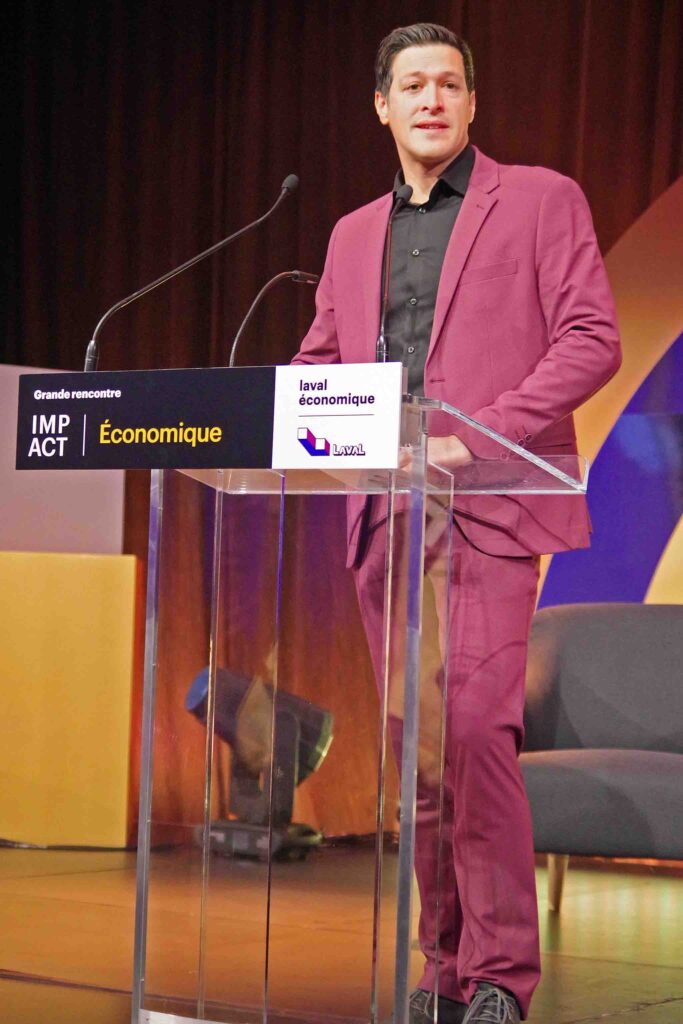
For several hours at the Château Royal, Laval was an epicenter of discussions on international trade during the IMPACT Économique Grand conference. More than 300 export experts, visionary entrepreneurs and economic and political decision-makers accepted the agency’s invitation to gather for a day of strategic discussions.
On the agenda were growth prospects, innovative business strategies and concrete opportunities for companies with a base in Laval seeking to establish themselves in national and global value chains.
Experts and stakeholders
The event brought together stakeholders, such as Mayor Stéphane Boyer, Marc-Aurèle-Fortin MP Carlos Leitão who is Parliamentary Secretary to the Minister of Industry, as well as high-level experts.
They included former Radio-Canada news correspondent Jean-François Lépine, senior Desjardins economist Benoit Durocher, vice-president for exports at Investissement Québec International Marie-Ève Jean, and Frédéric Legendre, director general of Trade Policy and External Relations at the Ministry of Economy, Innovation and Energy.
In opening remarks, Mayor Boyer outlined Laval’s role as an economic hub and the importance of exports in regional development. Lidia Divry, executive-director of Laval Économique, suggested some concrete solutions to support Laval’s businesses during these challenging economic times.
A ‘wake up’ from Trump
“If I’m here today with you, it’s because I want Laval to prosper and grow,” said Boyer, while adding that the well-being of Laval’s nearly 450,000 residents depends largely on the capacity of the region’s businesses and industries to excel.
He called the Trump administration’s actions since the Republican president took office last January a “wake-up call for Canada,” while noting that for the longest time, the U.S. was the country’s most important trading partner.
Still, he suggested that changing world events and a shifting political landscape also hold the potential to create new economic opportunities, and that one of the reasons for the gathering was to see “what we can do” to maximize the potential benefits for the Laval region’s industries and businesses.
A change in values
While noting the emergence of India as an economy poised to become the world’s third largest, and the impact of the Covid pandemic which disrupted the global economic system, Jean-François Lépine said Trump’s re-election a year ago led Canadians to discover that “our best best friend had become a sort of enemy, a figure with whom we no longer share the same values.”
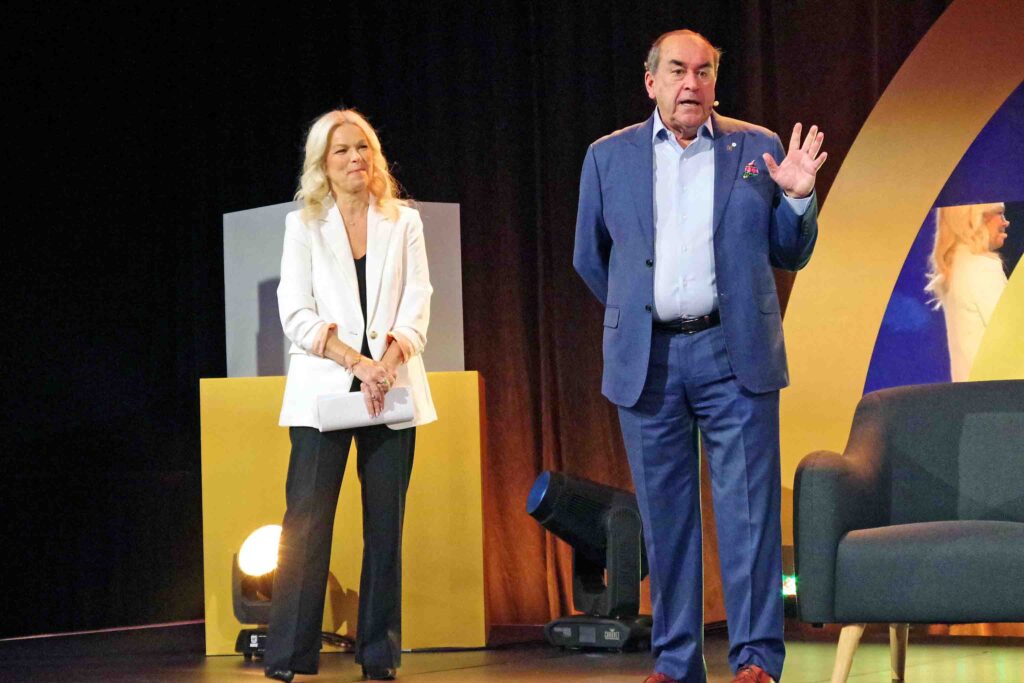
Apart from the economic impact, Lépine said Trump’s arrival may also have brought about the beginning of the end of the U.S.’s military global domination, which peaked after the late 1980s following the dissolution of the Soviet Union when the U.S. was perceived to have become “the world’s policeman.”
“You can see how American democracy has been evolving at great speed towards something we weren’t expecting at all,” Lépine continued. “The rules are being less and less respected. The conflicts are becoming more and more unpredictable with consequences that also are more and more unpredictable.”
Contending with China
Lépine, who was for many years Radio-Canada’s foreign correspondent in the People’s Republic of China, contrasted the authoritian communist nation’s market-driven surge that leveraged 800 million people out of poverty, with western nations like the U.S. where government intervention often is constrained by political quarrels over democratic values.
As well, he noted the emergence of China’s megacities, like Shanghai, populated by 25-35 million or more inhabitants in some cases, with matching mass transit systems to accommodate legions of workers. As he noted, the People’s Republic of China’s middle-class now includes 400 million citizens out of PRC’s 1,408,280,000 population.
However, as Lépine also pointed out, all is not well in China, where economic overreach has resulted in massive overdevelopment of housing, with potential blowback felt by non-Chinese investors. “If all of that were to collapse, there’d be the risk of China’s economy being in a situation from which no one knows whether it would be able to get out,” he said.