The current issue of the Laval News volume 27-04 published February 20, 2019, (Laval’s English Newspaper) covers local events such as politics, sports and human-interest stories. It features editorials and other columns. Click on the image to read the paper.
Front page of Laval News, Vol. 27-04
February 20, 2019.
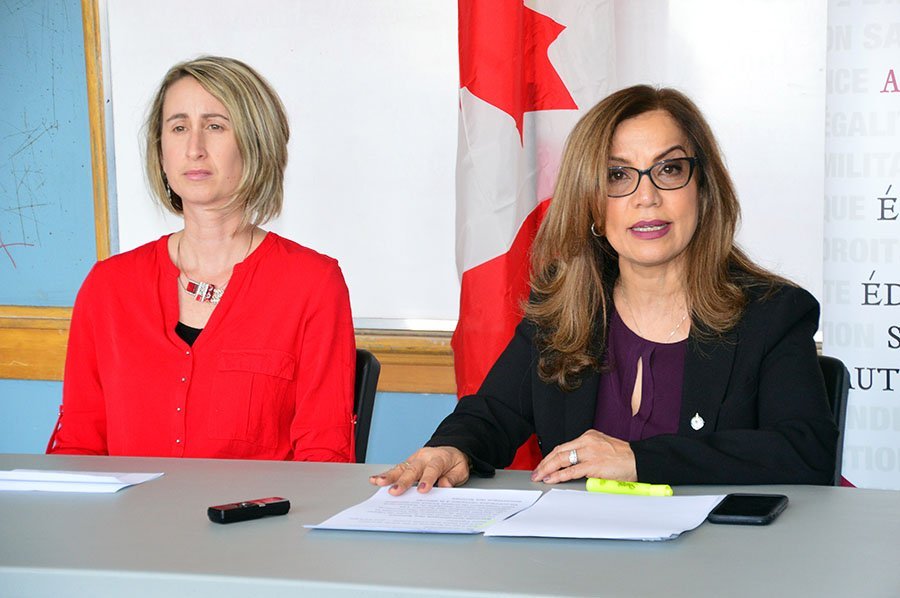
“The Table de concertation de Laval en condition féminine will be able to continue this noble mission they’ve chosen,” says Nassif (right).
Martin C. Barry
Vimy
Liberal MP Eva Nassif has announced that a local umbrella group of women’s
organizations will receive $295,725 in funding for a 36-month project whose
goal will be to remove systemic barriers to employment for vulnerable women in
the Laval region.
The
Table de concertation de Laval en condition féminine will collaborate with
local partners in key employment sectors, service providers and women in Laval,
whose lived experience of employment barriers include domestic abuse, poverty,
housing, mental and physical health issues.
Goal is a regional model
According
to the organization and Nassif, a gender-based analysis will be applied to
existing policies to determine common service gaps and barriers in
transportation, access to child care, training opportunities, job-matching
methods and other job placement issues. New procedures and protocols will be
piloted through three community partners to create a model that can be
incorporated into practices at the regional level.
“I
believe that with this important project, and with the help of key partners,
the Table de concertation de Laval en condition féminine will be able to
continue this noble mission they’ve chosen, which is to provide a more secure
future for women in need, and to fight alongside them so their rights will be
recognized,” Nassif said during an announcement made at the Centre
communautaire Saint-Joseph last week.
Advancing equality
“I
am proud that the Government of Canada is committed to supporting their efforts
through the Women’s Program at the Department for Women and Gender Equality,”
Nassif continued. “Advancing equality continues to be at the heart of our
government decision-making. It’s not just the right thing to do. It’s the smart
thing to do. We know that we when we invest in women we are strengthening the
economy for everyone.”
Established
in Laval around 30 years ago, the Table de concertation de Laval en condition
féminine draws together more than 30 groups and organizations, nearly a dozen
of which concern themselves primarily with women’s equality issues.
From the left, Table de concertation de Laval en condition féminine coordinator Marie-Ève Surprenant, Vimy Liberal MP Eva Nassif, and TCLCF members Jeanne Reynolds and Nadjeda Toussaint.
Needed: quality jobs
“We
are all very happy today to be participating in this announcement and to be
launching this project that will improve the chances of women to get and obtain
jobs, especially quality jobs through which they will be able to improve their
economic security while ensuring their financial autonomy as well as their
children’s,” said Table de concertation coordinator Marie-Ève Surprenant.
According
to Surprenant, financial uncertainty was the most common problem her
organization’s initial research discovered among women in Laval who will be
benefiting from the program. Health and emotional problems, which tend to
accumulate when women are faced with financial problems, also worsen, she
added. “When you have these problems, it becomes difficult to hold down a job
and ensure one’s economic security,” said Surprenant.
Improving employability
The
subsidy will be spent on a program whose goal will be to improve the
employability prospects of women facing poverty, homelessness, mental and
physical health issues and other types of situations. The Table de
concertation’s partner members will be called upon to contribute and take part
in the program. The McKinsey Global Institute research organization maintains
that women continue to be disproportionately affected by economic insecurity.
In 2015, women in Canada earned 87 cents for every dollar earned by men.
The
institute estimates that by taking steps to advance equality for women – such
as employing more women in technology and boosting women’s participation in the
workforce – Canada could add $150 billion to its economy by 2026. The institute
also says that women are much more likely to work on a part-time basis, making
up 76 per cent of all part-time workers, with 25 per cent of women reporting
childcare responsibilities as their reason for working part-time.
Sophia relaxing with a good book and a cup of coffee during her visit to Montreal
Editor’s note: This is the second in a series of profiles TLN will be publishing in recognition of outstanding accomplishments of current and former Laval residents in ventures at home and abroad. Today we feature the exceptional strides made by Sophia Trozzo, born and bred in Laval, now coordinating educational and cultural projects of international relevance and multinational importance. Here is Sophia’s story, so far, as told to Renata Isopo
Tell us about your love of
writing
In
high school I took every writing opportunity, co-editing the yearbook, and taking
natural-fit courses like journalism. Journalism class offered a taste of what
the trade demanded: non-negotiable tenacity, dedication, critical thinking and
great writing.
I
was mentored by Renata Isopo, vibrant educator, consummate journalist, worldly,
cultural, and fond of sharing treasures of wisdom and knowledge with students.
I greatly admire her unapologetic unconventional philosophy of life. Having a
teacher of positive influence at a young age, is a rare gift. I don’t underestimate how this has continued
to shape me throughout adulthood.
High-school
journalism led to internship at Courrier Laval, first real insight into how journalists
should conduct themselves professionally. I realized a great journalist of
integrity requires more than great writing. You need tenacity, attention to
detail, and strong ethics.
Editor
John Fasciano taught me that essence and substance are central to fair
reporting, that I should think deeply about what questions to ask, to
understand if I was motivated by prejudice or ignorance or simply to extract truth
from facts. I was profoundly struck by his editorial philosophy that it was
crucial for journalists to exercise the dual responsibility of “getting the
right story and getting the story right.” And that’s a lesson four years of
Journalism school tried to teach me over again.
I had learned it at 18.
From
Dawson College’s Honours Communication to Concordia Journalism, graduating in
2013 with Philosophy and Political Science minors. Study choices flowed from belief
in thoughtful questions and genuine curiosity about the world.
I will always have Paris
At
university, I spent a semester in France, studying Human Rights and
International Relations at l’Institut d’études
politiques de Paris Sciences Po, assisted by a Quebec government bursary
for academic excellence.
Subsequently,
I became digital project manager for MS Media, while tutoring English and Math at
Oxford Learning. Creating a travel website, I published my photography and interviews
with some of the world’s most extensively travelled people. At McGill University,
I participated in the Women in House
Program (2013), shadowing a Member of Parliament in Ottawa for a day, leading to volunteer work for New Democratic
Party MP Rosane
Doré Lefebvre, (Alfred-Pellan constituency), doing data entry and French
to English translation.
From
two summers of teaching English to children in Italy and travelling extensively
across the peninsula, I discovered deep passion for roots, moving to Italy for
a career in education. Intending to continue teaching, I was offered private-school
work in Rome, but declined when the company I had been working for offered full-time
recruitment-officer responsibilities at Sanremo headquarters. Four years later,
I am still International Recruitment Manager, based on the Italian Riviera.
Since 2015, I have recruited 1200 educators from Canada, UK, U.S.A. South Africa,
New Zealand and Ireland, for English summer camps in Italy.
It’s
rigorous, demanding, fast-paced bilingual work, maintaining communication with
international applicants and EDUCO coordinators across Italy. I deploy tutors
to 200 summer camps country-wide, as the main point of contact for conflict
management and general human resources.
Sophia visiting beautiful Laval’s “Centre de la Nature”
What do you love most
about your work?
Sharing
love of Italy with hundreds of people in summer programs, many of whom have
never been here before, or come with certain stereotypes/expectations in mind,
like the idea that only Florence, Venice or Rome are worth exploring. After
summers in small towns in the mountains of Brescia, in the Emilia Romagna
countryside, or sea-side in Puglia and Calabria, they gain entirely new
perspectives.
I’ve
had the joy of creating several teachers’ courses, including English literature,
based in Oxford, England, performing-arts school visits to Sweden, a MulticulturalLondon tour, and Italian cultural programs for tutors, taking place
in the mountain village of Bajardo (Liguria). Since 2015 I have maintained
partnerships between EDUCO and UNITED WORLD SCHOOLS (London based Charity),
fundraising for their Myanmar schools.
EDUCO and summer camps
A
non-profit organization, EDUCO promotes student-centred learning through
theatre/drama. Accredited by Italy’s
Ministry of Education, EDUCO was one of the first in Italy to utilize theatre/ drama power within learning frameworks, spending11
years successfully teaching English to Italian children through our touring
theatre-in-education company, TEATRINO and ‘Theatre-in-Education
Days’ (‘T.I.E. Days’). Annually, 100,000 Italians take part in our English Summer
Camps.
EDUCO recruits English-speaking actors, performers,
musicians, tutors and trainers from all over the world; our ever-expanding team
of collaborators work out of Sanremo, Milan, Naples, Rome and Sicily.
Our
summer program, an introductory TEFL (Teaching English as a Foreign Language)
course, promotes performance and play. Recognized by the World TEFL Accreditation
Association we’re also accredited the Italian government. Tutors attend a
mandatory five-day orientation training course facilitated by our didactic team.
Many are qualified teachers in TEFL, or CELTA (Certificate in English Language Teaching
to Adults),
or pursuing education degrees. We focus on learning language through songs,
games and drama-based activities. We assist Italy’s educational system, working
with thousands of teachers on how to implement successful language acquisition
strategies (games, workshops, songs, drama-based activities) in their
classroom.
Assigning
tutors to camps – north, south, and the islands (Sicily), EDUCO pays
transportation and places students with Italian families who provide room,
board, meals, and delicious cultural experiences.
Sacrifice…Why Italy?
La
Bella Italia is much more complicated than a romantic summer of gelatos and
gondolas. Prolonged time is needed to grasp how deep the problems run. To live
here, you have to sacrifice high salaries. Wages are low, even for managers. I
can’t complain, I’m much better off than many, but like others, I have to cope
with overwhelming bureaucracy.
So
why Italy? Because you can hop on a train, any direction, stop at any small
town, find poetry. Because “slowness of life” is vital to memory, mental peace,
true joy. Because life is not linear,
that you need to confront chaos in order to build order, and because I love a
good maze.
The
greatest sacrifice is not having family close. With my daughter’s birth, I
understood and felt its impact more than ever. With much grace, my family
accepted my move to another continent, with my daughter by my side. For this, I
am truly grateful.
In spite of assurances by Mayor Marc Demers that
changes he is seeking for Laval’s municipal charter won’t lead to abuses by his
administration, a group of opposition city councillors is urging Quebec not to
allow the changes – even though the government already has for five other large
municipalities.
Councillors’
denunciation
In their letter addressed to Quebec Municipal
Affairs Minister Andrée Laforest, Laval city councillors David De Cotis
(Saint-Bruno), Michel Poissant (Vimont), Isabella Tassoni (Laval-des-Rapides),
Aglaia Revelakis (Chomedey), Paolo Galati (Saint-Vincent-de-Paul) and Daniel
Hébert (Marigot) said they were “denouncing” Mayor Marc Demers’ attempt to modify
two clauses from Laval’s charter.
Although four of the group
are disaffected former Mouvement Lavallois members, Revelakis is the sole
remaining elected member of Action Laval on city council.
‘Too much power’
“While analysts of municipal
politics agree that the present Charter of the City of Laval gives too much
power to the executive-committee, the new version which allows the
executive-committee to make its own internal rules will go even further,” they
said, noting that the City of Laval was placed under trusteeship six years ago
as its political and administrative situations spun out of control.
“When the city was placed in trusteeship, the
trustees saw that this Charter had allowed Gilles Vaillancourt to act outside
the scrutiny of the municipal council. It should be recalled that the
executive-committee is presided by the mayor and that the councillors who sit
on it are appointed by him. He could thus govern without the Council
intervening.
No
to additional powers
“It is for all these reasons that we are asking you
to take a stand against any modification of the City of Laval’s Charter which
would give additional powers to the executive-committee, some of which already
caused considerable harm to Laval residents in the past,” added the
councillors.
In a statement responding to the letter, Mayor Marc
Demers maintained that there appeared to be confusion as to the extent of the
impact the requested changes would make.
“At this time, these powers are delegated through
the adoption of a by-law by a vote of simple majority,” said Demers. “The
proposed modification would be such that this delegation by by-law would
require a vote by 2/3 of the members of the municipal council. This would not
significantly increase the powers of the executive.”
Other
cities have the same
According to the mayor, the change the city wants
made to its charter would allow the executive-committee to pass an internal
by-law delegating certain powers to senior administrators. At the same time, he
noted that some of this power currently exists in the municipal charters for
the cities of Montreal, Longueuil, Lévis, Gatineau and Québec.
While
pointing out that officials with the City of Laval are currently working on a
new version of the municipality’s charter, Demers said that in the meantime
city council needs to be able to pass internal by-laws allowing it to delegate
certain powers.
In
an interview with the Laval News, De Cotis, who publicly split last year from
the mayor and the Mouvement Lavallois, said the dissident group’s current
demand comes following a refusal by Demers to explain the charter amendments
during the last city council meeting.
‘Blank
cheque,’ says De Cotis
“He’s
asking for a blank cheque, asking the Legault government to approve
modifications to the charter that would allow executive-committee members to
really pass any by-law they want, and in a sense create their own government
within the executive-committee,” claimed De Cotis.
Although De Cotis didn’t know of any administrative
abuses committed in the five other cities since they received the powers being
sought by Laval, he said the city’s well-documented history of corruption and
administrative abuse should serve as enough of a warning to refuse the charter
change request.
For her part, Aglaia Revelakis told the Laval News she
agreed with the other councillors that Demers was being unreasonable by not
disclosing exactly what changes he wanted to make to the city’s charter. “We
don’t know what they’re planning to change,” she said. “So why would we vote
for something when we don’t even know what we’re going to be voting for?”
The current issue of the Laval News volume 27-03 published February 6, 2019, (Laval’s English Newspaper) covers local events such as politics, sports and human-interest stories. It features editorials and other columns. Click on the image to read the paper.
Front page of Laval News, Vol. 27-03
February 6th, 2019.
Parents listening attentively at presentation concerning Laval Senior Academy and transportation issues.
Renata Isopo
On January 22,
following the January 21st Town Hall, TLN attended Laval Senior Academy’s
Governing Board (GB) meeting which in a nutshell resonated disheartened
sentiments concerning negative views
expressed by parents.
As stated by
parents at Town Hall, Laurier School Board’s declining enrollment leads to financial
shortages, a deficit culture since parents navigate to consider different school
choices across the Board and off-island. Numerous parents expressed preference
for Rosemere High and not Laval Senior Academy, requesting transportation,
refused by the Board. LSA principal Nathalie
Rollin shared concerns with GB members searching for answers.
“It’s important to find solutions, to address concerns expressed at Town Hall,” she stated. “Nice things weren’t said about this school, and I don’t know why.” Rollin said eight teachers from LSA attended the meeting, with reports that at least one teacher had been denied participation because of lack of pre-registration on their part. Laurier Communications Coordinator Maxeen Jolin contradicted this claim, stating to TLN that no one had been turned away by organizers.
Live and learn
experiences oriented around social themes bring together the LSA GB members on
a united front, making them passionate about what’s going on in their
school. Members noted LSA’s longstanding
tarnished reputation will require considerable effort by parents, staff, teachers,
and students to overcome.
“It’s a school where students should gather for social, academic, and emotional support; this is very important for the future,” stated spiritual animator Domenic Di Stefano. “We have to do more and have more parents involved which is not happening,” continued Di Stefano. “They don’t get involved.” Tony Beliotis, GB parent member and Parent Commissioner also expressed concerns. “As noted, on a slide, key features of the school’s travails are enrollment declines, low staff morale, and lack of community spirit.
Loss and grieving for staff and students
“The problem is that this school does not have an identity,” Beliotis added, pointing out that “This school isn’t Laurier and it isn’t Liberty. The question is how to change that? Lack of identity has brought about a sense of loss and grieving for staff and students who have undergone much change. There has to be a sense of belonging. We’re judged by a perception of 20 years ago regarding this building.”
Di Stefano added, “It looks bad for LSA when it can’t sell tickets for spaghetti night. Only three parent volunteers run the event; only 50 tickets sold for an event that’s happening in two weeks,” he emotionally unloaded. “We don’t want to cancel. Please help sell tickets,” he implored GB.
“We need
teachers to muster more than 50 people out of 1550. It’s the only way to
demystify the perception of this school,” Tony Beliotis pleaded.
Salt to the wound, teacher Renée St-Germain sadly reported she’s having difficulty recruiting for the renowned former Laval Catholic 41-year-old Blue and Gold Revue, which a huge number of students used to line up to audition for with an overload of candidates who wanted to participate. Out of 1550, she’s lucky to get 150 to audition, too-low a cohort from which to build a viable cast and crew, in her view. “There’s apathy. If we don’t get the numbers, this may be the last year for Blue and Gold.” Solemn faces around the table. Di Stefano added that division must end. “We must develop a sense of identity, tradition, and community. We can’t do this alone, we must get parents involved. The question is how?”
While a political battle rages on in the United States
over whether to build a massive wall along the U.S-Mexico border to contain the
flow of irregular migration, there will be no question of a similar barrier
along the Canada-U.S. boundary, says the Canadian federal minister responsible
for security along our border.
“I don’t believe a physical barrier is either
practical on a 9,000-kilometre border or necessary,” Border
Security and Organized Crime Reduction Minister Bill Blair told Newsfirst
Multimedia in a recent interview.
Different
approach
Although U.S. President Donald Trump remains transfixed
on building a wall along that country’s southern border to fulfill one of the
Republican president’s most cherished electoral promises, Blair sees Canada
taking an entirely different approach to the security of its border.
“Let’s keep in mind that even on irregular migration
we’re talking about a 9,000-kilometre border, and perhaps 30 to 40 people each
day are presenting themselves to cross irregularly,” he said.
Says
system now works
“It’s manageable. It’s not preferable. Our preference
is that people would go to the regular point of entry and that we would manage
it there. But for those who are crossing irregularly, the numbers are still
within our ability to manage. And I’m confident that we are maintaining the
safety and security of our country.”
Blair said that Canada hasn’t much need to even think
of having a border wall, since control of the boundary the country shares with
its southern neighbour is based on “the collaboration and cooperation of law
enforcement on both sides of the border. We are applying our laws and we are
deploying our resources in a way that maintains security.
Using
the law
“In other jurisdictions, in other areas of the world –
not between Canada and the United States – there may be other challenges with
maintaining the integrity of their border – and in those circumstances and in
some areas some have found it necessary to have a physical barrier,” he
continued.
“But we manage ours with law. It’s a filter. And we will
absolutely keep out people who represent a danger or criminality in this
country. But we also apply our laws for people who are entering. By
international convention and under Canadian law if someone is seeking asylum,
then they are entitled to due process. But there’s a right way of doing that.”
(TLN) On Jan 15, Laval city council adopted a by-law
that included $1 million in spending for a program, in conjunction with the
Quebec government, to give subsidies to owners of houses whose foundations have
been damaged by settling of the soil.
Laval residents who are owners of such buildings have
until March 18 to apply for financial assistance of up to two-thirds of the
total cost of repairs for a total of $35,000.
Financial
relief
“This subsidy will make it possible to offer some
important financial relief to Laval residents who are going through difficult
times due to damage to the foundations of their property,” says Sainte-Rose
city councillor Virginie Dufour who also sits on the executive-committee.
“We are certain that the allotted sums will allow the
greatest number of citizens possible who must restore the integrity and
security of their building,” she adds.
The Criteria
To
qualify for the program: you must be the owner of a residential building with 1
to 4 units; you must have had the necessary work done no more than 1 year
before the coming into effect of the present by-law, or you anticipate getting
the work done following acceptance of your application and issuing of the
construction permit; you must have spent or anticipate expenses of at least
$5,000 for the work; you must have installed or foresee installing at least 1
stake; you must have applied for a construction permit.
Officials from the City of Laval, as well as provincial MNAs and Jeux du Québec – Laval 2020 sponsors are seen here in front of the official logo for the event which was unveiled last week.
Martin C. Barry
Although there’s more than a year to go before the
City of Laval plays host to the 55th Jeux du Québec
finals, members of a local
organizing committee joined Mayor Marc Demers, city councillors and several
provincial MNAs last week to unveil the logo and to announce some of the first
commercial and institutional partners who will be helping to provide support.
A
community project
“The organization of the Jeux du Québec
finals in Laval is a project uniting and bringing together the community, which
emphasizes youth and the dynamic forces of sports associations, businesses and
institutional partners,”
said Mayor Demers.
Michel Allen, president of SportsQuébec which is the provincial organization behind the
organization of the event, said he had complete confidence in Laval to organize
a games event from July 31 to Aug. 8 in 2020 that will be memorable.
One of two cars that Vimont Toyota is lending to the organizers of the Jeux du Québec – Laval 2020 as a corporate sponsor.
An
event to remember
“Under the leadership of a committed administration,
the COFJQ – Laval 2020 is putting everything into place to make this major
competition a memorable event in the sports development of young athletes who
will be taking part,” Allen said.
The City of Laval estimates 130,000 people will
converge here next summer from all over Quebec for the Jeux du Québec
finals. Laval previously hosted events for the Jeux du Québec finals in 1971
and 1991.
Laval mayor Marc Demers at last week’s unveiling of the Jeux du Québec – Laval 2020 logo and the announcement of the event’s corporate and institutional sponsors.
The
sponsors
The corporate and institutional sponsors that will be
providing support for the Jeux du Québec in Laval in 2020 are Vimont Toyota (which is lending
a Corolla and a RAV4 with Jeux du Québec markings to the organizing committee), Courchesne Larose
(fruit), MonCloudPrivé.ca (IT services) and SS Info (telephone services).
The institutional partners are the Government of
Quebec, SportsQuébec, the City of Laval, Collège Montmorency,
Sports Laval, Tourisme Laval,
the Société
de transport de Laval, the Commission scolaire de Laval and the Sir Wilfrid
Laurier School Board, Collège Laval, Collège Letendre and the Cosmdôme.
The top 3 Laval real estate
agents for 2018 were announced last month by Rate-My-Agent.com. The review site
compiled and published the list of top rated Laval agents based on
ratings and reviews received during the past year.
In ranked order, the agents are:
Voula Kottaridis
Gabriela Jonas
Wassim Ibrahim
Unlike other agent ranking sites, agents can’t pay to have negative reviews removed or hidden and cannot pay to be included on the list of top-rated agents. The company says the reviews are verified through a process they wouldn’t disclose in order to protect the integrity of the process. When asked if they’ve had agents try to cheat, a spokesperson confirmed, “Yes, there have been many attempts by agents to game the system and rankings, which is why we keep our algorithms a closely held secret.”
The list will be published
annually based on that year’s verified reviews.
Rate-My-Agent.com is a rating and review website for Canadian and American
markets. It’s free for the general public and real estate
professionals. The company pledges 50% of profit to worthy causes.