(TLN) Surrounded by various partners and supporters,
members of the Laval Police Department unveiled the 2020 issue of their famous canine
calendar last week for the benefit of the Martin Matte Foundation.
More than a
decade
Since 2009, the calendar, featuring photos of the
police department’s canine squadron, has raised nearly a half-million dollars
for the foundation which provides support to persons from Laval living with the
after-effects of serious head injuries.
“We are proud to make available to Laval residents
today this magnificently-made calendar,” said LPD director Pierre Brochet.
Make a
difference
“For more than a decade, the members of the
dog-handlers section have been devoting their time to offering a better future
to the victims of cranial traumatism and their families. We are inviting the
population to get one of these calendars for the modest sum of $5 and make a
difference to all those who are in need.”
The LPD has been supporting this cause since the death
of dog handler Éric Lavoie following a head injury he sustained. He had become
injured during a car accident while responding to an emergency call. Every day,
ten Quebecers lose their autonomy following a head injury, of which half
involve road accidents.
Where they
are available
The calendars are available now at the City of Laval’s
Valérie-Gignac Building (3225 Saint-Martin Blvd.
East), at the LPD’s neighbourhood stations, as well as at the department’s
headquarters (2911 Chomedey Blvd.).
It’s
also possible to pick up a copy of the calendar at stores and businesses on the
territory of the City of Laval. As well, they can be ordered on the web site of
the Martin Matte Foundation: www.fondationmartinmatte.com.
The current issue of the Laval News volume 27-21 published November 6th, 2019, (Laval’s English Newspaper) covers local events such as politics, sports and human-interest stories. It features editorials and other columns. Click on the image to read the paper.
Front page of Laval News, Vol. 27-21
November 6, 2019.
(TLN) Several hundred patriotic
Greeks joined leaders from the local Hellenic community and Montreal-area
elected officials for a ceremony at the Hellenic Community Centre on Oct. 27
marking the 79th anniversary of the day towards the beginning of
World War II when Greece rejected its occupation by Axis forces.
Ultimatum
refused
Oxi Day is
celebrated throughout Greece, Cyprus and Hellenic communities
around the world each year to commemorate the refusal by Greek Prime
Minister Ioannis Metaxas to accept an ultimatum made by Italian
dictator Benito Mussolini on Oct. 28, 1940.
The
ultimatum was presented to Metaxas by the Italian ambassador to Greece. It
demanded that Greece allow Axis forces to enter Greek territory and occupy
certain strategic locations, or otherwise face war. The name for the day comes
from Metaxas’ straightforward reply. “No,” he is reputed to have said curtly,
following which he added, “Then it is war.”
They took to the streets
In
response, Italian troops stationed in Albania, which was an
Italian protectorate, attacked the Greek border, marking the beginning of
Greece’s involvement in World War II. On the morning of Oct. 28, Greeks
took to the streets, irrespective of political affiliation, shouting “Oxi.”
Since 1942, it has been a national celebration marked annually.
Dignitaries who attended
this year’s event organized by the Hellenic Community of Greater Montreal
included the Consul General in Montreal for Greece, several Montrealand Laval-area
MPs, city councillors from Montreal and Laval and local Greek community
representatives.
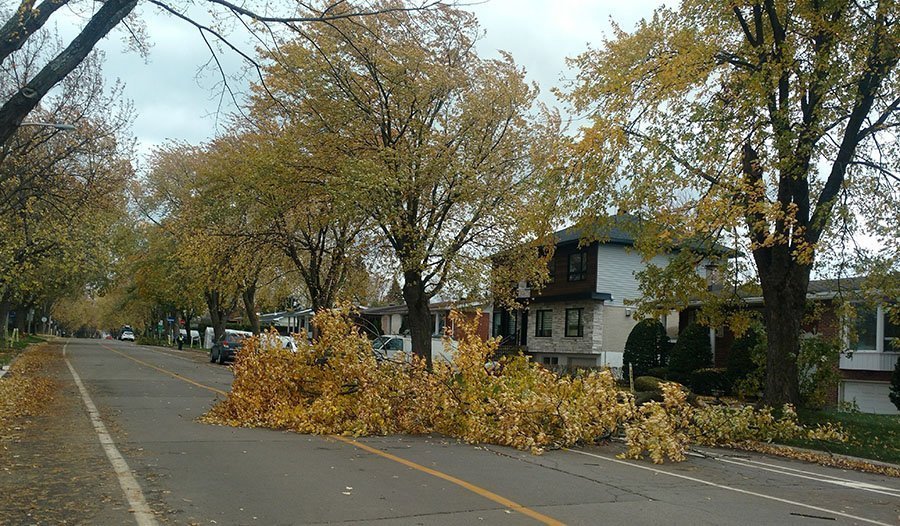
Trees and branches lined streets throughout the neighborhood
Renata Isopo
All
Saints Day, November 1st, not saintly at all! A spooktacular windstorm, which began on
Halloween night, struck Laval residents with a fury. A clash of storm
fronts created havoc, knocked over trees, downed power lines, and damaged
homes.
Environment
Canada’s weather office reported winds at times exceeding
100 kph. And, it wasn’t a question of “trick or treat”. Absolutely not a treat! According to meteorologists, most winds that cause damage at ground level are a result of
outflow generated by a thunderstorm downdraft. The recent dangerous
winds blowing through Laval, Greater Montreal,
and in other affected regions are known as “straight-line” winds to
differentiate their damaging impact from devastation caused
by tornados.
In
fact, damaging winds are classified as those exceeding 50-60 mph. Wind speeds can reach up to 100 mph and can
extend hundreds of miles. And, here it
came!
Hydro Quebec reported 24,902 power outages in
Laval alone as of 2 pm as the powerful windstorm ripped through many city neighborhoods. On our Friday
afternoon tour of several districts The Laval News (TLN) came across
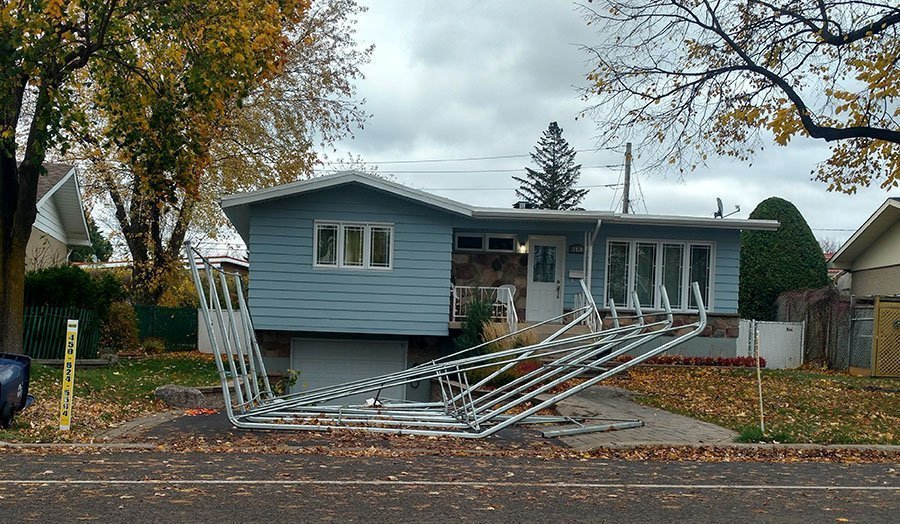
extensive damage to homes caused by flying debris, uprooted tempo shelters,
toppled trees, flipped and shattered ceramic flower vases, damaged vehicles
caused by flying objects crashing down from balconies.
Trees and branches lined many streets making it hazardous
for drivers to get through except for a single lane obstructed by
bicycle lanes.
TLN
was also blown away by harsh winds while examining the sorry-looking grounds
and homes. Lots of sirens in the distance, and the carnage of trees visible
everywhere. In Duvernay, yards and
streets were littered with broken branches and debris, garbage and recycling
bins strewn all over, waiting to be collected and
returned to front yards, which we managed to do in many instances as a neighborly service to
residents who surely were absent
since very few were to be seen.
Garage frame put to rest by ghastly winds.
TLN
was approached by the very few residents trying to tidy up the lawns and
gardens around their homes. In casual conversation, a resident expressed heavy concern
over hydro-power outages in many areas, with
little knowledge of when Hydro-Quebec would restore electricity. Mr. Hebert, resident of Duvernay, was upset but reasonably optimistic “I’m aware that Hydro
is sending crews out as quickly as possible to resolve the problem and to get
people back online, which is really appreciated.”
Another
resident, who wished not to be identified, whose home was struck and damaged by
an uprooted plastic garage adjacent to his property
advised people to be more cautious when
securing these seasonal installations. “They must
ensure that they are firm and stationary to
avoid these types of accidents. The weather is so volatile that we never know
when it will turn,” he stated.
In
Chomedey, a misfortune for Chris Giannini and his girlfriend who both had their
antique cars destroyed by heavy flying objects
from balconies at his residence. Chris
stated, “I’ll never get back the true value for those cars which I handled with
golden gloves,” he stated, adding that the condo
association did not warn residents to remove all furniture or objects from
their balconies. “I never received
anything from the association. Sadly, now, I probably have two cars that are
totaled because of it.” He also said
that other parked cars also suffered the same
fate, although not as bad.
TLN
noted that in general Lavallers have been very respectful and understanding
although worried and frightened by the unforgiving spooky windstorm.
(TLN) Having learned only in early September that she
would be replacing incumbent Eva Nassif as the Liberal Party’s candidate in
Vimy, Annie Koutrakis won the election easily with more than 47 per cent voter
support.
Bloc came
second
While Vimy has nearly 88,000 registered voters, just
over 55,000 (62.58 per cent) got out to vote. Koutrakis finished with 10,779
more votes than her nearest adversary, Claire-Emmanuelle Beaulieu of the Bloc
Québécois who finished with almost 28 per cent support.
Finishing third was Conservative candidate Rima
El-Helou with 10.8 per cent of the overall votes, followed by Vassif Aliev of
the NDP with 8.6 per cent.
Dream comes
true
Trailing behind her were the Green Party’s Faiza
R’Guiba with 3.8 per cent and People’s Party of Canada candidate Suzanne
Brunelle with 1.3 per cent.
“This is like an impossible dream since I didn’t even
know two months ago that I would be the candidate, much the less that I would
win,” Koutrakis, former president of the Hellenic Community of Greater
Montreal, said following her victory. “We worked very hard over the three weeks
of intensive campaigning.”
Restates
priorities
As she stated while campaigning, Koutrakis said her
priorities during the upcoming term will be seeing to the well-being of senior
citizens, young families from the middle-class and the ability of local
organizations and community groups to continue serving the people of her
riding.
In the 2015 elections, Eva Nassif won with 46.15 per
cent support, followed by the NDP’s France Duhamel with 20.96 per cent, the
Bloc Québécois’s Barek Khadouri with 16.69 per cent and the Conservatives’ Anthony
Mavros with 13.36 per cent.
City seeks ways to
improve building access for disabled
(TLN)
During a public meeting held on Oct. 23, the City of Laval’s
executive-committee made a number of decisions concerning traffic studies,
universal access to municipal buildings and youthful entrepreneurialism.
Traffic studies
The
committee, which makes recommendations to city council, asked council to
approve a mandate for a traffic studies firm to gather data on behalf of the
city’s engineering department in order to work out problems involving traffic
lights, bicycle paths and traffic calming.
The
contract for $350,616.26 was awarded to WSP Canada for its professional
services over the next three years.
Access to buildings
In
another decision, the executive-committee awarded a more than $73,000 contract
to Société Logique (OSBL) to conduct a study of the overall needs at municipal
buildings for providing universal accessibility (wheelchair access, etc.)
The
executive-committee also approved a partnership agreement for 2019-2020 with
the Commission scolaire de Laval in order to support a program at the school
commission that encourages entrepreneurialism among teenage students.
Flooding issues
At
the same time, the committee authorized city councillors Nicholas Borne and Ray
Khalil to participate in a forum of Quebec municipalities discussing issues
related to flooding. It is taking place this week in Quebec City.
Finally,
the committee authorized Councillor Virginie Dufour who sits on the executive-committee
to take part in a colloquium on the management of recyclable materials taking
place in Lévis on Nov. 14.
Laval
wins award for best municipal water in Quebec
City now eligible to
compete in U.S. water competition
(TLN)
On Oct. 23 during the 42nd Symposium on water management organized
by the Réseau Environnement, the City of
Laval won an award for the high quality of its drinking water.
The prize for best municipal water was awarded by an
independent jury for water produced by the City of Laval at its Pont-Viau
treatment station. The water station was one of 16 finalists from nine
municipalities that competed.
After winning the award, the City of Laval is now
eligible to take part in the Best of Best Taste municipal water competition sponsored
by the American Water Works Association (AWWA) which is taking place in June
2020.
Quebec’s
best water
“We are very proud to have received this prestigious
distinction,” said Laval city councillor for Sainte-Rose Virginie Dufour who
sits on the executive-committee.
“Our teams spare no efforts when it comes to improving
operations and furnishing to the population of Laval water of excellent
quality. Over the coming years, we will continue to innovate and refine our
practices so that our citizens may continue to benefit from the best municipal
water in Quebec.”
During the symposium which brought together nearly 350
stakeholders from the municipal domain for two days, Laval’s three water
treatment stations (Pont-Viau, Chomedey and
Sainte-Rose) also received a five-star rating. The Sainte-Rose station received
it for the 7th consecutive year, while the Pont-Viau station
received it for the 5th year.
Action Laval city councillors and members agree the City of Laval should start over from scratch to plan and build a new aquatic centre.
Martin C. Barry
A
year after the City of Laval`s decision to postpone construction of a new
aquatic complex, the city’s unofficial but largest opposition group is
denouncing the administration of Mayor Marc Demers for being without a coherent
plan for the facility, even though Laval will be hosting part of the Jeux du
Québec next year.
Calling
the situation a “financial fiasco,” Action Laval councillors and supporters
held a press conference last week to underscore the reality that the complex,
initially slated to be built on Terry Fox Ave. near the Cosmodôme, will almost
certainly not be built in time to host the 2020 Jeux du Québec. Instead, the City
of Laval will be leasing space at the City of Saint-Eustache’s aquatic complex.
Foundations poured
While
the City of Laval did some initial planning and had the concrete foundations
for a future aquatics complex poured into place in advance for $10 million, the
foundations had to be specially protected against the winter elements, while
contract bids that were received by the city came in too high and were
rejected.
While
the former administration of Mayor Gilles Vaillancourt had estimated it would
be a $36 million project, the Demers administration re-evaluated its cost as
being closer to $61 million. However, when the first contractor bids came in,
they were all for more than $80 million.
“Field
of Dreams was a 1989 film in which a farmer heard a voice telling him, ‘If you
build it he will come,’ said Action Laval councillor for Saint-Bruno David De
Cotis. “The aquatic complex is not the Field of Dreams. Marc Demers should stop
dreaming and face reality and get into action and solution mode.”
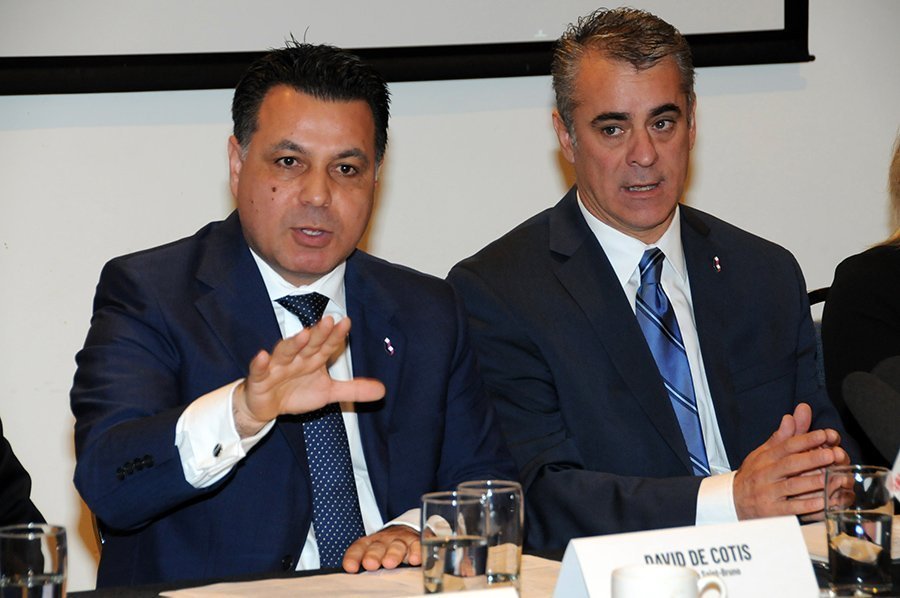
Action Laval city councillors David De Cotis and Michel Poissant spoke out last week against the City of Laval’s handling of the planning and construction of a new aquatic centre.
Examples of other projects
The
Action Laval research team found aquatic complexes – one completed in Brossard,
another in Mascouche – that according to the party were built for $39 million
and $14 million respectively.
“The
City of Laval can easily build an aquatic complex like the one in Brossard and
save $40 million,” De Cotis maintained. “How can we trust this administration
which does not respect established parameters and that throws away taxpayers’
money through the windows as if it was Monopoly money.”
De
Cotis went on to say that “the bad management of public funds which we are
seeing more and more often was one of the reasons I left the administration of
Marc Demers.” He said the city should re-start the aquatic complex project over
from scratch, bulldozing the foundations despite their $10 million cost.
Start over, says De Cotis
“The
City of Laval, instead of having a $10 million cement hole, should start from
zero, cut their losses, take the bulldozer, remove the foundation and build a
brand new aquatic centre for $60 million,” added De Cotis, insisting that such
a centre would meet residents’ requirements.
De
Cotis said the situation is “embarrassing” for the City of Laval. “We’re
hosting the Quebec Laval Games in 2020, and instead of having those games in
Laval we have them in Saint Eustache,” he said. “This is very embarrassing for
us all.”
Action
Laval city councillor for Chomedey Aglaia Revelakis agrees it’s not appropriate
for the Laval to be hosting something like the Jeux du Québec while using an
athletic facility in a neighbouring municipality. “In other words, we’re
hosting but we’re not hosting the games,” she said.
“This
is an embarrassment to a city that is the third-largest in Quebec and for all
its citizens,” she added. “Yes, we got the games, but in the end we’re not even
hosting them properly because we were not able to build the aquatic centre as
scheduled.”
Seen here on Oct. 24 during the launch of Royal Canadian Legion Branch 251’s annual poppy campaign are branch members, supporters, local elected officials and cadet corps leaders and members.
Martin C. Barry
Royal Canadian Legion members from Branch 251 are out
selling Remembrance Day poppies in preparation for the annual Remembrance Day
commemorations taking place in Laval as well as across Canada on Nov. 11.
Legion members along with supporters, including Air
Cadet program participants from Laval, held an official launch for the campaign
at Branch 251 headquarters on Curé Labelle Blvd. on Oct.
24.
An annual
tradition
“We hold this event every year for the kickoff of the
poppy campaign which runs this year from Oct. 25 to the 10th of
November,” said Eric Larsen, Branch 251’s president.
According to Shannon Westlake, 2nd
Vice President for branch membership and the poppy campaign chairperson,
Remembrance Day poppies are available at the branch or from branch members who
will be stationed outside major retailers in western Laval including Maxi,
Costco and Wal-Mart.
Representing Mayor Marc Demers, Laval city councillor Yannick Langlois received the campaign’s first Remembrance Day poppy from Branch 251 2nd vice-president Shannon Westlake who is responsible for the annual poppy campaign.
First poppy pinned
Among
the guests at the campaign launch was Laval city councillor for L’Orée-des-Bois Yannick
Langlois who was representing Mayor Marc Demers. “It’s a pleasure for me to be
here to have the first poppy pinned on me,” he told the Laval News.
“This
is something that is very meaningful. We all have a duty to remember our
veterans and all those who fought in wars. It is something that we regard as
very important for the city and that all Laval residents also consider
important.”
Students taking part
Helen
Kalipolidis, principal of Souvenir Elementary School, was on hand to represent
the school’s young students at the campaign launch. “The opening of the annual
poppy campaign is always a big occasion for us,” she said.
According
to Kalipolidis, Souvenir Elementary will be holding several events on
Remembrance Day. “We have assemblies planned for 3K all the way up to grade
six,” said Kalipolidis.
Incumbent Laval-Les Îles MP Fayçal El-Khoury was jubilant while surrounded by supporters on election night Oct. 21 upon learning he’d been re-elected with a major lead over his nearest rival in the riding, the Parti Québécois.
Martin C. Barry
Champagne corks popped and there was jubilation all
around at Laval-Les Îles Liberal candidate Fayçal
El-Khoury’s campaign headquarters in
Chomedey on the evening of Oct. 21 as the voting returns indicated beyond a
doubt the riding’s incumbent hopeful was re-elected and would serve a second
term.
Needed more
time
While acknowledging during an election night interview
with the Laval News that the Liberals’ overall fortunes were probably bolstered
by support from voters who made up their minds in the days leading up to the
vote, El-Khoury suggested he and the Liberals would have done better with just
a little more time to campaign.
“I believe if we still had one or two more weeks we
would have had a very good majority,” he said. “I felt from talking to people
and knocking door-to-door that the people were starting to understand our
message. But we were not able to knock on enough doors. One or two more weeks
would have made the difference.”
Optimism
despite minority
While the Liberals lost their House of Commons majority,
falling short by 13 seats, El-Khoury remained hopeful the party will somehow
still be able to make up for it and form an effective government.
“Even if it doesn’t happen, we will continue to serve
Canadians the way our Prime Minister taught us to do,” he said. “We did a lot
for Canadians. But there is still also a lot to do and we will do it.”
While the NDP won Laval-Les Îles
in the 2011 election with an overwhelming 47.2 per cent voter support, the
party finished this time with only a 9 per cent vote share and in third from
last place in a field of six candidates. The NDP managed to finish second in
2015.
Newly re-elected Laval-Les Îles MP Fayçal El-Khoury is congratulated by his wife moments after learning he’d won a second term.
The return of the Bloc
The
Bloc Québécois, which had been a consistent second-place finisher in Laval-Les Îles
in consecutive elections up to 2008, didn’t finish better than fourth place in
the 2011 and 2015 elections.
However,
with the NDP no longer considered a serious threat in Quebec, the Bloc regained
its second-place status this time, although finishing far behind El-Khoury, but with nearly 21 per cent voter support.
The Conservatives, represented by Tom Pentefountas, finished third with 16.5
per cent of the votes.
Although the Liberals are now in a minority situation
in the House of Commons and the Bloc Québécois
hold 32 of Quebec’s 78 riding seats, El-Khoury said
the Liberals will continue serving as they did before.
Believes in
the Liberals
“I believe we have to show the Canadians what kind of
job we did for them,” he said. “And we have to continue to serve them the way
they are expecting us to do. I believe we need to prove to them – especially
for Quebecers – that the Liberal Party was taking care of their interests.”
He pointed out that in the last Parliament, the
governing Liberal caucus’s membership from Quebec included six cabinet
ministers, as well as most of Quebec’s MPs, making for a formidable Liberal
presence on Quebec’s behalf.
Asked whether he is concerned about the influence of
the Bloc Québécois given their greater numbers now in the House of Commons, El-Khoury
maintained their impact will be minimal because of their almost certain
exclusion from decisions made by the government.
Dismisses
Bloc Québécois
“Their voice will be almost nothing,” he said. “They
could speak, but they will never have an influence in any legislation the government
is going to do. So I am appealing to all Quebecers here to look for the
interests of Quebec.
“I am a proud Canadian and a proud Quebecer,” added
El-Khoury. “When we have member like me within the Liberal Party and a
government that is governing this country, we can help to serve Quebec.
“But the Bloc will be always on the opposition side
and they will never be able to do anything from there. They could shout. But
they will never be able to influence decisions.”
Quebec Storm: Two people from Laval died in a car crash due to weather – SQ says
Two Laval residents lost their lives Friday night in Senneterre, Abitibi-Témiscamingue, in a collision that the SQ attributed especially to the tempestuous weather.
Sergeant Louis-Philippe Bibeau of the Sureté du Québec said that Kiriakos Thomopoulos, 70, and Lucie Corriveau-Thomopoulos, 67, were driving north on Highway 113 when their vehicle veered off course and hit a vehicle travelling in the opposite direction, shortly before 7 p.m., in Senneterre. They were transported to the hospital, and pronounced dead later in the evening.
The occupants of the second vehicle, both in their 60s, sustained life-threatening injuries, said Sergeant Bibeau.
“The weather could have contributed to this collision,” he explained.
School evacuated after carbon monoxide leak
At around 2 PM last Saturday November 2nd, Laval firefighters were called at the Aquarelle school in Sainte-Rose, to test for carbon monoxide leak, after an adult began feeling symptoms such as sudden nausea, dizziness and a headache.
According to Urgences Santé, that dispatched six ambulances at the scene, none of the 13 children experienced any symptoms but all 14 people inside the school were sent to hospital for precaution.
Restaurant owner arrested for sexually assaulting two minors who worked for him
Police are asking for the public’s help in finding other possible victims of the 47-year-old man.
The owner of a La Belle Province in the Saint-Francois district of Laval has been arrested on charges of sexually assaulting two minors who worked at the restaurant.
And Laval police are asking for the public’s help in finding other possible victims of the 47-year-old man.
Fredi Gonzalez Rodriguez, who was arrested Sept. 29, is alleged to have sexually assaulted two former employees in recent months.
Evelyne Boudreau, spokesperson for the Service de police de Laval (SPL), said investigators suspect Rodriguez, who has owned the restaurant for 20 years, may have other victims.
Rodriguez is facing four charges: two of sexual assault and two of sexual touching of minors.
He has been released on bail and ordered not to contact his alleged victims.