Home Blog Page 184

Laval sets new rules at its facilities following ‘Orange’ COVID-19 status

After Laval was declared an Orange (Alert) zone on Tuesday for COVID-19 by the Quebec government, the city issued a list of new regulations for the number of persons who can gather or take part in activities at the various municipal facilities.

The city says its facilities and services are all operating, although on a modified basis. Here are some examples:

At interior and exterior sports facililties (arenas, indoor pools, soccer and football fields)Nomber of participants: max. of 25 per distinct area. The play area and the spectator area are regarded as distinct from each other. For interior facilities, activities can take place in distinct play areas simultaneously, bringing together 25 participant each.
Nature CentreAll special activities cancelled. Visits only. Gatherings of more than 25 persons forbidden.
Community centresMax. 25 persons per locale, as well as in common areas and waiting areas. Two metres physical distancing, hand washing and face masks mandatory.
Maison des arts (Theatre area)Max. 250 persons and mandatory sanitary measures (see above).
LibrariesMandatory sanitary measures. No activities involving gatherings.
Municipal countersMandatory sanitary measures.
Police stationsMandatory sanitary measures. Four out of six neighbourhood police stations are open on a modified schedule. Hours available here.

Infrastructures managed by city’s partners

The city says it is working with its partners to limit the number of people present at these installations.

As such, the Champfleury community centre, the Centre du Sablon, the Centre sportif Bois-de-Boulogne, Place Bell and Place des aînés are some of the facilities owned by the city and managed by separate organizations that will adjust the occupancy levels in accordance with government requirements as they evolve.

Interior pools and gymnasiums that are located in schools where the city offers activities will be limiting the number of people present.

For any questions or concerns beyond the above-mentioned issues, the city invites residents to contact the Quebec government’s special line for COVID-19: 1 877 644-4545.

Quebec issues warning about undeclared ingredients in pizzas sold at Marché Adonis

The Quebec Ministry of Agriculture, Fisheries and Food Inspection has issued a warning of particular interest to persons with compromised immune systems regarding food products sold at Marché Adonis which were made with non-pasteurized milk that was not declared on the packaging.

The table below shows some of the products

Denomination of productFormatLot visé
« PARMESAN CHEESE GRANA PADANO »VariedUnits packaged in store and sold up to September 23 2020
« PARMESAN CHEESE REGGIANO »

The Ministry is also advising that persons suffering from an allergy or intolerance to Grenoble nuts or peanuts, to mustard, to milk, to eggs, to sesame, to soya or to sulfites shouldn’t consume the product in the following table. This product could contain any of these ingredients, which are not declared on the packaging.

Denomination of productFlavourFormatLot targeted
« PIZZA ADONIS »VariousSingleUnits sold until September 23 2020

The ministry says the products in question were offered for sale up to Sept. 23 inclusively, at all stores in the Marché Adonis network. They were sold while refrigerated. They were covered by a clear plastic wrap and were labeled as having been produced by “Groupe Adonis inc.”

The ministry noted that the company has voluntarily recalled the products in question and has worked closely with the Ministry of Agriculture, Fisheries and Food Inspection to get the word out about the recall.

Persons with compromised immune systems who are in possession of any of these products are advised to return them to the store where they were purchased, or to use them as ingredients in other dishes cooked to at least 74 °C, or to throw them out.

Those with allegies to Grenoble nuts or peanuts, mustard, milk, eggs, sesame, soya or sulfites are advised to return the products to the store where they were purchased or to throw them out. The ministry noted that to date there have been no reports of illness or adverse effects connected to the products in question.

Quebec infrastructure legislation Bill 66 gets enthusiastic endorsement from Demers

Following the tabling of the Quebec government’s Bill 66, which proposes among other things to fast-track the extension of the REM light rail train system to Laval, Mayor Marc Demers says he wholeheartedly supports the legislation.

“This draft law will allow several major projects to go ahead, including the extension of the REM towards downtown Laval, and a new axis connecting the two extremities of the city,” Demers said.

Council hears complaints about city’s slow response to snow and ice
Seen in this file photo, Laval mayor Marc Demers is enthusiastically supporting the CAQ government’s Bill 66, which contains important measures to improve road travel in the Laval region.

Demers pointed out that the proposed legislation contains elements which will allow recommendations that came out of the Forum on mobility and mass transit in Laval-Lower Laurentians in 2018 to be implemented.

Among these were the long-awaited extension of Autoroute 19, the creation of reserved lanes on Autoroutes 15, 440, 640 and 25, as well as a rapid bus service (SRB) on the Concorde/Notre Dame boulevards axis.

“I would encourage all the elected officials in the National Assembly to come to an understanding and rapidly adopt this draft law in order to re-launch the economy,” added Demers.

LPD Blue: News from the Laval Police beat

Drivers avoided Curé-Labelle, A-440 Sept. 17 after serious accident

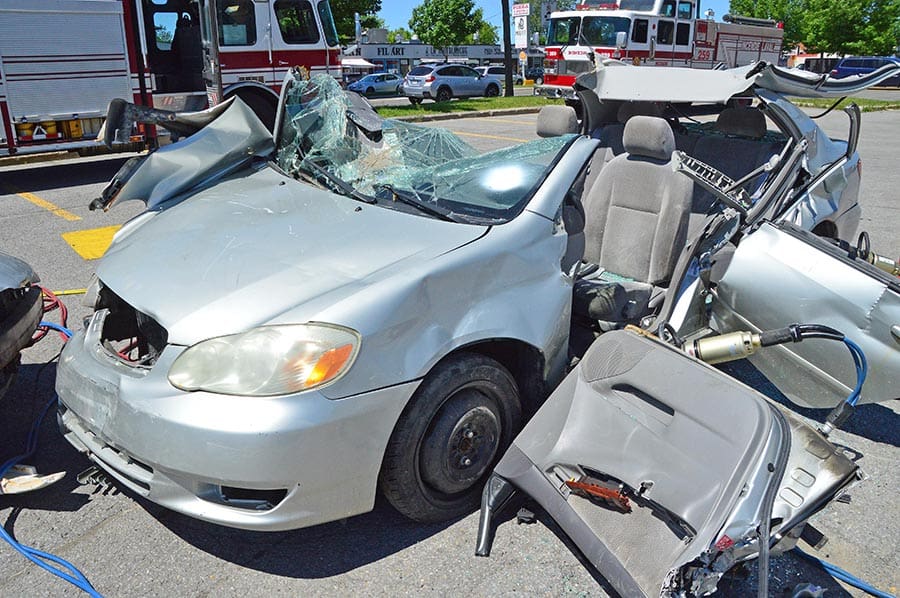
The Laval Police issued an advisory to motorists on a recent Thursday afternoon to avoid Curé-Labelle Blvd. between Saint-Elzéar Blvd. and Simone-de-Beauvoir St., as well as Autoroute 440 in that area, because of a serious motor vehicle accident that created a massive traffic jam.

According to reports by the Laval Police Department, the scene of the accident was on Curé-Labelle Blvd. near Fabreville. As traffic continued to back up and social media accounts went into a frenzy over the situation, Curé-Labelle remained closed to traffic between Simone-de-Beauvoir and Saint-Elzéar into the evening on that day.

Gunshots in Chomedey and St-François kept Laval Police busy

The Laval Police were kept busy on Saturday night Sept. 12 by reports that came in an hour apart from two different areas of the city where the sound of gunshots was heard by some residents.

Just before 6 pm on Sept. 12, the LPD answered a call from 77th Ave. in Chomedey where they were met by a witness who was close at hand when several shots were fired nearby, although there were no injuries.

Nonetheless, the police officers found a few spent bullets on the ground and an investigation was opened into the circumstances which led up to the incident.

A little more than an hour later, the LPD received a second call about gunshots, although this time it was from the other end of the island.

Upon arrival at the scene on Roxane St. in the district of Saint-François, officers came upon a man in his late 20s who was suffering from a serious and potentially life-threatening gunshot wound.

At last word, the LPD was treating this incident as an attempted murder. A command post was set up for a few days near the crime scene to facilitate a thorough investigation.

Laval Police identify suspect in alleged cell phone thefts

A suspect sought for about a week by the Laval Police Department for alleged fraud after three smartphones were picked up at a Laval Purolator courier branch by someone who hadn’t paid was finally identified.

According to the LPD, the victim of the alleged scam ordered the phones from a cellphone company in November last year. A month later, he called the company to report that the phones had never been delivered.

However, when the cell phone company investigated, they discovered that someone had picked them up at a Purolator branch located on Dagenais Blvd. West near Laval’s Champfleury area.

Upon further investigation, Purolator found that the individual who picked up the smartphones had presented a printed delivery notice, although there is no mention of whether he was asked to show a piece of identification.

The suspect, seen in a widely circulated photo taken by a surveillance camera at Purolator, was described as being in his 20s, with black hair, eyeglasses and wearing a black coat.

Public Security Minister happy with police op for COVID-19

Quebec Deputy Premier Geneviève Guilbault, who is Minister of Public Security, expressed satisfaction last Monday with a province-wide police operation designed to help counter a resurgence of the COVID-19 virus. In all, 30 police forces took part.

During the operation, more than 2,200 commercial establishments were visited across Quebec and 90 tickets were issued to individuals not wearing face masks, not respecting self-distancing rules, consuming alcohol in bars after legal hours, hosting more than 10 persons at a time, or failing to keep a register of customers.

As well, three notices were sent to the Quebec Director of Public Health’s office regarding establishments whose activities were regarded as being a risk to public health.

Also, five notices to appear were issued regarding hearings to be held in the near future by the Régie des alcools, des courses et des jeux over establishments that broke the rules and now face the possiblity of losing their license.

“I want to thank all the police officers for their great professionalism,” Guilbault said in a statement issued by the provincial government last Monday. “They did incredible work all weekend long, thanks to which the ambitious goal of visiting more than 1,000 establishments were largely surpassed.

A well-planned operation

“The operations took place in conformity with the planned goals and the visits were well received by those carrying them out as much as by the clients who, in the vast majority, were respecting the rules,” added Guilbault.

The purpose of the operation, according to the provincial government, was to identify the places where there could be problems having rules for safeguarding against COVID-19 respected. During the operation, more than 1,000 establishments holding liquor permits, consisting mostly of bars, restaurants and receptions halls, were visited.

All regions in Quebec were visited, with special attention being paid to areas where Yellow or Orange codes for COVID-19 were recently invoked by the provincial government.

Public health officials have now been notified by the police regarding establishments where additional sanitary measures were found to be necessary.

It is notable, according to the provincial government, that of the more than 1,000 bars, restaurants and other gathering places visited, only one refused to allow the police in. Charges are currently pending against that business.

Table régionale de concertation des aînés to mark International Day of Older Persons

‘Senior citizens should become one of our priorities,’ says TRCAL’s Carole St-Denis

With the COVID-19 pandemic continuing to impact many lives – but especially those of senior citizens – the Table régionale de concertation des aînés de Laval is reminding everyone, as the annual International Day of Older Persons approaches, to be mindful of the needs and wishes of senior citizens throughout the year.

The International Day of Older Persons is observed on Oct. 1 annually. The day started to be officially observed after Dec. 14, 1990, when the United Nations General Assembly voted for a resolution to establish Oct. 1 as the International Day of Older Persons.

Spotlight on seniors’ issues

International Day of Older Persons was observed for the first time on Oct. 1, 1991. The purpose of the day is to raise awareness of the issues affecting senior citizens, such as elder abuse and senescence. (Senescence is the gradual deterioration of a person as he or she grows older, otherwise known as biological aging.)

The day is also regarded as an occasion to appreciate the contributions that older people make to society. And the observance has become a special focus for many senior citizens’ organizations in Quebec, including the Table régionale de concertation des aînés de Laval.

“It would be very important for people to remember on this day that senior citizens need to become one of our priorities – that they should remember to prioritize the well-being of senior citizens and be present for them,” said Carole St-Denis, executive-director of the Table régionale de concertation des aînés de Laval.

Seniors need more attention

She maintains that, unfortunately as things are now, the well-being and needs of senior citizens often seem to come last in society’s list of priorities. But she also noted that the COVID-19 pandemic suddenly placed senior citizens’ problems in the foreground of news coverage, “because those problems were already there,” St-Denis said.

‘We should be acknowledging senior citizens’ accomplishments, as well as the fact so much that we have today is because of them’

“So I think that we must keep this in mind at the end of the day, because these are people who contributed towards the creation of our society and who built it. Therefore, we should be acknowledging senior citizens’ accomplishments, as well as the fact so much that we have today is because of them.”

Carole St-Denis suggested that this is an especially important year to be marking International Day of Older Persons, because the pandemic has drawn out longstanding senior citizens’ problems and issues.

Greater focus on seniors

“This is a year that has raised awareness of everything that seniors normally experience – isolation, abuse, depression, lack of resources – which are all things seniors were dealing with before,” she said. “But now these issues are even more present. We should make these issues part of our top priorities from now on.”

FILIA Association for Senior Citizens holds its first Walk A Thon in Laval

‘A lot of our members are now from here,’ says FILIA founder Johanna Tsoublekas

Although the year 2020 has been far from normal up to now because of COVID-19, it seemed only fitting that the FILIA Association for Senior Citizens would go with the flow and break with a longstanding tradition beginning this year.

So, while this marked the 14th year in a row FILIA was holding its annual Walk A Thon for senior citizens, this was also the first year the Park Extension-based organization held its health and awareness-raising event on a gorgeous autumn Saturday Sept. 19 at Saint Norbert Park in Laval’s Chomedey neighbourhood.

The impact of COVID

“We decided to do it in Laval because a lot of our members are now from here,” said Johanna Tsoublekas, founder of FILIA. “However, because of COVID-19 there are not as many people this year who have come out. But many of our members and supporters live in Laval.

From the left, Chomedey MNA Guy Ouellette, Souvenir-Labelle city councillor Sandra El-Helou, FILIA founder Johanna Tsoublekas, Laval-Les Îles MP Fayçal El-Khoury and Saint-Laurent MP Emmanuella Lambropoulos are seen in Saint Norbert Park on Sept. 19 before the start of the 14th annual FILIA Walk A Thon. Photo: Martin C. Barry

“But the thing is that with the COVID, many who are of a certain age are now afraid to come,” she continued. “All the same, we prepared carefully with face masks for those needing them. And we are, of course, keeping at a safe distance at the same time.”

FILIA offers services

The Walk A Thon is held in September every year as a fundraiser for the FILIA meals-on-wheels program. While FILIA’s initial mission was to provide assistance to Greek women of the Park Extension Hellenic community and later throughout Montreal, its mandate has since been broadened and people of every origin are now welcomed.

Some of the services FILIA provides are home housekeeping and supervision, volunteer training and a healthcare clinic for the feet. During this year’s Walk A Thon, rather than make their way around the streets of Park Extension, the walkers made their way along a circuit that went around Saint Norbert Park on Cartier Blvd. in eastern Chomedey.

Smaller event this year

Those who wished could later stop to rest and chat with longtime friends in Saint Norbert Park, while also enjoying the bagged lunch prepared by FILIA volunteers for everyone who took part in the walk. Although grilled souvlaki has traditionally been served at past FILIA Walk A Thons, the limiting conditions this year meant the organizers could only offer the bagged lunch.

FILIA founder Johanna Tsoublekas.

Among the special guests at the 2020 FILIA Walk A Thon were elected officials from Laval and other areas of the greater Montreal region. They included Chomedey MNA Guy Ouellette, Laval-Les Îles MP Fayçal El-Khoury, Laval city councillor for the district of Souvenir-Labelle Sandra El-Helou and Saint-Laurent MP Emmanuella Lambropoulos.

Officials among the guests

“I just want to thank everyone for being here today,” said El-Helou. “It’s not easy with the COVID situation. I would particularly like to thank Ms. Tsoublekas for everything she’s doing for people. And my thanks also to my colleagues for being here today. It is a pleasure to be among you.”

“I would like to thank the organizers, and in particular Johanna Tsoublekas, for organizing this event today,” said El-Khoury. “I am very happy to be here and to see the good work being done by FILIA for seniors here in Laval. I am working on their behalf in Ottawa and will continue to do so.”

Gathering in Laval at last

Ouellette noted that holding the FILIA Walk A Thon in Laval was the fulfillment of a longtime ambition for Tsoublekas. “Johanna has had this dream for so long,” he said, noting that Tsoublekas had spoken about it to him when FILIA held gatherings in recent years for supporters at the Château Royal in Chomedey.

“I am here to express my support for FILIA which does great work for the senior community on the island of Montreal and in Laval,” said Lambropoulos.

“It’s important to promote the fact that we can still live in health while finding ways to protect ourselves from COVID-19, regardless of the fact this virus is going around. If we wear masks and keep our distances, there are ways to continue living normally while staying healthy.”

Laval City-Watch

The implementation of new traffic lights at Saint Martin Blvd. and 100th Ave., an updated report on Laval’s economic situation during the ongoing COVID-19 pandemic, and special drainage grooves in sidewalks were some of the items the City of Laval’s executive-committee approved during a meeting on Sept. 9.

The executive-committee’s members decided to award a contract for $55,188 (including taxes) to FNX-INNOV to prepare plans and specifications prior to installing a new system of traffic lights next year at the intersection of Saint-Martin Blvd. West and 100th Ave.

Traffic lights at 100th Ave.

According to the city, traffic in the area is currently being managed by a system consisting mostly of stop signs. Considering the growing volume of traffic in the area with more anticipated in the future, the city considers it to be important to improve the current system with traffic lights.

The City of Laval’s economic development department issued a new report on the city’s recent economic performance. The department issues reports several times a year consisting of the principal data compiled on Laval’s economic performance, to which is added a table summarizing yearly economic indicators for the previous five years.

The city says this data provides a picture of the economic health of Laval’s economy, while allowing anyone to follow the progress of the situation. In the current context of COVID-19, says the city, a special issue of the report was created in order to put the impact of the pandemic in context. As such, data from Laval, Quebec and Canada were included in order to provide a full perspective of the situation.

Sidewalks on Albert-Murphy

While dealing with a program for implementing new infrastructure for the management of rainwater, the City of Laval’s engineering department is proceeding with the preparation of plans and specifications for the creation of new drains with shrubs and greenery in sidewalks to be built soon.

The new sidewalks will be created on Albert-Murphy Ave., south of Le Carrefour Blvd., as well as on Berlier St., between Le Corbusier Blvd. and Industriel Blvd.

To do this, the executive-committee members decided to award a contract for $66,247,22 to Englobe Corp. to conduct an environmental condition and geotechnical preliminary study of the soils. This was deemed necessary before the preparation of plans and specifications for the project.

Executive-committee members

The City of Laval’s executive-committee meets each week to make decisions on a variety of issues. The executive-committee includes the following people: Mayor Marc Demers, vice-president Stéphane Boyer (also councillor for Duvernay–Pont-Viau) councillors Sandra Desmeules (Concorde–Bois-de-Boulogne), Ray Khalil (Sainte-Dorothée), Virginie Dufour (Sainte-Rose) and associate members Nicholas Borne (Laval-les-Îles) and Yannick Langlois (L’Orée-des-Bois).

Are the nasal pcr tests for Sars-2-cov too “sensitive”?

A lot of commotion in the news lately concerning tests. The good news is that newer and faster
tests are being developed with a saliva gargle test
on the verge of approval in BC.
At CNN though, there was a headline in
the ticker tape that turned heads and spread
like a virus (pardon the pun) in all sorts of
conspiracy web pages. “Health experts warn
Covid-19 tests aren’t just slow, they’re too
sensitive”. NSN reached out to Dr. Christos
Karatzios Assistant Professor of Paediatrics at
the Montréal Children’s Hospital for a muchneeded clarification.
The doctor started by saying that people
didn’t understand what they were reading and
of course they told him that positive tests are
“false positives”.

Dr. Christos Karatzios.


His answers are all here:
Yes, the tests are sensitive. They HAVE to be.
They pick up genetic RNA material of SARS-2-
CoV in your nose.
No, the tests do not pick up false positive
results. The nasal PCR test for SARS-2-CoV
ONLY DETECTS SARS-2-CoV and nothing
else. So, it doesn’t pick up “other coronaviruses”.
The false positive rate is extremely low and
mostly has to do with lab error (i.e. contamination
with a positive sample in the lab). This is very rare.
The false negative rate is much higher due to
various factors (i.e. sampling error – not getting
the swab deep enough in the nasal passage, or
sample timing – too early in the disease or too
late).
The test is a “YES” or “NO” test for the presence of the virus. It tells you nothing about live
(growable and infectious virus), or dead remnant
pieces of the RNA (therefore not infectious virus).
Someone can remain positive for weeks as many
of my friends reading this have. Some have stayed
positive for 6 weeks. It does NOT mean they are
contagious all these weeks.
Immune suppressed people and people with
severe COVID-19 (in ICU on a ventilator etc),
may be contagious for 3-4 weeks.
For the rest of the healthy population (i.e. children in school) who got COVID-19, live infectious virus stops shedding after about 10 days.
Your test can still pick up genetic pieces after
this but the virus is dead.
A quick hint: do you have fever and a bad cough
and diarrhea? You’re contagious until all gone.
You were contagious 1-2 days before it all started.
A PCR is a test that checks for the genetic
material and, if present, enzymes in the test start
making copies of the genetic material until we
are able to detect it. The checking happens in
cycles. The less cycling needed to detect, the
more genetic material that exists in that swab
and so the Ct (cycle threshold) is LOW. The
less genetic material that exists in the swab, the
higher is the Ct.
This is NOT a viral load. It does not give you
a number of copies of the virus per mL of snot
or per nasal surface cells in your nose. This is
the major mistake many papers and scientists
are making.
A viral load has a curve – so therefore it rises

  • and it falls -. Scientists can only presume that
    with the current PCR test the Ct rises and falls
    too. But a viral load curve needs a denominator
    to be constant and that is the sample. In HIV
    we know the viral load of a patient because we
    sample a constant blood volume. For a respiratory virus like SARS-2-CoV, it depends on the
    sample and this isn’t constant as many of you
    who have had the test done know – you thrash
    about because it’s uncomfortable and there may
    be less cells in the nasal swab. Or the testing
    person samples the front of the nose where the
    virus doesn’t live well when compared to the back
    of the nose. There is no constant denominator
    unlike a blood test – and we don’t have those
    developed for this pandemic.
    Unlike flu (300 viral particles in droplets but
    3 if airborne), Shigella causing shigellosis and
    dysentery (1-10 bacteria), and Salmonella causing typhoid fever or other salmonellosis diarrheal
    illnesses (100-200 bacteria) we do NOT know
    the infective dose of the SARS-2-CoV.
    So, even if we knew the viral load of the test
    we would not know what it meant. Does it take
    1, 10, 10,000 viral particles to cause COVID19? What about black people who have higher
    numbers of ACE receptors for the virus, or kids
    and mild asthmatics who have less? How many
    viruses are needed to cause disease in them?
    We just don’t know and we will not know for
    a while. Remember we are learning as we live.
    We are building the boat as it is sailing during
    this pandemic.

Also, what if the viral load is low…can a child
return to school let’s say as was suggested by
CNN? How do you know if the viral load is on
the upswing (early in the disease and the patient
is asymptomatic and will have a big viral load
in a few hours when he/she becomes presymptomatic) or late in the disease as it has passed?
In conclusion, yes, the tests are sensitive but
they are specific for this virus only. If positive
we don’t know where you are on the disease
timeline unless you have symptoms. Isolation
and contact tracing are the only way to control
this disease apart from wearing masks, washing
hands, and keeping distances. Unfortunately, we
can’t predict who can go to school or who can’t.
If an outbreak happens based on positive tests,
a school may need to fully close. Unfortunately,
that’s the limits of our technology. Maybe in a
few months we will know more.

Robert Vairo’s ‘That’s What I’m Thinking’

0

Speak Softly and Start Believing

Nothing personal but the language or languages you speak may influence
whether you become infected with the Covid virus. Different languages
spew more moisture than others. Do you speak softly, or loudly? Do
you project when you speak, like singers, teachers, and broadcasters?A
study in the journal Aerosol Science and Technology, says this all has
an effect on how the virus will impact you. For example when we speak
English, we aspirate a lot. We produce voiceless but plosive consonants
like p, t, and k. We pronounce those letters within a word with exhaling
breath. A researcher named Sakae Inouye from the University of Tokyo
observed that like English, the Chinese language actually has even more
aspirated letters. Inouye concluded that in Chinese, “the consonants p,
t, k, q, ch, and c, when placed in front of vowels, are pronounced with a
strong breath”. In fact when a Chinese, English and Japanese speaker were
compared, the tissue in front of their mouths fluttered in English and
Chinese but not in Japanese. That could be the reason Japan has only one
third the number of Covid cases of Canada, yet it has three times Canada’s
population. And if you speak French and most of us do, you will agree
that at least anecdotal evidence suggests the expressive French, Italian,
and Greek speakers have plenty of potential viral particles to pass onto
others! Now it can’t all be attributed to language because the Japanese
have a mask wearing culture, are disciplined in social distancing, and
respect their government’s suggestions of avoiding crowds. We are still
learning about this virus, but it’s worthy of note that different speech
sounds produce either more or less moisture according to the study
in the medical journal LANCET. And loud speakers clearly emit more
aerosolized particles than soft spoken speakers, in some cases ten times
as many! So whichever way you chose, try to reduce your air flow, and
keep your moisture to yourself.

Newsfirst columnist Robert Vairo..

No matter what language we speak we are all human beings and as
humans, we tend to lie, a lot. A recent study found fully one third of
the population lies about whether they have symptoms or have in fact
been infected. Psychology researchers at St Catharines Ontario’s Brock
University found “34% of those testing positive denied having symptoms”.
Women more than men were more honest, older but not younger adults
told the truth.

But what bothers me the most, is the recent on line Leger survey clearly
showing pandemic fatigue has set in, and fully half of Canadians think
our politicians are holding back information. Younger Canadians find
politicians and health officials exaggerate the severity of this deadly virus.
Why? Because we’ve been lied to, too often. Italians were told the virus was
created in a Chinese lab. The Chinese said the virus originated with the US
military. Donald Trump said the anti malaria drug hydroxychloroquine
was the cure. Ottawa Public Health said recovered patients of the virus
would not be reinfected for at least two years. Granting 14 day exemptions
to Uline U.S. billionaire Liz Uihlein and her gang’s private jet fly in for
their 36 hour visit to Milton Ontario. That severely undermines public
confidence. We were told masks were not effective. Yes they are. Health
Minister Patty Hajdu admitted “We knew very early about COVID-19, the
risk that it posed to human health”. This was in December 2019! Hajdu,
Justin Trudeau, Doug Ford, and no doubt other politicians that we don’t
know about have not followed their own rules. Teachers complain about
class sizes but it was an infected teacher (no mask) who forced the closure
of a Pembroke high school. And I am not alone wondering why 50 people
can gather in a strip club but only 10 are allowed at a house party. And
so one can perhaps understand why many no longer believe what they
hear and have dropped their guard. And what about a vaccine. Can it
be trusted now? All this despite a troubled Premier Legault saying “The
situation is critical…please think about others”, promising more powerful
screen ads but he hasn’t changed the rules, yet. Ontario’s Doug Ford
has, and is fed up, instituting a system of provincially enforced measures
that cary heavy fines. I read this recent powerful commentary from an
outraged Canadian, “Not realizing, or not caring about our overworked
medical staff, selfish, spoiled, disrespectful citizens are going to kill us”.
Most believe, some don’t. The sad reality is one infected can send 30
others to hospital, hopefully to recover, thanks to our dead tired doctors
and nurses. That’s what I’m thinking.

Robert Vairo. robert@newsfirst.ca

Quebec aims for food autonomy, with major greenhouse farming project

0

Legault criticizes China, while pitching closer ties to Ontario and Alberta

Concerned that Quebec might one day be unable to import essential foods like fruits and vegetables during a crisis like the current COVID-19 pandemic, Premier François Legault said during an online CAQ policy discussion last weekend that the government hopes to launch a major greenhouse farming project, with power provided by Quebec’s vast hydro electric network.

Keven Brasseur, president of the Commission de la Relève de la Coalition Avenir Québec.

Alluding to the CAQ’s policy convention in May last year which focused on environmental issues, Legault noted that a key conclusion during that first CAQ gathering since the October 2018 election was that Quebec’s hydro electric grid should play a key role in helping re-empower the province’s economy.

Ensuring food security

And while acknowledging that public and private modes of transportation as well as industry are already being retooled for this “greener” way of doing things, Legault suggested that environmentally-sustainable methods could also be implemented to assure food security.

“For me, one the great fears I had as I was trying to reassure everyone last March was that we would not be able to import fruits and vegetables during the crisis,” he said, alluding to the start of the COVID-19 crisis, in a keynote address delivered during last weekend’s online event.

The focus on local

“I was truly afraid of that. And it sort of accelerated the necessity of going towards food autonomy.” Out of all the food products consumed in the province, Legault noted that only around half actually are produced in Quebec.

For example, only about two per cent of the wine consumed in Quebec is made here, he said. As well, he pointed out that beef is largely imported from western Canada, although Quebec has the means to raise and process cattle on its own territory.

“There are a lot of areas of production that could be given a second look, and this is an area, agriculture, that young people could look into,” Legault told the mostly young caquistes who took part in last weekend’s gathering.

Criticizes Chinese tactics

In addition to his comments on a greener approach for reviving the province as it recovers from the COVID-19 pandemic, Legault said certain questionable business practices being used by the People’s Republic of China are undermining Quebec’s plans for resuscitating its own economy.

“We are exporting for $3 billion worth to China, but we are importing $12 billion in products from the Chinese every year, for a commercial deficit of $3 billion,” he said. “This has consequences on our economy.

“And I think we will just say things they way they are,” added Legault. “The Chinese often don’t make calls for bids, they play with their exchange rates. And also the Chinese don’t always protect the patents of North American companies. So what I would like is that we are competitive, that we are aggressive, [although] we will not be able to replace all Chinese products.”

Large commercial deficit

Legault said he and Quebec Minister of Economic Development, Innovation and Export Trade Pierre Fitzgibbon had recently worked on identifying products which could be produced in Quebec, and they talked about working collaboratively with provinces such as Alberta and Ontario and their respective Premiers, Jason Kenney and Doug Ford.

‘One the great fears I had as I was trying to reassure everyone last March was that we would not be able to import fruits and vegetables during the crisis,’ said Legault

“We need to work together, because all of Canada has a large commercial deficit with China,” he said. “If we put our Canadian weight together, and we could think at the same time of working with the Americans, then we could maybe be competive for certain products.”

Carbon-neutrality goal

In other developments during the webcast, the CAQ membership decided that before the United Nations holds its COP 26 climate change conference after the COVID-19 pandemic, the provincial government should take measures to set carbon-neutrality as a goal for Quebec to achieve by the year 2050.

The current pandemic offers us a unique opportunity unique to get ahead of things with regards to future generations,” said Keven Brasseur, president of the Commission de la Relève de la Coalition Avenir Québec, which organized last weekend’s webcast event.

The CRCAQ is also asking the CAQ government to promote the idea of the province’s work force being able to alternate between working from home and the workplace. “It is important that during this time of pandemic, young people should be able to maintain a balance between work and family and studies,” the CRCAQ said in a statement.

Weather

Laval
overcast clouds
11.4 ° C
11.4 °
11.4 °
75 %
3.4kmh
100 %
Tue
14 °
Wed
9 °
Thu
9 °
Fri
17 °
Sat
20 °