Monday, February 23, 2026
8 C
Laval
spot_img
Home Blog Page 183

Politics run deep in Liberal Gov’t House Leader Pablo Rodriguez

0

Longtime Honoré-Mercier MP touches base with Newsfirst Multimedia

Just about any way you measure it, there’s no denying that Pablo Rodriguez has come a long way in the 44 years since he first arrived in Canada.

The Liberal MP for Honoré-Mercier and current Leader of the Government in the House of Commons first came to Canada with his parents eight years after a key date in Canadian history.

Parents fled Argentina

Although Pablo was born in Argentina in 1967 – Canada’s “centennial year” – Rodriguez’s parents had to flee from that South American country to Canada in 1976 after the military junta ruling Argentina repeatedly jailed and tortured his father who had become active in Argentinian politics.

A graduate of the University of Sherbrooke where he obtained a degree in business administration, Pablo Rodriguez spent an earlier part of his career working in public affairs and the management of international development projects. During this time, he became especially focused on humanitarian causes. As such, he was vice-president of Oxfam Québec during the early 2000s.

His introduction to politics

Before entering federal politics, Rodriguez underwent an apprenticeship of sorts as an election organizer and political attaché to former Liberal MP for Papineau Pierre Pettigrew, who served from 1996 to 2006 in several of Prime Minister Jean Chrétien’s cabinets.

‘Politics is in my blood, it’s in my veins. You want to change the world,’ says Rodriguez

According to one anecdote, which Pablo Rodriguez confirms, his father cautioned him not to pursue politics as a career. “My father was running for governor, and he was also a lawyer so he was defending people who were accused of speaking against the government,” said Rodriguez.

“So he was thrown in jail. He was tortured. They bombed our house. That’s why, when we came to Canada, and we could barely survive at first, my dad said, ‘You know son, this is a country where there is freedom of opportunity and you can do whatever you want. But please no politics.’

Out to change the world

“But politics is in my blood, it’s in my veins,” Rodriguez continued. “You want to change the world. That’s why I worked for Oxfam in countries in Africa, South America and Asia: to help people. As for politics, as my father always said, there’s no perfect tool to change the world. But politics is the best thing for now. And so here I am.”

As Government House Leader in the Commons, Pablo Rodriguez is responsible for planning and managing the Liberal government’s legislative program. He described the current difficulties that the government is facing while dealing with issues such as the COVID-19 pandemic.

A key role in Liberal gov’t

“We’re facing this difficult situation in a minority government,” he said. “Whatever we do, we have to get the support of another party. As Leader of the Government, the leader is the chief negotiator with the other parties. And remember that right now, during the pandemic, you have to negotiate from your home, from your basement because you can’t go out.

“So you’re on the phone fifteen hours a day. This is how I negotiated CERB and other programs – sometimes getting the support of one party, sometimes two, sometimes all the parties. We put in place programs we think have been beneficial to Canadians. Not perfect, but they were necessary.”

An avid fan of soccer all his life, Rodriguez continues to play the sport in his spare time as part of a team of MPs from all parties who compete on the field in Ottawa. “Thomas Mulcair has played with us. Stéphane Dion,” he said. “Several ministers and MPs. We play together. We also have ambassadors playing sometimes. And sometimes also journalists.”

As for the future…

Finally, what does the future hold for Pablo Rodriguez? “I don’t know,” he replied with a laugh. “It’s a privilege just to be around the table as a cabinet minister – it’s an honour and a privilege – and I give my best and the people will decide. And I am very thankful to be there for the people of Honoré-Mercier and they will decide to keep me on or not.”


Nearly $2.5 million in federal aid announced for tech development

Ottawa sees Laval as an influential player in Quebec’s economy

Federal Minister of Economic Development Mélanie Joly was in Laval last week to announce more than $2.44 million in financial assistance to four Montreal-area organizations that play a key role in business development – three of which are in Laval.

Subsidy for C of C

In a statement issued by Joly’s office, the ministry says, “The repercussions the health crisis is having on the Laval economy are significant, and some regional organizations need assistance to structure their operations, manage cashflow and adapt to the COVID-19 situation to pursue their activities.”

A such, the ministry is granting a non-repayable contribution of $544,660 to the Chambre de commerce et d’industrie de Laval, to make it possible for the chamber to offer technical assistance services to businesses and NPOs affected by the economic impacts of COVID-19, and so they can benefit from the expertise and accompaniment of specialized resources.

Growing small businesses

“This will ensure they are better positioned for the economic recovery,” says the ministry. Laval is not alone in hosting organizations whose purpose is to encourage businesses to grow and prosper, while sometimes also helping plant the seeds to get them started.

In this screenshot from federal Economic Development Minister Mélanie Joly’s meeting with the Laval Chamber of Commerce and Industry last week are seen Joly (centre), as well as Alfred-Pellan MP Angelo Iacono, Vimy MP Annie Koutrakis, Laval-Les Îles MP Fayçal El-Khoury, Marc-Aurèle-Fortin MP Yves Robillard and chamber of commerce officials.

The greater Montreal region is home to thousands of entrepreneurs with innovative ideas and dynamic organizations helping to boost the vitality of their community by creating quality jobs and enhancing the regional economic fabric.

Enterprise incubators

With that in mind, Joly’s department is providing support to business incubators and accelerators which help leverage innovation and grow the economy. The Laval-based Centre québécois d’innovation en biotechnologie (CBIQ) and the Montreal-based Campus des technologies de la santé (CTS) are together receiving a non-repayable contribution of $1.5 million from the ministry.

According to her ministry, the CBIQ and CTS will be working together while using the money to establish MEDx, a program to support and accelerate the development of start-ups in the field of health care technologies.

The ministry is also supporting the Laval-based businesses Group Elite Communications and SynergX Technologies with up to $399,626, “to enable them to enhance their productivity and market their innovative solutions internationally,” says the ministry.

Helping create employment

“Homegrown businesses, regardless of their size, are key to kick-starting our economy,” Joly said during a webcast meeting with Laval Chamber of Commerce and Industry officials. “Helping them innovate so they can enhance their competitiveness and create jobs for Quebecers is thus at the heart of our priorities. With today’s announcement, our message is clear: we are here for Quebec with concrete measures and we are working with homegrown businesses to create jobs for Quebecers and rebuild a stronger economy.”

‘We are here for Quebec with concrete measures,’ Economic Development Minister Mélanie Joly said during a webcast from the Laval Chamber of Commerce and Industry

“While the current pandemic is having major repercussions at various levels, we will fight fiercely, including for the Laval region’s economic development, so that our residents can continue to work and ensure their family’s financial security,” said Laval – Les Îles MP Fayçal El-Khoury.

Support from Laval’s MPs

“The economy is recovering, and we are supporting our homegrown entrepreneurs as they demonstrate dynamism, innovation and resilience,” said Alfred-Pellan MP Angelo Iacono. “In this way, we are helping them kick-start our local economy now more than ever, thereby fostering the economic development of our community as well as the prosperity of Laval residents.”

“As Member of Parliament for Vimy, I would like to thank Minister Joly for her commitment to Laval’s economic development,” said Vimy MP Annie Koutrakis. “I am proud to play a part and to see businesses in our region take flight.”

Promising future, says MP

“Since being elected in 2015, I have been proud to advance the economic development of my region, and I reiterate my support for our government, which is offering essential assistance and a more prosperous future for Laval businesses,” said Marc-Aurèle-Fortin MP Yves Robillard.

The repayable and non-repayable contributions are being granted under the Economic Development Canada’s Regional Economic Growth through Innovation (REGI) program, which aims to help Quebec SMEs to develop through innovation, among other things. The non-repayable contribution for the Chambre de commerce et d’industrie de Laval is being granted through the Regional Relief and Recovery Fund (RRRF).

Canada and Quebec invest $9.2 million in Laval’s water infrastructure

Move seeks to ensure adequate service, while stimulating the economy

Elected officials from the governments of Canada and Quebec gathered at Laval city hall last Friday to announce a combined $9.2 million in federal and provincial subsidies to upgrade the City of Laval’s water management infrastructure.

Alfred-Pellan MP Angelo Iacono and Sainte-Rose MNA Christopher Skeete announced funding for two infrastructure projects to improve municipal drinking water, storm-water management and wastewater collection systems in the Laval region.

A Quebec-Canada project

The projects involve replacing close to nine kilometers of drinking water, storm water and wastewater pipes, and installing new storm water pipes as well as associated road restoration and roadway landscaping.

Ottawa is investing more than $4.6 million through its Green Infrastructure Stream of the Investing in Canada Plan. Quebec is also investing more than $4.6 million through the Fonds pour l’infrastructure municipale d’eau (FIMEAU) funding program.

Alfred-Pellan MP Angelo Iacono, centre, announces financial aid from Ottawa to the City of Laval for water infrastructure upgrading, with Sainte-Rose MNA Christopher Skeete on the left, and Laval executive-committee vice-president Stéphane Boyer on the right side of the table. Photo: Martin C. Barry

For its part, the City of Laval will contribute $2.3 million towards the projects. Federal–provincial contributions, announced in August by both governments, are part of a $637.8 million investment to upgrade water infrastructure in the province.

Ensuring safe, reliable water

“In collaboration with our provincial and regional partners, we are implementing two projects in Laval to ensure safe and reliable drinking water and wastewater collection systems,” said Vimy MP Annie Koutrakis, speaking on behalf of Catherine McKenna, Minister of Infrastructure and Communities in the Trudeau cabinet.

“Building healthy communities starts with investing in essential services,” she continued. “Modern and efficient water infrastructure is vital to support healthy and resilient communities throughout Quebec. Canada’s infrastructure plan invests in thousands of projects, creates jobs across the country, and builds stronger communities.”

Building healthy communities

“When it comes to water management, residents of Laval expect sound environmental practices,” said Iacono. “It is for this reason that investing in essential services, such as water infrastructure, is vital to building healthy communities. With today’s announcement, we are ensuring Laval residents have a sustainable, reliable and resilient drinking water and wastewater infrastructure.”

“We are delighted with the announcement of these investments in Laval,” said Skeete, speaking on behalf of Quebec Environment Minister and Minister Responsible for Laval Benoit Charette. “The replacement of water pipes in the city will not only modernize aging infrastructure, but will also help reduce significant water loss from underground networks. This is a win-win situation for both the economy and the environment.”

Boyer said Laval has good water

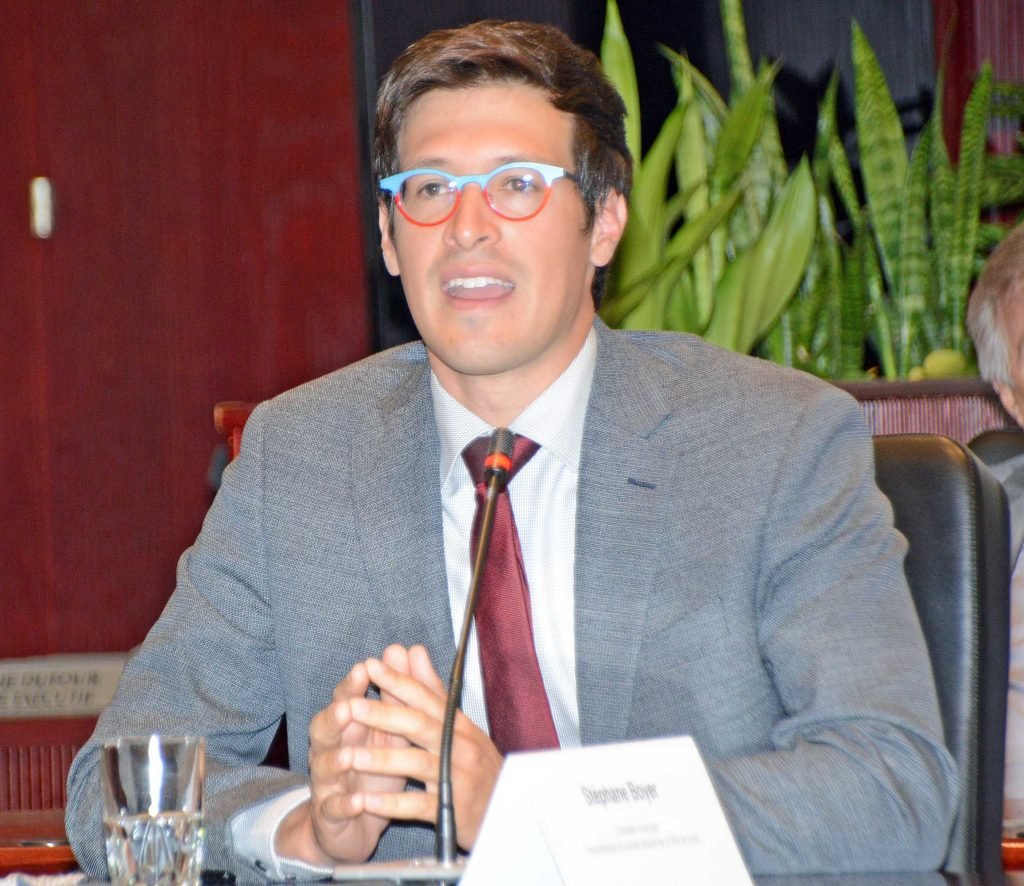
“Laval is pleased to be taking part in this announcement this morning,” said Laval executive-committee vice-president Stéphane Boyer, speaking on behalf of Mayor Marc Demers, while noting that the city allotted nearly $200 million in capital funding in 2014-2015 to overhaul its water processing facilities.

“We have some of the finest water in Quebec and we’re very proud of it,” he added. He said the money from Ottawa and Quebec will help maintain Laval’s water treatment system. “We have nearly 250 kilometres of water network to maintain and it grows larger every day.”

Other Quebec-Canada projects

Under the Investing in Canada plan, the federal government is investing more than $180 billion over 12 years in public-transit projects, green infrastructure, social infrastructure, trade and transportation routes, and Canada’s rural and northern communities. As part of the same plan, the federal government has invested over $6.2 billion in 790 infrastructure projects in Quebec.

The government of Quebec’s Fonds pour l’infrastructure municipale d’eau (FIMEAU) aims to carry out the construction, rehabilitation, expansion and addition to municipal water and wastewater infrastructure. It consists of a total investment of $1.5 billion. Two more project submission periods are planned for 2022 and 2024.

David De Cotis readmitted to Action Laval caucus

Was suspended by opposition party after conflict-of-interest allegations

More than six months after David De Cotis was suspended from the Action Laval party, officials at Action Laval announced last week they had accepted the Saint-Bruno district councillor and former executive-committee vice-president back into the party caucus.

Three suspended

Earlier this year following conflict-of-interest allegations in articles published in the Journal de Montréal, De Cotis was suspended from the Action Laval caucus, along with St-Vincent-de-Paul councillor Paolo Galati and Laval-des-Rapides councillor Isabella Tassoni.

Laval city councillor for Saint-Bruno David De Cotis (seen at centre in this file photo) has been taken back into the Action Laval caucus after being cleared of wrongdoing by a provincial ethics investigation that looked into allegations of conflict-of-interest.
 

The claims originated in e-mails leaked from Laval city hall, which suggested that the three were involved in ethically questionable real estate transactions. While Galati and Tassoni were cleared of suspicion months ago by a provincial ethics authority, it was only recently that De Cotis was also completely exonerated.

To serve residents

With that chapter finally over, De Cotis said this week he hopes now to continue concentrating on his principal task – serving the residents of his district. “Serving the people of Saint-Bruno to my full capacity continues to be my priority, to be the liaison between them and the city,” he told The Laval News.

Regarding the allegations and the decision rendered by the Commission municipale du Québec exonerating him, De Cotis said, “They said there was no conflict of interest, no use of influence, there was nothing unethical that I did – it was an open and shut case.”

Laval City-Watch

Members of the City of Laval’s executive-committee made several decisions during their Aug. 26 sitting, including awarding an almost $650,000 contract for the improvement of Firehall No. 3 in St-Vincent-de-Paul, awarding a contract for preliminary work on the Laval public library’s future central branch, and awarding a contract for sidewalk rehabilitation in various parts of the city.

The committee awarded a contract for $649,105.44 to Légaré Construction (including taxes) for the company to carry out expansion and enlargement work at Firehall No. 3 at 4411 de la Concorde Blvd. East. The work will involve creation of a new dressing room for firefighting apparel and gear.

Firehall improvements

According to the city, the work is being done following the publication in 2017 of guidelines by the provincial parity committee for health and security in the workplace, which highlighted illnesses endemic to certain professions. As such, Laval decided to take measures to ensure that firefighters’ suits and apparel would meet new standards for workplace well-being.

Laval city hall on Souvenir Blvd. in Chomedey.

According to new procedures to be implemented once the dressing area is completed, after each fire the firefighters will immediately have to wash their suits, which will be contaminated with residues and contaminants from the fires. Following this, they will place the suits in special lockers equipped with a ventilation system to dry them thoroughly.

A healthier environment

Particles washed off or vacuumed from the suits by the system will be exhausted outdoors by ventilation fans. It is believed that this new way of doing things at the firehall will significantly help reduce risks by the firefighters of contracting various forms of cancer, which have long been considered an inherent risk in the firefighting profession.

During the same meeting, the executive-committee members also awarded a contract for $313,074 (including taxes) to the architectural firm Hébert Zurita Danis Smith to create a functional and technical program (PFT) for a major culture infrastructure program – the central library and the Centre de création artistique professionnelle.

Central library building

As part of the City of Laval’s wide-ranging strategic vision looking forward to the year 2035, the city wants to encourage access to culture by all residents. As well, in conjunction with the cultural development plan adopted in 2019, the central library building, to be located in the Montmorency downtown core sector, is expected to be a magnet for future creative endeavours and projects.

In a statement, the city says that the new central library branch “will reinforce the library network through the elevation of a central and modern library that, while complementing the development of local library branches, will also fill the needs of all Laval residents.

Committed to culture

“The construction of this new crossroads of culture and learning will bear witness to the commitment by the municipality towards culture, the arts and social development. The infrastructure will become one of the richest collective legacies that will contribute to reinforcing the identity of Laval, while spreading word about the city.”

In another decision made on Aug. 26 by the executive-committee, the members decided to award a $109,325 contract (including taxes) for sidewalk construction to the firm FNX-INNOV. As part of a master plan adopted by the city in July last year for pedestrian infrastructure development, nearly 55 kilometres of additional sidewalks and other comfortable and secure pedestrian infrastructure were planned for the next three years.

New sidewalks to be built

According to the city, work in the above-mentioned contract will be fulfilled before this year is over in the following places: Place Alton-Goldbloom, Romain St., Maisonneuve St., 52nd St., 49th Ave., Edgar St. and Cléroux Blvd.

Finally, the executive-committee awarded a $2,595,976 contract (including taxes) to Construction G-NESIS for rehabilitation work of small bridges in the district of Sainte-Dorothée, more specifically on des Jardins St. and under the cycling path located in Couvrette Park.

Bike path improvements

The city says the work is needed to replace equipment that is at the end of its useful life on the bicycle path network, in order to assure the safety of users. The money being allotted for the work comes from a City of Laval fund used for the rehabilitation of structures, including bridges and overpasses, in the triennial capital works budget.

The City of Laval’s executive-committee meets each week to make decisions on a variety of issues. The executive-committee includes the following people: Mayor Marc Demers, vice-president Stéphane Boyer (also councillor for Duvernay–Pont-Viau) councillors Sandra Desmeules (Concorde–Bois-de-Boulogne), Ray Khalil (Sainte-Dorothée), Virginie Dufour (Sainte-Rose) and associate members Nicholas Borne (Laval-les-Îles) and Yannick Langlois (L’Orée-des-Bois).

Ouellette hopes his new book blows the lid off UPAC

Chomedey MNA still waiting for an apology for his arrest after info leak at UPAC

If it’s been a while since most people in Quebec heard news from the province’s Unité permanente anticorruption – better known as UPAC – Chomedey MNA Guy Ouellette – a former Securité du Québec police investigator who, ironically, is not a fan of the anti-collusion police – is drawing UPAC back into the spotlight with a new book-length exposé, as well as a lawsuit that got underway on the same day last week as the book launch.

An arduous task

Chomedey Independent MNA Guy Ouellette hopes his new book sheds light and vindicates him of wrongdoing in the controversy over his arrest by UPAC. (Photo: Martin C. Barry, Newsfirst)

“Today marks the end of some hard work that started 10 months ago,” Ouellette said in an interview with The Laval News during a media and by-invitation event held last week at the Château Royal convention centre in the heart of the riding he represents.

Ouellette, who spent a significant part of his three decades in the SQ investigating the Hell’s Angels and other criminal motorcycle gangs, says his new 336-page work, Qu’on accuse ou qu’on s’excuse: Les Dessous to mon arrestation illégale, could finally blow the lid over what’s left of UPAC.

The book’s foreword was written by former National Assembly Speaker Jacques Chagnon, who had previously come vigorously to Ouellette’s defence.

Facts for BEI inquest

Ouellette said the book focuses primarily on facts, which he hopes will be put to good use by the Bureau des enquêtes indépendantes (BEI), a Quebec agency that looks into police wrong-doing, to guide them in their investigation of the circumstances that led to Ouellette’s arrest by UPAC in October 2017 on suspicion he was involved in a leak of information at UPAC.

Despite the arrest, Ouellette was never charged.

First elected as a Quebec Liberal in 2007, Ouellette currently sits as an independent member of the National Assembly. He was expelled from the Quebec Liberal Party caucus shortly before the 2018 election, after news reports claimed he had leaked information about the Liberals to the Coalition Avenir Québec, who won the election. Premier François himself maintained that Ouellette furnished information to the CAQ.

Insight into UPAC

“It’s insight also,” Ouellette added regarding the book, noting that its conclusion raises serious questions as to whether UPAC is needed nine years after the department was created by the then-Liberal government. The other question Ouellette raises, as suggested in the book’s main title, is whether he will receive a formal apology from the province’s current Premier, François Legault.

‘I’m not the leak UPAC was looking for,’ says Ouellette

As Ouellette noted, the title, in fact, quotes word-for-word the phrase used by Jacques Chagnon in the National Assembly on Oct. 31 2017, during a response to Ouellette’s arrest. At that time, Chagnon said, “An MNA has suffered a serious blow and his reputation has been tarnished. […] May charges be brought, or may public apologies be made. May he be charged or may apologies be made.”

Chagnon’s remarks, as well as a unanimous standing ovation Ouellette received from members of all parties in the National Assembly, were viewed as a strong reaction by the province’s elected representatives to what they saw as an ominous threat posed by the police towards parliamentarians.

‘I’m not the leak,’ he says

Regarding the UPAC leak, Ouellette adamantly maintains he was not the source. “I’m not the leak UPAC was looking for,” he said. “I have nothing to reproach myself for.” In addition, Ouellette claims that because UPAC wants to safeguard the identity of the actual source, they are refusing, “But they know,” he said, while also claiming that some media outlets are also well aware of the source’s identity.

Further to this, Ouellette pointed out that in February 2018, when he was called to testify during court proceedings in Quebec City in a fraud and abuse of power case pending against former Quebec Liberal cabinet minister Nathalie Normandeau, he swore under oath that he neither knew nor was he the leak’s source. He makes that specific claim again in his book.

In an added twist, the first court date for a libel suit Ouellette launched two years ago in conjunction with the UPAC arrest, naming the Quebec Solicitor General as defendant, was delayed until the very day of his book launch last week.

Registration underway for public consultations on Laval Police Department

In preparation for the creation of a new master plan to provide guidelines for operating the Laval Police Department, the City of Laval has announced the opening of registration for residents and community leaders who would like to take part in a public consultation.

The city says that an important goal following the consultation may be to take measures, as deemed necessary, to deal with systemic racial discrimination.

Focus groups, led by the Institut du Nouveau Monde, will be taking place online on Sept 17 at 6:30 pm, and on Sept. 18 at 3:30 pm. To take part, residents must have access to a computer, a computer tablet or a smartphone equipped with a microphone and (ideally) also a camera.

Additional information and registration: www.repensonslaval.ca/dialogue-police

https://www.laval.ca/Pages/Fr/Nouvelles/microsite-police/consultationscitoyennes.aspx

CISSS de Laval gears up screening for wave two of COVID-19

0

Faced with a resurgence in demand for testing to be done for COVID-19, the Centre intégré de santé et de services sociaux (CISSS) de Laval has announced that five screening clinics will be offering service in Laval and that their hours of operation will increase. 

Locations for the screening clinics: 

► Pierre-Creamer Arena, 1160 Pie lX Blvd., Laval.

► 34D, Cartier Blvd. Ouest, Laval (beginning September 11).

► Mobile unit (located in the parking lot at Cartier Arena at 100 Montée Major, Laval).

► 1200 Chomedey Blvd., Laval.

► 3400 Dagenais Blvd., Laval.

CISSS de Laval is also inviting everyone who wants to be screened to visit their web site to find out the waiting times that can be expected: https://www.lavalensante.com/soins-et-services/information-pratique/info-covid-19/#c14731

Laval’s Claude-Ferragne Athletics Stadium now open in Auteuil

0

Thursday will be remembered as an important date for Laval residents who are into competing in athletics or track-and-field sports.

Officials from the City of Laval, as well as from the Club d’athlétisme Dynamique de Laval, were on hand at the Odyssée-des-Jeunes school park in Auteuil for the official opening of the new $6.6 million Claude-Ferragne Athletics Stadium.

The new facility, which is open to athletes from Laval or any other resident who wants to train in a first-class setting, has been created by the city for the Jeux du Québec, part of which are scheduled to be taking place in Laval during the summer next year.

From the left: Lyne Carry, president of the Club d’Athlétisme Dynamique de Laval, Annie Potvin, head coach Club d’Athlétisme Dynamique de Laval, and Stéphane Boyer, vice-president of the Laval executive-committee are seen here on the surface of the running track at the new Claude-Ferragne Athletics Stadium in Auteuil.

Until next summer, according to the city, the facility is available to any resident who wishes to use it. It’s named after Claude Ferragne, a world-class high-jumper who took part as a Canadian athlete in the 1976 Montreal Olympics where he finished 12th in his sport. He won a gold medal at the 1978 Commonwealth Games. He coached and taught high-jump at Collège Ahuntsic.

Among other things, the stadium includes a 400-metre 8-lane running track, a 100-metre section with 10 lanes, two long-jump runways, several zones for pole-vault and high-jump, zones for disc, hammer, weight and javelin throw, a triple-jump corridor, a judges’ tower, four light towers and bleachers to accommodate up to 600 spectators.

“We can be very proud of these additional facilities, confirming Laval’s leadership with regards to sports,” said Mayor Marc Demers.

Opposition questions ‘transparency’ of Laval’s ‘Grande Bibliothèque’ project

Demers and Boyer say too little information available yet to share with council

Although construction work on a new central branch for the City of Laval’s public library network is still far from underway, the opposition on Laval city council is already raising questions about “transparency” and questionable costs for a project slated to be built in Laval’s downtown core.

No transparency: Opposition

Seen here in a file photo, Laval executive-committee vice-president Stéphane Boyer says the city hasn’t enough information gathered on the Grande Bibliothèque project yet to reveal any preliminary planning.

During the Sept. 1 webcast of Laval city council, objections were voiced from several opposition councillors to an agenda item calling for the awarding of a 12-month contract worth a little over $313,074 to an architectural firm to produce a preliminary technical study for the future “Grande Bibliothèque.”

“There is a shortage of information,” said opposition councillor for Saint-Bruno David De Cotis. “It leaves the impression that there is a lack of transparency. Because I can understand that studies have to be done. But I am convinced that the committee members who worked on this were given a presentation and they know where the Grande Bibliothéque is going to be built.

Team work, suggests De Cotis

“They know the needs,” added De Cotis. “So we don’t need an outside consultant to tell us the functioning or technical needs. What I am asking managers at city hall is to give us a presentation with all the information that is available today. After that it will be easier for us all as a team to vote on budgets.”

De Cotis and fellow opposition councillor Isabella Tassoni, who represents Laval-des-Rapides, agreed that athough she’s the councillor for the district, even she is being kept in the dark by the Demers administration as to the details of the project.

While Tassoni, De Cotis and others said they agreed that a central library building is needed – “I want to see it in my district more than anybody,” Tassoni said at one point – she added that she found it impossible to vote even on a preliminary part of a project when the administration hadn’t provided any information on it.

Tassoni voted No

“At the end of the day, I don’t know how we can vote on something that we have no idea how it’s going to take place,” she said, adding that even though she understood the points being made by Mayor Marc Demers and executive-committee vice-president Stéphane Boyer, she saw no option but to vote against the library project contract.

St-Vincent-de-Paul city councillor Paolo Galati said he, too, supported the Grande Bibliothèque project, “except that for me there is a lack of transparency,” he added, citing the City of Laval auditor-general’s most recent annual report which noted an absence of transparency in a number of the administration’s dealings. For that reason, Galati said he would vote against the contract.

Info not ready yet, said Demers

Responding to the criticism that the project lacks transparency, Stéphane Boyer said that because planning is still in the early stages there wasn’t enough information to share at this point. Mayor Demers said the city is currently seeking subsidies from the provincial government to help pay for the project. He said that when further studies have been completed, the administration will be in a position to present an outline to all the city council members.

During the public question period, Laval resident Mélanie Guimond said that following the vandalism committed against the statue of John A. MacDonald in downtown Montreal, the City of Laval might consider denouncing such acts as they could end up also taking place in Laval. She suggested a resolution should be tabled at the council meeting to denounce all forms of vandalism being used to stifle constructive debate.

No monuments here, said mayor

While agreeing that the violent upheavals and events recently in the U.S. as well as the vandalism in Montreal shouldn’t be ignored, Mayor Demers said Laval has little in common with those incidents. “In the City of Laval, we have very few monuments honoring historic figures and so we are perhaps not as vulnerable to the type of situation that took place in Montreal,” said Demers.

“But I can assure you that all of the elected officials here tonight heard you and we oppose any manifestation of violence whether it is verbal, physical or otherwise to meet a goal. I think that the best way to win people over is by speaking and letting the facts be known.”

Weather

Laval
overcast clouds
-0.3 ° C
0.7 °
-1.6 °
53 %
5.7kmh
100 %
Mon
-0 °
Tue
-2 °
Wed
-1 °
Thu
0 °
Fri
-6 °