The current issue of the Laval News, volume 33-17, published on September 10th, 2025.
Covering Laval local news, politics, and sports.
(Click on the image to read the paper.)

The current issue of the Laval News, volume 33-17, published on September 10th, 2025.
Covering Laval local news, politics, and sports.
(Click on the image to read the paper.)

Park Extension’s Place de la Gare was filled with joy and jubilation on the afternoon of Sunday Aug. 17 as people of Indian heritage from everywhere in the Montreal region gathered to take part in joyful festivities marking the day 79 years ago when India became a nation.
For many elected officials from Parc Ex as well as from throughout the Montreal region, the India Independence Day celebrations were just one of a lengthy series of events taking place all weekend as Montrealers were beginning to wind down after summer vacation.

One of Parc Ex’s big events

Organized annually by the India-Canada Organization, India Independence Day is one of the largest public events in Parc Extension every year. Months of preparation take place, leading up to it annually.
Although there has not been an India Independence Day parade along Querbes Ave. for a number of years, India-Canada Organization chairman Naseer Mehdi Khan, as well as an event organizer from the Borough of VSMPE both suggested to Nouvelles Parc Extension News that they haven’t given up hope of holding a parade next year if the conditions are right and there is willingness to go ahead with it.
Progress report on India
In addition to the celebrations, India Independence Day is also an occasion for the organizers to publicly speak about progress that’s been made during the previous year in the home country and to focus on issues of concern there.
Since the early 1990s, India has emerged as one of the fastest-growing economies in the developing world. This has been accompanied by increases in life expectancy, literacy rates and food security. India is now one of the world’s largest economies by nominal GDP, and third-largest by purchasing power parity.

Indian economy booming
During the local celebrations, an official representative from the Republic of India’s high commission in Canada spoke optimistically of India’s prospering economy, which ranks next to Germany, China and the United States (which is in first place).

He also spoke of significantly improved relations between India and Canada with the leadership of Prime Minister Mark Carney. Relations between Canada and India fell to an historic low during former Prime Minister Justin Trudeau’s time in office.

Hundreds of people in a mood to party gathered in the centre of Parc Extension on the weekend of August 15 to 17 to talk, eat, dance and soak up the Hellenic ambience at the annual Montreal Greek Festival.
Held around the same time as the Greek Orthodox Church’s Feast of the Dormition of the Mother of God, the last day, Sunday, was the culminating celebration of all things Greek.

Four days of fun
It all took place at the intersection of Saint Roch and Outremont streets where hundreds of people of all ages – many of them Hellenic teens – formed circles and danced until late into the night. More than 20,000 attended the festival.
This was the first year newly-elected Hellenic Community of Greater Montreal president Basile Angelopoulos presided over the festivities.
“This is truly the beginning of a new era at the HCGM,” said Angelopoulos, a longtime Laval resident, who was elected in June. While he grew up in Laval, his parents lived in Parc Extension for a number of years after first arriving from Greece.

A continuing tradition
“Welcome to all our friends and thank you for being here to share this wonderful occasion, a tradition that continues and one that we will ensure will continue in the future,” he told the gathering prior to the beginning of a performance by Greek folk dancers.
Although she represents a Laval constituency, Vimy Liberal MP Annie Koutrakis spent an important part of her youth in Parc Extension. Before moving to Chomedey at age 17 with her parents, she attended Barclay School in Parc Ex and has fond memories of playing in the parks and on the streets of the area.

A ‘homecoming’ for some
“The Montreal Greek Festival is like a homecoming for me every year,” she said in an interview with Nouvelles Parc Extension, reflecting a view held by many Greek Montrealers from all over the region who regard Parc Extension, with its many Greek Orthodox churches, as the spiritual centre of the Montreal Greek community.
A highlight of the evening on Sunday August 17 was the presentation by Chomedey Liberal MNA Sona Lakhoyan Olivier of a National Assembly Medal to longtime Parc Extension city councillor Mary Deros in recognition of Deros’s many years of public service. Although she now lives in Laval, Lakhoyan Olivier grew up in Parc Extension.



Although some were worried about a sudden and unexpected downpour raining out the party, nearly all concerns were set aside when hundreds of residents of Laval’s Saint-Bruno district gathered near Lausanne Park Sunday afternoon August 24 for local city councillor David De Cotis’s ninth annual Fête de Quartier.
The area’s biggest community celebration of the year drew more than a dozen local organizations and merchants.

They were eager to touch base with people from the area. Elected representatives from various levels of government were also on hand to introduce themselves.
All for a good cause
The event was organized by De Cotis in conjunction with the Service bénévole d’entraide Vimont-Auteuil (SBEVA), a local non-profit that provides meals-on-wheels to hundreds of individuals impacted by loss of personal autonomy.
All proceeds from the Fête de Quartier de Saint-Bruno will be going to SBEVA. “This a community event to create a sense of belonging for everyone – but especially the children,” De Cotis said in an interview with The Laval News.
“But at the same time, all the money raised today is going straight to the SBEVA. straight to the SBEVA.”



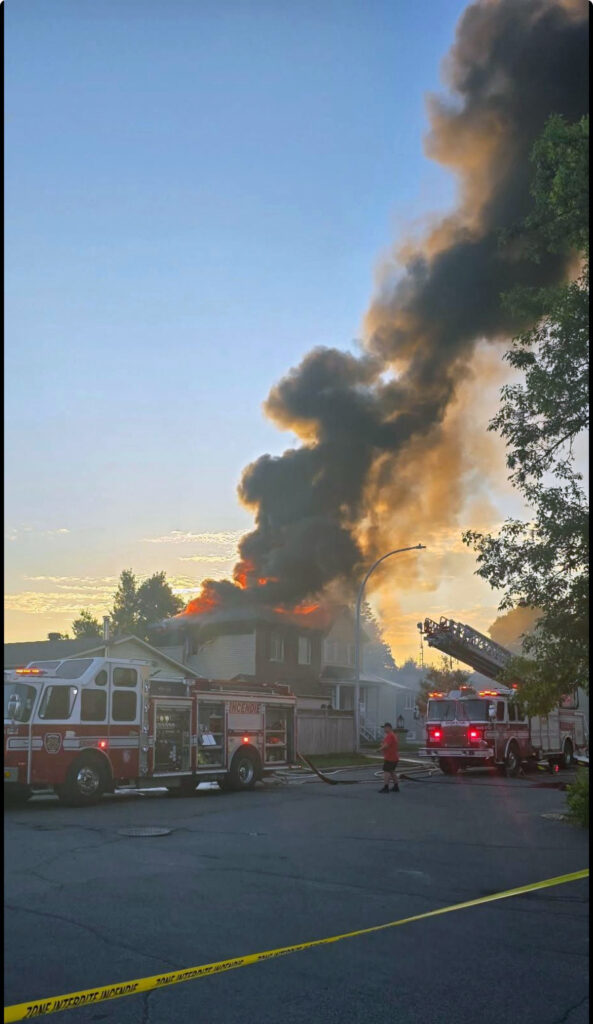
A fire that broke out at a home on Pierre Boucher St. in Laval’s Saint-François district on August 22 will be costing the owners or their insurers more than a half-million dollars to repair the damage.
The Laval Fire Dept. received a distress call about the blaze via 9-1-1 around 7 pm and were on the scene within four minutes.
According to a post placed on the X feed of the Association des Pompiers de Laval (the firemen’s union), flames were visible at the rear of the dwelling upon the firefighters’ arrival, then spread to the roof.
However, the occupants were able to get out safely before the firemen arrived.
In all, 34 firemen and nine fire department units were summoned to the scene. They reported the situation as being under control by nearly 9:30 pm.
Human error was a probable factor, fire investigators concluded in an initial report on the source of the blaze, without providing more detailed information.
They estimated damages to the building (worth $681,000, according to City of Laval property valuation records) at $450,000, while damages to interior furnishings were estimated at $100,000.
Body found on Cité-de-la-Santé Hospital roof in Laval
Laval police are investigating after a body was found on the roof of Cité-de-la-Santé Hospital on the morning of Tuesday August 19.
A call to 9-1-1 was made around 9:35 a.m. after hospital staff discovered a deceased person on the roof of one of the hospital campus’s buildings, according to a spokesperson for the Laval Police Dept.
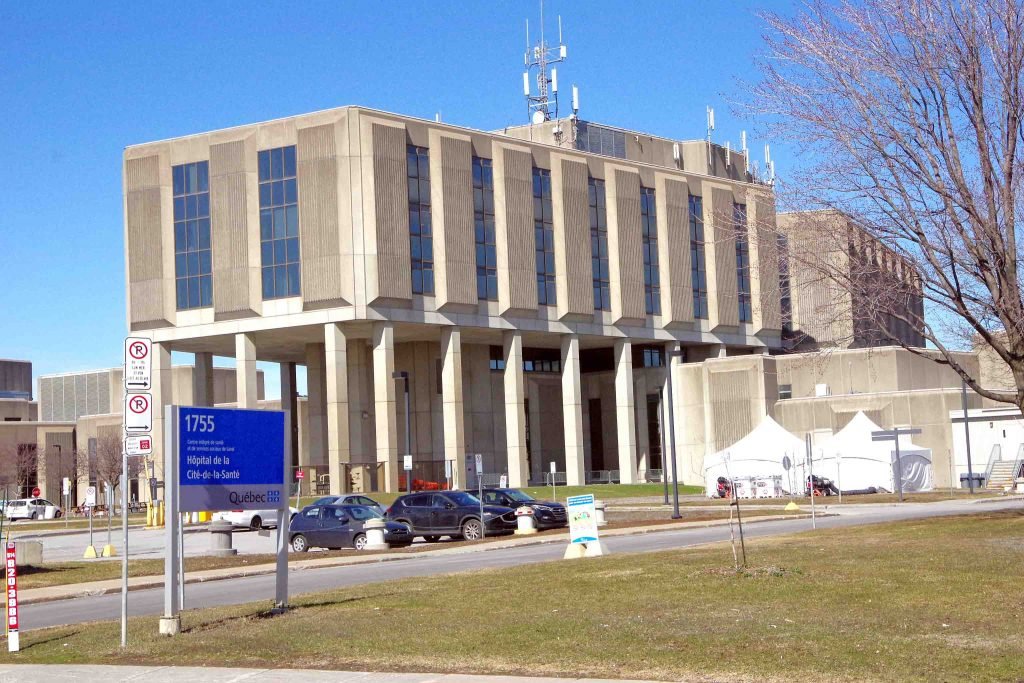
Authorities confirmed that the person was pronounced dead on the scene. The LPD’s crimes against persons’ squad took charge of the file, in conjunction with the coroner’s office.
According to the police, an investigation will attempt to determine the causes and circumstances of the death. The Centre intégré de santé et de services sociaux de Laval declined to issue a statement last week, saying they could not as the incident remained under police investigation.
But in the meantime, they confirmed that there would be no impact on services to Cité de la Santé patients or visitors.
QMI news reported last week that the deceased was a former Cité de la Santé cardiology patient who had been released a few days before, and that the body was found on the roof of the cardiology unit.
House in Duvernay evacuated after reported natural gas leak
A home on Curé Cloutier St. in Laval’s Duvernay district was evacuated as a precaution on the morning of Friday August 22 after excavation machinery accidentally ruptured a natural gas line nearby.
Laval Fire Dept. personnel confirmed the gas leak, after which they accompanied the house’s occupants outside, then summoned Hydro-Québec to neutralize any risk posed by electrical sources.
As a result, there was an electricity blackout on several streets for several hours, although the situation was deemed as being under control before 9:30 am.

After warning that nearly one in five small Canadian businesses impacted by tariffs couldn’t last more than six months without intervention by the federal government, the Canadian Federation of Independent Business changed its tune late last week, saying it welcomed Ottawa’s decision to drop retaliatory tariffs on a wide range of U.S. goods.
Damaging retaliation
“This is a step in the right direction and will take some of the pressure off Canadian small businesses as trade talks continue,” said CFIB vice-president of advocacy Corinne Pohlmann
However, she maintained that many small business owners had told the CFIB before then that Canada’s retaliatory measures were almost as damaging as the U.S. tariffs themselves.
“While small firms were in favour of Canadian counter tariffs as the trade war began, their support has been falling since February,” Pohlmann added.
While maintaining that the government’s announcement provided some relief going forward, she said the CFIB still wants Ottawa to immediately release tariff revenue to small businesses and work quickly to resolve small business requests still tied up in the remissions process.

Free trade is on again
In a statement issued by Prime Minister Marc Carney’s office last week, Carney said that the Canadian government decided to match the United States by removing all of Canada’s tariffs on U.S. goods, specifically those covered under the Canada-US-Mexico trade agreement.
The decision takes effect on September 1. “In short, Canada and the U.S. have now re-established free trade for the vast majority of our goods,” Carney said.
However, Canada will retain tariffs on steel, aluminum and autos as it works intensively with the U.S. to resolve the issues there. The federal government underscored the fact that Canada is the second-largest foreign investor in the U.S.
Carney said that to address challenges in strategic sectors from agriculture to autos, the government will soon announce a new comprehensive industrial strategy that protects Canadian jobs, boosts Canadian competitiveness, buys Canadian goods, and diversifies Canadian exports.
Small business hit hardest
The CFIB said before the government’s announcement that new data it obtained revealed small businesses were being hit hardest by U.S. and Canadian tariffs on steel and aluminum and Canada’s own retaliatory tariffs on other U.S. goods. In addition, according to the CFIB, nearly one-third of Canadian SMEs would be negatively affected by the loss of the $800 U.S. de minimis exemption.
U.S. President Donald Trump had signed an executive order on July 31, raising tariffs on some Canadian goods to 35 per cent. Canada might have been able to avoid the hike had it managed to strike a new trade deal with the U.S. by an August 1 deadline, although that didn’t happen.
The Canadian government had imposed retaliatory tariffs on U.S. goods three times since the trade war began, including counter-tariffs on $60 billion worth of U.S. consumer goods and additional tariffs on U.S. autos.
Bad deal vs. lasting uncertainty

“Small businesses don’t have a lot of runway left,” Pohlmann warned last week before the federal government’s latest announcement. She said the worst outcome for Canada in the trade war would be “a bad deal,” but the second worst outcome would be the regularization of an uncertainty that small business owners had been contending with for the past six months.
“The federal government needs to provide some stability and return tariff revenue to help small businesses,” she said. “We’ve suggested several options, including temporarily reducing the federal small business tax rate to zero or a tariff rebate designed on earlier models, like the carbon tax rebate.”
CFIB data indicates that nearly two-thirds (62 per cent) of small businesses face higher expenses, while many are also seeing lower revenues (48 per cent), supply chain disruptions (41 per cent), and paused investments (36 per cent).
As well, nearly one in five (19 per cent) of small businesses dealing with extra tariff costs reported they would not be able to last more than six months if the tariff status quo remained, while nearly four in 10 (38 per cent) said they would last less than a year.
What happens to collected tariffs?
With Ottawa having collected billions in additional tariff revenue on U.S. imports, a strong majority (82 per cent) told the CFIB the government should ensure that any tariff revenue that is returned includes support for smaller businesses affected both directly and indirectly by trade disruptions.
“The trade war’s impact on Canada’s small businesses should be top of mind for the government as Canada continues its negotiations with the U.S. Canada can’t fix its productivity crisis without empowering its entrepreneurs,” according to Pohlmann.
“If the government wants to build one Canadian economy, it needs to ensure small businesses are part of the solution and that includes providing them with tariff support during this very challenging time,” she said.

Nearly a year after the city announced a wide-ranging strategy for the transformation of a long-vacant expanse of land at Laval’s centre into a mixed-use project, Action Laval is demanding the Boyer administration come clean on its plans for Carré Laval and share whatever information is available with Laval’s taxpayers.
In September last year, with much fanfare, Mayor Stéphane Boyer announced that the Carré Laval project would be taking place over a span of at least 20 years on a mostly vacant square of land at the southwest intersection of Autoroute 15 and Saint-Martin Blvd.
The most notable landmarks there until now have been the Palais de Justice, as well as the abandoned stone quarry behind the courthouse, and in more recent years the staging base for the lightshow entertainment start-up Illumi Laval, who have vacated the site.
A major project

In a press release issued by the city last year, Laval officials referred to Carré Laval as a “flagship project,” serving possibly as a prototype for similar developments elsewhere in Laval.
The city acknowledged it is an “ambitious vision” for an area that was chosen largely because of its strategic location immediately next to the A-15, allowing widespread exposure to a steady stream of traffic passing through Laval and greater Montreal.
During an expected first phase, a 22-hectare regional park (the equivalent of 30 football fields, according to the city) would be created, with the disused stone quarry dominating the middle. Eventually, 3,500 units of housing would be built in Carré Laval, although the initial plan calls for the creation of 1,000 housing units, 500 of which would be affordable.
Working with Angus developer
To reach this goal, the city said last year that it would be working closely with the Société de développement Angus (SDA), a property developer that operates on principles of social economy. SDA’s main accomplishment to date was the redevelopment of the former Angus railway yards in the east end of Montreal into a mixed-use residential/commercial community.
The City of Laval signed an agreement in principle with the Société de développement Angus, which sets out three phases for SDA’s involvement with Carré Laval: construction of 500 units of affordable housing; development of an additional 500 housing units of an unspecified type; and the realization of a public building built around the “One Health” concept, as well as life sciences and commercial research.
The city launched a wide-ranging public consultation on Carré Laval with an initial presentation in September last year. The plan also calls for life and health sciences companies to eventually locate their research facilities in Carré Laval.
‘Just an announcement’
“When the mayor announced this project, along with things like social housing that was supposed to go with it, it was basically just an announcement, right,” said Action Laval councillor for Saint-Bruno David De Cotis.
“But there’s no other plan, there’s no budget associated with this. It’s just a dream, but with nothing around it. Nothing to say any of this is actually going to happen. Which is why we’re asking for transparency.”
During the August Laval city council meeting two weeks ago, Action Laval’s interim-leader Achille Cifelli tabled a motion asking the city’s executive-committee to publicly release all documents relating to the Carré Laval project.
Among other things, the motion asks the executive-committee to hold an independent audit of the expenses associated with the project, as well as the anticipated tax impacts, while asking that public additional consultations be held.
‘Not against development’
“We are not against development, but it has to be transparent, responsible and supported by the population,” Cifelli said in a statement. “Today that is not the case with Carré Laval.” Action Laval’s motion is scheduled to be debated during the September city council meeting.
“The elected officials from the Action Laval team will be present to defend the motion and to protect the interests of the citizens,” added Frédéric Mayer, the party’s candidate for mayor in the November 2 elections.
“All Laval residents are entitled to know how their money is being used and how Carré Laval is being managed,” he added. “My colleague’s proposal seeks clear information and real consultations of the population.”

Although Saturday may already have been a rainy washout for some of those who’d been planning to attend the first day of the City of Laval’s Fête de la famille outdoor celebration on Labour Day weekend, the good news is that all-day sunshine is in the forecast for day two on Sunday.
One of the city’s largest annual outdoor gatherings is taking place at the Centre de la nature over two days instead of one day as is usually the case.
From 10 am to 5 pm on both dates, the city is staging a special two-day celebration to mark the fact that 2025 is the 60th anniversary of the City of Laval’s founding in 1965.
With an emphasis on sports and games, the celebration will include a multitude of activities, shows and hosted activities for children as well as adults.

“This special staging of the Fête de la famille is an occasion to celebrate once again our 60 years of community life in Laval by bringing together young and old around a schedule of programming that is rich and festive,” says Mayor Stéphane Boyer.
“These moments of celebration reinforce the link that holds us together with feelings of belonging, nourishing our pride in being from Laval and it makes me happy to see this growing from year to year.”
Over the two days of this year’s Fête de la famille, there will be three zones for activities in the Centre de la nature. The first, the Turbulence Zone, is for those who like to move.
It will feature a big overhead Zip Line, a climbing wall, a dance workshop, sports challenges, an expo of heavy equipment, members of the Laval Rocket hockey team, officers from the Laval Police with their mascot Flair, BMX stunt bike displays and an initiation to pumptrack cycling.
The second zone is dedicated to budding young geniuses. It will feature science workshops, nature talks and exhibits, a mobile library, giant games, digital challenges with the Laval public library’s Espace numérique, an exposition of archeological artifacts, and a section about animal protection.
Finally, the third zone is for the very young. It will feature inflatable games, face painting, a mini-Zip Line, a firefighters’ challenge led by staff from the Laval Fire Dept., a circus village (Opération Bazar), and opportunities to meet unusual characters strolling around the Centre de la nature.
For teens and older persons seeking something a little more exciting, there are two new features at this year’s Fête de la famille: BMX and pumptrack will be filling the bill.
As well, over the two days a number of young performers alone and in teams will be staging shows on the Fête de la famille’s main stage, in the mini-village on the Centre de la nature site, and in front of the main big top tent.
They include Arthur L’Aventurier, the Switch dance group, Zak the challenger, Ariane Deslions, as well as Hiatus, Juju and Marcelle, L’agent Jean, Maddox, Aventurosaure and Les Volk.
Finally, near the Turbulence Zone, there will be an exhibition of equipment used by the Laval Police Dept., whose officers will be on hand to explain what they’re for and how they work.
It’s worth noting that the Fête de la famille will be taking place rain or shine, regardless of the prevailing weather on Saturday and Sunday August 30 and 31.
To ensure the safety of everyone during the event, Avenue du Parc which runs along the west side of the Centre de la nature will be closed to motor vehicle traffic on both days.
Special measures for parking will be in place, and shuttle buses provided by the Société de transport de Laval will help facilitate access to the Fête de la famille site.

In his opening remarks at the start of the August 12 meeting of Laval city council, Mayor Stéphane Boyer noted that it was nearly a year to the day since the worst weather-related disaster Laval residents ever experienced – Tropical Storm Debby.
After-storm cleanup
The remnant of Hurricane Debby peaked in the Laval region on August 9 last year, impacting up to 15,000 families whose homes in many cases were flooded, forcing a massive cleanup over the following weeks that left piles of debris stacked along streets in neighbourhoods all over Laval.

The mayor maintained that progress has been made towards developing a more effective municipal contingency plan for future weather disasters and that several studies and reports have been issued to help make Laval a safer place to live.
New climate reality
“We also have many infrastructure construction and investment projects underway so that the city can become increasingly resilient,” said Boyer, while noting that it took Laval six decades to develop its infrastructure to the level it’s at now.
“So, it’s going to take a certain amount of time before our infrastructure can be adapted to the new climate reality.”
He said that one of the city’s new projects, along Saint-Martin Blvd., is being designed to absorb rainwater directly from the heavily-trafficked street into the soil, so that the equivalent of two Olympic-size swimming pools of water will be kept out of the stormwater sewer system whenever it rains.
As well, according to Boyer, the city is building a new rainfall reservoir around the Metro station at the intersection of Cartier and des Laurentides boulevards.
Making Laval more resilient
“These are some of the projects that are underway at this time,” he continued. “And we know that worksites can cause momentary inconveniences. But the idea is to make a city that will be more resilient and that can ensure peace and well-being for our residents.”
As August 6 was the official date of the merger 60 years ago of more than a dozen previously independent municipalities on Île Jésus into the City of Laval, Mayor Boyer noted that the main issues in the beginning were better fire protection and better water and sewer infrastructure.
“Thankfully, we have made a lot of headway since then,” he said. “We are now at the stage where we have good services for the population and today Laval is an example among municipalities 60 years after merger.”
Former councillors eulogized
In passing, Mayor Boyer pointed out the recent deaths of two former Laval city councillors: former Laval-les-Îles councillor Jean-Jacques Beldié and former Saint-François councillor Jacques St-Jean, both of whom served for nearly a quarter-century each.
“Being in politics isn’t always easy,” added the mayor, without being specific. (Beldié and St-Jean were both longstanding members of the administration under former Mayor Gilles Vaillancourt.)
“We often face criticism, we are often confronted by many problems and issues,” he said. “But I think we should always point out the involvement of people who devoted years of their lives to public service. Especially people like Mr. Beldié and Mr. St-Jean who served for around 25 years each.”

By Matthew Daldalian, LJI Reporter
Quebec’s CEGEP network is entering the new academic year with fewer staff, aging buildings, and more students than ever — a mix union leaders say is unsustainable.
From support workers to professional staff, those on the ground say they are being asked to do more with less as a government-imposed hiring freeze and budget reductions collide with steady growth in student enrolment.
Valérie Fontaine, president of the Fédération du personnel de soutien de l’enseignement supérieur (FPSES-CSQ), said more than 50 positions have already been cut in the 13 colleges her federation represents.
“For sure it’s gonna bring some work overload for those people still there,” she said. “You cannot have people to do more with less resources.”
The positions being lost are not just administrative jobs, Fontaine said, but front-line roles that directly serve students. Recreation technicians, social work technicians, laboratory staff, and special education workers have all been affected.
“Those are all positions that give direct services to the students,” she said. “So, for sure there’s gonna be an impact.”
The cuts come as CEGEPs are welcoming more students with special needs than in the past. Fontaine noted that while some schools once served just a handful of students requiring accommodations, many now have a large population.
Physical infrastructure is also showing its cracks. Fontaine said many colleges have long delayed necessary repairs, with two-thirds of campuses reporting urgent needs last year. But the freeze has tied their hands even further.
“Last year we weren’t even able to buy books,” she said. “Imagine working in a CEGEP without being able to buy books—it makes no sense for us.”
Laboratories and classrooms are also increasingly ill-suited for modern learning. Fontaine warned that without proper funding, equipment and facilities will only fall further behind.
For professional staff who provide psychological services, academic guidance, and counselling, the situation is just as dire.
“If a CEGEP used to have three guidance counsellors and now we’re down to two, of course that will eventually have impacts,” said Éric Cyr, president of the Fédération du personnel professionnel des collèges (FPPC-CSQ). “There’s a limit to what we can do.”
Cyr said the consequences are already clear: waiting lists for counsellors, students being redirected to the private sector, and heavier workloads for those who remain.

Éric Cyr, président of the Fédération du personnel professionnel des collèges (FPPC-CSQ) speaking at a press conference. (Courtesy photo by the CSQ)
“The worst consequence that could happen is that students would not have what they need to persevere and get a diploma,” he said.
Professionals are already reporting increased pressure to do more with less, a situation Cyr says may lead to burnout, sick leave, or resignations. The result, he warned, is fewer services precisely as student numbers climb.
At the same time, enrolment is climbing. Both Fontaine and Cyr stressed that student numbers are rising steadily, with this fall marking one of the largest increases yet.
“We don’t have money, they’re gonna have less services, and we have more students,” Fontaine said. “We need space because we’re lacking space too.”
Cyr agreed, pointing out that today’s CEGEP students often arrive with a wider range of learning needs than in past generations.
“Many students now come to CEGEP who would not have been in the system 30 years ago,” he said. “Professional services are really needed in great numbers if we want to keep these students getting diplomas and succeeding.”
Even the Centrale des syndicats du Québec’s (CSQ) president, Éric Gingras, described in a press release the situation as part of “the slow erosion of a network once considered a Quebec treasure,” adding that elected officials appear “completely indifferent.”
For English-language colleges, an added pressure comes from Law 14, which expanded French language requirements in 2022. Cyr said complying with the law has created “a lot of extra work” for staff, just as resources shrink.
“Now there’s gonna be less resources for our colleagues in the English CEGEPs to do that work,” he said.
Both leaders flagged staff morale as a growing problem. Fontaine noted that while support workers are dedicated to their colleges, rising workloads risk pushing many out of the system, with mental health concerns at the forefront.
Cyr said professional staff are in the same position.
“We will do everything we can to give great services and help the students,” he said. “But eventually something will have to give.”
Union leaders say the quickest step would be to lift the hiring freeze so that vacancies from retirements, sick leave, or departures can be filled. Fontaine argued it is unreasonable to expect colleagues to cover the work of three positions.
“It’s not normal for the colleague to take all the jobs,” she said.
Cyr said the priority should be restoring depleted counselling and psychology positions, which he called essential to student success.
“Direct services that are now impacted since last May — those would have to be the priority if we want all these new students to have a good experience with CEGEPs and stay there and get a diploma,” he said.
For both Fontaine and Cyr, the message is the same: Quebec’s CEGEP network cannot keep doing more with less.
The FPPC-CSQ represents over 2,200 professional staff across 38 CEGEPs in Quebec. It is affiliated with the Centrale des syndicats du Québec, which represents more than 225,000 members province-wide.