Sunday, February 22, 2026
8 C
Laval
spot_img
Home Blog Page 169

CISSS de Laval makes progress with COVID-19 saliva testing

A pilot project undertaken by the CISSS de Laval to introduce saliva testing for COVID-19 in schools or at home may soon become the standard across the region.

At this stage, the project is still in the developmental stage at only three learning institutions belonging to the Centre de services scolaire de Laval (CSSL).

Test kits, which have so far been distributed at a CSSL high-school and two elementary schools, are distributed to parents and teachers with an explanation on how to use them.

As the test is less intrusive than the nasal swab test, and can be administered by someone without special training, it’s considered to be a step toward more efficient testing for COVID-19.

The CISS de Laval may be extending access to the test to all schools in Laval in the coming weeks.

Canadian Competition Bureau fines Laval-based CIMA+ $3.2 million

Laval-based CIMA+ civil engineering announced on Tuesday that it has reached an agreement with the Competition Bureau of Canada for the settlement of a dispute with CBC regarding anti-competitive activities carried out in the early 2000s involving several players in the engineering industry.

The agreement provides for the payment of a $3.2 million fine by CIMA+. Under the settlement, no charges are brought against the firm.

“Over the past few years, CIMA+ has made considerable efforts to regain the trust of markets and public organizations,” CIMA+ said in a statement without elaborating.

However, CIMA+ was one of several civil engineering firms in Quebec whose names came up during testimony given to the Charbonneau Commission regarding bid-rigging.

“Since the early signs of allegations, the firm’s new management team has taken the necessary steps to regularize the situation.”

The company, which is the anchor tenant at a high-rise office building across the street from Laval city hall, said that in addition to renewing its senior management team, it implemented a new governance, with a board of directors comprised of several independent members.

CIMA+ said it also enrolled in the Quebec government’s voluntary reimbursement program and that it has been continously collaborating with regulatory authorities.

“The signature of this agreement, combined with the fact that strict measures in terms of ethics and integrity have been implemented over the past few years, allows for turning the page and looking forward,” said the company.

In a statement issued by the CBC, the federal agency said the settlement ends the competition bureau’s investigation of CIMA+’s role in a bid-rigging scheme that targeted municipal contracts in Quebec City, Montreal, Laval, St-Eustache and Gatineau between 2003 and 2011.

“There is a price to be paid by those who defraud taxpayers by rigging bids on municipal contracts,” said Matthew Boswell, the bureau’s Commissioner of Competition.

“This latest settlement is a reminder that we will continue to pursue all those involved in such criminal schemes.”

The CBC said CIMA+’s payment was the sixth settlement resulting from the bureau’s ongoing investigation.

CIMA+ and five other engineering firms were ordered to pay a total of $12,050,000 for their respective roles in the bid-rigging scheme. The five other firms were:

Laval Police seek help on whereabouts of Havre des Îles murder suspect

The Laval Police Department is seeking the help of anyone who can furnish information regarding the comings and goings of a suspect arrested in conjunction with a murder which took place on Havre des Îles Ave. on Île Du Tremblay on Friday Dec. 4.

According to a statement issued by the LPD, the investigators want to know where the suspect was in the days prior to the crime.

Officers from the LPD were called to the scene of the murder on an upper floor of an apartment block at 2525 Havre des Îles Ave.

A person who lives in the building where the incident took place told The Laval News the LPD was on the scene for several days.

“I only found out after the police and ambulance vehicles arrived,” said the resident who preferred not to be identified.

“The investigation unit was here and they were here until last Sunday evening,” he added. “Now [Tuesday] they’re back again, but in a smaller vehicle to finish their invetigation. I guess they had something they needed to complete.”

The resident, who lives on the fourth floor of the building, said he didn’t know the couple living in the apartment where the incident took place, which he said was on the eighth.

The 74-year-old female victim was found lying on the floor lifeless, with various indications on her body that she had been subjected to violence.

Albert Nathaniel, 58, who was identified by the LPD as a co-habitant of the apartment, was placed under arrest and is charged with second degree murder.

He is expected to make a court appearance on Dec. 10.

In the meantime, the LPD says it is also trying to locate a vehicle owned by the murder victim, a white 2009 Dodge Caravan with license plate H28 THP.

Should anyone see the vehicle, they are advised to not go near or touch it. Anyone with information can call 450 662-INFO (4636), and say you are calling about police file LVL 201204 034.

CISSS de Laval opens homeless shelter at former Maison Saint-Joseph

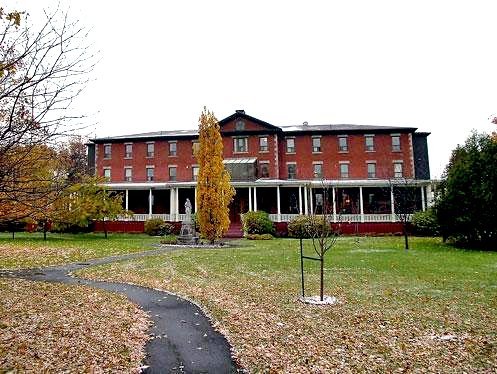
The Centre intégré de santé et de services sociaux (CISSS) de Laval says a new shelter for people without a roof over their heads has opened its doors at the Maison Saint-Joseph, a former religious centre at 3550 Lévesque Boulevard West in Chomedey that the City of Laval purchased a year ago.

According to the regional health and social services agency, the shelter project, which is being conducted in partnership with the City of Laval, the Regroupement des organismes et intervenants en itinérance de Laval (ROIIL) and the Table de concertation de Laval en condition féminine (TCLCF), will be providing support, meals, wash-up services, a place to sleep and more to the homeless, thus improving their access to assistance and essential services this winter.

The CISSS says those using the shelter will be able to receive psychosocial services offered by an intervention team from participating organizations, and they will be sleeping in separate areas reserved for men and for women to ensure a safe environment.

The emergency shelter will be open each day from 6 pm to 8 am.

“This temporary arrangement is in keeping with government directives on ensuring access to care and services for people with no fixed address in order to prevent the community spread of the virus within this segment of the population,” the CISS de Laval said in a statement.

Laval buys INRS’s riverside property for use as future public park

The City of Laval says it has purchased a large riverside green space on des Prairies Blvd. in Laval-des-Rapides, with an historic building on the lot, for eventual development into a park.

The $6.84 million acquisition from the Institut national de recherche scientifique (INRS) includes a heritage building that now houses the Musée Armand Frappier.

A retirement residence for senior citizens is expected to be built in a corner of the lot near 58th Ave.

“This magnificent lot on the edge of the waterfront is located near the downtown and has inestimable value we think,” Mayor Marc Demers said in a statement.

“This purchase, which is about the size of 17 NHL rinks, shows once again our determination to turn Laval into a green and welcoming city, working towards developing our urban fabric along sustainable lines,” he added.

LPD sting op leads to conviction of 13 men who tried to buy sex from teenage girls

A Montreal media report recently documented how a special unit of the Laval Police Department mounted a sting operation that led ultimately to the arrest and conviction of more than a dozen men who were charged with trying to obtain the sexual services of teenaged girls.

According to assistant director for criminal inquiries at the LPD Manon Ouellet, the force opened 120 new files involving the sexual exploitation of minors since late October. This compares to 96 the year before. She said the COVID-19 pandemic has only accelerated the trend.

The LPD currently has a large number of dossiers concerning men accused of online sexual indiscretions involving minors, said Ouellet, while adding that the Laval police force is emphasizing prevention in its approach to the problem, but that the LPD is still determined to work actively on the ground to intervene when necessary.

Opération Défensif

The LPD had previously mounted an operation, known as Opération Défensif, designed to keep track of the clients of underage prostitutes. In that operation, up to 40 men were arrested by the LPD after it was determined they were on the brink of paying for the sexual services of a minor.

The LPD published fake ads on internet web sites offering the sexual services of girls. An undercover female LPD officer played the role of a ring operator, informing the men of the rates charged, while also stating repeatedly that the girls in question were minors. Although the ads drew 133 potential male clients, only 13 ended up following through all the way to a hotel where police were waiting and arrested them.

Guilty pleas and verdicts

Laval is said to have a reputation among pedophiles as an area where it is easy to get caught by police. Out of the 13 suspects who were snared, most pleaded guilty or were found guilty in court to the charge they tried to procure the sexual services of a minor. One is still being sought by police. None of those charged had any prior criminal record.

Among those caught in the LPD’s net were Jean-François Paquet, 48, a former high-school teacher and Canadian Forces soldier who was involved as a volunteer in little league baseball in Laval. He was found guilty of having tried to obtain the sexual services of a minor. According to news reports, the LPD lured him to a motel on Curé Labelle Blvd. where he thought he was going to meet two 16-year-old girls.

Sentences under appeal

Paquet is currently appealing the sentence, claiming that the six-month mandatory minimum imprisonment he was given is unconstitutional. Another man caught in the sting by the LPD, Charles Martin of Sainte-Marthe-sur-le-Lac, appealed his mandatory minimum sentence, which was reduced to 90 days and community service.

The 60-year-old had sought the services of what he thought would be two teenage girls. Like the previous two, Michel Bergeron, who was also snared by the LPD, is appealing his mandatory minimum sentence. The 57-year-old was found guilty last year of agreeing to pay for the sexual services of a 16-year-old girl.

The 13 who pleaded guilty or were found guilty

Éric Cyr

Age 57

Blainville

Found guilty in December 2017

Sentenced to six months

Robert Geffrard

Age 77

Laval

Pleaded guilty in September 2019

Sentenced to six months

Sylvain Fafard

Age 46

Saint-Jérôme

Found guilty

Sentenced to six months

Patrick Maillette

Age 49

Pleaded guilty in October 2017

Sentenced to six months

Mauricio Vasquez Menjivar

Age 60

Laval

Pleaded guilty in March 2018

Sentenced to six months

Aldrin Cabanilla

Age 41

Montreal

Pleaded guilty in October 2016

Sentenced to six months with probation

Charles Martin

Age 60

Sainte-Marthe-sur-le-Lac

Pleaded guilty in May 2018

Sentenced to 90 days and probation (currrently being appealed).

Réjean Mainville

Age 42

Saint-Eustache

Found guilty in October 2019

Awaiting sentencing

Jean-François Paquet

Age 48

Laval

Found guilty in May 2019

Awaiting sentencing

Michel Bergeron

Age 57

Laval

Pleaded guilty in August 2019

Awaiting sentencing

François St-Georges

Age 70

Rosemère

Pleaded not guilty.

Awaiting trial.

Mokhtar Ben Haj Mohamed

Age 43

Laval

Pleaded not guilty.

Awaiting trial.

Oktay Guzel

Age 54

Montreal

Currently being sought by police.

Man from Laval wins race-profiling case against LPD

The Quebec’s Human Rights Commission has recommended that Laval Police Department officers and the City of Laval pay more than $10,000 to a man who alleged he was discriminated against in a race incident involving the LPD.

For Pradel Content, it was a second legal victory over police officers in Laval. A first racial profiling complaint against the city and two police officers was upheld last month by the Quebec Human Rights and Youth Rights Commission.

The commission had asked for higher damages from the city and two police officers than were stated in the decision. In the most recent ruling, it recommended that the city and two other officers pay Content a total of $13,000 in damages. The commission also asked that the city enact systemic measures to address racial profiling.

Content was in the parking lot of a building on Biencourt St. in Laval on the night of July 12, 2018, talking to two friends, when he was approached by two police officers who claimed to be responding to a complaint about a disturbance.

After some discussion between him and the officers over Content’s use of his cellphone to video-record them, they made a sarcastic remark to him and he muttered a curse word as they were leaving. A week later, he received a $77 ticket in the mail for insulting a police officer.

The Human Rights Commission found that Content was a victim of racial profiling based on his race, colour and gender, and asked both officers and the city to jointly pay him $10,000 in damages. In addition, Bélisle and Langlois were asked to personally pay Content $2,000 and $1,000 respectively in punitive damages.

December 1-7 is National Safe Driving Week

Distracted driving is an important topic, both in the safety sphere and in the context of public discussion. Focus is often placed on the dangers of handheld devices, and for good reason. But while this is one example of a potentially fatal action that can be taken behind the wheel, it’s not the only one.

“Distraction is distraction, no matter how you slice it,” said Gareth Jones, President and CEO of the Canada Safety Council. “We all have a responsibility — to ourselves, to our loved ones and to our fellow road users — to remain vigilant at all times and stay focused on the task at hand.”

The task of driving always requires your full attention. Any activity that removes your focus off the road can be qualified as distraction. This can include using your phone, reprogramming your radio or Global Positioning System (GPS), grooming, entering a conversation with passengers and, yes, even eating and drinking behind the wheel.

A momentary loss of focus on the road can cost you a second or two in which to react to a sudden change in expected traffic or behaviour. And that small moment of time can make all the difference in the world.

Most Dangerous Foods Behind the Wheel (according to the National Highway Traffic Safety Administration):

  • Coffee
  • Soup
  • Tacos
  • Chili
  • Hamburgers
  • Barbecued food
  • Fried Chicken
  • Jelly Doughnuts
  • Soft drinks
  • Chocolate
  • Cup of coffee in vehicle’s cup holder

Collège Citoyen teacher receives Governor General’s Award for Excellence in Teaching

Francis Lalande’s winning project combined bicycling and Lachine Canal history

A teacher from the Laval-based Collège Citoyen was presented last week with the Governor General’s Award for Excellence in Teaching for a project involving the history of bicycling.

Francis Lalande’s project, ‘Histoire à vélo,’ invited students to take part in a bicycle tour with historic overtones along the Lachine Canal in the Montreal neighbourhood of Lachine. In addition, he filmed the tour with a Go Pro video camera.

“I can only express my gratitude towards Canada’s National History Society which recognizes the work of teachers,” said Lalande. “This award is a personal victory, but it also bears witness to my pride to work in an environment that is stimulating and encouraing.”

“All across Canada, the laureates work every day to empower students, connect with communities and tell stories of the past — inspiring and engaging us with their passion for history,” said Janet Walker, president and CEO of Canada’s History Society which administers the awards. “I would like to extend my sincere congratulations to all of the 2020 recipients.”

The Governor General’s History Awards are administered by Canada’s History Society and recognize excellence in five categories: Community Programming, Museums, Popular Media, Scholarly Research, and Teaching. The awards are Canada’s top history honours and involve the leading agencies of Canada’s history and heritage community. Each award category is administered by the presenting organization and has its own jury, selection process and prize structure.

Canada’s History Society is a national charitable organization with a mission to promote greater popular interest in Canadian history through its magazines, Canada’s History (formerly The Beaver) and Kayak: Canada’s History Magazine for Kids, as well as its education and award programs.

Everyone should test for radon, experts urge during online event

‘Radon Action Month’ draws attention to No. 2 cause of lung cancer

While many people now associate the month of November with the annual “Movember” movement which raises awareness of men’s health issues, not as many may know that November is also Radon Action Month when health authorities draw attention to the threat posed by a radioactive gas that is the second most common cause of lung cancer after cigarette smoking.

On Nov. 19, Take Action on Radon, a national health coalition funded by Health Canada, held an online question and answer event to mark Radon Action Month. During the session, experts answered questions ranging from the impact of radon on health, to how to test homes and reduce the risk of radon exposure.

Ever-present radon

Radon is a radioactive gas that forms from uranium present naturally in the earth’s crust. Radon is found in soil, everywhere on the earth’s surface. Levels of radon in the soil can vary greatly from one place to another. Radon can also be present in groundwater.

Experts say that the only way to be sure of the radon level in any home is to test

Radon can seep into buildings, particularly through foundations. It can sometimes accumulate and reach levels that can lead to health risks. Given it is a gas with no smell, taste or colour, it is impossible to detect with the senses. But at the same time, is the leading cause of lung cancer in non-smokers.

According to Health Canada, when radon is released from the ground into the outdoor air, it is diluted and is not a concern. However, in enclosed spaces such as homes, it can accumulate to high levels and become a risk to the health.

Gets into houses

As the air pressure inside homes is usually lower than in the soil surrounding the foundation, this difference in pressure draws in air and other gases – including radon – from the soil. As such, radon can enter a home from wherever it finds an opening where the house in in contact with the ground. These openings can include cracks in the foundation floor and walls, construction joints, gaps around service pipes, support posts, window casements, floor drains, sumps or cavities inside walls.

Kelley Bush, Manager, Health Canada, Radon Education and Awareness Program, said the federal ministry is leaving responsibility for radon testing up to each individual and home owner.

Radon gas can be found in almost all homes in Canada. Concentrations differ greatly across the country, but are usually higher in areas where there is a higher amount of uranium in underlying rock and soil. While Canada’s western provinces, including Alberta and Saskatchewan, are considered to be at very high risk for radon gas, the risk is much lower in Ontario and Quebec.

Low radon levels in Quebec

According to a Quebec government website dealing with radon, Canadian guidelines stipulate that radon concentration in dwellings should not exceed 200 Bq/m3. However, in general radon concentration is not very high in Quebec homes, usually not exceeding 35 Bq/m3. But concentrations can sometimes reach very high levels, meaning that testing should always be carried out.

Experts say that the only way to be sure of the radon level in any home is to test. They say testing for radon is simple to do and should be done in every home, in every community across Canada, regardless of whether a community is known to have high radon levels.

Moderately-priced testing kits (less than $30) are available commercially from companies like AccuStar Canada (which has an office in Quebec City), or from the Association Pulmonaire du Québec which sells the kits for $45. Both sources are easily accessible through internet websites.

Testing for radon up to you

While Health Canada has been doing its part to raise awareness of the radon threat, an official from the federal ministry said during the online event that testing remains the responsibility of each individual and home owner.

“Similar to other health risks in homes like carbon monoxide and fires, Health Canada provides Canadians with guidance and information so that they can take necessary steps and actions to ensure their homes are healthy and safe,” said Kelley Bush, manager of Health Canada’s Radon Education and Awareness Program. “At the end of the day, it’s Canadians who need to take that last step and take action to reduce their radon exposure.”

Laval wins award at 15th annual Fleurons du Québec

City plans to reforest autoroute interchanges to cut impact of heat islands

On Nov. 12, the City of Laval was recognized by agricultural experts from across the province with an award for the city’s project last year to restore a more natural environment to four autoroute merger areas.

The project, which was launched in the spring of 2020, was inspired by the City of Laval’s desire to reduce the impact of heat islands.

The City of Laval has won an award with a new program through which it plans to reforest green spaces like this one at intersections along Autoroutes 15 and 440.

“Keeping in mind the need to adapt the territory to climate change, recognition of this initiave can only make us happy while encouraging us to put into place other innovative solutions in the coming years,” said city councillor for Sainte-Rose and executive-committee member Virginie Dufour who is responsible for environmental dossiers.

Controlling heat islands

The city is working towards reforesting the autoroute interchange areas in order to reduce their contribution to rising temperatures in urban settings. Trees will help to do this. The city plans to plant more than 23,000 shrubs and small trees of around 30 species at the following autoroute intersections:

  • Boulevard des Laurentides and Autoroute 440;
  • Boulevard Industriel and Autoroute 440;
  • Boulevard Chomedey and Autoroute 440;
  • Boulevard Saint-Martin and Autoroute 15.

The project is being conducted in conjunction with the Quebec Ministry of Transport, the Montreal Metropolitan Community (CMM) and Prof. Alain Paquette and his lab team from the Centre d’étude de la forêt (CEF) at UQAM.

Weather

Laval
snow
-1.1 ° C
-0.4 °
-2.1 °
67 %
6.2kmh
100 %
Sun
-1 °
Mon
-1 °
Tue
-9 °
Wed
-2 °
Thu
-3 °