The current issue of the Laval News volume 29-24 published July 28th, 2021.
Covering Laval local news, politics, sports and our new section Mature Life.
(Click on the image to read the paper.)

The current issue of the Laval News volume 29-24 published July 28th, 2021.
Covering Laval local news, politics, sports and our new section Mature Life.
(Click on the image to read the paper.)

CNW/ – The Government of Canada is prioritizing the health and safety of everyone in Canada by taking a risk-based and measured approach to re-opening our borders. Thanks to the hard work of Canadians, rising vaccination rates and declining COVID-19 cases, the Government of Canada is able to move forward with adjusted border measures.
The gradual lifting of restrictions will allow the gradual resumption of tourism, first with the United States, then with the rest of the world.
As a first step, starting August 9, 2021, Canada plans to begin allowing entry to American citizens and permanent residents, who are currently residing in the United States, and have been fully vaccinated at least 14 days prior to entering Canada for non-essential travel.
Subject to limited exceptions, all travellers must use ArriveCAN (app or web portal) to submit their travel information. If they are eligible to enter Canada and meet specific criteria, fully vaccinated travellers will not have to quarantine upon arrival in Canada.
On September 7, 2021, provided that the domestic epidemiologic situation remains favourable, Ottawa intends to open Canada’s borders to any fully vaccinated travellers who have completed the full course of vaccination with a Government of Canada-accepted vaccine at least 14 days prior to entering Canada and who meet specific entry requirements.
To further support these new measures, Transport Canada is expanding the scope of the existing Notice to Airmen (NOTAM) that currently directs scheduled international commercial passenger flights into four Canadian Airports: Montréal-Trudeau International Airport, Toronto Pearson International Airport, Calgary International Airport, and Vancouver International Airport.
International flights permitted to land at five additional airports
Effective August 9, 2021, international flights carrying passengers will be permitted to land at the following five additional Canadian airports:
• Halifax Stanfield International Airport;
• Québec City Jean Lesage International Airport;
• Ottawa Macdonald–Cartier International Airport;
• Winnipeg James Armstrong Richardson International Airport; and
• Edmonton International Airport.
These airports, in cooperation with the Public Health Agency of Canada, the Canada Border Services Agency and Transport Canada, are working to implement the measures necessary to safely welcome international passengers as soon as possible after August 9, as conditions dictate.
All travellers, regardless of vaccination status, will still require a pre-entry COVID-19 molecular test result.
Some vaccines only
These easing of border restrictions will only apply to travellers who have received two doses of vaccines licensed by Health Canada.
Currently, only those manufactured by Pfizer-BioNTech, Moderna, AstraZeneca/COVISHIELD and Janssen (Johnson & Johnson) are approved.
Travellers from countries where other vaccines are distributed will therefore have to wait. For example, 70 countries around the world, including Mexico, distribute the Sputnik vaccine manufactured in Russia.
Ottawa is currently considering giving the green light to travellers who have received other vaccines, but is not ready for it at the moment.
Family trips facilities
Children under the age of 12 who do not have access to vaccination will no longer be required to comply with strict quarantine, starting on 9 August for the United States and 7 September for the rest of the world.
However, children will need to be tested upon arrival and eight days later. They will also have to avoid gathering places, including summer camps, schools and daycares for 14 days after arrival.
Adjusting its post-arrival testing
However effective August 9, 2021, the Government of Canada is adjusting its post-arrival testing strategy for fully vaccinated travellers. Using a new border testing surveillance program at airports and land border crossings, fully vaccinated travellers will not need a post-arrival test unless they have been randomly selected to complete a Day 1 COVID-19 molecular test. There are no changes to the mandatory testing requirements for unvaccinated travellers.
This strategy allows the Government of Canada to continue monitoring variants of concern in Canada and vaccine effectiveness. Using these layers of protection, the Government of Canada can monitor the COVID-19 situation in Canada, respond quickly to threats, and guide decisions on restricting international travel.
Finally, with the advent of increased vaccination rates in Canada, declining COVID-19 cases and reduced pressure on health care capacity, the three-night government authorized hotel stay requirement will be eliminated for all travellers arriving by air as of 12:01 A.M. EDT on August 9. Fully vaccinated travellers who meet the requirements will be exempt from quarantine; however, all travellers must still provide a quarantine plan and be prepared to quarantine, in case it is determined at the border that they do not meet the necessary requirements.
While Canada continues to trend in the right direction, the epidemiological situation and vaccination coverage is not the same around the world. Border measures also remain subject to change as the epidemiological situation evolves.


Traffic calming and better waste-water management combined in one

This fall in Chomedey, the City of Laval will be starting the implementation of sidewalk protrusions, which are special concrete areas built next to sidewalks to absorb water while encouraging the growth of shrubs and small trees.
While the protrusions will serve the purpose of calming traffic, they will also be playing an important role in helping to control excess rain water and keeping air temperatures down in areas known as “heat islands.”
Traffic/water management
The Quebec government recently awarded the City of Laval a $498,350 subsidy to carry out this project. The provincial program is part of a larger plan to create a greener economy in Quebec.
In all, the city will be implementing 34 similar projects in other neighbourhoods, including Albert Murphy St. between Saint Martin Blvd. and Le Carrefour, as well as on Berlier St. between Le Corbusier and Industriel boulevards.
According to the city, the sidewalks protrusions act as traffic calming measures by inciting car drivers to slow down in their vicinity because of the protruding shape. It is believed that in directing rain water towards these sidewalk devices, more water will be retained naturally and the sewer system won’t be overworked.
Innovative thinking
“The traffic calming measures put into place are adapted to each location,” says Laval city councillor and executive-committee member responsible for public works and engineering Ray Khalil.
“This implementation of draining and greened-over protrusions is a good overall example, while also being an example of innovation: for while the are dealing with traffic issues and embellishing streets, they also allow sectors to be greened and heat islands to be reduced, while favouring the management of rain waters.”
“I am proud to see cities like Laval mobilizing and developing innovative solutions for better rain water management,” says Quebec Municipal Affairs Minister Andrée Laforest, who was instrumental in granting the subsidies to the city.
Efforts please Quebec
“Not only does this allow for the resilience of the entire community to be increased against the new climate warming realities, but it also contributes to the development of sustainable, healthy and quality living environments.”
“I am happy to see that successful initiatives are being put into place by the municipalities with the goal of encouraging sustainable management of rain water,” added Benoit Charette, Minister of the Environment and for the struggle against global warming.
“It is by committing to accomplishing actions like these that we contribute to a future that is greener for all Quebecers,” he added.
Useful facts:
• Since 2017, the City of Laval has been accelerating its implementation of traffic calming measures.
• In 2021 and 2022, 700 additional speed bumps around parks and schools to increase safety for young Laval residents.
• Over the past few years, several protrusions have been implemented by the city.
• With draining greened over protrusions, traffic calming and water management are combined into a single effort.
• The greened-over, draining protrusions reduce water headed towards Laval’s sewers, thus improving the cleanliness of the water that ends up at the end of the system for cleansing and purification.

Senator Leo Housakos calls Bill C-10 ‘an adamant attack on freedom of speech’
Has Canada’s Senate shut down Liberal Heritage Minister Steven Guilbeault’s attempt to establish tighter controls on the Internet with Bill C-10?
While some social conservatives have been stridently denouncing the proposed federal law as an outlandish intrusion into the private lives of Canadians, Bill C-10 may still die of its own natural causes, since members from both sides of the Senate floor agree the bill needs more work before being enacted.
Objections from the Tories
However, some still believe the Liberal government will revive the bill should the Liberals receive a new mandate in an election. Although the Liberals, the NDP, the Bloc Québécois and the Greens all support Bill C-10, the Conservatives remain the lone hold-out.
The other parties’ seeming unanimity led long-time Tory MP Pierre Poilièvre to comment during a House debate in June that the underlying reason they all support Bill C-10 isn’t actually difficult to understand.
‘The state above the citizen’
“They’re all the same,” he said. “They all believe in putting the state above the citizen. That’s the core of their ideology. They believe in worshipping at the altar of the state – that big government should decide and that the people should just follow.”
In the Senate, one of the strongest opponents of Bill C-10 has been Montreal-based Senator Leo Housakos. “C-10 is a very feeble attempt on the part of the Liberal government to reform the Canadian Broadcasting Act,” he said in an interview with Newsfirst Multimedia. (Enacted in 1991, the Broadcasting Act defines broadcasting policy in Canada, including the role of the CRTC and the CBC/Radio-Canada.)
Attack on freedom, he says
According to Housakos, the Liberals had initially described Bill C-10 as a piece of legislation meant to regulate inconsistencies in Canada’s telecommunications domain, while taking into account the emergence of powerful web-based digital technology and online platforms over the past two decades.
“Unfortunately, somewhere along the line this bill has gone haywire,” Housakos added. “It’s become an adamant attack on freedom of speech. We’ve seen this government take out clauses that protected freedom of speech.
‘Irresponsible’ legislation
“They’ve given draconian authority to the CRTC to be able to determine what Canadians watch, what they post on the digital web, in places like Twitter, YouTube, Facebook and so on and so forth. And if there’s something we cherish as Canadians it’s freedom of expression, freedom of speech. I think it’s part and parcel of our democracy.
“It’s regrettable that the Trudeau government has decided to put forward this very irresponsible piece of legislation, which in addition to attacking freedom of speech, it also essentially is taking the digital modern era of communications and is trying to drag it back to an antiquated time of broadcasting, instead of taking the antiquated broadcasting platforms and telling them to adjust themselves to basically work within the confines of the modern era.”
Good for Canadian content
Housakos suggests that a law like Bill C-10, which he says could effectively suppress certain portions of the internet, such as YouTube, would only end up being counterproductive, and could inadvertently undermine Canadian content.
“Let’s remember that Justin Bieber was discovered on YouTube,” he said, adding that Indo-Canadian comedian and talk-show host Lilly Singh was also discovered on the web-based video medium. (Singh has been ranked as one of the world’s highest-paid YouTubers, with reported earnings at one point of $7.5 million.)
An opportunity, says Housakos
“This opportunity to post Canadian culture and give it access to world markets is something we should embrace, not something we should muzzle or try to kill.”
Although Bill C-10 has reached third reading in the Senate, Housakos said the Senate has “made it abundantly clear to Mr. Guilbeault and the Trudeau government that this bill in its current form has no chance of passing. We’ve punted it to the committee on transportation and communications in the Senate where it’s going to receive a very thorough and comprehensive review.
If there is an election…
“And the government can take this to the bank: there will be severe amendments coming back. If there isn’t an election by fall, then of course the bill will die on the order paper where it deserves to die. But if there isn’t an election and we come back in the fall, the government has to be ready to accept drastic amendments.”
According to Housakos, the Senate members reacted to Bill C-10 in a non-partisan fashion. While the largest bloc in the Senate consists currently of Liberal government appointees, he said “a multitude of voices from caucuses on all sides of the chamber agreed this is a bill with many holes.”

The current issue of the Laval News volume 29-23 published July 21st, 2021.
Covering Laval local news, politics, sports and our new section Mature Life.
(Click on the image to read the paper.)

Following a call for tenders process, the Société de transport de Laval (STL) says it has entered into an agreement with Taxelco to service its 16 shared taxi lines for both on-request and regular service in Laval.
The two-year agreement came into effect on July 1, 2021, and has an option for three additional years.
The STL says a transition period can be expected with this new supplier but clients will notice few changes: schedules, routes, stops and terms of use will all stay the same.
However, some people will notice new vehicles driving around Laval as Taxelco operates under several banners, including Taxi Diamond, Taxi Hochelaga and Téo Taxi.
The STL says the contract covers only the STL shared taxi service and not any other transportation service using taxis, such as the paratransit service or particular operational needs in the event of a detour or other reason.
Shared taxi services are an extension of the STL bus network, providing service to sectors that either cannot be easily accessed by bus, such as highway service roads or industrial sectors, or having a low volume of commuters that does not justify a bus line.
The STL says this form of on-request transportation is a good way to test out new routes with the aim of eventually setting up a bus line, which was the case with the STL’s Line 36.

For four days this month, hundreds of appreciators of quality sculpture and art from all over eastern Canada will gather in Laval’s picturesque Vieux Sainte Rose village for an annual event that many now accept as one of Quebec’s most respected and esteemed outdoor art shows – the Sainte-Rose Art Symposium.
Fifty artists in 2021
Fifty artists will be exhibiting their works at this year’s symposium on Thursday July 22, Friday July 23, Saturday July 24 and Sunday July 25, organized as always by the members of the Corporation Rose-Art artists’ collective.
Although more than 90 artists usually participate in the Sainte-Rose Art Symposium, the 2021 symposium is somewhat smaller, with 50 artists, due to relaxed but still ongoing sanitary restrictions mandated by the provincial government because of the COVID-19 pandemic.
A chance to see great art
The Saint-Rose Art Symposium is regarded by some as one of Canada’s most successful gatherings of visual artists and their works. Each year, attending the symposium is seen by connaisseurs of art as a great opportunity to enjoy the creations of many different artists who express themselves in many different styles.
The Saint-Rose Art Symposium is regarded by some as one of Canada’s most successful gatherings of visual artists and their works
For many patrons, the Saint-Rose Art Symposium has become an annual pilgrimage to an art show where they know quality art works can be purchased to enhance the home, or as lasting gifts for family and loved ones.
Admission to the symposium is free, and attending offers the additional opportunity of being able to explore and experience all the charm and historic atmosphere of Laval’s Vieux Sainte Rose village, which was home at one time to world-renowned artists.
Art in an historic setting
The hours during which the symposium will be open are Thursday July 22 and Friday July 23 from 1 pm to 8 pm, Saturday July 24 from 10 am to 8 pm, and Sunday July 25 from 10 am to 5 pm.
As is the case each year, your starting point can be at Corporation Rose-Art headquarters in the Vieille Caserne Art Gallery, 216 Boulevard Sainte-Rose, Laval, QC H7L 1L6, where Rose-Art volunteers will provide complete information.

Laval Police officers were waiting earlier this week to meet two young men who were shot during the night last weekend in a Chomedey neighbourhood resto-bar, but who failed to report it.
The two, both in their 20s, checked into hospitals in Laval and Montreal for treatment of non-life-threatening injuries. Police had responded around 1:20 a.m. after reports of gunshots fired at the Aztec Supper Lounge on Curé-Labelle Blvd.
“When they arrived on the scene, no victims were located by the police,” said LPD spokesperson Stephanie Beshara. “However, we were informed a little later that two victims were taken to two different hospitals for gunshot wounds.”
One of the two young men was released from the hospital and both will eventually be interviewed by investigators.
“It is certain that when the situation allows it, when they are able to talk to us, the investigators will go to meet them,” added Beshara. “Now it remains to be seen if they want to cooperate with the police or not.”
Four-year-old dies after falling unconscious from heart issue
The Laval Police have confirmed the death of a four-year-old boy who was found unresponsive inside a residence Saturday night in Laval’s Pont-Viau district.
A 911 call, received at 6:40 p.m., led emergency services to Bazin Ave. where a young boy was reported to be unconscious. The child was in cardiorespiratory arrest when police arrived.
“Our officers began CPR (resuscitation) and paramedics took over,” said Beshara. “He was taken to a hospital where unfortunately he was pronounced dead.”
Several hours later, few details were available on what happened inside the residence, but information circulating on other media suggested it was an accident.
“All hypotheses are being investigated,” added Beshara. “At the time of the event, three people were on the scene and these three people were met by the police.”
According to TVA news, the child died after apparently strangling accidentally. The network claims that a member of the child’s family found the boy in the basement of their home, while the father-in-law was outside next to a swimming pool.
Upon arrival, police tried to resuscitate the boy who was in cardio-pulmonary arrest, while waiting for paramedics to arrive. The boy was then taken by ambulance to hospital where death was confirmed. At least one of the parents was said to be in deep shock and an autopsy was scheduled.
LPD seeks two suspects in aborted home invasion
The Laval Police are looking for two suspects nearly a month after a home invasion that took place in Laval’s Sainte-Dorothée neighbourhood. The incident happened around 9 pm on June 18 on des Géraniums Ave.
According to the police report, a resident at that address told the suspects that a closed-circuit camera was built into the doorbell of her home, which apparently caused them to flee.
The LPD says one of the suspects was a woman of apparent South American origin, around 25 years old, who spoke Spanish. She was wearing a camouflage-pattern hoodie with an Adidas logo on it, and the inscription HU Hiking written on the back, as well as grey slacks, black shoes and she had a black bag.
The other suspect was man of apparent South American origin, around 20 years old. He also was wearing a black hoodie with white writing in front, black slacks, black shoes and a black cap with a logo.
Anyone with information on the pair is asked to contact the Laval Police Department’s confidential Info-Line at 450 662-INFO (4636), or call 911. The file number is LVL 210622-042.

Two young women from the Laval and North Shore areas who are pursuing post-secondary studies in marketing and business administration are among 26 students from across Quebec who have been awarded Ted Rogers Scholarships to help pay for their studies over the next four years.
In spite of the pandemic
Although it was the second year in a row that traditional rites of passage for graduating students were muted by the COVID-19 pandemic, for 26 deserving students for Quebec who received the Ted Rogers Scholarships the virtual celebration on June 23 was a moment to recognize their achievements and look forward to what the future holds next.
Vanessa Catena is from Laval, while Sara Tessier is from Rosemère. Both were awarded their scholarships during the webcast. According to Rogers Communications, the Ted Rogers Scholarships help reduce education barriers, offering $2,500 renewable scholarships for up to four years or $10,000 to recognize young leaders nominated by 18 community partnership organizations.
Students/volunteers
Vanessa is entering her first year at Bishop’s University in Lennoxville this fall and hopes to work in marketing after her studies. In the meantime, she volunteers with Big Brothers and Big Sisters and is hoping in the future to offer her marketing experience to help the organization continue its mission.
Sara is currently finishing CEGEP while pursuing a sports program and will be starting at HEC Montréal this fall. She volunteers with Gris-Montreal and has her own podcast, where she invites young guests to speak about different LGBTQ+ topics. Inclusion and diversity are important topics for Sara.
In video interviews with both winners posted online by Rogers, Catena and Tessier talk about some of their hopes and aspirations, while also speculating on what they see themselves accomplishing later in life.
A decade from now
Where does Vanessa see herself in ten years? “I realize that where I see myself has a lot do with what my values and passions are,” she said. “I see myself working in the consumer goods industry in the marketing world. This upcoming school year I will be majoring in marketing at Bishop’s University. It is something that I am really interested in as it is going to allow me to utilize my creative side.”
For her part, Tessier said she would like to be able to expand on the links she has established with the LGBTQ community while pursuing her goal to succeed in business. “In the future, my ultimate goal would be to launch a company that would have a culture of inclusion and diversity where everyone would feel accepted and would be listened to,” she said.
From all over Quebec
The Rogers Scholarships 2021 recipients represent more than 12 municipalities across Quebec including Laval, Rosemère, Brossard, Côte Saint-Luc, Gatineau, Longueuil, Montréal, Pierrefonds, Québec, Sainte-Anne-de-Bellevue, St-Colomban and Terrebonne.
According to Rogers, reports show that youth from low-income households, equity-seeking groups or remote communities are less likely to pursue post-secondary studies due to barriers like affordability. They say that Rogers Scholarships help reduce those barriers, offering $2,500 renewable scholarships for up to four years or $10,000 to recognize young leaders nominated by 18 community partnership organizations.
A diverse generation
Rogers says that nearly three-quarters of recipients nationally self-identify as members of equity-seeking groups including Black, Indigenous, People of Color, LGBTQ2S+, and young women. “These scholars reflect a vibrant and diverse generation which will propel Canada forward with ideas and innovation and power our growth and economy,” the company says in a statement.
Rogers says it has invested more than $406,000 since 2017 to support over 250 Quebec youths pursuing post-secondary studies
Since launching Ted Rogers Scholarships in 2017, Rogers says it has invested more than $406,000 to support over 250 Quebec youths attending post-secondary studies, with the program now celebrating its first cohort of university and college graduates.
Encouraging potential
“We are proud to support the next generation of Quebec leaders and changemakers by giving them well-deserved encouragement to achieve their highest potential,” said Edith Cloutier, president for the Quebec Region of Rogers Communications.
“Our youth have shown incredible resilience this past year and it is inspiring to know that Canada will move forward and grow with young leaders who have a vision for community, inclusivity and diversity,” added Paul Davidson, president of Universities Canada which provided support.
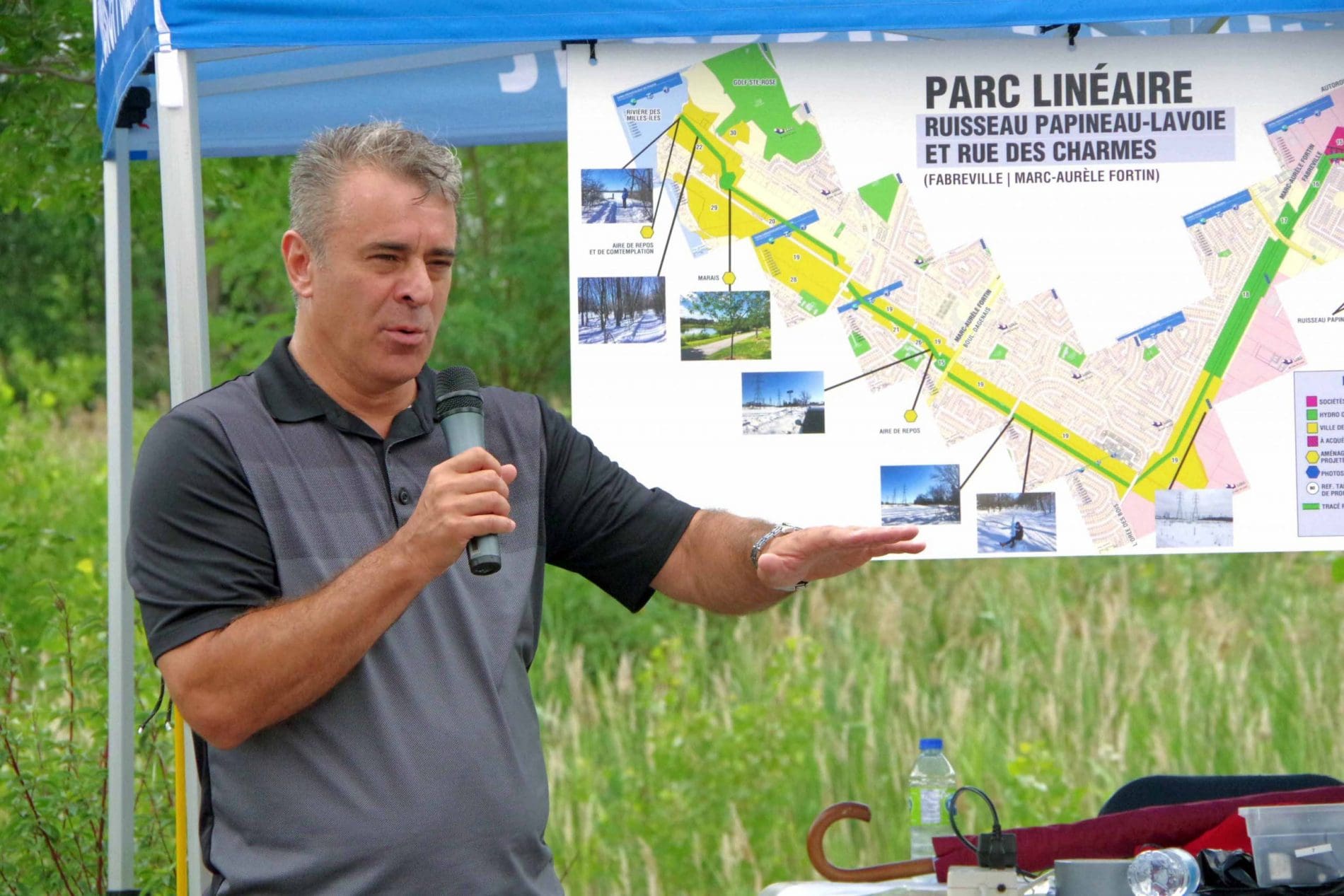
Despite a current lack of support from the city for his project, Laval Citoyens leader and mayoralty candidate Michel Poissant is pledging to build an eight-kilometre nature trail through some key wetlands in Laval if he becomes mayor in the November municipal elections.
Poissant, the city councillor for Laval’s Vimont district, made the announcement last week during a press conference held outside the Quintessence high-rise condo building complex on St-Elzéar Blvd. on the northern edge of Chomedey.
An electoral priority
A large group of residents came out to express support with placards calling on the city to protect Laval’s wetlands from development. The proposed trail was mapped out and designed by Georges Pelletier.

The condo buildings on St-Elzéar are located next to a wetland. Poissant is pledging to make the nature trail – to be known as the Parc linéaire Ruisseau Papineau-Lavoie et rue des Charmes – a priority should he be elected on Nov. 7.
‘Citizen project,’ says Poissant
While addressing the crowd, Poissant maintained that the trail should be relatively easy to complete since the land it would travel across is owned largely by Hydro-Québec and the City of Laval. “It’s a project that is very interesting from the standpoints of being economical and citizen-driven,” he said.
‘It’s a project that is very interesting from the standpoints of being economical and citizen-driven,’ says Poissant
“Thanks to the creativity and perseverance of a resident of the area, Mr. Georges Pelletier, we are pleased to present one of the many projects of our program, namely an eight-kilometre nature trail that will be carried out during our first term,” he added.
Bike and walking path
“The vast majority of the land used is already owned by the city and/or Hydro-Québec and therefore acquisition costs will be minimal. As soon as we take office, we will begin negotiations.”
For the areas under power lines where there is more space, Poissant said they will develop a path for pedestrians and cyclists. “We can then move or rearrange certain bike paths nearby,” he continued. “This trail will be the biggest in Laval and can be compared to those of several cities of the north shore.”
Making Laval greener
He noted that the route of the proposed path would contribute to the Laval region’s growing green heritage. “The pandemic made us realize the importance of having access to nature as a prized resource,” he said.

While explaining the route of the path, Georges Pelletier acknowledged that there could be some obstacles to overcome.
He said there are some private tracts of land where it would have to pass across. In all, the path would cover 90 hectares of land.
He said they would try to buy the private tracts, while paying as little as possible.