Saturday, February 21, 2026
8 C
Laval
spot_img
Home Blog Page 148

City of Laval signs collective agreement with firefighters’ union

New contract grants firefighters an indexed 2 per cent annual pay raise

The City of Laval announced last week that it has signed a new and historic collective agreement with its firefighters, which will be in effect retroactively from 2019 until 2024.

According to a statement issued by the city, the agreement meshes well with Laval’s long-term fire safety plans, while also pushing forward significantly the city’s intention to integrate first responders into Laval’s overall public safety agenda.

The agreement grants the firefighters a 2 per cent annual salary increase indexation.

Win-win city and union

“This agreement raises the quality of life of our firefighters, while offering them significant additional support in their work,” said Laval city councillor for Bois-de-Boulogne and executive-committee member Sandra Desmeules, who handles public security dossiers.

“I would like to point out the close cooperation of the union executive all through this process,” said Patrick Taillefer, director the Laval Fire Department.

“With an agreement where all parties work with a common goal, we can be proud to still be at the front of the line where it comes to working in the field of firefighting. I should mention at the same time the professionalism of our firefighters and our prevention inspectors, who have pursued their activities with rigor and devotion throughout the pandemic.”

Details of new contract Some major elements of the new agreement: Some parts of the collective agreement were modified in order to optimize supplementary working hours; implementation of a 24/7 air supply and equipment transport vehicle allowing firefighters to be more efficient during interventions; revision to training modalities, in order to favour the development of firefighters while increasing their efficiency at interventions; more flexibility in the work contract in order to improve prevention activities with citizens, in conformity with the city’s new fire risk coverage plan.

This year, May 24 was Tax Freedom Day

Date came week later, because of higher tax revenues this year

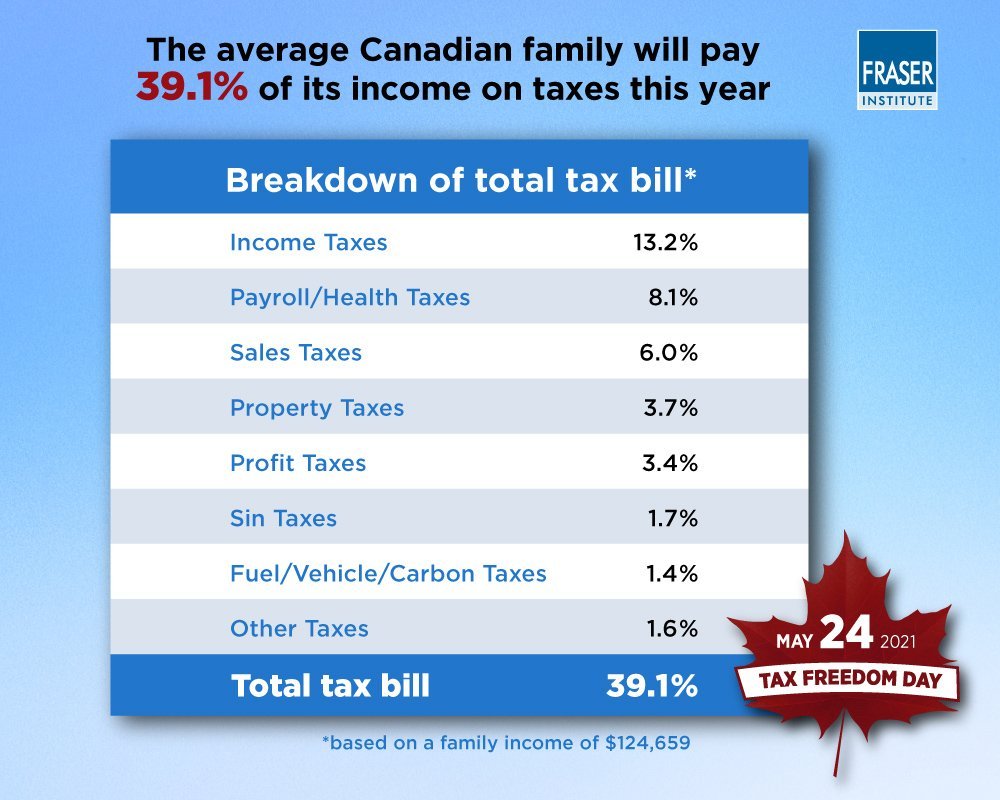
Tax Freedom Day in Canada this year falls on May 24, according to the Fraser Institute’s annual calculations — although there is no reason to celebrate as all signs point to a rising tax bill in the future, the think tank says.

Tax Freedom Day measures the total yearly tax burden imposed on Canadian families by federal, provincial and municipal governments. If you had to pay all your taxes up front, you would give government every dollar you earned before Tax Freedom Day.

Last year, Tax Freedom Day landed on May 17.

“This year, Tax Freedom Day arrives a week later than last year because of the increase in tax revenues forecasted by Canadian governments in 2021,” said Jake Fuss, senior economist at the Fraser Institute.

Average family pays 39.1 %

In 2021, according to the institute, the average Canadian family (with two or more people) will pay $48,757 in total taxes — or 39.1 per cent of its annual income ($124,659). Taxes include income taxes, payroll taxes, health taxes, sales taxes, property taxes, fuel taxes, carbon taxes and more.

Represented as days on the calendar, the numbers add up to more than four and a half months of income — from January 1 to May 24. It’s not until May 24 — Tax Freedom Day — when families start working for themselves and not the government.

Moreover, says the policy analysis group, all indications suggest Canadians are looking at a much later Tax Freedom Day in the future. The $233.5 billion budget deficits the federal and provincial governments are running this year are simply taxes deferred into the future, the group maintains.

Balanced Budget

To see how these deficits impact Tax Freedom Day, the Fraser Institute calculates the Balanced Budget Tax Freedom Day: the day of the year when the average Canadian would finally start working for themselves if all governments paid for all their spending with taxes collected this year.

In 2021, the Balanced Budget Tax Freedom Day won’t arrive until July 7. “Deficits are deferred taxes, so future generations of Canadians will have to pay significantly higher taxes for the unprecedented deficits governments across Canada are running,” said Fuss.

Quebec must rebuild restaurant and hospitality work force, says Francine Charbonneau

Liberal critic for vocational education agrees with Montreal C of C study findings

Mille-Îles Liberal MNA Francine Charbonneau, who is official opposition critic for vocational education in the PLQ shadow cabinet, is in agreement with the conclusions of a recent study by the Chamber of Commerce of Metropolitan Montreal on rebuilding the restaurant and hospitality sectors following the COVID-19 pandemic.

Reviving economy

Both believe the CAQ government needs to increase support for provincially-sponsored vocational education programs that train chefs, table servers, sommeliers and other high-end restaurant staff if this sector of the economy is to fully recover.

In a special report published last week on the state of restauranting in Quebec in the coming post-pandemic era, the Montreal C of C noted that the COVID-19 crisis, which brought massive restaurant closings since early last year, has also resulted in a drastic drop in enrollments at vocational educational institutions teaching cuisine and other skills crucial to the province’s restaurant and hospitality sectors.

Enrollment drops

According to the chamber, the total number of available personnel involved in professional kitchen work has dropped by 22 per cent since early last year, while enrollments at the Montreal-based Institut de tourisme et d’hôtellerie du Québec (Quebec’s leading educational venue for providing secondary-level, college-level, university-level and continuing education for the sector) are down by a full one-third.

Among other points the report makes to help revive the province’s higher-end restauranting sector, it suggests developing the culinary trades, and specifically the cooking trades, in partnership with vocational education institutions and schools.

The interest’s not there

“There’s been a loss of a lot of students,” Francine Charbonneau said in an interview with the Laval News. “First of all, nobody wants to go into hôtellerie right now because everything is closed. These schools teach cooking, learning to serve tables, winery. But students are not buying into the fact that these are jobs that can be learned and done, because everything is closed.”

At the same time, Charbonneau pointed out that for certain skills and professions, it’s impossible to teach them with distance-learning methods. “You have to be there with a teacher who teaches you how the methods and tools are used,” she said. “These are things that can’t be learned just by looking at a video feed. And that’s why these schools are closed now. These are hard times for everyone in this sector.”

Vocational training neglected

Despite the challenges, Charbonneau maintains that Quebec Education Minister Jean-François Roberge seemed to have forgotten during the pandemic about the dire situation in the restaurant and hospitality sector. She maintains that the students’ needs went largely ignored, while vocational education teachers were kept largely in the dark about the protocols they needed to follow during the pandemic.

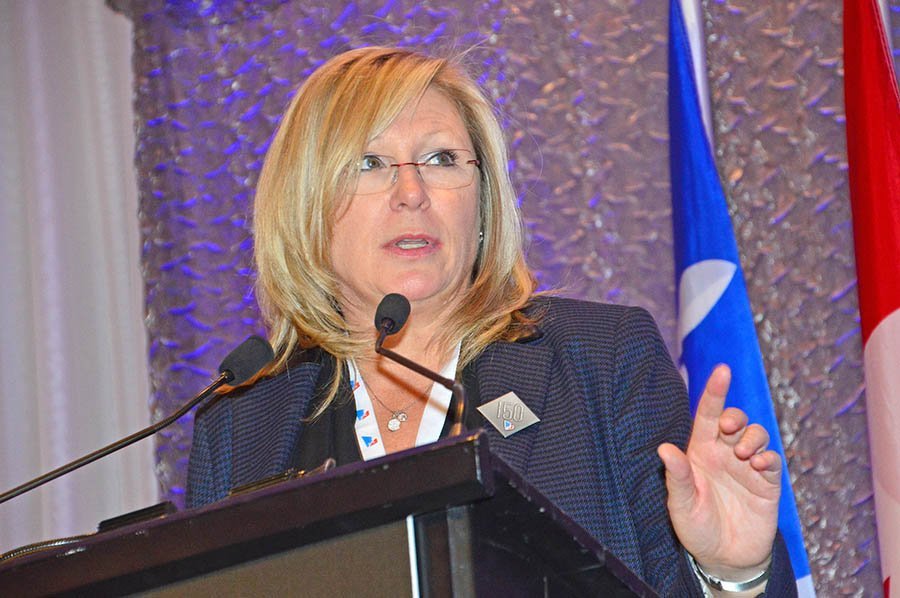
‘There’s been a loss of a lot of students,’ says Charbonneau, noting the impact of the COVID-19 pandemic on vocational and skilled training institutions

“The minister just forgot about them,” said Charbonneau, noting that while the education ministry devoted a lot of attention to the situation of students and staff in the grade school and secondary school sectors, vocational and skills education were largely ignored.

Serious worker shortage

“The minister just didn’t come forward on anything that had to do with adult or vocational training. So, while it’s been a bumpy road, we’ve had to push the minister a bit for answers on what he was going to do.”

Acknowledging that more recently Roberge appears to have wakened up to the challenges facing the restaurant/hostelry/vocational education sectors, Charbonneau said the province’s employment ministry is now facing the reality that there is a serious shortage of workers in key areas of the economy, including hairdressing and other positions requiring skills and training.

Keeping salaries competitive

However, another point she makes (which is also raised by the Chamber of Commerce of Metropolitan Montreal in their report) is that even before the pandemic hit, salaries in several areas of the skilled trades haven’t kept up with other parts of the economy.

“The thinking of the Premier [François Legault] right now is that a job under $58,000 is not a good job,” Charbonneau said. “But if you’re a hairdresser, of if you’re serving in a restaurant, or you’re a cook, it’s not guaranteed that’s the salary you’re going to get.”

Under those circumstances, she suggested the government will still have a lot of work to do to make the restauranting, hospitality and other skilled work areas more able to attract potential workers in order to successfully rebuild Quebec’s post-COVID economy.

Laval News Volume 29-15

0

The current issue of the Laval News volume 29-15 published May 26th, 2021.
Covering Laval local news, politics, sports and our new section Mature Life.
(Click on the image to read the paper.)

Front page of the Laval News.
Front page of the Laval News, May https://lavalnews.ca/wp-content/uploads/2021/05/TLN-29-15-WEB.pdf26th, 2021 issue.https://lavalnews.ca/wp-content/uploads/2021/05/TLN-29-15-WEB.pdf

LPD seeks suspects in sales transaction gone wrong

The Laval Police Department is asking for the public’s help to identify suspects wanted in connection with an armed robbery.

Around 1 :30 pm on April 3, the victim was on 10th St. in Laval-Ouest in order to sell a watch. During the transaction, the first suspect asked to see the watch, which the victim agreed to.

At that moment, the second suspect sprayed the victim with pepper spray. The suspects then fled with the watch and boarded a vehicle that was parked a short distance away.

Description of suspects

Suspect 1:

 Arabic male, around 20 years old

  • Spoke French
  • Height 1 metre 70 (5’ 5’’)
  • Was wearing a black tuque, a grey cotton pullover, dark pants

 Suspect 2:

 Arabic male, around 20 years old

  • Spoke French
  • Height 1 metre 68 (5’ 5’’)
  • Was wearing a black coat by Columbia, brown pants with Puma logo.

Vehicle description:

  • Kia Rio or Hyundai Accent 2015 white

Anyone who feels they have useful information can call the LPD’s Info-Line at 450 662-INFO (4636) or 911. The file number is LVL 210403-032.

High-end development that will change Laval’s skyline

Promoters of Le Marquise VI unveil Phase 6 of 114-unit condominium project

Laval’s building boom tends to get into one’s face, when one navigates sidewalk-closures. Towering cranes are modifying many neighborhoods, generated by growing urban development and/or an artificially-propped up real-estate market. But for certain, Laval’s experiencing facelifts.

Effervescent vibrant community

Developer Meta Inc./Groupe MONSAP proudly announce the official sales-launch of the 114 units of Le Marquise’s 6th Tower – 15-story prestigious prime-quality residential complex in the heart of downtown Laval. Prospective buyers are offered an environment of enviable quality-of-life, with major advantages of living in an “effervescent, vibrant community”. All this, close to popular entertainment venues – Place Bell and Salle André-Mathieu; at a stone’s throw are first-rate shops, services, and restaurants, strategically located, crossroads of highways 15 and 440.

Rising demand

Demand for condos has risen dramatically in the past decade. Condominiums are seen as great real-estate options, offering maintenance-free-lifestyle, affordability, and reliable first-home/investment property. Buyers – single, married, and/or families – are attracted to this type of living which responds to their lifestyle, needs and aspirations.

Condo projects are popping up everywhere in Laval and beyond – city-center, inner-city, surrounding communities. The market is hot. Realtors point to solid reasons behind the boom. Developers are not building just for today but for future demand.

Condo projects take several years to develop. Planning, designing, and financing take time, and it’s difficult for condo developers to stop and start on economic swings in our city’s boombust economy. But regardless, for young professionals and couples, condos, have become ideal start-ups or permanent homes; for retirees, it’s convenience.

Le Marquise VI is the perfect fit for discriminating tastes in high-end options. It offering desired amenities such as gymnasium, swimming pool, a spectacular entrance exuding luxury and freedom, exterior green spaces, community garden, interior parking.

It’s become trendy to buy condos. Cultural changes come from unusual places, and Laval is no exception; the city is an exquisite example of what’s present and future. In today’s market, millennials want location and boomers want luxury. Both want condos.

Laval up-and-rising

Laval welcomes these magnificent, luxurious projects, signs of a growing economy, maybe not back to boom times, but toward sustained growth. More proof that Laval is up-and-rising, attracting people from all walks of life, boding well for the future.

Lifestyle means different things to different people. Cash paid must match product. Condos are often similar in design and price, appealing to similar demographics, except this time it’s different. Spectacular layouts, elegant gourmet-kitchens, spacious baths, and more world-class amenities in beautifully-kept, convenient-setting right here in Laval. Inner-city lifestyle – theatre, restaurants, and cafés -appeals to culture vultures.

Le Marquise VI targets preferences and desires of the most discriminating tastes, embedding these perks into their condos. Those who want an urban lifestyle surrounded suburban living, with easy access to a world-class city and a cosmopolitan ambiance will not be disappointed in what they pay for.

Sonia Baudelot wants to make better use of use city’s surpluses

Action Laval mayoralty candidate says she wants to protect jobs and businesses

Action Laval mayoralty candidate Sonia Baudelot says was floored recently upon learning of the large amount of surpluses the City of Laval managed to put away from its 2020 spending.

While saying that businesses are dying because of the hardships brought on the pandemic, she noted that the city is sitting on $86 million in surpluses, and that they are in addition to accumulated surpluses from past years.

“With the exception of Montreal, our city is the only one that has never come out of the red zone since September,” says Baudelot.

Businesses restricted

“Our businesses are having the maximum of restrictions for months. There are thousands of jobs that could vanish if these businesses aren’t already closed already. We must without fail create flexible programs to help our SMEs, while protecting the jobs of Laval residents. It will take more than subsidies for Internet sites.”

‘We must without fail create flexible programs to help our SMEs, while protecting the jobs of Laval residents,’ Baudelot SAYS

Baudelot pointed out that many businesses in Laval are having great difficulty getting through the economic crisis, and that they have fixed rents and other costs to pay. When they economy gets back underway, they’ll also have to pay salaries.

Summer key, says Baudelot

She said the coming summer will be a key moment to relaunch the economy. However, she pointed out that various programs by the federal government will soon be drawing to and end. Baudelot said the City of Laval should step forward and fill some of the role of the federal government before Ottawa’s assistance expires. “We are talking about the financial security of Laval residents,” she continued.

“We must be listening to the citizens and businesses on our territory to give them the best chances to grow, even in these difficult times. For the relaunch period, bureaucracy must be cut. We must put into place a temporary service to accompany the SMEs when dealing with the city’s services. It’s time to get down to work for our citizens.”

Laval is offering $125,000 subsidy to manufacturers

City anticipates digitization of the manufacturing sector

Last week, the City of Laval launched a new program of subsidies for manufacturers based in the city, designed to support productivity while helping to accelerate the digital conversion of manufacturing processes.

According to the city, manufacturers in Laval can apply to receive non-reimbursable financial assistance of up to $125,000. The city would be providing guidance, assistance and advice at the same time.

“Support to businesses has been part of our priorities since the beginning of the pandemic,” says says deputy mayor and executive-committee vice-president Stéphane Boyer, who is responsible for economic development dossiers.

A digital future

“This $125,000 in financial aid is more necessary than ever to ensure a sustainable relaunch of the economy,” he adds.

“This sum will help businesses support their digital transformation, while also giving them access to experts from Laval to follow them during projects. This subsidy will make a big difference for our businesses, while also making a positive impact on our economy.”

‘This $125,000 in financial aid is more necessary than ever to ensure a sustainable relaunch of the economy,’ says Deputy Mayor Stéphane Boyer

The subsidy is being made available by the city as a non-reimbursable sum based on certain conditions:

  • 25 per cent of the cost for acquiring equipment, up to a maximum $100,000 per business;
  • Related costs for the acquisition of equipment (to a maximum of 15 per cent of the cost of the acquisition);

Additional benefits for projects with a significant element involving manufactured items for the “Internet of Objects” (up to 25 per cent of the cost of acquisition of equipment to a maximum of $125,000 per business).

Maria Diamantis and Dimitris Ilias presented with National Assembly Medals

Music directors recognized for their book/CD projects for children

On Friday May 7, Chomedey MNA Guy Ouellette presented the Quebec National Assembly Medal to soprano Maria Diamantis and tenor Dimitris Ilias.

Over the years, the two artists have worked closely with Ouellette as music directors on several projects involving hundreds of Laval children singing and recording operas for kids as book/CD projects.

A special relationship

“We are so deeply moved by this award,” said Maria Diamantis. “We have been collaborating with Mr. Ouellette for six years now on projects like The Golden Touch, L’or du roi Midas and The Carnival of Marvels and Monsters. His support has been invaluable.”

“From the first time we walked in his office, we knew we were dealing with a man of integrity and deep passion for the citizens of his riding, especially children,” said Dimitris Ilias. “This medal will be cherished forever by both of us not only as a great honor, but as a reminder of our friendship.”

Book/CDs by children for children

Via their music organizations Chroma Musika and Panarmonia Atelier Musical, Maria Diamantis and Dimitris Ilias organize a plethora of concerts, seminars and recordings ranging from ancient Greek music to contemporary composers. In doing so, they provide employment opportunities to many Quebec musicians.

Through their children’s book/CD operatic productions, they have exposed thousands of children, from over 60 ethnic backgrounds, to symphonic music and mythology.

Providing opportunities

At the same time, they have provided unique opportunities to young choristers to sing with renowned Montreal symphonic orchestras and learn how professional CDs are recorded in venues like Oscar Peterson Concert Hall, Place des Arts and Église St-Jean Baptiste, to name a few.

According to Maria and Dimitris, their productions have received “dithyrambic” reviews, massive media exposure and have been launched inside the Parliament of Canada, the City Hall of Montreal and the Salon du Livre de Montréal.

“The Golden Touch” featuring 200 students from the Sir Wilfrid Laurier school board was chosen among 192 applicants to be part of the City of Laval’s 50year celebrations.

Statement in National Assembly

Guy Ouellette made the following declaration in the National Assembly regarding his awarding of the National Assembly Medal to Maria and Dimitris.

“I would like today to pay homage to the soprano Maria Diamantis and the tenor Dimitir Ilias, both of whom are musical directors of Chroma Musika and Atelier Musical Panarmonia.

On the occasion of celebrations of the 200th anniversary of the independence of Greece, I gave to each of them the National Assembly Medal in recognition of their involvement, their support and their remarkable contributions to Quebec society.

“Their musical organizations, their conferences and their recordings allow many Quebec artists and musicians to make develop fully, while also helping several charitable groups substantially and financially,” added Ouellette.

Will the CAQ suffer the same fate with Bill 96 as the PLQ with Bill 22?

If you have lived in Quebec long enough, you may have come to realize that language and sovereignty are two issues that are never resolved here and probably won’t be hundreds of years hence.

While some Quebecers may have been hoping that the two issues would be behind us by now, others with a little more insight may well have figured out that the scenario shaping up over Bill 96 is yet another example of history repeating itself.

Basically, the CAQ government is in a similar position to that of the Liberal Party of Quebec when the PLQ introduced Bill 22 in 1974.

For those who may recall, Bill 22 was the PLQ’s belated response to mounting discontent among the French-speaking majority of Quebec over the declining status of their language and culture within Canada and North America.

In spite of the Liberals’ best intentions, Bill 22 failed to go over well, and the PLQ government fell in the 1976 election, in large part because the French-speaking majority saw Bill 22 as an insufficient measure.

Following the general election that year, the Parti Québécois formed a government for the first time, and in 1977 they introduced the Charter of the French Language, which was much more comprehensive than Bill 22, while raising greater objections than ever from Quebec’s anglophone and allophone minorities.

Forty-four years later, the CAQ government faces an ironically similar dilemma. Too little too late for some, the proposed law doesn’t quite manage to please others, leaving both sides alienated. Which is exactly what split the vote and led ultimately to the Liberals’ defeat.

If historical patterns prevail, and the CAQ government fails to please anyone in the revived language debate, Quebec’s October 2022 election may see the current government leaving behind a permanent legacy as a one-hit wonder that held promise at the outset, but fell while trying to please too many people.

In the meantime, the Parti Québécois is waiting in the wings to begin beating an even more nationalistic drum, in anticipation of a renewed surge like the one that helped them form their first government in 1976.

Weather

Laval
light snow
-8.2 ° C
-7.7 °
-9.1 °
66 %
8.2kmh
100 %
Sat
-7 °
Sun
-1 °
Mon
-2 °
Tue
-5 °
Wed
-7 °