Friday, February 13, 2026
8 C
Laval
spot_img
Home Blog Page 14

Fête de la famille 2025: Two days of celebrations to mark Laval’s 60th birthday

Although Saturday may already have been a rainy washout for some of those who’d been planning to attend the first day of the City of Laval’s Fête de la famille outdoor celebration on Labour Day weekend, the good news is that all-day sunshine is in the forecast for day two on Sunday.

One of the city’s largest annual outdoor gatherings is taking place at the Centre de la nature over two days instead of one day as is usually the case.

From 10 am to 5 pm on both dates, the city is staging a special two-day celebration to mark the fact that 2025 is the 60th anniversary of the City of Laval’s founding in 1965.

With an emphasis on sports and games, the celebration will include a multitude of activities, shows and hosted activities for children as well as adults.

“This special staging of the Fête de la famille is an occasion to celebrate once again our 60 years of community life in Laval by bringing together young and old around a schedule of programming that is rich and festive,” says Mayor Stéphane Boyer.

“These moments of celebration reinforce the link that holds us together with feelings of belonging, nourishing our pride in being from Laval and it makes me happy to see this growing from year to year.”

Over the two days of this year’s Fête de la famille, there will be three zones for activities in the Centre de la nature. The first, the Turbulence Zone, is for those who like to move.

It will feature a big overhead Zip Line, a climbing wall, a dance workshop, sports challenges, an expo of heavy equipment, members of the Laval Rocket hockey team, officers from the Laval Police with their mascot Flair, BMX stunt bike displays and an initiation to pumptrack cycling.

The second zone is dedicated to budding young geniuses. It will feature science workshops, nature talks and exhibits, a mobile library, giant games, digital challenges with the Laval public library’s Espace numérique, an exposition of archeological artifacts, and a section about animal protection.

Finally, the third zone is for the very young. It will feature inflatable games, face painting, a mini-Zip Line, a firefighters’ challenge led by staff from the Laval Fire Dept., a circus village (Opération Bazar), and opportunities to meet unusual characters strolling around the Centre de la nature.

For teens and older persons seeking something a little more exciting, there are two new features at this year’s Fête de la famille: BMX and pumptrack will be filling the bill.

As well, over the two days a number of young performers alone and in teams will be staging shows on the Fête de la famille’s main stage, in the mini-village on the Centre de la nature site, and in front of the main big top tent.

They include Arthur L’Aventurier, the Switch dance group, Zak the challenger, Ariane Deslions, as well as Hiatus, Juju and Marcelle, L’agent Jean, Maddox, Aventurosaure and Les Volk.

Finally, near the Turbulence Zone, there will be an exhibition of equipment used by the Laval Police Dept., whose officers will be on hand to explain what they’re for and how they work.

It’s worth noting that the Fête de la famille will be taking place rain or shine, regardless of the prevailing weather on Saturday and Sunday August 30 and 31.

To ensure the safety of everyone during the event, Avenue du Parc which runs along the west side of the Centre de la nature will be closed to motor vehicle traffic on both days.

Special measures for parking will be in place, and shuttle buses provided by the Société de transport de Laval will help facilitate access to the Fête de la famille site.

Boyer highlights Laval’s storm preparedness investments a year after Hurricane Debby

Mayor pays homage to former councillors St-Jean and Beldié, who recently passed away

In his opening remarks at the start of the August 12 meeting of Laval city council, Mayor Stéphane Boyer noted that it was nearly a year to the day since the worst weather-related disaster Laval residents ever experienced – Tropical Storm Debby.

After-storm cleanup

The remnant of Hurricane Debby peaked in the Laval region on August 9 last year, impacting up to 15,000 families whose homes in many cases were flooded, forcing a massive cleanup over the following weeks that left piles of debris stacked along streets in neighbourhoods all over Laval.

Mayor Stéphane Boyer speaks during the August 12 meeting of Laval city council.

The mayor maintained that progress has been made towards developing a more effective municipal contingency plan for future weather disasters and that several studies and reports have been issued to help make Laval a safer place to live.

New climate reality

“We also have many infrastructure construction and investment projects underway so that the city can become increasingly resilient,” said Boyer, while noting that it took Laval six decades to develop its infrastructure to the level it’s at now.

“So, it’s going to take a certain amount of time before our infrastructure can be adapted to the new climate reality.”

He said that one of the city’s new projects, along Saint-Martin Blvd., is being designed to absorb rainwater directly from the heavily-trafficked street into the soil, so that the equivalent of two Olympic-size swimming pools of water will be kept out of the stormwater sewer system whenever it rains.

As well, according to Boyer, the city is building a new rainfall reservoir around the Metro station at the intersection of Cartier and des Laurentides boulevards.

Making Laval more resilient

“These are some of the projects that are underway at this time,” he continued. “And we know that worksites can cause momentary inconveniences. But the idea is to make a city that will be more resilient and that can ensure peace and well-being for our residents.”

As August 6 was the official date of the merger 60 years ago of more than a dozen previously independent municipalities on Île Jésus into the City of Laval, Mayor Boyer noted that the main issues in the beginning were better fire protection and better water and sewer infrastructure.

“Thankfully, we have made a lot of headway since then,” he said. “We are now at the stage where we have good services for the population and today Laval is an example among municipalities 60 years after merger.”

Former councillors eulogized

In passing, Mayor Boyer pointed out the recent deaths of two former Laval city councillors: former Laval-les-Îles councillor Jean-Jacques Beldié and former Saint-François councillor Jacques St-Jean, both of whom served for nearly a quarter-century each.

“Being in politics isn’t always easy,” added the mayor, without being specific. (Beldié and St-Jean were both longstanding members of the administration under former Mayor Gilles Vaillancourt.)

“We often face criticism, we are often confronted by many problems and issues,” he said. “But I think we should always point out the involvement of people who devoted years of their lives to public service. Especially people like Mr. Beldié and Mr. St-Jean who served for around 25 years each.”

Quebec’s CEGEP Network Stretched Thin, Unions Warn

By Matthew Daldalian, LJI Reporter

Quebec’s CEGEP network is entering the new academic year with fewer staff, aging buildings, and more students than ever — a mix union leaders say is unsustainable.

From support workers to professional staff, those on the ground say they are being asked to do more with less as a government-imposed hiring freeze and budget reductions collide with steady growth in student enrolment.

Valérie Fontaine, president of the Fédération du personnel de soutien de l’enseignement supérieur (FPSES-CSQ), said more than 50 positions have already been cut in the 13 colleges her federation represents.

“For sure it’s gonna bring some work overload for those people still there,” she said. “You cannot have people to do more with less resources.”

Support Roles Disappearing

The positions being lost are not just administrative jobs, Fontaine said, but front-line roles that directly serve students. Recreation technicians, social work technicians, laboratory staff, and special education workers have all been affected.

“Those are all positions that give direct services to the students,” she said. “So, for sure there’s gonna be an impact.”

The cuts come as CEGEPs are welcoming more students with special needs than in the past. Fontaine noted that while some schools once served just a handful of students requiring accommodations, many now have a large population.

Aging Infrastructure

Physical infrastructure is also showing its cracks. Fontaine said many colleges have long delayed necessary repairs, with two-thirds of campuses reporting urgent needs last year. But the freeze has tied their hands even further.

“Last year we weren’t even able to buy books,” she said. “Imagine working in a CEGEP without being able to buy books—it makes no sense for us.”

Laboratories and classrooms are also increasingly ill-suited for modern learning. Fontaine warned that without proper funding, equipment and facilities will only fall further behind.

Professional Staff Under Pressure

For professional staff who provide psychological services, academic guidance, and counselling, the situation is just as dire.

“If a CEGEP used to have three guidance counsellors and now we’re down to two, of course that will eventually have impacts,” said Éric Cyr, president of the Fédération du personnel professionnel des collèges (FPPC-CSQ). “There’s a limit to what we can do.”

Cyr said the consequences are already clear: waiting lists for counsellors, students being redirected to the private sector, and heavier workloads for those who remain.

Éric Cyr, président of the Fédération du personnel professionnel des collèges (FPPC-CSQ) speaking at a press conference. (Courtesy photo by the CSQ)

“The worst consequence that could happen is that students would not have what they need to persevere and get a diploma,” he said.

Professionals are already reporting increased pressure to do more with less, a situation Cyr says may lead to burnout, sick leave, or resignations. The result, he warned, is fewer services precisely as student numbers climb.

A Growing Student Body

At the same time, enrolment is climbing. Both Fontaine and Cyr stressed that student numbers are rising steadily, with this fall marking one of the largest increases yet.

“We don’t have money, they’re gonna have less services, and we have more students,” Fontaine said. “We need space because we’re lacking space too.”

Cyr agreed, pointing out that today’s CEGEP students often arrive with a wider range of learning needs than in past generations.

“Many students now come to CEGEP who would not have been in the system 30 years ago,” he said. “Professional services are really needed in great numbers if we want to keep these students getting diplomas and succeeding.”

Even the Centrale des syndicats du Québec’s (CSQ) president, Éric Gingras, described in a press release the situation as part of “the slow erosion of a network once considered a Quebec treasure,” adding that elected officials appear “completely indifferent.”

Extra Strain on English CEGEPs

For English-language colleges, an added pressure comes from Law 14, which expanded French language requirements in 2022. Cyr said complying with the law has created “a lot of extra work” for staff, just as resources shrink.

“Now there’s gonna be less resources for our colleagues in the English CEGEPs to do that work,” he said.

Morale and Mental Health

Both leaders flagged staff morale as a growing problem. Fontaine noted that while support workers are dedicated to their colleges, rising workloads risk pushing many out of the system, with mental health concerns at the forefront.

Cyr said professional staff are in the same position.

“We will do everything we can to give great services and help the students,” he said. “But eventually something will have to give.”

Calls for Change

Union leaders say the quickest step would be to lift the hiring freeze so that vacancies from retirements, sick leave, or departures can be filled. Fontaine argued it is unreasonable to expect colleagues to cover the work of three positions.

“It’s not normal for the colleague to take all the jobs,” she said.

Cyr said the priority should be restoring depleted counselling and psychology positions, which he called essential to student success.

“Direct services that are now impacted since last May — those would have to be the priority if we want all these new students to have a good experience with CEGEPs and stay there and get a diploma,” he said.

For both Fontaine and Cyr, the message is the same: Quebec’s CEGEP network cannot keep doing more with less.

The FPPC-CSQ represents over 2,200 professional staff across 38 CEGEPs in Quebec. It is affiliated with the Centrale des syndicats du Québec, which represents more than 225,000 members province-wide.

Laval Residents Stranded Amid Air Canada Strike

By Matthew Daldalian, LJI Reporter

Air Canada passengers across Canada and abroad were left scrambling last week after more than 10,000 of the airline’s flight attendants took to the picket line. The strike, which lasted from Aug. 16 to 19, grounded flights at the peak of the summer travel season and affected nearly half a million people worldwide.

The walkout ended after a tentative deal was reached between Air Canada and the Canadian Union of Public Employees (CUPE), but backlogs continued for days as travellers tried to make their way home.

“I can’t even explain the emotional rollercoaster that we went through,” said Laval resident Rosy Trimboli, the uncertainty turned her family’s first trip to Europe into a drawn-out ordeal. “It’s been hell to say the least.”

The Flight

Trimboli’s return flight to Montreal was scheduled for Sunday, Aug. 17. On the Thursday previous, she received an early notice warning of potential disruptions. Before she knew it, Air Canada flights were grounded, and her family’s return was suddenly in question.

Attempts to reach Air Canada took hours, with spotty Wi-Fi connections and long waits on hold. When she finally connected with an agent, she was told her original flight was still technically intact— meaning the airline could not yet rebook her family onto a competitor. The only other option was to reschedule for later in the week.

“It was like a real-life gambling decision on the spot,” she said, describing the pressure of deciding whether to rebook or hold onto her original flight. Faced with uncertainty, Trimboli tested her luck: her eldest would fly alone on Thursday, while the rest of the family would follow Friday through Frankfurt. Hours later, news broke that a tentative agreement had been reached.

Under Canada’s Air Passenger Protection Regulations, airlines are required to rebook customers on other carriers if flights are cancelled. But because strikes are considered beyond an airline’s control, Air Canada is not obligated to cover additional costs like hotels or meals.

Still, the carrier expanded its policy, pledging to reimburse “reasonable” out-of-pocket expenses such as lodging and transport for travellers affected between Aug. 15 and 23.

For Trimboli’s family, the uncertainty stretched over days. As they weighed their options, they also booked a separate set of refundable tickets at a steep cost.

“Hours of searching and thinking and how can we get out of here,” Trimboli said. “We were just throwing money to get home.”

Ultimately, the family cancelled those tickets, hoping the rebooked Air Canada flights would hold. The decision added to an exhausting stretch of second-guessing and mounting costs, including multiple Airbnbs and meals for the extra days.

Air Canada expects most delayed passengers to be rebooked by the end of the week, though it acknowledged that clearing the backlog will take time.

After a Cruise

While Trimboli grappled with uncertainty overseas, other Laval residents faced similar challenges closer to home.

Christine, who asked that her full name not be published, had just disembarked from a cruise with her family of five when she discovered their return flight was cancelled the night before departure. With limited phone access on the ship, she scrambled for alternatives.

Flights back to Montreal quickly became unaffordable, so Christine cobbled together a patchwork itinerary through the northeastern United States. Her family eventually flew into Albany, New York, then drove across the border to Laval.

“It was chaotic and stressful,” she said, adding that a looming hurricane in Florida only heightened the pressure.

Part of her frustration came from how little information she could get from the airline while trying to make arrangements. She also questioned why action from authorities only came once flights were already grounded. “What’s even more disappointing, to be honest, is that the government didn’t get involved at all before this,” she said.

Despite the disruption, Christine said she had no resentment toward the crews who formed the picket line. “I totally agree that these people should be paid from the moment they get on the plane and not just when they’re in the air,” she said. “I absolutely sympathize with the flight attendants.

Labour Issues

The tentative agreement with CUPE includes annual raises over four years and, for the first time, pay for work done on the ground. Newer attendants would see a 12 per cent increase retroactive to April, while those with more seniority would receive eight per cent. Salaries would continue to rise gradually, with the cap moving from $80,000 to $88,000.

Ground pay would also be phased in, starting at half an hourly wage and rising to 70 per cent by the end of the contract. Union members are expected to vote on the deal between Aug. 27 and Sept. 6.

For Zareh Asparian, another Laval resident, the strike meant turning a weekend trip to Edmonton into a cross-country road journey. He had travelled with his wife and daughter for a skating certification event, only to find return flights to Montreal repeatedly cancelled. After exploring connections through the country and even the U.S., he and his family were left without viable options.

Instead, they extended their car rental and drove the 3,700 kilometres back to Laval over three days.

“There are worse things in life,” he said. “But where I have a hard time is… you can’t leave people stranded.”

Asparian said he supports fair pay for flight attendants but called striking as a tactic “outdated”. “I think things could be handled in a much more professional manner,” he added.

Back to Work

This summer’s unrest is not the first time Air Canada passengers have found themselves caught in the middle of a labour dispute. In 2011, flight attendants and ground crews staged separate walkouts over pensions and wages, only to be forced back on the job through federal legislation. The following year, pilots protested imposed contracts with coordinated “sick-outs,” disrupting hundreds of flights before Ottawa again stepped in.

Similar tensions have flared before, including a nationwide strike in 1998 and repeated disputes after Air Canada’s merger with Canadian Airlines in 2000. Labour unrest has been a recurring challenge for the country’s flagship carrier.

The strike was the first since 2011 to defy a federal back-to-work order. Labour Minister Patty Hajdu invoked Section 107 of the Canada Labour Code, which grants the government power to intervene in work stoppages deemed disruptive to industrial peace. Critics say the measure undermines unions’ bargaining leverage, while advocates argue it protects the travelling public.

For many passengers, the broader debates about contracts and labour law mattered less than the immediate toll of being stuck far from home. Trimboli said the hardest part was the lack of clarity. “I was just hoping for a bit more transparency as opposed to a little bit every day of like, here, you’re cancelled, we don’t know,” she said.

Air Canada has encouraged passengers to submit claims for reimbursement. However, some travellers may face long waits for resolution as CBC reported that Canada’s complaints backlog is already at more than 87,000 cases.

For Trimboli, the experience left a lasting impression. “People told me there are worse places to be stuck. But there’s nowhere in the world that you want to be stuck when you just want to get home,” she said.


Quebec MNA pushes plastic production cap

By Matthew Daldalian, LJI Reporter

Quebec Liberal MNA Virginie Dufour sitting at her desk in her constituency office on August 18 2025. (Photo: Matthew Daldalian, Newsfirst Multimedia)

The collapse of international treaty negotiations in Geneva earlier this month has renewed calls for tougher measures against plastic pollution from Quebec Liberal MNA Virginie Dufour.

Dufour, who represents Mille-Îles and serves as the official opposition critic for the provincial environment minister, said the outcome highlights the urgency of stronger national and provincial action.

The MNA recently joined the Interparliamentary Coalition to End Plastic Pollution (ICEPP), a network of about 50 parliamentarians from more than 30 countries working to curb plastic waste worldwide.

In the lead-up to the talks, she sent a letter to federal environment minister Julie Dabrusin urging Canada to take a hard line at the negotiating table. The Geneva meetings ended without an agreement, after Canada and others rejected what Dufour described as a “really, really weak” draft treaty.

Dufour warned that relying solely on recycling will not solve the problem, noting that much plastic still ends up in the environment or is incinerated. She argued the focus must shift toward reducing production itself if the goal of ending plastic pollution is to be achieved.

“My goal was to make sure that Canada would have strong leadership in those treaty negotiations and not accept, you know, a treaty that does not address the real issues,” Dufour said.

From Plastics to Microplastics

For the MNA, the issue extends beyond waste management to a mounting public health concern.

“We don’t realize, but we all have microplastics inside, you know, our blood, in our head. And, you know, we know it’s a health issue,” she explained.

With Quebec’s health system consuming more than half of the provincial budget, she argued that a precautionary approach is necessary to limit future costs and protect public health.

Quebec’s Role

Dufour said a global reduction target would translate locally into greater responsibility for producers, pointing to recent changes that make them accountable for handling municipal recycling.

“Everything we put in the blue bin now is handled by the producers of those products. And so hopefully they will start to use less plastic or at least use those that are recyclable,” she said.

Dufour pointed to a Terrebonne pilot project where restaurants switched to reusable utensils and dishes. Initially resistant, she said many changed their minds after subsidies helped them adopt the system and they quickly saw savings from reduced waste.

Plastic Production

Internationally, Dufour is calling for a cap on plastic production. She said output keeps rising every year, and without firm limits or targets, it will be impossible to bring production down.

She warned that well-intentioned local policies can backfire if not part of a broader strategy. As a former Laval city councillor, she recalled debates over banning thin plastic bags: “Everywhere where they banned those thin plastic bags, the production of plastic increased,” she said.

Next steps

Looking ahead, Dufour said she will continue pressing the issue both internationally and in Quebec.

“I’m gonna try to have more conscience about microplastics and the risks that are linked to them,” she said. “I would like the government to invest more in [microplastic] research. Municipalities are not equipped to filter them.”

Dufour said stronger efforts are needed to develop alternatives to plastic, warning that some replacements—like chemically treated cardboard straws—can be even more harmful than the plastics they replace.

Despite setbacks in Geneva, Dufour remains committed. “I am determined to continue my involvement with the ICEPP to contribute to the fight against plastic pollution, a real poison for human health and the environment,” she said in a statement on August 15.


In a previous version of this article, Virginie Dufour was described as the official opposition critic for the federal environment minister. She is the critic for the provincial environment minister. The article also referred to a Montreal pilot project on reusable utensils and dishes. The initiative is located in Terrebonne, not Montreal.

The Laval News regrets these errors.

Laval teen builds future on two wheels

By Matthew Daldalian, Local Journalism Initiative Reporter

The future of cycling infrastructure is already here for one Laval teen – Video by Matthew Daldalian

Streets in the greater Montreal area are changing. Bike lanes continue to expand, more BIXI e-bikes are finding themselves in street corners, and debates over cycling infrastructure keep dividing residents. While critics say the changes squeeze already-congested roads, supporters argue they mark a step toward cleaner, more sustainable transportation.

For 15-year-old Marc-Anthony Mourad, that future is already here.

Childhood Hobby

Over the summer, the Laval Senior Academy student dedicated himself to building e-bikes and showing other kids how to do the same, running workshops that turned regular bicycles into battery-powered rides.

“I was always into those kinds of things, you know, mechanics and electricity,” Mourad said. “I would always watch videos on electric bikes. I was like ‘man, I wish I had one’.”

The idea combined his childhood hobby of tinkering with power tools alongside his grandfather with his fascination for electric vehicles. He designed the bike to run on drill batteries and presented it as a project for the Hydro-Québec Super Expo-Science competition back in April.

His entry tied into five United Nations sustainability goals, from clean energy to sustainable cities, and he documented the process on his YouTube channel Marco E-Rides.

That work caught the eye of Tami Belhadj, Director of Club Techno at the Centre Lavallois de Ressources Éducatives et Culturelles (LREC).

“He actually made an e-bike by himself […] he was very autonomous, and I was really impressed with his work,” Belhadj said. “So, I invited him to come to Club Techno and we discussed: ‘can you teach other kids to do what you did?’”

The eager Mourad agreed. Over the summer, he ran workshops where participants— some younger than him, others older— built e-bikes using conversion kits. He prepared theory lessons, step-by-step slides, and even played instructional videos from his YouTube channel as students followed along.

Building Bikes

With grant funding, the centre purchased Walmart bicycles and online motor kits. Over several weeks, the workshops produced five functioning e-bikes.

“By turning a traditional bike into an e-bike, they understand the ins and outs of this technology,” Belhadj said. “Hopefully it gets them to think about career opportunities in these industries in the future.”

The next step, Belhadj added, is to build a solar charging station so the bikes can be borrowed and returned like a “BIXI-type service.”

The LREC’s Club Techno, organizes technology workshops, environmental projects and summer programs for local youth. Belhadj’s past initiatives have ranged from composting and eco-houses to hands-on STEM activities, all aimed at linking education with sustainability.

For Mourad, the project was as much about inspiring others as it was about building machines. “When you have an idea, put your mind to it and don’t stop until you get there,” he said.

Teen engineer Marc-Anthony Mourad sitting upon one of the e-bikes built by participants of the summer e-bike workshops outside the Centre Lavallois de Ressources Éducatives et Culturelles (LREC) (Photo: Matthew Daldalian, Newsfirst Multimedia).

E-bikes and Infrastructure

Experts say e-bikes like Mourad’s are transforming how people move through cities.

“[E-bikes] allow you to cover longer distances with less effort,” said Ahmed El-Geneidy, professor at McGill University’s School of Urban Planning. A regular cyclist might travel five or six kilometers in a day, he explained, but an e-bike doubles that, opening access to jobs, groceries and other opportunities without relying on a car.

El-Geneidy said Mourad’s approach— converting traditional bikes into electric ones— could make the technology accessible to more Montrealers. “If we have someone here who can commercialize it and sell it in Montreal, that will put us ahead of many places around the world,” he said.

But challenges remain. Store-bought e-bikes can cost between $3,000 and $5,000, making them a target for theft. Montreal’s cycling infrastructure also lags behind demand, according to El-Geneidy, with faster e-bikes and scooters sharing space on narrow bike paths. “We need to expand our bicycle network and make sure that we have enough space for cycling in general,” he said.

Still, Mourad is convinced electric vehicles are the path forward, with home-built models replacing gas alternatives. “If we continue on this path, our world will become a lot cleaner and we’ll have a more sustainable future,” he said.

For now, though, he’s focused on finishing secondary school, applying to CEGEP, and slowly but surely working on his next invention.

Accident shuts down A-440 westbound

By Matthew Daldalian, LJI Reporter

An accident shut down westbound lanes of Autoroute 440 at the height of Route 117 in Laval Thursday morning, forcing drivers onto detours as crews responded.

The closure initially involved both lanes of the highway, with officials warning it would remain in place for an undetermined period. Significant traffic congestion was reported in the area, as westbound drivers were redirected onto the local road network.

Police later confirmed the incident was caused by a container truck that snagged overhead electrical wires along the service road. The closure stretched between boulevard Curé-Labelle and Autoroute 13.

Hydro-Québec teams were dispatched to carry out emergency repairs. No injuries were reported.

By early afternoon, the service road had been partially reopened, though motorists were still advised to plan for delays as crews continued working in the area.

Laval News Volume 33-16

0

The current issue of the Laval News, volume 33-16, published on August 27th, 2025.
Covering Laval local news, politics, and sports.
(Click on the image to read the paper.)

Fire heavily damages single-story Fabreville home

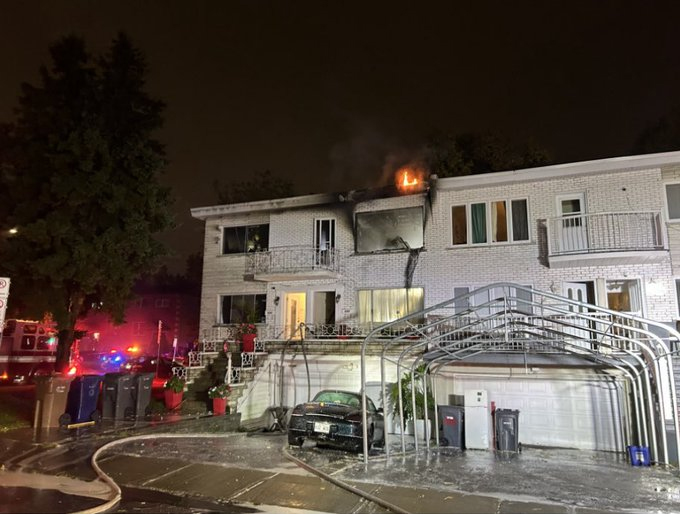
A one-story house on Éric Street in Fabreville suffered substantial fire and smoke damage on Monday August 18 after flames that started on an exterior rear balcony spread to the roof of the home.

An initial distress call from the owners was received by 9-1-1 operators around 5:30 am and the occupants were reported to have evacuated about five minutes later.

Although Service de sécurité incendie de Laval firefighters reported the situation as under control in around 45 minutes, an estimated $100,000 in fire and water damage had been done by then.

Laval Police fail to intercept Sainte-Rose car thief

On Friday August 8, the Laval Police needed the help of several officers as well as the canine squad to try and track down the perpetrator of a car theft near the Sainte-Rose neighbourhood.

Just after 5:30 am, 9-1-1 received a call notifying them that a grey 2024 Lexus had been stolen in nearby Fabreville.

With modern tracking technology being what it is now, it wasn’t long before the LPD were able to locate the vehicle, which was in motion around 6:55 am as it rolled along Autoroute 440 going west near Saint-François.

Although the police made an initial attempt to intercept the vehicle, the driver refused to stop.

Given that the morning rush-hour was coming up, the officers decided not to engage the vehicle in a chase because of the risk to the public.

Two Highland cows get loose in Sainte-Dorothée

A pair of Highland cows that escaped from their owners in Sainte-Dorothée over the weekend hadn’t yet been taken back into captivity as of last Monday morning.

The owners, who had just purchased the livestock, reported to police that the cows, which are longhaired and have prominent horns, escaped from a transport trailer on avenue des Bois.

They were last seen fleeing southward into farm land. The owners, who are from the Quebec City area, said the cows were not bred in Laval, hence they are not familiar with the territory.

The owners warned that, although the animals are not considered dangerous, it would be inadvisable to run after them.

They said they might respond to offers of apples or carrots to keep them in place until help arrives to recapture them.

Weather

Laval
few clouds
-15 ° C
-14.1 °
-15.6 °
85 %
2.6kmh
20 %
Fri
-7 °
Sat
-2 °
Sun
-6 °
Mon
-1 °
Tue
1 °