The current issue of the Laval News, volume 34-09, published on April 29th, 2026.
Covering Laval local news, politics, and sports.
(Click on the image to read the paper.)

The current issue of the Laval News, volume 34-09, published on April 29th, 2026.
Covering Laval local news, politics, and sports.
(Click on the image to read the paper.)
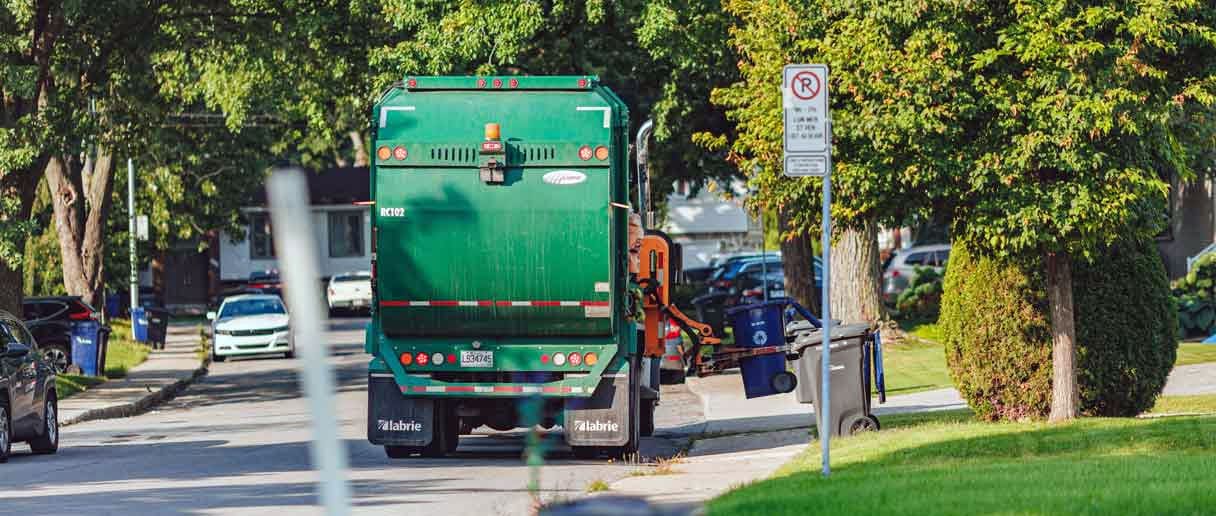
Residents report overflowing bins and confusion, while city says change will cut costs and reduce waste
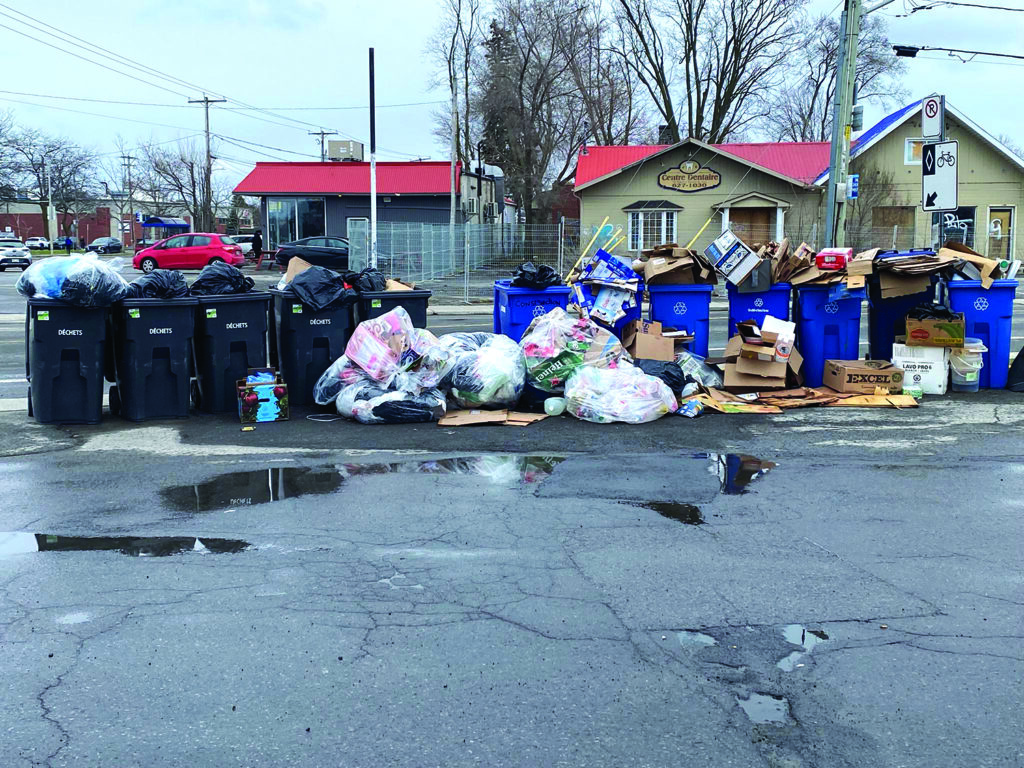
Garbage piled on at a shopping plaza in Ste-Rose, Laval. Courtesy photo Amber Row.
Laval’s shift to biweekly garbage pickup is drawing criticism from some residents. Weeks after the new collection calendar took effect on April 1, complaints online range from missed bins to overflowing waste containers outside homes and multi-unit buildings.
The city reduced household garbage collection to once every two weeks as part of a larger waste-management strategy. Recycling pickup has also moved to a biweekly rhythm in many sectors, while compost collection remains weekly in summer and every two weeks in winter.
Online, residents have used neighbourhood Facebook groups and petitions to vent frustration, posting photos of full bins, bags left beside containers and confusion over zone schedules.
One petition opposing the change has gathered more than 11,000 signatures. Wael Hamdar, a Laval resident, said he launched it after learning of the decision during the holiday period.
“I got a little bit, should I say outraged, because no consultation has been made with the resident,” Hamdar said. “The city council took that decision.”

Wael Hamdar, a Laval resident, said he launched his petition after learning of the decision during the holiday period. Photo Matthew Daldalian.
Hamdar said some residents in his area appeared caught off guard when the new system began.
“A lot of people got surprised because there was a lot of people not knowing about this,” he said. “When your garbage bin is full, people are trying to put their garbage in black bags next to it.”
Saint-Bruno district councillor David De Cotis said residents contacting him have expressed anger over reduced service levels.
“They’re frustrated, they’re not happy,” De Cotis said. “They’ve seen that taxes are rising, services are being reduced, so we’re getting less services, paying more taxes.”
De Cotis said different neighbourhoods may require different approaches depending on housing density and household needs.
“What we’re asking for is a public consultation,” he said. “Laval is a huge territory. Different districts have different realities.”
Ecological transition consultant Mélissa de la Fontaine, who works with the Incita co-operative, said the policy follows a logic already seen in other municipalities: lower costs and lower waste volumes.
“There is the logic of cost savings, and there is the logic of reducing residual waste,” she said in an interview with The Laval News in French.
She said fewer truck routes can reduce fuel use, traffic wear and operating expenses, while encouraging households to better sort materials into compost and recycling streams.
“We pay a very, very high price for managing our residual waste,” she said. “If we collectively succeed in reducing what we send out […] collectively, we’ll save money too.”
De la Fontaine said many households can make relatively simple changes, such as choosing products with less packaging and avoiding disposable items.
She suggested citizens should read up on using compost more effectively.
“Most people, the vast majority of people, can adapt to the changes,” she said, while adding that special cases should contact the city for help.
For some residents, the challenge has been less about principle and more about remembering a more complicated schedule.
Dmitriy Laptev, who develops software solutions for businesses at Dotcom Specialty Corporation, said missed collections and full bins led him to help create a free online alert service called CiteHub.
“I actually missed a few bins and it’s really unpleasant to have a full bin,” Laptev said.

Dmitriy Laptev said missed collections and full bins led him to help create a free online alert service called CiteHub. Photo Matthew Daldalian.
The tool allows users to register their address and receive email or text reminders based on Laval’s zone calendar.
“When it’s your turn, you are getting an alert the day before,” he said.
Laptev said even weeks into the new system, some neighbours still appeared unsure of the schedule.
“People, they still don’t know what’s going on,” he said.
In an email statement, Director of Communications for the Mayor’s Office and Executive Committee, Gabrielle Brais-Harvey said the change aligns with the Communauté métropolitaine de Montréal’s waste plan, which sets a maximum target of 26 garbage collections per year by December 2027.
For the city, reducing frequency is a recognized way to encourage better sorting habits and increase use of blue and brown bins, according to Brais-Harvey. She added that 69 municipalities in the Montreal metropolitan community already offered 26 collections annually or fewer in 2024.
Additionally, RECYC-QUÉBEC data shows 78 per cent of average garbage-bin contents could be diverted from landfill, including 57 per cent to compost and 21 per cent to recycling.
Brais-Harvey mentioned that the new system is expected to generate annual savings of about $3.5 million by 2027 while reducing greenhouse-gas emissions tied to transport and landfill disposal.
For overflowing bins, residents or building managers are recommended to request an evaluation and possible adjustments, including added organic or recycling containers when needed.
For now, the city is not planning special summer or density-based collection changes, but staff are monitoring conditions on the ground.
Hamdar said he plans to keep his petition active as residents continue adapting.
“I’m still hoping that something will happen in Laval,” he said.
In a previous version of this article, Gabrielle Brais-Harvey was referred to as Director of Communications for the City of Laval. She is in fact the Director of Communications of the Mayor’s Office and Executive Committee. The Laval News regrets this error.

Hundreds gather for march, monument relocation and ceremony on April 24

Participants carrying flags joined together in the newly renamed park on April 24 2026. Photo Matthew Daldalian.
Hundreds gathered in Chomedey’s newly renamed parc de l’Espoir on the evening of Friday, April 24.
Laval’s Armenian community marked Armenian Genocide Remembrance Day with a march, speeches and the official unveiling of a new home for the city’s Armenian Genocide memorial.
The April 24 ceremony also marked the renaming of parc des Coccinelles to parc de l’Espoir, following a March 10 city council decision tied to the relocation of the Armenian Genocide Memorial within the park grounds.
The monument, titled L’Espoir, was created by late Armenian-Canadian sculptor Arto Tchakmakchian. It honours the Armenian men, women and children killed between 1915 and 1923 during the Armenian Genocide, widely recognized as having claimed 1.5 million direct victims.
Events began around 5:30 p.m. outside Laval’s Citizen Relations building on Blvd. Chomedey, where participants carrying Armenian flags walked together toward the newly renamed park. Many speeches and announcements were delivered in Armenian, with portions in French.
As daylight faded and the sky turned orange, families, elders and children formed a wide circle around the monument while music, poetry and community performances continued into the evening.
The monument was previously located near the intersection of Hwy. 440 and Blvd. Daniel-Johnson, a site community members had long said lacked visibility and reflective public space.
Sako Yacoubian, president of the Laval Joint Committee for the Armenian Genocide Monument, said community representatives had worked for years to create and later relocate the memorial.
“The committee was formed over 16, 17 years ago,” Yacoubian said. “Representatives from each Armenian church came together, formed a committee and we worked on the monuments.”
He said the original monument opened in October 2013 before discussions began with the city on moving it.

Sako Yacoubian is president of the Laval Joint Committee for the Armenian Genocide Monument. Photo Matthew Daldalian.
“We worked with the city to try to relocate the monuments,” he said. “And finally, they heard our needs.”
Yacoubian said Laval was the natural place for such a monument because of the city’s large Armenian population.
“We’re a 45,000 strong community and the majority live in Laval,” he said. “So, it was important for our people to have a place for our 1.5 million genocide victims.”
Speakers repeatedly framed the event not only as remembrance of the past, but as a warning for the future.
Yacoubian said younger generations visiting the park may learn about genocide and the need to prevent future atrocities.
“We want to make sure that the youth acknowledge, remember and also prevent future genocides,” he said.
Herag Herkelian, a previous art historian and Laval resident, said public memorials can help broaden historical understanding.
“I hope that the main takeaway for people who come across this monument would be to learn about it, to learn about the other genocides, to learn to speak up,” Herkelian said.
He added that his hope was visitors leave with “that message of peace, of cooperation, of recognition, restorations and reparations.”
Laval Mayor Stéphane Boyer, city municipal councillors, Quebec MNAs and federal MPs were among those in attendance.
Those attending politicians included Members of the House of Commons of Canada Fayçal El-Khoury, Annie Koutrakis and Carlos Leitão.
Mayor Boyer told the crowd the gathering showed the strength and permanence of Laval’s Armenian community.
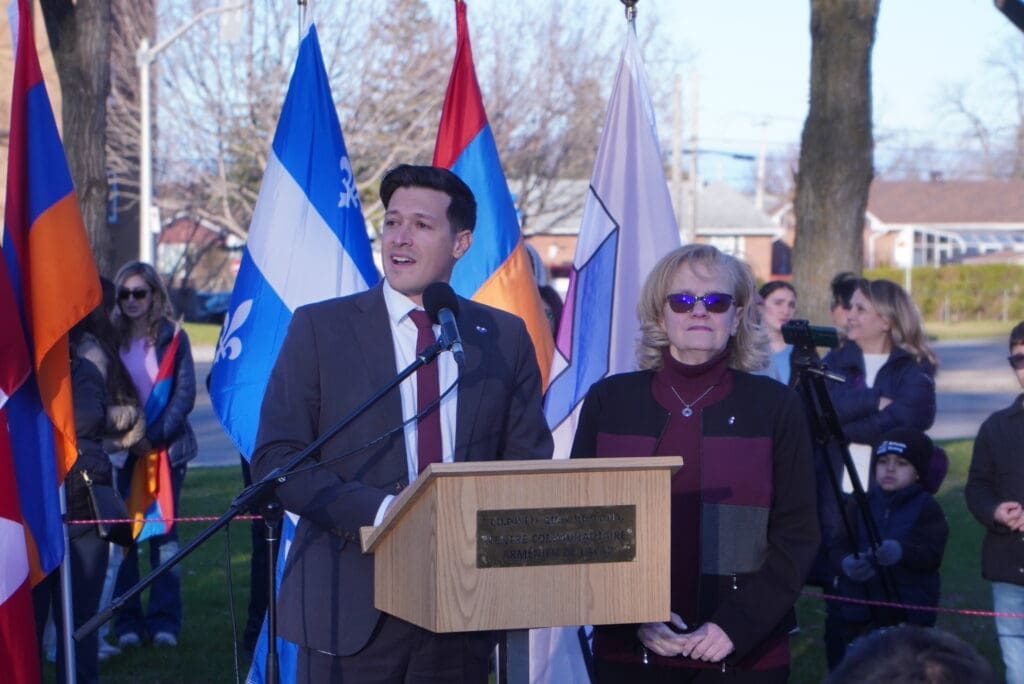
Mayor Stéphane Boyer pictured with Renaud-Coursol district Councillor Seta Topouzian on April 24 2026. Photo Matthew Daldalian.
“When I was on my way here and saw everyone marching, the young people singing, and now seeing so many people here today with flags, I tell myself that the Armenian community is very much alive,” Boyer said.
He said the new site was more fitting for reflection and annual commemorations, while also representing hope.
“That is why we are here today, among other things, to inaugurate the new location of the Monument of Hope,” he said.
Renaud-Coursol district Councillor Seta Topouzian called the park renaming especially meaningful.
“This year, this moment of reflection takes on particular significance in Laval, as the commemorative monument now finally has a dignified and unifying home at Parc de l’Espoir,” she said in a statement to The Laval News.
For many attendees, the ceremony carried both grief and pride. Children moved between adults holding flags. Hymns and Armenian songs carried through the park. Some stood quietly near the monument while others embraced after speeches.
Herkelian said outside support from political leaders and non-Armenian residents mattered deeply.
“They are all on our side. They’re our allies,” he said. “They understand that this is a bigger issue and not just an Armenian issue.”
Yacoubian said municipal recognition sends an important message.
“We’re an important community within the city,” he said. “This means a lot for us.”
As night settled over Chomedey, the monument’s new setting reflected its purpose that evening, one of mourning and endurance.

Transports Québec has announced the closing over a period of four days next week of some traffic lanes and exits on Autoroute 15, affecting motorists in Boisbriand, Sainte-Thérèse, Blainville and Mirabel.

On April 26, from 9 p.m. to 5 a.m. the following day:
On April 27th, from 9pm to 5am the following day:
On April 29, from 9 p.m. to 5 a.m. the following day:
On April 30th, from 10 PM to 5 AM the following day:
Transports Québec advises that the work may be postponed, extended or cancelled due to adverse weather conditions or operational constraints.
To stay informed about all disruptions and updates related to this work, consult Québec 511, a practical tool for planning trips, and download the Québec 511 mobile app to activate notifications.

The Laval Police say they are seeking the public’s help in a fatal crash investigation that claimed the lives of two children last January.
The incident occurred on January 5 around 7:30 p.m. along Route 335 between Dagenais Blvd. and Saint-Saëns Street.
“Investigators assigned to this case are looking for anyone who witnessed the incident or may have relevant information, particularly video footage,” the Laval police said in a statement.

They say they are searching for a Hyunday Kona.
According to the LPD, the case involves allegations of dangerous driving that led to multiple injuries as well as two fatalities.
According to the LPD, the investigation remains open and the investigators are urging anyone who may have been a witness or who may have recorded even a portion of the events through a dashcam or other digital device to contact them.
Anyone with information is asked to contact the police at the LPD’s Info Line at 450-662-4636 or by calling 9-1-1. The file number is LVL-260105-079.

Nova Scotia-headquartered Empire Company announced last week that they are expanding into Quebec with the acquisition of food retailer Mayrand Food Group, marking Empire’s entry into the discount market in this province.

Mayrand operates four large format locations across the greater Montreal area, including one on Autoroute 440 in Laval.
Empire, which oversees IGA stores in Quebec and operates Sobey’s stores in Atlantic Canada, says the acquisition is a “strategic entry into the Quebec discount/warehouse food market.”
“Mayrand is a respected Quebec institution with deep local roots and a loyal customer base,” said Luc L’Archevêque, chief customer officer at Empire.
“This transaction allows the Mayrand brand to continue serving customers and communities while benefiting from Empire’s scale, operational expertise and long‑term commitment to food retail in Quebec,” he added.
Empire says the company plans to maintain the Mayrand banner and grow the business as a distinct brand.
Founded more than 110 years ago, Mayrand is known for its vast and select product assortment, competitive pricing and cordial relations with both suppliers and retail customers.
Mayrand also operates stores in Anjou, Brossard and Saint‑Jérôme.

CIMA+, a civil engineering consulting firm with a longtime presence in Laval, has acquired CSched, a Laval-based consultancy focusing on advanced timetable planning and optimization solutions for public transit and private transportation providers.
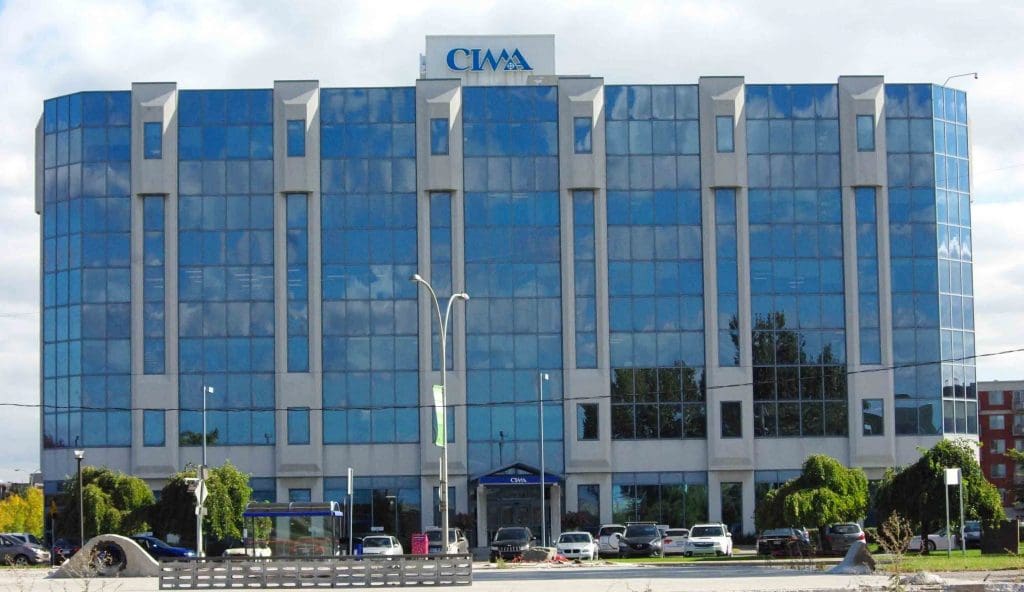
Founded in 2008, CSched provides consulting services, training programs and software for timetable and operations planning.
The boutique firm works with public transit operators as well as private transport providers (schools buses and intercity coaches).
CSched’s consulting practice for transit include scheduling efficiency review, labour negotiation support, tender bidding support and zero emission bus transition support.
The firm’s proprietary software – Hastus by CSched – is used by major transit agencies worldwide and has cloud-based solutions across planning, scheduling, and operations.
CSched has 12 employees listed on LinkedIn.
CIMA+ says in a statement that its acquisition of CSched will strengthen its public transit offering.
“CSched’s expertise in advanced planning and operational optimization reinforces our position in the transportation sector and consolidates our ability to support clients in implementing sustainable and high-performance solutions,” said Steeve Fiset, chief strategy officer at CIMA+.
CIMA+ was founded in 1990 and has more than 3,500 people across 40+ offices in Canada.
The firm provides consulting engineering services in energy and resources, infrastructure, transportation, buildings, project management, as well as operational and digital technologies.
“Joining CIMA+ gives us the scale and complementary skills needed to better support our clients in this evolving landscape,” said Michel Courval, president and CEO of CSched.
“It also allows us to focus more on developing proficiency within the industry, particularly through training and knowledge sharing,” he added.
The transaction closed on April 1, 2026.
CIMA+ last year acquired Lakeland Consulting, an Oakville, ON consulting firm specializing in commercial management services for construction projects and B&A, a Calgary-based urban planning firm.
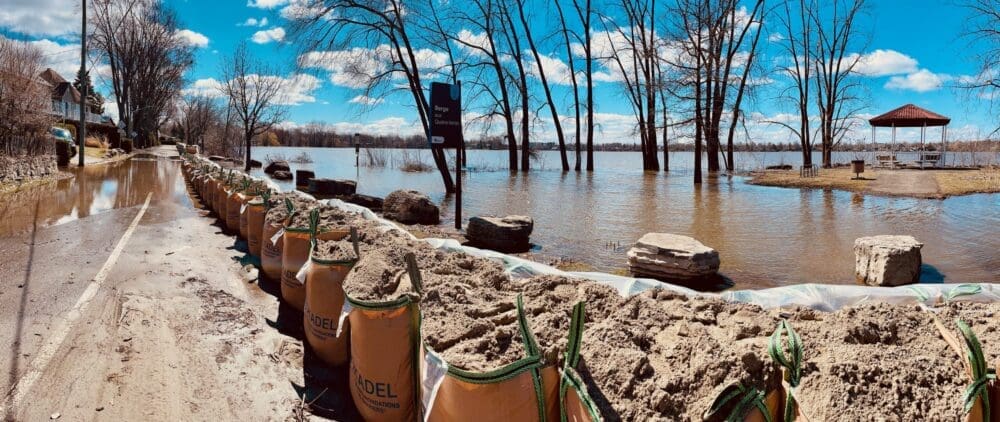
The City of Laval says it is cycling into intervention mode in response to rapidly rising river waters after a “minor flooding” threshold was reached.
“The situation remains under control, although the forecast predicts rising water levels for the coming days,” the city said in a statement issued on Friday
According to the city, public works crews have secured 1.2 km of dike along the banks of Laval Island, while installation continues in the Riviera Street area of Fabreville-Sainte-Rose-Laval-Ouest.

Friday morning, further installation work began in the same area, as well as in Chomedey (Sector 3). Work continues on installing protective measures, and preventive checks by the Fire Department (SSIL) are ongoing.
“Constant monitoring of the embankments has not revealed any anomalies,” says the city.
Support for Residents
The city says that over the previous 24 hours, there was an increase in calls to the municipality’s 3-1-1 hotline. Up to mid-day Friday, approximately 20 calls were received, most of which concerned flood preparedness.
The city is advising Laval residents living in flood zones to follow the safety guidelines available at laval.ca/inondations.
The city is urging affected Laval residents to subscribe to the municipality’s alerts and update their contact information at laval.ca/abonnement to be promptly notified of important notices.
As well, for any emergency that threatens safety or health, the public should contact 9-1-1 immediately.
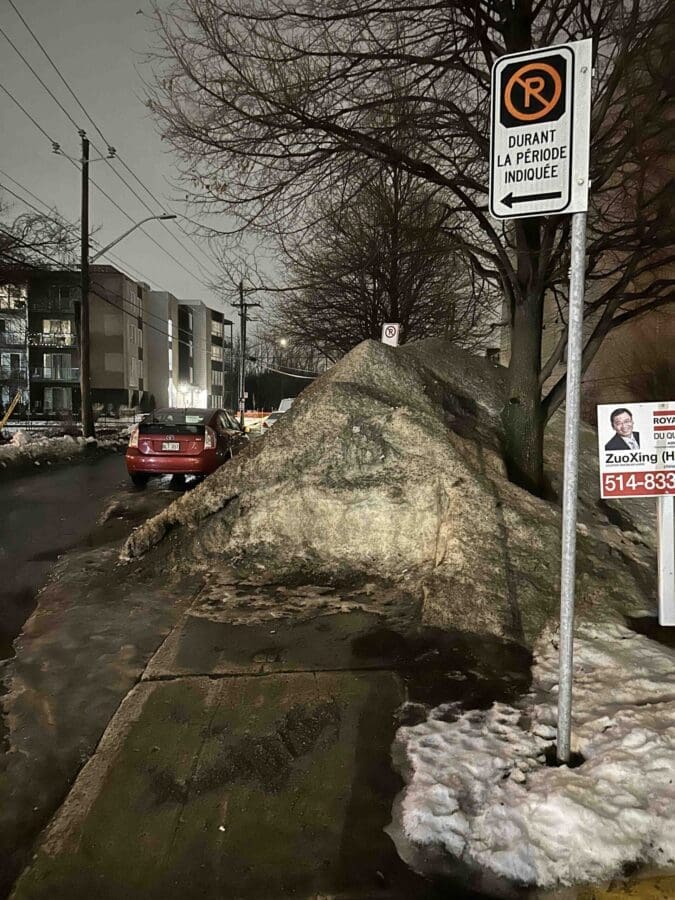
Although it can finally be said that winter 2025-26 in Laval is almost certainly over, one resident is thinking proactively about the snowfall next December and the first few months of 2027.
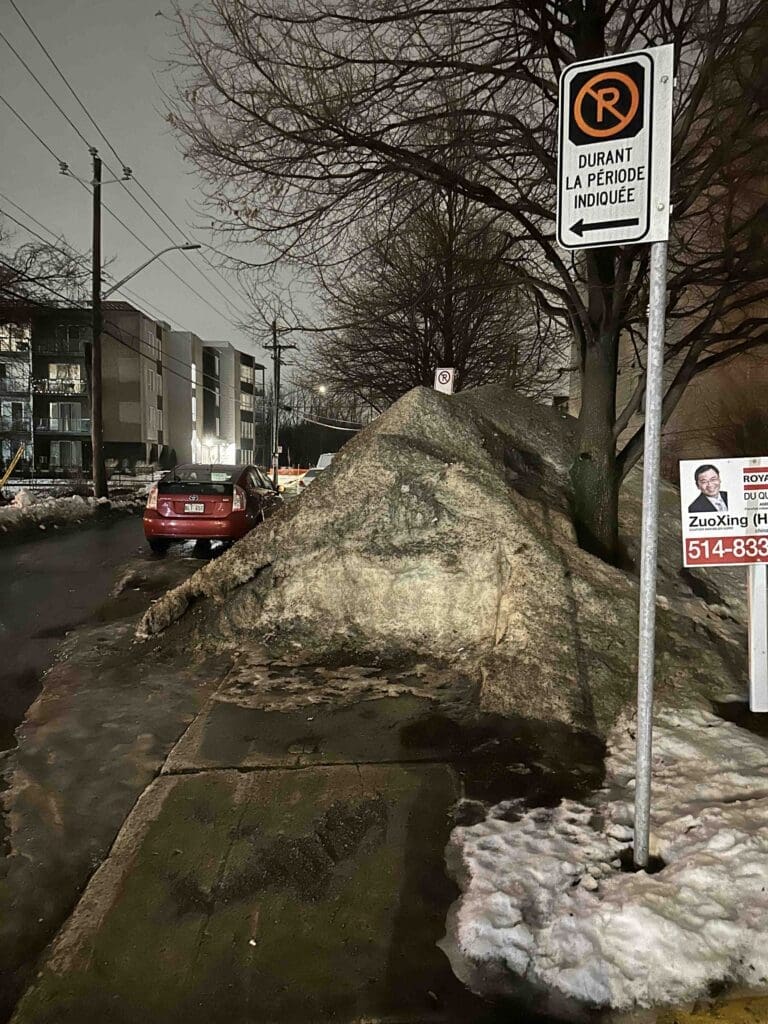
In an e-mail to The Laval News, Hardik Anand, who lives on Lulli St. a short walk from the corner of de l’Avenir Blvd. and du Trait-Carré Rd., said he wanted to “highlight a serious and ongoing public safety issue” in Laval-des-Rapides near Montmorency Metro a short distance from a large seniors’ residence.
Snow blocked sidewalk
“A sidewalk in this area has been blocked by a mountain of snow for months,” he said at the beginning of April as spring was just starting to set in and the accumulated winter snow was melting.
“It has not been cleared,” he continued. “And as a result, people have fallen there many times. This is especially disturbing given the location next to a residence for older people, who are even more vulnerable to injury.”
Anand said he had tried repeatedly to get this addressed through official channels. “I submitted three separate online complaints to the city, and all three were closed without any response or meaningful action,” he said.
‘Nothing was done’
“I also emailed the mayor and the local councillor and sent photographs, but nothing was done,” he added. “I then contacted the ombudsman, only to be told that he could not act because my online complaint is now more than three months old, even though the snow obstruction is still there and the danger still exists.
“This is exactly the kind of issue that deserves public attention,” Anand said. “When residents report a hazardous sidewalk multiple times and are ignored, and when even the complaint system becomes a dead end because of timing technicalities, it leaves people with no real recourse.”
He said he hoped The Laval News could help bring attention to the blocked sidewalk and ask the city why such a dangerous condition had been allowed to remain for so long – especially near Montmorency Metro and next to a seniors’ residence (Résidence Soleil Manoir Laval on de l’Avenir) in Laval-des-Rapides.
Five months without cleaning
In an interview with The Laval News late last week, Anand said the last of the snow bank was still visible since its enormous size meant it would continue melting long after most of the snow in the area had disappeared.
“That entire part of the sidewalk was never cleaned throughout the winter season – I would say for the last five months,” he said, while adding that he had personally fallen there at least three times and knew of others who also fell in that spot.
While acknowledging that he suffered some minor injuries, he said they weren’t serious, but the accumulation of snow on the sidewalk forced him as well as other residents to walk out on the street where they were exposed to the hazard of rapidly moving traffic.
Anand said the files for three complaints he made to the City of Laval, beginning in January, were summarily closed “without giving out any information. The first two complaints were closed without any response. By the time of the third complaint, they just gave a general response about snow clearing policy and stuff and they closed that one too.”
City of Laval replies
Following an exchange of e-mails between The Laval News and the City of Laval’s communications department, an official with the city got back to us with a response.
“The City of Laval is well aware of the situation reported by the resident regarding the snow accumulation on Chemin du Trait-Carré, near Boulevard de l’Avenir,” said Nesrine Saci, adding that snow removal operations in the area are carried out by a private contractor hired by the city.
“Generally, snow removal operations aim to keep sidewalks safe and accessible to pedestrians,” she continued.
Piling snow not allowed
“It is not permitted to leave piles of snow obstructing a sidewalk. That said, during clearing operations or due to space constraints, snow may sometimes be temporarily deposited near or along the edge of a sidewalk. Action is then taken to clear the walkways and ensure safety.”
While noting that the 2024-2025 winter season was marked by significant snowfall, including two storms totaling nearly 80 centimeters of snow, Saci maintained this “can lead to exceptional situations related to snow storage capacity.”
She said the city has a snow patrol that conducts on-site inspections to identify problem areas, including obstructions to pedestrian traffic.
“Inspections will be carried out in this area during the upcoming winter season,” she added. “And if necessary, tickets may be issued for any violations observed.”

Although it’s a no brainer to ask someone to break a dollar in exchange for four quarters, most people who’ve lived in this country long enough are well aware that $100 can’t be exchanged for four $25 bills because there is no such unit of currency in Canada.
While the Bank of Canada did issue a $25 note in 1935 to honor the silver jubilee of King George V, the Laval Police used a mock-up of a fake $25 bill on April Fool’s Day (April 1) to make a point that counterfeiters in Laval are now circulating fake $100 notes.
According to the LPD, several Laval residents have reported receiving counterfeit $100 bills during transactions on resale sites like Facebook Marketplace. The police point out that victims of counterfeiting will not be compensated, regardless of their loss.

That’s why they are urging anyone selling for cash to be vigilant and follow some practical tips to help verify the authenticity of the bills received during such transactions.
Serial number: Each bill must have its own unique serial number. Make sure there are no duplicates.
Transparent strip: Examine the transparent strip of the bill. Tiny numbers corresponding to the currency’s value must be visible.
Portrait on the transparent strip: The portrait visible on the transparent strip must match the main portrait on the currency.
Small numbers in the maple leaf: Using bright light, look for small numbers hidden within the transparent maple leaf.
Metallic portrait: Make sure the metallic portrait changes color depending on the angle of the light.
Ink texture: Run your finger over the main portrait to feel the texture of the embossed ink.
Remember that you are under no obligation to accept a currency note if you have any doubts about its authenticity. You should feel free to ask for another or choose another payment method if you are unsure.
The Laval Police say that a neutral zone, supervised by the police, is available to ensure the security of transactions. This zone is located at Laval Police Headquarters, 2911 Chomedey Blvd.
Anyone with information regarding the circulation of counterfeit currency is encouraged to confidentially contact the Laval Police on their Information Line at 450-662-INFO (4636) or by calling 911.
LFD was kept busy fighting fires recently
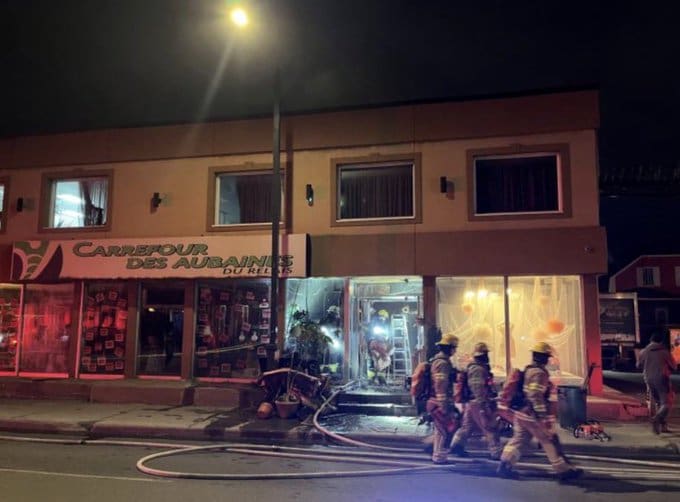
The City of Laval’s firefighters were more than a little busy over the last two weeks, putting out nearly a half-dozen fires at commercial and residential addresses throughout the city.
On April 8 around 9:45 pm, a building fire on des Laurentides Blvd. in the Pont-Viau district caused extensive damage to a non-profit retail business serving primarily a disadvantaged clientele.
The Carrefour des aubaines du Relais Communautaire de Laval was the scene of an electrical fire. A fault or defect in the electrical wiring installed in the walls is believed to have been the cause of the blaze.
Upon the arrival of the firefighters, smoke and flames were visible inside the building just south of Grenon St. They were able to halt the spread of flames, confining them to the front of the store. Despite the firefighters’ efforts, damage was estimated at approximately $100,000 for the building and $50,000 for its contents.
Other recent fires:
APRIL 10 | 18:15 // Building fire on boulevard Curé-Labelle in the Chomedey sector. Commercial building. Visible smoke. The Code was 10-12, second alarm.

APRIL 9 | 19:16 // Building fire on Belmont Street in the Saint-François sector. Residential building. Visible flames. The Code was 10-09, full rescue engaged, possible worsening.
APRIL 6 | 10:30 // Building fire on Place des Capucines in the Sainte-Dorothée sector. Residential building. Visible smoke coming from the basement. Code was 10-09, full rescue engaged, possible worsening.
3 APRIL | 15:08 // Building fire on boulevard Dagenais Ouest in the Fabreville sector. Multi-unit residential building. Visible smoke coming from a basement apartment. The Code was 10-07, intervention necessary.