Home Blog Page 119

#NewsMatters: The National Assembly Report

How we navigate out of pandemic has become alarmingly divisive in Quebec

Raquel Fletcher in Quebec City

It’s become clear politicians, like Quebecers in general, are fed up with the pandemic that keeps dragging on. Health Minister Christian Dubé even let loose a swear word Friday in the house. Ignoring all decorum, he described the COVID-19 health crisis as “this damn pandemic.” But while everyone can agree the frustration is universal, the question about how to navigate out of this crisis has become alarmingly divisive.

This past week, Quebec lawmakers have had to contend with threats of armed violence. Organizers of the Quebec City trucker convoy, which drew thousands of protesters two weekends ago (and hopes to do the same next weekend) published videos online in which they claimed they knew of people who were considering “taking up arms” and attacking the National Assembly.

Premier François Legault then raised ire and eyebrows when he lashed out, not at the people making threats, but at his political opponents. He accused both the Liberal Party and the Parti Québécois of condoning violent behavior. In nuanced statements, the opposition parties had told reporters earlier that the government was partly responsible for polarized attitudes and rising social division. However, they also unequivocally condemned all threats of violence.

During a debate Friday morning, Liberal MNA Monsef Derraji called out Dubé when he repeated the premier’s comments.

“I want to put an end to this once and for all,” Derraji said, addressing the speaker. “There is not one MNA, not one, in this legislature who encourages violence.”

Quebec City correspondent for Global Raquel Fletcher.

“To suggest otherwise is irresponsible in my opinion,” he added.

The minister eventually acknowledged he was in the wrong. “I’m sorry and I think it’s important Quebecers see us all working together,” Dubé said.

The apology might also be a sign the government believes it’s in its best interest to maintain a constructive and collaborative tone with opposition parties. The trucker convoy in Ottawa, which has now led to Ontario declaring a state of emergency, is stoking more and more tension in the population, as well as anti-government sentiment. Quebec, conscious it needs to tread carefully to avoid similar protests, has now released a reopening calendar with things slated to get back to normal by mid-March. The Legault government hopes this will release the building pressure.

Refusal to end state of emergency

However, Quebec refuses to end the public health state of emergency order, which gives the government exceptional powers to act without debate at the National Assembly. Opposition parties argue this cannot continue.

Debate is needed, they say, to answer pressing questions: Is the vaccine passport still effective? Should mask mandates stay in effect long-term? What happens in the event of a sixth or even seventh wave? Will there be more shutdowns? The only way out of this pandemic, opposition parties say, is if government allows the return to the regular way of debating and passing legislation, rather than governing by decree as it has been since March 2020.

The government sort of agrees. The health minister says he plans to table a bill to address these questions when the National Assembly reconvenes after the March break.

Despite the calls from both sides of the house for more collaboration, politics remains a game of division. That is the very nature of government: to argue, to criticize, to oppose, especially when the province is headed towards an election campaign. But it’s often hard to see when creating division goes too far.

Painting into corner over bilingual judges

In another example this week, French language minister Simon Jolin-Barrette tried to paint the Liberal Party into a corner over bilingual judges. After rising to defend English-speaking communities the week prior, the Liberal Party then supported the minister’s motion this week to affirm that the province should not disqualify unilingual candidates from becoming judges.

Liberal MNA David Birnbaum accused the Legault government of trying to create a conflict where none need exist. He said it is possible for Quebec to strike a balance between the right to work in French and the right for the English minority to have access to justice in their maternal language.

However, playing identity politics can be advantageous for parties, according to Laval University political science professor Marc André Bodet.

“Identity politics has been very useful for the CAQ,” Bodet explained. “It was a way to marginalize the Parti Québécois, but also to marginalize to a certain extent, the Liberal Party.”

“In that sense now a part of the CAQ branding is a defense of the Quebec identity, whatever that is,” he added.

But Bodet cautions against the government and all parties playing that card too often in the current political climate.

“There is a major event that is very salient. That is COVID-19. And then there’s a lot of small politics going on and parties are trying to make gains at the margin.”

In other words, Bodet believes there are few political points to be scored from these kinds of tactics. But there are potentially many political points to be lost when parties start accusing each other of things like inciting violence. Maybe a better strategy is more cohesion and less division.


Has masking in schools exceeded its best before date?

Children and teenagers bearing the brunt of health-threatening policies whose risks are outweighing their benefits

From a political and legal standpoint, the battle over whether mask wearing should be enforced in schools is still raging. Add to this that from a scientific standpoint, the issue of whether masks really do help curb the spread of the coronavirus in schools or in fact, anywhere, has gained enormous ground.

Close to home, students at Laval Senior Academy, weary of the tiresome mandate to wear masks throughout the school day, spontaneously undertook a semi-official protest over the mask restrictions imposed by the government and the school board. Numbering 200, these students became part of a scenario reflecting not an isolated occurrence but a trend rapidly developing across the world whereby students, in the thousands if not millions, are speaking up, demanding that their needs be respected. They are fed up, to say the least, with the violation of their rights.

Public-school students have to, by law, check out their constitutional/human rights, and whether schools can punish them for speaking out depends on where, when, and how they decide to express themselves. Caution.

The assertion that forced-masking all children ages 2 and up has any impact on school safety vis-a-vis COVID-19 is not data-driven and is not reflective of a scientific consensus. Several studies over the past year have claimed without proof that widespread masking can significantly curb transmission among students.

The question, then, becomes what to do in the face of the pandemic, regarding masks? In public schools, especially, the powers that be, the school board, must convert its current policies and strategies, to more normalizing applications of common sense through extensive implementation of such measures as fresh-air, air purifiers, and yes some social distancing, but all of it in the wisdom of doing away with masks which are simply not working.

But masking was intended to be a short-term intervention and we haven’t talked enough about the drawbacks of mandating them for children/youth long-term. If we accept that we don’t want masks to be required in our schools forever, we have to decide when is the right time to remove them. And that’s a conversation that we’re not really having, are we?

The debate about masks in schools can quickly turn vicious because it pits legitimate interests against one another. Many people who are immunocompromised, or live with those who are, understandably fear that getting rid of mandates will make them more vulnerable. But keeping kids in masks month after month also inflicts harm, even if it’s not always easy to measure, but there are significant signs that apart from questionable protection against both contracting and passing on the virus, the damage to emotional stability, physical well-being, social interaction, and psychological/ mental health – the masks are conclusively and negatively consequential.

It would be naïve to not acknowledge that there are downsides of masks. Although some of that data is harder to come by because those outcomes are not as discrete as Covid or not-Covid. But according to teachers and parents of younger children especially, there are significant issues related to language acquisition, pronunciation, concentration, and proper breathing.

As well, very clear social and emotional side effects for older kids, although not always sufficiently covered by mainstream media, are being pointed out as a threat to the general well-being of these adolescents. In classrooms, teachers must spend a lot of time overseeing proper mask-wearing, a difficult task to fulfill in addition to keeping good order and motivating students to learn. Establishing and sustaining an atmosphere conducive to optimum learning requires constant reinforcement by teachers. That’s especially true for young children and those with special needs.

How much longer can kids bear the brunt of all-day masking and punitive mask culture that create disruptions to learning, to literacy and to speech? Worried parents and fed-up-students are legitimately asking what the benefits are, at this stage, for policies like masking and whether they outweigh the harm.

The objective of ending COVID was once laudable, but at this point it’s driven by a mixture of naivete, hubris, arrogance, and entitlement. We can all be furious and devastated by the death and illness this virus is still causing, but we can’t misread people’s desire for normal as indicating callous disregard for human life.

What does the science say about all this? Despite the widespread all-day masking of children in school, the short-term and long-term consequences of this practice are not well-understood, in part because no one has successfully collected large-scale systematic data and few researchers, for mysterious reasons, have tried. Perhaps because mental and social-emotional outcomes are hard to observe and measure, and can take years to manifest. Initial data, however, are not reassuring. Recent prospective studies in Greece and Italy found, not surprisingly, evidence that masking is a barrier to speech recognition, hearing, and communication.

Imposing on millions of children an intervention that provides little discernible benefit, on the grounds that we have not yet gathered solid evidence of its negative effects, violates the most basic doctrine of medicine – to do no harm. The foundation of medical and public-health interventions should be that they work, not that we have insufficient evidence to say whether they are harmful. Continued mandatory masking of children in schools, especially now that most school children are eligible for vaccination, fails this test. Or does it? That is the question.

Renata Isopo

renata@newsfirst.ca

Yves Robillard questions Justin Trudeau’s handling of Covid response

Marc-Aurèle-Fortin MP sides with fellow Liberal Lightbound in pandemic dispute

Marc-Aurèle-Fortin Liberal MP Yves Robillard, normally a reliable defender of his party from the House of Commons’ backbenches, broke his habitual silence last week to come out supporting fellow Liberal Joël Lightbound, who spoke out a few days before to denounce the Trudeau government’s pandemic response.

Response ‘politicized’

According to an account Robillard gave to the Ottawa-based Hill Times, he said he agreed with Lightbound, a fellow Quebec MP representing the riding of Louis-Hébert near Quebec City, that Prime Minister Justin Trudeau had mishandled pandemic response measures and that the federal government’s actions had become politicized and divisive.

“He [Lightbound] said exactly what a lot of us think,” Robillard said in an interview with the Ottawa-based publication. “I agree with everything that Lightbound said.” Lightbound held a press conference last week during which he criticized the Liberal government.

‘Not all equal,’ he said

While saying he wanted to distance himself from the Freedom Convoy 2022 protest, Lightbound said the concerns of the Freedom Convoy 2022 demonstrators and other Canadians shouldn’t be overlooked. He said he’d been hearing similar concerns from his own constituents.

Marc-Aurèle-Fortin Liberal Member of Parliament Yves Robillard, normally a discreet presence on the House of Commons backbenches, spoke out last week to say he agreed with Louis-Hébert Liberal MP Joël Lightbound that Prime Minister Justin Trudeau was mishandling management of the federal government’s pandemic response. (File photo: Martin C. Barry, Newsfirst Multimedia)

“I’ve heard from people worried that those making the decisions seem at times to have been blind to the fact that we’re not all equal for lockdowns, that not everyone can earn a living on a Macbook at the cottage,” Lightbound said. “I’ve heard people worried that a few might have lost sight of the quiet and discreet suffering of the many.”

Until last week, Joël Lightbound was the Liberals’ Quebec caucus chair. However, following a meeting with chief government whip Steven MacKinnon, he stepped down, while agreeing that he would stay on as a Liberal MP.

Was kicked off committee

For his part, Yves Robillard told The Hill Times that following a conversation he’d had with Lightbound, he agreed he would come out to support him and work together with Lightbound to follow up on the issues.

It’s worth noting in all this that the Marc-Aurèle-Fortin MP got into hot water with the chief government whip last December when he disregarded a recommendation made by the Prime Minister to all Liberal MPs that they refrain from non-essential travel outside Canada because of the ongoing threat from Covid.

Robillard believes more Liberal MPs are willing to step forward to express disagreement with the Prime Minister’s Covid containment policies

After Robillard travelled to Costa Rica anyway, he was removed from the Standing Committee on National Defence. Last December, MacKinnon said that although he realized Robillard was fully vaccinated, the MP’s trip during the Commons’ holiday break wasn’t considered essential, and so he was removed from his committee duties as a result.

Stands by his actions

Robillard maintains that he travelled outside the country because international travel wasn’t prohibited at that point. He said Trudeau had recommended to caucus members that they not travel during the Christmas break, but didn’t specifically forbid it.

He told The Hill Times he had no regrets about travelling outside the country during the Christmas break. In his interview with The Hill Times, Robillard objected to MacKinnon’s decision to drop him from the House National Defence Committee and said he wanted the Liberal whip to apologize.

He said he was not concerned about being expelled from the Liberal caucus, and that he believed there were more Liberal MPs willing to come forward to express their disagreement with the Prime Minister’s ongoing policies for Covid containment. Earlier this week, Robillard was invited by the Laval News to elaborate on some of his comments, but he had not responded by deadline.

Laval News Volume 30-06

0

The current issue of the Laval News volume 30-06 published February 16th, 2022.
Covering Laval local news, politics, sports and our new section Mature Life.
(Click on the image to read the paper.)

Trudeau invokes federal Emergencies Act to deal with ‘Freedom Convoy’ truckers’ protests

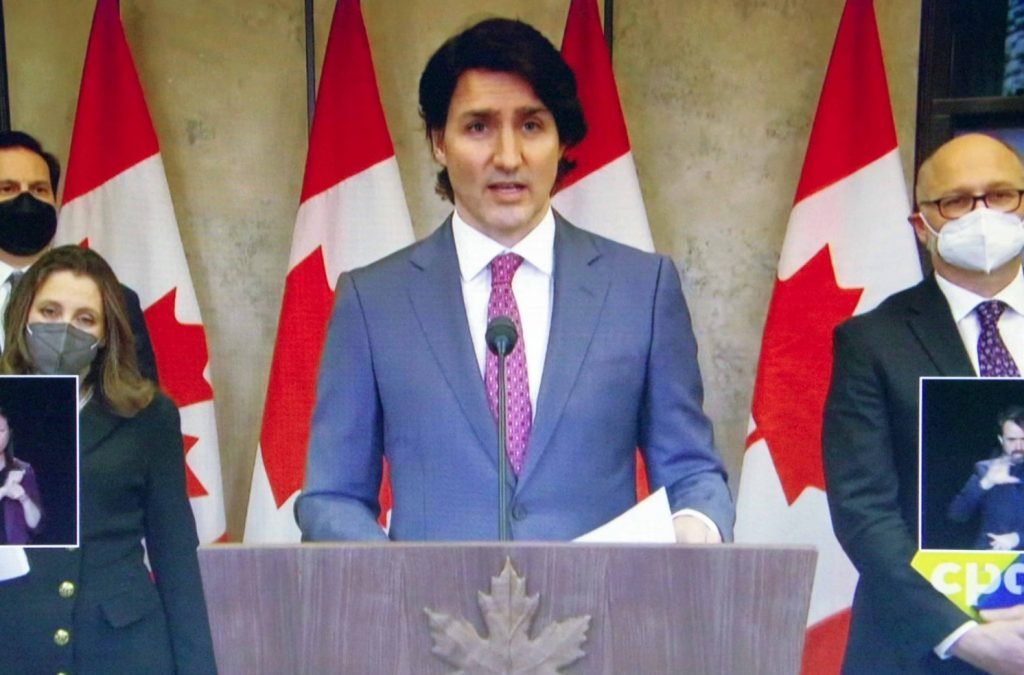
Saying the federal government was taking action after consulting territorial and provincial leaders across Canada, Prime Minister Justin Trudeau announced late Monday afternoon that Ottawa is invoking the Emergencies Act to deal with the Freedom Convoy 2022 protests which continue to occupy the nation’s capital and have resulted in the closing of several border crossings between Canada and the U.S.

“I want to be very clear: The scope of these measures will be time-limited, geographically-targeted, as well as reasonable and proportionate to the threats they are meant to address,” said Trudeau.

He said the Emergencies Act “will be used to strengthen and support law enforcement agencies at all levels across the country. This is about keeping Canadians safe, protecting people’s jobs and restoring confidence in our institutions.”

Seen here during a press conference in Ottawa, Prime Minister Justin Trudeau invoked the Emergencies Act on Monday Feb. 14.

Justice Minister David Lametti said that having now declared a public order emergency, the Liberal government will table a declaration in Parliament as required within the next seven days.

But the declaration will only last 30 days unless it is renewed. “However, we can and sincerely hope to revoke the emergency much sooner,” Lametti said.

Environment Canada issues ‘Flash Freeze’ warning for Laval, Montreal regions

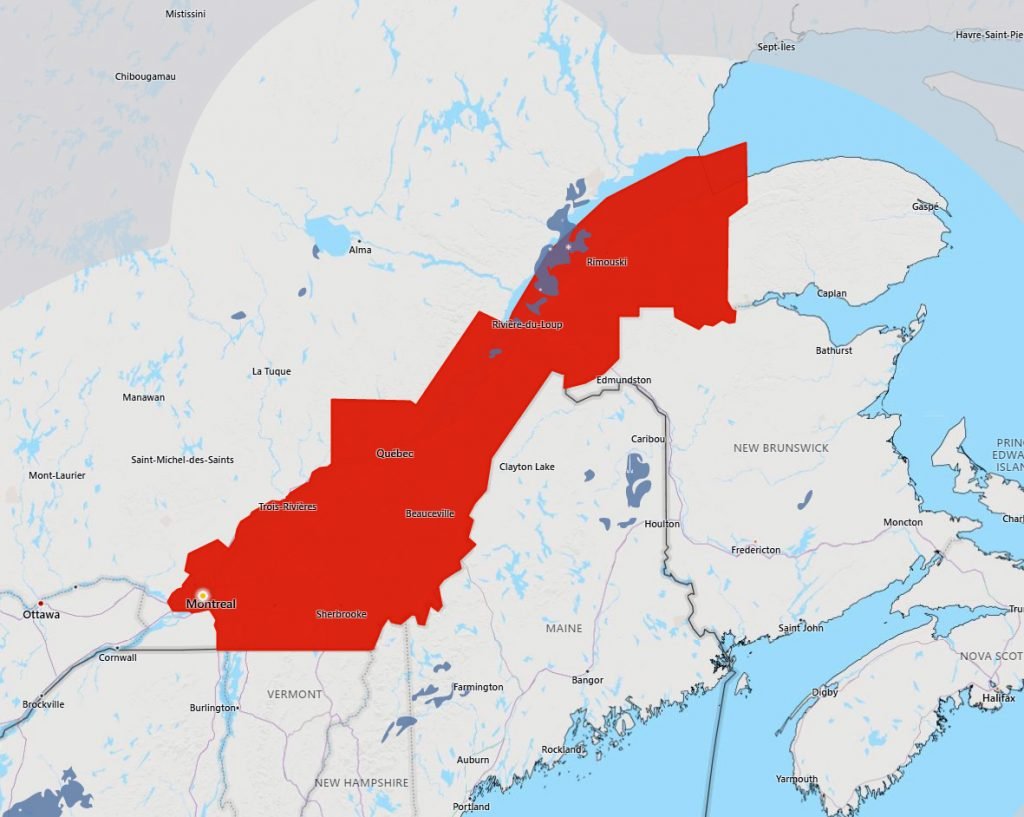
During the mid-afternoon on Saturday, the Environment Canada weather service issued an advisory that a “flash freeze” warning is in effect, with temperatures dropping drastically over the coming hours, and puddles, wet snow and any additional precipitation expected to freeze over.

Surfaces such as highways, roads, walkways and parking lots may become icy and slippery, says the federal weather service, requiring heightened vigilance on the part of motorists on icy streets and highways, as well as by pedestrians on potentially treacherous sidewalks.

The affected freeze-over area stretches from just west of Laval and Montreal, to as far south as Sherbrooke and southeast to the Beauce, following a trajectory along the St. Lawrence River past Rimouski and into the Gaspé peninsula.

Third suspect arrested in Fabreville home invasion

The Laval Police Department says it has arrested a third suspect believed to have been involved in a recent home invasion and kidnapping on Clémence St. in Fabreville.

Around 8:12 pm on Jan. 17, the police received a call through 9-1-1 about the home invasion and an altercation that broke out at the same time. After a gunshot was fired, a 26-year-old female resident of the home was kidnapped and taken aboard a waiting vehicle which fled the scene.

Twenty minutes later, the vehicle, with the woman and the suspects aboard, was located just north of Laval by the LPD with assistance from local police. Two suspects were arrested at that time, while the whereabouts of a third remained unknown.

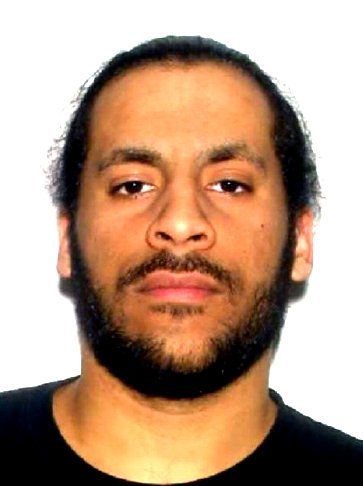
Christopher Cajuste Chima was arrested by Ottawa Police and was returned to Laval after allegedly taking part in a home invasion and kidnapping in Fabreville on Jan. 17.

On Jan. 27, the third and final suspect, Christopher Cajuste Chima, age 27, was arrested in Ottawa for alleged kidnapping, illegal confinement, illegal firearms possession and breaking and entering. He was arraigned at the Palais de justice in Laval on Jan. 31 and was due back in court on Feb. 4 for additional court proceedings.

According to information released by the LPD, Christopher Cajuste Chima is a resident of Ottawa. While carrying out the arrest, the Ottawa Police seized a loaded firearm, an ammunition clip with a 30-round capacity, ammunition, three bulletproof vests, cocaine and other evidence.

Anyone who believes they may have information potentially useful to the LPD for this investigation can call their confidential Info-Line at 450 662-INFO (4636), or 9-1-1. The file number is LVL 220117-080.

Laval man arrested by Smiths Falls Police for alleged identity theft

A 58-year-old male resident of Laval was arrested on Tuesday Jan. 25 by police in Smiths Falls, Ont. after trying to buy a vehicle worth more than $100,000 at a car dealership while using identity documents which were not his own.

The Smiths Falls Police Service charged Ghislain Galipeau with fraud and identity theft.

They were alerted by staff at the car dealership after Galipeau had completed on online financing application on Monday Jan. 24, which he had filled in with information from the allegedly fraudulent I.D. documents.

Upon returning the following day, he was arrested by the police.

The charges against him include:

  • Being in possession of two fraudulent identity documents;
  • Identity fraud;
  • Identity theft;
  • Fraud over $5,000;
  • And obstructing a peace officer.

LPD thanked by RCMP in B.C. for arresting fugitive

RCMP officials in Burnaby B.C. recently thanked the Laval Police (Service du police de Laval) for the assistance they provided when arresting a suspect wanted in Burnaby in conjunction with a serious road accident causing bodily harm in which the driver left the scene.

Following his arrest in Laval, the suspect, 33-year-old Moussa Daoui, who was wanted following the rollover crash that seriously injured a female passenger, was transported back to B.C. on Jan. 27 to face charges.

On June 5, 2020 at 1 a.m., Burnaby RCMP responded to a report that a Dodge Durango had rolled over in Burnaby. It is alleged that Daoui left the scene, leaving the female passenger with severe injuries.

Burnaby RCMP Criminal Collision Investigation Team (CCIT) took over the investigation and several charges were approved in May 2021, although the suspect had left B.C. by then. As a result, a Canada-wide warrant was issued for Daoui’s arrest.

Moussa Daoui now faces the following charges in B.C.:

  • Failing to stop after an accident causing bodily harm;
  • Two counts of impaired operation causing bodily harm;
  • Criminal negligence causing bodily harm.

“Despite the suspect leaving the province while under investigation for this crash, our investigators never gave up on ensuring he would face these charges in a B.C. courtroom,” said Cpl. John Hargreaves with Burnaby RCMP’s Criminal Collision Investigation Team (CCIT). “We are also grateful to our partners at Laval Police (Service du police de Laval) for their assistance in this file,” he added.

Action Laval councillors refuse to support Aquatic Complex contract

De Cotis, Cifelli suspect current $125 million budget won’t cover additional costs

Action Laval city councillors David De Cotis (Saint-Bruno) and Archie Cifelli (Val-des-Arbres) said last week that they would not be voting in favour of the contract for the Aquatic Complex because, according to their party, it “won’t be serving its original purpose” and “does not answer to the needs of the population.”

Budget skyrocketed

In addition, they said in a statement, supplementary costs could end up being added to the bill, even as the initial budget has skyrocketed, and certain elements in the original design, including a glass canopy, some parking spaces and an outdoor terrace, are not part of the new plan, they stated.

“In the end, what’s left is just a big interior swimming pool that will only serve a clientele living near the downtown along with elite swimmers from Laval,” said Action Laval party officials.

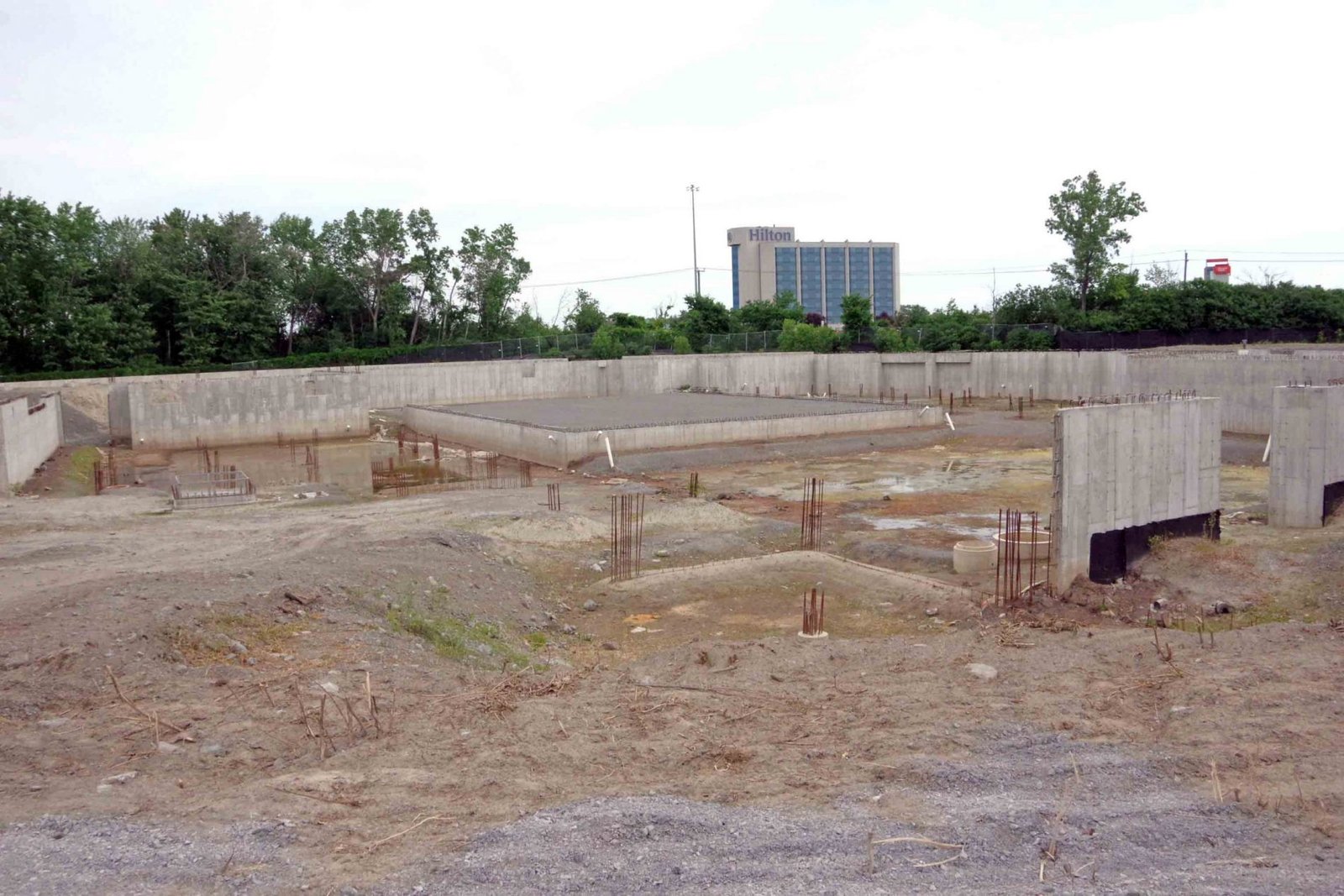
The foundations for Laval’s future Aquatic Complex are already in place on a site next to the Cosmodôme in central Laval. (Photo: Martin C. Barry, Newsfirst Multimedia)

‘Humiliating,’ says Cifelli

“It was the coming of the Jeux du Québec that got this project started,” said Cifelli. “In addition to paying double for getting half as much, we will have to pay neighbouring municipalities to use their infrastructures during the next Jeux du Québec. I feel this is something humiliating for the people of Laval.”

The opposition party is suggesting, given the multiple delays in developing and bringing forward the project, and the postponement of the Jeux du Québec on two occasions, that the Aquatic Complex will be delivered late, while Laval residents in eastern and western district suffer from a lack of services, including indoor swimming in their own neighbourhoods.

The ‘two pool’ plan

“With two reasonably-priced projects, one in the east and one in the west, the citizens would have been well-served and the facilities could have served for the Jeux du Québec,” said De Cotis, referring to an alternate swimming facility plan Action Laval had suggested. “The mayor is really not listening to the needs of his population.”

‘In the end, what’s left is just a big interior swimming pool,’ Action Laval says of the Boyer administration’s revised Aquatic Complex plans

Action Laval also suspects that the current budget does not include additional costs that could come following a revision of the project. As well, the party noted that the concrete foundations, which were laid down more than three years ago, should have been reassessed before awarding the contract, and that any extra costs should there be any problems will only add to the overall budget.

Construction contract for Laval’s Aquatic Complex goes to Pomerleau Inc.

Work set to begin this spring on site next to Laval’s Cosmodôme

A key moment in the drawn-out saga over the City of Laval’s Aquatic Complex was scheduled to take place on Tuesday evening this week when Laval city council was set to pass a resolution awarding a $108,444,700 contract for the project to the Montreal-based project engineering firm Pomerleau.

While a statement issued by the city’s executive-committee last week states the contract with the company is worth $108,444,700, the agenda for the special meeting of council, providing detailed information on the resolution to be passed, stated the amount as $124,684,293.83, which is in line with a cost estimate the city most recently provided.

Starts this spring

“The city succeeded in coming up with a project in which a balance between costs and quality has been respected,” the executive-committee said of the contract in its statement, while adding that the beginning of work is scheduled to take place this spring on the site next to the Cosmodôme and Autoroute 15.

Mayor Stéphane Boyer’s administration maintains that the Aquatic Complex will generate many types of benefits, including a better quality-of-life for residents as well as economic spinoffs.

“After the long road towards the realization of one of the most important infrastructure projects on our territory, we are arriving at the finish line,” Mayor Stéphane Boyer said. “More than ever, the aquatic complex is important for everyone in Laval who wants to have an active lifestyle.

City says it will pay off

“These facilities equipped with sports and games equipment that meet specifications for national competitions in a range of aquatic disciplines will be up to everyone’s needs to learn, have fun and to excel personally.”

The contract was awarded just a few weeks after the city announced it was adding $50 million to an earlier-estimated $75 million cost for the aquatic complex, raising the price tag to $125 million.

Despite the cost increase, the city maintains that the aquatic complex will have positive impacts on different levels, including lifting Laval’s status internationally, generating short- and longer-term economic benefits, and encouraging physical activity by Laval’s population.

$20 million in gov’t subsidies

The city also maintains that Laval’s property tax payers won’t be on the hook for the entire amount. While the federal government has agreed to provide $10 million through its cultural and recreational community infrastructure program, the provincial government is providing another $10 million through a similar program.

‘We are arriving at the finish line,’ says Mayor Stéphane Boyer

The City of Laval launched the architectural competition for the aquatic complex in 2016, after years of speculation on what Laval’s next big project would be after the construction of the Place Bell multipurpose arena.

Cost has more than doubled

When first announced in January 2017, the cost of the aquatic complex was initially projected to be $61.1 million and the city hoped to complete it by 2020, although that changed as circumstances evolved. When completed, the project will include the following key elements:

  • Three swimming pools (one recreational, another of 50 metres and a diving basis with a 10-metre diving tower. There will also be a multifunctional training studio and a physical fitness workout room.
  • It is expected to host important national and provincial swim competitions.
  • It is also expected to accommodate 875 swimmers and 500 spectators.
  • The sports expected to be practiced at the Aquatic Complex will include swimming, synchronized swimming, water polo, diving, aquatic exercise, life-saving training and free swim events.

It is expected to contribute to the overall development of athletics in various sports in the Laval region.

City, Arts Council offer subsidies to performers and groups

The Quebec Arts and Letters Council and the City of Laval, working in conjunction with Culture Laval, have launched a call for bids to receive subsidies for performance projects to take place on Laval territory. The deadline date to submit plans and ideas is April 28.

Applications are being accepted by the city for two categories of projects:

          Professionnal performers and writers:

          Professional performance organizations:

Culture Laval is offering, on an appointment basis, individual accompaniment to professional performers and writers, as well as representatives of performance groups, who may wish to submit applications.

A virtual presentation will be taking place for performers and writers in order to furnish them with additional information on their possible admissibility to programs and how applications should be submitted.

Laval City Hall.

The session will be taking place on March 16 from 11:30 am to 1 pm. Interested individuals can contact Éric Dufresne-Arbique (e.dufresnearbique@culturelaval.ca) to make an appointment and to receive a link for the online information session.

The subsidies program is being offered as part of a triennial agreement (2021-2024) between the the Quebec Arts and Letters Council and the City of Laval, with Culture Laval, in which the partners have invested $600,000.

The program’s goals are as follows:

  • To encourage artistic creation and performance in Laval ;
  • To further the development of the talents of the performers and writers;
  • To encourage their presence in Laval;
  • To promote the emergence and use of digital technology;
  • To encourage professional performers’ organizations in Laval.

Weather

Laval
overcast clouds
6.2 ° C
6.2 °
6.2 °
47 %
2.3kmh
89 %
Sun
8 °
Mon
14 °
Tue
14 °
Wed
14 °
Thu
12 °