On June 2, the Laval Police Dept.’s general crimes division arrested Jonathan Dubuc, 37, and a 35-year-old female accomplice as suspects in a series of break-ins committed at retail businesses in Laval’s Vimont and Laval-des-Rapides districts.
In May 2022, investigators started to notice certain similarities between break-in incidents that had recently taken place. For example, the perpetrators were turning up at businesses located close to the street, while they waited in their vehicle. From there, they would break a glass window using a hard object, and would enter the establishment and steal the contents of the cash register.
The arrested suspects face charges of breaking and entering, as well as theft and mischief. Jonathan Dubuc remains in detention, according to the LPD. He is due to make a court appearance on July 6. His unidentified female accomplice was released on bail, with conditions to follow, and will be making a court appearance on a date the LPD did not disclose.
Information gathered together by the LPD, as well as by police forces in Terrebonne and Montreal, resulted in 30 break-in incident dossiers being linked to Dubuc and the other suspect. An estimated $30,975 is estimated to have been stolen, not including damages to property.
After being delayed for two years because of the Covid pandemic, organizers of the Jeux du Québec’s final competitions in July say they are ready to greet the anticipated 130,000 visitors who are expected.
The various events will be taking place at 14 different sites, where 3,300 youths from all over the province will be competing.
“We are eagerly awaiting to welcome these visitors to have them live an experience that will be unforgettable,” says city councillor for Laval-Les Îles Nicholas Borne who is responsible for leisure and sports.
“For our own sports community, hosting such an event that is synonymous with great preparations,” he added. “The holding of the Jeux du Québec in Laval has allowed for the creation of new sports infrastructures that will be accessible to all citizens, while also making a positive impact on the development of sports for our population and all our organizations.”
The games take place from July 22 – 30. The sporting events will include basketball, athletics, baseball, swimming, volleyball and cycling. A later segment will also include golf, soccer, softball, archery, triathlon and mountain biking. The opening and closing ceremonies will be taking place at Place Bell on July 22 and July 30.
STL announces summer schedule, starting June 25
From June 25 to Aug. 28, the Société de transport de Laval will be in summertime mode. As such, bus schedules will be somewhat different, new bus lines will come into effect, and there will be a modified fare structure.
The STL advises anyone who uses STL services to employ the online trip planner, available at STLaval.ca, to see in real time when buses are leaving and arriving.
As well, remember that July 1, Canada Day, is a holiday and the bus schedules on that day (which is a Friday) will be according to the schedule normally in effect on a Saturday.
City calls for candidates to sit on committees
The City of Laval is recruiting Laval residents as candidates to join certain city council committees as citizen members, as well as on the boards of some organizations.
Those chosen will be asked to consider issues of municipal interest, while providing advice on decisions to be made. Applications can be made on the city’s web site.
“Participation on a committee or on a board is one of the best ways to become involved in the development of the city, while getting to understand the way things work, meeting people with common interests and developing skills and networking,” says Laval city councillor for Laval-des-Rapides Alexandre Warnet who is responsible for citizen engagement dossiers.
Some of the areas where the city has volunteer committee and board member positions to fill include the issues of governance, public security, entrepreneurialism, urban planning, youth and the environment.
Laval’s libraries offer a range of activities over the summer
The City of Laval’s public library network, in conjunction with the National Library and Archives of Canada, is offering kids 12 years of age and younger some reading enjoyment over the coming summer through the TD Summer Reading Club.
“Encouraging the pleasure of reading among children is often a challenge,” notes Laval city councillor for Sainte-Rose Flavia Alexandra Novac, who is responsible for libraries on council.
“And yet, as we all know, reading contributes greatly to the school success of youths. That is why we are proposing to Laval’s families the TD Summer Reading Club, which suggests books to read, games, animations, handicrafts-making and other resources.” Children who wish to register for this program can do so at their neighbourhood Laval public library branch, where they will receive a theme kit containing a pamphlet in which to record what they read, a games book, and a coupon to be eligible in a draw to win books, games and a family outing. The club’s activities take place from June 16 to Aug. 19.
Twenty-two-year-old Maria Muscari has Stage 4 Hodgkin’s lymphoma
Editor’s note:In the interest of a Laval family that finds itself at this time in dire need, the Laval News has decided to share their story with our readership. By reaching out to the Laval community, we hope all will benefit, while also showing some generosity. Twenty-three-year-old Maria Muscari’s mother, Elsa Moritis, shares this first-hand account.
It all started around November 2017. Maria was scratching and getting welts on her legs and hands from all the scratching; she was having a tough time sleeping, and really wasn’t feeling like herself.
By May, her scratching was so bad that she was not sleeping and was so irritated that she lay on the couch crying; her legs, arms and body were full of welts of scabby skin. I finally told Maria that we were going to a dermatologist. So, we booked ourselves a dermatologist appointment and off we went. The dermatologist specialist evaluated Maria and said that she had eczema, they prescribed her creams and off we went home. But weeks passed by, and she was not getting better. So, off we went again, this time to the emergency department. We left with the same diagnosis (eczema). This happened about six more times (ERs and walk-in clinics, more ERs, more clinics) and they all had the same diagnosis (eczema). Nothing was working or helping her.
Maria Muscari in better times,
Fast forward to September 2018. Maria asked me if she could come sleep in my bed (thank God I agreed), because I will never forget that night. I lay awake listening to her breathing: It was so bad and she was literally gasping for air. I went to touch her arm and her t-shirt was drenched in sweat. Next morning when she woke up, I asked her, “Maria how long have you been breathing like that and sweating like that?” She replied, “About three months.” That’s when I started to get worried, thinking something is not right! (At this point I never thought it was the c word; I truly thought she might have pneumonia). So, I contacted my cousin who works at the hospital and asked her if she could get Maria an x-ray of her chest asap.
The next morning, off I went to work and Maria made her way by herself to the hospital for her x-ray. September 18, 2018 was the worst day of our lives … That was the day that Maria received the devastating news that she had cancer … Imagine being told you have cancer at 18 and your mom is not even with you … I got the devastating news on the phone from my cousin. I fell to the floor crying. We made our way to the hospital to meet Maria and everything after that was just a blur …
The following days were filled with CT scans, special blood tests, pet scans, biopsies upon biopsies … I could see the fear in my beautiful daughter’s eyes, but I had to be strong, I had to show no fear. I would hide in the bathroom and cry so Maria would not see me. On September 24, 2018, we got more devastating news: Maria was diagnosed with stage 4 aggressive Hodgkin’s lymphoma that had spread to her lungs.
Our world came crashing down … Our wonderful Dr. April Shamy at the JGH and her team assured us that maria’s prognosis looked good, but little did we know that this cancer had other plans … I will always remember the 1st chemo treatment; we all cried, but the fear in Maria’s eyes was just devastating … Week after week of chemo … I will never forget the day when I went in the bathroom and found Maria on the shower floor crying her eyes out as her beautiful hair was all falling out and she had stuck every clump of hair on the shower wall so she could see it. The pain in her eyes was heartbreaking; but again, I had to be the strong one …
Maria recently, shortly after undergoing a round of chemotherapy.
Fast forward to today … My beautiful 22-year-old Maria has been through hell and back, has never been in remission, has had 6 to 7 lines of therapy, numerous biopsies, I can’t even count how many blood tests, blood transfusions, pet scans, chemos, immunotherapies, her own stem cell transplant, having her eggs frozen (because the chances of her ever having children are slim to none), the loss of hair multiple times. In four years, there has been nothing that has worked, nothing she has had to stop chemos, because they are doing nothing; no therapy is working, her health is deteriorating and as a mother, it scares me to death. Seeing the fear in your child’s eyes and not being able to do anything about it is not only draining but heartbreaking.
This week (June 15, 2022), we finally got some hopeful news that Maria qualifies for a research trial called innate cell engager (ice) afm13, combined with preactivated and expanded cord blood (CB) at the MD Anderson Cancer Center in Houston Texas. After many discussions with Dr. Yago Nieto (MD Anderson and our oncologist Dr. Shamy), they both agree that this research trial is the only thing that will save Maria’s life … But everything comes with a cost, especially because we must go to Houston Texas to get this treatment (a cost of $250,000 USA dollars).
So, imagine in order to save my child’s life, I have to do whatever it takes to save her life. Maria deserves a chance to live, Maria deserves to finish her 3rd year of nursing, Maria deserves to go out and party just like any 22-year-old, I deserve to see my beautiful daughter get married … Life is really not fair sometimes … Seeing your child suffer and seeing her health deteriorating like this is just not fair and I cannot believe that this is the only way we can save my daughter’s life. So please help our family by donating any little amount you can. If 18,000 people can donate $20, we can reach our goal and save Maria’s life. And if you cannot donate, please just share, share, share the go fund me link …
Thank you to every single person who took the time to read our story and share our pain.
Work on $246 million building, for a growing electric bus fleet, is set to begin this fall
A more than $142 million subsidy announced by Quebec last week will allow the Société de transport de Laval to increase the size of its future electric bus garage by 50 per cent, while making the project the largest ever undertaken by the transit agency, as well as one of the biggest of its kind in the province.
Seen here on June 22 at STL headquarters are representatives of the transit agency, the City of Laval, including Mayor Stéphane Boyer, the federal government (Vimy MP Annie Koutrakis), and the Quebec government (Sainte-Rose MNA Christopher Skeete). (Photo: Martin C. Barry, Newsfirst Multimedia)
Electrification of transit
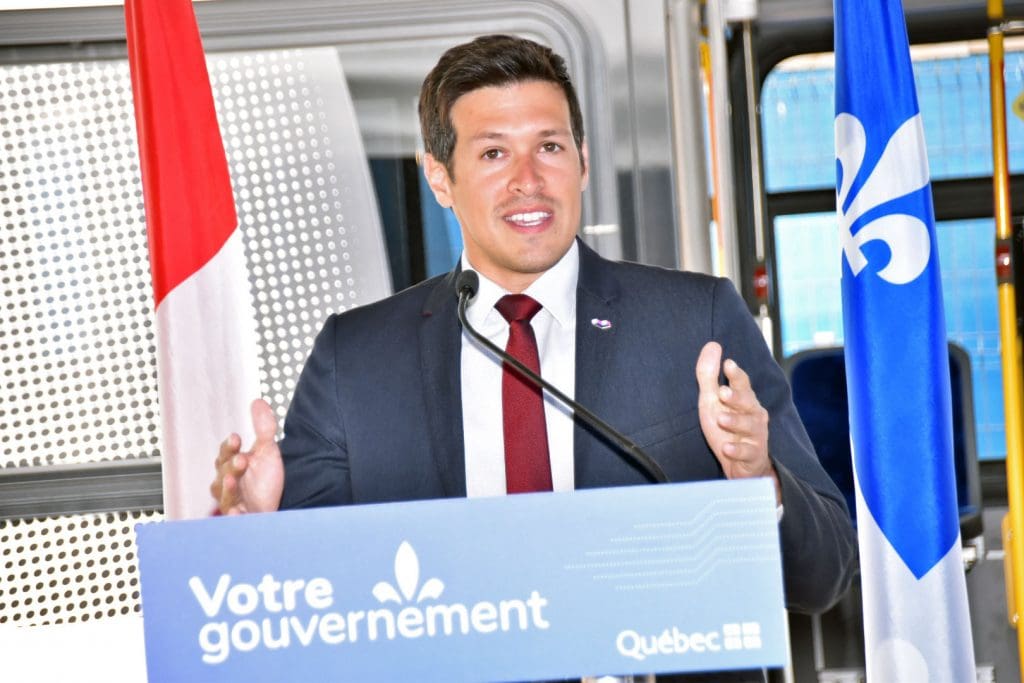
Sainte-Rose CAQ MNA Christopher Skeete made the announcement to a gathering of STL and City of Laval officials at STL headquarters in the City of Laval’s industrial park on June 22.
“I commend the efforts of the STL, which is mapping out and reorganizing its network in light of several factors in order to make a more ecoresponsible type of mobility available,” said Skeete.
“The government is proud to be able to provide support for the electrification of mass transit in the Laval region,” he continued. “It is the residents who will be benefiting from the improved mobility.”
More power than Place Bell
To get some idea of the magnitude of the undertaking in terms of electricity that will be used, the project will include the addition of a new industrial-capacity electric power entrance to supply 20 megawatts of electricity to recharge the growing fleet of electric buses.
According to Quebec government and STL officials, this is four times the amount of electricity currently needed to power activities at Laval’s Centre Bell multipurpose entertainment venue and arena. The STL’s new garage building will also be highly energy-efficient through a cutting-edge system that recycles heat, with eco-energetic lighting and green roofs.
Laval Mayor Stéphane Boyer was understandably very pleased with the provincial government’s announcement of $142 million in funding for the STL’s electric garage project. (Photo: Martin C. Barry, Newsfirst Multimedia)
Call for tenders launched
The Quebec government’s announcement coincided with the STL’s decision on the same day last week to launch a public call for tenders for a contractor to build the new garage. Work is scheduled to begin this fall. The garage electrification project is being undertaken as the STL and the provincial government continue to try to meet targets for reducing greenhouse gas emissions produced by gasoline-powered vehicles.
The eletrification of the STL’s garage will allow the transit authority to add 145 new parking spots for electric buses. Total cost of the project is expected to be $246 million. Besides the $142 million announced by Quebec, the federal government has allotted $85 million, while the City of Laval is budgeting $18 million.
Ottawa also involved
“Our government is investing to electrify transportation in Quebec just as in the rest of the country,” said Vimy Liberal MP Annie Koutrakis, who is Parliamentary Secretary to federal Intergovernmental and Infrastructure Minister Dominic Leblanc. “The STL’s garage enlargement project will allow the City of Laval to take another step towards the electrification of its entire bus fleet, for the benefit of everyone in Laval.”
Beginning in 2025, the STL and other transit authorities across Quebec plan to purchase only electric buses, with support from higher levels of government, when they are acquiring new bus fleets. This is in accordance with an agreement the transit agencies have made with each other. The STL is planning to have a 100 per cent electric bus fleet by the year 2040.
STL general manager Guy Picard. (Photo: Martin C. Barry, Newsfirst Multimedia)
Project picks up speed
“The arrival of this garage is more than a rumor,” said Mayor Stéphane Boyer. “This new facility will allow us to truly pick up speed with the electrification of our bus fleet in Laval. I point out once again that the government of Quebec shares our vision for the development of a dignified and modern city of the 21st century.”
“Our major electrification project will be transforming how we do business in every way,” said Laval city councillor Jocelyne Frédéric-Gauthier, who is president of the STL. “We are very fortunate to be able to count on our partners to accompany us in this major transformation, which is sure to benefit all our clients and our teams.”
Time line of electrification at the STL
2012: The STL was the first transit authority in Canada to buy a full-length electric bus (40 feet – 12 metres).
2018: The STL – in conjunction with the STM in Montreal – launched a public call for tenders for the supply of 10 slow-charge electric buses.
2019 to 2021: After receiving its first New Flyer electric bus, the STL carried out a series of trial runs on a closed road network.
2020: The STL received nine more electric buses which were put into service during the summer of 2021. Each electric bus keeps 70 to 80 tonnes of greenhouse gas emissions from going into the atmosphere each year.
Fall 2022: Work on the enlargement and electrification of the STL’s garage be starting.
Frustrated and anxious travellers cope with endless lineups at Service Canada Laval
Officers from the Laval Police Dept. were called in to maintain order outside the Service Canada outlet at the Mega Centre Notre-Dame on Autoroute 13 last week, as federal government workers tried to deal with a huge backlog of passport applications resulting from a surge of interest in global travel following the two-year-long Covid pandemic.
The line starts here
A long line of passport applicants snaked all the way around to the far side of the Service Canada building. The queue included mothers, fathers, children, and sometimes even grandparents. All were seeking to complete and file the proper paperwork for passports.
As well, there was a much younger crowd, including students hoping to travel to foreign destinations this summer, before returning to classes in the fall. Most had brought portable camping chairs to be comfortable during the long wait.
The lineup at the the Laval Service Canada outlet snaked all the way around the building. (Photo: Martin C. Barry, Newsfirst Multimedia)
Rita, a Laval resident who didn’t want to be identified by her last name, said her husband had started standing in line at 5 am last Wednesday morning. She replaced him around 10 o’clock.
Passport needed in 24 hours
Not long before noon, she reached the halfway mark to the Service Canada front door. Like certain other people in line, she was waiting on behalf of a family member – in her case, a teenage son, who was scheduled to fly to Europe, although departure was scheduled in a few days time. However, for others the departure was scheduled in less than 24 hours.
“We need to get this done either today or tomorrow, because he’s leaving on Saturday with his grandmother,” said Rita. Asked what would they do if they couldn’t reach the front door by the time the office closed for the day, she replied, “We stay here tomorrow.
‘Waiting and not knowing’
Although not angry with the federal government over the long lineups, she acknowledged she was “shocked and frustrated, but this is where we’re at. There’s a lack of information, us just sitting here, just waiting and not knowing.”
She said her son’s passport application had been sent to Service Canada as long as three months ago, yet there had been no response. “So, we don’t know if we’re doing this for nothing. We have no idea. Because we called the number we were supposed to call and they never got back to us.”
At another spot in the line, Gabriel Gauthier, a 20-something Mascouche resident, was waiting patiently to file documents on behalf of his younger brother who hoped to travel to South America to visit with members of their family who live there.
A three year wait … then this
“It’s been three years we couldn’t go because of the pandemic,” said Gabriel. Next to them in line, Léonie Clark, a woman also in her 20s from Montreal, decided to come to the Laval Service Canada office after seeing that the lineups at the Montreal office were far worse.
From the left, a clearly frustrated Nicholas Gauthier, his brother Gabriel, and Léonie Clark, are seen here waiting for their turn at Service Canada Laval on June 22 at the Mega Centre Notre-Dame mall. (Photo: Martin C. Barry, Newsfirst Multimedia)
As her plane departure was scheduled for the next day at 5 pm, she was uncertain whether she’d get to clear up her passport issues on time. “With the number of applications they had to deal with, I don’t understand why they didn’t implement a 24/7 service to get this cleared up,” she said.
Much further to the rear of the line, the Jannille family from the Hochelega district of Montreal were hoping to get clearance to travel to France where their parents reside. Mom, dad and their infant child had been waiting since around 8 am in line.
‘Who’s to blame?’
While Quentin Jannille, the father of the family, took into consideration that the post-pandemic rush to travel was partly to blame for the situation, he felt the federal government had fallen down on the job. “It was clear this was going to happen,” he said, while adding that the government failed to prepare, and Service Canada employees were being overworked largely as a result.
Last week, federal Families Minister Karina Gould, who is responsible for passport services, said the government was adding more staff to help triage the long lineups at the 35 passport offices across the country, as tens of thousands of people tried to get their hands on travel documents.
‘What’s the deal,’ says Poilièvre
The change in strategy came as Conservative Party of Canada opposition critics took aim, saying the situation should never have been allowed to reach this point, when it was obvious to many that there’d be a strong interest in travel as the pandemic ended.
CPC leadership candidate Pierre Poilievre said last week, in a video posted to his social media channels, that the Canadian public deserved better than what transpired at the passport offices. “What’s the deal folks?” Poilièvre said in the video posting, in which he’s shown meeting passport applicants waiting in line.
‘It was clear this was going to happen,’ said one frustrated traveler, adding that the federal government failed to prepare
“Well, this is a waiting nation. We are asked to wait for everything as sleepy bureaucrats and government gatekeepers stand in the way of you getting the basic services to which you are entitled — one of them is a passport. You see what’s happening here? The government is doing a lot of things poorly rather than a few things well.”
Chaos at Montreal offices
After initial reports of chaos at passport offices in the Montreal area last week, Minister Gould said Service Canada was deploying managers to speak to would-be travellers about their applications before they reached a customer service agent. Hopefully, the system would identify people who were most in need of a passport.
Those who were in need of a passport to travel in the next 12, 24 or 36 hours would receive priority, while others would be told to come back at another time, said Minister Gould. As that went on, a government website that tracks wait times was warning people to expect delays of at least six hours at some of the busiest sites, such as the Service Canada office at Place Guy-Favreau in Montreal.
Ex-bureaucrat critical of gov’t
Andrew Griffith, a former director general with Citizenship and Immigration Canada, and a former top official at Service Canada, said in an interview with CBC News last week that the government should never have allowed the situation to deteriorate to this point.
He said that in Immigration, Refugees and Citizenship Canada’s 2022-23 department plan, managers advised the government that there would almost certainly be a surge in passport applications as COVID-related travel restrictions were relaxed, and that the demand for passports would continue to increase for three more years.
The current issue of the Laval News, volume 30-18, published on June 29th, 2022. Covering Laval local news, politics, sports, and our new section Mature Life. (Click on the image to read the paper.)
Front page of the Laval News, June 29th, 2022 issue.
Transports Quebec says Autoroute 15 southbound will be partly closed overnight from 10 pm June 28 to 5 am June 29 near de la Seigneurie Blvd. West in Blainville so that asphalting work can take place.
As a result, three out of four lanes of the southbound A-15 will be shut, allowing motorists to proceed only via the far-right lane.
As well, the Blainville/Boulevard de la Seigneurie exit is closed, with a detour via Mirabel (Saint-Augustin)/Sainte-Thérèse (downtown).
Weather conditions could cause some or all of the work to be postponed to a later date, according to the highways department.
With the summer holiday peak period about to begin, Transports Québec is advising motorists to always follow established safety rules that apply when road maintenance crews are parked along the side of the highway.
As part of the work they do to see that the province’s network of roadways is always maintained, Transports Québec employees sometimes must stop their vehicles on or next to the roadway.
When a Transports Québec vehicle is stopped, a large illuminated yellow arrow, a rotating yellow dome light or some other emergency warning system atop the vehicle is switched on and motorists are expected to respect a “safety corridor” near the vehicle.
Just as if a car is about to be passed, motorists should first check the rear-view mirror, switch on a right or left turn signal (depending on the situation), reduce speed, and pass the Transport Québec vehicle, so that there is an effective corridor of safety between the moving and stationary vehicles.
While Transports Québec officials acknowledge that motorists always seem to comply with this rule when they see the distinctive blue and red flashers on police vehicles, they say the yellow flashers used by road maintenance crews don’t seem to get anywhere near the same response – even though the rule is the same.
And the penalty is also the same: A fine ranging from $200 to $300, and four demerit points, leading to higher driver’s license and car insurance fees when they next become payable.
Four men between the ages of 23 and 25 were arrested on Wednesday last week to face charges of conspiracy and identity theft involving the so-called “grandparent fraud.” The Laval Police Dept. said the alleged fraud ring had nearly 190 victims.
A search warrant executed at a Laval residence police allege was a call centre used by the suspects yielded 18 cellphones and more than $13,000 in cash.
A police investigation uncovered 187 fraud cases across Quebec totalling more than $900,000. In grandparent scams, fraudsters call victims and claim to be a grandchild or other young relative. They say they are in trouble with the law and need money to be released from jail.
A member of the fraud ring, impersonating a police officer or other intermediary, then instructs the victim on how to withdraw cash from their bank, place it in an envelope and give it to a person who goes to the victim’s home.
Anyone with any information on this type of fraud is urged to call Laval police at 450-662-4636 or call 911 and mention file LVL 210615 049.
Laval Police seek ‘misrepresentation’ fraud suspect
The Laval Police Dept. is seeking the public’s help to locate a suspect wanted on several warrants involving misrepresentation and fraud.
According to the LPD, during 2021 several suspects, including Yani Noel, age 21, were allegedly involved in a type of fraud known as “false representation” in several regions across Quebec.
The suspects contacted victims, pretending to be employees of financial institutions, while claiming to have found fraudulent transactions made with the victims’ bank debit cards which needed to be rectified.
As part of the scam, the victims were asked to provide the suspects with confidential personal information, such as PIN numbers. As well, an accomplice would go to the residence of the victims to pick up the victims’ debit cards, which the fraudsters claimed were no longer valid.
The LPD alleges that the suspects would then use the stolen debit cards, with the information they obtained, to steal money from victim’s bank accounts. The LPD alleges that Yanni Noel acted as an intermediary, going to victims’ homes to pick up the debit cards.
Description of Yani Noel:
Mixed race, speaks French.
Black hair, brown eyes.
1 m 78 (5’10’’) tall, weights 79 kg (175 lb).
Has tattoos on the fingers of his right hand. Anyone who believes they have information about Yani Noel’s whereabouts can call the LPD’s confidential Info Line at 450 662-INFO (4636), or 911. The file number is LVL-220424-020.
Crimes against individuals up, LPD says in annual report
The Laval Police Dept. recorded a larger than usual number of crimes against individuals involving firearms last year, the LPD says in an annual report released on June 8.
Last year, the LPD reported that this category of crime rose 25 per cent over the previous year, during a time when the Covid pandemic was underway.
According to the force, the majority of firearms incidents took place in public places, and most of these in turn occurred in Chomedey.
From 2020 to 2021, crimes of sexual nature, criminal harassment and making threats also rose, says the LPD, including cases of domestic violence.
Man in his 60s dies after car crash in Laval
A man in his 60s has died after his vehicle went off the road early last Saturday morning in Laval.
A 911 call shortly after 4:30 a.m. notified emergency services of the crash that had just happened on Autoroute 440 eastbound near the St-François overpass.
According to early reports, the driver lost control of his vehicle after feeling discomfort. The driver ended his trajectory by hitting the median wall.
The man was alone in his vehicle. He was transported to hospital in critical condition and later succumbed to his injuries. A Sûreté du Québec investigation is continuing.
Laval driver in B.C. crash receives two-year sentence
After a nearly two-year-long investigation, a driver from Laval who was involved in a rollover crash that seriously injured a female passenger in June 2020 has pleaded guilty to Criminal Negligence Causing Bodily Harm and has received a two-year sentence.
On June 5, 2020 at 1:00 a.m., the Burnaby B.C. RCMP responded to a report that a Dodge Durango had rolled over at Gilmore Avenue and Halifax Street. The driver left the scene, leaving his female passenger with severe injuries.
Burnaby RCMP’s Criminal Collision Investigation Team took conduct of the investigation. Several charges were approved in May 2021, but the suspect had left the province and a Canada-wide warrant was issued for his arrest.
In January 2022, with the assistance of Laval Police Dept. (Service du police de Laval), 33-year-old Moussa Daoui was arrested in Laval and returned to B.C.
On Monday, May 30, 2022, Daoui pleaded guilty to Criminal Negligence Causing Bodily Harm and received a two-year prison sentence.
Mayor Stéphane Boyer and several city councillors were among the guests
On June 9, Le Pilier Foundation was pleased to welcome more than 100 guests to the first edition of their Urban BBQ event, with the mayor of Laval as a special guest of honor, at the Château Taillefer Lafon vineyard near Laval-Ouest.
Respite for families
From the left, Pierre Bélanger, executive-director Fondation Le Pilier (FLP), Bernard Rochette, administrator FLP, Stéphane Boyer, mayor of Laval, city councillor Sandra El-Helou, Isabelle Bonin, FLP board administrator, Sylvain Fontaine, president of the board FLP, Daniel Paquette, FLP board administrator, Sylvie Parent, FLP board administrator, and Johanne Desjardins, executive-director for philanthropy, development and communications at FLP. (Photo: Martin C. Barry, Newsfirst Multimedia)
With a fundraising target of up to $50,000, all proceeds from the event are going towards supporting the adaptative activities and specialized respite services available at Le Pilier’s Centre Marcelle et Jean Coutu in Laval, for families of persons with disabilities.
In a relaxed and informal atmosphere, with the Andy Dacoulis Quartet jazz band providing musical entertainment, the guests were invited during the evening to enjoy a taste of the renowned vineyard’s various products, with expert guidance provided by a sommelier, while networking with members of the Laval business community.
Many supporters
As participants in the fundraiser, the board members of Le Pilier Foundation said they wished to extend their warmest thanks to Laval mayor Stéphane Boyer, to the City of Laval, to Pillar Platinum sponsors Jean Coutu and Brunet, as well as to all the other sponsors, partners, donors and guests who helped make the foundation’s first annual Urban BBQ event a resounding success.
From the left, Valérie Gagnon Paradis and Jonathan Turcotte Lebreton, who are special ambassadors for Le Pilier, were among the guests at last week’s Urban BBQ. (Photo: Martin C. Barry, Newsfirst Multimedia)
“I am honoured to have contributed to the first edition of Le Pilier Foundation’s Urban BBQ,” said Mayor Boyer. “It was important for me to attend and show my support for this charitable organization involved with people with disabilities and their families.
Mayor supports Le Pilier
“This is especially important since Le Pilier Foundation has been providing essential services in the community for over 37 years, even before I was born,” he added. “They deserve all our support in the continuation of their mission.”
“All proceeds from our Urban BBQ will support many families of people with disabilities,” said Sylvain Fontaine, president of Le Pilier Foundation. “This new tradition of Le Pilier Foundation also helped us celebrate the Québec Week for Disabled Persons.”
Quality of Life
For the past 37 years, the mission of Le Pilier Foundation has been to improve the quality of life of people with disabilities, young or adult, living with an intellectual disability, a head injury or another type of physical disability, or an autism spectrum disorder, without forgetting the benefits for their families.
More than 100 guests attended the first edition of Le Pilier’s Urban BBQ event with the mayor of Laval at the Château Taillefer Lafon vineyard near Laval-Ouest on June 9. (Photo: Martin C. Barry, Newsfirst Multimedia)
Today, Le Pilier Foundation includes more than 200 employees dedicated to the well-being of people with disabilities who work daily with 110 people with disabilities in ten adaptative living environments.
Services for the disabled
Two hundred and fifty other disabled people also benefit from Le Pilier’s specialized respite services, inclusive housing for autism and youth, and adaptative activities at the Marcelle and Jean Coutu Centre in Laval.
The foundation is grateful to its donors who, since the foundation’s creation in 1985, have supported Le Pilier’s mission. Donations can be mailed to Le Pilier Foundation (425 Jean-Coutu Place, Laval, Quebec, H7H 3C8) or can be made electronically online at www.lepilier.org.