Laval cancels tendering for aquatic complex project
(TLN)
The City of Laval’s executive-committee has announced that a call for tenders that was made for the construction of the Laval aquatic complex, building envelope and other aspects of the future aquatic centre has been cancelled because the lowest of three bids came in 46 per cent higher than the city budgeted.
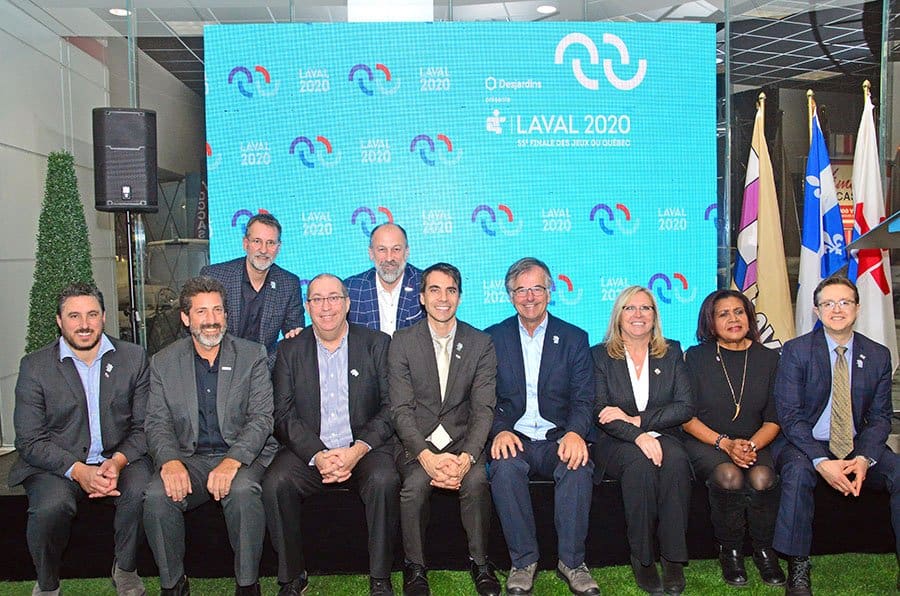
“We are determined to build an aquatic centre,” Mayor Marc Demers said in a statement. “We are talking about an infrastructure that is necessary for the well-being of Laval residents. On the other hand, we are not going to build it any price. We are aware that this decision will have an impact on the holding of certain events at the 55th finals of the Jeux du Québec in 2020.
Situation being analyzed
“In the greater metropolitan region, we see an increase in the number of work sites, but mostly in their costs,” Demers continued. “Our teams are presently analyzing various scenarios for the concretization of this much anticipated infrastructure. It must be done with respect for our capacity to pay. That is of utmost importance.”
According to the city, measures will be taken to protect the existing foundations for the aquatic centre in view of the approaching winter season. On Oct. 2, city council will be taking up the issue of an expense of $710, 930.75 to pay for the application of a waterproofing membrane on the concrete foundation. However, the city added that this waterproofing work would have been done anyway as part of the regular construction process.
The current issue of the Laval News volume 26-18 published September 26, 2018, (Laval’s English Newspaper), covers local events such as politics, sports and human-interest stories. It features editorials and other columns. Click on the image to read the paper.
Front page of Laval News, Vol.26-18 September 26, 2018.
And they’re off!: Runners in the 2018 Laval Terry Fox Run set off on the course in Parc des Prairies on the morning of Sunday Sept. 16.
Martin C. Barry
The second Terry Fox Run for cancer research held in Laval since 2004 raised nearly $5,000 for the cause. “The 2018 Terry Fox Run Day Laval held this past Sunday Sept. 16 in Parc des Prairies was a great day and a great success,” said the event’s chief organizer Jeffrey Marshall.
People from Laval and from all over were invited to walk or run at the family oriented non-competitive event. While many schools in Laval hold Terry Fox Runs for their students, this was one of the first Terry Fox Runs to be held in Laval in nearly 15 years.
The run was held with the support of many volunteers.
Participation up
“We had twice as many participants and volunteers versus last year for a total of just over 100 attendees,” said Marshall. “We had family and local Lavallers supporting the runners and walkers – everybody enjoyed the event and we expect most to return next year.
“We are very thankful to once again have had permission to use this beautiful park – a real gem for Laval and the Laval-des-Rapides sector,” he added. “We thank the special guests (including Mme. Eva Nassif, Mr. David De Cotis and Mr. Paolo Galati) and the people that supported the day and of course all of the participants.”
Volunteers in this year’s Laval Terry Fox Run shout out with enthusiasm before the event’s start in Parc des Prairies.
Elected officials take part
Despite the fact she was suffering from a foot injury that hadn’t yet entirely healed, Vimy Liberal MP Eva Nassif walked the course. “This is one of the biggest fundraising causes in the world,” she said in an interview with the Laval News. “We are all at some point touched by cancer, whether it’s family, a relative, a neighbor. We hope for a day when there is a cancer-free world.”
De Cotis pointed out that many buildings, parks, schools and other landmarks have been named after Terry Fox in the 37 years since he made his historic run. “This marathon is a marathon of hope, and our hope is that it ends up raising enough funds to put an end to cancer,” he said.
Among those who turned up at the 2018 Laval Terry Fox Run to show their support were (from the left) Laval city councillor for St-Vincent-de-Paul Paolo Galati, Vimy Liberal MP Eva Nassif, the event’s chief organizer Jeffrey Marshall and Laval city councillor for Saint-Bruno (and Deputy Mayor) David De Cotis.
Incredible results
Participants in this year’s Laval Terry Fox Run could raise money online at terryfoxrun.org, by gathering pledges from family and friends, or by submitting a donation on the day of the run. The efforts of Terry Fox Run participants have yielded incredible results.
Since 1999, the Terry Fox Foundation has financed over $50 million dollars for cancer research projects in Quebec. For those that wish to make a donation to the Terry Fox Foundation and the Laval Terry Fox Run can still do so by calling 1-888-836-9786 or on-line at: https://www.terryfox.ca/journeeterryfox/laval-fr, or at https://www.terryfox.ca/terryfoxrun/laval.
Vimy MP Eva Nassif, seen here with chief organizer Jeffrey Marshall, walked the Laval Terry Fox Run with a lame foot.
Sacred Heart School of Montreal has educated many generations of girls in the 157 years of its existence.
Martin C. Barry
Sacred Heart School of Montreal is growing again. The school’s international program is growing. The school’s enrolment has grown for a third year. And now Sacred Heart is one of a few select high schools in Quebec – and the first all girls’ school in Montreal – to offer a Grade 12 program.
“Our growth is proof to me that people want values-based education,” says Shawn O’Donnell, Head of the school for the past decade.
“They want an education that is more than just academics and that involves true values and character building,” he says. “We believe there is more of a need for our education and our values-based program than ever.”
A robotics program at Sacred Heart School of Montreal, conducted in conjunction with Loyola High School, allows Sacred Heart Secondary 2 student Meggie, left, to explore robotics with Loyola Secondary 4 student Ryan Meehan under the supervision of Dominique Levesque, a Sacred Heart graduate who is now a CEGEP student.
Faith-based, but inclusive
With a total school population of 230 girls, Sacred Heart School of Montreal offers boarding for 16 students, with room to accommodate 20 more boarders. The school prides itself on the small class size it offers, as well as a low 6:1 student/faculty ratio. One-hundred per cent of Sacred Heart School of Montreal graduates advance to post-secondary education.
While Sacred Heart School of Montreal was founded and continues to be based on traditional Catholic beliefs and values, girls from a wide spectrum of faiths are enrolled as students. “We’re very inclusive and various faiths are represented at the school,” says O’Donnell.
“Studies show that girls learn differently from boys,” says Director of Advancement Lili Le Fèvre, explaining some of the reasons the school offers single-gender education. According to O’Donnell, the girls are able to learn in a natural environment where they don’t feel pressure from the opposite gender. “They are free to be themselves,” he says.
Sacred Heart School of Montreal students Olivia, Cassidy and Gabriella are seen here with their mathematics teacher Josh Friedmann.
The Grade 12 program
As of August 2019, Sacred Heart School of Montreal will become the first all girls’ school in Montreal, and one of a select few high schools in the entire province, to offer a Grade 12 program. The program, offered in English, will be delivered online through a partnership with the Ontario Virtual School (OVS), in conjunction with physical classes taught by teaching specialists at Sacred Heart School of Montreal.
Students will be able to choose between a Commerce and a Science stream. Girls must have completed Grade 11, but do not require a Certificate of English Eligibility to attend. At the end of the one-year, full-time program, students will receive a Grade 12 diploma (OSSD) from the Ontario Ministry of Education, enabling them to apply to universities in Quebec, other Canadian provinces, the United States, and throughout the world.
Head of School Shawn O’Donnell explains aspects of the Sacred Heart School of Montreal program to parents during a recent open house event.
In Montreal since 1861
As part of a world-wide network of Sacred Heart schools operated by the Society of the Sacred Heart in more than 40 countries on six continents, Sacred Heart School of Montreal has been providing faith-based education since 1861 when the Convent of the Sacred Heart first opened its doors as a school for young girls.
At that time, the school was located on St. Hubert St. in Montreal and the enrolment was just 15 pupils. It was only after several changes of location that the current building on Atwater Ave., which has been a landmark for generations, opened in 1928 and started to receive students.
In 1982 the former convent was renamed Sacred Heart School of Montreal, as it underwent a transformation that installed a lay administration, with an understanding they would continue abiding by the mission and philosophy of the founders.
Vast educational experience
Sacred Heart School of Montreal is well-positioned to lead among providers of education in Montreal, in an increasingly crowded domain where some relatively new private educational institutions have no more than a few decades of experience behind them.
A strong point in Sacred Heart’s favor is its direct affiliation with hundreds of other Sacred Heart schools all over the world. With the sort of globe-trotting, fast-paced lives that many successful parents now lead, knowing there’s a Sacred Heart School in a distant city can be comforting.
Using its international network, Sacred Heart School of Montreal has a well-established exchange program that can provide enriching travel and learning experiences to senior students. Some of these exchanges have seen girls from Sacred Heart pursue studies in England, Scotland, Ireland, Belgium, France, Taiwan, Japan, Australia and New Zealand.
Among those attending Centre de Sablon’s 25th anniversary gathering on Sunday Sept. 16 was Chomedey city councillor Aglaia Revelakis, Chomedey MNA Guy Ouellette, Angelo Faraoni, general manager of the centre, and Liisa Shafer, Centre du Sablon’s director operations and human resources.
Martin C. Barry
To celebrate Centre du Sablon’s 25th anniversary, members of the Chomedey community were invited to the centre on Sunday Sept. 16 to take part in a Family Fun Day that included a range of activities and a picnic lunch.
Those who’ve lived in Chomedey longer than a quarter-century may remember a time before Centre du Sablon, when the building and its facilities were operated as the Chomedey branch of the Montreal region’s YM-YWHA organization.
Some of the physical exercises that visitors could indulge themselves in during the 25th anniversary gathering on the Centre du Sablon grounds.
A new beginning in 1993
In the early 1990s when YM-YWHA officials were increasingly finding that keeping their Chomedey centre open was no longer sustainable, a grassroots effort began in Chomedey, with assistance from the City of Laval, to take over the centre with a new mandate to serve a wider spectrum of the population.
“We’re here to stay and we invite families to come in,” said Angelo Faraoni, general manager of the centre, who was hosting the Family Fun day along with Liisa Shafer, Centre du Sablon’s director operations and human resources.
Angelo Faraoni, general manager of the centre, is seen here with illusionist and magician Blair Marshall during Centre du Sablon’s 25th anniversary event.
Activities for all
On the grounds behind the centre, staff and volunteers helped conduct demonstrations of yoga as well as exercise “boot camps.” There was also a bake sale, with proceeds going towards reinvesting in the centre’s activities, and there was face-painting for the kids and inflatable games. Strolling magician Blair Marshall was also there to demonstrate some of his powers of illusion.
“After 25 years, Centre du Sablon is, of course, a very important presence in the Chomedey community,” said Chomedey Liberal MNA Guy Ouellette who came during the afternoon to enjoy some of the festivities.
Chomedey city councillor Aglaia Revelakis sat on the first board of directors that was set up to oversee Centre du Sablon when the centre first came into being. “I am very happy to see how it has evolved over the last 25 years and where we have taken it,” she said.
Thanks expressed to board
“And I would like to congratulate the board of directors,” she continued, “as well as Angela, for the tremendous work they do to keep the centre going and to have activities for the community at large – the English community most.
“The focus is on the English community. It’s open to everybody, but we need an English centre, and this is the focus in Chomedey. We continue building and growing the centre and taking it towards newer paths in the future.”
Du Sablon has lots to offer
According to Shafer, the centre meets the needs of a wide range of residents from Chomedey. “It brings sports and leisure activities to people who might not necessarily be able to afford it,” she said.
“And we offer a vast variety of activities for all ages and all ethnicities. We have Arabic classes, English classes, French classes. We have all sorts of sporting classes, and of course our aquatics. Almost every one of our aquatics classes is full. And we have many special needs classes. There is something here for everyone.”
Once again this year, the Terry Fox Run to raise money for cancer research will be taking place in Laval. The popular event will be held at Parc des Prairies on Sunday Sept. 16 beginning at 10:30 am. Members of the community are invited to take part in this non-competitive family event by walking or jogging to raise money for the cause.
A number of schools in Laval are holding Terry Fox Days for their students, although on Sept. 16 the Terry Fox Run in Parc des Prairies will be open to all. Participants can solicit donations online beginning from the web site terryfoxrun.org, by gathering donation pledges from friends and family members, or by making donations in person on the day of the Terry Fox Run.
Research paying off
The work done by participants in Terry Fox Day has led to some tremendous results. “We have visited research centres in Montreal where the Terry Fox Foundation financed research projects on cancer,” says Jeffrey Marshall, who has spearheaded organization of the Laval Terry Fox Run in the past few years.
“We must continue to support this very important cause and contribute to helping make Terry Fox’s dream a reality,” he added. “Let’s do our part while participating in Terry Fox Day on Laval this year.” Those wishing to serve as volunteers can get in touch with the organizers qc@terryfox.org, or by calling 1-888-836-9786. For additional information, the web site is www.terryfox.org/fr/.
William Émard is receiving his bursary from the hands of Sylvain Cossette, President and Chief Executive Officer for Cominar. Photo credit: Gilles Fréchette
(TLN)
Cominar, one of Canada’s largest real estate investment companies,awarded $40,000 in bursaries to 11 student-athletes through the Fondation de l’athlète d’excellence du Québec (FAEQ).
Sylvain Cossette, president and CEO at Cominar, revealed the names of the 11 student athletes who took part in the FAEQ’s fourth bursary program sponsored by Cominar. Altogether they received a total sum of $40,000.
Recognizing excellence
“It is with great joy that Cominar joins together with the Fondation de l’athlète d’excellence in order to recognize academic and sports excellence in Quebec, and this for a fourth consecutive year,” said Cossette. “The success of these student athletes across the province inspires all the employees at Cominar and it is with great pride that we support 11 of them today,” he added.
This year, according to the FAEQ, seven academic excellence bursaries were awarded in recognition of the excellent scholastic achievements of some students, as well four academic and sports bursaries in order to encourage conciliation between sports and studies to the greatest extent.
Helping young athletes
Claude Chagnon, president of the FAEQ, noted that in recent years the organization has provided support to a number of student athletes who went on to enjoy success in their chosen sport.
They include freestyle snowboarder Laurie Blouin who won a gold at the 2017 Ski and Snowboarding World Championships and a silver medal at the Winter Olympics in Pyeongchang; cross-country skier Alex Harvey; paralympic wheelchair basketball player Cindy Ouellet; and professional tennis player Félix Auger-Aliassime.
Some facts about William Émard
Age: 18 / Artistic gymnastics
Birth: 17 March 2000 in Laval / School: Collège Montmorency
Bursary: $4,000 for academic excellence
Gold medallist on the rings in the Japan Junior Cup
Gold medallist in general program at the Austrian Future Cup
Silver medallist with the Canadian team at the Pacific Alliance Championships
Currently studying natural sciences at Collège Montmorency where he is maintaining a grades average of 80 per cent
William is said to be very good at managing the intense pressure that is typical of this demanding sport. He aspires to go easier on himself, while developing more patience and becoming more confident. He hopes to take part in the Pan American games next year, as well as the world championships and the Olympics in 2020 and 2024. Beyond athletics, he also hopes one day to have a career in physiotherapy or sports medicine.
Québec Solidaire spokesperson Manon Massé, centre, is seen here with the party’s six candidates in Laval during the launch held by QS at the Dallas Bar on Cartier Blvd. West last week.
Martin C. Barry
“Politics is not democracy,” Québec Solidaire co-spokesperson Manon Massé told a boisterous crowd of supporters who got together on Sept. 4 at the Dallas Bar on Cartier Blvd. West to launch the party’s 2018 provincial election campaign in the Laval area.
Defining democracy
“Democracy is you,” said Massé, who shares spokesperson status with Gabriel Nadeau-Dubois. “And if you don’t concern yourself with it, you can be sure that the politicians will be taking care of it. We’ve known for a long time that the system as it is currently organized, that the system with the decision-makers we have now, is offering us solutions which make no sense whatever.”
The message from Massé and her party was that “it takes a change of direction with people who have enough courage, like the people from Québec Solidaire, like you, people with enough courage to go and find the money necessary to make the necessary economic change to make sure that our water, our natural resources, and even the relationship between us and nature, is taken care of.”
Québec Solidaire candidate in Chomedey Rabah Moulla was introduced and greeted by party spokesperson Manon Massé during the launch held by QS in Laval-des-Rapides last week.
A ‘radical’ alternative
Massé said the QS members who now sit in the National Assembly don’t want to be there just to vote for a system that never changes. “What we want is to take power because we want to change things profoundly, and I am going to use the word ‘radical.’”
Originally from the town of Windsor in Quebec’s Eastern Townships, Massé grew up in a family whose existence depended largely on the paper mill which was and remains that municipality’s principal employer. In talks to Québec Solidaire members, she often emphasizes her working class roots and the necessity for Quebec’s economic strategy to increasingly reflect the needs of workers.
Environmental issues
Québec Solidaire candidate in Laval-des-Rapides Graciela Mateo, who was one of several speakers during the rally, said QS shares the same environmental preoccupations as a large segment of the Quebec population and stands ready to take action.
“The resources of this planet are not inexhaustible,” she said. “Its various eco-systems can’t go on being disturbed indefinitely. There is no time left. Each act counts. We can no longer accept the unacceptable, doing nothing, the absence of political courage to make things happen.
Québec Solidaire’s Manon Massé makes no apologies for admitting the party’s ideas and platform are more radical than any of the other political parties in Quebec.
Time to act, says candidate
“We know that if we had better public transit by making it more accessible, we would use our cars less often and we will pollute as well,” she continued, pointing out that Québec Solidaire recently proposed cutting public transit fares in half across the province. She said the party also wants to encourage local and urban farming as another way of reducing pollution while contributing to healthy lifestyles.
“You will find when you see our platform that our plans are ambitious,” she continued. “But there’s a reason for that – there’s no time left and we must act right away. Climate warming is affecting our lives and quality of living in each instant. But only one MNA in the National Assembly isn’t good for much. So we need your participation. But what else do we need? We need Manon Massé in order to have the courage to change things at the root.”
From the left, Notte In Bianco guest Jean-Sébastien Charrette, Maria Guzzo, Vince Guzzo and guest Alex Decalonne.
Martin C. Barry
The eleventh annual Notte in Bianco, a dress-white fundraising event held on Sept. 6 at the Terrebonne home of Maria and Vincent Guzzo of Cinémas Guzzo, raised around $300,000 to help support innovative children’s mental health research.
Summer white tradition
Based partly on a summertime party tradition the Guzzos brought back to Montreal from the Hamptons on the ocean coast of New York State where they have spent many summers, dress white is considered ‘de rigueur’ each year for Notte In Bianco.
Several hundred guests pay $1,000 a ticket each year to take part in an event that is regarded as a must on the Montreal social calendar. The guest of honor this year was Steve MacLean, a Canadian astronaut who served as a mission specialist on the International Space Station in September 2006. MacLean is also a former president of the Canadian Space Agency.
From the left, Nadine Wielgopolski and her husband Canadian astronaut Steve MacLean, and Louise Légaré with her husband Roger Légaré, a longtime Notte In Bianco supporter and board member.
Shared concern for youth
The Guzzos discovered recently that MacLean shared their concern for youth mental health causes and decided to invite him aboard for their event. “A lot of youths look up to him since it’s every boy’s or girl’s dream to one day become an astronaut,” said Maria Guzzo. “We decided he was the perfect fit.”
MacLean said in an interview with Newsfirst Multimedia that when he was asked, he accepted without hesitation, “because it is an important issue. But especially there are now ways to deal with youth mental health problems. It’s something that if caught early enough, intervention can really make a difference. I’m here to support that.”
In keeping with tradition, Notte In Bianco guests were treated to champagne upon arrival at the Guzzos’ home in Terrebonne.
Guest star Gloria Gaynor
The evening’s star musical guest was 1970s-era disco queen Gloria Gaynor, best known for her hits ‘I Will Survive’ and ‘Never Can Say Goodbye.’ In the past, Notte In Bianco has welcomed Corey Hart, Taylor Dane, Ginette Reno and many others. This year’s guest list also included Hydro Quebec CEO Michael Penner, Parasuco Jeans founder Sal Parasuco, as well as Nadia Saputo, a member of the Saputo family of Saputo dairy products fame.
Although proceeds from Notte In Bianco went for the first eight years towards a research chair at University of Montreal investigating links between environmental causes and cancer, in 2015 the Guzzos decided that goal had been attained and shifted the focus of their fundraising towards youth mental health.
A cocktail reception held before the evening’s main dinner and entertainment event included a seafood bar.
Numerous causes supported
However, according to Maria Guzzo, part of the funds raised each year through Notte In Bianco continue to support an imaging unit at the Jewish General Hospital’s Pavilion K emergency department, as well as to the Shriners’ Hospital which they also furnished with equipment used for medical imaging.
The imaging units were donated to better accommodate patients at the hospitals’ emergency departments as well as to provide a more functional working environment for health professionals. The units reduce test wait times for patients in emergency, thus shortening waiting times for test information coming from external clinics.
Federal Infrastructure and Communities Minister François-Philippe Champagne received his new portfolio on July 18.
Federal Infrastructure and Communities Minister François-Philippe Champagne had mud on his boots when he arrived for an interview with Newsfirst Multimedia at the federal cabinet’s Montreal offices in Old Montreal in early August.
But there was good reason. He had just completed an inspection at the site of the massive new span currently being built across the St. Lawrence River to replace the aging Champlain Bridge.
It was a fitting introduction to a federally-elected official who seems to prefer a direct and hands-on approach in all his dealings. The 48-year-old Champagne, who is the Member of Parliament for Saint-Maurice–Champlain in Quebec’s Mauricie region, is on fairly familiar ground when it comes to bridges.
Infrastructure and Communities Minister François-Philippe Champagne (centre of photo) is seen here during a recent tour of inspection he made at the new Champlain Bridge project.
Knows infrastructure
According to a CV of Champagne’s credentials and experience over the past two decades, he served on the board of Incheon Bridge Corp., which operates a cable-stayed span and roadway that are a major piece of road transportation infrastructure in South Korea.
A lawyer and international trade specialist, Champagne was also, among other things, a senior legal counsel for the multinational industrial equipment manufacturer ABB Group, before being appointed Minister of International Trade last year. He received his current portfolio from Prime Minister Justin Trudeau on July 18.
“Anyone who’s coming into politics is bringing in their background in terms of professional qualifications and experience,” said Champagne. “I did have a chance as a lawyer, not as an engineer, to work in a number of engineering firms in my previous roles in the private sector. So I know big infrastructure projects and that’s why I’m very excited in this role.”
New Champlain Bridge
Regarding the new Champlain Bridge, Canada’s auditor-general issued a statement last May, saying there was uncertainty as to whether the bridge will be finished by a projected completion date of Dec. 21 this year. All the same, more than three-quarters of the $4.2 billion project is now finished.
“What is known is that the work is well in advance,” Champagne said when asked about the progress of the project. “But the objective and what I will be doing in the coming weeks is sitting down, as you would expect, with the experts, because this is a very complex project. So I want to really sit down with the experts to really understand what are the opportunities and what still needs to be done.”
Infrastructure and Communities Minister François-Philippe Champagne consults with new Champlain Bridge construction officials during his first inspection of the structure in early August.
Making sure it’s done right
In his report, the auditor-general did not clearly confirm an earlier claim made by the federal government and the consortium building the new bridge that it will last 125 years. Nonetheless, Champagne emphasized the importance of getting the project done properly, although delays might also have an economic impact.
“You know when you look at an infrastructure that complex and that will go well over a century, I think the people who are reading your paper would want to make sure that we get it right,” he said.
“I think the bottom line is to make sure that we get it right, because this is an infrastructure that I want every Montrealer, Quebecer and Canadian to be extremely proud of what we have achieved together. There are more than 1,500 workers on the site and every time I have the opportunity, I go around to thank them personally for their work.”
A Jean Chrétien admirer
According to a profile in the Toronto Globe & Mail in 2009 (six years before Champagne first went to Ottawa), he was inspired to get into politics by another high-profile native of Shawinigan and Liberal – former Prime Minister Jean Chrétien. Perhaps for that reason, Champagne has a certain directness about him that was also a notable quality of the ex-PM and MP Saint-Maurice.
“When you come from Shawinigan and you’re a kid and you have a towering figure like Jean Chrétien, it’s obvious,” he said, confirming his admiration. “I always wanted to serve. I was involved quite early in my life in different organizations. And that’s why I left the private sector. I spent a good part of my career in firms around the world. But I always wanted to serve the people from Shawinigan.”
Impact of carbon tax changes
In early August, the Liberal government in Ottawa announced that it had decided to scale back carbon pricing guidelines in preparation for next year when a price range is supposed to be applied on industrial carbon emissions. Some programs offered by Champagne’s ministry involve the creation of environmentally-sustainable and “green” infrastructure.
“We’re going to continue our historic investment in green infrastructure,” he said when asked whether the carbon pricing modifications stand to alter plans at his ministry. “I think Canadians from coast to coast to coast understand that global warming is probably the most challenging issue of all time. And certainly they expect their federal government to be at the forefront leading.
“Certainly from an infrastructure perspective, my mission is to build modern, resilient and green infrastructure,” he added. “I think Canadians expect that. They expect infrastructure that we’re building now and for decades to come to be mindful of the environment, and that’s how we can lead the way.”