(TLN)
A new addition was recently made to the City of Laval’s sports facilities with
the opening of eight new outdoor beach volleyball courts.
It’s
worth noting that those using the new courts will be taking part in a sport
that will be part of the 55th finals of the Jeux du Québec being held in Laval during the summer of 2020.
Although paid for by the City of Laval, the courts
will be managed and maintained by the Centre sportif
Bois-de-Boulogne.
Photo :
(Left to right), Yves Carignan, president of the organizing committee for the
55th Finale des Jeux du Québec – Laval 2020, Philippe Ciarlo, general
manager of the Complexe Bois-de-Boulogne, Dynamik, mascot for the 55th Finale
des Jeux du Québec – Laval 2020, Stéphane Boyer, municipal councillor for
Pont-Viau and Nicholas Borne, municipal councillor for Laval-les-Iles.
(TLN)
It was with shock and great sadness that Laval mayor Marc Demers, as well as
the members of the executive-committee and city councillors, learned last week
of the sudden death of their colleague, Councillor Gilbert Dumas.
Dumas, who represented
Marc-Aurèle Fortin, was city
councillor for the district since 2013 and was also one of the original
councillors elected under the banner of the currently governing Mouvement
lavallois municipal party.
Condolences
from mayor
“My first words are for the daughters of Gilbert, his
immediate family and his friends to whom I send my most sincere condolences on
behalf of all our team,” Demers said in a statement.
“Mr. Dumas was liked by all his colleagues, all the
members of the cabinet as well as the staff of his colleague councillors,” he
continued. “His upbeat attitude and his team spirit
were an inspiration to everyone, and the faithful support he provided all his
colleagues was especially valuable.
A personal loss, says
Demers
“As
concerns me personally, as with many of us I am losing a greatly valuable
colleague as well as an inestimably valuable friend. All the moments shared
with Gilbert will always remain as memories, of the same sort as those we have
for those who are most meaningful to us.”
In
addition to the mayor’s remarks, the Mouvement lavallois also issued a
statement on Gilbert Dumas’ passing.
Could always be counted
on
“In
the name of the party to which he gave so much, in the name of the
executive-committee of the Mouvement lavallois/Équipe Marc Demers and supporters, I would to offer my most sincere condolences
to his daughters and his close family members,” said MLEMD president Lyne
Sylvain.
“As president of the party, I really must say that
from the earliest days Gilbert could always be counted on for his assistance
and caring each time we called upon him for his services,” she added. “We are
losing a man of great value as well as a loyal friend.”
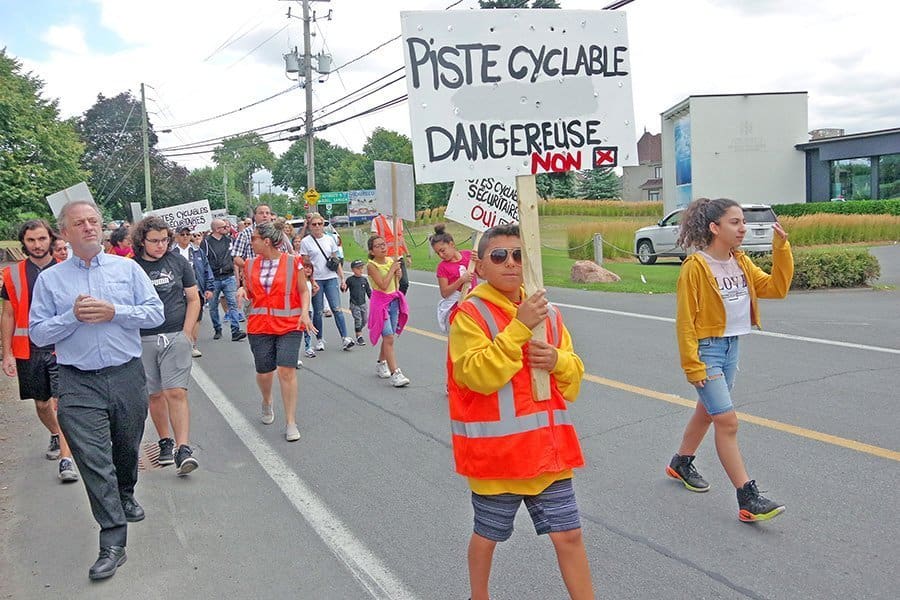
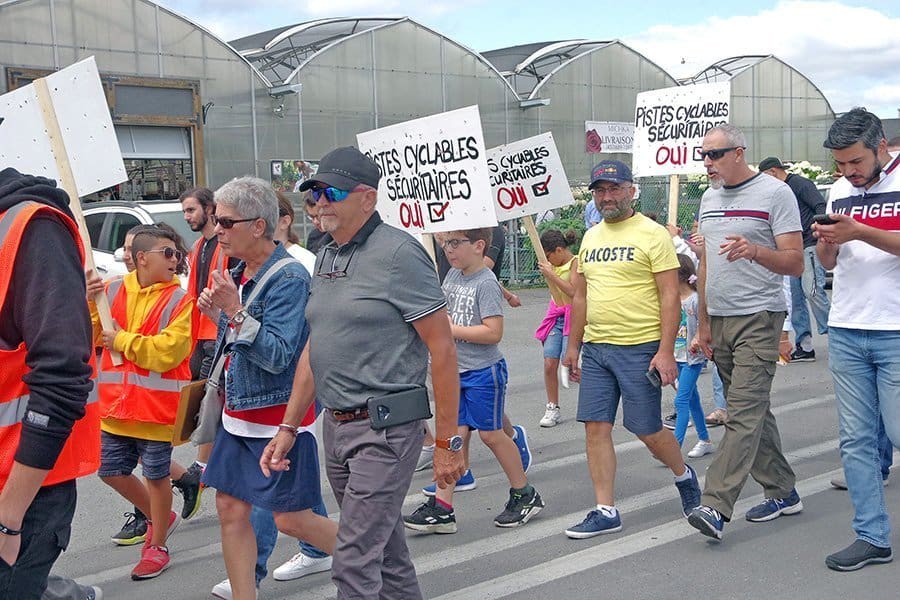
Demonstrators objecting to the way the City of Laval configured a bike path in Sainte-Dorothée make their along Bord-de-l’Eau Rd. last Saturday.
Martin C. Barry
After staging a demo last May on the east side of
Laval on the configuration of the city’s network of bike paths, members of the
Action Laval city hall opposition spent part of last Saturday drawing attention
to the issue on the west side in Sainte-Dorothée.
A trouble
spot
Up to 100 people from the area as well as from other
Laval districts took part in the march that started near the corner of Samson
Blvd. and Cléophas Charbonneau St. then proceeded
westward along Bord-de-l’Eau Road.
Samson
and Cléophas Charbonneau is considered to be an especially troublesome spot,
because of massive traffic bottlenecks that take place at the intersection on an
almost daily basis during rush hours.
Few bicycles on path
While
dense rush hour traffic at the corner of Samson and Cléophas Charbonneau has
been a common sight for years, critics say the situation got worse when the
city reduced the number of regular traffic lanes to create the bike path. They
also say that during rush hours few people are actually using the bike path.
Regarding
the Vimont and Sainte-Dorothée bike paths, Action
Laval’s position is that the administration of Mayor Marc Demers used a
one-size-fits-all approach when implementing the paths, rather than taking into
account local factors.
Rush hour
traffic jams
“We’re here to try to convince the city that these
bike paths are unsafe and very problematic, especially for the residents of
Sainte-Dorothée,”
said Action Laval city councillor for Chomedey Aglaia Revelakis. (The area is
represented by Mouvement lavallois councillor Ray Khalil, who was not present
at the protest.)
“There is major traffic congestion here every
morning,” added Revelakis. “It takes people at least an hour just get from home
to Autoroute 13. We want to the city to understand that we are not against bike
paths. But at the same time we have to make sure than when they are installed
they are safe and not problematic.”
‘Not Le
Plateau’: Revelakis
Revelakis and others believe the city greatly
underestimated the number of bicycle users in Sainte-Dorothée
and other areas in Laval when it began
implementing the bike path network several years ago as part of an overall
traffic plan.
“People have to understand that Laval is not Le
Plateau,” she said, referring to the trendy neighbourhood near downtown
Montreal. “We are not accustomed to taking our bikes to go to work.
Caution
with bike paths
“Yes, bikes are good and we must encourage anything
that is good for the environment. But at the same time there has to be caution
when installing these bike paths. Because if they’re problematic and causing
people problems, then that’s a problem that needs to be fixed.”
Action Laval city councillor for Saint-Bruno David De
Cotis noted that the traffic which idles daily at the intersection is pumping
additional pollution into the atmosphere while cancelling any environmental
benefits from the bike paths.
“How much greenhouse emissions is each motorist
causing?” he asked. “We’re not against bike paths. We’re against the way the
administration of Marc Demers randomly deployed these bike paths.”
A
resident’s perspective
Hassan Ibrahim, a Sainte-Dorothée
resident who took part in the protest, agreed that the intersection is very
problematic and the situation is made worse by a poorly-implemented bike path.
“I
live five minutes from here, but every morning I wait here for up to an hour
just to get onto the thirteen,” he said, while adding that he is seriously
considering moving out of the area. While admitting that he and his family own
bicycles, he said getting to work on time in the morning is their priority.
The Société de transport de Laval (STL) unveiled recently Québec’s first battery-electric city bus with a range of 250 km, which will be used for testing and validation ahead of the 2020 entry into service of the province’s first all-electric bus line. The unveiling event was attended by Eva Nassif, Member of Parliament for Vimy, representing the Honourable François-Philippe Champagne, federal Minister of Infrastructure and Communities; François Bonnardel, Québec Minister of Transport and Minister responsible for the Estrie Region; and Marc Demers, Mayor of Laval.
The 100% electric bus line will comprise 10 such vehicles, acquired as part of the largest contract for electric-bus production ever awarded in Québec. The STL initiated the project to procure 10 40-foot slow-charge electric buses in collaboration with the Association du transport urbain du Québec (ATUQ). The Société de transport de Montréal (STM) participated in the call for tenders with an order of 30 additional buses.
Besides reducing greenhouse gas (GHG) emissions by 70 to 80 tonnes a year, the electric bus will offer transit users a smoother and, especially, a quieter ride. It has a range of 250 km and will be charged overnight at the STL garage; this type of vehicle will therefore guarantee service flexibility for the transit authority. Canadian-based New Flyer Industries Canada ULC has received the contract to manufacture 10 battery-electric buses for the STL, for summer 2020 delivery.
Procurement of the buses is made possible thanks to $9.6 million in financial assistance from the governments of Canada and Québec, through the federal Gas Tax Fund (GTF) and the Programme d’aide aux immobilisations en transport en commun (public transit capital acquisitions assistance program) of the Société de financement des infrastructures locales du Québec (SOFIL), respectively. The Government of Canada is contributing $6.8 million, while the Government of Québec is extending $2.8 million in aid.
Quotes:
“I am delighted to be here today to mark the arrival of this first electric bus, which, along with the nine others to come, will help reduce greenhouse gas emissions while improving the overall experience of Laval transit users. Investing in public transit infrastructure is vital for building sustainable communities and supporting growth that benefits everyone. With the amounts available through the GTF, communities can count on stable, long-term sources of funding to plan and implement their local infrastructure projects.” —Eva Nassif, MP for Vimy, representing the Honourable François-Philippe Champagne, Federal Minister of Infrastructure and Communities.
“The addition of this all-electric bus to the STL network perfectly embodies the essential shift in direction that we must make in Québec. I am therefore very pleased to be taking part in today’s inauguration, and I hope this initiative will have a ripple effect on other transit authorities in Québec.” —François Bonnardel, Québec Minister of Transport and Minister responsible for the Estrie Region
“Thanks to the STL’s determination to pursue innovation, today we’re welcoming this first all-electric city bus, which will save 70 to 80 tonnes of GHG emissions every year. This public-transit vehicle of the future is great for the environment, first of all, and second, it will make for a more enjoyable user experience, since it’s quieter. Electric buses are clearly part of our future vision in Laval.” —Marc Demers, Mayor of Laval
“A leader in electrification since 2012, the STL is today taking a major step toward the full conversion of its network by taking delivery of this new battery-electric bus. We are powered by positive energy and committed to reducing our GHG emissions by 45%, and these slow-charge vehicles will ensure that we meet that target. By 2024, purchases of gaspowered buses will be a thing of the past for the STL.” —Éric Morasse, Chairman of the Board, STL
(TLN)
The members of the City of Laval’s executive-committee made several significant
decisions on Aug. 14 involving grants to local community organizations, as well
as an agreement involving the development of Laval’s downtown core.
Subsidies for groups
The
executive-committee members approved a subsidy from the Social Economy Fund
(FES) of almost $100,000. The sum will be divided between several community groups
in Laval.
For
example, Diapason-Jeunesse will be receiving $10,000 in order to assess the
shared use by several organizations of a single space administered by a
cooperative. As well, the SCAMA Centre is receiving a $30,000 subsidy to put
into a place a multiservice client service desk.
More subsidies
As
well, the Association des résidents de Champfleury and Loisirs Renaud-Coursol
will each be receiving $5,000 each to work out their strategic planning. And Théâtre
Bluff will be receiving $30,000 to further their growth and increase their
exposure through publicity and marketing.
Since
the beginning of this year, the executive-committee has approved subsidies from
the Fonds Jeunes Promoteurs in the amount of $70,000 to help young
entrepreneurs create their own businesses.
CSDL receives funds
The
executive-committee also approved a $52,000 subsidy to the Centre communautaire
Val-Martin. At the same time, the executive-committee approved a $20,000 grant
to the Commission scolaire de Laval for their “Accessibilité culture” project
to encourage access to culture for the largest number of students possible.
Finally,
the executive-committee recommended to city council that they approve an
agreement between the city and the Senseable City Consortium (SCC) at Massachusetts
Institute of Technology (MIT). Through the agreement, the Senseable City Lab is
mandated explore and find innovative new ways to develop the City of Laval’s
growing downtown core.
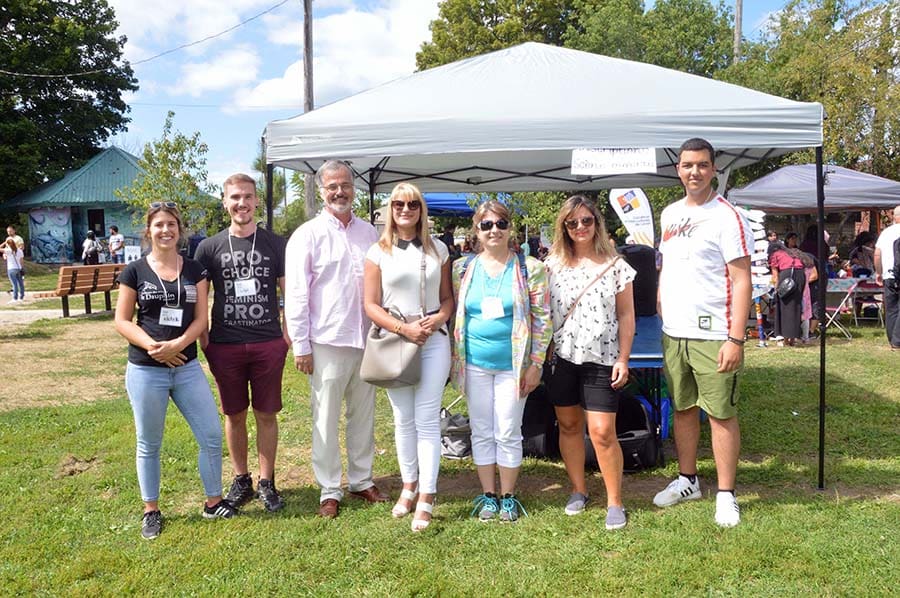
Chomedey MNA Guy Ouellette and Saint-Martin city councillor Aline Dib are seen here organizers and volunteers during the Fête de Quartier de Chomedey last Saturday in Labelle Park.
Martin C. Barry
Hundreds
of residents of Chomedey got to meet their neighbours while enjoying a day of
fun and games at Parc Labelle near the heart of the district on Aug. 24 when
they turned out for the 11th annual Fête de Quartier de Chomedey.
Great summer weather
Many
moms, dads, children and grandparents enjoyed a day that was unmatched for fine
late summer weather. They saw stage entertainment and organized events for the
kids. And, as is the case each year, the Fête de Quartier promoted healthy
living.
Among
the many things to see and do were inflatable games, demonstrations of martial
arts by experts, dancing on stage, and information booths sponsored by community
organizations.
Among the elected officials who came out to greet
their constituents during the afternoon were Chomedey MNA Guy Ouellette,
Saint-Martin city councillor Aline Dib and Chomedey city councillor Aglaia
Revelakis.
Among the sports activities to be enjoyed were scrimmage soccer matches.
A learning
experience
“This is a good way for the Chomedey residents to come
out and learn about the different services that are available to them,” said
Revelakis. “They can also enjoy all the activities, including many for the
kids. But this is mostly a day for the kids to come out and have fun before
they go back to school.”
“For us, this is a tradition around the end of the
summer and an opportunity to spend some time with our citizens,” said Dib. “It
is also important for me to be here with my constituents,” added Ouellette.
New
location this year
This was the first year the Fête
de Quartier de Chomedey took place in Labelle Park, after being staged
previously in Pie X Park. Marlène
Paradis, a spokesperson for the
organizing committee, said the organizers wanted to hold the event this year in
a location that was closer to the centre of Chomedey.
According to Paradis, more than 20 organizations
accepted an invitation to take part. They included Le Chez Moi des Petits, the
City of Laval’s mobile public library, the Centre communautaire Val-Martin, Au
Panier de Chomedey and the Maison d’enfants Le Dauphin.
The current issue of the Laval News volume 27-16 published August 28th, 2019, (Laval’s English Newspaper) covers local events such as politics, sports and human-interest stories. It features editorials and other columns. Click on the image to read the paper.
Front page of Laval News, Vol. 27-16
August 28, 2019.
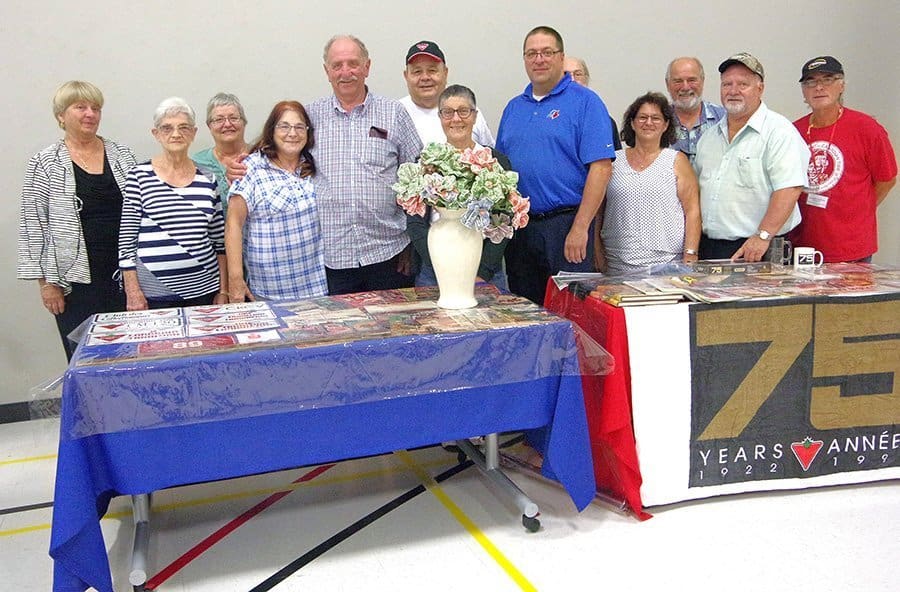
Some of the CTCC members and memorabilia dealers who attended this year’s convention held Aug. 17 at Collège Citoyen in Laval.
Martin C. Barry
After introducing much of the rest of the country to
the joys of collecting memorabilia issued by Canada’s most iconic retailer,
members of the Canadian Tire Collectors Club chose Laval for their 17th
annual national convention earlier this month.
Canadian
Tire collectibles
Held on Aug. 17 at Collège
Citoyen in Sainte-Rose, the all-day event brought together several dozen
collectors who are fascinated with every kind of Canadian Tire memorabilia, including
the company’s emblematic discount bank notes, as well as books and toys imprinted
with the famous Canadian Tire logo.
Like-minded
collectors of Canadian Tire items first formed the Canadian Tire Collectors
Club in 1990. Since then, the value of CT collectibles has risen exponentially.
A Canadian Tire die-cast truck was sold by one dealer at this year’s convention
for $1,000.
All kinds of
memorabilia
While
the first collectors were interested primarily in bank notes, since then others
have expanded with the collection of old CTC catalogues, limited edition
die-cast cars and trucks, commemorative pins, colourful gift cards, tokens and
limited edition coins.
However,
the list goes on to include such odd items as patches, frisbees, hockey pucks
and golf balls, all of which have become Canadian Tire specialty memorabilia
among certain more advanced collectors.
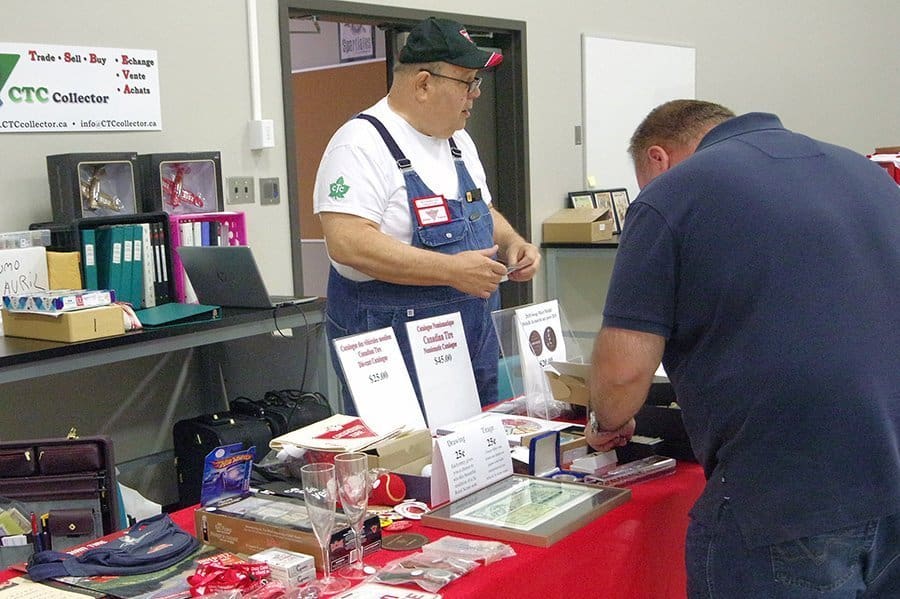
Left, Jerome Fourre of Blainville, who organized this year’s national CTCC convention, is seen here with a buyer of some of his extensive line of Canadian Tire collectibles.
A Canada-wide
gathering
This year’s convention was organized by Jerome Fourre,
a resident of Blainville on the North Shore, who’s been collecting CTC
memorabilia since 1987. Last year’s CTCC convention took place in Edmundston,
NB and the group’s gatherings have taken place in major cities virtually
everywhere in the country.
Fourre had previously been a collector of Canadian
government-issued coins. However, following a home robbery, during which the
thieves made off with everything except his collection of Canadian Tire money,
Fourre decided the most secure investment in collectibles he could make was
Canadian Tire bank notes. He has stuck faithfully to that formula since then.
Valuable
memorabilia
“At that time no one appreciated Canadian Tire money,”
he said in an interview. Some examples of CTC bank notes in his collection that
have become valuable are a $1 bill now valued at $600. Another note is worth
$3,000. He estimates his $25,000 in face-value CTC notes are worth $500,000
based on their value to collectors. He figures his entire collection is worth
around $1million.
Collectors of ubiquitous Canadian Tire bank notes
grade it based on a value system identical to one used for establishing the
collectors value of regular bank notes. The Canadian Bank Note Co., which
prints all of Canada’s currency, has printed Canadian Tire money since 1972,
prior to which it was printed by the British American Bank Note Co.
Paper notes
still circulate
Although Canadian Tire Corp. announced the cancellation
of its bank note program five years ago, according to Fourre the company never
moved forward with the plan and CTC money continues to be issued and circulated
to this day.
Among Fourre’s most valuable memorabilia is a 1927 CTC
catalogue issued just a year after the company first started publishing them.
He has more than 600 catalogues in his collection, as well as an assortment of
Canadian Tire license plates. A special sub-category of his overall collection
enshrines memorabilia issued to commemorate Canadian Tire’s 75th
anniversary in 1996-97.
Conrad Lauzon of Edmundston, NB was among the many Canadian Tire memorabilia collectors who met in Laval for their 17th annual Canada-wide gathering.
Why they
chose Laval
Although the club might have chosen central Montreal
to stage this year’s CTCC gathering, Fourre explained why they chose Laval. “We
were looking around and we found the location of Laval is ideal,” he said,
noting the city’s direct access to Pierre Elliott Trudeau Airport along
Autoroute 13. As well, he said Laval’s hotel accommodations are more reasonably
priced than in Montreal.
Among the collectors from all over Canada who came to
Laval for the Canadian Tire collectors
Club’s 17th annual gathering was Conrad Lauzon, a former Canadian
Tire store operator/owner who is now retired after 40 years of service.
Values his
CTC service pins
“My first discount coupon, which I acquired in 1972, I
still have in my possession,” he told The Laval News, while adding that it is
not for sale. Lauzon’s most treasured collectibles are the service pins he
received over the course of the four decades he spent affiliated with the
corporation.
Lauzon had the great honour during his career of meeting
several members of the Billes family, who founded and continue to take an
active interest in the company. Canadian Tire was founded in Toronto in 1922 by
brothers John William Billes and Alfred Jackson Billes. A.J. Billes’s daughter,
Martha, owns a controlling share of the company’s common stocks to this day.
A preview of some of the spectacular light displays to be seen at Illumi, which opens in Laval in early November.
Martin C. Barry
Laval Mayor Marc Demers, Quebec Tourism Minister Caroline Proulx and Cavalia founder Normand Latourelle met at Cavalia’s
offices on Aug. 20 to unveil Illumi,
a spectacular outdoor light show that will be held in Laval from early November
through the Christmas holidays.
The lights were switched off at Cavalia on d’Iberville Street in Montreal as
dignitaries and guests wandered through the glow of light structures that will
decorate the gigantic Illumi site.
10 million
points of light
Located alongside Autoroute 15 near downtown Laval where Cavalia staged
their spectacular equestrian shows for many years, the Illumi site
measures 50,600-square metres – an area equivalent to 30 hockey rinks.
When completed, the Illumi show will illuminate the night
with more than 10 million brilliant lights in the largest multimedia sound
and light show on the planet, according to its creators.
The night-time outdoor event, which Cavalia says will
be “a magical, captivating and extraordinary journey” created from thousands of
colourful light structures, will be open until early January 2020.
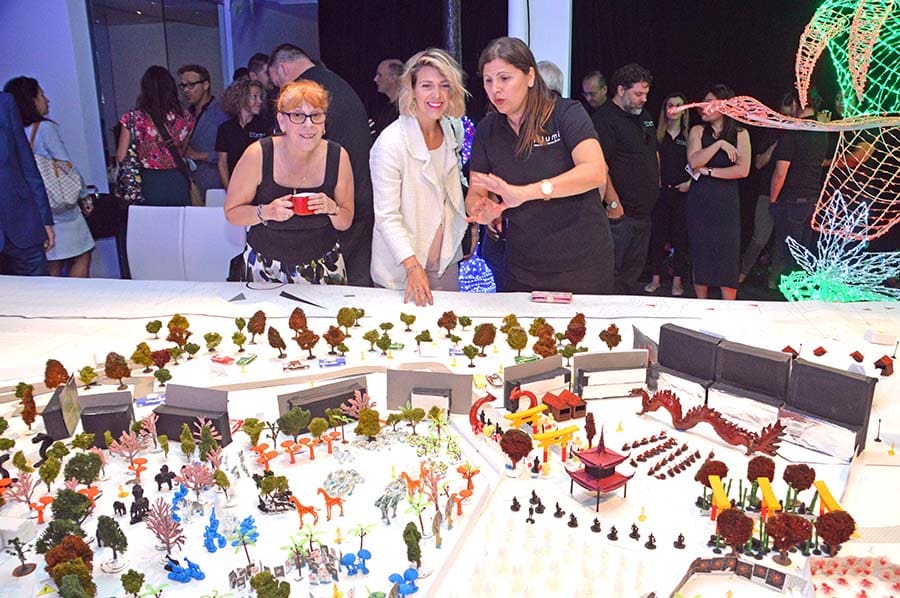
Guests at the Illumi preview last week got a glimpse of the light show, opening in November, from this scale-model.
Five-year
contract with city
Ticket prices will be ranging from $14.50 to $26.50 (+
taxes). The City of Laval has signed a contract with the company that will see
the show or a variation of it continue over a period of five years.
“I am very happy to have Cavalia returning to our city
with a new, unique, world-class artistic concept that will make Laval shine,”
said Demers. “We have entered into an agreement for the production of this
event, with an investment of $750,000 over five years that will generate major
economic benefits for Laval and for Quebec as a whole.
Local
employment creation
“This event will also make it possible to support over
120 jobs, most of which will be right here in Laval,” he added. “We believe
that with Illumi
we will continue to rank as a choice tourist destination.”
Proulx announced a $2 million subsidy for the Illumi
project as part of the Quebec government’s efforts to develop event tourism and
promote Quebec products in order to stand out from the international
competition.
The project has already received $200,000 in support
provided in equal shares by the Ministry of Tourism and Tourisme Laval. According
to the ministry, the investments will help stimulate Laval regional economy, attract
visitors and increase Laval’s tourism revenues.
Quebec Tourism Minister Caroline Proulx announced a $2 million subsidy to Cavalia to help develop its Illumi project.
Raising
Quebec’s profile
“Your government is indeed proud to support this
initiative, which is enriching our tourism offerings by proposing an
extraordinary winter experience,” said Proulx. “This vast project will
assuredly raise Quebec’s profile abroad and, more than ever, position it as an
essential, world-class destination, thereby engendering significant economic
spinoff.”
“This unique event will wonderfully complement the
winter touristic offer in the Greater Montreal region,” said Geneviève Roy,
president and CEO of Tourisme Laval. “We are enthusiastically welcoming this
new multimedia creation in the heart of downtown Laval for the next five years.
Once again, the spirit of cooperation, engagement and determination of
stakeholders from Laval’s tourism industry highlight our commitment to develop,
together, rallying projects that will benefit the region.”
Helping Cité
de la Santé
At same time, Illumi announced that
they are partnering with the Fondation Cité de la Santé de Laval to support
their annual fundraising efforts. As such, 50
per cent of the ticket sales in the first week of Illumi will go to the Laval-based
health care foundation.
“This generous offer from Mr. Latourelle will allow
the Foundation, between November 3 and November 10, to stress the urgent needs
in our community and the actions taken by the CISSS de Laval to improve the
quality of care and social services in the region,” said Louis Gaudreau, chair
of the board of directors of the Fondation Cité de la Santé.
Seen in the photo are: Brian Cann of Microsoft, Marc DeBlois, of COFJQ – Laval 2020, Josée Vaillancourt of Rôtisseries St-Hubert, François Lallier of MondoAmerica, Laval city manager Jacques Ulysse, SportsQuébec president Michel Allen, Yves Carignan of COFJQ – Laval 2020, Charles Saindon-Courtois of the Rocket de Laval, Mayor Marc Demers, Laval city councillor Nicholas Borne, Jacinthe Godmer of the Caisse Desjardins de l’Ouest de Laval and Julie Perron [co]motion. (PHOTO: COFJQ-Laval 2020)
(TLN) The organizing committee for the 55th Final of the Jeux du Québec-Laval 2020 held a ceremony at the Restaurant 1909 at Place Bell last week to mark exactly one year to the day before the competitions are set to begin next summer.
During a 5 to 7 cocktail event, Mayor Marc Demers rallied supporters sponsoring partners and restated the city’s commitment to holding a memorable games from July 31 to Aug. 8 next year.
“This will be a unique occasion pour all the people of Laval to gather together and carry the torch towards an event of the magnitude of the Jeux du Québec,” he said. “Its success will reflect the effort made by all, be they financial partners, volunteers or citizens.”