With two Quebec cabinet ministers and three
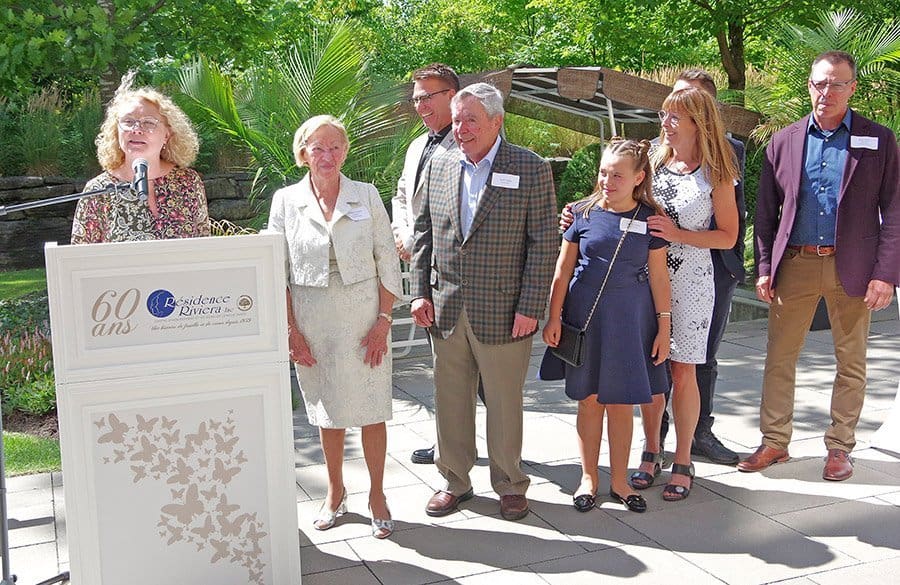
generations of the Nadon family on hand to mark the Riviera Residence’s sixty
years of dedication to golden agers, guests at an anniversary celebration
optimistically inaugurated the seventh decade by releasing monarch butterflies.
Quebec Finance Minister Eric Girard, Senior Citizens
Minister Marguerite Blais, Laval mayor Marc Demers, Souvenir-Labelle city
councillor Sandra El-Helou, Chomedey MNA Guy Ouellette and former
Laval-des-Rapides MNA Serge Ménard were among the 60 guests who attended the joyful
event on Aug. 30.
A year of
events
The gathering was the first of four events the
Riviera’s administration will be holding with employees, residents and families
over the next year to commemorate the important milestone.
The Riviera Residence on Notre Dame Blvd. in Chomedey
is one of a five seniors’ residences that have been opened beginning in 1959 by
the Nadon family.
André and Marilyn Nadon, who are today the
oldest members of the clan, were followed by their children who now constitute
a third generation of the Nadon family to be involved.
Quebec Senior Citizens Minister Marguerite Blais (left) is seen here with three generations of the Nadon family, who own and operate the Riviera Residence.
In the
founders’ footsteps
Finance Minister Girard, who is also Minister
Responsible for the Laval Region, said the Riviera Residence’s owners, Perry
and Jean Nadon, were following in the footsteps of the founders, while
promoting constant and respectful communications between residents, their
families, employees and managers, in order to create a warm and loving
atmosphere.
“It is truly a gift for the people of Laval to have
you with us,” Mayor Marc Demers said of the Riviera Residence’s longtime
presence in Laval. “It is a source of pride for a community to have
organizations like yours that care for people. As I have often said, the
quality of a community can be recognized by the way it takes care of its most
vulnerable people. And in that sense you are the example to follow.”
Premier
sends a letter
Premier François Legault sent
a letter which was read out, in which he pointed out that in 2003 when he was
Minister of Health and Social Services with the Parti Québécois government, he
had issued the necessary authorizations for an expansion at the Riviera
Residence.
Among
other things, the Riviera Residence was the first long-term health care
facility (CHSLD) in Canada to become accredited in 2009 in accordance with the
BOMA BEST standard for environmental sustainability.
(TLN)
A police chase involving six police cars ended last week in a multi-car pileup
in Laval’s Vimont district.
In
addition to the vehicular carnage, four policemen had to be transported to
hospital afterwards as a result of minor injuries they sustained.
No driver’s license
The
incident started when Laval Police officers spotted a Jeep Liberty travelling
at very low speed, although erratically. After running a license plate check, the
officers found the owner of the vehicle hadn’t renewed his driver’s license and
tried to intercept him.
The
Jeep Liberty increased its speed and took dangerous shortcuts across several
centre medians before heading out onto Autoroute 19 while driving against the
traffic. The police were determined the keep up the chase as they realized the
driver could easily cause a head-on collision.
Rammed police cars
According
to witness accounts, the police had a very hard time getting the driver to come
out of the car and surrender. They say that in trying to flee, the driver
repeatedly rammed several police vehicles before finally being cornered.
The
suspect, who was described as being a male around 25 years of age, was finally
arrested on Dagenais Blvd. near the A-19.
One
of the things that brought him to a halt in the end was the fact his Jeep had a
flat tire. He was charged with driving while under the influence of intoxicants
and with causing the police to chase him down.
During her stop at the Riviera Residence for its 60th anniversary, Quebec Senior Citizens’ Minister Marguerite Blais made a pledge that could see her losing her head – symbolically that is – if she is unable to make good on a promise before the next provincial election.
Referring to the fact the provincial government
emphasizes home care for seniors, although a small percentage of seniors are
living in residences or long-term care facilities, Blais said, “We want to
change the model.
“But believe me,” she added. “If I don’t succeed in
doing such that in the next three years there are 2,600 new places in 30 senior
citizens’ residences, my first name will be Marie-Antoinette.”
Blais served as Minister for Seniors in the Couillard
Liberal government, before leaving the PLQ and winning the National Assembly
seat for Prévost
while running in the 2018 election for the CAQ.
She said the very reason she got into politics in the
first place was “to take care of caregivers and seniors.”
(TLN) On Sept. 5, nearly 700 blood donors took part in
the Laval Blood Donors Clinic, proving once again that the Laval community is
deeply committed to the cause.
Among the participants, 17.3 per cent of the donors
(109 people) made a donation for the first time, compared to 100 new donors in
2018. According to the organizers, this was largely because of efforts that
were made to get the donors to the clinic.
Volunteers thanked
The
success of the event was also seen as a result of the involvement of some 62
volunteers who came out this year and who have also helped in years past.
Among
the partners who provided assistance to the City of Laval and Héma Québec at
this year’s blood clinic were Sanofi, Rhythme FM, Metro Plus Dépatie,
McDonald’s and the centre sportif
Bois-de-Boulogne.
Marc-Aurèle incumbent Liberal candidate Yves Robillard, centre, is seen here at his campaign headquarters with two supporters who turned up last week for the official opening.
At incumbent Marc-Aurèle-Fortin
Liberal Yves Robillard’s campaign
headquarters last week, that colour was furthest from the minds of his
supporters and volunteers in a riding that has voted NDP and Bloc Québécois in the past 15 years
– but never Conservative.
An emerging
theme
However, before the starting shot for the 2019 federal
election campaign is fired, old, new and borrowed could well become part of a
Liberal campaign theme leading towards an anticipated Oct. 21 voting date. That
at least is what seemed to emerge during a gathering for the opening of
Robillard’s election headquarters.
As of last Thursday, Robillard and his campaign team
were still waiting for the election call to be made by Prime Minister Justin
Trudeau. Elections Canada has recommended the Oct. 21 date, although the final decision
is the prerogative of the Prime Minister.
Old posters
recycled
In the meantime, Robillard, who is seeking his second
term after first being elected in 2015, was using old printed campaign
materials left over from his first run four years ago.
These included a large poster of the Liberal Party
leader taped prominently into the Robillard headquarters front window – with
one important difference: the number 5 in “Trudeau 2015” was conspicuously cut
out. After all, this is presumably an entirely new ball game.
According to Robillard, campaign spending rules forbid
advertising for the current election before the electoral period has been
officially declared open. However, he added, a loophole allows old posters and
other materials left over from previous campaigns to be employed.
And what’s
new?
In terms of the new, a sneak peek of some of the 2019
Liberal campaign material was to be seen inside the Robillard campaign HQ. On a
wall, for instance, Liberal Party items promoting “Team Trudeau,” and campaign
year 2019 – with the number zero formed into a distinctive profile of Justin
Trudeau’s head – were also on display.
Regarding the old, Robillard suggested during an
interview with The Laval News that the Liberals may be rehashing the central
campaign theme they used in 2015: giving a break to the middle-class.
Middle-class
rerun
“I think the main issue for us is certainly the
middle-class,” he said, noting the efforts the Liberal government made in the
past four years to ease the financial burden of young families, senior citizens
and others in need through tax breaks and subsidies.
Like many other Liberal candidates, Robillard is also
emphasizing that the Liberals created an estimated one million jobs since 2015,
while managing to keep the economy running satisfactorily.
Riding’s Québécois
roots
As Robillard pointed out during the interview, the
demographics of Marc-Aurèle-Fortin are somewhat different from other ridings in western
Laval. While a riding such as Laval-Les Îles
is now predominantly multicultural, he noted that the electorate in Marc-Aurèle-Fortin
is still made up of around 78 per cent French-speaking
people with Québécois roots.
“Yes, we have a number of communities here, such as
the Lebanese, Greek and others,” he said. “But it’s not the same as in other
nearby ridings. In the others there are many more people of different
nationalities, like Greeks, Lebanese and Italians. But in this riding there are
more who have Québécois roots, although many are
bilingual.”
(TLN)
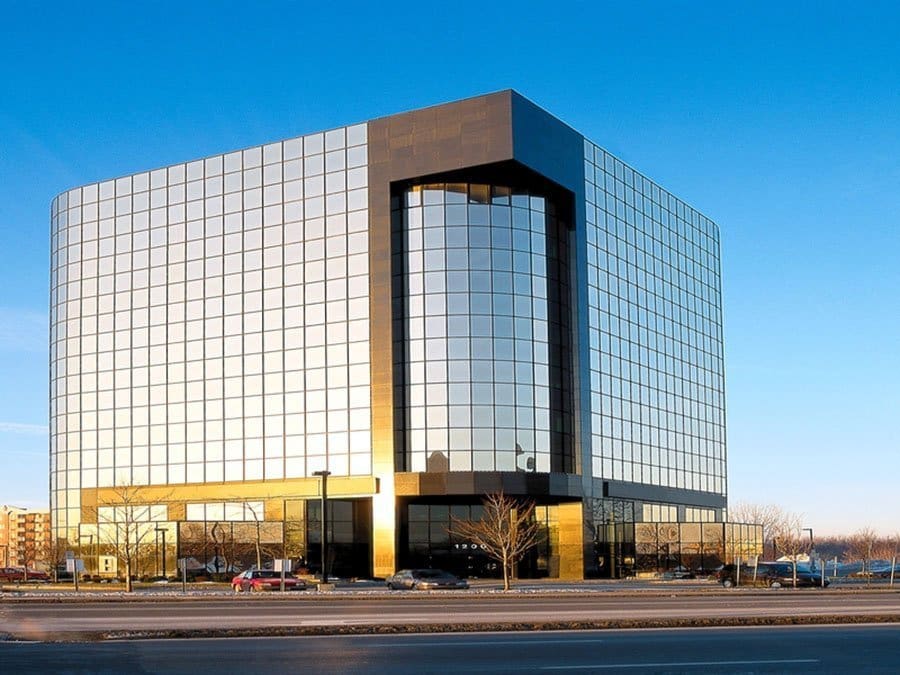
Laval city council recently took out a loan of nearly $30 million to buy a
building at 1200 Chomedey Blvd. According to the city, the purpose of the
acquisition is to create more space for municipal administration departments in
an area where Laval already has two other office buildings.
Seen as a good deal
According
to Mayor Marc Demers who explained the purchase at the last city council
meeting, city administrators jumped at the opportunity to purchase the building
from Desjardins Sécurité Financière, which had offered it at around $1million less than its estimated value.
Located near city hall, the nine-storey building
constructed more than three decades ago already contained City of Laval
offices, although they were leased from the owner. City
offices currently located in the
building include the multi-service
counter, dog and cat licensing, as well as the departments of urban planning
and engineering.
Purchase criticized
During
the council meeting, opposition city councillor Claude Larochelle wondered how
the city could absorb the purchase expense without impacting Laval’s overall
debt load, as the administration insists it won’t.
He
noted that in his own district of Fabreville, vital resources for sports and
municipal administration are lacking, while the city invests in its centralized
administration. Executive-committee member (and city councillor for
Sainte-Rose) Virginie Dufour insisted the investment will save the city money
in the long run.
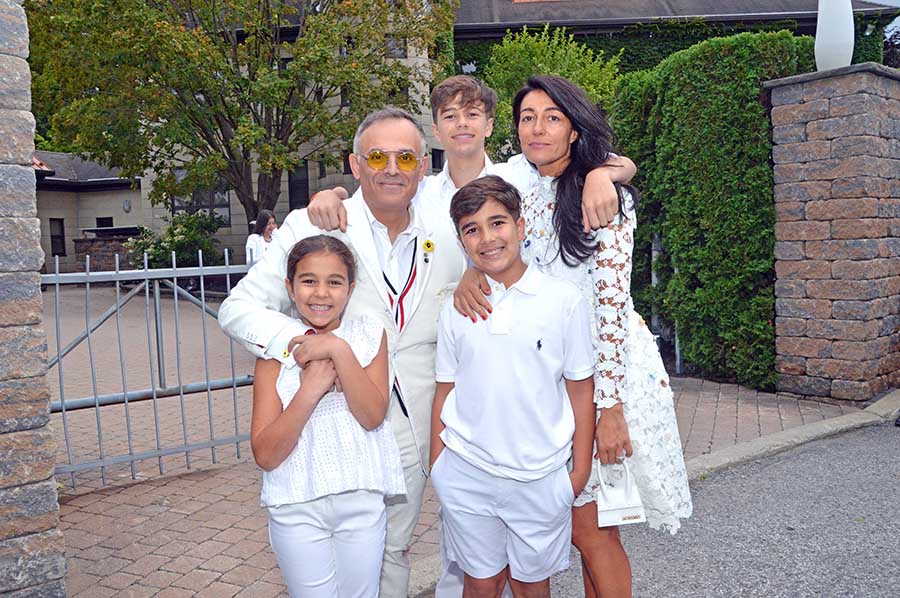
Seen here outside their Terrebonne home prior to their 2019 Notte In Bianco are members of the Guzzo family (Vincent and Maria Guzzo with three of their five children).
Martin C. Barry
The
twelfth annual Notte in Bianco, a dress-white fundraising event held on Sept. 4
at the Terrebonne home of Maria and Vincent Guzzo of Cinémas Guzzo fame, raised
more than $250,000 to help support innovative children’s mental health
research.
Guests
partied
Held for the benefit of the Guzzo Family’s initiative
in youth mental health, funds from the event will be distributed to the Jewish
General Hospital, the Shriners Hospital and Youth Mental Health (Literacy for
Dyslexia).
The well-attended event was organized by Maria and
Vincent Guzzo under the honorary presidency of Robert Dumas, president and CEO
of Sun Life Financial Quebec. They welcomed more than 350 guests who danced the
night away to the music of the Crystal Waters.
Helping out
youths
Maria Guzzo, vice-president and head of charitable
donations for the company, is currently pursuing a Doctorate in Psychiatry
(with an emphasis on youth mental health issues) in the Faculty of Medicine at
McGill University.
Vince Guzzo, president and CEO of Cinemas Guzzo, has
been a Dragon on the hit TV show Dragon’s Den. Both have directed their
philanthropic energies into support for youth mental health research, hoping to
offer young people a better life.
Based
partly on a summertime party tradition the Guzzos brought back to Montreal from
the Hamptons on the ocean coast of New York State where they have spent many
summers, dress white is considered ‘de rigueur’ each year for Notte In Bianco. Several
hundred guests pay $1,000 a ticket each year to take part in an event that is
regarded as a must on the Montreal social calendar.
All guests at the all-white Notte In Bianco event were treated to a glass of champagne upon arrival
Laval movie
screen delayed
In an interview with Newsfirst Multimedia, Vince Guzzo
said the company has experienced a delay in opening a new movieplex near
Autoroute 13 in Sainte-Dorothée, although discussions
remain underway with the City of Laval.
“The
problem in Sainte-Dorothée is a simple one:
the city’s infrastructure,” he said. “Their infrastructure at the site cannot
necessarily take 2,500 people in terms of sanitary services required for that building.
Film
distribution division
“But they’re now giving us a timeline of when they
think we can do this. In the meantime, if it’s not our next project after one
we’re doing in Saint-Jean on the South Shore, it will be the next after a
Quebec City expansion which we’re also looking at very seriously.”
In another development within the company, Guzzo said
they have also been exploring with success the idea of becoming a distributor
of films. “It’s going to be a growing segment,” said Guzzo, while adding that
they had also explored the possibility of producing movies, although
distribution appears to be the more promising prospect.
Among the special guests at this year’s Notte In Bianco were South Shore Conservative candidate Isabelle Lapointe, Senator Pierre-Hugues Boisvenu, as well as South Shore Conservative candidate Ilario Maiolo and his wife.
Family’s
impact on theatres
Following his arrival in Quebec from Italy in 1967,
Vince Guzzo’s father, Angelo, became one of the pioneers of independent
multi-screen movie theatres in Canada. As a talented, responsible and
warm-hearted businessman, Angelo Guzzo built a solid
reputation for himself in movies, earning widespread respect in the industry.
For many years, he led the struggle for independent
movie theatre owners to obtain the right to project first-run movies, thus
opening the way for others. Today, both father and son work as a team to bring
moviegoers the best cinema has to offer. Angelo Guzzo is President of the company,
while Vincenzo has been Executive Vice-President since 1990.
Learned
from his dad
As an only child, Vince started going to the movies
with his parents when he was four and soon became fascinated with the selection
of movies. He developed what he calls a flair for a good film.
During his teens, he was actively involved in the
family business. His father took him along on many business trips to the United
States to select movies for their programming.
(TLN)
The City of Laval’s executive-committee made several significant decisions at
its Sept. 4 sitting, including awarding contracts for street repairs and an
$80,000 subsidy to Couche Tard to renovate its headquarters.
Street work expenses
The
committee recommended to city council that it award a $4.7 million contract to
Construction CJRB for work to be done on du Plateau, du Plateau, de la Colline,
Kugler, De Sèves and Lachance streets, as well as for the prolongation of des
Trembles Ave. The work will allow the city to conform to demands made by the
Quebec Ministry of the Environment.
At
the same time, the city asked city council to grant Couche Tard an economic
incentive subsidy of $80,000 in 2019, with additional subsidies each year until
2023 for a total of $400,000. The subsidies will allow Couche Tard to enlarge
its headquarters.
Renovating Couche Tard
A
longtime presence in Laval’s industrial park area, the Couche Tard headquarters
is being renovated by the company at a cost of $6 million. The company intends
to expand its work force at the headquarters by 200 employees, raising the
total number of people employed there to 500.
The
executive-committee also recommended to city council that it award a $1.46
million contract to Saho Construction for the refurbishment of Cluny Park as a
nearby school is being built. New facilities will be built in the park,
including a children’s playground, playground equipment, water games and a
small hill for sliding on during winter.
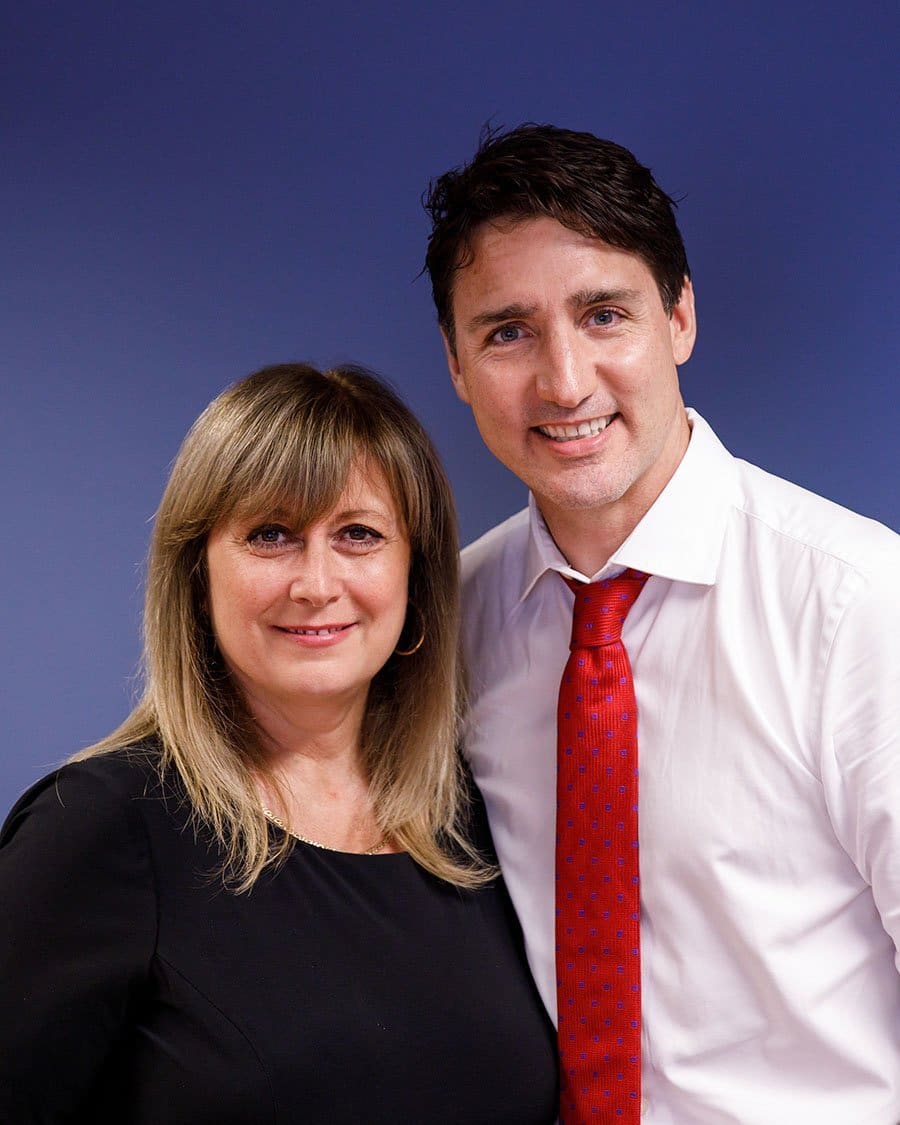
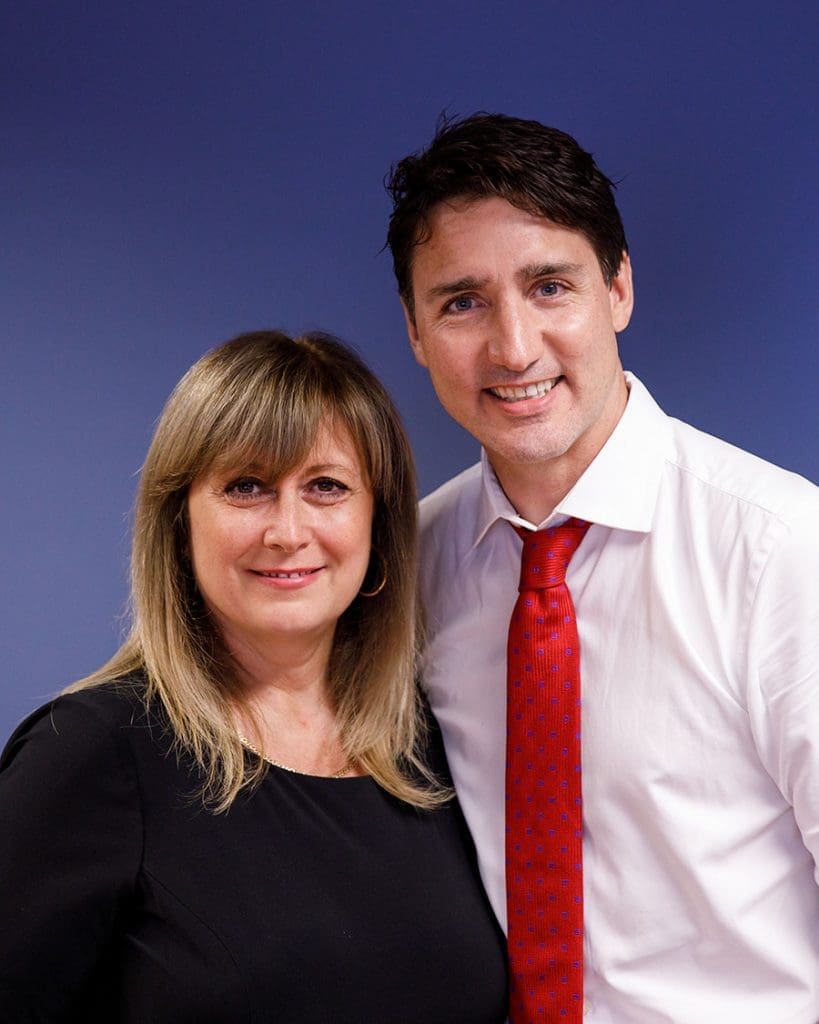
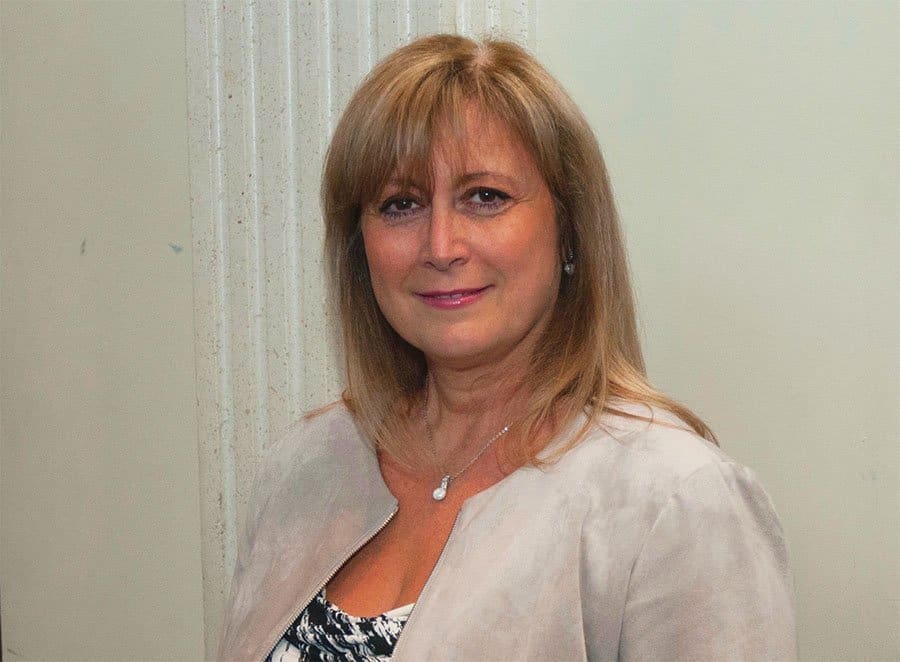
In a new development last week that took at least some
local political observers by surprise, the Liberal Party of Canada announced
that Annie Koutrakis, who is quite well-known in the greater Montreal Greek
community, will be running for the Liberals in the Laval riding of Vimy in the
Oct. 21 federal election.
The Laval News had the opportunity this week to touch
base with Annie Koutrakis in an exclusive interview. Here are some of the
things we asked along with her answers.
TLN: It was unfortunate but perhaps necessary from the party’s point of view that the previous Liberal MP in Vimy, Eva Nassif, could not run for a second term. What are your thoughts on this decision? A.K.: I have not had the pleasure of meeting Mme. Nassif. Deciding to run for public office is a deeply personal decision and one that each person must decide for herself or himself. I sincerely wish Mme. Nassif and her family all the best in their future endeavours.
TLN:You are a VP, an assistant branch manager and a services advisor with the Raymond James Canada investment banking group in Montreal. As well, you have been president of the HCGM since mid-June. What other experience do you bring as a candidate to be Vimy’s next Member of Parliament? A.K.: I truly believe that one’s ability to contribute in a meaningful way not only depends on one’s professional experience and accomplishments. Aside from being a Vice-President of a financial services firm, I am also a mother of two adult boys, a community member, and an engaged citizen. All my experiences have contributed to who I am today. While my professional experience has given me the ability to deal with complex issues, my other experiences have given me the ability to be compassionate, human, understanding, giving, and resourceful. I think that the people of Vimy want more than just a Member of Parliament that has a strong professional background. I think the people of Vimy expect a Member of Parliament who is able to understand their challenges, their hopes, and their dreams. I want to be that Member of Parliament that will listen, that will be compassionate, and that will help the people of Vimy move forward.
TLN:Do you have financial expertise (owing to your experience) that would be especially useful in a future Liberal government? How would you apply this expertise in terms of creating useful legislation? A.K.: Again, I will bring all my experiences, including my financial expertise, to serve the people of Vimy. With any legislation, I would have one guiding objective: is this legislation beneficial to the people of Vimy.
TLN:Are you thoroughly bilingual in French and English (as this will be a necessity in a riding like Vimy)? A.K.: I am thoroughly trilingual (French, English, and Greek). I would like to share something with the people of Vimy. The process to become a Liberal Party of Canada is rigorous, including a very detailed in-person interview in front of a committee. All my interviews with the Liberal Party of Canada for the candidacy were done in French.
TLN:What are three key issues in this election that you are telling voters in Vimy about? A.K.: There are more than three key issues in this election campaign that I would like to share with the people of Vimy, but the three I would like to discuss here are: support for the middle-class, the environment, and the economy.
The
Prime Minister has made support for middle-class families his number one
priority. We understand that it’s not always easy for middle-class families to
get ahead. Since the last election, the Liberal government has introduced many
programs to support the middle-class including a more just Child Care Benefit
program that is non-taxable, an affordable housing program, and a First-time
Home Buyer program that can save hundreds of dollars a month for those
first-time homebuyers who need that assistance. I will work hard to ensuring
that the people of Vimy continue to have real and fair chances at
success.
Another
key issue is the environment. Like many people in Vimy, I am very concerned
about the environment. The fact that the Harper government did nothing about
the environment was extremely frustrating. The fact that the current
Conservative Party continues to follow that same thinking is even more
puzzling – not far from denying the existence of human driven global
warming. Climate change is real, period. I will continue to work to reduce
carbon emissions, reduce plastic pollution, and ensure that we leave future
generations with an environment that is on the right track.
It
goes without saying that a strong economy is at the core of a healthy and
prosperous country. Over the last four years, the Liberal government has
introduced a number of measures to help grow the economy including massive
investments in infrastructure and technology, negotiating international trade
agreements that better reflect the economic realities of today and the future,
and taking measures to support small and medium sized businesses. This has
resulted in the creation of one million jobs, record unemployment, a
reduction in small business tax, and record foreign investment in Canada which
is a sign of international confidence in the Canadian economy. I will work to
continue on always improving the economic health of our great nation.
TLN:The NDP swept a large part of the Quebec electoral map in the 2011 election in the so-called Orange Crush. How would you describe their chances in the 2019 election? A.K.: That’s a question you should ask the NDP. I think that this election will be about choosing between progress for the middle-class or a return to the Harper years. I think that the people of Vimy will choose going forward with a Liberal government.
TLN:Are there any special needs in the riding of Vimy that you see which need attention and which you could help to fix if elected? A.K.: The riding of Vimy is a vibrant, strong, and wonderful place to live. I should know, I lived here for many years. But like other ridings across Canada, Vimy has unique challenges that need to be addressed. I look forward to listening and working with the people of Vimy, with the provincial and municipal elected officials, with the business community, and with community organizations in order to prioritize what challenges need to be acted on.
Who
is Vimy Liberal candidate Annie Koutrakis?
Annie
Koutrakis, the Liberal Party of Canada’s candidate in Vimy in the October
election, is a financial services industry professional and community leader.
She
was born and raised in Montreal. In addition to attending public elementary and
high schools, she completed elementary and high school at Greek Saturday
schools. She subsequently attended Dawson College where she successfully
obtained a Diploma in Social Sciences/Business Administration, and eventually
went on to complete courses towards a Certificate in Human Resources at
Concordia University.
Koutrakis
has also completed numerous financial industry courses. She has been in the
full service stock brokerage investment business for 30 years, reaching
the position of Vice President, Branch Manager, Advisor Services for a
major financial services firm.
A
fervent believer in volunteering, Koutrakis has given of her time as a
volunteer for a number of community organizations. She was elected to the Board
of CLSC Norman Bethune (now CLSC du Ruisseau-Papineau) in Laval, has served on
the Board of Directors of Hellenic Social Services of Quebec, and was Vice
President of the Parents Committee at École Démosthènes.
She
has also been a member of the Alexandria Fundraising Committee in Laval, and is
a member of the Board of the Hellenic Board of Trade of Montreal. As well, she
has volunteered in municipal, provincial and federal elections in various
roles.
Most
recently, Koutrakis served as President, CEO and member of the Board of
Directors of the Hellenic Community of Greater Montreal, the first woman to hold
such a position in the 113-year history of the HCGM.
Annie
is also the proud mother of two adult sons, and step-mother to two adult children,
all four of whom are in their early 30s. Her spouse Gerry is a retired former
executive and a dedicated community volunteer.
The current issue of the Laval News volume 27-17 published September 11th, 2019, (Laval’s English Newspaper) covers local events such as politics, sports and human-interest stories. It features editorials and other columns. Click on the image to read the paper.
Front page of Laval News, Vol. 27-17
September 11, 2019.