Quebec’s official tax collector, Revenu Québec, says the owner of a Laval-based club that catered to wife-swappers and swingers must pay a more than $24,000 penalty after being found guilty of not paying provincial sales and income taxes.
Alain Joyal, 61, a Montreal resident, pleaded guilty to three charges on Jan. 10 at the Palais de Justice de Laval. Joyal is listed in the provincial registry of businesses as the sole owner of Gestion 10 133 inc.
The holding company did business as Club Frenchkiss on Cunard St. in Laval’s industrial park, although the club is now closed. According to a Revenu Québec press release, the tax agency opened an investigation into Joyal’s business dealings after being tipped off by the Laval Police Department.
The LPD told the agency that Gestion 10 133 inc. was organizing swingers’ evenings where alcoholic beverages were being sold. Neither Gestion 10 133 inc. nor Club Frenchkiss had a Quebec liquor permit.
The investigation revealed that from 2014 to 2017, the company failed to report and to remit to Revenu Québec sales taxes that it collected, an amount calculated to be $17,325.32. As well, the company was found guilty of not paying the business income tax during the same period.
Apart from the sale of liquor, court documents revealed that Club Frenchkiss also derived revenue from membership fees, event tickets, renting out bedrooms in the club and fees for coat check services. During the time it was open, the club’s hours were from Thursday to Saturday evenings, and sometimes on Sundays for special events.
Court statements also suggest that the company wasn’t very good at record-keeping. The owner wasn’t using an efficient accounting system and the company’s accounting data was incomplete.
The LPD turned the matter over to Revenu Québec after executing a search warrant at Club Frenchkiss in 2017, based on an allegation that the club was operating in violation of local zoning requirements, which forbade operating a bar in that area. Consequently, nearly 800 bottles of liquor were seized by the police. As well, Revenu Québec executed a search warrant at the owner’s home on Île Bizard in Montreal in May 2018.
Trudeau gov’t hopes to stimulate economic recovery, while changing ministry practices
Federal Minister of Immigration, Refugees and Citizenship Sean Fraser has announced new measures, which should help speed up immigration to Canada.
Fraser said during a webcast press conference last Monday that the government will be getting back on track by the end of 2022, after COVID-19 caused a major backlog over the past two years in the processing of immigration applicants.
“These measures are part of a broader process to address key challenges faced by our clients, and achieve the more predictable processing times that our clients expect and deserve,” Fraser’s ministry said in a statement.
More staff to be hired
Last year, the Trudeau government announced it would spend $85 million to deal with the backlogged immigration department applications. Fraser said on Monday that the sums will be used primarily to hire additional staff.
He said the new immigration workers will assist the government in getting back to normal processing times for study and work permits, permanent resident renewals, visitor visas and proof of citizenship applications. However, not on the list of priorities is family unification applications. According to Fraser, they already meet the ministry’s standards for processing time.
Process delays frustrating
“I know that processing delays have been incredibly frustrating for many individuals,” Fraser said. “Helping clients come to Canada quickly, with predictable processing times and efficient communication with IRCC, remains a top priority for me.
Canada’s Minister of Immigration, Refugees and Citizenship Sean Fraser announced changes to the country’s immigration policies in Ottawa last Monday, designed to speed up processing which had been slowed during the Covid pandemic.
“Many people are choosing Canada as the place to visit and build their future,” he added. “And to ensure that we stay competitive, we have introduced concrete measures to make sure those who want to come to Canada have the client experience they deserve.”
Dealing with labour shortages
According to Fraser’s ministry, immigration is playing an essential role in helping to address some of the most severe labour shortages brought on by the pandemic. However, the remaining challenges continue to include the processing delays, as well as postponements for applicants hoping to come to Canada to work or to reunite with their families.
While the ministry says Canada welcomed the highest number of permanent residents in a single year in 2021 by processing a record number of applications, border restrictions and other pandemic-related factors led to delays for many applicants.
Applications from outside
The ministry says it has already hired approximately 500 new processing staff, taken measures to digitize applications and reallocated work to ministry offices around the world. To help accelerate the processing work, they are expanding the use of advanced data analytics in helping officers sort and process visitor visa applications submitted from outside Canada.
The federal Ministry of Immigration, Refugees and Citizenship is introducing new methods to speed up processing times. (Photo: Courtesy of Canadian International Council)
“We understand that clients want easier access to status updates on their case files,” the ministry says in its press release. “That is why we will also introduce a new Permanent Residence Application Tracker in February 2022 for spouses and dependents, to allow clients to easily access their application information and status online.”
Virtual citizenship ceremonies
For citizenship applicants, IRCC has also introduced online testing, developed an online application tracker and launched virtual citizenship ceremonies. Over the last few months, they have hosted approximately 350 virtual ceremonies per month, and more than 170,000 new Canadians have been sworn in since April 2020.
They are continuing to expand the use of virtual ceremonies. Moving forward, they are exploring an option for those who wish to self-administer the oath of citizenship by signed attestation and celebrate their citizenship at a later date.
The Laval executive-committee is asking city council to approve measures that will pave the way towards creating one of the largest nature reserves in Quebec along the edge of the Rivière-des-Mille-Îles.
The first phase of the plan calls for the inclusion of 432 municipal land lots (568 hectares), including islands in the river. The lots in question are already within an area defined as protected by the city.
The new status will grant them additional protection. The project initially got underway following a recommendation made by the Laval-based non-profit nature conservation group Éco-Nature.
“I am proud of this step forward towards the realization of my commitment, big news for Laval residents,” said Mayor Stéphane Boyer. “These additions will multiply by a factor of 20 the area of this protected zone, making an area around twice the size of Central Park.
“The refuge is home to around two-thirds of the animal species in Quebec,” Boyer continued. “By protecting and by connecting these areas together, we will be encouraging the survival and reproduction of hundreds of animal and plant species that live there, while also ensuring people from Laval access to their nature heritage.”
The provincial government is also very enthusiastic about the City of Laval’s plan. “The Rivière-des-Mille-Îles nature refuge is an exceptional site from the point of view of fauna as well as flora and is an area with very high biodiversity,” said Pierre Dufour, Minister of Forests, Fauna and Parks in the CAQ government.
Calling the 568-hectare preserve “a considerable area for protection on private lands,” Dufour said the city’s move is “an important step and an important advantage in the enlargement project for the Rivière-des-Mille-Îles nature reserve ever realized by our biologists in conjunction with Éco-Nature.”
“For more than 20 years, the City of Laval has supported, through real measures, the mission of Éco-Nature to protect, conserve and promote the rivière des Mille Îles and its tributaries,” said Éco-Nature director-general Christine Métayer.
“The addition of these islands, shores and wetlands to the nature refuge is the most recent example. The entire team from the Parc de la Rivière-des-Mille-Îles is overjoyed with this decision. The people of Laval should feel proud of the commitment by their mayor and his commitment to this magnificent ecological, recreational/touristic project, a major legacy for future generations.”
Among the islands in the Rivière-des-Mille-Îles that will become part of the nature preserve are l’île aux Vaches and l’île Saint-Pierre, which were purchased by the city in 2020. The city says that a third island, l’île Locas, is about to be purchased and the transaction is near the point of being completed.
Laval allows property tax late payments and in two installments
The City of Laval says that due to ongoing economic fallout from the Covid pandemic, property tax bills for the year 2022 will be payable in two installments, due in June and in September. The due dates for the installments are also being extended.
According to the city, the first installment (which had initially been due on March 23) will now be payable no later than June 15. The second installment (which would normally have been due on June 21) is now payable no later than Sept. 13.
“The effects of the pandemic continue to be felt within many families in Laval,” said Mayor Stéphane Boyer. “We hope to help lighten the load for them, allowing them to benefit from a few months of respite in order to better plan their budgets. This boost will also be applying to businesses in Laval.”
City receives certification for stance against domestic violence
The City of Laval has become the first municipality in Quebec to become certified by the provincial government for its efforts to help reduce domestic violence through support provided in the workplace.
Sponsored by the provincial government, the program was launched on Jan. 25 by Isabelle Charest, the minister for women’s issues in the CAQ government. Quebec banking corporation Groupe Desjardins is the only other organization to have received the certification so far.
Through the certification, the city acknowledges its responsibility as an employer to take action when a situation involving harassment by the spouse of an employee arises in the workplace. The city has also pledged to adopt a workplace policy whose goal will be to put into place preventive measures to stop domestic violence.
“The city wishes to facilitate and encourage employees caught up with domestic violence problems so that they can ask for help and to make the situation known,” said Laval Souvenir-Laval city councillor and executive-committee member Sandra El-Helou, who is responsible for women’s issues dossiers on council.
“We hope to have a workplace environment that is respectful and empathetic and where people know they are supported and not alone,” she added. “This is an employer’s responsibility, although mostly a human responsibility.”
In Laval, there are three shelters for women and children who are victims of domestic violence: Maison de Lina (450 962-8085), Maison L’Esther (450 963-6161) and Maison Le Prélude (450 682-3050). Their services are confidential and are offered 24 hours out of 24, 7 days out of 7.
Refundable deposits rising to 10 and 25 cents, wine and liquor empties included
Although it’s been two years since Quebec pledged to upgrade the province’s recycling capacity with a new liquid container consignment program and higher refundable deposits on empties, Benoit Charette, the environment minister in the Legault government, announced last week that the program won’t be getting underway until spring 2023 – six months longer than originally planned.
Covid blamed for delay
Initially announced to be starting up by the fall of 2022, Charette, who is also responsible for the CAQ government’s climate change portfolio, blamed most of the delay on labour shortages caused by the Covid pandemic.
“We are very, very aware of the issues and the impacts from the pandemic which have caused a lot of harm to various players, and this is the reason why we are agreeing to an additional six-month delay,” Charette, who is the MNA for Deux-Montagnes and Minister Responsible for the Laval Region, said during a webcast press conference.
10 and 25 cent deposits coming
Under the new rules, the number and variety of glass, plastic and metal liquid containers that will have to be recycled is being extended to include anything as small as 100 millilitres and up to 2 litres. Some other types of liquid container, such as plasticized multi-layer juice box-formats, will become subject to deposit and recycling two years after the program begins.
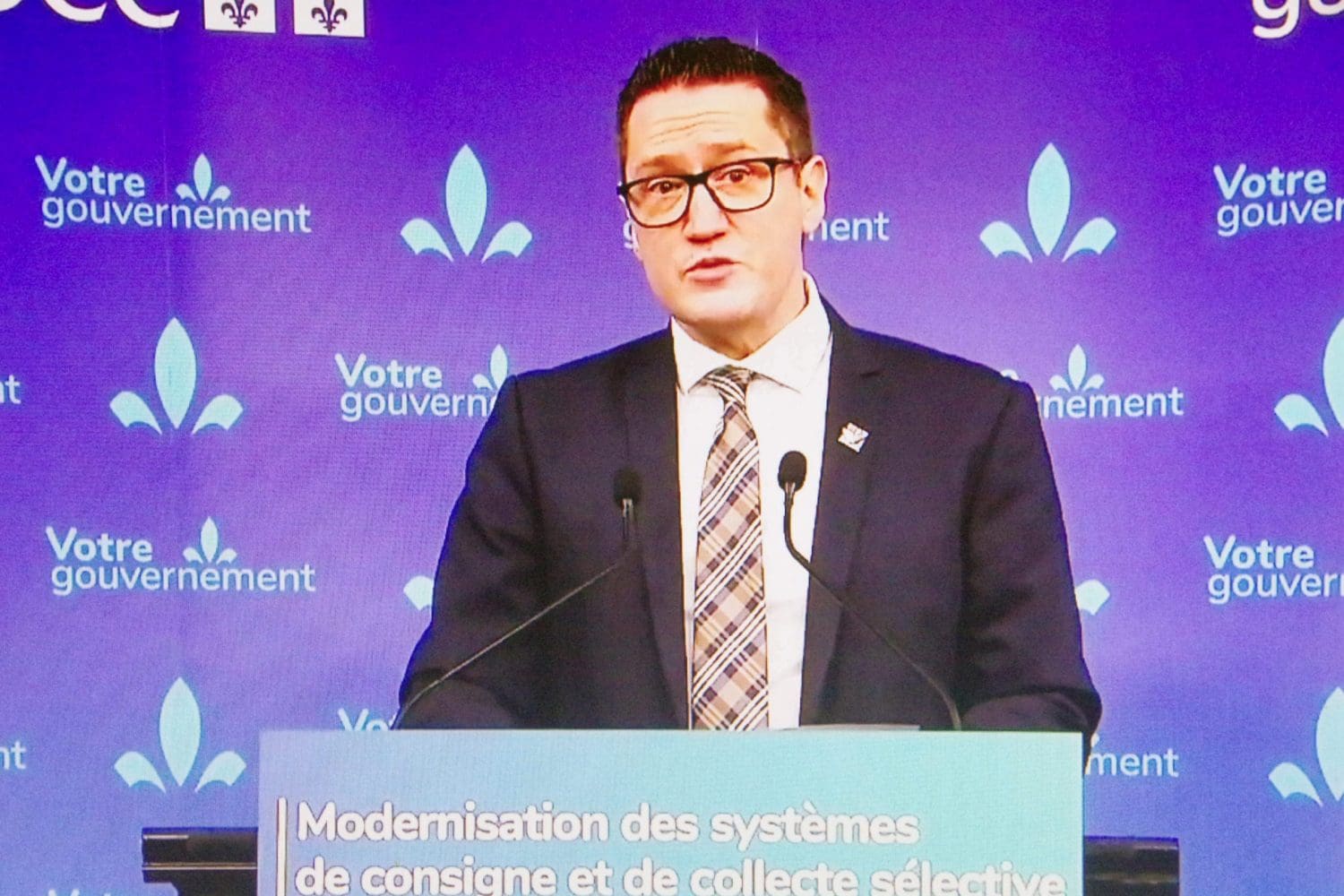
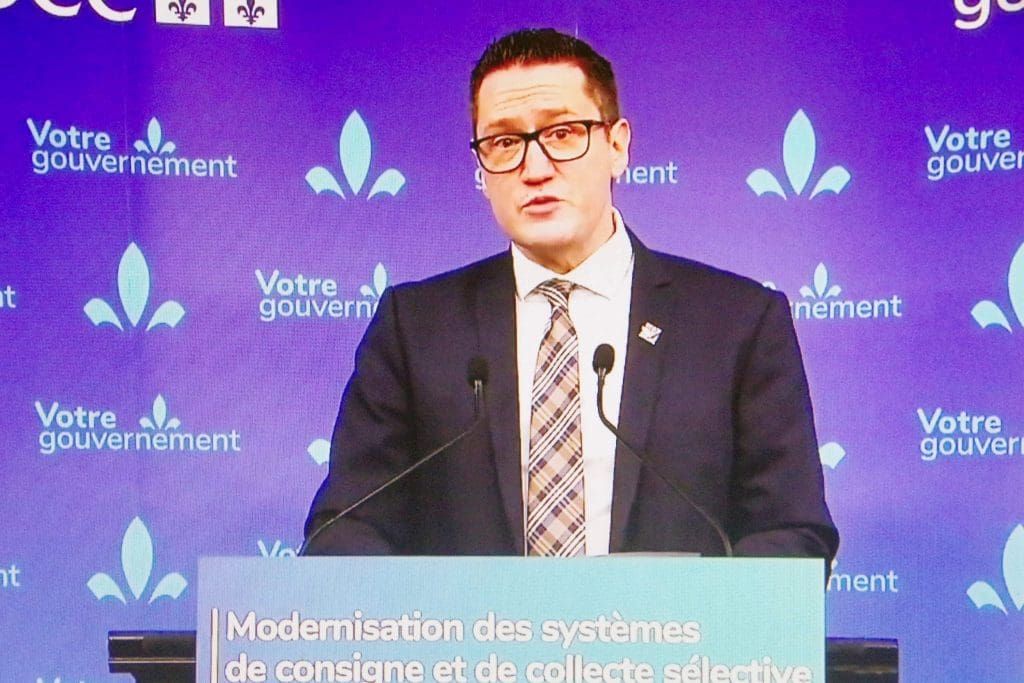
Quebec Environment and Climate Change Minister Benoit Charette announced major changes last week for the province’s recyclable materials programs.
The deposits, which now range from 5 cents for soft drink cans to 10 cents or higher for larger containers depending on size, are being standardized at 10 cents and 25 cents. When the program starts up, this will include wine and liquor bottles, on which deposits of 10 and 25 cents will be due.
Public consultation in March
According to Charette, a province-wide public consultation will be taking place on the recycling overhaul until this March 11.
While some media are reporting that Quebec has long lagged behind other Canadian provinces in updating its recycling capacities, Charette’s ministry claims the province’s reform will “allow Quebec to become a global leader in this domain.”
All the same, the environment ministry acknowledges that the Quebec overhaul “was inspired by the best practices in Canada and internationally,” with local goals added.
Expanded role for Recyc-Québec
The new system will be largely self-governing and led by a consortium of companies whose products are packaged in recyclable containers. Recyc-Québec, an umbrella group already supervising a large expanse of recycling responsibilities in the province, will be mandated to oversee the new entity.
“Thanks to proposed regulations, we can at last foresee a net improvement in the management of our waste materials with a reduction in the amount sent to landfill,” added Charette. “At the same time, we will be helping to strengthen the recovery and recycling industries in the coming years with local outlets. This is another way to reduce waste of resources, while encouraging the circular economy and reducing greenhouse gas emissions.”
More use of recyclables
By not sending up to 50,500 tonnes of waste into landfill, the government expects to prevent the release of around 26,500 tonnes of CO2 into the atmosphere. In 2020, the equivalent of $50 million worth of materials composed of paper, cardboard, plastic, rubber and glass were imported into Quebec from outside. The government believes most of these materials could be replaced by materials coming from recyclables produced by the new recycling system.
According to the environment ministry, a large consigned container returns and deposit refund network will need to be developed, requiring 1,500 points of service in order to reach more than 90 per cent of Quebec’s population beginning in 2023.
Containers not included
Not included in the overhaul are drink containers of less than 100 millilitres or more than 2 litres, as well as containers for concentrates, ready-mixes, condiments (bouillons, sauces, etc.), medicated syrups, beverages sold in soft packaging (wines), self-serve-type containers (ground coffee pouches), and multi-fill containers (8-litre water tanks, for ex.), which according to the ministry are already subject to their own deposit systems.
‘We can at last foresee a net improvement in the management of our waste materials with a reduction in the amount sent to landfill,’ said Charette
The environment ministry says the amount set for each type of deposit is intended to serve as an incentive to improve recycling, while creating a uniform system whose ultimate goal is to make life easier for consumers and others who play a role in the system.
Waste goals unmet, says BAPE
In addition to increasing the private sector’s role in the province’s recycling efforts, the government says the reform will also help to focus more attention on the role of municipalities as entities which are closest to the population.
Charette unveiled the new program a day after Quebec’s environmental impact consultation agency, the Bureau d’audiences publiques sur l’environnement (BAPE), upbraided provincial officials for not meeting waste reduction goals.
According to the BAPE, nine of Quebec’s 38 landfills will reach capacity by 2030, while 13 others will get there between 2030 and 2041 if the dumping of waste continues at the current rate.
But parents-in-the-classroom are not the solution to the current crisis of substitute-teacher shortages
So it’s come to this: in the event that schools that re-opened two weeks ago will soon face predicted teacher/staff shortages for various reasons, including Covid-related developments, Minister of Education François Roberge intends to deploy willing parents to classrooms to oversee in-person-learning, or as it will turn out, to baby-sit/child-care anyone who shows up for a day-at-school.
Where to begin to unravel this Covid-knotted cotton ball of mismanagement of the basic fact of education – professional presence in Québec classrooms? Let’s start by addressing the challenges this poses for school principals. Their job description includes managing the school’s budget, supervising staff and making big-picture decisions. But soon, some may have to return to their former roles of teacher and coach, filling in for absent teachers in the face of severe shortages of qualified substitute teachers.
Recent published reports acknowledge that many schools have been able to find substitutes for only 80%-85% of absent teachers on any-given-day, leaving existing staff to fill the void. It’s an all-hands-on-deck process. This has always been part of the emergency substitution plan inserted into teachers’ schedule for decades.
For teachers active in the system, the recently emerged need to fill-in for others is nothing new given that they did, on some days, in fact on many days, teach all day without planning periods, requiring them to do the planning at late-afternoon and evenings. What is new, however, is the impact on many staff members who are reaching the end of their rope, as debilitating fatigue is on the increase in all sectors of society.
It’s the latest example of how the pandemic has exacerbated the already exhausting challenges of running schools. When teachers are absent due to illness, COVID-19 exposure or other reasons, principals face the daunting task of finding qualified replacements to take their place, according to the Ministry of Education.
Numerous principals and school-board-officials maintain they were having trouble finding enough qualified substitutes to cover teacher absences long before Covis-19 struck, admitting that finding qualified substitute teachers is now even more of a challenge than any other school position, including bus-drivers, technicians, paraprofessionals, full-time-teachers, and custodians.
Clearly, the pandemic has provoked an escalation of staff-stress, impacting mental health at every level, according to teacher unions. Like all educators, the job of a substitute teacher has become more fraught during the past two years. They are called upon to teach in schools where children are likely still unvaccinated and might not be required to wear masks. In some cases, they’re filling in for teachers who are quarantining at home after being exposed to COVID-19. And many substitute teachers are in an age group more vulnerable to the disease. A substantial number of substitute teachers are retired educators, and in many cases, they simply are not willing to risk the COVID challenges to return to classroom/school work.
But the shortage of substitute teachers also preceded the pandemic in many places, as they face unpredictable schedules and the challenge of supervising students who might misbehave in the absence of regular teachers. Substitutes have no protection, no security; they pay union dues but are minimally-protected since they’re usually not-on-contract.
Several school boards have responded by changing requirements to become a substitute. Some schools have created emergency substitute-teacher lists, loosening requirements in response to severe-staffing-shortages. Yes, “loosening” as we have heard from Quebec’s Education Minister, Jean-François Roberge. Is he suggesting that parents, caretakers, anything with two legs and breathing, warm bodies are permitted to be substitute teachers, without credentials, not even minimum university requirements? Is he saying that all you need are baby-sitters in the classroom? A band-aid to the crisis of lack of qualified substitute-teachers? This has been an on-going problem for years, its solution escaping both the Ministry of Education and school boards. Covid-19 is a very poor excuse to play the blame game.
Without additional substitute-teachers, irreparable harm is inflicted on school children. These loosened rules, stop-gap-measures used to address critical shortages, are signs of desperation, indications of negligence in putting in place effective tools to fill needs that have had a long history of plaguing our public schools.
But merely lowering teaching qualifications is worrisome. Education experts and concerned parents, clamour for systemic changes that would make the profession more desirable and competitive long-term, especially for substitutes with university degrees, needing certification. They should be helped to obtain teaching certificates through special short-term university programs. Are those at the helm sleeping-at-the-switch? They will eventually also lose these individuals to other sectors in the workforce, if they don’t act swiftly. Where are the 8,000 qualified teachers reported to be needed by 2026 going to come from, if the Québec government doesn’t wake up from its Covid-19 deep sleep?
Yes, Minister Roberge’s suggestion that lowering standards for substitutes to the point where you’re not getting people skilled or knowledgeable in the content area, is questionable, and problematic, but he neglected to even remotely address the issue of the critical current void, in sane and pragmatic ways.
Schools, school boards, and the Minister of Education — because much of this is their responsibility — need to rebuild the teaching profession in ways that offer interested individuals the tools to facilitate certification based on their education and years of dedication and service to the community.
No, M. Roberge, as Education Minister, you must be accountable and held responsible for our children’s education. Warm bodies in classrooms simply will not do.
More N95 masks and rapid testing to be available, says board chair Paolo Galati
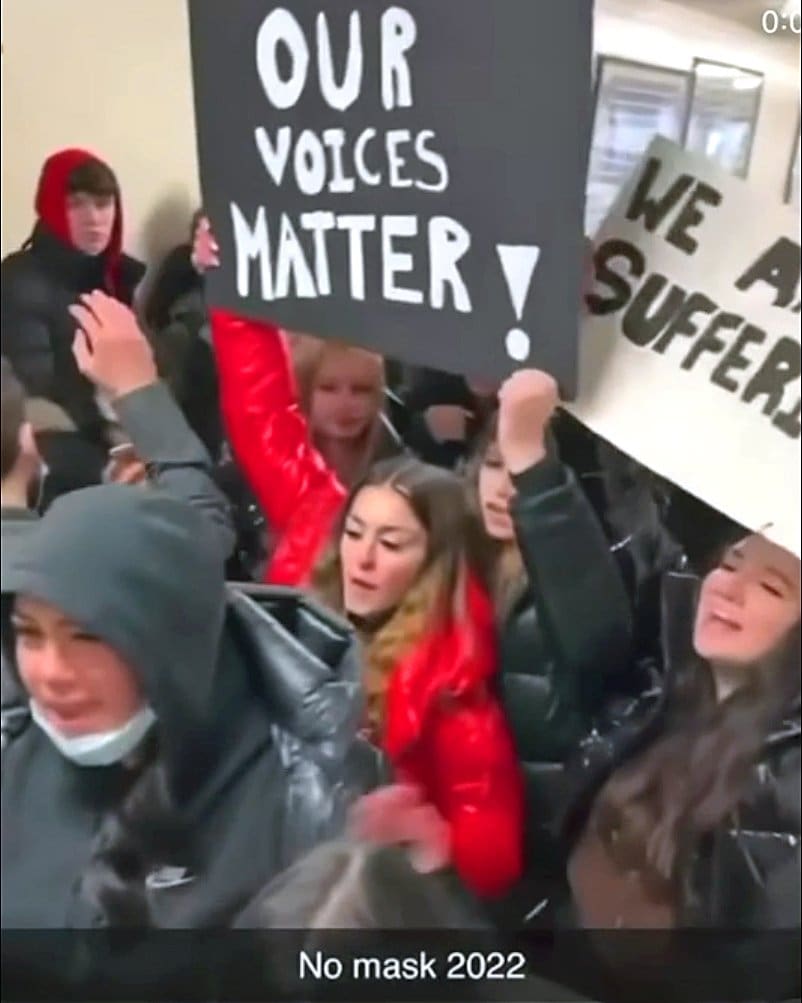
In spite of directives from the provincial government and the Sir Wilfrid Laurier School Board calling on students to wear face masks in order to minimize COVID-19 transmission, as many as 200 students at Laval Senior Academy staged a protest against the rule one afternoon last week by going maskless.
According to an estimate by the SWLSB, at least 50 students at the high school on Souvenir Blvd. in Chomedey took part in the protest on Jan. 27, part of which was captured on video and uploaded to the web.
The students staged protests inside the school in the morning, and then outside during lunch hour. A video posted to Facebook showed noisy teenagers shouting in a Laval Senior Academy hallway while waving handmade protest placards.
Face masks everywhere
The teens weren’t happy about the Covid face mask restrictions which were back in place following the post-Christmas resumption of classes, requiring them to wear face coverings everywhere in the school except while eating in the cafeteria, a Sir Wilfrid Laurier School Board spokesperson said.
A still from the video posted online by students at Laval Senior Academy who staged a no-mask protest last week.
In a letter sent out to parents on the day of the incident, Laval Senior Academy’s principal maintained the demonstration was mostly peaceful, but that a few students’ families were contacted and disciplinary measures were necessary.
Principal Nathalie Rollin said the parents of some students were contacted as some disciplinary enforcement was needed for a minority of students who were deemed to have acted inappropriately.
Police called at one point
She said several students left class during the second period to express their concerns about the sanitary measures in place at the school. The students gathered outside on the sidewalk on Souvenir Blvd., while carrying placards.
But at one point, she added, school administrators decided to call police, although the protest was under control, and most students went back to class and continued with their day. By the end of recess, most students had returned inside the school, added Rollin.
However, while most students returned to class, others continued walking in hallways, prolonging the disruption. Rollin said some students were then escorted outside by administrators, who listened along with police to their concerns and the reasons behind their protest.
Students rejected masks
Although the SWLSB estimated the number of participants at about 50, others claimed there were at least 200 students involved at one point.
In her letter to parents, Rollin said the students complained that “they find it challenging to wear the mask at all times and find it difficult to only have the cafeteria as an option to eat their lunch. The cold weather and the fact that restaurants are closed add to their frustration.”
While maintaining they had to uphold public health rules for the safety of all, Laval Senior Academy officials offered to seek solutions to the lunch-hour cafeteria issues so that students might have more freedom on where they can eat within the school.
Challenge ahead, Galati says
In a recent televised interview prior to the resumption of in-person classes and before last week’s student protest, Paolo Galati, chairman of the SWLSB council of commissioners, emphasized that what the board is looking for is a safe in-person return to school.
While the SWLSB estimated the number of student protesters at around 50, others claimed there were at least 200 students involved
“And our highest priority, as always, is to ensure the health and safety of all our students and staff,” he said. “We know it’ll be a challenge. But we know we will get through the next couple of weeks together.”
Quebec’s new national director of public health, Dr. Luc Boileau, has initially dismissed the wearing of N95 masks in most classroom settings. However, Galati noted that Education Minister Jean-François Roberge said that teachers and support staff working with special needs students will have access to N95 masks.
N95 masks for all staff
“Although we are happy about this, we still feel that all staff – and I repeat all staff – who wish to have N95 masks should be entitled to have them. We want to protect our teachers and staff to the best of our ability, who as we all know will be exposed to the Omicron virus while in their classrooms or within the hallways and throughout their school environment. So, our wish at Sir Wilfrid Laurier is to provide N95 masks to any staff member that requests one.”
Responding to a suggestion that at some point volunteer parents might step in to provide in-school help if too many teachers come down with Covid, Galati said: “To have parents come in, I’m not sure that’s the best idea.”
Sir Wilfrid Laurier School Board chairman Paolo Galati.
Guest mask guidelines
As it is, guidelines regarding the wearing of masks in schools (updated by the provincial government on Jan. 25) allow for visitors, who are defined as “any individual carrying out work at the school (e.g., guest speaker, science facilitator).”
Regarding COVID-19 rapid testing, Galati said that just as rapid tests were distributed to all elementary school students in December, the SWLSB was undertaking a second distribution to elementary students as the test kits are received, after which a third distribution would take place in February.
Galati said students who develop symptoms at school will be sent home whether they test negative or positive. “Omicron being very contagious, we’re not taking any chances due to the higher false negative results of rapid tests,” he said. “So, we will immediately isolate students who have any symptoms, as well as their siblings.”
The current issue of the Laval News volume 30-04 published February 2nd, 2022. Covering Laval local news, politics, sports and our new section Mature Life. (Click on the image to read the paper.)
Front page of the Laval News, February 2nd, 2022 issue.
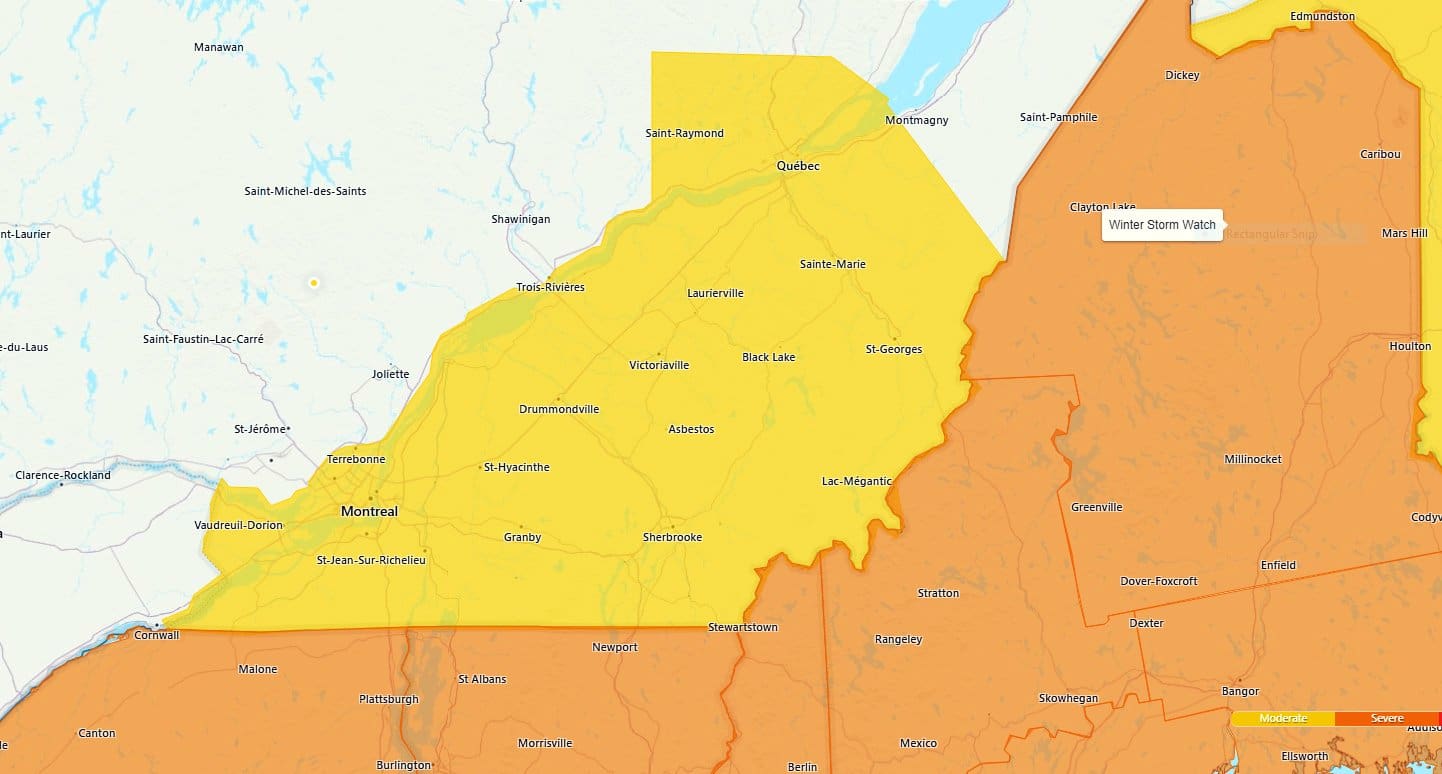
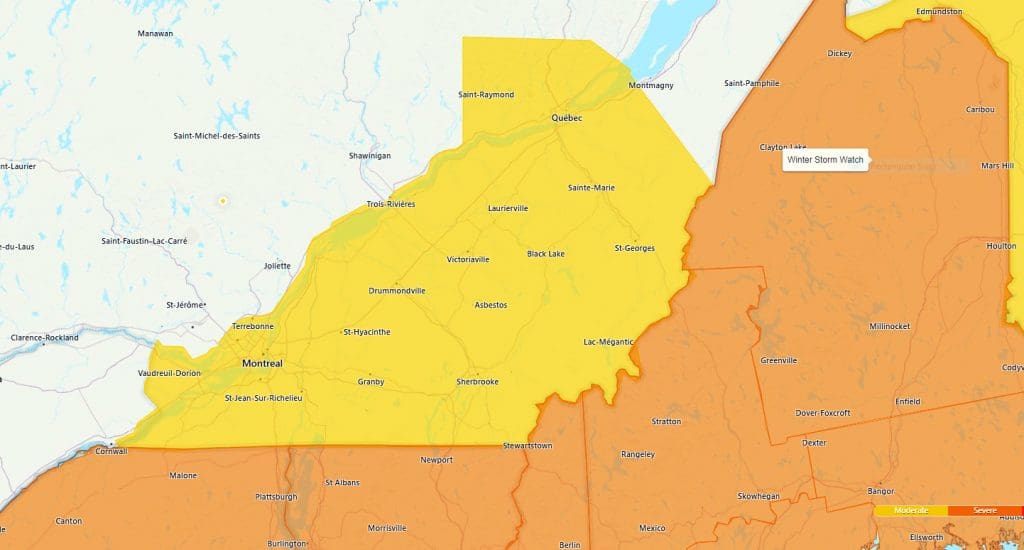
The federal meteorological service issued a special weather statement Tuesday afternoon advising that Laval and other areas of greater Montreal can expect a snowfall of up to 15 centimetres beginning Thursday and continuing through Friday morning.
According to the weather service, a low pressure system from Texas will merge with a cold front moving across the province on Thursday. These two systems will affect mostly the regions south of the St Lawrence.
Rush hour traffic on Thursday evening may be difficult due to rapid snow accumulation on roads. Beginning Thursday afternoon, moderate northeasterly winds will result in blowing snow, leading to poor visibilities locally.
The weather service says there is still some uncertainty regarding the track of the weather system, which could impact the snowfall amounts expected.
The forecast for Laval and Montreal is more optimistic than the one for the north-eastern U.S. states, where weather officials are on the watch for a full winter storm.
A 58-year-old male resident of Laval was arrested on Tuesday Jan. 25 by police in Smiths Falls, Ont. after trying to buy a vehicle worth more than $100,000 at a car dealership while using identity documents which were not his own.
The Smiths Falls Police Service charged Ghislain Galipeau with fraud and identity theft.
They were alerted by staff at the car dealership after Galipeau had completed on online financing application on Monday Jan. 24, which he had filled in with information from the allegedly fraudulent I.D. documents.
Upon returning the following day, he was arrested by the police.
The charges against him include:
Being in possession of two fraudulent identity documents;
Although bars, public gyms and casinos remain closed for the time being, the province’s restaurants will be open for business again on Monday following the end of the latest lockdown for COVID-19.
The lifting of the pandemic restrictions means that restaurant dining rooms will be open for business beginning Monday, although at 50 per cent seating capacity for the time being.
However, there are still come conditions.
Customers will have to show vaccine passports, and per-table seating will be limited to four persons from a maximum of two different families.
The reopening is part of a gradual lifting of Covid sanitary restrictions announced by Premier François Legault last week.
Also beginning Monday, private indoor gatherings are being allowed, but with certain restrictions.
Sports and leisure activities for children and teens under 18, including extracurricular activities in schools, are also resuming, except for competitions and tournaments.
However, spectators are not allowed and groups are limited to 25 people.