Firefighters with the Service d’incendie de Laval were still on the scene late Wednesday morning on Berri St. in Pont-Viau where a two-storey apartment block was heavily damaged by fire.
According to initial reports, a small cannabis growing operation was found by firefighters on an upper floor, although it appeared to be legal.
Firefighters were on the scene since around 3 am, when they saw dense smoke billowing from an upper level. In all, three alarms were sounded.
Des Laurentides Blvd. between Lévesque and Tourangeau were shut to traffic early Wednesday morning. No injuries were reported.
A 58-year-old man narrowly escaped life-threatening injuries on Monday morning when the sub-compact car he was driving along Route 125 while merging onto the Autoroute 440 service road in eastern Laval was broadsided by a dump truck.
The Laval Police Department and the Laval Fire Department were summoned to the scene around 9:15 am. The LFD had to use their “jaws of life” tool to force open the badly-damaged Honda Civic and free the driver.
While the car was badly damaged on the driver-side, the driver himself was reported to have suffered mostly neck pain and light injuries.
According to the SPL who reconstructed the scenario leading to the collision, the Honda’s driver appears to have neglected seeing the dump truck coming from behind on the A-440 service road as the Honda was completing its merge.
One in ten SMEs can no longer find an insurance provider, says national lobby group
More than half of small businesses have seen their insurance premiums increase over the past 12 months, with one in six reporting an increase of 25 per cent or more, according to some of the latest survey results issued by the Canadian Federation of Independent Business (CFIB).
With those figures in mind, the CFIB is calling on the insurance industry and provincial governments to ensure small businesses have access to affordable insurance coverage.
“Businesses can’t legally operate without insurance, but many have been priced out or are unable to find an insurer willing to cover them,” says Corinne Pohlmann, Senior Vice-President of National Affairs at t he CFIB.
Insurance situation dire
“It would be in everyone’s interest – business owners and insurance providers – to maintain those relationships and work together rather than shutting out a large sector of the economy from this essential service,” addes Pohlmann. “We are pleased that the industry has tried to step up to find solutions but the situation remains dire for too many small businesses.”
The CFIB is calling on the insurance industry and provincial governments to make sure small businesses have access to affordable coverage
According to Pohlmann, Canadian businesses in the hospitality (25 per cent), transportation (23 per cent) and agriculture (22 per cent) sectors were more likely to report a premium hike of 25 per cent or more in the past year.
Insurers reluctant to cover
In addition, nearly a tenth (9 per cent) of all businesses in Canada say they were not able to find an insurer willing to offer coverage for their business needs in the past 12 months, but that number rises to 14 per cent of hospitality businesses and 12 per cent of those in transportation.
The CFIB says the pandemic has exacerbated small businesses’ insurance needs: 40 per cent say COVID-19 has increased their risk of general liability. The federation says it has kept governments and the insurance industry informed about the needs of small businesses and presented its latest survey findings recently to the Insurance Bureau of Canada’s National Commercial Insurance Task Force.
Liability immunity
To move forward, the CFIB is recommending to provincial governments across Canada that they provide liability immunity during the pandemic to all businesses performing services in accordance with applicable public health guidelines while acting in good faith. To the insurance industry, the CFIB suggests adopting a moratorium on cost increases and policy cancellations during the pandemic.
“The insurance industry is willing to listen to small business owners’ concerns and are trying to provide solutions with some providers proactively offering relief measures to their clients,” added Pohlmann. “I encourage businesses to call their insurance broker and see if there is anything available for them. At the same time, CFIB will continue working to ensure fairness for those still struggling to access coverage.”
Following years of litigation, Canada’s national police force, the RCMP, was ordered by an appeals court last week to pay more than $700,000 to a Laval family, who according to the judgment, were unfairly charged in 2006 with “human trafficking.”
The ruling also found the RCMP botched the investigation into their case and presented false information in order to cover mistakes.
Nichan Manoukian and his wife Manoudshag Saryboyajian, whose story was covered by the Laval News in early 2018, had originally been charged by the RCMP in a case involving one of the first applications of new federal anti-slavery and human trafficking legislation.
“Sunny,” the Manoukian/Saryboyajian family’s former domestic, is seen third from the left in this photo, with other family members, at their former home in Lebanon.
They had previously won judgements against the RCMP amounting to hundreds of thousands of dollars, but the federal police force continued to contest the verdicts in appeals court. Although the accusations were judged to be baseless and were dropped within six months, the ordeal had important repercussions on the health and reputation of the entire family.
Following their arrest, Manoukian and Saryboyajian were taken to the RCMP’s Quebec headquarters in Montreal where they were fingerprinted and photographed. The family, which includes the two parents as well as four children, decided to launch a civil lawsuit against the RCMP, as well as against the crown prosecutor, police and other officials who were involved.
The case centered around “Sunny,” a domestic worker of Ethiopian origin who had been working for Saryboyajian and Manoukian in Lebanon since 1998. She was being paid a monthly salary by the family at that time. When the family decided to immigrate to Canada in 2004, their domestic employee, who had been hired through an employment agency in Lebanon, followed them to Canada.
Possibly in a hurry to publicize the RCMP’s first prosecuted case involving what was then a new federal anti-human trafficking law, it would appear the force proceeded without first checking all the circumstances.
According to an earlier judgment rendered by Quebec Superior Court, statements made by the RCMP during a high-profile press conference announcing the charges weren’t consistent with reality and left out important information.
Give plasma for Samy!
The Laval Police Department is inviting all Laval residents and others from around the Montreal region to take part in an important plasma donation drive that will be taking place from November November 9 to December 5 at the Centre Globule on Le Corbusier Blvd. at the Centre Laval mall.
Initiated by colleagues of LPD sergeant-detective Aziz El-Fara, the purpose of the drive is to come to the help of El-Fara’s son, Samy, who is not quite 17 months old, and is the only child in Quebec suffering from a condition known as Roifman Syndrome. This rare congenital disorder is characterized by immune deficiency, abnormal growth and formation of bones and joints, vision problems and cognitive delay.
“Samy has to undergo a transfusion of immunoglobulin each week,” says sergeant-detective Sara-Imane Chemloul, a member of the committee that organized the drive. “His life depends on it.
Taking an hour to make a donation of blood or plasma can make all the difference for Samy or anyone else who needs plasma or blood products. We are hoping to bring out the most donors possible, because even during a pandemic the needs are important in order to ensure an adequate supply for hospitals all over Quebec. Every donation counts. On behalf of Samy, we say thanks.”
To become a donor, a reservation must be made at jedonne.hema-quebec.qc.ca (for plasma donations only), or by telephone by calling 1 888 666-4362. Donors wishing to make a blood donation are also welcome. A plasma donation can be made every six days, while a blood donation can only be made every 28 days by men and 56 days by women.
Residents can now follow the online progress of requests to the city
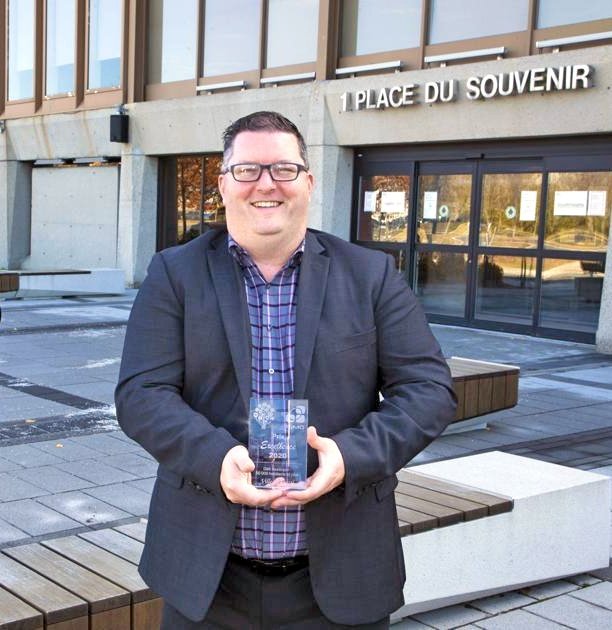
Officials with the City of Laval were recognized by their peers last week with an award recognizing efforts made by Laval to upgrade its systems for dealing with requests made by citizens. The Prix Excellence 2020 for municipalities with 50,000 or more residents was awarded by the Réseau de l’informatique municipale du Québec (RIMQ).
Innovation recognized
According to a press release from the city, the award recognized a significant program of changes Laval made to its inter-office systems in order to improve the priority of requests made by residents. The lessons learned from the project will now be shared with other municipalities across Quebec.
“We thank the RIMQ for this award,” said Laval city councillor for Laval-Les Îles Nicholas Borne, adding that the city’s management team managed to fundamentally alter its approach for dealing with citizen requests.
According to the city, the Citizen Requests project was launched four years ago with public consultations as well as marketing research. Apart from the involvement of Laval residents whose input was used, 700 municipal employees also took part, says the city.
Uses AI and algorhithms
With the new system, Laval residents now have a web portal with cloud support on which they can follow the progress of requests they make to the city. Artificial intelligence and algorhithms are also used to track and transcribe interactions between residents and employees. The city says the lessons learned from creating the new system will now be shared with other municipalities. As such, on Nov. 19 officials from the city will be taking part in a web conference sponsored by Microsoft and Gestisoft, who assisted the city with the project, where information and data from the project will be shared with other municipalities.
Part of an $85 million sum going to 280 family groups all over the province
Nearly a dozen Laval-based community organizations that provide support and social services to families will be receiving more than $1.3 million in additional subsidies from the Quebec government over the next five years, Sainte-Rose MNA Christopher Skeete announced recently on behalf of Family Minister Mathieu Lacombe.
Organization
New funding allotted (per year)
CENTRE COMMUNAUTAIRE VAL-MARTIN
$132,502
MAISON DES ENFANTS LE DAUPHIN, DE LAVAL
$130,000
MAISON DE LA FAMILLE DE LAVAL-OUEST
$130,000
BUREAU D’AIDE ET D’ASSISTANCE FAMILIALE PLACE SAINT-MARTIN INC.
$130,000
LA PARENTÈLE DE LAVAL INC.
$146,010
LE RELAIS DU QUARTIER DE SAINT-VINCENT-DE-PAUL
$130,000
MAISON DE LA FAMILLE DE SAINT-FRANÇOIS
$130,000
MAISON DE QUARTIER DE FABREVILLE INC.
$133,012
REGROUPEMENT DES FAMILLES MONOPARENTALES ET RECOMPOSÉES DE LAVAL
$130,000
LE RELAIS FAMILIAL D’AUTEUIL
$130,000
MAISON DE QUARTIER VIMONT
$130,000
The sum is part of an $85 million amount being allotted to around 280 similar organizations all over Quebec during the same period. The CAQ government says it is providing the funding especially to provide better support for the developmental needs of children, who are regarded as vulnerable.
Good news for families
“The government is attentive to the needs of Quebec’s families,” said Skeete. “The announcement of this additional financing is done in this spirit. This is excellent for the families of Laval. I am pleased to know that the community organizations that are here for the parents of families in the region will have the means to intervene consistently, especially during these times which are more difficult than usual.”
“As Ministre of Families, I consider it important that these organizations should have the means to meet the needs of families, especially during these challenging times,” added Lacombe. “I would like to acknowledge the outstanding work done by the intervenors who are out in the field. You are making a difference in our children’s lives, in addition to supporting the many parents.”
Offices of the mayor and opposition relocated for next four years
The City of Laval says that beginning on Nov. 23, the city hall offices of the mayor, the opposition, the independent councillors and the administration will be moved to 3131 Saint-Martin Blvd. West for the next four years because of a major City Hall renovation project.
According to the city, relocation of the city clerk’s office, supply and services, as well as the city council meeting chamber where the executive-committee also meets, will be relocated in 2021.
Services not impacted
The city says these temporary relocations won’t have an impact on the services available to residents, which will continue to be coordinated through the multi-service outlet. However, since Nov. 2, residents are obliged to make an appointment online at inscriptions.laval.ca before going to the outlet.
Laval City Hall was built from 1963 to 1964, just prior to the creation of the City of Laval following the merger of a number of towns and villages on Île Jésus. The building is regarded as one of the most avant-garde examples of modern architecture in Quebec when the Quiet Revolution was bringing about sweeping changes to the province.
Former astronaut Julie Payette shares views on space travel with science journalist
If there are two people in Canada who should know a thing or two about the International Space Station (ISS), they’d have to be Governor General Julie Payette, who did two tours of duty as an astronaut from Canada aboard the spacecraft, and Canadian science journalist Bob McDonald, who has been covering the ISS since its launch at the beginning of the new millenium.
Last week, Payette hosted two virtual conversations over the internet, revolving around the theme, ‘20 Years of Continuous Habitation on the International Space Station,’ to mark the anniversary. One was with McDonald, host of the CBC’s long-running Quirks and Quarks science series, while the other was with Charles Tisseyre, the host of ‘Découverte,’ a televised Radio-Canada science program.
From the left, Canada’s Governor General Julie Payette, who spent time on the International Space Station twice while a Canadian astronaut, shared anecdotes and thoughts about the ISS last week with Canadian science journalist Bob McDonald, who left his mark on the space station in an odd sort of way.
ISS’s 20th anniversary
The ISS is an orbital science laboratory and the largest human-made object in space. Its construction required more than 40 assembly flights over 13 years. Measuring the length of a football field, the ISS is made up of 16 pressurized modules, with four pairs of giant solar arrays to generate on-board electricity.
The first long-duration crew arrived at the International Space Station on November 2, 2000. Since then, 240 astronauts from 19 countries have worked on the ISS, conducting construction missions, spacewalks and maintenance operations, as well as a multitude of research projects.
Informed conversation
McDonald is a seasoned journalist who is passionate about science as well as the future of human space exploration and travel. His expertise, combined with the Governor General’s first-hand experience on the ISS as an astronaut, brought a unique perspective to their conversation.
“I always make a point to say that the International Space Station could not have been built if it hadn’t been for Canada,” Governor General Payette said, noting the robotic Canadarm2 which was deployed on the ISS in 2001. “The Canadarm2 and the Dexterous Manipulator are still very crucial to this,” she said. “It’s a fitting thing that Canada decided that its contribution would be so vital, and continue that contribution.”
Saw space program grow
Asked by the Governor General for his impressions of the space station, McDonald said, “For me, it’s a continuation of watching the space program from the very, very beginning, because I’m old enough that I remember Sputnik, the very first satellite. The whole thing. I watched all the moon landings, not just the first one. I knew the names of all the astronauts.”
The International Space Station could not have been built if it hadn’t been for Canada
– Governor General of Canada Julie Payette
Although he never travelled into space, McDonald said he had a personal connection with the ISS. In 1995 when Canadian astronaut Chris Hadfield was training for his first space station mission, McDonald tagged along with Hadfield to the factory in Russia where modules for the ISS were being built.
Left his mark on the ISS
“So, I went over to one of them that was sitting there – it wasn’t finished – they were still building it,” he said. “It was just this big metal tube. They were putting in wiring and plumbing. So, I went over and I stuck my head in and I got a real sense of just how big those modules are.
“I mean they’re the size of buses,” he continued. “And I thought this is really neat. And then when nobody was looking, I took my thumb, I reached inside and I put my thumb on the metal. So, my thumbprint is in space, my DNA is in space. So, I have a personal connection with the space station.”
The future of space travel
McDonald and the Governor General agreed that the cost of commercial space travel is coming down, anticipating a time, possibly soon, when “space tourism” becomes a reality. “It is actually beginning to happen,” said McDonald, noting that major stakeholders such as Richard Branson are investing heavily in commercial space travel, with suborbital flights by his company expected to begin before the end of this year.
While space research is sometimes criticized as wasting money which could be spent resolving problems on earth, McDonald suggested a lot has been learned from the International Space Station. “What it showed us is how to live in space,” he said. “If we’re going to go to Mars, we have to live in space. And the space station did that.”
Accessing health and social services during the pandemic becomes an issue
Some 25 members of the Laval English-speaking community, including many Agape-NPI partners, attended a virtual Agape-Networking and Partnership Initiative (Agape-NPI) meeting on November 5, during which access by Anglophones to telephone help lines during the COVID-19 pandemic was discussed.
A good turnout
Among those present were many English-speaking seniors, representatives from the Community Learning Centre/Laval Senior Academy, the Learning Exchange, pedagogical and guidance counselling facilitators from the Sir Wilfrid Laurier School Board, and representatives of a provincial committee for access to health and social services in English.
The goal, according to Agape coordinator and social worker Ian Williams, was to have the Agape-NPI’s health and social services partner, the Centre intégré de santé et de services sociaux de Laval (CISSS de Laval), present information on important service access points for health and social services to the Laval English-speaking community – especially in view of the COVID-19 pandemic.
Concerns over pandemic
In light of the pandemic and public health directives to keep physical distance from one another and to avoid crowds, said Williams, there may be concerns in the community about going to health facilities where those who are potentially infected with COVID-19 may come into contact with those who are not.
On the other hand, he added, accessing and following up with one’s physical and mental health are all the more important in the context of a pandemic. During the meeting, there were discussions about confusion which has arisen over the Quebec COVID-19 information line (1-877-644-4545) and its mandate, and when and why one should call this number.
Info was presented on important access points for health and social services to the Laval English-speaking community – especially in view of the COVID-19 pandemic
Julie Lafontaine, assistant to the manager responsible for the Laval regional Info-santé line, as well as Carl Blondin, director for the Info-social info line, spoke about the 8-1-1 phone service, saying it is the main and best access point for both health concerns or psychosocial needs.
Gateways to services
According to Williams, often these phone lines are gateways to other services within the health and social services system at the CISSS de Laval as well as to community organizations offering social services. He said the mandate of the 1-877-644-4545 Service Quebec COVID-19 info line was also explained and contrasted to the 8-1-1 lines. Specific examples were given during the meeting about why one would call the COVID-19 information line.
Also during the meeting, the Agape-NPI coordinators reminded the participants about community referral resources such as the 2-1-1 community referral line (operated by the Referral Centre of Greater Montreal), as well as specific resource guides online which complement the 8-1-1 line.
As always, added Williams, the Agape-NPI provided a space where participants could engage in networking to address specific community needs between community members and local organizations or between organizations.
About Agape-NPI
The Laval NPI Partners Committee is a “network partnership initiative” created in conjunction with the Community Health and Social Services Network (CHSSN). Formed in 2000, the CHSSN supports English-speaking communities across Quebec in their efforts to redress health status inequalities and promote healthy communities. Agape Inc., which provides a range of social services, including children’s daycare, from its storefront and offices on Notre Dame Blvd., is the sponsoring organization for the Laval NPI Partners Committee. The Laval network has attracted as many as 50 organizations which share an interest in improving local health and social services. They have included the CISSS de Laval, the Sir Wilfrid Laurier School Board and the Jewish Rehabilitation Hospital.
Sonia Baudelot will lead opposition party into elections next year
In preparation for the municipal elections in November 2021, the Action Laval opposition party announced its new leader last week.
Sonia Baudelot founded and led the Avenir Laval party as a mayoralty candidate in the 2017 election. She had also been a council candidate in the 2013 elections.
A non-politician
As well, Baudelot ran for the Conservative Party of Canada in the riding of Marc-Aurèle-Fortin in the 2019 federal elections.
According to Action Laval officials, the decision to choose Baudelot was made by 136 Action Laval members during an online webcast meeting. In a media release, the party describes Baudelot as a young mother, born in Laval, active in community organizations, and not a professional politician.
Says she loves Laval
“My children were born at the Cité-de-la-santé in Laval,” she said during a launch on Oct. 5. “I love my city, but I love its people even more. It’s for their sake that I get involved in our communities and that I want to be mayor. I have a passion for it.
Sonia Baudelot, who is leading Action Laval towards the November 2021 municipal elections, is seen here with Action Laval city councillor for Saint-Bruno David De Cotis during the party’s recent launch.
“You have to dare to run if you want to initiate change,” she added. “I commit myself to the causes I believe in. The challenges are considerable and the barrier to entry is significant. Fortunately, Action Laval is a serious and solid party whose values reflect those of Laval residents and my own.
Humane and attentive
“As candidate for mayor, I will promote these values and offer Laval residents an administration that is humane and attentive to their needs, with solutions to their everyday issues while investing responsibly in our future. We will offer this choice to voters in November 2021.”
In addition to her political activism, professionally she is a flight director for a major airline and vice-president of a local union for a flight crew.
As well, she sits on the board of directors of a senior citizens’ residence and has been a member of the board of directors of the Ligue d’action civique, director of a community centre in Laval and an active member of a large number of cultural, community and women’s organizations.
The ‘main opposition’
While the rival Parti Laval opposition party has only two members currently sitting on city council, that party holds the status as the official opposition. Action Laval refers to itself as “the main opposition” in Laval city council because it holds four council seats: Chomedey (Aglaia Revelakis), Saint-Bruno (David De Cotis), Laval-des-Rapides (Isabella Tassoni) and Saint-Vincent-de-Paul (Paolo Galati).
As candidate for mayor, I will promote these values and offer Laval residents an administration that is humane and attentive to their needs
– Action Laval mayoralty candidate Sonia Baudelot
Action Laval says its main goal leading towards the 2021 elections will be “to defeat the Demers administration” and “replace it with a united, proactive team that is open to new ideas and innovation and truly attentive to the needs and concerns of Laval citizens.”
She is well-connected
With Baudelot now in the driver’s seat, Action Laval interim-leader Archie Cifelli will be out of the limelight at least for the time being. Cifelli said the party vetted three candidates to fill its leadership position before deciding on Baudelot. Cifelli said the party currently has more than 1,000 members.
He said one of the party’s considerations in choosing Baudelot was her vast network of connections – which Action Laval plans to put to good use. “It was one of the key reasons – her network – for our choosing her,” he said. “I will be contacting a lot of friends of mine who are like family – politics becomes a big family,” she added.