Saturday, February 21, 2026
8 C
Laval
spot_img
Home Blog Page 149

French Québec’s ‘Inferiority Complex’

René Lévesque once told me “it’s a sort of inferiority complex”, in a discussion about the push back of his government over English domination. It was in the midst of a post interview discussion over Bill 101, when I was a reporter at CJAD. I was often sent to Québec City to interview the various PQ ministers, (some of whom, ironically were more bilingual than Robert Bourassa’s Liberal ministers). And that also meant meeting up with Premier Lévesque. The program was called “Québec Report”. The “inferiority” comment surprised me. I remember being so upset that I had not gotten that sound bite on tape. I doubt Lévesque would have uttered it on air.

No one separatist or sovereigntist, or Quebec nationalist would disagree with what Lévesque said, then or now. So, is this sense of French Quebec “inferiority” the same motivation today, or is it really about “linguistic transfer” – not sufficient immigrants “transferring” to French? Why is this debate never ending?

I ask because I hear the same rhetoric 45 years later. Especially in this Bill 96 addressing the use of French in the workplace, access to English CEGEPS, French only ‘need apply jobs’, applying the Charter to the number of employees in small businesses etc. It’s all a repeat, but it’s taken further now.

Lévesque at the time revealed in one my interviews with him that Québec was going to form its own constitution. Unlike the “inferiority” comment, this was indeed on air. And it made The CTV National News with Lloyd Robertson. I can still hear Lloyd, “A Montreal radio station reported today that Premier René…its own Quebec Constitution…”.

Now the minister in charge of the Charter of the French Language, wants to change the Canadian Constitution. It’s possible because the CAQ is getting help. Mr. Trudeau’s Liberals, our Prime Minister is going to help get Bill 96 passed, by getting Parliament to consent. Have you noticed Ontario’s Conservative Premier Doug Ford and Alberta’s Conservative Premier Jason Kenney are the constant target of Justin Trudeau? The Prime Minister loves to divert attention, by squabbling with anyone who is not from his ideology, except Québec. Never has he criticized Québec. And that applies to all the marionette ministers. He is silencing negativity towards Quebec because after all, he is from Quebec, a member of Parliament from Papineau who needs to be re-elected, but more importantly because he needs to stop the Bloc. And he’s having trouble doing it.

The Bloc (13 points ahead of Liberals among French survey-Leger) is the major obstacle for Trudeau to obtain a majority vote in the next election. That’s one big reason why he says nothing to protect our English minority, nothing against the law on secularism, nothing on Quebec events like the vandalism of the John A. Macdonald statue. But Trudeau will do what he can to get Bill 96 passed.

Suddenly it’s not about Liberal ideology.

It’s about votes. It’s about power.

To be fair, they are all need to sway Quebec votes. The Bloc of course will support Bill 96. Conservative leader Erin O’Toole will support it because the West, the Conservative stronghold, will continue to vote for O’Toole. Frankly, the West does not care what happens to Quebec. And the NDP’s Jagmeet Singh, after a disastrous fall from a high of 59 seats thanks to the Jack Layton days, will go with wherever the wind is blowing. He can not afford not to support Bill 96. It’s all about votes. They all just love Quebec, don’t they? It’s a ‘sea of love’. And all federal leaders, Trudeau included, never miss an opportunity for a photo op with Quebec Premier Legault. Why? Because Legault is the most popular Premier in Canada right now. Legault’s opinion poll rating is upwards of 60%. Every politician loves to rub elbows with a winner.

Many English-speaking Quebecers are angry and disillusioned, even betrayed by the Liberal party. They stayed, despite the PQ win of ’76, despite the referendum of ’80 and despite the second referendum that was almost lost in ’95. Friends and family left. They stayed.

And now this.

Enough already.

Keep it all in mind when you prepare to cast your ballot at the next federal election. And when will that be? Well technically, the liberals could wait till October 16th, 2023, but they will not. It will be this year. Trudeau’s free-spending budget is a clear sign. Besides, Mr. Trudeau is obsessed with having a majority government, so as not to have to deal with an effective opposition in the House of Commons. That is just the way he likes to rule. He will of course blame the opposition. “…the Conservatives’ tactics have turned into obstruction. That must end,” Liberal House Leader Pablo Rodriguez said in a statement to Reuters.

But make no mistake. The call for an election in large part, depends on the right conditions, like vaccine distribution in Canada. We are the only country in the world to disregard science and stretch out the period from first to second vaccine jabs to 16 weeks, claiming to maximize shots to as many Canadians as possible, Trudeau pretends to lay out “a summer when a vast majority of Canadians have received one dose…where we can see our loved ones and invite our friends over for BBQs” Isn’t that a wonderful uplifting liberal campaign platform!

“That’s What I’m Thinking”

Robert Vairorobert@newsfirst.ca

Legault’s anglo liaison Christopher Skeete goes to bat for Bill 96

CAQ government’s Bill 101 update draws both praise and condemnation

Despite concerns by anglophone interest groups over the possible infringement of freedoms and rights, Sainte-Rose MNA Christopher Skeete, Premier François Legault’s liaison to Quebec’s English-speaking community, is defending Bill 96, the CAQ government’s proposed new law updating the Charter of the French Language (Bill 101).

Last week, the Legault government tabled a draft version of the legislation, whose broadest proposal would be to amend Canada’s constitution by adding clauses to define Quebec as a “nation,” with French as a single official and common language.

An historic Bill 101 update

While months of intense scrutiny and debate over the proposed legislation lie ahead, at the outset it is believed to be the most rigorous revision Bill 101 has undergone since 1977 when the Parti Québécois government, then in its first mandate, passed the Charte de la langue française.

That bill, in turn, extensively added to work that had been started by the Quebec Liberal government, when it enacted the ill-fated Bill 22 under the guidance of then-Premier Robert Bourassa, who was defeated in his own riding in the historic 1976 provincial election when the PQ was first elected.

Facing rising political pressure from Quebec nationalists, as well as academic and anecdotal evidence of the growing dominance of the English language in metropolitan areas while French declines, the Legault government seeks to raise the use of French generally, with increased emphasis on the province’s work places.

Laval at centre of debate

Laval, where spoken English is heard more and more often in public places and where the population is increasingly multilingual, has been cited in recent years by academics and demographers as an example of what successive provincial governments have been trying in varying degrees to regulate.

Census data from 2016 suggest that more than 21 per cent of people in Laval are now considered to be English-speaking, marking a significant increase since the 2011 census.

However, more than 60 per cent of the population still speaks French as their mother-tongue, and French is spoken most often at home by more than 65 per cent. Still, anglophones and allophones now account for nearly 40 per cent of Laval’s population.

Bill 96 highlights

Although still in its developmental stages, Bill 96 would include, among other things, the following measures:

  • Making Bill 101 applicable to businesses with 25-49 employees as well as all federal workplaces;
  • Making all commercial signage with non-French-language trademarks include a “predominant” amount of French;
  • Establishing the maximum number of students attending English-language CEGEPs at 17.5 per cent of the overall Quebec student population. Anglophones would also be given admission priority into English CEGEPs;
  • For the first time, French language training would be provided by Quebec to residents who aren’t already obliged by Bill 101 to go to school in French;
  • A municipality’s bilingual status would be revoked if census data showed that English is the first language for less than 50 per cent of the population, unless the municipality decided to maintain its status by passing a resolution to conserve it;
  • All provincial communications with immigrants would be in French, starting six months after their arrival.

Skeete defends Bill 96

Defending Bill 96 on CJAD last week, Christopher Skeete said, “I think if you look at what’s being proposed, you see a deliberate attempt to show extreme deference to the English community. I’m talking about solving a historical problem, which has been the growing inability of English-speaking Quebecers to access the CEGEP system. We’re fixing that problem.”

He also suggested that the CAQ government is showing “recognition that municipal autonomy needs to be used in order to protect the bilingual status of cities.”

And he said English-speaking Quebecers are being granted “the right to learn French in order to be successful in Quebec, which solves a myriad of issues for the English-speaking community, notably accessing the civil service, getting better-paying jobs, fixing other types of access to the wider Quebec society. There are lot of good things in there for the English-speaking community.”

Demers pleased with legislation

Laval mayor Marc Demers issued a statement last week which praised overall the CAQ government’s language law reform efforts. “There can be no doubt that the retreat of French in the greater metropolitan region is an issue that merits being addressed,” Demers said, adding that he was satisfied overall with the thoughts and ideas brought forth by French Language Minister Simon Jolin-Barrette.

Demers praised especially the following elements in government’s draft Bill 96:

  • French being made Quebec’s sole official and common language;
  • Raising the status of French in Quebec at all levels of society;
  • Allowing the state to serve as and to set an example in the use of French;
  • Establishing a linguistic governance that manages to be objective but strong.

Regarding elements of Bill 96 affecting Laval’s English-speaking community, Demers suggested the proposed new legislation is flexible enough to meet needs without interference from Quebec. “The draft law respects municipal autonomy,” he said. “As we understand it, the City of Laval will be able to continue offering services to the anglophone community.”

‘Overrides rights,’ QCGN suggests

The Quebec Community Groups Network (QCGN) wasn’t nearly as receptive to Bill 96.

“The Quebec Community Groups Network deeply regrets that proposed changes to the Charter of the French Language override fundamental human rights and will erode the vitality of our English-speaking minority community,” the Montreal-based group said in a statement.

“The proposed legislative changes are more far-reaching than we could have ever imagined,” QCGN president Marlene Jennings said, adding that the bill, “which invokes the notwithstanding clause throughout, puts the collective rights of French-speaking Quebec ahead of the fundamental rights and freedoms of individual Quebecers.”

Jennings said that at a recent meeting by the QCGN with Jolin-Barrette, “the government had assured us its objective is not to take away or diminish the rights of English-speaking Quebecers, divide the two language groups, or act to the detriment of the institutions of the English-speaking community. Unfortunately, this bill will have the opposite effect.”

‘Unconstitutional,’ says Jennings

The QCGN said it was “taken aback” that the government is proposing to unilaterally amend the Canadian Constitution to recognize the linguistic specificity of the Quebec nation. “That’s a constitutional curveball we certainly were not expecting,” said Jennings. “This is a fundamental shift in the Canada/Quebec relationship and one we believe is unconstitutional.”

‘I think if you look at what’s being proposed, you see a deliberate attempt to show extreme deference to the English community,’ said Sainte-Rose MNA Christopher Skeete

“This is a closed-in, narrow vison of a Quebec that is increasingly distancing itself from the rest of Canada,” she added. “Stricter regulations for commercial signs and the imposition of the notwithstanding clause to supersede the rights and freedoms of Quebecers represents a huge step backward that will create unnecessary conflict and division.”

The QCGN, which represents up to 60 stake holding groups and organizations across Quebec, said it was also concerned about the plan to extend the application of Bill 101 to businesses with between 25 and 49 employees and the amount of red tape created by a fresh multitude of complicated rules and regulations.

Bad for business, QCGN says

“This bureaucratization will make it more difficult for small businesses to operate and flourish in Quebec, within Canada, and to build strong links with North America and the world,” Jennings said.

“The government’s priorities are ill thought out. Many businesses are struggling to stay afloat and the pandemic has had a devastating impact on small businesses in every region of this province. This is certainly not the time to make the lives of these hard-working merchants and businesspeople even more difficult.”

However, Jennings said the QCGN “is certainly pleased that the government is widening access to French language training – a longstanding demand of our community, particularly from our youth.” She called it “a positive and welcome step that will allow more English-speaking Quebecers to find gainful employment and remain in Quebec.”

Laval Police assist in arrest of three in drugs/firearms raids

Officers from the Laval Police Department provided assistance to investigators from the Montreal Police Department on May 13 and 14 to arrest three suspects and seize two firearms and an assortment of street drugs during raids conducted in downtown Montreal and Chomedey.

During the operation, police seized a handgun, a fully automatic rapid-fire rifle, eight ammunition magazines, a large quantity of munitions, and an assortment of narcotics that included cocaine, heroine and cannabis.

The Montreal Police Department issued this image of one of the firearms seized during the raids.

As well, $7,000 in cash found on the premises was also seized.

The three suspects, who remain in police custody after being arraigned in Montreal on charges that include possession of firearms and illicit drug trafficking, are Soheyb Hammi, age 31, Hichem Rouabah, age 26, and Mohamed Reda Drif, age 22.

Laval News Volume 29-14

0

The current issue of the Laval News volume 29-14 published May 19th, 2021.
Covering Laval local news, politics, sports and our new section Mature Life.
(Click on the image to read the paper.)

Front page of the Laval News.
https://lavalnews.ca/wp-content/uploads/2021/05/TLN-29-14-WEB.pdfFront page of the Laval News, May 19th, 2021 issue.

Firefighters rescue distressed boater on Rivière des Mille Îles

During the late afternoon on Saturday May 15, firefighters with the Laval Fire Department’s marine rescue unit made a successful intervention on the Rivière des Mille Îles after a boater lost control of a small vessel in the current near Île aux Vaches.

According to a post sent out last Saturday evening from the Laval firefighter union’s (Association Pompiers Laval) Twitter account, the operation was relatively short.

A photo posted by the APL suggested the distressed boater managed to make it to shore on one of the many islands on that stretch of the river, where the rescuers found him.

Laval public works employees fired for using marijuana on the job

The union representing City of Laval public works employees is contesting a decision by the city to fire three employees after they were filmed by a resident while they were using marijuana on the job.

According a report last week by the TVA network, the resident spotted the employees in early March in a Laval neighbourhood where they were working.

While two of the workers were full-time and had 16 and eight years experience respectively, the third employee was part-time, said TVA.

The network said the three were initially suspended with pay while an investigation was undertaken, but were terminated permanently in April.

While the union hasn’t commented on whether the workers were using cannabis, they consider the punishment to be out of proportion, while noting that the employees themselves haven’t been allowed to view the video.

Following the federal government’s regularization of the sale and use of cannabis in 2018, many municipalities in Quebec adopted new by-laws which, among other things, established strict rules prohibiting the use of cannabis by employees while on the job.

LPD seeks suspect in Pont-Viau assault incident last August

The Laval Police Department says it is seeking the public’s help in identifying a woman suspected of having committed an assault last summer at a convenience store in Pont-Viau, injuring a victim.

According to the LPD, on Aug. 3 last year around 3:45 pm, the 60-year-old victim was making purchases at the convenience store.

The suspect was in line behind the victim after placing a container of milk on the counter and was visibly impatient.

After the two exchanged angry words inside the store, the suspect followed the victim outside while she was leaving and gave her a hard shove.

According to an account provided by the police, the victim fell forward down the store’s front stairs, after which the suspect taunted the victim, then returned inside to pay for purchases.

The suspect boarded a car, on the passenger side, that was waiting outside. The victim suffered an injury to the right leg and now has physical scars and suffers from a psychological trauma disorder resulting from the assault.

Description of the suspect:

  • Female, white, around 18-19 years old
  • Speaks French with québécois accent
  • Height: 1 m 57 (5’2” )
  • Slim build
  • Dark brown, mid-length hair

Description of vehicle:

  • Light-colored sedan

Anyone who thinks they may have useful information about the identity of this suspect can call the LPD’s confidential Info-Line at 450 662-INFO (4636), or dial 911. The dossier number is LVL 200807-030.

Revelakis provides update on Webb Ave. street changes

Chomedey city councillor Aglaia Revelakis says she is continuing to work behind the scenes to resolve a dispute between residents of Webb Ave. and the City of Laval over changes to the street the residents object to.

One of the the residents’ most significant complaints concerned the city’s plan to narrow Webb Ave.

According to Revelakis, officials at the city’s engineering deparment decided, after she met with them last Monday while the residents were staging a short demonstration on their street, that a public consultation will now be held.

“Just rest assured that I’m on top of this file,” she told the Laval News. “And everybody will be receiving a notice to participate in the meeting sometime in the future.”

All the same, she said that some of the work will be starting, including street excavation for the replacement of underground water and sewer infrastructure.

Careless pellet gun use earns a 19-year-old 26 months

A 19-year-old man who fired off a pellet gun at some friends’ house, while also firing into the face of a young female acquaintance causing injury, was sentenced recently at the Laval courthouse to 26 months behind bars.

In his decision rendered against Gabriel Marion, Judge Serge Cimon recounted how the accused fired four times at one victim, hitting her in the forehead, while also shattering her eyeglasses and causing pieces of glass to enter one of her eyes.

Marion had just turned 18, reaching the age of a legal adult, when the act took place in January 2020. Although he was already subject to special conditions previously imposed by court order to not be in possession of firearms, he nonetheless got a hold of a pellet-firing gun, before turning up at his friends’ residence.

Fired pellets inside home

According to facts stated by the judge in his report, Marion had used marijuana beforehand, then started firing off the weapon inside the home.

Although the people he was visiting asked him to stop, he continued firing off rounds at them, according to the judge’s report.

At one point, one of them asked Marion to fire at her so that she could learn to control her fear. Happy to oblige, he followed through on her request, and a year after the incident she still has pain in the eye that was wounded by one of the pellets.

The accused was charged under criminal code sections concerning possession of firearms, even though the weapon he was using was a pellet-firing weapon. According to the Canadian criminal code, some pellet-firing weapons are classified as firearms.

Judge threw the book

Although Marion expressed regret for his actions and for having wounded a friend, the judge noted the seriousness of his acts given they were committed with dangerous weapons.

A psychiatrist’s report tabled during the trial noted that the accused had in recent years developed an increasing interest in firearms, and that he had expressed a desire to eventually acquire a real gun.

In addition to the 26-month prison sentence, Marion also was given three years of probation, and he is now forbidden from owning certain types of firearms for the rest of his life.

Notre Dame/Curé Labelle shutdown draws flack from nearby businesses

Busy Chomedey intersection to be closed a month (at least) for water and sewer pipe work

It happened so fast, it was like night and day.

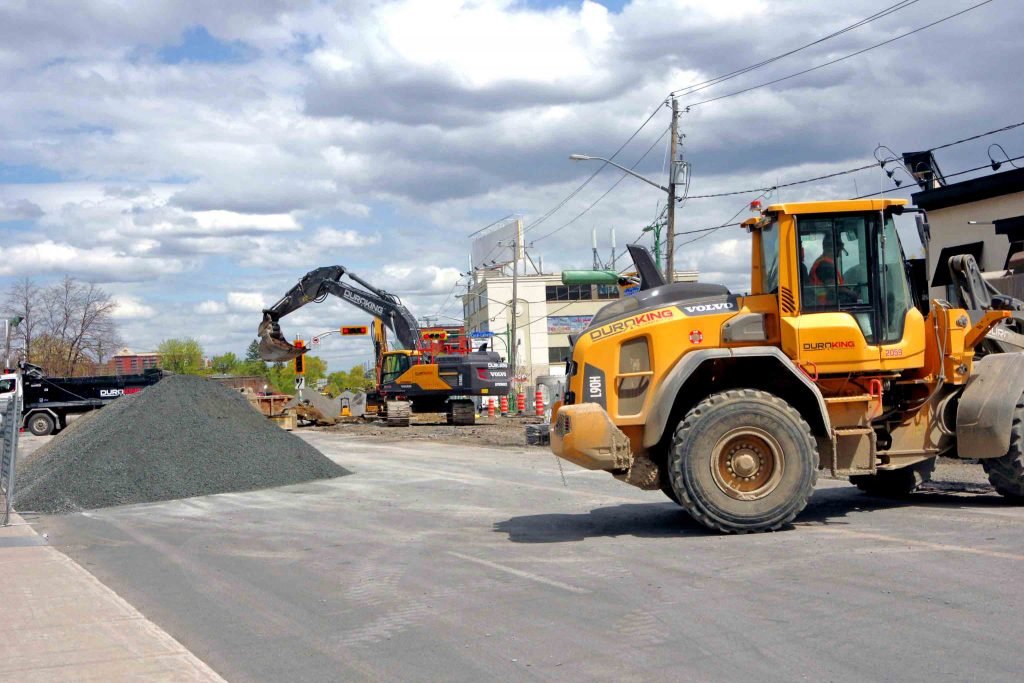
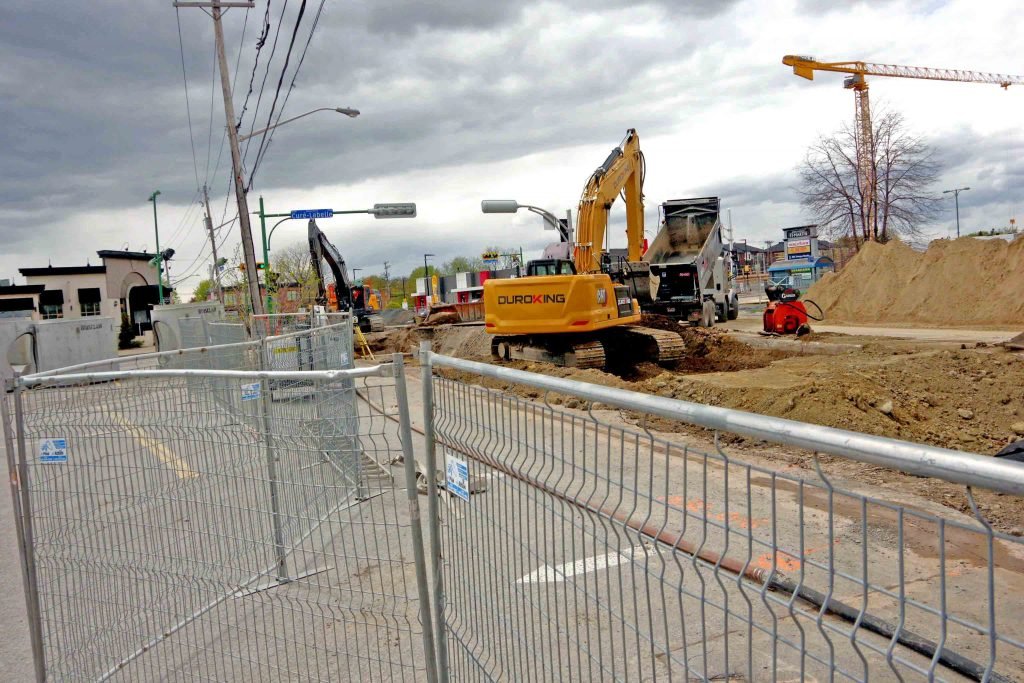
That’s how quickly the corner of Notre Dame and Curé Labelle – probably Chomedey’s busiest intersection – was transformed over the past week-and-a-half into an impassable no man’s land, as the City of Laval began work on a long-awaited storm drain and water main replacement project.

Water and sewer pipes

The work includes replacement of a 200-mm drinking water main with a pipe measuring 400 mm to allow better water flow in the neighbourhood, and the addition of a second sewer water drain to provide greater protection against sudden and extreme storm flooding.

According to l’Abord-à-Plouffe city councillor Vasilios Karidogiannis, the intersection could remain closed as late as June 24, or at least for the next month, he told the Laval News.

Once the intersection reopens, the epicentre of the project will shift a block west to the corner of Notre Dame and Jarry, which is expected to be at least partly closed over the coming summer.

This was waiting after return

For Ian Williams, the staff social worker at Agape social services on Notre Dame (a stone’s throw from the centre of the carnage), his first day back at work full-time following a pandemic-related furlough was a shock when he saw the transformation of the intersection.

“This is going to be problematic for us,” he said in an interview last Friday, noting that parents who bring their children to the daycare could have trouble getting in and out because of the numerous detours they’ll now have to navigate.

“A lot of them come in off Autoroute 15, and some from Autoroute 13, and this is definitely going to be a factor,” Williams added, noting that he and other people assumed the work was completed last year when the city carried out some preliminary aspects on the street outside the Senior Wellness Centre.

Making life complicated

He said staff at the Agape Senior Wellness Centre, located a block away on the east side of Curé Labelle, had recently been in the middle of a move, and the street closure would only complicate things for them further.

On a personal note, he said that driving his son to a nearby school is now much harder. “At a time of day when everyone is so busy, it just adds minutes to the drive in and creates more headaches,” said Williams.

A block east on Notre Dame, Giannoula Chinis, owner of the Oneiro II children’s wear boutique, had plenty of reason to be angry about the shutdown of the intersection, considering it’s just the latest of aggravations related to the sewer infrastructure.

A longstanding problem

As reported by the Laval News in February 2016, the boutique dealt with a series of floods since the late 1990s, which destroyed tens of thousands of dollars of merchandise stored in her business’s basement. And she wasn’t the only business on that stretch of Notre Dame that was impacted.

Despite efforts by the City of Laval to correct the situation, lakes of water continued to accumulate outside on Notre Dame whenever there was a heavy rainfall, because the sewer system was inadequate to deal with storm surges. The latest work that has shut the corner of Notre Dame and Curé Labelle will hopefully fix the problem permanently.

Still, she remains frustrated that the corrective work is taking so long. “What I don’t understand is that they fixed this side of the street, they closed it for so many months, and now they’re here again,” she said, pointing to the shut intersection.

Was promised five years ago

Saying that the city had promised to fix the situation five years ago, she was even less than impressed now given the delay. “They promised us that before 2016 the problem would be fixed because they had government funding,” she said, while acknowledging that the city probably did improve things by installing an underground storm water collector last year near the corner of Thomas Chapais St.

‘What I don’t understand is that they fixed this side of the street, they closed it for so many months, and now they’re here again,’ says one discouraged local business owner

At Pizza Morado, another nearby Notre Dame Blvd. business now partly cut off from the street by safety barriers, a long-time employee expressed overall displeasure with the situation. “This has been going on for such a long time – why is it taking so long?” he said, referring to last year’s disruptions as well as the latest ones.

Area growing, says Karidogiannis

In an interview, Councillor Karidogiannis said the purpose of the work is not only to address the existing floodwater problem, but also takes into account the fact that major demographic and economic growth is happening in the area.

This includes a large new multi-unit residential project now being built on the site of the former Récréathèque on the north-west side of Notre Dame and Curé Labelle, as well as dozens of units of new social housing being built at the Val-Martin housing project just east of 80th Ave.

It had to be done, says councillor

“That whole area is changing and growing,” he said. “And to accommodate all that new stuff we need to improve the underground plumbing.”

According to Karidogiannis, the work will also be helping to alleviate sewer and water supply issues elsewhere in l’Abord-à-Plouffe. “So, it’s not just for that particular area. It affects an area probably all the way down to 100th Ave. plumbing-wise.”

While admitting that the disruptions are regrettable, he said the city had no choice but to proceed, since the beginning of the work last year was disrupted by the accelerating COVID-19 pandemic.

“While I understand the frustrations of people in the neighbourhood, this is something that’s got to be done,” said Karidogiannis.

Weather

Laval
light snow
-8.2 ° C
-7.7 °
-9.1 °
66 %
8.2kmh
100 %
Sat
-7 °
Sun
-1 °
Mon
-2 °
Tue
-5 °
Wed
-7 °