Two teenagers were beaten at the exit of classes in Laval on Tuesday by a group of young people who fired a shot during the altercation, ultimately leading to a large police deployment to arrest one of the suspects in the evening.
According to Laval police, it all started at 3:04 p.m. when a car stopped on the grounds of the Latour pavilion of Curé-Antoine-Labelle High School. On the spot, the group of suspects attacked two young men of 17 years, including one who sought to intervene to defend his friend, said Stéphanie Beshara, spokeswoman for the Laval police.
Both victims were beaten, to the point where one of them had to be taken to hospital to treat injuries deemed minor. A shot was also fired in the air by one of the suspects during the altercation.
Police say several witnesses described the suspect vehicle and license plate number. They later tracked down the vehicle in Laval’s Sainte-Dorothée neighbourhood, and the suspect was questioned overnight. To try to find out more about his role in this story of assault. The Beshara agency was not in a position to say whether he was known to the police. Police say there could still be more arrests.
The current issue of the Laval News volume 29-40 published November 17th , 2021. Covering Laval local news, politics, sports and our new section Mature Life. (Click on the image to read the paper.)
Front page of the Laval News, November 17th, 2021 issue.
The Laval police say they have arrested two men suspected of being connected to a sexual assault and say there may have been additional victims.
The LPD issued a statement on Nov. 1 saying that Jean-Michel Richard, 37, and Schnaider Toussaint, 24, had been arrested and appeared on Oct. 22 and 28 at the Laval courthouse under several charges related to sexual assault.
The allegations stem from an incident on Jan. 31, when a young woman went to the home of the two suspects to spend the evening. She was allegedly sexually assaulted by them that night.
Police say there are indications that other people may have been victims and that investigators hope to speak to them.
Anyone who believes they may have been sexually assaulted by these individuals is invited to contact Laval police confidentially at 450 662- INFO (4636) or by dialing 911. The file number is LVL 210218-057.
Laval Police find missing girl
The LPD says it has located 17-year-old Magaly Champagne who had been reported missing.
On Nov. 2, she had left her home to go to an appointment. She had not been seen since and those close to her feared for her safety.
She was believed to be somewhere in the greater Montreal area.
Montreal man charged with sexual assault and luring minors online
Police investigators from the Sûreté du Québec’s major crimes division say they have arrested a 57-year-old Montreal man in connection with several alleged sexual infractions.
Acher Sabbah appeared at the Laval courthouse last week to answer charges of sexual assault, sexual contacts, sexual coercion and child luring over the internet. The alleged offenses took place from 2015 to 2019 in Lachute, Beauharnois and Laval.
The suspect allegedly sought out his victims on various internet chat platforms, using such false names as “Adam.”
It is alleged that he would exchange text messages and have phone conversations with victims, followed by in-person meetings during which the alleged infractions occurred.
Police believe Sabbah could have more victims who have not yet been identified.
Laval-based wellness company to pay $200,000 for violating telemarketing rules
The Canadian Radio-television and Telecommunications Commission (CRTC) announced last week that CA Diffusion has agreed to pay a $200,000 penalty as part of a settlement for making non-compliant telemarketing calls.
The Laval-based company, more widely known as Physaro, specializes in the direct sale of wellness products geared toward seniors.
“This case was particularly worrisome as the products being sold targeted a vulnerable segment of our population,” said CRTC chief compliance and enforcement officer Steven Harroun.
“CA Diffusion cooperated with our investigation, voluntarily entered into an agreement, and has implemented corrective measures to ensure compliance with the rules. We continue to closely monitor organizations to uphold Canadians’ choice not to be bothered by telemarketing calls.”
The CRTC investigation uncovered that CA Diffusion committed several violations of the Unsolicited Telecommunications Rules between September 2018 and July 2019.
During that period, millions of unsolicited calls were made to Canadians – some of which were made to telephone numbers registered on the National Do Not Call List (DNCL) and outside of the permissible calling hours.
Some calls were also made during periods when the company failed to purchase a subscription to the National DNCL. The company enlisted the services of call centres based in Senegal and Morocco.
The CRTC reminds telemarketers that it is their duty to comply with the Unsolicited Telecommunications Rules, whether based in Canada or abroad, and whether they make the calls themselves or hire a third-party agency to do it for them.
The CRTC’s Unsolicited Telecommunications Rules are a strict set of regulations that individuals, companies and organizations must follow when making unsolicited telecommunications, including telemarketing calls.
The CRTC says it is continuing to monitor to ensure telemarketers follow the rules and to reduce the number of unwanted calls to Canadians.
The National DNCL was launched in 2008 to protect Canadians from unsolicited telecommunications. Canadians may register their numbers permanently on the List at no charge. Over 14 million numbers have been registered on the List.
The CRTC says that since 2008, a total of $10,716,930 has been issued in administrative monetary penalties. In 2020-21, Canadians filed 45,874 complaints with the National DNCL Operator.
Canadians can register their numbers, verify whether a number is on the List or file a complaint about a telemarketer by calling 1-866-580-DNCL (3625) or visiting the National DNCL website.
Stéphane Boyer obtains a strong mandate to become City of Laval’s next mayor
Who will form the next Official Opposition on Laval city council?
On Monday earlier this week, that was the burning question being pondered by election officials at Laval city hall, as election runner-ups Action Laval and the Parti Laval jostled in a tense neck-and-neck situation to see which would wear the mantle in the aftermath of Sunday’s municipal elections.
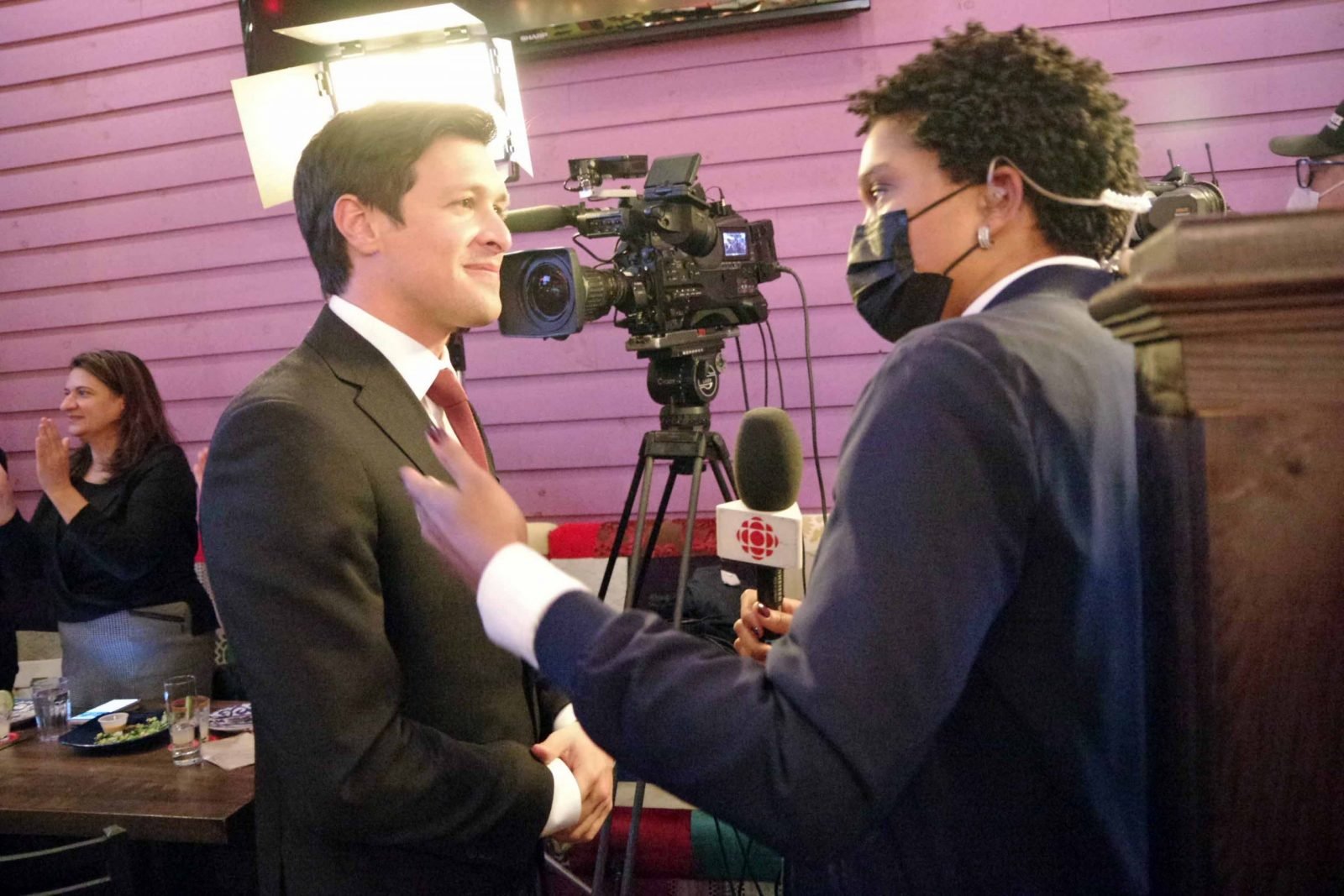
Newly-elected Laval mayor Stéphane Boyer is interviewed for television at Carlo & Pepe’s last Sunday evening. (Photos: Martin C. Barry, Newsfirst Multimedia)
Boyer decisively elected
About one thing there was no uncertainty: Stéphane Boyer clearly won the mayoralty race for the Mouvement lavallois, receiving 41.53 per cent support from the City of Laval’s voters.
However, a district-by-district vote count on Monday showed the Parti Laval and Action Laval less than 900 votes apart in overall support, with the former favoured to become the official opposition after having served in that role for the past four years.
The new council seat count
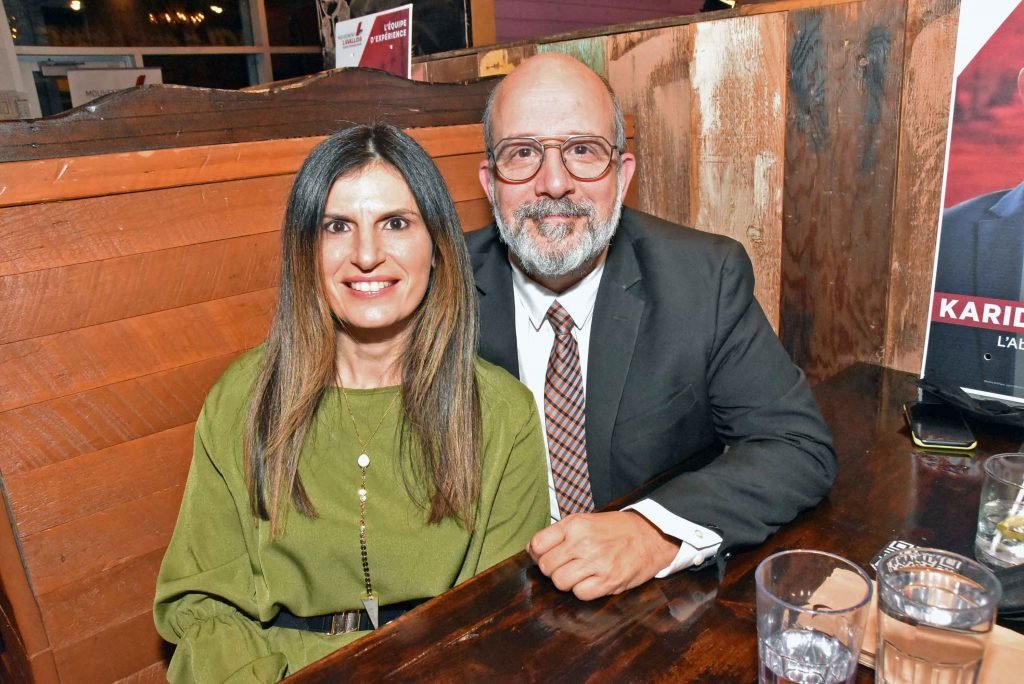
Re-elected ML L’Abord-à-Plouffe city councillor Vasilios Karidogiannis is seen here with his spouse last Sunday evening.
As the dust settled, the new seat count in Laval city council showed the Mouvement lavallois having won 14 districts, Action Laval taking five, and the Parti Laval winning two.
The five elected Action Laval city councillors are Aglaia Revelakis (Chomedey), David De Cotis (Saint-Bruno), Paolo Galati (Saint-Vincent-de-Paul), Achille ‘Archie’ Cifelli (Val-des-Arbres), and Isabelle Piché (Saint-François).
Piché is the spouse of De Cotis and their presence together on city council as part of the opposition promises to deliver some potentially-interesting “tag team” dynamics.
A sixth possible seat for Action Laval was the district of Renaud, where AL candidate Grace Ghazal and the Mouvement lavallois’s Seta Topouzian were separated by just 23 votes.
Two seats for Parti Laval
Incumbent Parti Laval city councillor for Fabreville Claude Larochelle was confirmed the winner in his district with 48.11 per cent support.
Former francophone school board president Louise Lortie won a second city district for the Parti Laval in Marc-Aurèle-Fortin, taking over the seat vacated by Michel Trottier who was the party’s unsuccessful mayoralty candidate.
Re-elected ML Sainte-Dorothée city councillor Ray Khalil is seen here with his spouse last Sunday evening.
In an interview with the Laval News inside the Mouvement lavallois’s chosen election night venue in Carlo & Pepe’s at the Centropolis, mayor-elect Stéphane Boyer said he was “very proud of the results tonight. We see it as a vote of confidence in the Mouvement lavallois for the good work we’ve done for the last few years. We’re very happy to see these results tonight and we’d like to thank all the population.”
Boyer to follow through on pledges
While Boyer said the new administration will be following through on its platform commitments, including new sports infrastructure, and the purchase of additional forestlands and green spaces, “I also want to have a bigger focus on housing to make sure that we have affordable housing for everyone,” he added, noting that his administration would also like to improve security in all the districts with a greater police presence and increased enforcement of traffic regulations near schools.
Regarding the Aquatic Complex project to be built next to the Cosmodôme, the new mayor said the project has been submitted to a second round of tendering for bids, and envelopes containing offers from contractors “should be opened in the coming weeks. We absolutely want to move forward with this project.”
AL leader’s future uncertain
At Action Laval headquarters on Saint Martin Blvd. near de l’Avenir, the mood was more subdued last Sunday evening. In an interview with the Laval News, party leader and mayoralty candidate Sophie Trottier, who finished the race with 24.16 per cent support (one percentage point behind the Parti Laval’s Michel Trottier), was uncertain about her future.
Left, defeated Action Laval mayoralty candidate Sophie Trottier is greeted by a supporter at party HQ on Saint-Martin Blvd. last Sunday evening.
“Right now, honestly, we’re going to need to sit down and talk about the options,” she said, referring to the party membership.
(Following Action Laval’s poor results after the 2013 election, party founder and mayoralty candidate Jean-Claude Gobé gradually receded from public consciousness).
“I never abandon people in life,” said Trottier. “What’s going to be my role exactly? We’ll see. But when the time comes, we’ll be making an official statement.”
Gains a third term, while outdistancing nearest rival by nearly 30 percentage points
If there is one thing that has been consistent about Action Laval since the municipal party’s inception eight years ago, it is Chomedey city councillor Aglaia Revelakis’s ability to win the district’s Laval city council seat from the very beginning and with overwhelming support.
Won 52.19 % support
Last Sunday’s municipal elections were no exception. Revelakis, who just finished her second term, handily won Chomedey for Action Laval/Team Sophie Trottier with 52.19 per cent support.
She left her closest rivals, Omar Waedh of the Mouvement lavallois and Evangelia Tsakiris of the Parti Laval, far behind with just 22.68 and 21.55 per cent respectively each.
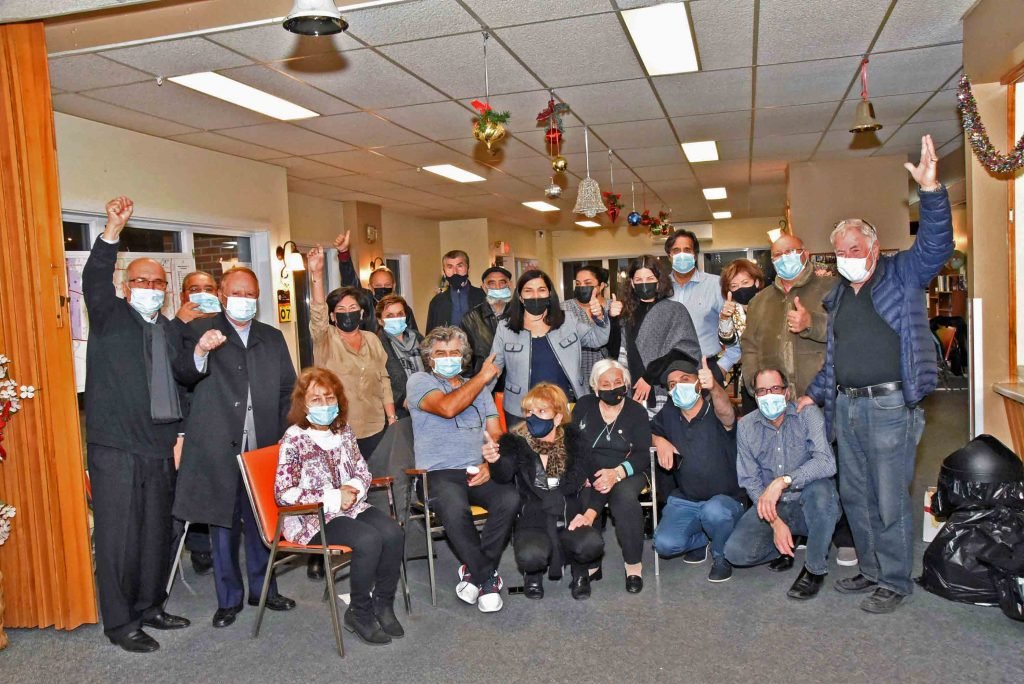
Surrounded by enthusiastic supporters at her Favreau St. campaign headquarters last Sunday evening, re-elected Action Laval city councillor for Chomedey Aglaia Revelakis (centre) won the district with more than 52 per cent voter support. (Photo: Martin C. Barry, Newsfirst Multimedia)
Marie-Josée Duval of Laval Citoyens/Équipe Michel Poissant obtained a little more than 3.5 per cent support, laying to rest fears a week before the election that a misprint on the Chomedey voter information card, misidentifying Duval as running for Action Laval, might give her an edge at Revelakis’s expense.
Tireless campaign work
Revelakis was surrounded by volunteers and friends at her campaign headquarters on Favreau St. on election night last Sunday as the returns came in. Even though it was her third straight win, she and her team had worked tirelessly on a door-to-door canvassing campaign over the previous weeks, knowing that no election is ever really easily won.
‘This is the district that pulls Action Laval up’
“I’m excited, but I’ve gotta tell you something,” Gus Milonopoulos, a Revelakis supporter from the start, told the Laval News. “She had supporters, phone callers, errand runners, drivers, you name it.”
An anchor for Action Laval
In an interview last Sunday evening, Revelakis acknowledged that her dominance of Chomedey in every election since 2013 has helped to anchor Action Laval and kept the party viable as a political force, regardless of what happens to their fortunes in the city’s other districts.
“This is the district that pulls Action Laval up,” she said. “I want to thank my team. I had an incredible team behind me. We did all that we had to do in order for us to win. And without my volunteers, I would not have been able to do this. One person could never do this.
Re-elected Chomedey city councillor Aglaia Revelakis (top left) is seen here with supporters watching and commenting on the results as they come in on the City of Laval’s election returns website. (Photo: Martin C. Barry, Newsfirst Multimedia)
Getting out the vote
“There has been army of people here today helping from 10 o’clock to eight this evening, making calls, trying to get out the vote,” she continued. “I have been doing continuous door-to-door for five, six hours a day to make sure that I met every single person in my district to ask them for their support.
“So, I would like to thank everybody who has been given me the opportunity to be here and represent Chomedey. Chomedey is always going to be my priority. I love Chomedey and have been living here for more than 30 years.”
But country ranks near bottom for number of doctors, hospital beds, MRIs and wait times
Despite spending more on health care than most other developed countries with universal health care coverage, Canada has some of the lowest numbers of doctors, hospital beds, and medical technologies and the longest wait times, concludes a new study released this month by an independent Canadian public policy think-tank.
We rank 21st out of 24
Among other things, the Fraser Instituite researchers found that Canada ranked 21st (out of 24) for the number of Magnetic Resonance Imaging (MRI) machines, with 10.5 MRIs per million people, and 22nd (out of 26) for CT scanners, with 15.2 scanners per million people.
Among the 10 comparable universal health-care countries that measure wait times, the study found Canada ranked last with the lowest percentage (38 per cent) of patients who waited four weeks or less to see a specialist, and the lowest percentage of patients (62 per cent) who waited four months or less for elective surgery.
‘A clear imbalance’
“There is a clear imbalance between the high cost of Canada’s health-care system and the value Canadians receive in terms of availability of resources and timely access to care,” said Bacchus Barua, Director of health policy studies at the Vancouver-based institute.
With policy analyst Mackenzie Moir, he co-authored ‘Comparing Performance of Universal Health Care Countries 2021,’which was published by the Fraser Institute on Nov. 2.
“Canada’s relative lack of critical resources and struggle with long wait times for treatment precede the COVID-19 pandemic,” said Moir. “To improve Canada’s health-care system in the post-pandemic world, policymakers should learn from other successful universal health-care countries, for the benefit of Canadians and their families.”
Health systems compared
The study compared 28 universal health-care systems in developed countries, spotlighting several key areas including cost, availability and use of resources, access to care, clinical performance and quality, and the health of Canadians.
In 2019, the latest year of comparable data, Canada’s health-care spending as a share of GDP (11.3 per cent) ranked second highest (after adjusting for population age) behind only Switzerland.
But despite Canada’s high level of spending, availability and access to medical resources is generally worse than in comparable countries (its performance in terms of utilization and quality is mixed).
We rank 26th of 28 for doctors
For example, (out of 28 countries) Canada ranks 26th for the number of doctors (2.8 per 1,000 people), 25th (out of 26 countries) for the number of hospital beds (2.0 per 1,000 people), and 24th (out of 28 countries) for the number of psychiatric beds (0.37 per 1,000 people).
The study used a “value for money approach” to compare the cost and performance of 28 universal health-care systems in high-income countries. The level of health-care expenditure was measured using two indicators, while the performance of each country’s health-care system was measured using 40 indicators representing four broad categories: availability of resources, use of resources, access to resources, and quality and clinical performance.
Second highest for costs
“Canada spends more on health care than the majority of high-income OECD countries with universal health-care systems,” the study’s authors wrote in an executive summary. “After adjustment for ‘age,’ the percentage of the population over 65, it ranks second highest for expenditure on health care as a percentage of GDP and eighth highest for health-care expenditure per capita.”
The data suggested that Canada has substantially fewer human and capital medical resources than many peer jurisdictions that spend comparable amounts of money on health care. They said that after adjustment for age, the country has “significantly fewer physicians, acute-care beds, and psychiatric beds per capita compared to the average of OECD countries included in the study.”
Performance below average
They said the country ranks close to the average for nurses and ranked eighth for the number of long-term care beds (per 1,000 over the age of 65). While Canada has the third most Gamma cameras (per million population, age-adjusted), they found it has fewer other medical technologies than the average high-income OECD country with universal health care for which comparable inventory data are available.
“Although Canada ranks among the most expensive universal-access health-care systems in the OECD, its performance for availability and access to resources is generally below that of the average OECD country, while its performance for use of resources and quality and clinical performance is mixed,” wrote Moir and Barua.
The City of Laval announced last week that it is awarding more than $394,000 in subsidies to several community sports and leisure activities organizations in order to encourage physical fitness and artistic ventures among the region’s young people.
The organizations receiving the funds – Sports Laval, the Club cycliste Espoirs Laval, the Club de Football Bulldogs de Laval and the Théâtre Fêlé – will be sharing the sums which are coming out of the city-administered Fonds Place-du-Souvenir.
According to the city, the subsidies will be helping children and teenagers from disadvantaged households by allowing them to develop sports skills, to take up bicycling, and to play football, while attending school and taking part at the same time in creative activities.
In all, $88,260 over two years is being given to Sports Laval for its Ini-Sports project, which offers children ages 7 to 12 from disadvantaged households the possibility of discovering new sports disciplines while developing themselves physically. Lasting nine weeks in three weekly cycles, the project aims to incite youths to pursue sports.
As well, the Club cycliste Espoirs Laval will be receiving $53,435 over a one-year period to support its project, known as Ça roule Laval, to assist young residents also from disadvantaged households to take up cycling. According to the city, 500 youngsters ages 4 to 12 will receive equipment kits containing materials to be creative.
Meanwhile, the Club de Football Bulldogs de Laval will be receiving $88,000 over a two-year period for its project, Plan PSO2025 Football Bantam-Midget. The goal of the project is to encourage access to football for 100 youths ages 13 to 17 who are in vulnerable situations in the districts of Chomedey, Pont-Viau and Saint-François, with a leadership program designed to help with homework.
Finally, the amount of $165,000 over a three-year period was awarded to Théâtre Fêlé to allow for the support of their Q.G. Chomedey project, which seeks to offer help for juvenile delinquincy in the district through artistic creation for youths ages 12 to 17.
The Fonds Place-du-Souvenir was created on June 19, 2017 to:
Directly reach children and youths ages 0 to 17 who are from disadvantaged neighbourhoods and households in order to improve their lives;
Improve the quality of life of young Laval residents;
Be a lever for intervention in social development terms for youths across Laval;
Be a coherent part of the City of Laval long-range development policy, Laval 2035 : urbaine by nature, as well as the regional social-development plan (PRDS) for Laval.
STL receives coveted award for management excellence
The Société de transport de Laval was recently awarded the Canada Prize for Excellence-Platinum, for its excellence in overall management.
The distinction, regarded as one of the highest in the public transit sector, recognized the STL for the quality of its management and its overall performance.
STL general manager Guy Picard, along with STL president Éric Morasse accepted the award on Nov. 4.
“It is is a genuine pleasure for us to realize that our determined will to evolve and improve continuously has been recognized and that we are receiving today this prestigious prize,” said Morasse.
“Rigorous management and performance are exercised in all our organizational and we are proud to be able to harvest the fruit of all these efforts today.” “We believe in ourselves,” added Picard. “Being at the controls of an organization as innovative and motivated towards excellence is for me a great source of pride. The STL would not be what it is without the support of its 1,100 or so employees and its 9 directors on the administrative board, who have a common passion to see big while working for the common good.”
It wasn’t just the move from classrooms to computer screens. It tested basic ideas about instruction, attendance, testing, funding, the role of technology and the human connections that hold it all together. Nearly two years later, a rethinking is underway, with a growing sense that some changes may last.
This may be an opportunity to reimagine what schools will look like in the future. It’s always important to continue to think about how to evolve schooling so the kids get the most out of it. Others in education may see a similar opening. Learning loss is getting new attention. Schools with poor ventilation systems have been slotted for upgrades or have already installed the needed improvements. In the need for upgrades, can be cited the Sir Wilfrid Laurier School Board’s task of having to add about 600 air purifiers to the 200 already in place at end of the 2020-21 school year, to cover the 800 needed in its schools and centres. It would not be unusual to conclude that similar circumstances are prevalent in many other school boards across Québec.
Many teachers, in Laval and elsewhere, who made it through a crash course or self-taught learning to teach virtually, are finding lessons that endure. There are a lot of positives that happened because teachers have been forced into this uncomfortable and often awkward situation. The reality is that Covid has changed education and attitudes for both teachers and students. And, make no mistake, school systems in the world are not done with remote learning. They want more of it. However, this isn’t necessarily a shared opinion amongst educators in Laval and Québec.
After a year when some systems did nothing but teach by computer screen, it has become clear that learning virtually has a place in the schools, if simply as an option. It’s like a genie that is out of the bottle, and you can’t get it back in. In many respects, this was overdue. Few suggest that remote learning is for everyone. The pandemic showed, unmistakably, that most students learn best in person — in a three-dimensional world led by a teacher, surrounded by classmates, in a school environment. But school systems across the world are looking at remote learning as a way to meet diverse needs — for teenagers who have jobs, children with certain medical conditions, or kids who prefer learning virtually.
Distanced learning has also emerged as a way to expand access to less-common courses. If one high school offers classes in Italian, Greek, Spanish, students at another school could join remotely. In reality, this is nothing new; universities have been using remote learning for many years offering degrees which are accredited and valid in most provinces in Canada leading to a chosen career.
Teaching during the pandemic has meant having to make many adjustments, including learning at-distance instead of in schools, writes Renata Isopo.
Teachers, administrators, and school personnel are taking all that they have learned from the pandemic and going with it. The pandemic has helped school boards to see that it is possible and it can be done. Not everyone imagines the same path forward. In elementary and high school, remote learning is a supplement, not a substitute, for in-school instruction, emphasizing that classroom learning is best for most students and that remote school can mean intense isolation. Staring at a screen all day is not optimal and “Zoom” fatigue is real.
While remote education has worked for many families, most kids have struggled — and the toll on mental health and social well-being is hard to ignore. Could these almost two long pandemic years — when so many children fell so far behind, when students dropped off the radar, when teachers could hardly tell who understood what as they tried to teach from a distance — could this be the time that Québec education gets serious about understanding and helping kids.
Moreover, with remediation, the goal is to make up what a child missed the first time around. The problem is students may never catch up. Accelerated learning, by contrast, seeks to make grade-level work accessible to those who are behind through a combination of intensive help and modifications. Realistically, there is simply not enough time for teachers to make up all the lost time and material.
Undoubtedly, the mental health struggles of the school children will outlast the pandemic. Many teachers have stated that some days they didn’t see or hear anybody. There was no interaction at all. When they’re in the physical classroom, you can see if they’re struggling. You can push them and help them. You can check in on them. But this was crazy according to several teachers’ remarks.
“Crazy” is a word several Laval-area teachers have used to describe teaching during the pandemic. And frustrating. And exhausting. They had to become technology wizards, Zoom screen DJs, counselors, cheerleaders and teachers, all in one. Workloads doubled and stress levels quadrupled. Nothing in their training had prepared them for this. But as the end of the 2021 school year had approached, many looked at what they learned about teaching and about themselves during the pandemic and thinking about how they’ll incorporate that in their classes once some normality would return.
For many teachers, the past year has only confirmed the importance of their vocation. And being a present and encouraging educator for students has never been more necessary. They had to shift their thinking and shift the way they taught lessons when they went online. Even veteran teachers were back to being new first-year teachers in this whole new world.
Over the last year, by necessity, the vast majority of students have been connected. Millions of devices and hotspots have been purchased and distributed. The question now is: Will this new, more equitable arrangement persist? Most say yes. Time will tell. The days when out-ofschool learning required only paper and pencil are long gone. Today, students live their lives online and use Internet-based resources for so much of their modern education. Education does not only happen at school. Kids do homework at night and that’s education. For decades, students took their places at desks in classrooms, as teachers took attendance. But as schools shuttered and students began to learn remotely, the conventions of taking presence through “seat time” fell away.
Everywhere, school systems scrambled to come up with new ways to define attendance in remote school. Was it enough just to log in for the day or tune into a Zoom class? For many school leaders, the issue was a balancing act as they tried to support students who may be in crisis — as Covid-19 has claimed lives and left many workers strapped and jobless.
Parents, students, and teachers were hyper-focused during the pandemic on when closed schools would reopen. Some school boards began to consider permanent changes that would meet the changed and changing education landscape. Referring to remote learning that began during the pandemic and will last beyond the crisis, teachers will be doing a lot more of that now, and this emerging way of teaching kids through blended learning is not a butt-in-desks model of education. Not so easy. We’re still not out of the woods.
Laval’s Liberal MPs face a heavy workload, after being sworn into office last week
For several Liberal MPs from Laval who were sworn into office last week following the September general election, a full plate of parliamentary work lies ahead tying up loose ends for Covid-19 relief programs, while also setting the course for the post-pandemic economic recovery.
House resumes on Nov. 22
In Ottawa, the House of Commons is scheduled to resume sitting on Nov. 22. This follows the swearing-in of cabinet members and MPs from across the country, which took place in the nation’s capital in late October and early November.
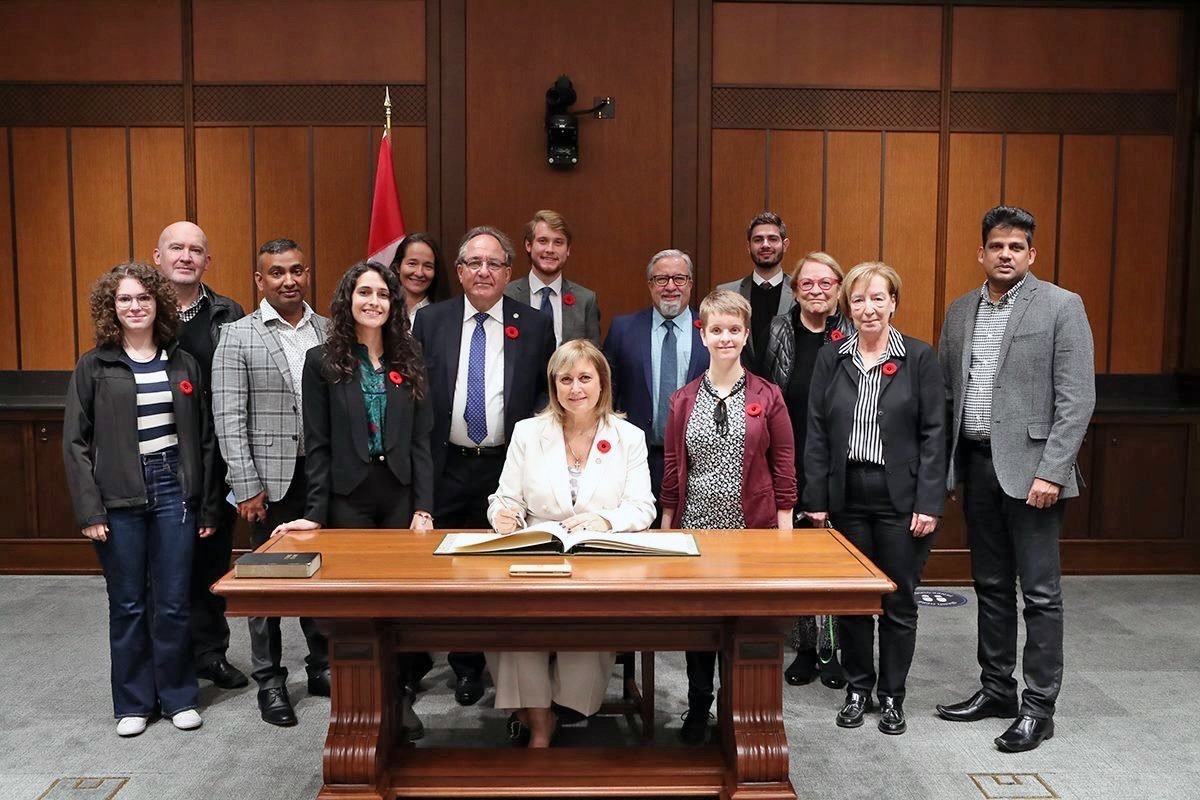
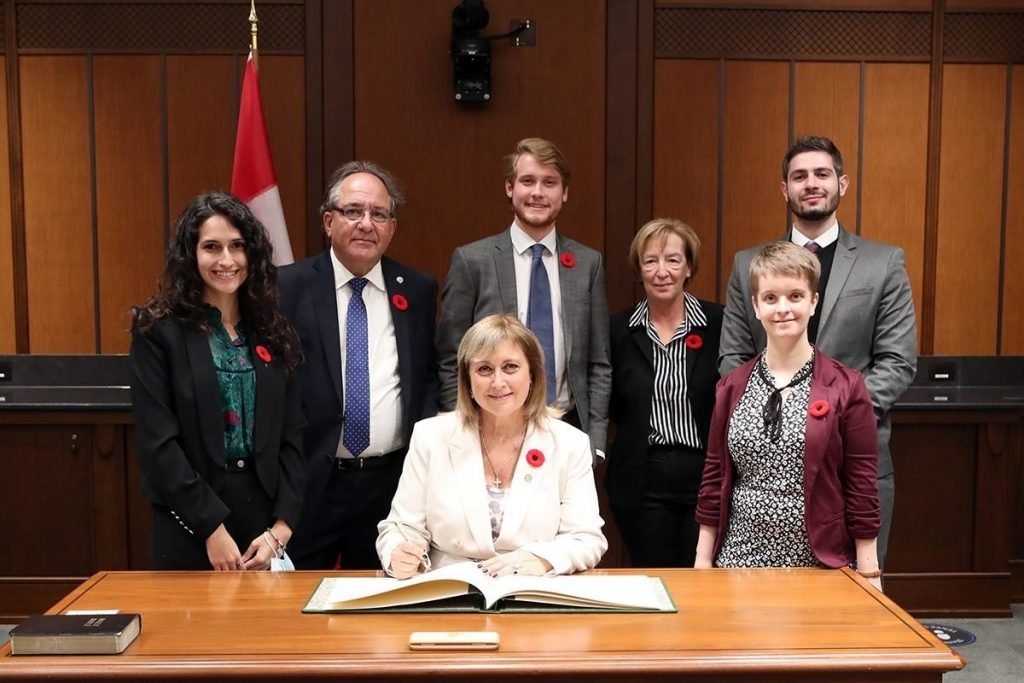
Among the elected members from Laval who were sworn into office last week were Vimy Liberal MP Annie Koutrakis and Laval-Les Îles Liberal MP Fayçal El-Khoury.
According to Koutrakis, who is starting her second term, continuing concerns about COVID-19 meant that she and other MPs were allowed to invite only a minimal number of guests to the swearing-in ceremony which took place in a committee room in the West Block on Parliament Hill.
Re-elected Vimy Liberal MP Annie Koutrakis is seen here with family members, friends and volunteers immediately following her recent swearing-in as the riding’s elected representative in Ottawa.
Swearing-in ceremony
“I had my spouse there, my staff, people who helped during my campaign as volunteers,” she said in an interview with The Laval News, emphasizing that she made a special effort to invite as many of her campaign volunteers as possible.
With cabinet appointments already announced, the Prime Minister’s next move will be the appointment of Parliamentary Secretaries, followed by the assignment of MPs to House of Commons committees working on a wide range of issues.
Koutrakis, who sat on the Standing Committee on Finance during the last term, said she asked to be reappointed to it, while also asking to be named onto committees dealing with medical assistance in dying (MAID), global affairs, industry/technology and transport.
Committee appointments coming
“I chose those committees because they’re very important to Vimy in terms now of the economy and recovery,” she said. “It’s very gratifying to be able to sit on any one of those committees where studies are taken towards further policy-making. Whatever comes out of those committees is what is then presented and debated in the House of Commons, which is where policies are made.”
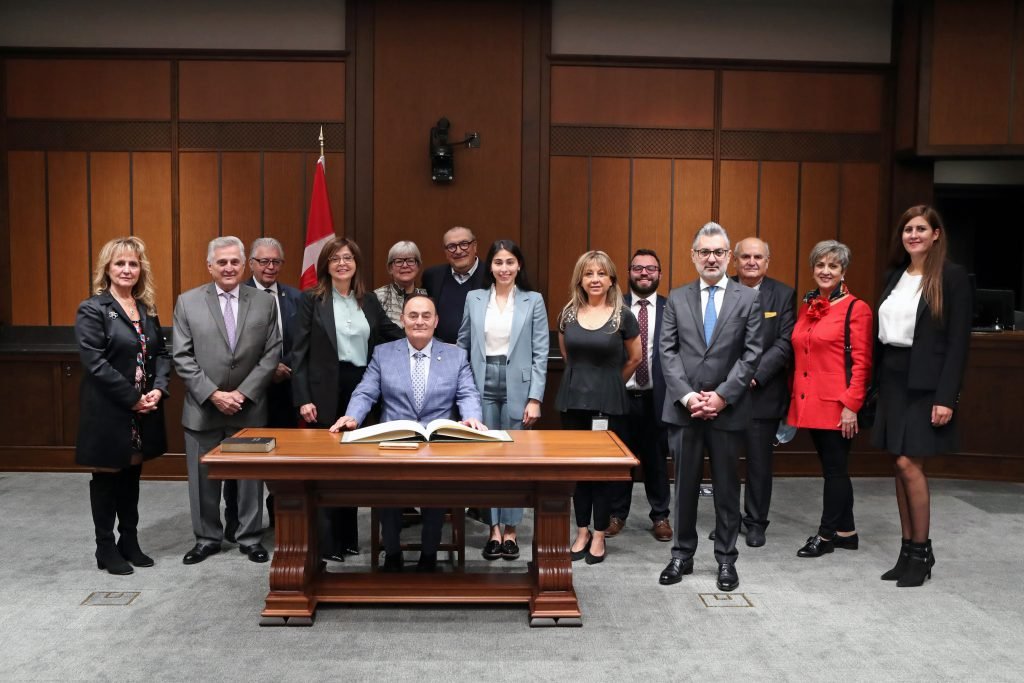
Among El-Khoury’s guests for his swearing-in were members of his family, some staff and a few friends who reside in the nation’s capital. A special guest was the ambassador for Lebanon in Canada, His Excellency Fadi Ziadeh.
El-Khoury, who is beginning his third term as Laval-Les Îles’s elected representative in Ottawa, said he and other MPs expect to probably be hearing an announcement on the parliamentary committee appointments this week.
Climate on agenda, says El-Khoury
He agreed that the Liberal government’s focus during the upcoming session will be measures to bring an end to the pandemic, after which the economy must be rebuilt. “It will require a lot of effort,” he said. “But the government, I am sure, will do whatever should be done so as to point our economy in the best direction.”
Re-elected Laval-Les Îles Liberal MP Fayçal El-Khoury is seen here with family, campaign volunteers and friends following his recent swearing-in in the nation’s capital.
El-Khoury pointed out that another major issue on the Trudeau government’s agenda over the coming term will be the environment and climate change. This will come following pledges made by Prime Minister Justin Trudeau at the recent United Nations Climate Change Conference (COP26) held in Glasgow, Scotland, including an agreement to end deforestation by the year 2030.
Covid’s still on the radar
With the reconvening of Parliament, the re-elected minority Trudeau government will be delivering a new Throne Speech. It is expected that the government’s strategy during Parliament’s upcoming session will include taking final steps to top up efforts undertaken since early last year to deal with COVID-19, with some forward-looking economic measures added.
“One of the immediate areas of focus for the next Parliament will be the COVID-19 support benefits that many Canadians and businesses still rely on, and the government will work collaboratively with other parliamentarians to continue to have Canadians’ backs,” the Prime Minister’s Office said in a statement.
Vaccination commitments
The PMO maintains that over 82 per cent of eligible Canadians are now fully vaccinated, even though the fight against COVID-19 isn’t over. As such, the government outlined five vaccination commitments to take place during the first 100 days following the swearing-in of the new cabinet.
The Prime Minister previously provided details on the government’s plan to ensure everyone 12 or older travelling within Canada on a plane or train is fully vaccinated. He also outlined a plan to ensure all federal employees and people in federally-regulated workplaces are fully vaccinated.
National vaccine passport
At the same time, the government announced its commitment towards establishing a standardized proof of vaccination (vaccine passport) for Canadians travelling internationally, while supporting provincial and territorial proof of vaccination programs, and the introduction of legislation to make it a criminal offence to harass or threaten health care workers.
Some additional ideas of what is likely to be in the Throne Speech can be found in a list of early Liberal government priorities, including re-introducing legislation to ban conversion therapy, moving ahead with 10-day paid sick leave for all federally regulated workers and bringing the provinces and territories together to work on better sick leave for Canadians across the country.
The current issue of the Laval News volume 29-39 published November 10rd , 2021. Covering Laval local news, politics, sports and our new section Mature Life. (Click on the image to read the paper.)
Front page of the Laval News, November10th, 2021 issue.